Categories
Age China WAG

Yang Bo: The Gymnast Who Never Loved Gymnastics

In Gymnastics’ Greatest Stars, Kathy Johnson introduced American audiences to a rising Chinese gymnast:

“Her name is Yang Bo, and in Chinese, Bo means waves, which is exactly what she made at the ’89 Worlds with this move on the beam. She is one of the fresh new faces who has pushed the Chinese women back into the top three.”

The move Johnson was describing was a layout step-out directly into a high Rulfová—one of the most breathtaking combinations ever performed on balance beam.

Yang Bo has long since earned her place in the pantheon of great beam workers. But there is one small complication. She should not have been at the 1989 World Championships at all.

Officially, Yang Bo competed with a 1973 birthdate. In reality, she appears to have been born in 1975, according to her profile on the Beijing Sport University website. That would have made her just fourteen in Stuttgart.

In other words, one of the most celebrated beam routines of the late 1980s may also have been performed by an underage gymnast.

And in a twist that feels almost ironic, Yang Bo herself never particularly loved the sport. As she reflected years later:

“Choosing gymnastics was not really my decision. I didn’t actually love gymnastics—I just happened to be good at it. After becoming an athlete, I sometimes wanted to quit, but my parents told me to persevere.”

Her real passion, it turned out, was singing.

The article below—published in 2007 by Bund Pictorial—captures Yang Bo years after her gymnastics career ended, as she attempted to reinvent herself on an entirely different stage.

Note: The interview itself appears to assume a 1974 birth year, while Yang Bo’s Beijing Sport University profile lists 1975.

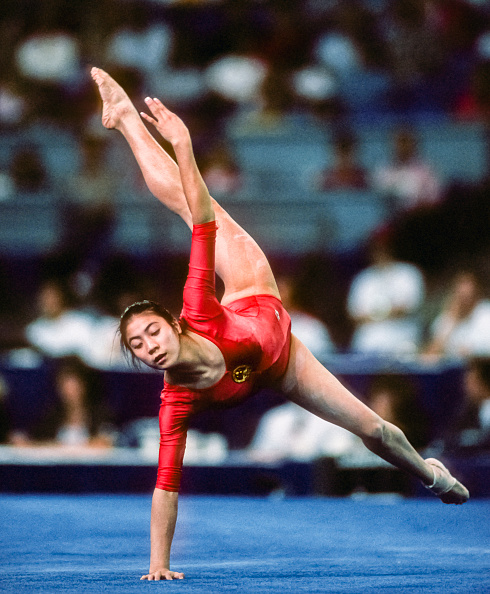
Yang Bo, 1990
Categories
Age China WAG

1994: A Profile of Mo Huilan – “Lanlan Is Not a Fragile Little Doll”

Mo Huilan was one of the most gifted gymnasts of the 1990s — a rare all-rounder in an era when Chinese women were typically known for one or two events — and her story is worth telling in full. She is remembered for the Mo Salto, for five gold medals at the 1994 Hiroshima Asian Games, and for the agonizing near-misses that defined her elite career. She is less remembered for what happened after gymnastics: the abandoned study-abroad plans, the quiet retirement, the life she built on her own terms.

Like several of her contemporaries, Mo Huilan’s age requires a brief note. Her competitive records list a birth year of 1979, and contemporary press coverage is largely consistent with that date. Chinese websites today, however, routinely give her birthdate as July 11, 1980. If that is correct, she would have been underage during the 1994 elite season. 

Enjoy this brief profile from 1994, Mo’s breakout year, as well as two post-retirement interviews.

Mo Huilan, 1996
Categories
1992 Age China Olympics WAG

2006: An Interview with Lu Li – “Success Comes from Interest”

Lu Li was fifteen years old — or so the record showed — when she mounted the uneven bars at the 1992 Barcelona Olympics and earned a perfect 10.0, becoming the first gymnast from Hunan province to win an Olympic gold medal and the second Chinese female gymnast to do so, following in the footsteps of Ma Yanhong.

The interview below, published in August 2006 by the Hunan Daily and translated here from Chinese, finds Lu Li fourteen years later — living in Gilroy, California, coaching alongside her husband, and reflecting on her career and her relationship to the sport: driven by curiosity rather than obligation, and by a stubbornness she wears as a point of pride. She crossed half of Changsha alone at age six to sneak into a gymnasium. She arrived at Peking University having never attended regular school and insisted on being treated like any other student. The interview is, among other things, a portrait of that temperament — and of what became of a champion after the spotlight moved on.

One detail is worth noting before reading. The article lists her birth year as 1977. With a late-August birthday, she would have still been fourteen at the time of the Olympics, turning fifteen weeks later. Her official competition record, however, lists a birth year of 1976, making her fifteen in Barcelona, turning sixteen weeks later. Why her birth year was altered is unclear, particularly since her real birth year of 1977 would have made her age-eligible for the 1992 Olympics. (It is my understanding that she uses a 1977 birth year in the United States.)

At any rate, enjoy the interview below!

Lu Li, 1992 Olympics
Categories
China MAG

2003: The “Image Project” of the Chinese Men’s Gymnastics Team

Sometimes, I run across an article that is too unexpected to stay buried in an archive. This is one of them.

Published in People’s Daily in March 2003, just months before the Chinese men’s team would win the team title in Anaheim, this piece offers a glimpse behind the medals and difficulty values. It’s not about start values or stuck landings. It’s about braces. Haircuts. Turned-up collars. Confidence. Image.

Under the headline “The Men’s Gymnastics Team’s ‘Image Project,’” the article follows stars like Li Xiaopeng and Teng Haibin as they fine-tune not just their routines, but their smiles — literally. What begins as a lighthearted look at a “brace trend” inside the team becomes something more revealing: a meditation on beauty, masculinity, performance, and the belief that gymnastics is as much art as sport.

Li Xiaopeng, Datum: 05.11.2003 Copyright: imago/Soccer Weekly

Note: These are not the photos that accompanied the article. But they do illustrate what the article is about.
Categories
Age China WAG

Zhang Nan: How a 16-Year-Old Led China (and Why She May Not Have Been 16)

In the autumn of 2002, a sixteen-year-old Beijing gymnast named Zhang Nan arrived at the Busan Asian Games as a relative unknown and left as a star. Competing in her first major international competition, she helped a Chinese women’s gymnastics program — then in the depths of a generational transition — win a team gold medal. She went on to capture three individual golds in the all-around, floor exercise, and uneven bars, announcing herself as the new face of Chinese women’s gymnastics.

The two People’s Daily profiles translated here document Zhang Nan at the very beginning of her rise. The first, published on October 4, 2002 — the morning after her all-around victory — is a brief dispatch from Busan, capturing the immediate excitement of a breakthrough performance. The second, published six months later in April 2003, is a longer portrait that situates her achievement within the harder story of how she got there: a childhood of financial hardship in western Beijing, a training regimen of brutal physical demands, and parents who pushed her—literally—precisely because they understood what was at stake.

Together, the two pieces offer a double exposure — the public triumph and the private formation behind it. They also preserve something of the particular texture of Chinese sports journalism in the early 2000s, which moved freely between match reporting and the kind of intimate biographical detail that Western sports media typically reserved for longer-form features. Read side by side, they sketch a portrait of a young athlete who had already learned, at sixteen, that nothing came easily — and who, by all appearances, was only getting started.

But was she really sixteen in 2002? A Chinese journal article suggests that she was not.

Zhang Nan, 2002
Categories
Age China WAG

Li Li: The Gymnast Who Aged Four Years in Just Two

Even though Li Li never won a medal at the Olympics or World Championships, she remains a gymnastics icon. Her uneven bars routine was something special: German giants directly connected to a Tkatchev, borrowing an old skill from men’s high bar and adding a release to the end. On beam, she unveiled a back spin that few gymnasts could execute cleanly on the floor, let alone on ten centimeters of suede. And then there is the photograph: Li Li, draped over the balance beam, back arched, legs in a perfect split. For a generation of fans, that image is Chinese gymnastics at the dawn of the 1990s.

But like many gymnasts of her era, Li Li had two ages: her official birth date and her competitive birthdate, which had been adjusted to meet the age requirements for the 1990 World Cup and the 1990 Asian Games.

Categories
1996 Age China WAG World Championships

1996: A Profile of Kui Yuanyuan – “10 Years of Tempering the Blade”

At the 1996 World Gymnastics Championships in San Juan, Puerto Rico, fifteen-year-old Kui Yuanyuan stepped onto the floor exercise as an unlikely candidate for gold. Not considered a core member of China’s women’s team, she had nonetheless turned heads in the semifinals with a second-place finish — and then, in the final, delivered a routine that would define her young career. The following profile, published in People’s Daily on April 22, 1996, captures that remarkable night through the eyes of staff reporter Miao Lu.

Kui Yuanyuan’s San Juan triumph was the beginning of a decorated international career. She would go on to help China claim the team bronze at the 1997 World Championships in Lausanne and earn individual bronze on balance beam at that same competition. She was also a member of the 2000 Olympic team that was stripped of its bronze medal.

But was she really 15 in 1996? The answer—drawn from the People’s Daily itself—is most likely no. Six months after describing her as 15 in San Juan, the same newspaper covered the 1996 National Championships, where Kui won the all-around, and referred to her as “not yet 15.” The contradiction is telling. With her birthday reportedly in June, an athlete who was “not yet 15” in October 1996 could not have been born in 1981. Which means she could not have been 15 at the World Championships in April or the Olympics in July—and could not have been 16 at the 1997 Worlds, either.

But was she still delightful to watch? Yes. So, enjoy these articles and videos of Kui.

Kui Yuanyuan, DTB Pokal, 1997
Categories
1981 Age China WAG

1981: A Profile of Huang Qun – “For the Raising of the Five-Star Red Flag”

In the spring of 1981, People’s Daily ran a glowing profile of Huang Qun, one of China’s most promising young gymnasts. The piece described her as 13 years old — a detail that would later take on significance. If the newspaper was correct, Huang was born in 1968. Yet when she stepped onto the podium at the 1984 Los Angeles Olympics to claim a bronze medal with her team, the official record listed her birth year as 1969. The discrepancy is modest by the standards of Cold War gymnastics, but it is documented in one of China’s own state-run publications, at a moment when there was no reason to misrepresent her age in either direction. The profile below, translated here in full, offers a rare contemporaneous snapshot of Huang Qun at the start of her international career — and another data point in the long history of age falsification in elite gymnastics.

Huang Qun, 1984 Olympics
Categories
2000 Age China WAG

How China Explained the Dong Fangxiao Case

In April 2010, the International Olympic Committee stripped China’s women’s gymnastics team of its bronze medal from the 2000 Sydney Olympics. The decision followed an eight-month investigation by the International Gymnastics Federation (FIG), which concluded that team member Dong Fangxiao had been 14 years old at the Games—two years below the minimum age of 16.

The English-language coverage of the scandal—the discovery of conflicting documents, the investigation, the ruling, and the redistribution of medals—has been extensively documented. Less familiar to English-speaking audiences is how the case unfolded inside China: how state media framed the ruling, how sports officials explained it to the public, and how Chinese journalists and commentators responded.

What emerged was not a single narrative, but a fractured one. Alongside brief, formulaic official statements ran a parallel discussion in China’s press that questioned responsibility, credibility, and the structure of a state-run sports system that governed athletes’ lives long before—and long after—the medal was won.

Dong Fangxiao, DTB Pokal, 2000
Categories
Age China Interviews & Profiles WAG

1986: A Profile of Chen Cuiting – “Like a Spring Swallow Arriving Gracefully”

In 1986 and 1987, Chinese media presented Chen Cuiting as a gymnast perfectly timed for inheritance: the nation’s elegant answer to Romania’s Daniela Silivaș. Reporting from the Seoul Asian Games, a People’s Daily correspondent lingered on her “spring swallow” lightness, praising the ease with which she carried herself to the all-around title. Both that article and a subsequent China Pictorial profile placed her age at fifteen—young, but properly arrived.

The China Pictorial piece, published in February 1987, filled in the arc behind the moment. Born on July 15, 1971, in Changsha, Hunan, Chen had risen from a raw “tumblebug”—a nickname earned for her explosive tumbling—into a national champion who, as the magazine put it, had learned to “smile spontaneously to the music.” It was a familiar story of discipline refined into artistry, told at precisely the point when promise seemed to be turning into permanence.

From today’s vantage point, however, that narrative no longer sits so easily. Across both Chinese- and English-language websites, Chen’s birthdate now appears as November 15, 1972. If accurate, she would have been only thirteen, turning fourteen, during the 1986 season—below the minimum age of fifteen required for senior international competition. The confident certainties of the mid-1980s press thus coexist uneasily with a digital record that rewrites the calendar.

Whatever the truth of her age, Chen Cuiting’s competitive record is unmistakable. She dominated Chinese women’s gymnastics through the late 1980s, breaking out internationally at the 1986 Asian Games with team gold, all-around gold, floor gold, and vault silver. She remained the country’s leading all-arounder at home, winning the title at the 1987 National Games and the 1988 National Championships. Though her Seoul Olympics yielded no individual medals—fourteenth in the all-around, sixth with the team—she rebounded at the 1989 World Championships with team bronze and top-six finishes in the all-around, beam, and floor. Her career closed where it had begun to crest: at the 1990 Asian Games in Beijing, she again swept gold in the team, all-around, and floor, adding another vault silver before retiring. In just five years, she anchored the national team through a transitional era, her dominance unquestioned even as the story told about her grew more complicated.

Chen Cuiting, 1986, Goodwill Games