Sometimes, I run across an article that is too unexpected to stay buried in an archive. This is one of them.
Published in People’s Daily in March 2003, just months before the Chinese men’s team would win the team title in Anaheim, this piece offers a glimpse behind the medals and difficulty values. It’s not about start values or stuck landings. It’s about braces. Haircuts. Turned-up collars. Confidence. Image.
Under the headline “The Men’s Gymnastics Team’s ‘Image Project,’” the article follows stars like Li Xiaopeng and Teng Haibin as they fine-tune not just their routines, but their smiles — literally. What begins as a lighthearted look at a “brace trend” inside the team becomes something more revealing: a meditation on beauty, masculinity, performance, and the belief that gymnastics is as much art as sport.
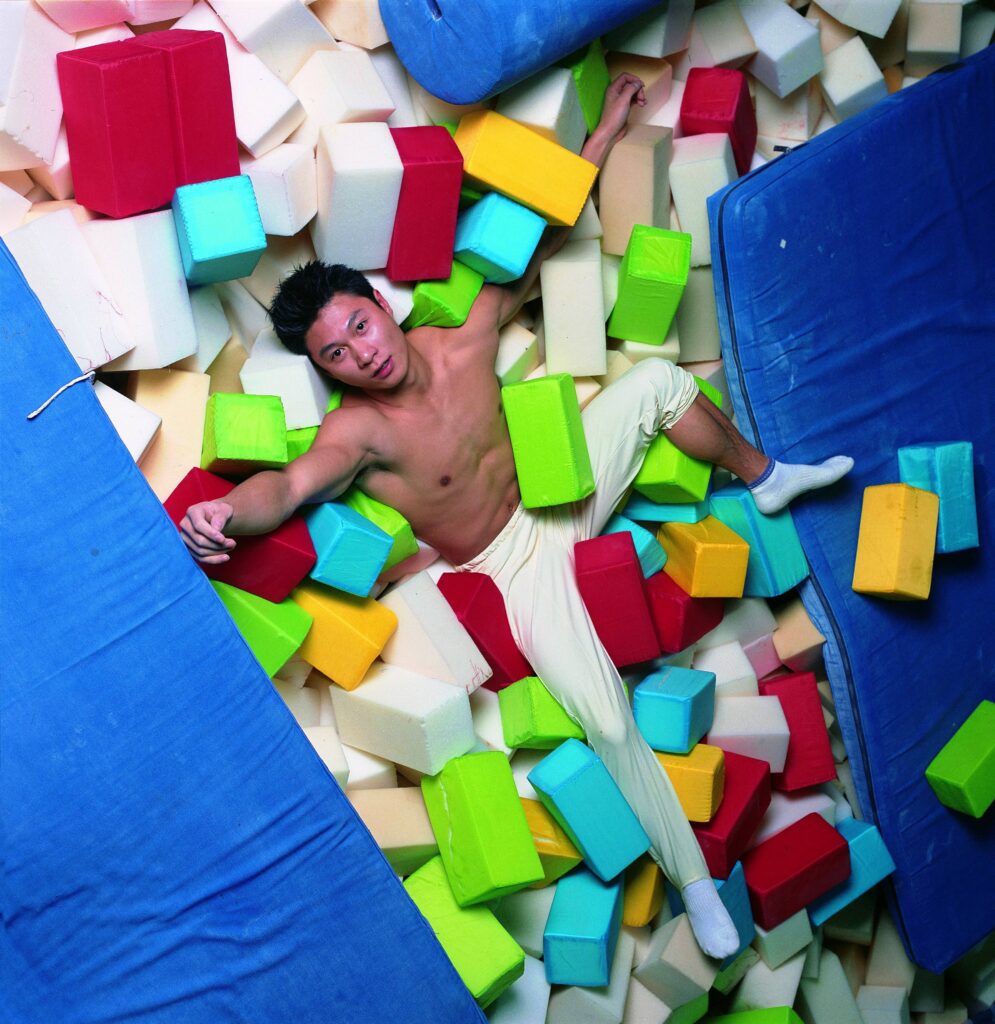
Li Xiaopeng, Datum: 05.11.2003 Copyright: imago/Soccer Weekly
Note: These are not the photos that accompanied the article. But they do illustrate what the article is about.
In the autumn of 2002, a sixteen-year-old Beijing gymnast named Zhang Nan arrived at the Busan Asian Games as a relative unknown and left as a star. Competing in her first major international competition, she helped a Chinese women’s gymnastics program — then in the depths of a generational transition — win a team gold medal. She went on to capture three individual golds in the all-around, floor exercise, and uneven bars, announcing herself as the new face of Chinese women’s gymnastics.
The two People’s Daily profiles translated here document Zhang Nan at the very beginning of her rise. The first, published on October 4, 2002 — the morning after her all-around victory — is a brief dispatch from Busan, capturing the immediate excitement of a breakthrough performance. The second, published six months later in April 2003, is a longer portrait that situates her achievement within the harder story of how she got there: a childhood of financial hardship in western Beijing, a training regimen of brutal physical demands, and parents who pushed her—literally—precisely because they understood what was at stake.
Together, the two pieces offer a double exposure — the public triumph and the private formation behind it. They also preserve something of the particular texture of Chinese sports journalism in the early 2000s, which moved freely between match reporting and the kind of intimate biographical detail that Western sports media typically reserved for longer-form features. Read side by side, they sketch a portrait of a young athlete who had already learned, at sixteen, that nothing came easily — and who, by all appearances, was only getting started.
But was she really sixteen in 2002? A Chinese journal article suggests that she was not.
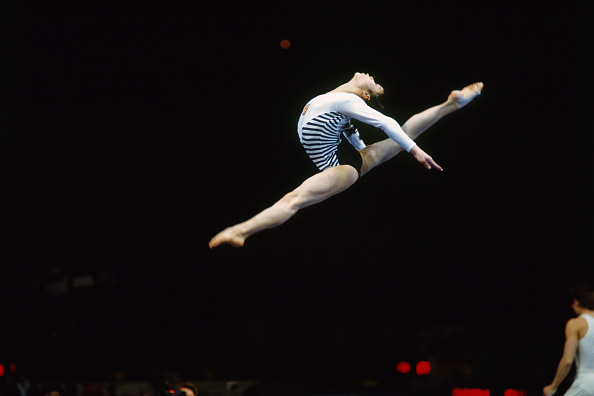
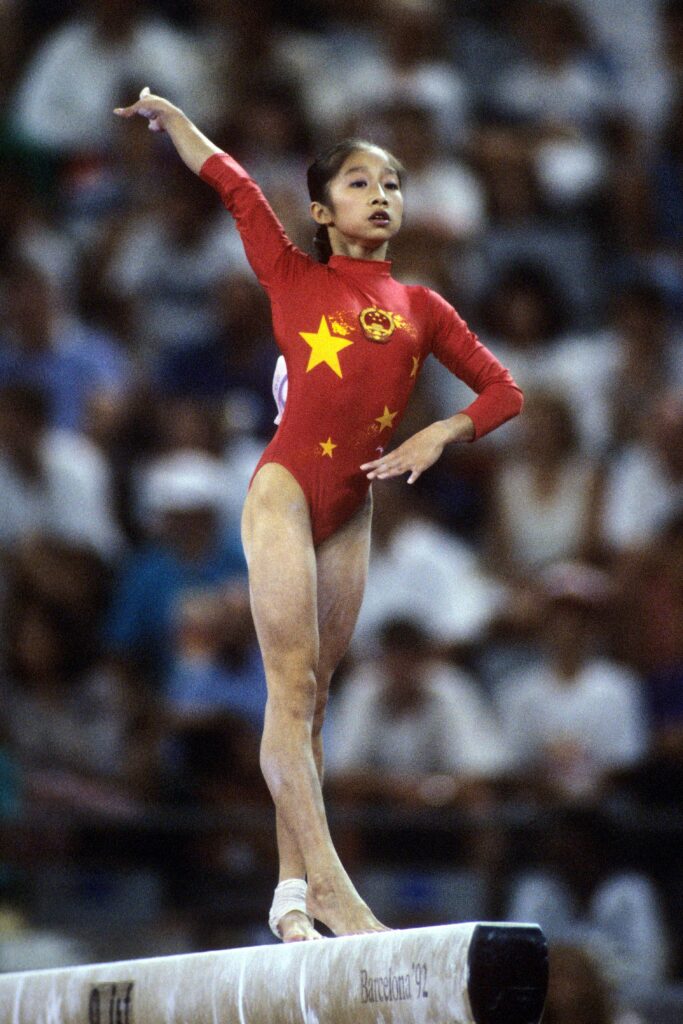
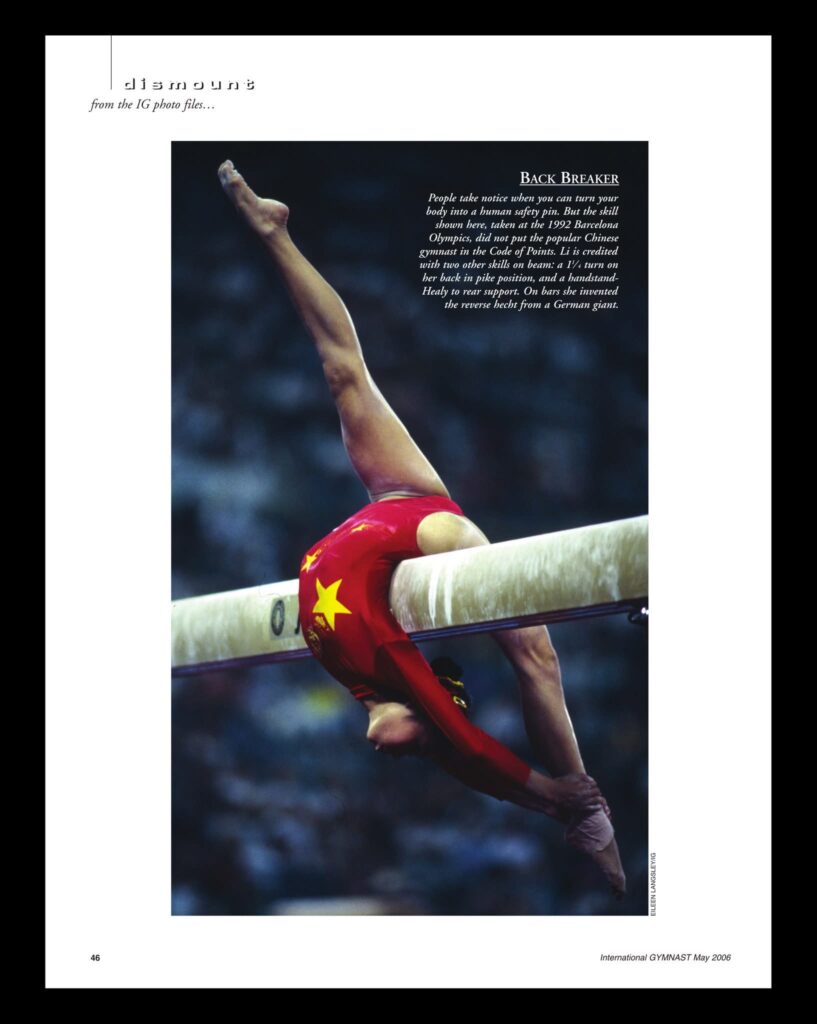
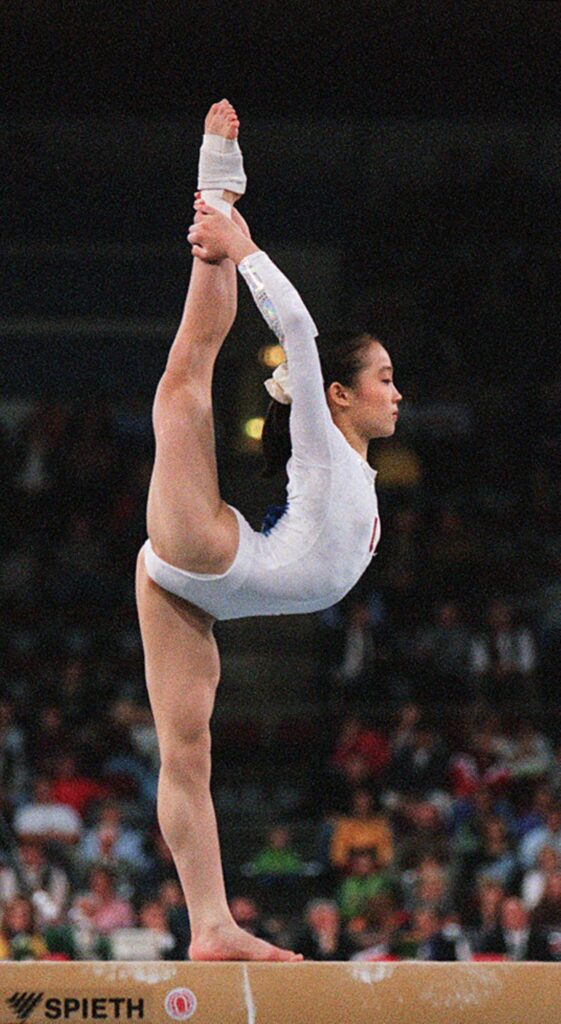
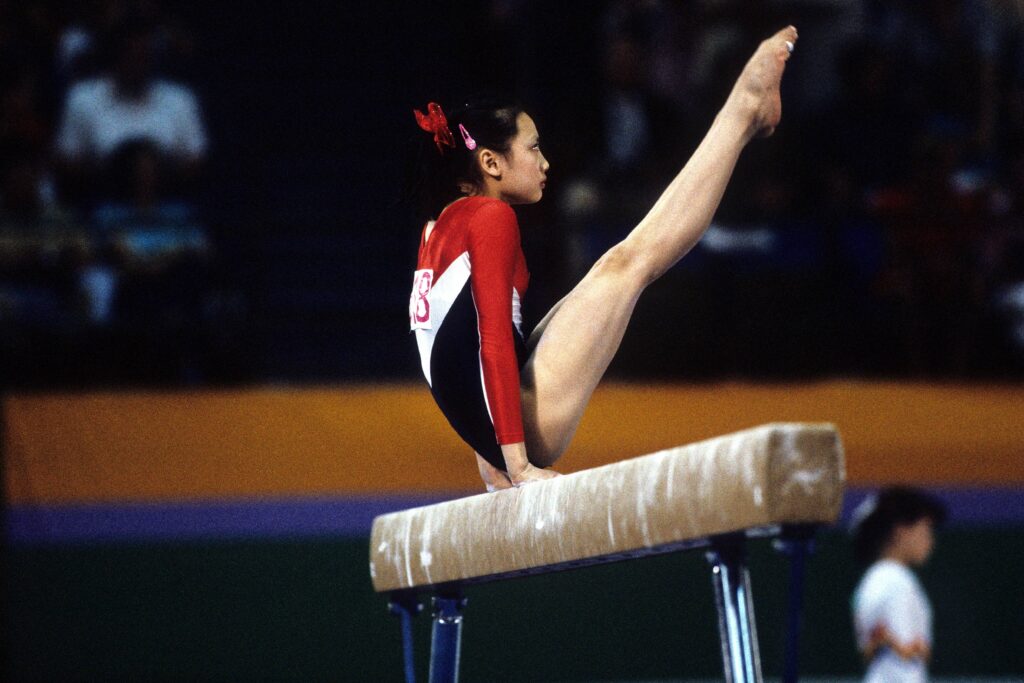
Even though Li Li never won a medal at the Olympics or World Championships, she remains a gymnastics icon. Her uneven bars routine was something special: German giants directly connected to a Tkatchev, borrowing an old skill from men’s high bar and adding a release to the end. On beam, she unveiled a back spin that few gymnasts could execute cleanly on the floor, let alone on ten centimeters of suede. And then there is the photograph: Li Li, draped over the balance beam, back arched, legs in a perfect split. For a generation of fans, that image is Chinese gymnastics at the dawn of the 1990s.
But like many gymnasts of her era, Li Li had two ages: her official birth date and her competitive birthdate, which had been adjusted to meet the age requirements for the 1990 World Cup and the 1990 Asian Games.
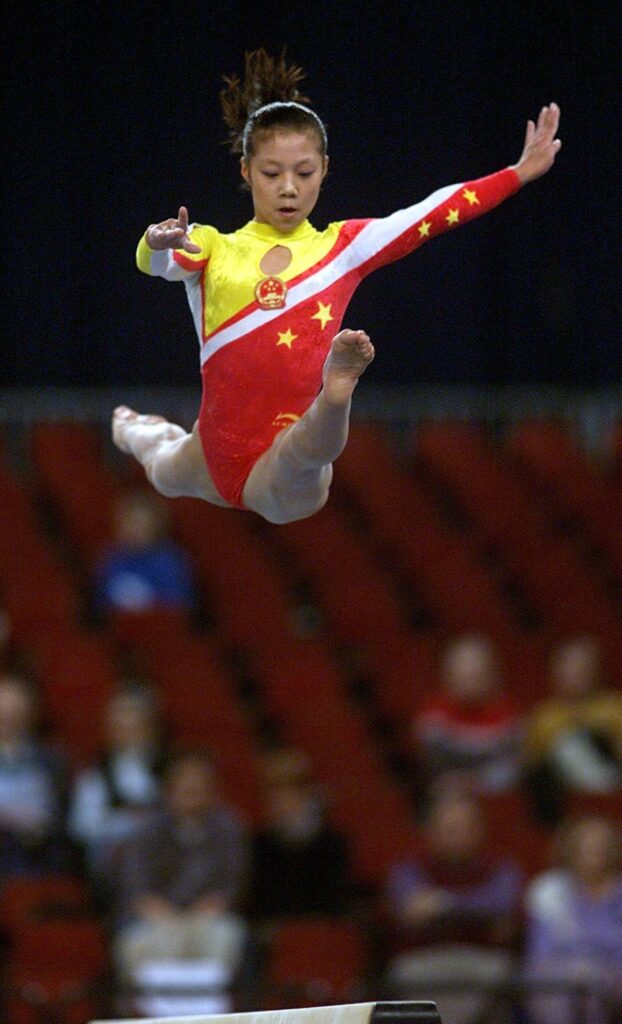
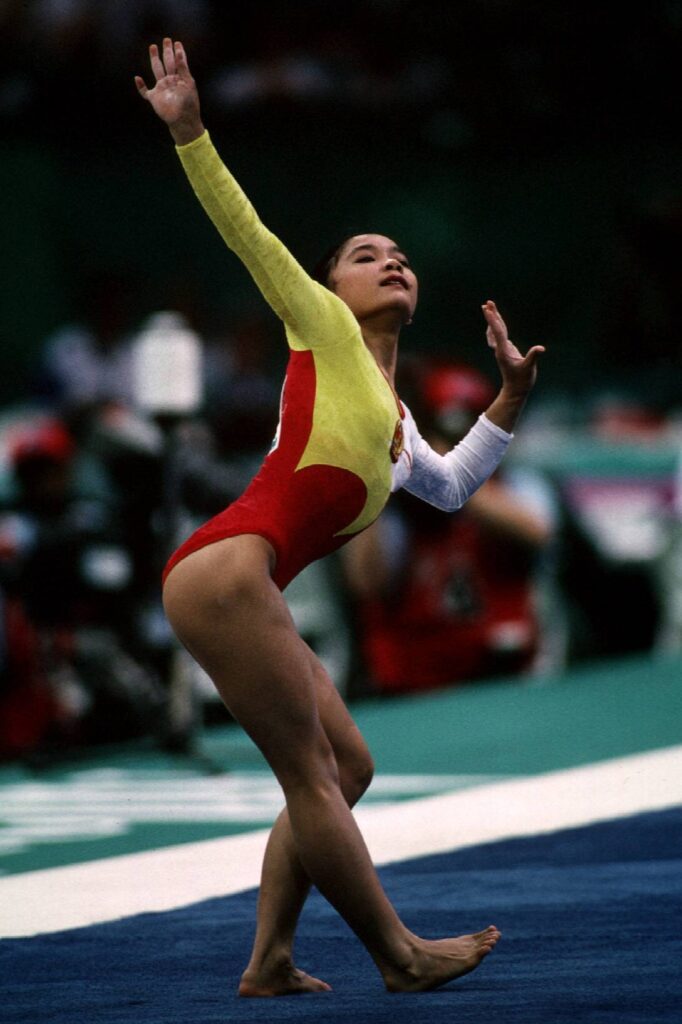
At the 1996 World Gymnastics Championships in San Juan, Puerto Rico, fifteen-year-old Kui Yuanyuan stepped onto the floor exercise as an unlikely candidate for gold. Not considered a core member of China’s women’s team, she had nonetheless turned heads in the semifinals with a second-place finish — and then, in the final, delivered a routine that would define her young career. The following profile, published in People’s Daily on April 22, 1996, captures that remarkable night through the eyes of staff reporter Miao Lu.
Kui Yuanyuan’s San Juan triumph was the beginning of a decorated international career. She would go on to help China claim the team bronze at the 1997 World Championships in Lausanne and earn individual bronze on balance beam at that same competition. She was also a member of the 2000 Olympic team that was stripped of its bronze medal.
But was she really 15 in 1996? The answer—drawn from the People’s Daily itself—is most likely no. Six months after describing her as 15 in San Juan, the same newspaper covered the 1996 National Championships, where Kui won the all-around, and referred to her as “not yet 15.” The contradiction is telling. With her birthday reportedly in June, an athlete who was “not yet 15” in October 1996 could not have been born in 1981. Which means she could not have been 15 at the World Championships in April or the Olympics in July—and could not have been 16 at the 1997 Worlds, either.
But was she still delightful to watch? Yes. So, enjoy these articles and videos of Kui.
In the spring of 1981, People’s Daily ran a glowing profile of Huang Qun, one of China’s most promising young gymnasts. The piece described her as 13 years old — a detail that would later take on significance. If the newspaper was correct, Huang was born in 1968. Yet when she stepped onto the podium at the 1984 Los Angeles Olympics to claim a bronze medal with her team, the official record listed her birth year as 1969. The discrepancy is modest by the standards of Cold War gymnastics, but it is documented in one of China’s own state-run publications, at a moment when there was no reason to misrepresent her age in either direction. The profile below, translated here in full, offers a rare contemporaneous snapshot of Huang Qun at the start of her international career — and another data point in the long history of age falsification in elite gymnastics.
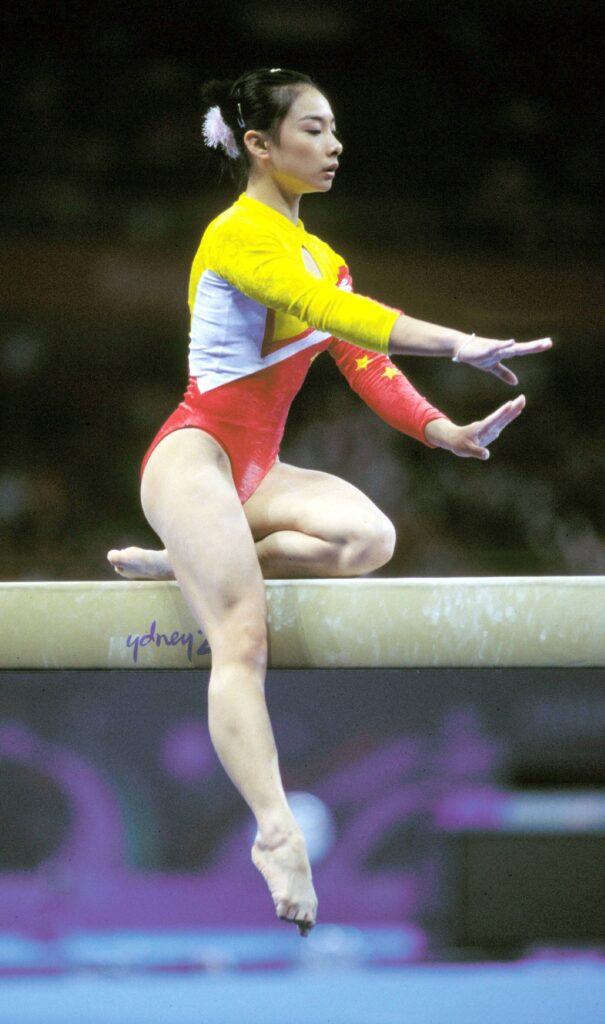
In April 2010, the International Olympic Committee stripped China’s women’s gymnastics team of its bronze medal from the 2000 Sydney Olympics. The decision followed an eight-month investigation by the International Gymnastics Federation (FIG), which concluded that team member Dong Fangxiao had been 14 years old at the Games—two years below the minimum age of 16.
The English-language coverage of the scandal—the discovery of conflicting documents, the investigation, the ruling, and the redistribution of medals—has been extensively documented. Less familiar to English-speaking audiences is how the case unfolded inside China: how state media framed the ruling, how sports officials explained it to the public, and how Chinese journalists and commentators responded.
What emerged was not a single narrative, but a fractured one. Alongside brief, formulaic official statements ran a parallel discussion in China’s press that questioned responsibility, credibility, and the structure of a state-run sports system that governed athletes’ lives long before—and long after—the medal was won.
In 1986 and 1987, Chinese media presented Chen Cuiting as a gymnast perfectly timed for inheritance: the nation’s elegant answer to Romania’s Daniela Silivaș. Reporting from the Seoul Asian Games, a People’s Daily correspondent lingered on her “spring swallow” lightness, praising the ease with which she carried herself to the all-around title. Both that article and a subsequent China Pictorial profile placed her age at fifteen—young, but properly arrived.
The China Pictorial piece, published in February 1987, filled in the arc behind the moment. Born on July 15, 1971, in Changsha, Hunan, Chen had risen from a raw “tumblebug”—a nickname earned for her explosive tumbling—into a national champion who, as the magazine put it, had learned to “smile spontaneously to the music.” It was a familiar story of discipline refined into artistry, told at precisely the point when promise seemed to be turning into permanence.
From today’s vantage point, however, that narrative no longer sits so easily. Across both Chinese- and English-language websites, Chen’s birthdate now appears as November 15, 1972. If accurate, she would have been only thirteen, turning fourteen, during the 1986 season—below the minimum age of fifteen required for senior international competition. The confident certainties of the mid-1980s press thus coexist uneasily with a digital record that rewrites the calendar.
Whatever the truth of her age, Chen Cuiting’s competitive record is unmistakable. She dominated Chinese women’s gymnastics through the late 1980s, breaking out internationally at the 1986 Asian Games with team gold, all-around gold, floor gold, and vault silver. She remained the country’s leading all-arounder at home, winning the title at the 1987 National Games and the 1988 National Championships. Though her Seoul Olympics yielded no individual medals—fourteenth in the all-around, sixth with the team—she rebounded at the 1989 World Championships with team bronze and top-six finishes in the all-around, beam, and floor. Her career closed where it had begun to crest: at the 1990 Asian Games in Beijing, she again swept gold in the team, all-around, and floor, adding another vault silver before retiring. In just five years, she anchored the national team through a transitional era, her dominance unquestioned even as the story told about her grew more complicated.
When Ma Yanhong scored 19.825 on uneven bars at the 1979 World Championships in Fort Worth, Texas, she became the first Chinese gymnast to win a world title. The moment carried weight beyond sport. It was December 1979, just months after the United States and the People’s Republic of China had established full diplomatic relations, and American spectators watched the five-star red flag rise in a Texas arena. A fifteen-year-old from the Bayi military sports team had arrived on the world stage at a pivotal moment in both gymnastics history and geopolitical realignment.
The two articles translated here—one an immediate dispatch from Xinhua News Agency filed from Fort Worth, the other a 1981 profile from the People’s Daily—show how Chinese state media framed this breakthrough. They follow familiar patterns of socialist sports journalism: diligence and endurance, sacrifice of personal comfort for collective glory, the coach’s discernment, and the athlete’s humility in victory.
At the same time, these reports preserve a vivid record of elite athletic life in late-1970s China. They describe a life of extreme (and unhealthy) discipline: cracked lips from dehydration, severely restricted food intake, and hands hardened by hundreds of repetitions of release moves. This is sports journalism in the service of a state narrative, but it is also lived reality. These accounts capture details that help us understand China’s re-emergence as a world power in women’s gymnastics.
Read closely, the articles also hint at unresolved questions. The ages they cite—fourteen at the 1978 Asian Games and fifteen in December 1979—imply a 1964 birth year. When International Gymnast interviewed her in 1999, the magazine reported her birthdate as March 21, 1964. However, at the 1984 Olympics, Ma’s official competitive date of birth was July 5, 1963. Under either birth year, Ma was age-eligible to compete at the 1979 World Championships. The puzzle, then, is not eligibility but motive: why alter her date of birth at all?
Unfortunately, the articles do not answer that question. Nonetheless, I hope that you can enjoy these articles about Ma, whose bar work, according to International Gymnast, possessed “a quality that has never been surpassed.”
These three People’s Daily articles, spanning fourteen years from 1981 to 1995, trace the arc of Li Ning’s transformation from teenage gymnastics prodigy to business entrepreneur. Read together, they chart not only an individual career but a broader shift in Chinese sport and society, as the values and constraints of Mao-era athletic culture gradually gave way to new possibilities.
The first piece, published on August 30, 1981, introduces Li Ning at eighteen as a rising talent who had just won China’s first gold medal at the World University Games in Bucharest. Its narrative structure would become familiar in Chinese sports journalism: early discovery, setbacks overcome through ideological commitment, and moral guidance from exemplary teammates—in this case, Tong Fei. Li Ning appears here as a product of the state sports system at its ideological peak, his achievements framed primarily in terms of collective honor, discipline, and service to the nation rather than personal advancement.
By the end of the 1980s, both Li Ning’s career and China itself were entering a period of profound transition. Following the death of Mao Zedong in 1976, Deng Xiaoping initiated a series of economic reforms that gradually loosened the rigid command economy of the Mao years. Limited private enterprise and selective engagement with foreign capital were introduced, even as Communist Party control remained firmly in place. In the early 1980s, these reforms were tentative and uneven; by the early 1990s, they had begun to reshape everyday life, labor, and ambition, including elite sport.
It is against this backdrop that the second article, published in October 1990, finds Li Ning navigating unfamiliar terrain. Retired from gymnastics, he had joined Jianlibao, a state-owned sports drink manufacturer, to help develop China’s first indigenous sportswear brand. The piece reveals an athlete unsettled by the indignity of competing in foreign-branded clothing and determined to create a Chinese alternative. In a familiar literary trope about emerging markets, we witness Li Ning trying to cut across time and space in impossible ways. The writer even suggests that, for the retired gymnast, time itself has become three-dimensional.
The final piece, from March 1995, is an obituary for Li Ning’s mother. Qin Zhenmei, who died of cancer at fifty-four, is presented as the archetype of the self-sacrificing Chinese mother—a mother who went to great lengths to sew her son a training uniform and who promoted her son’s clothing brand from her deathbed. Yet the article is equally structured around Li Ning’s confession of filial failure—his admission that years of relentless work left him scarcely present at her bedside, sharing only three meals with her in her final year. Here, personal loss and moral regret serve to place commercial success within an acceptable moral framework, ensuring that entrepreneurial achievement does not appear to override traditional obligations.
Enjoy this longitudinal view of Li Ning’s biography, as refracted through the People’s Daily.
“A Person Must Have Some Spirit” appeared in the People’s Daily on January 2, 1982. It was attributed to Tong Fei, one of China’s pioneering male gymnasts in the early reform era. The essay recounts his performance at the 1981 Grand Prix in Paris, where—competing just days after suffering a concussion in a car accident—he won three gold medals and an all-around silver.
Tong’s account offers a window into Chinese gymnastics culture at a crucial moment: China had only recently rejoined the international gymnastics community after decades of isolation, and athletes like Tong were among the first generation to compete regularly against Western and Soviet opponents. Published in the Communist Party’s official newspaper, the piece follows the conventions of socialist-realist athlete narratives, emphasizing collective duty, national honor, and ideological commitment over individual achievement. Yet beneath the formulaic rhetoric lies a genuine athletic feat and a glimpse of the mentality that would soon propel Chinese gymnastics to world dominance.
The essay also references Li Yuejiu, another pioneering Chinese gymnast who had competed through injury at the 1980 Alternative Games in Hartford, Connecticut. He established a template of athletic sacrifice that Tong explicitly invokes as precedent.