In July 1984, when the Romanian delegation marched into the Los Angeles Coliseum, they received one of the most enthusiastic receptions of the Opening Ceremony—a standing ovation from nearly 100,000 spectators. It was a remarkable scene: a Warsaw Pact nation being cheered by an American crowd at a Games shaped by the Soviet-led boycott. The applause was not simply for athletes. It was also a response to Romania’s highly visible decision to defy Moscow and attend the Olympics, a decision rooted in one of the most carefully calibrated gambits of the Cold War.
1984: Waiting for the Right Moment
Under Nicolae Ceaușescu, Romania had spent more than a decade cultivating a reputation as the Eastern Bloc’s awkward dissenter — denouncing the Soviet invasion of Czechoslovakia in 1968, resisting deeper economic integration within COMECON (the Soviet-led economic bloc that bound together the communist states of Eastern Europe), and courting Western institutions long before such behavior became fashionable. Western observers began referring to Romania as “the maverick of Eastern Europe.”
By the early 1980s, however, that image was beginning to lose some of its force.
The country faced a sovereign debt crisis in the early 1980s, forcing it to seek IMF assistance in 1981. Food rationing had spread nationwide. The Securitate, Romania’s feared secret police, tightened its grip on an increasingly restless population. Western governments were raising serious concerns about human rights abuses, while Washington was reconsidering Romania’s Most Favored Nation (MFN) trade status — preferential treatment originally granted as a reward for Bucharest’s independent foreign policy.
Then the Soviet Union announced that it would boycott the Los Angeles Olympics.
What followed was one of the more remarkable pieces of political theater in Olympic history. Romania did not immediately declare whether it would attend. Instead, Bucharest fell silent while the Western press constructed an increasingly dramatic narrative of Soviet pressure. Reports circulated of tense meetings between Ceaușescu and the Soviet ambassador. IOC president Juan Antonio Samaranch publicly wondered whether Romania would join the boycott. The Los Angeles Times speculated about “Kremlin pressure.” The suspense was genuine; the uncertainty was not. As scholar Harold E. Wilson’s research demonstrates, much of the drama rested on a carefully cultivated illusion.
Romanian Foreign Ministry official Mircea Raceanu later confirmed what David Funderburk, the U.S. ambassador in Bucharest, had already suspected: participation was never seriously in doubt. Raceanu recalled that when a U.S. State Department official asked Foreign Minister Ștefan Andrei whether Romania would attend, Andrei merely smiled and observed that Romanian athletes had “never stopped preparing for the Games.” In Raceanu’s telling, the question of participation had “never been in doubt in the Romanian leadership’s mind.”
What Ceaușescu was waiting for was not clarity but leverage. As Funderburk wrote in a pointed telegram to Secretary of State George Shultz, the Romanian leader “knows perfectly well what the U.S. wants him to do” and was attempting to extract “as much as he can” from a decision that had effectively already been made.
The strategy paid off handsomely. The Los Angeles Olympic Organizing Committee (LAOOC) and the International Olympic Committee agreed to cover two-thirds of the Romanian delegation’s transportation costs. Equipment would be shipped free of charge. Ronald Reagan, in a letter to Ceaușescu shortly before the announcement, all but urged Romanian participation while simultaneously recommending another year of MFN trade status.
When Romanian sports minister Haralambie Alexa finally rose at the Warsaw Pact sports ministers’ conference in Prague on May 24, 1984, and announced that Romania would attend the Los Angeles Games, the room reportedly fell silent. According to one diplomatic source, the announcement was followed by a request for a five-minute recess that stretched into half an hour. The East German delegate lodged a formal protest. The Soviets said nothing. The performance was over.
Promises Made, Promises Kept — and Promises Broken
In Los Angeles, Romania leveraged its deviation from the boycott to extract tangible economic benefits, repair its fraying relationship with the West, and reframe the human rights conversation through the warm glow of Olympic achievement.
As a media analysis of the Romanian press reveals, the domestic framing of the Olympics was entirely different. Romanian citizens were told almost nothing about the Soviet boycott. The state sports newspaper Sportul pivoted instead to columns celebrating Ceaușescu’s “Golden Epoch” and linking Olympic preparation to the 40th anniversary of Romania’s communist revolution. Athletes who returned from Los Angeles with twenty gold medals were greeted at the airport not by the grand reception they had expected, but by a modest party delegation — their purpose, as scholar Harold E. Wilson grimly observed, having already been served.
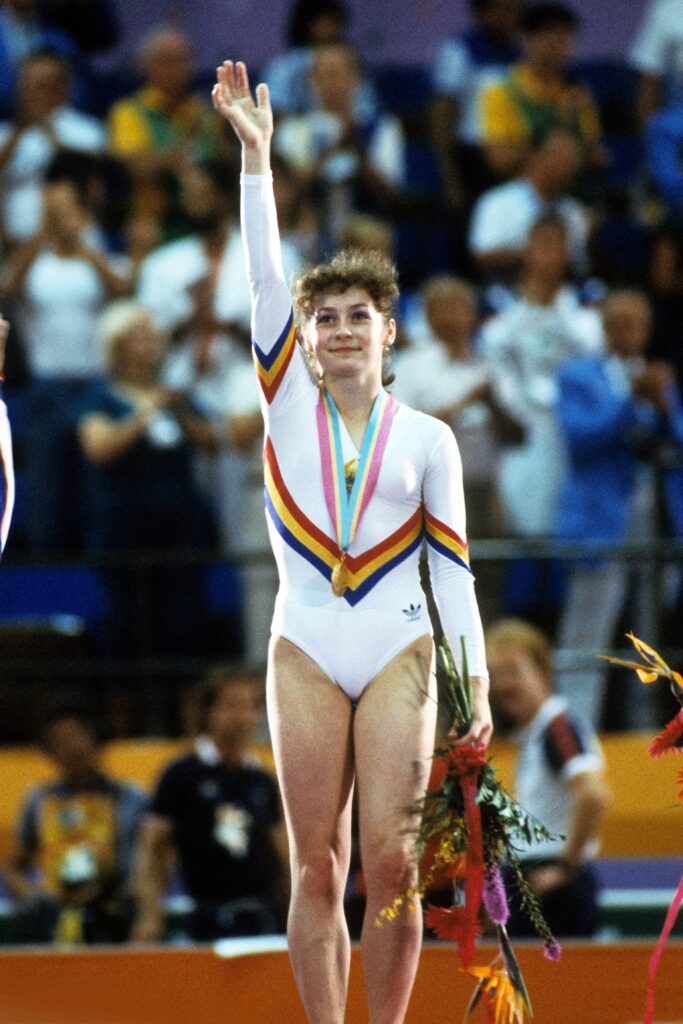
Romania’s gymnasts felt that deeply. Mihaela Stănuleț, who won team gold in Los Angeles as part of the six-woman Romanian squad, was promised a Dacia car and 100,000 lei on returning home. She received 16,000 lei — her reward for, as she put it, “17 years of hard work and heavy restrictions” on her personal life. When she retired, the Romanian Gymnastics Federation asked her to return the tracksuit she had worn at the Games.
Ecaterina Szabó — or Katalin Szabó, as she was actually named — won four gold medals and a silver in Los Angeles. She was told that Adidas presented a video recorder to every Olympic gold medalist, meaning she was owed four. She received one, and never learned what happened to the other three. Of the 102,200 lei she signed for as a cash reward, she received 52,000. The car she was told she could obtain without waiting in line, she was subsequently told to wait for like everyone else. For nearly three years after retiring, she was employed as an unskilled worker at a mining enterprise on a monthly salary of 2,121 lei.
The Romanian government had smiled and waited, extracted everything it could from its Olympic participation, and dedicated the athletes’ victories to Ceaușescu and the 40th anniversary of the revolution. Meanwhile, the athletes, having served their purpose, were largely left to find their own way.
References
Goeijenbier, Jan-Julius. “Romanian Sports Diplomacy at the Olympics in the 1980s: A Waste of Chalk?” MA thesis, Utrecht University, 2020.
Petracovschi, Simona. “Propaganda and Censorship for the 1984 Los Angeles Olympic Games: The Internal Politics of Ceaușescu.” The International Journal of the History of Sport 33, no. 16 (2016): 2046–2058. https://doi.org/10.1080/09523367.2017.1355305.
Wilson, Harold E., Jr. “The Golden Opportunity: Romania’s Political Manipulation of the 1984 Los Angeles Olympic Games.” Olympika: The International Journal of Olympic Studies 3 (1994): 83–97.