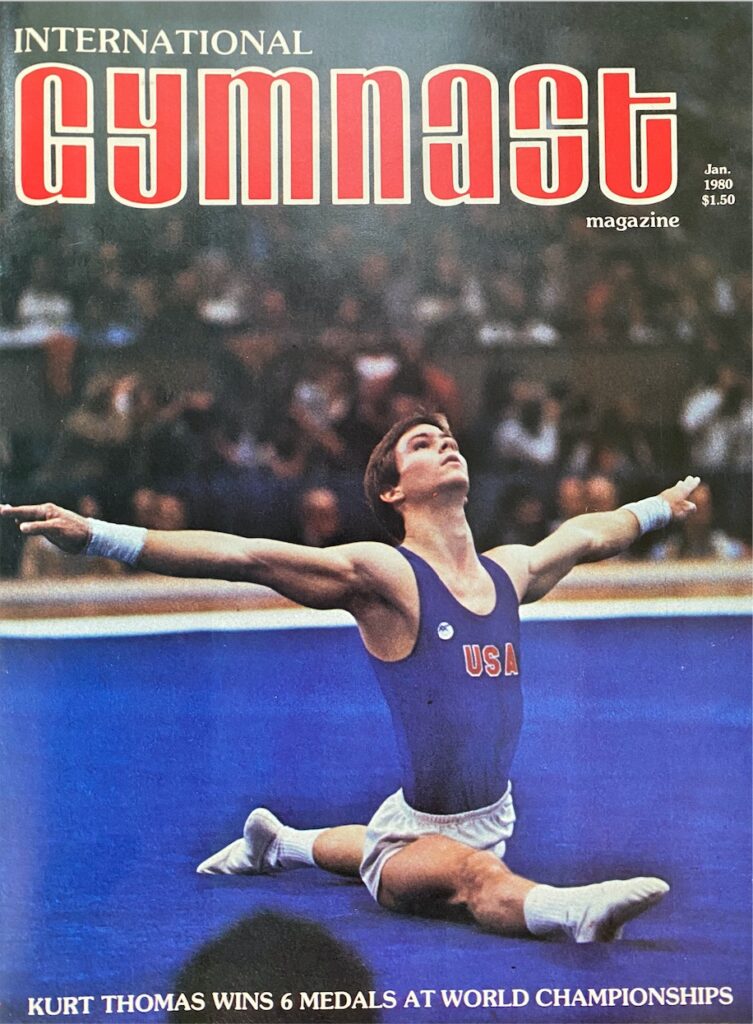
In 1978, at the World Championships in Strasbourg, France, Kurt Thomas became the first American man to win a world title. The achievement was all the more remarkable because Thomas, then twenty-two, had discovered gymnastics only eight years earlier after wandering into a gym in Miami. A year later, he surpassed even that breakthrough, collecting six medals at the 1979 World Championships, including gold on floor exercise and high bar and silver in the all-around.
By 1980, Thomas was one of the best gymnasts in the world, and the Moscow Olympics, scheduled to open on July 19, were supposed to be the culmination of nearly a decade of work.
But the opportunity never came. On April 21, 1980, President Jimmy Carter formally announced what he had threatened since January: the United States would boycott the Moscow Games. For Thomas—and for dozens of other American gymnasts at different stages of their careers—the Soviet invasion of Afghanistan had suddenly become something more than a distant geopolitical crisis. It had become the reason they would never compete in the Olympics they had spent years preparing for.
Why America Stayed Home: The 1980 Olympic Boycott
On December 27, 1979, Soviet forces invaded Afghanistan, toppling the country’s government and installing a Soviet-backed regime in Kabul. President Jimmy Carter condemned the invasion but had few options for direct retaliation. A military response risked a confrontation neither superpower wanted. Instead, the administration turned to a combination of economic sanctions, diplomatic pressure, and a more symbolic target: the Moscow Olympics.
The idea was not entirely Carter’s. Among its earliest advocates was Soviet dissident Andrei Sakharov, who urged the West to use the Games as leverage against the Kremlin. Carter had been corresponding with Sakharov for years about human rights in the Soviet Union, and the boycott offered a way to translate those concerns into a visible act of international pressure. On January 20, 1980, Carter announced that, unless Soviet troops withdrew from Afghanistan within one month, the United States would not participate in the Moscow Olympics.
The Soviets ignored the ultimatum. When Carter’s deadline expired on February 20, his administration intensified its campaign to pull both the United States and its allies out of the Games. The United States Olympic Committee resisted fiercely, arguing that athletes should not bear the burden of foreign policy. But after months of political and financial pressure, the USOC voted 1,604 to 797 not to send a team to Moscow.
Roughly sixty-five countries ultimately joined the boycott, including Canada, West Germany, and Japan. Others, including Great Britain and France, allowed their athletes to compete despite government pressure. The boycott was large enough to diminish the Games but not large enough to isolate the Soviet Union completely.
Whether it achieved its broader political goals remains debated. While the boycott denied the USSR a major propaganda victory, Soviet troops remained in Afghanistan until 1989, and the Moscow Olympics proceeded with eighty participating nations. Four years later, the Soviet Union and most of its allies boycotted the Los Angeles Olympics in a move widely viewed as retaliation. What is beyond dispute is that the boycott’s most immediate consequences were borne not by presidents or diplomats, but by the athletes whose Olympic opportunities disappeared with it.
The Gymnasts React
The discussion of a boycott reached American gymnastics in early January 1980, before Carter had made anything official, and it landed differently depending on whom you asked. Jim Hartung, one of the University of Nebraska’s most credible Olympic prospects, was skeptical from the beginning—not simply of the policy itself, but of the assumption behind it. “I could be wrong,” he said after Carter’s initial statement, “but I don’t think Russia cares if we come or not. It’ll look better to their people if we do, but I really wonder how much a boycott would affect what they do.”
Bart Conner, the Oklahoma University senior widely viewed as a lock for the Olympic team, approached the issue differently. Unlike some athletes who focused primarily on the personal cost of missing the Games, Conner wrestled openly with the political dimensions of the crisis. “The fact that the Olympics are in Moscow makes it political,” he said. “The Olympics are hopefully free of politics. This is a perfect setup for Russian propaganda.” Yet he remained uncomfortable with using athletes as instruments of foreign policy. “The Olympics shouldn’t be used for political maneuvering. They’re using athletes as tools. I don’t agree with the idea of a boycott.”
As the spring wore on and the boycott became inevitable, Conner focused less on reversing the decision and more on adapting to it. Unlike many of his teammates, he believed he still had time on his side. “I plan on competing long past the Olympic Games, maybe one or two more Olympics,” he explained in May. Rather than viewing Moscow as the culmination of his career, he tried to treat it as “just another important competition.” The adjustment was not easy, but it allowed him to focus on what remained within his control. “You say, ‘OK, what’s important to me?’ I decided to compete … I can still hang on,” he said. At the same time, Conner recognized that not everyone occupied such a fortunate position. “For some of the guys who are marginal, this was the crowning blow.”
Among American gymnasts, no athlete entered 1980 with a stronger claim to Olympic gold than Kurt Thomas. He was a world champion, an innovator, and an athlete who had spent most of the previous decade building toward Moscow. Speaking to the press by telephone in late January, he gave voice to what many athletes were thinking, but few expressed so plainly: “I’ve been working for this Olympics. It’s what I’ve been aiming for my whole life.”
Thomas insisted that the prospect of lost fame or financial opportunities was not what troubled him most. “As for the money possibilities from worldwide recognition,” he said, “I’m not worried about that. After the Olympic Games, or if there aren’t any Games, I’ll work on my professional degree, perhaps try to get into broadcasting or something like that.”
By early April, as the likelihood of a boycott increased, Thomas continued training for the Olympic Trials and held onto the hope that President Carter might reconsider. He pointed to the recent Winter Olympics in Lake Placid, where American successes had helped generate public enthusiasm for the Olympic movement.
“I’ve seen a change. I think our overall success at Lake Placid triggered it,” he said. “I want to go. I want to get my chance. I hope this will influence the president.”
Thomas’s worries extended beyond his own Olympic ambitions. He feared that a boycott would leave lasting damage on a sport that had only recently begun to gain traction in the United States. “The boycott will not only affect our athletes,” he told the Associated Press in April 1980. “But it will affect our country for 10 or 20 years. It’s really going to hurt our sport.”
The sharpest criticism came not from an athlete but from a coach. Dick Mulvihill, who ran the Oregon Academy of Artistic Gymnastics and was training Tracee Talavera, Julianne McNamara, and Karen Kelsall (Canada), saw the boycott less as foreign policy than as selective sacrifice. “If you’re going to let the hammer down, let it down hard,” he said in March. “They’re still fishing in our waters. They’re still getting our grain, our technology. There are cultural and athletic events going on over there right now.”
Mulvihill’s warning that athletes were bearing the costs of the boycott was not theoretical. In early April, officials at Muriel Grossfeld’s American Gold Elite Training Program in Milford, Connecticut, announced that the program would shut down on April 15. Corporate sponsors and private donors had begun pulling away as soon as Carter started publicly discussing a boycott. The word “Olympics” itself, one official explained, had become toxic. “It’s like pricking a balloon,” said program director Bob Hanscom. “The bubble bursts.” Twenty-four young gymnasts would be sent home. Some athletes, including Marcia Frederick and Leslie Russo, remained to train privately with Grossfeld, but the broader institutional structure collapsed almost overnight.
By the time the national championships opened in Salt Lake City in mid-April, the emotional reality of the boycott no longer needed interpretation. The athletes explained it themselves. “We athletes have worked hard practically all of our lives for the 1980 Olympics, and we’re almost there,” Tracee Talavera said. “It just isn’t fair for us not to go.” Talavera had missed the 1979 World Championships because she was too young to compete internationally. Moscow was supposed to be her debut on the world stage. Instead, it became another major competition she could only watch from a distance.
Talavera’s frustration was widely shared, but not universal. Kathy Johnson, who had won a bronze medal on floor exercise at the 1978 World Championships and entered 1980 as one of America’s strongest medal hopes, reached a different conclusion. At twenty years old, she understood better than most that Moscow might be her only Olympic opportunity. Yet when the boycott became official, she chose not to direct her anger toward the White House.
“I guess I back President Carter,” she said in March. Her support stemmed less from politics than from what she described as her moral convictions. “If we were to compete in the Games, then we’d be condoning what the Russians are doing in Afghanistan. If this is the way to show we don’t do this, then I back what he’s doing.”
Johnson admitted disappointment but resisted framing the boycott as a personal tragedy. “Like most athletes, I can’t put all my aim and work into one competition,” she explained. “The Olympics stand for the highest achievement, and they’re so important because they are a gathering of all sports. But there are other things I can work toward.”
Instead, she began recalibrating her ambitions around making the Olympic team, competing at future World Championships, and continuing to develop new routines. “I’ve had to reestablish my goals,” she said. “Going to Moscow wasn’t really the only reason I’ve been training in the last year.” The boycott, she reflected, “didn’t break me.”
Even so, Johnson’s comments revealed the cost of the decision. She had spent years imagining the Olympics as the pinnacle of her sport and admitted that part of her disappointment stemmed from seeing that vision disappear. “I wanted the Olympics to be as glorious as I had always imagined,” she said. For Johnson, as for many American gymnasts, the boycott did not end a career overnight. It forced athletes to find new reasons to continue one.
Marcia Frederick and the Lost Olympics
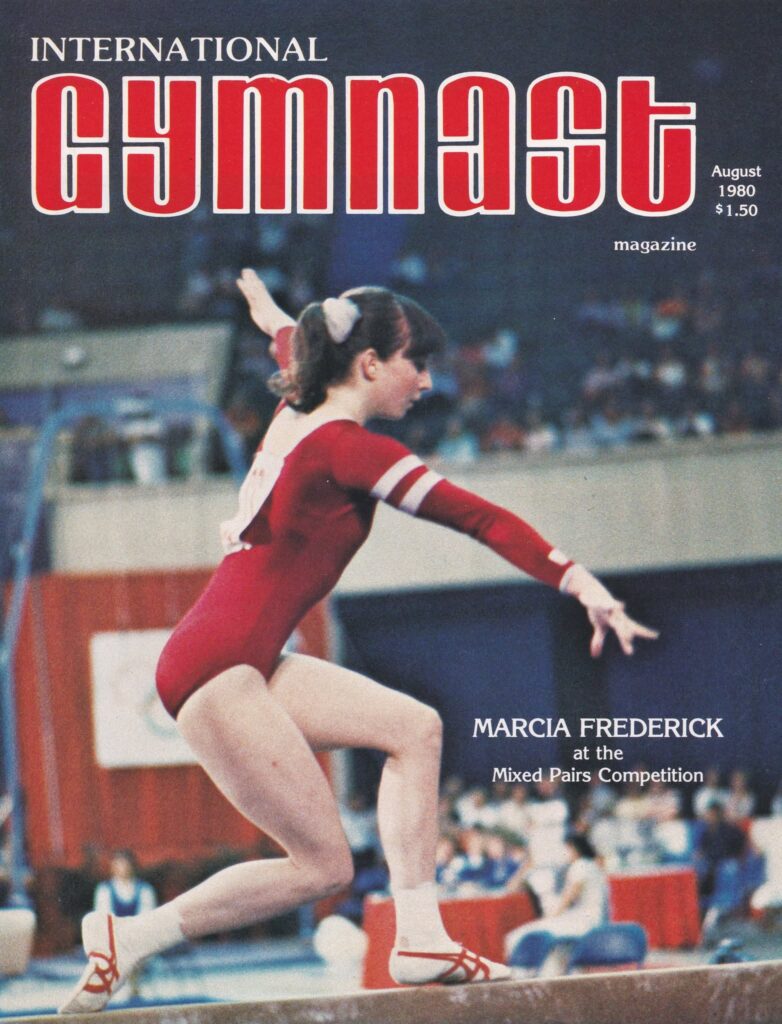
If Kurt Thomas embodied the lost promise of American men’s gymnastics, Marcia Frederick occupied a similar place on the women’s side. Two years before the boycott, Frederick arrived at the 1978 World Championships in Strasbourg for the first major international competition of her career. Within American gymnastics, coaches already regarded her as one of the country’s strongest uneven-bars workers; internationally, however, she was largely untested. Even Frederick expected only a top-five finish.
She qualified for the bars final in first, but she was up against the likes of Nadia Comăneci, the reigning Olympic champion, and Elena Mukhina, the newly crowned world all-around champion. Frederick later recalled that Comăneci herself was not especially intimidating. The real problem was the cold. The judges delayed the uneven bars final for nearly ten minutes, leaving her standing in an over-air-conditioned gymnasium waiting for the signal to begin. “I couldn’t feel my hands,” she later remembered.
When the judges finally gave the signal, Frederick performed a routine featuring a Stalder to full pirouette, an innovation that would later bear her name. The exercise earned a 9.95 and made her the first American woman ever to win a world championship gold medal. Looking back, Frederick argued that innovations like hers helped alter how gymnasts approached uneven bars. “It changed how girls thought about bars, how they swing,” she said. “Where girls are now on uneven bars is truly close to a high bar routine.”
By 1980, Frederick was at her peak. She was developing a new uneven-bars release—a reverse hecht from a sole circle—and was widely regarded as one of America’s strongest medal prospects for Moscow. Then the boycott arrived.
“Naturally, I’m disappointed that we’re not going to compete in the Olympics,” she said that spring. “Athletics and politics should not be put together. But what can you do? The decision has already been made.”
While some American Olympians became outspoken critics of the boycott, Frederick largely accepted that the decision was beyond her control. Instead, her comments at the time carried a tone of resignation. The opportunity she had spent years preparing for was disappearing, and there was nothing she could do to stop it.
Officials floated alternatives throughout 1980—replacement meets, substitute competitions, and symbolic gestures intended to compensate athletes for the loss of Moscow. Frederick welcomed them without much enthusiasm. “Any alternative is better than staying home,” she said.
She ultimately performed her new release at the boycott’s alternate competition in Hartford, Connecticut, where she finished second in the all-around. The skill itself survived, though history attached another name to it. Nearly two decades later, after Elise Ray performed the same element at the 1999 World Championships, the Code of Points credited it to Ray rather than Frederick.
The loss of Moscow, however, proved harder to replace than any eponymous skill. The boycott had altered her relationship with gymnastics. The question was no longer whether she could make another Olympic team. It was whether the next Olympics could be trusted at all.
“I was still struggling with, ‘Are they going to boycott this again? Are we going to go through this again?'” she recalled years later. “I don’t want to go train and put my body through this again. Working out was painful. I couldn’t trust that something wouldn’t happen.”
The doubts lingered long after 1980. Frederick continued competing and even fought her way back from a serious automobile accident in early 1981, returning to competition just six weeks later. But the boycott had left its mark.
Her verdict, rendered in 1984, was unsparing: “I think [the boycott] did nothing. It was a complete waste of time and a lot of timeless torture for people who put their lives into a 10-minute moment.”
Notes
1. Retaliation remains the most common explanation for the Soviet boycott of the 1984 Olympics, but it is not the only one. Grigory Rodchenkov, the former director of Russia’s national anti-doping laboratory, has advanced a different theory: Soviet officials were also concerned about the possibility of positive doping tests in Los Angeles.
[I]ncredibly, the Soviets had been planning to hide a doping control laboratory on board a ship in the Port of Los Angeles during the 1984 Olympic Games, after Donike and Don Catlin of UCLA’s Olympic Analytical Laboratory announced they would be able to detect all steroids — including stanozolol and testosterone — at the LA Games. Testing athletes before their departure would not suffice — the Soviet sports czars had to have their own on-site laboratory, in order to ensure that no “dirty” Soviet athletes made it to the starting lines. Remarkably, the secretive Semenov never told his bosses that his own laboratory couldn’t detect stanozolol and testosterone.
When Los Angeles wouldn’t allow our ship to enter the harbor, that was the last straw. The Politburo pulled the plug and boycotted the Olympics entirely.
The Rodchenkov Affair
Dr. Vitaly Semenov was the head of doping at VNIIFK (the All-Union Scientific and Research Institute for Physical Culture).
The Politburo was the top leadership committee of the Soviet Communist Party and functioned as the country’s most powerful decision-making body. Major policies were often debated and approved there before being implemented by the Soviet state.
Stanozolol was a steroid commonly used by Soviet athletes at the time.
2. For Johnson, Talavera, McNamara, Conner, and Hartung, the story did not end with the boycott. All five returned four years later as members of the 1984 U.S. Olympic team and reached the Olympic podium in Los Angeles.
3. In 1980, Muriel Grossfeld cut down to a “nucleus” program, sending many competitors and coaches home, and she went on a vacation. By 1982, she was back coaching. See “Grossfeld Resumes Training of Champions in Gymnastics,” Connecticut Post, February 7, 1982.
4. Frederick later alleged that coach Richard Carlson sexually abused her while she trained at Muriel Grossfeld’s gym in 1979–80. In 2018, she sued Carlson, Grossfeld, USA Gymnastics, and the U.S. Olympic Committee, claiming that officials failed to protect her from the abuse. More here.
5. The Official Roster of the 1980 United States Olympic Team as compiled by the United States Olympians Association and the USOC:
- Cahoy, Philip Michael
- Collins, Luci Andrea
- Conner, Bart
- Frederick, Marcia Jean
- Galimore, Ron
- Gerard, Larry D.
- Hartung, James N.
- Johnson, Kathy Ann
- Kline, Beth
- Koopman, Amy Richelle
- McNamara, Julianne Lyn
- Talavera, Tracee Ann
- Vidmar, Peter
- Wilson, Michael Gower
- Men’s Head Coach: Allen, Francis
- Men’s Assistant Coach: Meade, William
- Women’s Head Coach: Weaver, Ernestine
- Women’s Assistant Coach: Ziert, Paul
- Pianist: Stabisevski, Carol
Appendix: USGF’s Editorial
For the January/February 1980 issue of USGF News, Frank L. Bare, the organization’s executive director, penned the following editorial:
EDITORIAL
1980…The Olympics that might not be.
Historically, amateur sport in the United States has been totally separated from government involvement, whether that involvement was positive in the area of financing, or more negative in the area of involvement in program determination. Many previous administrations have spoken and written that the government did not wish to become involved in amateur sport. It all changed within the past several weeks. One can scarcely question the motivation for the involvement. Who could possibly side with the U.S.S.R. for invading another nation? Not taking part in the 1980 Olympic Games, will not ruin our national program and, in fact, gymnasts can begin now to prepare for the World Championships of 1981. It is a good thing that the FIG voted a year or so ago to have our own World Championships every two years instead of every four as before.
I regret that many gymnasts will not have the chance to prove their readiness in Moscow. Further, we all hope they have some opportunity to make their mark in some worthy event before their careers are ended. So strong is popular opinion now against going to Moscow that the Olympic Games, as far as the U.S.A. is concerned are no longer a reality. Perhaps, with the awesome wealth of the nations joined together for the boycott some meaningful substitute event will be brought into being and the athletes of the world will yet have an opportunity to compete on friendly ground.
Let us hope from a sports standpoint that this is not the beginning of direct government involvement in amateur sport in America. We had been, until this incident, perhaps the last of a few nations where sport was allowed to stand alone. Now that has all changed, and we have become, as other nations did years ago, an amateur sports nation with direct government involvement in amateur sport. It is a change that may never revert back to the old system. Once again, however, one can hardly speak of the problems of sport in relation to the more serious problems of invasion of a foreign country and possibilities of war. We can though, hope for speedy resolution of the over-all problems and then hope that amateur sport will not continue as a means of waging cold-wars between nations, or amateur sport as we have known it in the past, at least on the international scene, will be a thing of the past.
References
Academic Work
Eaton, Joseph. “Reconsidering the 1980 Moscow Olympic Boycott: American Sports Diplomacy in East Asian Perspective.” Diplomatic History 40, no. 5 (2016): 845–864. https://doi.org/10.1093/dh/dhw026.
Rice, Andrew C. “The American and Canadian Decisions to Boycott the 1980 Moscow Olympics: A Comparative Analysis.” Journal of Olympic Studies 6, no. 2 (2025): 43–63.
Sarantakes, Nicholas Evan. Dropping the Torch: Jimmy Carter, the Olympic Boycott, and the Cold War. New York: Cambridge University Press, 2011.
Newspaper Articles
“NU Olympic Hopeful Dislikes Boycott Idea.” Omaha World-Herald, January 6, 1980.
Biggs, Charles. “OU’s Olympic Gymnast Will Listen to the People.” Tulsa World, January 22, 1980.
“No Reason to Boycott Olympics, Gymnast Says.” Kokomo Tribune, January 26, 1980.
Robichaux, Gerry. “Kathy Johnson—Olympic Dreams Fade.” The Times (Shreveport, LA), March 1, 1980.
Aubrey, Coult. “Oregon Gym Team’s Coach Is 100 Percent Against Boycott.” The Morning Call (Allentown, PA), March 21, 1980.
“Thomas Will Honor Boycott: Gymnast Says Olympic Holdout Will Hurt Americans.” The Palm Beach Post, April 4, 1980.
“Call for Olympic Boycott Dries Up Gymnasts’ Funds.” Chicago Tribune, April 5, 1980.
Roberg, R. C. “Gymnastic Competitors Upset About Boycott.” The Salt Lake Tribune, April 17, 1980.
“Conner Takes Boycott Calmly,” Associated Press, Lansing State Journal (Lansing, MI), May 28, 1980.
McLaughlin, Joe. “Gymnast Thomas’ Goal Foiled, but He Lands on His Feet.” Houston Chronicle, June 30, 1980.
United Press International. “Olympics ’84 Weekend Newsfeature.” UPI Archives, August 10, 1984. https://www.upi.com/Archives/1984/08/10/Olympics-84-weekend-newsfeature/7159460958400/.
“Frederick Changed Gymnastics, But Boycott Ended Olympic Dream,” Hartford Courant, August 15, 2010, https://www.courant.com/2010/08/15/frederick-changed-gymnastics-but-boycott-ended-olympic-dream/.