The story of He Kexin’s age has been told many times, but nearly always from the same vantage point. Western readers know the New York Times investigation, the deleted spreadsheets, and Béla Károlyi’s comments about baby teeth. What they do not know — because almost none of it has been translated or discussed in English — is how Chinese mainland media told the same story.
This essay traces that mainland narrative across a single year, from the first stray press mentions of He Kexin’s age in late 2007 through the International Gymnastics Federation’s formal resolution of the controversy in October 2008. It is not, primarily, a story about whether she was 14 or 16. It is a story about how the same events, covered by journalists working under different constraints and writing for different audiences, can produce such divergent accounts.
2007: The Timestamp
On November 3, 2007, the People’s Daily ran what appeared to be a routine dispatch from the Sixth National Urban Games — the kind of survey of promising young athletes that fills sports pages during off-peak competition seasons. Reviewing the results, sports official Xiao Tian praised a group of outstanding young competitors who had displayed a fearless, combative spirit and solid fundamentals. Among them was a seventeen-year-old table tennis prodigy who had just upset world champions and a gymnast:
13岁的何可欣在女子体操比赛中出色地完成高低杠”李娅空翻”。
Thirteen-year-old He Kexin outstandingly completed the uneven-bars skill known as the ‘Li Ya somersault’ in the women’s gymnastics competition.
— People’s Daily, November 3, 2007
The detail was presented as precocity. Look at this fearless kid, the newspaper was saying. Look at the next generation. In hindsight, it read like a timestamp. A thirteen-year-old in November 2007 could not turn sixteen before the Beijing Olympics opened the following August, regardless of when her birthday fell in the calendar year.
A month later, the Beijing Evening News returned to the same framing, this time in the language of Olympic preparation:
张佩文口中的”秘密武器”就是最近涌现出的新星何可欣。这名13岁的小将不仅能轻松地完成”李娅空翻”,还在比赛中表现出了与年龄不相符的稳定。
The ‘secret weapon’ mentioned by Zhang Peiwen is the newly emerged rising star, He Kexin. This 13-year-old youngster can not only effortlessly complete the ‘Li Ya salto,’ but has also displayed a level of steadiness in competition that seems far beyond her years.
— Beijing Evening News, December 2, 2007
Zhang Peiwen was the head of the Chinese gymnastics delegation —the same official who would later, in July 2008, tell Xinhua that all athletes on the Olympic roster met the FIG’s age requirements. In December 2007, he publicly described his prospective Olympic secret weapon as a thirteen-year-old.
Early reports like these became an important part of the Western evidentiary case, alongside online registration lists and cached government sports records. But in 2007, in the context of domestic sports reporting, they were simply promotional copy — proof of the next generation’s talent.
July 2008: The U.S. Allegation
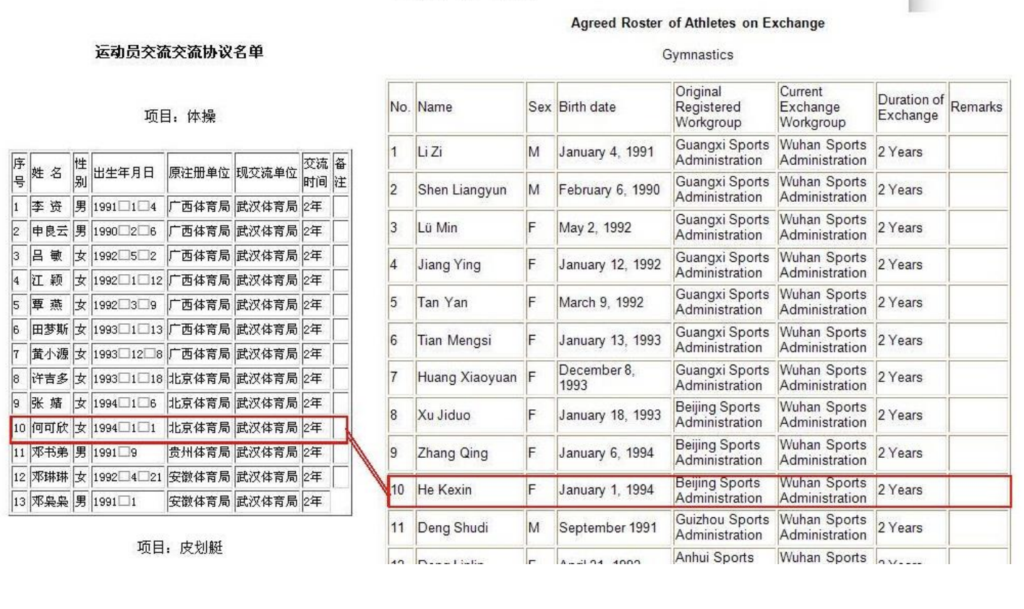
On July 27, 2008, the New York Times published “Records Say Chinese Gymnasts May Be Under Age” by Jeré Longman and Juliet Macur. The article cited two online registration lists, including one from a national gymnastics registry, that gave He Kexin’s birthdate as January 1, 1994, two years later than the January 1, 1992 date on her passport. It also cited newspaper profiles from 2008 that listed He Kexin as 14.
When contacted, Chinese officials provided copies of the gymnasts’ passports to the New York Times. According to the FIG’s Secretary General, André Gueisbuhler, the federation had already heard the rumors and contacted the Chinese Gymnastics Federation for clarification. After reviewing the passport copies, the FIG concluded that “everything is O.K.” Gueisbuhler explained that passports were the only documents the federation could verify, and that without a formal complaint or additional proof, there was no reason to pursue the matter further.
Chinese media responded immediately. A July 28 dispatch from Xinhua News Agency carried the headline, “Chinese Gymnastics Team Clarifies Allegations of Falsified Ages, Says All Athletes Meet Requirements,” and opened with a categorical defense from Zhang Peiwen:
体操队奥运阵容中所有选手的年龄都是按照所在省市提供的有效身份证件登记的,已达到奥运报名标准,也已经得到了国际体联的确认。
All athletes named to the Olympic roster were registered strictly on the basis of valid government-issued identification documents provided by their respective provinces and municipalities. All athletes meet the Olympic age requirements, and their eligibility has already been confirmed by the International Gymnastics Federation.
— Xinhua, July 28, 2008
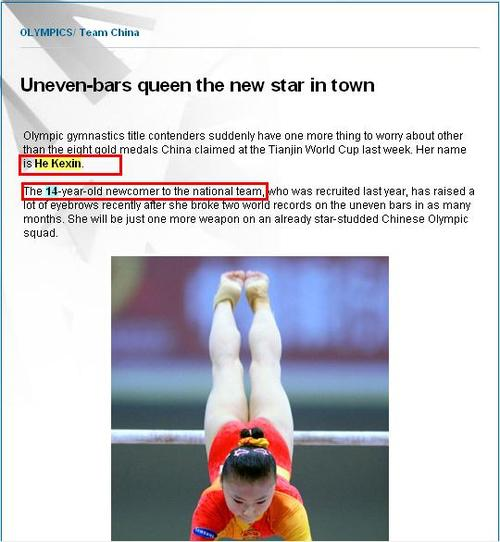
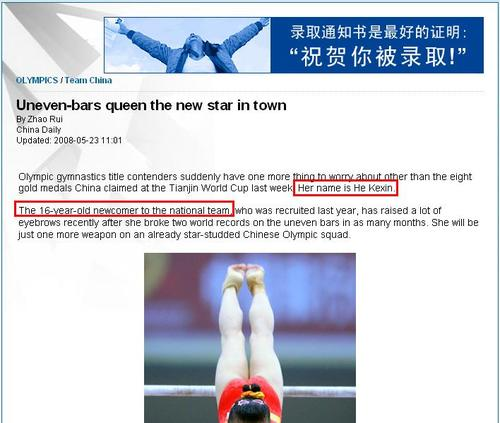
The Xinhua article offered two specific rebuttals. First, all six female gymnasts had previously competed in official FIG events — Jiang Yuyuan at the 2007 World Championships, He Kexin at the Doha and Cottbus World Cups earlier in 2008 — and the FIG had verified their ages through passport checks at each of those events. Second, foreign media had cited a Xinhua article describing He Kexin as fourteen years old, but had failed to mention that the same newspaper issued a correction four days later, revising He Kexin’s age to sixteen. The Western press, Xinhua implied, was selectively deploying Chinese sources.
Zhang Peiwen stated in the Xinhua piece, “There is too much information on the internet. Everyone knows that a lot of it contains errors. We simply don’t have the time or energy to verify every single item.”
This framing — foreign media speculation based on internet documents vs. official documentation — would remain the dominant mode of Chinese coverage for the following three months.
August 9: The FIG Confirms, and the Case Is Closed
The Beijing Olympic gymnastics competition opened on Saturday, August 9, 2008. That afternoon, the International Gymnastics Federation issued a statement declaring that all gymnasts competing in Beijing met the age requirements. Passports issued by the athletes’ home countries, it said, were the legally recognized basis for verifying age. The International Olympic Committee had confirmed that all passports were valid, and the FIG noted that eligibility had already been carefully verified at previous international competitions.
Later that day, the FIG president, Bruno Grandi, faced a press conference dominated by American journalists still pressing the age question. (At least, that is how the Chinese media framed it.) His answers were unequivocal. Passports, he said, were the lawful proof of age, and the Chinese athletes’ passports presented no problems:
“护照是合法的年龄证明,中国选手护照没有问题,年龄都符合奥运会参赛规定。”对于记者提到的网上“证据。”
“Passports are lawful proof of age. The passports of the Chinese athletes present no problems, and their ages all comply with Olympic eligibility requirements.”
—Bruno Grandi, Xinhuanet, August 9, 2008
The FIG’s secretary general, André Gueisbuhler, echoed that sentiment:
“到目前为止,我们对年龄不存在怀疑。除非有确实的证据,否则没有理由对中国队采取任何行动。”他进一步明确说:“使用护照作为证明是国际间普遍采用的做法,我们没有理由要求检查护照之外的证据。”
“At present, we have no doubts regarding age. Unless there is concrete evidence, there is no reason to take any action against the Chinese team.”He further clarified:
“The use of passports as proof is a practice commonly adopted internationally. We have no reason to request checks of evidence beyond passports.”
—André Gueisbuhler, Xinhuanet, August 9, 2008
Chinese state media presented the moment as a definitive resolution. Xinhuanet’s report ran under the headline: “Gymnastics Age Issue Comes to a Close — FIG: No Reason to Investigate China.” The next day, the Guangzhou Daily ran the same Xinhua dispatch under a more emphatic headline: “Are the Ages of Chinese Gymnasts a Problem? International Gymnastics Federation: Completely Groundless!”
One question, however, went unexplored in the Chinese coverage. If the online evidence cited by foreign journalists was worthless, why had the information appeared in the first place on official Chinese sports registration websites? The correction-to-a-newspaper-article explanation addressed a single report, but it did not account for the General Administration of Sport’s own registration data. That explanation would not appear until nearly two weeks later.
August 13–14: He Kexin in the Press Room
When China won the women’s team gymnastics gold on August 13, the focus was on He Kexin again. At the post-competition press conference, the first question was directed at her.
The Oriental Sports Daily sent special correspondent Du Min, who filed a detailed account of what followed. His article appeared under the headline: “He Kexin Responds to Foreign Media’s Age Questions at Press Conference: ‘I Am 16 Years Old!’”
According to Du Min, an American female journalist raised her hand. The venue press officer—who, he noted, “generally gives foreign media ample opportunity to ask questions”—called on her.
何,你确信你自己是16岁吗?你能亲口告诉大家你到底几岁吗?为什么会有那么多人质疑你的年龄?
“He, are you certain that you are 16 years old? Can you personally tell everyone how old you really are? Why are so many people questioning your age?”
Du Min described the question as “confrontational” and noted that it surprised everyone in the room, coming immediately after a championship celebration. He Kexin brought the microphone closer, “expressionlessly,” and replied:
“我就是16岁,别人怎么说与我无关。我自己知道我是16岁就可以了,我可以参加比赛,其他人爱怎么想、爱怎么写,我管不着。”
“I am 16 years old. What others say has nothing to do with me. As long as I know that I am 16, that’s enough. I am eligible to compete. Other people can think whatever they want or write whatever they want — that’s not my concern.”
— Oriental Sports Daily, August 14, 2008
Du Min called the answer “composed and watertight” and said that “the 16-year-old passed the test.”
A second American journalist was then called on. She asked He Kexin to tell the press room where she had spent her fifteenth birthday. “A number of boos immediately rang out in the press room,” Du Min wrote. He Kexin, “without losing her temper,” answered in a “still somewhat childlike voice” that she had spent it with the team — training was busy, they had all celebrated together, it was an ordinary birthday. Du Min described her as having “shut the American reporter down” with a response that refused to fall into the trap of “this highly leading question.” The reporter, he noted, “visibly uncomfortable, lowered her head.”
It is worth noting that not all mainland coverage reported the confrontation. A reader of the PLA Daily on August 20 would have had no idea the press conference had been contentious at all. In Chai Hua’s summary piece, “China’s Gymnastics: Proven by Strength,” the American and Japanese media appeared after the competition not as accusers but as gracious conceding parties: “The U.S. team performed very well,” they were quoted saying, and “China is simply too strong, unbeatable.” The ugly details of the post-competition press room had been entirely filtered out.
The same press conference, seen from the Western side, looked quite different. The Times of London’s correspondent noted that the question about the fifteenth birthday had been posed to suggest she had not yet celebrated her sixteenth. Thomas Boswell, writing for NBCNews.com, focused on the gymnasts’ appearances: “a small girl in glittery makeup trying to pretend she’s 16 — and eligible for the Olympics — when she may only be 14.” He added, “Next to He, accepting praise, was Jiang Yuyuan, an amazing uneven-bar performer. Both looked extremely young despite thick makeup, sparkles, and fairly sophisticated hairstyles.”
The same exchange produced two different press conference accounts. The Chinese version saw Western journalists as provocateurs, He Kexin as poised and principled. The American version saw a child whose answers confirmed nothing and resolved nothing.
August 18–19: Profiling an Individual Gold Medalist
He Kexin won the uneven bars gold medal on August 18, edging Nastia Liukin in a tie-break. The following morning, Chinese newspapers introduced the new Olympic bars champion to their readers.
And in those profiles, He Kexin’s age was everywhere. The Workers’ Daily called her the “16-year-old Beijing ‘little girl’ He Kexin.” The Beijing Entertainment News opened its account by noting that she was sixteen. The People’s Daily emphasized that “only this year — after turning 16 — was she finally able to compete on the world stage.” Even a celebratory poem published in the PLA Daily addressed her directly as “you, sixteen-year-old girl, from Beijing.”
In these pieces, the age was not presented as a rebuttal to foreign allegations. It appeared instead as a marker of precocious achievement — proof that a teenager from Beijing had reached the summit of Olympic sport.
The People’s Daily traced the story back to a kindergarten near Yonghegong in Beijing’s Dongcheng district. There, coach Shang Chunyan first noticed a five-year-old girl who was “neither tall nor overweight,” meeting the basic physical criteria for gymnastics. Even then, Shang remembered, the child showed unusual strength and explosive power. What stood out most was her determination: even when sick with a fever, she insisted that her parents take her to training.
From there, the path followed the familiar ladder of the Chinese sports system. At eight, He Kexin entered the Shichahai Sports School. Later, she advanced to the Beijing team, but the step to the national team nearly did not happen. When selectors first saw her, national team coach Liu Qunlin later recalled, they were unimpressed:
那时何可欣外形不是太好,又不会什么动作,我们开始看了并不太想要。没想到她在高低杠上的感觉特别好,弹跳力也不错。她的这些特点打动了我们,这才从北京队把她带走了。
“At that time, He Kexin’s physical appearance wasn’t great, and she didn’t know many skills — when we first watched her, we weren’t particularly interested in taking her. What we didn’t expect was that she had an especially good feel for the uneven bars, and her explosive power was also quite good. Those qualities won us over, and that’s when we brought her over from the Beijing Team.”
— Workers’ Daily, August 19, 2008
Other profiles filled in additional details. According to the Beijing Times, recurring foot injuries eventually made it impossible for He to train on balance beam or floor exercise. Coaches decided to have her specialize on uneven bars. Within a couple months, she had mastered the “Li Ya salto,” astonishing her coaches.
Not every step of the journey was triumphant. At the 2007 City Games — the same competition where the People’s Daily had earlier described her as thirteen — she fell on uneven bars. Afterward, she sat alone in the stands watching the rest of the competition, refusing food or rest, “more heartbroken than ever before.”
Some details emphasized not athletic brilliance but temperament. One profile described a dormitory inspection in which a coach found the athletes’ room messy and ordered them to clean it before leaving. The others quietly slipped away. Only He stayed behind and finished the task herself. Coaches described her as someone who, even when criticized or punished, “never lost her temper or became emotional.”
Another report captured a small moment after the Olympic final. When Yang Yilin dismounted from the bars to secure the bronze medal, He — much smaller than her teammate — ran over and lifted her into the air. Asked later about the impulsive celebration, she smiled shyly: “I thought she did very well, too. We both represent China.”
The PLA Daily rendered the moment in verse. Zhou Yongshan’s poem compared her movement to a swallow in flight, tracing arcs “like drifting clouds and flowing water.” As she performed, the poem imagined the nation holding its breath:
翻飞翻飞从高杠到低杠 / 停跳的心啊为你悬着
Flying — flying — from high bar to low,
our hearts stop beating, suspended for you.
Western readers encountered a very different portrait. In the days surrounding He Kexin’s victory, coverage in the New York Times returned repeatedly to the same unresolved question: her age. “He, who is listed as 16, but whose age has been at issue at these Olympics, won the gold,” the paper reported. Descriptions of the routine emphasized contrasts with Nastia Liukin — her compact body against Liukin’s long lines — and noted even small execution details, such as He’s step to steady herself after landing.
Beyond these observations of age, physique, and performance, Western coverage offered little sense of the person behind the routine.
August 21–22: The Case Reopens
Starting on August 19, an American computer security expert working under the blog name Stryde Hax — real name Mike Walker — published an account of how he had retrieved two spreadsheets from the website of China’s General Administration of Sport. These were not stray files found on the internet; they were documents posted online by China’s central sports authority. The documents had been removed from the site, but Walker had located cached copies through the Chinese search engine Baidu. Both listed He Kexin’s birthdate as January 1, 1994. Walker argued that these were primary documents issued by the Chinese state and constituted evidence rising above the level of “allegation.”


The Times of London broke the story in the Western press, reporting that the IOC had ordered an investigation. IOC spokeswoman Giselle Davies confirmed that “more information has come to light that did point to discrepancies” and that the FIG had been asked to look into the matter further with the Chinese federation.
Chinese coverage of the development was framed differently from Western reports. An August 22 dispatch from Titan Sports Network, for example, ran under the headline “No Evidence of Chinese Violations — Athlete Age Question Provisionally Closed.” The article centered on the International Olympic Committee’s August 21 statement that “no evidence has emerged capable of substantively proving” the allegations. It quoted IOC spokeswoman Emmanuelle Moreau Davies, who said that the athletes’ ages were “in compliance” based on passport documentation. The dispatch also alleged that Nastia Liukin and USA Gymnastics president, Steve Penny, were privately supporting the decision to pursue further investigation into the ages of the Chinese gymnasts.
On August 22, a joint press conference was held by the International Olympic Committee and the Beijing Organizing Committee for the Olympic Games (BOCOG). The Chinese-language transcript captures the questions and responses about the gymnasts’ ages. After opening remarks on medal counts, attendance, and other routine Olympic matters, an NBC reporter raised allegations that Chinese gymnasts might be underage.
Davies responded cautiously, emphasizing that this was not a formal investigation: “We have asked the gymnastics federation to clarify certain inconsistencies that have arisen on this matter,” she said, adding that the Chinese Gymnastics Association had been “very cooperative.” Christophe Dubi, the IOC Sports Director, noted that the International Gymnastics Federation had already reviewed the issue in the spring and was again requesting “relevant documentation.” BOCOG executive vice president Wang Wei closed the exchange by stressing that all athletes’ eligibility had been strictly verified: “If there had been a problem, they would not have competed.”
Two days later, on August 24, Cui Dalin — deputy head of the Chinese Olympic delegation — addressed the issue directly at a Chinese delegation press conference in Beijing. His remarks circulated widely in the Western media. On the mainland, they appeared in a dispatch from the China News Service under the headline “Cui Dalin: Ages of Chinese Gymnasts Fully Comply with Olympic Regulations.”
Cui opened his remarks with an unequivocal defense of the Chinese team’s eligibility.
“我首先郑重地告诉大家,中国代表团体操运动员的年龄完全符合参加北京奥运的规定。”
“I would first like to state solemnly to everyone that the ages of the gymnasts in the Chinese delegation fully comply with the regulations for participating in the Beijing Olympics.”
According to Cui, the International Gymnastics Federation had already conducted a review of the issue after receiving inquiries from foreign media. The Chinese Gymnastics Association, he said, had cooperated fully and provided a series of legally valid documents — including passports and national identity cards — which the FIG had accepted as proof that the athletes met the minimum age requirement.
Cui also offered the most detailed official explanation yet for the conflicting records that had circulated online. He acknowledged that an incorrect birth year had appeared in certain domestic registration materials but attributed it to a bureaucratic error tied to China’s internal competition system:
在我们国内竞赛中允许运动员转会交流,去年的城市运动会,何可欣由一个代表团队转到了另一个代表团队,在转会注册当中出现了年龄的差错,是转会基础工作上的一些错误导致以后的这些误会。
“In our domestic competitions, athletes are permitted to transfer between teams. During last year’s City Games, He Kexin transferred from one delegation to another. In the registration process for that transfer, an error occurred in recording her age — it was a basic clerical mistake in the transfer paperwork that led to these subsequent misunderstandings.”
In Cui’s account, the 1994 birthdate circulating online was therefore not evidence of falsification but the product of an administrative mistake made during a routine transfer registration and later superseded by the legally binding documents used for international competition.
Mainland reporting framed the episode largely as a misunderstanding fueled by foreign media speculation. The China News Service dispatch emphasized that the FIG had accepted the documentation provided by the Chinese federation and closed by reiterating Cui’s central message:
“但这里我可以准确地讲,我们中国体操运动员的年龄完全符合参加北京奥运会的规定。”
“But I can say with certainty: the ages of our Chinese gymnasts fully comply with the regulations for participating in the Beijing Olympics.”
It was the clearest official explanation yet offered by the Chinese delegation. Whether it satisfied skeptics, both in China and abroad, was another question.
The FIG Beyond the Passport
At the August 9 press conference, Bruno Grandi and André Gueisbuhler were unequivocal. The passport was the legal standard. Online information was not official documentation. There was no need to look further. Even the newly announced identity card system, Gueisbuhler explained, would rely on passport age. The FIG had no intention of changing this principle.
Less than two weeks later, that position had changed. By August 22, the FIG had asked the Chinese federation to submit additional documents, including old passports, residency cards, and ID cards. Lu Shanzhen confirmed to the Associated Press that these materials had been provided on August 21. In procedural terms, this was a clear shift: the FIG had moved from relying on a single document to cross-checking multiple records for consistency.
The change broke with decades of precedent. After Olga Bicherova’s age was questioned at the 1981 World Championships, Yuri Titov, the FIG president at the time, was blunt: “We make the control with the passport. What else can we do?” In August 2008, for the first time, the federation answered that question differently. It chose to look beyond the passport.
October 1: The Case Closes — Incompletely
The FIG issued its final statement on October 1, after five weeks of investigation. Xinhua’s report ran under the headline: “Chinese Women’s Gymnastics Team ‘Cleared’ of Beijing Olympic Age Issue.”
The opening paragraph was straightforward: the FIG had concluded that the Chinese team that won gold at the Beijing Olympics met the required age regulations. The original official documents provided by the Chinese Gymnastics Association — passports, identity cards, and household registration records — all confirmed the athletes’ eligibility.
CCTV’s Morning News carried a direct quotation from the FIG’s Secretary General:
“根据我们掌握的所有事实,我们确实可以得出结论,北京奥运会(中国女子体操队)一案可以了结,因为我们有充分证据证明,中国体操运动员的年龄没有问题。”
“Based on all the facts in our possession, we can indeed conclude that the Beijing Olympic Games case — regarding the Chinese women’s gymnastics team — can be closed, because we have sufficient evidence to prove that the ages of the Chinese gymnasts were not a problem.”
— Gueisbuhler, quoted by CCTV, October 2, 2008
The team had been exonerated, and China’s historic team gold would not be stripped from the team.
But the statement was not entirely congratulatory. The FIG simultaneously announced that it would continue investigating two members of the Chinese team that competed at the 2000 Sydney Olympics: Yang Yun and Dong Fangxiao. Questions about their eligibility had surfaced during the Beijing Games, prompted in part by Yang Yun’s own admission on Chinese state television that she had been fourteen when she competed in 2000. The FIG was explicit:
“我们认为,目前对这两名选手年龄问题的解释和所提供的证据不令人满意。”
“We believe that the explanations currently provided regarding the age issues of these two athletes, as well as the evidence submitted, are not satisfactory.”
— FIG statement, October 1, 2008
The case, therefore, closed without the triumphant resolution that had seemed imminent in early August, when Bruno Grandi declared that passports were dispositive. The Beijing team was cleared, but the announcement was paired with an ongoing investigation into the Sydney team. The exoneration was real, but it arrived shadowed by a separate unresolved case.
The Case Closes; the Argument Continues
The FIG’s ruling on October 1, 2008, fixed He Kexin’s birthdate in the official record: January 1, 1992. In the language of international sport governance, the case was closed. The documents had been reviewed, the results stood, and the federation moved on.
But the story did not end there.
In the months that followed, even Bruno Grandi — the same FIG president who had insisted in Beijing that passports were dispositive and that there was “no reason to go further” — began to speak in a different register. Kind of. In an interview with Leon magazine from early 2009, he said that there was “strong circumstantial evidence” that something had been wrong. Yet he immediately drew a line beneath that admission: “I’m not the police or Interpol.” The role of the federation, as he framed it, was not to investigate beyond what could be legally proven, but to accept the documents it was given.
That tension ran through all of his remarks. The evidence might be suggestive; the proof, in a legal sense, was not. “When people on the Internet find fake documents,” he said, “you need to legally prove that these are fake, and that’s not my job. I have to respect the documents that the Chinese government gives me. What else should I do — declare war on China?”
Grandi’s comments revealed something the October ruling had obscured. The controversy had never been fully resolved; it had only administratively concluded. In the words of the most powerful man in gymnastics, one could hear both suspicion and restraint: an acknowledgment that something might have been wrong, paired with an insistence that nothing actionable could be proven because all the legal documents were in alignment.
Nearly two decades later, that unresolved tension still defines how the case is remembered. The official record remains intact. The alternative record — built from cached webpages, early press reports, and lingering doubts — continues to circulate and be debated on message boards, Reddit threads, and YouTube comments.
The case closed. The argument did not.
* * *
In the next article, we will look at how the story continued in mainland China in an unexpected way.
Coda
On October 16, 2008, just days after the FIG cleared the 2008 team, CCTV.com—the website of China’s state broadcaster, China Central Television—republished an article from Sohu Sports. The piece looked ahead, outlining Lu Shanzhen’s plans for the next Olympic cycle. “Beijing is already behind us—we’ve now begun setting our sights on the next Olympic Games in London!” he remarked.
Lu Shanzhen added:
“楊伊琳、何可欣、江鈺源這批隊員屬於94那撥的,因為那撥隊員挑選非常成功,才有我們在北京奧運會上的歷史性突破。如今我們又面臨倫敦奧運會的人才選拔,等於又迎來一個輪迴,這次人才選拔的重要性不言而喻,決定着我們倫敦奧運會的成績。”
“Athletes like Yang Yilin, He Kexin, and Jiang Yuyuan belong to the ‘94 group. Because that group was selected so successfully, we achieved our historic breakthrough at the Beijing Olympics. Now, as we face selection for London, it’s like another cycle beginning. The importance of this talent selection goes without saying—it will determine our results in London.”
The phrase “’94 cohort” is a curious one. It does not imply that the gymnasts were born in 1994, but rather that they were born around that year. Even so, it is a striking formulation to appear on CCTV’s website two weeks after He Kexin had been officially deemed to be born in 1992—not 1994, as Western media had alleged. The grouping is also unusual, given that the athletes’ registered birthdates hovered around 1992, not 1994: Yang Yilin in 1992, He Kexin in 1992, and Jiang Yuyuan in 1991. And from a planning perspective, a “’94 cohort” would not be eligible for the Beijing Olympics, but a “’92 cohort” would be.
But were Jiang, Yang, and He actually born in 1991 and 1992? The FIG ruled that they were. Even so, doubts persisted. After the federation determined that Dong Fangxiao had competed underage at the 2000 Olympics, Chinese media began to speak more openly about age falsification across sports such as soccer, table tennis, and volleyball. In a 2011 piece on age falsification in Chinese sports, Life Daily (生活报) dedicated a paragraph to the 2008 team:
在北京奥运会前,何可欣和杨伊琳就被外国媒体指责未到国际体联规定的16岁。对此,中国体操队以出生证明、户口簿、身份证、护照来证明中国体操队所有人的年龄都达到标准,但是被怀疑这些资料都做了修改。
February 20, 2011
Before the Beijing Games, He Kexin and Yang Yilin were both accused by foreign media of being under the FIG-required age of 16. In response, the Chinese gymnastics team produced birth certificates, household registration documents, identity cards, and passports to demonstrate that every member of the team met the age standard. But suspicion remained that all of these documents had been altered.
Three years after the Games, suspicion remained—even within China’s borders.
A Note on Sources
Chinese-language sources used in this essay include: People’s Daily (November 3, 2007); Beijing Evening News (December 2, 2007); Xinhua dispatches of July 28–29, 2008; Xinhuanet (August 9, 2008); Guangzhou Daily/Dayang Net (August 10, 2008); China News Service (August 13, 2008); Oriental Sports Daily (August 14, 2008); People’s Daily Online, Beijing Entertainment News, Workers’ Daily, Oriental Sports Daily, and Beijing Times (all August 19, 2008); PLA Daily (August 19 and 21, 2008); Titan Sports Network (August 22, 2008); CRNTT press conference transcript (August 22, 2008); China News Service, China Review News, and Liberty Times [Taiwan] (August 24, 2008); Xinhua/CCTV (October 1–2, 2008). Western sources include the New York Times (July 27, August 13, and August 18, 2008), the Washington Post (August 13, 2008), NBCNews.com (August 13, 2008), The Times of London (August 22, 2008), and The Guardian (August 22, 2008).
This piece does not attempt to offer a definitive account of how mainland Chinese media covered this story. The volume of that coverage makes any such claim impossible, especially for a researcher located in the United States. This article is offered instead as an orientation for English-speaking readers — a sense of the framing, tone, and emphases that characterized reporting on the issue within China.
Additional Notes
This was not the first time that something like this happened. Kang Xin was 13 in the Chinese media in 2001, but she was 16 in 2002.
By historical standards, a Chinese women’s team without age discrepancies would have been the anomaly. Even Ma Yanhong has multiple birthdates on the record.
Here is another mention of 13-year-old He Kexin from 2007:
He Kexin (Gymnastics) 13-year-old Wuhan native He Kexin faced national team member Yang Yilin in the women’s uneven bars competition. With the support of the home crowd, she executed the full “Li Ya salto” combination brilliantly in the final to edge the World Championships bronze medalist Yang Yilin — who had already posted a high score — and claim the title.
November 4, 2007 | Changjiang Times | Archived here
何可欣(体操)
13岁的武汉选手何可欣在女子高低杠比赛中的对手是国家队的杨伊琳。在主场观众的支持下,这个小姑娘在决赛中出色地完成了“李娅空翻”的全套动作,险胜已经得到高分的世锦赛季军杨伊琳,拼下冠军。
Appendix A: Additional Chinese-Language Articles
Here are four articles that give you an idea of how the Chinese-language media, at large, handled the story across three distinct political contexts: Hong Kong, Taiwan, and the diaspora in the United States. My goal is to give you an idea of how this controversy was covered in non-English publications.
Hong Kong
Baseless Accusations — the Ugly Conduct of Petty People Revealed.
The 2008 Beijing Olympics have been widely praised around the world and are a source of pride for the Chinese people. Yet certain media outlets in Hong Kong refuse to miss any opportunity to spread rumors. The moment they detect even the slightest “trace of suspicion,” they seize upon it, exaggerating and attacking relentlessly.
After claiming that the little girl in red at the opening ceremony, Lin Miaoke, had someone singing behind the scenes for her, and that the twenty-eight “footprint” fireworks were computer-generated, they now treat another issue as if they struck gold: alleging that one member of the Chinese women’s gymnastics team, He Kexin, “doesn’t measure up”—that she is under sixteen and therefore does not comply with International Olympic Committee regulations.
It is understood that someone has already requested an investigation from the International Gymnastics Federation and the IOC. But it is obvious that the answer can only be: “The truth will vindicate the innocent”
In fact, the claim that He Kexin “looks” younger than sixteen is, up to now, nothing more than a completely unfounded accusation.
As everyone knows, girls of different races, countries, and regions can grow at very different rates. In some African countries, girls barely over ten may already look like young women and may even bear children. More importantly, gymnastics is a highly specialized sport. In mainland China, some girls are selected for sports schools at seven, eight, or even younger to undergo systematic training. Traditional women’s gymnastics standards require athletes to have a slender, light physique, which helps them complete complex flipping and tumbling movements. For this reason, female gymnasts around the world tend to be small and delicate in build. The Chinese gymnastics community is especially so—both male and female athletes are generally not tall.
As for whether there were previously different reports of He Kexin’s age, there are two points to consider. First, when media outlets report an athlete’s age, they may not verify documents and often rely simply on interviews. Second, many athletes come from rural areas, where some parents only register a child’s household record when the child is about to start school, sometimes giving only an approximate age.
More importantly, in China’s sports schools there are many girls with physical qualities like He Kexin’s. There is simply no need to cheat or to “report a younger age.” Moreover, the Beijing Olympics are the first ever hosted by the Chinese people; China would never sacrifice its integrity and reputation for such a thing.
Questioning and discussion of these doubts may be acceptable. But when a certain female radio host repeatedly talks of “fabrication” and “fraud,” claiming that China is a “nation of fakes” whose “credibility has collapsed,” such malicious slander* only reveals the speaker’s own dark and despicable mentality. China’s gold medals will not be tarnished by such attacks.
[*The Chinese idiom literally means “spraying people with a bloody mouth.”]
Ta Kung Pao, Saturday, August 23, 2008, A3
Note: Ta Kung Pao is a pro-Beijing newspaper
指控莫須有小人醜態現
○八京奧,全球讚譽,國人自豪,本港
個別傳媒卻不放過任何可以造謠的機會,一
有任何 「蛛絲馬迹」 ,立刻抓住不放,在那
裡大肆渲染和抨擊。
繼開幕禮紅衣小女孩林妙可有人幕後代
唱、二十八個 「腳印」 煙花經電腦合成之後
,他們又 「如獲至寶」 ,指中國女子體操隊
成員之一的何可欣 「唔夠秤」 ,年齡未足十
六歲,不符合國際奧委會的規定。
有關問題,據悉已有人向國際體操聯會
和國際奧委會提出調查要求;但顯而易見,
答案只能是 「清者自清」 。
事實是,所謂何可欣「看來」不足十六歲
,迄今為止,完全只是一個「莫須有」的指控。
眾所周知,不同種族、國家、地區的女
孩子,生長狀況可以有很大的差異,有些非
洲國家,十歲出頭的女孩子已經長得有如少
女,甚至可以生兒育女;更重要的是,體操
運動是一門非常獨特而又專門的訓練,在內
地,一些女孩子七歲、八歲甚至更小就已經
被選進體校,接受系統的訓練;而傳統女子
體操標準,要求運動員的體態必須長得是纖
細、輕巧,才能有利於完成一整套的翻騰跳
躍動作。所以各國體操女運動員大多都是纖
巧型的,中國體操界更是如此,男、女選手
的身型都是不高的。
至於說,何可欣的年齡在這之前是否曾
經出現過不同的說法,一來,傳媒報道運動
員的年紀未必會查驗過文件,一般只是口頭
採訪;二來由於不少運動員來自農村,有些
父母,到孩子要上學了才去報戶口、報個大
概年齡。
而更重要的是,中國體校,如何可欣般
條件的女孩子多的是,根本沒有作弊、 「報
細」 的必要。更何況,京奧是中國人首辦,
絕不會以犧牲誠信、聲譽為代價。
對有關質疑,討論不妨,但如某電台節
目女主持人,開口就是 「造假」 、閉口就是
「騙人」 ,說什麼中國是 「造假大國」 、
「誠信已經破產」 ,如此血口噴人,反映的
只能是其人的陰暗、卑劣心態而已,中國金
牌不會因此被抹黑。
Another perspective from Hong Kong:
The Magical Dream of the Little Gymnastics Flower Children
24 August 2008 — Lin Chuangcheng, The SunAt the 1988 Seoul Olympics, the most shocking moment was when Canada’s flying man Ben Johnson won the 100-metre gold and was then found to have used banned substances, skulking off in disgrace with his medal stripped. Twenty years on, Jamaica’s twin flyers Bolt are still, for the moment, clean enough — but the Beijing Olympics may yet produce another superscandal: China’s three gold-medal gymnastics flower girls are suspected of falsifying their ages in violation of the rule that competitors must be at least sixteen.
If He Kexin and the others truly did misreport their ages and are stripped of their medals, the shock would far surpass the Ben Johnson case, and the two blemishes of the opening ceremony — the computer-generated “special-effects footprints” and the lip-syncing — would instantly look trivial by comparison.
The suspicion is easily aroused, and the surface evidence holds up. In 2006, an official “athlete exchange agreement roster” on the Chengdu Sports Bureau website listed He Kexin’s date of birth as 1 January 1994. A 2007 Xinhua report stated: “Thirteen-year-old Wuhan competitor He Kexin defeated national team member Yang Yilin in the women’s uneven bars competition.”
Even the director of the General Administration of Sport, Liu Peng, said at last year’s Sixth National City Games: “Thirteen-year-old uneven bars athlete He Kexin brilliantly completed the full Li Ya salto routine, defeating Yang Yilin, who had just won bronze at the World Championships.”
Thirteen last year, suddenly sixteen this year — remarkable. It seems human precocity can defy biology in the most astonishing ways. Perhaps the fairytale of a child waking up transformed into an adult overnight is real after all.
Of course, there is another possibility: everyone else got it wrong. The official website made an error; Liu Peng was simply repeating what he had heard, delivering his speech without having verified the girl’s identity documents. A chain of false reports, and the result is an unfortunate misunderstanding.
Which it is, we leave to the International Olympic Committee to investigate in depth. I recall that Liu Peng said this past July that China’s Olympic delegation would compete with clean hands, firmly opposed to doping. The thing is, he only said opposed to doping — he never said anything about opposing age falsification.
China has risen on its own two feet, and yet it always leaves people uneasy, because the bad habit of deception simply cannot be kicked. A country that has streets full of surgically enhanced beauties need hardly surprise us with a few more children who grew up overnight through magical means.
體操小花童夢奇緣
24/08/2008
文: 林創成
八八年漢城奧運,最震撼人心的是加拿大飛人賓莊遜贏了百米金牌,然後被驗出服用禁藥,面目無光頭耷耷被取消資格。事隔二十年,牙買加雙飛人保特暫時還算乾乾淨淨,然而北京奧運卻有機會爆出另一宗超級醜聞:中國金牌體操三小花懷疑報大數,違反年齡不得小於十六歲的規定。
假如何可欣等人真的虛報年齡而褫奪金牌,驚駭程度必然遠勝賓莊遜,開幕禮的兩粒老鼠屎「特技腳印」與「咪嘴假唱」即時顯得微不足道。
的確又容易惹人質疑,而且表面證供絕對成立。○六年成都市體育局官方網站的一份「運動員交流協議名單」上,何可欣的出生日期列明一九九四年一月一日;○七年新華網一篇報道說:「十三歲的武漢選手何可欣在女子高低槓比賽中的對手是國家隊的楊伊琳。」
連國家體育總局局長劉鵬也在去年第六屆全國城市運動會上說過:「十三歲的體操高低槓選手何可欣出色地完成了『李婭空翻』的全套動作,戰勝了剛剛獲得世錦賽季軍的楊伊琳。」
去年才是十三歲,今年忽變十六歲,太神奇了,原來人類的早熟速度,可以如此驚人地違反生物學,一覺醒來兒童變成人的「童夢奇緣」也許是真的。
當然,還有一個可能,全人類都搞錯了,官方網站擺烏龍,劉鵬也只是人云亦云而已,發表講話之時又沒有核對小妹妹的身份證,結果以訛傳訛,鬧出一場不太美麗的誤會。
是耶非耶,留待國際奧委會深入調查。記得劉鵬曾於今年七月講過,中國體育代表團要乾乾淨淨參加奧運會,堅決反對興奮劑。問題是,反對興奮劑而已,沒有說過反對虛報年齡。
中國雖然大腳崛起,然而總是讓人不放心,皆因弄虛作假的壞習慣始終戒不掉。中國既然滿街都是人造美女,再多幾個一夜長大的童夢奇緣實在不足為怪。
Taiwan
As one might imagine, the Taiwanese press largely took a skeptical, if not antagonistic, view. On August 24, for instance, the Liberty Times ran a piece with the headline, “China’s ‘Child Soldiers’? Inflated Ages?” (中國娃娃兵 年齡灌水?) Below is an excerpt from a longer feature published in Look Magazine.
Cover Story: Republic of Cheats – “Fakers” Flying Everywhere
The hottest and most sensational news from the Beijing Olympics was China’s “fakers” flying everywhere.
China has a long-circulating saying: “Out of 1 billion people, 900 million are cheats, and another 100 million are in training.” Originally, this was Chinese citizens’ sarcastic commentary on dissatisfaction with life or current affairs. Even though China’s population has now reached 1.3 billion, some self-mockingly say: “At least China still has 300 million honest people.” But the “fraud” spreading throughout China remains “public opinion.” No one expected that when the CCP wanted to proclaim national prestige to the world through the Beijing Olympics, what was exposed to the world was not the demeanor of a “great nation rising,” but rather the national disgrace from the saying—”fraud”—displayed vividly before the world.
Faking Their Way to Perfection
After the glamorous opening of the Beijing Olympics, even though China’s gold medal total remained world number one throughout, and the total of gold, silver, and bronze medals ranked second only to the United States, what attracted massive international media coverage was not China’s outstanding performance on the sports field. Since the Olympics opened on August 8, searching Google’s English news sites for Beijing Olympics coverage reveals thousands of global media outlets uniformly pointing to one thing—the Beijing Olympics opening ceremony was “fake.”
ABC (American Broadcasting Company) used a straightforward headline in its report: “Faking Their Way to a Perfect Olympics.” The New York Times similarly observed: “For Beijing authorities, presenting a ‘perfect’ Olympics is their highest goal.” The report stated that for this goal, Beijing first swept away street stalls full of counterfeit brand handbags, pirated DVDs, and fake products; Beijing and nearby polluting enterprises shut down for three months to ensure reduced air pollution; transport vehicles were not allowed into Beijing, and even cars had to take turns based on odd and even license plate numbers; to ensure no rain, Beijing fired over 1,000 artificial rain-dispersal rockets, creating clear, cloudless but extremely sultry weather. Finally, the $100 million Olympics opening ceremony made its splendid debut. Was it perfect? Of course, beauty is in the eye of the beholder.
After the Beijing Olympics entered competition, the Chinese team with “home advantage” reported victory after victory, but off the field, the Beijing Olympic Organizing Committee had a hard time. Because after the “infinitely glamorous” Olympics opening ceremony, officials admitted that the “big footprints” fireworks that made audiences’ “jaws drop” were computer-generated for the first 28 of 29. International media used “faker” (a homophone of the English word “fake,” meaning “fraud”) to describe the incident.
Afterward, it emerged that the child singing “Ode to the Motherland” at the opening ceremony—9-year-old Lin Miaoke performing—was actually only seen but not heard, with the actual recording being 7-year-old Yang Peiyi’s voice. Using someone else’s voice-over in a large outdoor concert had no precedent internationally. International media shouted: another “faker.”
[…]
Faker Seven: Gymnast He Kexin Aged 3 Years in One Year
Chinese athlete He Kexin performed excellently in the Beijing Olympics women’s uneven bars final on the 18th, winning gold. “Are you sure you’re 16?” “I am 16!” This was the exchange between Western reporters and He Kexin at the press conference. The age dispute of “13 last year, 16 this year” became a focus of Western media attention at the Beijing Olympics.
Taiwan has a saying (in Taiwanese): “Growing an inch overnight.” This describes babies’ rapid growth changes. But apparently gymnasts are no less impressive, able to “age 3 years in one year.”
“13 Last Year”
“13 last year” comes from CCP official Xinhua Net’s November 3, 2007 report on the 6th “City Games.” “16 this year” is based on He Kexin’s current passport.
13 Last Year
According to China’s official Xinhua News Agency November 3, 2007 report (this news has been deleted): “China’s competitive sports continuously progress, with reserve talent emerging endlessly. At the 6th National City Games, tomorrow’s stars stood out, with larger and higher stages awaiting them.” “He Kexin (gymnastics) The 13-year-old Wuhan athlete He Kexin’s opponent in the women’s uneven bars competition was national team member Yang Yilin. With home audience support, this little girl excellently completed the full ‘Li Ya somersault’ routine in the final, narrowly defeating Yang Yilin who already scored high as World Championships bronze medalist, seizing the championship. National women’s team head coach Lu Shanzheng also applauded her.”
On August 13, 2008, China News Network reported that when asked about the “age question,” He Kexin seemed somewhat helpless, but she patiently answered: “Regardless of what others say, I know this is my true age and that’s enough.”
According to regulations, gymnasts participating in the Beijing Olympics must be born before December 31, 1992 (no younger than 16). According to registered age, He Kexin was born on January 1, 1992, meeting competition requirements.
A foreign media reporter asked: “He Kexin, do you remember where you spent your 15th birthday?” He Kexin answered: “My 15th birthday was spent with the team. Due to training, I didn’t even have time to go home.”
“16 This Year”
Actually, people questioned Chinese gymnasts’ ages before the Olympics. Therefore, on July 29, the Chinese Gymnastics Association specially showed media photocopies of He Kexin and Jiang Yuyuan’s ID cards and passports. The Chinese Gymnastics Association stated the International Gymnastics Federation strictly verified their passports, confirming their ages met age regulations for participating in World Championships, World Cups, and Olympics. After the Chinese women’s gymnastics team won the Olympic team championship, Chinese officials reiterated these disputed athletes all met competition age.
Who’s real, who’s fake? Fairly speaking, as a local athlete participating in the “City Games,” there should be no reason to fake. It was precisely “13-year-old He Kexin’s” outstanding performance at the City Games that made her a gymnastics rising star. Afterward, attracting the attention of national team coaches preparing for the Olympics, it’s possible they doctored the passport to clear the Olympic path.
Whether it’s fake 13 or fake 16, one must be fake, and these fakes are all CCP national-level units—national-level fraud for a so-called “national interest,” all “national fakes.”
The Japanese have a saying: “Clay figures can’t withstand rain, lies can’t withstand investigation.” However, this doesn’t seem to work on the CCP. The CCP’s “national fake” characteristic is that it can control all national resources, manipulate all links in fraud, use new fakes to continuously cover old fakes, making your investigation impossible. The journalist who reported “13-year-old He Kexin” can come out and apologize, the Sports Bureau director who said “13-year-old He Kexin” can go on TV and retract, the midwife from years ago can come out and testify she delivered the baby in 1992, clearly remembering thunder that day, kindergarten teachers, neighbors, etc. will all go on newspapers and TV describing how this child was born in ’92… With overwhelming propaganda, even non-believers will all believe. If insiders want to expose the truth, first they don’t dare, second there’s no place for them to speak.
The most “touching” scene would be having the party stand before media swearing to heaven: “I am 16.” This scene has already been performed in a simple version. This was He Kexin’s verbal battle with reporters at the press conference. At such a young age, she must be lying publicly for a so-called “national interest” political task. The child is innocent; what’s frightening is the regime behind her that incites lies and poisons children’s minds.
看雜誌 (Look Magazine), August 27, 2008, Lǐ Guìyīng, Lín Yǎlì, Ōuyáng Fēi
[…]
飞客七:
体操选手何可欣一年长3岁
中国选手何可欣18日在北京奥运会女子高低杠决赛中表现出色,夺得金牌。「你确信自己是16岁吗?」「我就是16岁!」这是西方记者和何可欣在新闻记者会上的对白。「去年13,今年16」的年龄之争成了北京奥运会西方媒体关注的一个焦点。
台湾有句俗语(闽南话):「一瞑大一吋。」这是形容婴儿成长变化的快速。但不知体操选手不遑多让,可以「一年大三岁」。
「去年13」来源于中共官方新华网2007年11月3日年第六届「城运会」的报导。「今年16」的根据则是何可欣现在的护照。
去年13岁
根据中国官方新华社2007年11月3日报导(这则新闻已经被删除):「中国竞技体育不断进步,后备人才层出不穷。第六届全国城运会上,明日之星脱颖而出,等待他们的将是更大更高的舞台。」「何可欣(体操)13岁的武汉选手何可欣在女子高低杠比赛中的对手是国家队的杨伊琳。在主场观众的支持下,这个小姑娘在决赛中出色地完成了「李娅空翻」的全套动作,险胜已经得到高分的世锦赛季军杨伊琳,拚下冠军。国家女队总教练陆善真也为她鼓起了掌。」
2008年8月13日,中国新闻网则报导,被问及「年龄问题」,何可欣显得有些无可奈何,不过,她耐心地回答说:「不管别人怎么说,我知道这是我的真实年龄就可以了。」
按照规定,参加北京奥运会的体操选手必须出生于1992年12月31日之前(不得低于16岁)。按照登记年龄,何可欣出生于1992年1月1日,符合参赛要求。
有海外媒体记者又问:「何可欣,你还记得自己的15岁生日是在哪里度过的吗?」何可欣作答:「15岁生日是在队里度过,因为训练的缘故,都没时间回家。」
「今年16岁」
其实,人们对中国体操运动员的年龄提出质疑,在奥运会之前就已经出现了。为此,中国体操协会7月29日特别向媒体出示了何可欣、江钰源两人的身分证和护照影印本。中国体操协会表示,国际体操联合会严格验证了她们的护照,确认其年龄符合参加世锦赛、世界杯和奥运会的年龄规定。中国女子体操队获得奥运女团冠军后,中国官员又重申,有争议的这几名运动员都已达到参赛年龄。
谁真谁假呢?平心而论,作为地方运动员参加「城运会」,应该没有理由去造假。恰恰是「13岁的何可欣」在城运会上的出色表现,成为体操新星。之后引起了备战奥运的国家队教头的注意之后,为奥运开路,有可能在护照上动手脚。
不管是假的13岁还是假的16岁,总有一个是在造假,而且这些造假的都是中共的国家级单位,是国家级的造假,而且是为了一个所谓的「国家利益」造假,造的都是「国假」。
日本人有句谚语,「泥人经不起雨打,谎言经不起调查。」但是,这用到中共身上似乎就不太管用了。中共造「国假」的特点就是,它能够控制一切国家资源,能够操纵造假的各个环节,能够用新的假不断地去掩盖旧的假,让你的调查无从查起。报导过「13岁的何可欣」的记者可以出来道歉,说过「13岁的何可欣」的体育总局局长可以上电视反悔,多年前的接生婆可以出来作证是1992年接的生,清楚地记得那天还打了个响雷呢,幼儿园的老师,街坊邻居等都会上报纸上电视描述这孩子是如何在92年生出来的……铺天盖地一宣传,不信的人,也就全都信了。就是有知情人想出来戳开画皮,一是不敢,二是也没有地方让他去说。
最「感人」的一幕,就是让当事人站出来在媒体面前指天发誓,「我就是16岁。」这一幕已经上演过一个简单的版本。这就是何可欣在记者会上与记者的唇枪舌战。小小年纪的她,一定是为了所谓的「国家利益」的政治任务,当众撒谎。孩子是无辜的,可怕的是后面的那个教唆撒谎、毒害孩子心灵的政权。
U.S. Diaspora
Lu Di (芦笛) is a mainland-born Chinese essayist and polemicist whose writing circulated largely outside official publishing channels, especially in the late 1990s and 2000s. Known for his abrasive, satirical style, he wrote from overseas and focused on themes of nationalism, mass mobilization, and moral complicity, often pushing arguments to extremes to expose what he saw as the internal logic of collective conformity rather than to offer policy reform.
Congratulations on the Successful Conclusion of the Olympics
“Several firsts”—the Olympics have finally come to a successful close. Not only have the people breathed a sigh of relief; the government has done so as well.
First: nothing happened during the Games—especially no terrorist attacks or harm to civilians (this was what independent governments feared most). Before the Olympics, we heard endless warnings about possible threats; at airports, even ordinary passengers were subjected to rigorous screening, with experts in anti-terrorism deployed everywhere.
Second: hosting the Olympics was a great success, giving the government a tremendous boost in prestige and giving ordinary citizens something to take pride in.
Third: China ranked first in gold medals. For a country like ours, this was not easy. In terms of raw physical ability, yellow people are no match for Black and white athletes. This is an inconvenient truth that few dare to acknowledge—only a “racialist” like me would say it outright. Therefore, if the world insists that China must sweep all medals simply because of its population size, that would itself be unfair. The athletes genuinely gave their all, and they deserve sincere thanks and respect.
What is regrettable is that women’s gymnastics exposed a shocking scandal of age falsification. And it was falsified so crudely. Those little girls looked to me to be about 12–15 years old—especially Deng Linlin, who looked closer to ten. It was hard to accept. One could only hope the world would believe they were all 16. The decision-makers were simply too reckless this time.
What is laughable is that when Western journalists questioned the girls about “age falsification,” the girls bared their teeth and snapped back. Afterwards, domestic media rushed to praise this as “two little flowers calmly facing provocation,” applauding loudly. CNN (SI.com) promptly posted the girls’ photos online, asking readers to “Judge for yourself.” They also dug up Xinhua’s report from November of the previous year, proving that He Kexin was 13 at the time. With evidence as solid as iron, how could this possibly be denied?
What makes this episode especially tragic is not merely that athletes were forced to trample basic moral boundaries, but that the entire country moved in unison, mobilizing resources to carry out a systematic falsification project. The media, which should expose social ugliness, instead unknowingly joined the collective deception.
The result is terrifying: the belief that “as long as it’s for winning gold medals, any shameless lie can be told—and should be told” has been planted deep in people’s hearts. How can we later expect citizens to value honesty or integrity? For gold medals, dignity and moral character were discarded. What future does such a nation of liars have?
Lu Di, an excerpt from Hanjian Guozei (汉奸国贼 — “Traitors and National Criminals”). Internet Archive.
贺奥运圆满结束 贺奥运圆满结束
“熬晕”总算是圆满结束了,不禁为百姓也为政府大大地松了口气:第一
在赛事期间什么事也没出,特别是没有发生恐怖活动殃及百姓(独裁政府防止
这套比民主国家要结棍。前苏联似乎从未听说过有什么劫机发生,人家飞机上
都常规配备了克格勃大内高手);第二是举办得很圆满,给政府大大挣了面
子,小民与有荣焉;第三则是夺得了金牌第一,这对黄种人来说很不容易。论
体力,黄人绝非黑人和白人的对手,此乃遗传使然,只有我这个“种族主义分
子”敢公开承认这事实。因此,若因为中国人口世界第一便认定中国人必须包
揽所有奖牌,那就太不公平了。运动员们的确尽了最大的努力,在此向他们表
示微不足道的感谢与敬意。
美中不足的是就是体操队爆出了弄虚作假的惊天丑闻。这假作得也太糟糕
了,那些小女孩我看也就是 12-15 岁左右,尤其是那邓玲玲,好像也就 10 岁左
右,实在小得出了奇。指望全世界会蠢到相信她们都是 16 岁少女,决策者未免
也太大胆了些。可笑的是领导不但教那些小女孩 “弄虚作假,为国争光”,在
西方记者询问时还铁嘴钢牙地撒谎,事后媒体还要为“两小花沉稳对挑衅”而
高声喝彩。CNN(SI.com)当即在网上贴出那些“小花”的照片来,要读者自
己作判断(“Judge for yourself”)。人家更刨出新华社去年 11 月间的报道,
证明了何可欣当时才 13 岁。铁证如山,这下还怎么抵赖?
这件事我觉得特别恶劣,倒不光是运动员们践踏了其代表在开幕式上发下
的绝不弄虚作假的神圣誓言,更是因为举国一致,群策群力地进行这“作伪系
统工程”。媒体本该是披露丑恶社会现象的工具,却恬不知耻地加入这场集体
行骗勾当。这综合效果就是把“只要能为国争光,便什么卑鄙无耻的勾当都可
Appendix B: The Internet of the Early Aughts
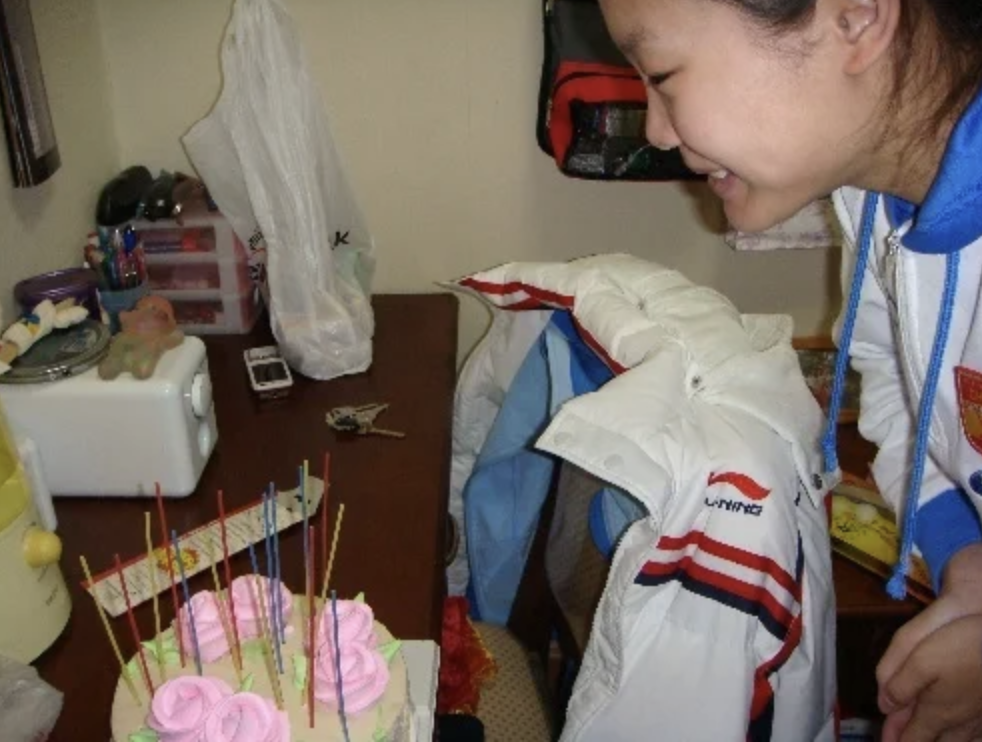
To be fair to Chinese officials, the internet of the early aughts was quite the place. Perhaps you recall trying to count the candles on Cheng Fei’s birthday cake in 2007.
Appendix C: A Translation of the Bruno Grandi Interview
THE AESTHETICS OF WOMEN’S GYMNASTICS TAKES CENTER STAGE
FIG President Bruno Grandi on changes to the Code, Chinese “robots,” and the impact of the financial crisis on the FIG
Interview conducted by Sandra Schmidt, Leon Magazine, 2009
[Sidebar:] Prof. Bruno Grandi: “What drives me is that we must make our sport comprehensible. We must bring the public, the spectators, the television audience on board.”
What moment at the Olympic Games in Beijing gave you the most pleasure, and what was your greatest frustration?
What gave me the most pleasure was that the competitions ran smoothly; we naturally still monitor everything, but fundamentally, the results were in order. It is always the same in gymnastics: one person likes this a little better, another likes that a little less, but on the whole, they were the right decisions.
What has always concerned me greatly — and this applies to Beijing too — is that people cannot follow our competitions. We are too complicated, too complex. I have tried to simplify the Code of Points so that one can say: here is the difficulty and here is the execution. In technical and practical terms that can work well, even if it is not yet perfect. The perfect Code, however, does not exist, because there can be no perfect code for judging the aesthetics of human movement.
The Code for men still prescribes ten elements per routine, but for women, it will be only eight. Shouldn’t the Codes be as uniform as possible?
We want women’s gymnastics to continue developing in an artistic direction, with the technical component — the difficulty component — having less influence on the final score. Eight elements is few, but that is precisely how the aesthetic moment is elevated. It will be better to concentrate on execution and the ten points awarded there. It will become more important to focus on, for example, the music, and thus to achieve a better aesthetic presentation. These were also the arguments of the presidents of the Technical Committee [Nelli Kim, ed.], and the Executive Committee stated at this point that it makes no sense to treat men and women in exactly the same way. For women, the aesthetic component is far more significant than for men. The Code is, in this sense, also an educational instrument — it points the way to where we want to go.
But won’t the routines — with only eight elements — frequently resemble one another very closely and function almost like compulsory exercises?
Even now, the routines are very similar, and reducing them by two elements will not change that much. The gymnasts should also concentrate on the musical and aesthetic component, and if there is no harmony between the construction of the routine and the music, a deduction is the consequence [CdP Art. 11.5: Deductions for artistic presentation — error: “background music” 0.5] — otherwise, one might as well just play some random birdsong in the background.
One more question about the Olympics. In a “President’s Letter” in October 2005, you spoke in general terms about state-sponsored falsification of identity data, including date-of-birth data, and claimed those days were a thing of the past. How do you view this now, following the investigations into the ages of the Chinese gymnasts?
I must acknowledge the official documents we had in front of us — I am not Interpol or the police. When I then establish that falsifications have occurred, then I can act. There were strong indications, certainly, but these investigations are not mine to conduct. I forwarded everything to the IOC, and the IOC conducted its investigations, and the information was the same. On what basis? We — on behalf of the IOC — had the birth certificates provided to us. The IOC gave us its results; we reviewed them and found nothing. If others find forged documents on the internet, they must prove legally that they are forged — that is not my responsibility. I respect the documents that the Chinese state provides me. What else am I supposed to do — declare war on China?
Perhaps the problem is actually a different one: these Chinese gymnasts delivered a nearly perfect performance both in execution and in difficulty…
No! The Chinese gymnasts were robots. From a geometric point of view, the movements were very well executed — but let me give you an example: compare the way Anastasia Liukin performs a single movement: with artistry. You can see how she almost stops time in order to complete a movement fully. The other is a geometrically perfect figure. But the aesthetic moment is something a Code can never fully capture — otherwise we would all be the same.
[…]
More on Age