Categories
1996 China Interviews & Profiles MAG

 Li Xiaoshuang’s Rise to the Pinnacle of World Gymnastics

Olympic all-around champion, world all-around champion, and one of China’s greatest athletes, Li Xiaoshuang was among the biggest stars in world gymnastics during the mid-1990s. Yet there is much about him that remains unfamiliar to English-language readers.

For starters, “Li Xiaoshuang” is not actually his given name. Born an identical twin, he was originally named Li Fenghua (李锋华). His older twin brother was Li Weihua (李卫华). Because almost no one could tell the boys apart, their first coach renamed them Dashuang (“Big Twin”) and Xiaoshuang (“Little Twin”), nicknames that eventually replaced their given names entirely. To Chinese readers, this is immediately apparent; to many English readers, it is not.

These two articles, published in Wenshi Chunqiu in 1998, tell the story behind that famous name. They begin not with Olympic medals but with Li’s childhood in rural Hubei, his remarkable relationship with his twin brother, and the coach who discovered the boys and devoted himself to their development. Along the way, they introduce a chatty, mischievous, and fiercely competitive young athlete whom the world came to know simply as “Little Twin.”
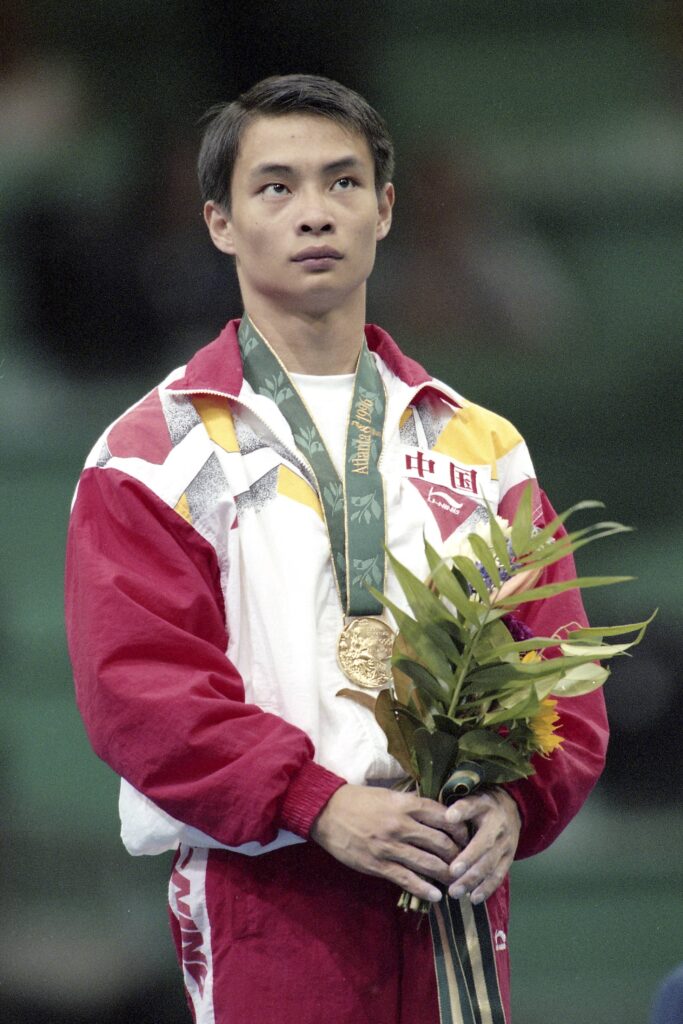
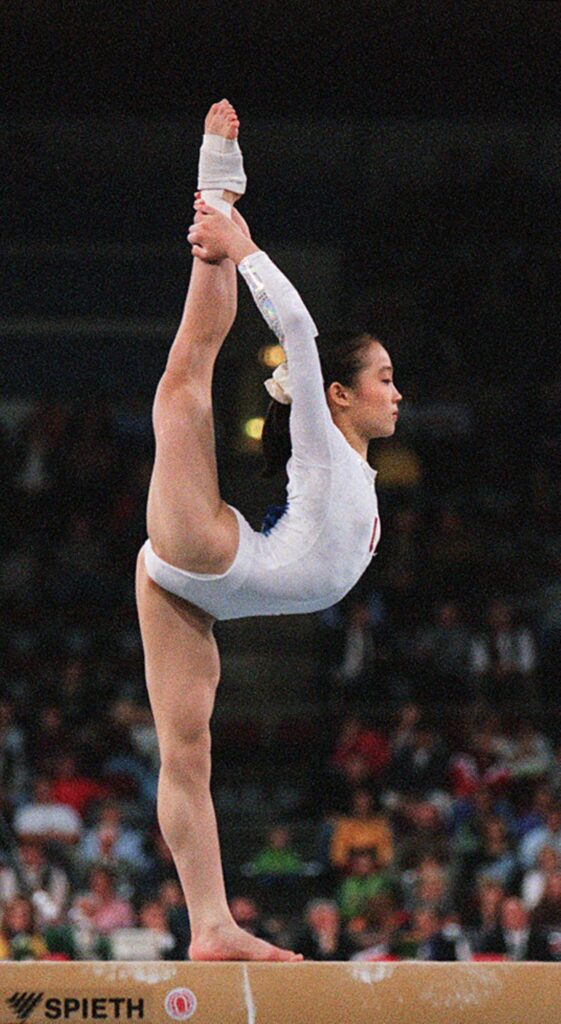
Li Xiaoshuang, 1996 Olympics, Copyright: imago/Sven Simon
Categories
1996 Age China WAG World Championships

1996: A Profile of Kui Yuanyuan – “10 Years of Tempering the Blade”

At the 1996 World Gymnastics Championships in San Juan, Puerto Rico, fifteen-year-old Kui Yuanyuan stepped onto the floor exercise as an unlikely candidate for gold. Not considered a core member of China’s women’s team, she had nonetheless turned heads in the semifinals with a second-place finish — and then, in the final, delivered a routine that would define her young career. The following profile, published in People’s Daily on April 22, 1996, captures that remarkable night through the eyes of staff reporter Miao Lu.

Kui Yuanyuan’s San Juan triumph was the beginning of a decorated international career. She would go on to help China claim the team bronze at the 1997 World Championships in Lausanne and earn individual bronze on balance beam at that same competition. She was also a member of the 2000 Olympic team that was stripped of its bronze medal.

But was she really 15 in 1996? The answer—drawn from the People’s Daily itself—is most likely no. Six months after describing her as 15 in San Juan, the same newspaper covered the 1996 National Championships, where Kui won the all-around, and referred to her as “not yet 15.” The contradiction is telling. With her birthday reportedly in June, an athlete who was “not yet 15” in October 1996 could not have been born in 1981. Which means she could not have been 15 at the World Championships in April or the Olympics in July—and could not have been 16 at the 1997 Worlds, either.

But was she still delightful to watch? Yes. So, enjoy these articles and videos of Kui.

Kui Yuanyuan, DTB Pokal, 1997
Categories
1996 Floor Music Olympics WAG

1996: The Floor Music of the Atlanta Olympics

A Big Trend in 1996: Americana. 

Just as there was a lot of flamenco music during an Olympics held in Spain, there was a fair amount of U.S. music, particularly from the American gymnasts and the Romanian gymnasts. 

Another Big Trend: Songs from movie soundtracks. 

The French team pulled from recent movies like The Mask and Basic Instinct. But there were songs from older movies, including Galieva’s Charlie Chaplin tribute and Marinescu’s music from the Italian film Investigation of a Citizen Above Suspicion.

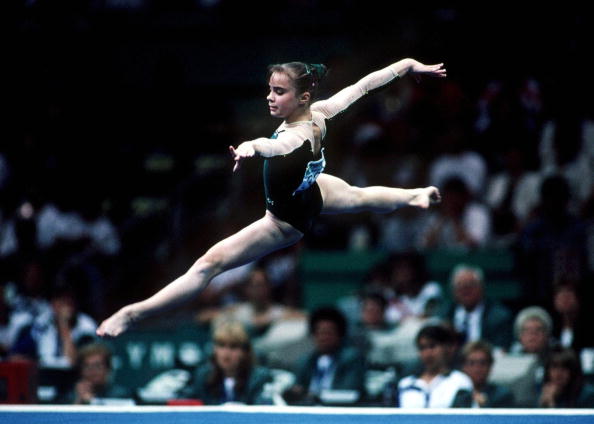
UNITED STATES – JULY 29: KUNSTTURNEN: BODEN/Frauen ATLANTA 1996 29.7.96, Lilia PODKPPAYEVA/UKR GOLD – MEDAILLE (Photo by Mark Sandten/Bongarts/Getty Images)