On the website for CCTV, Yang Yilin’s athlete profile no longer loads. The page it once pointed to is gone. But the underlying source code—the part of the page that tells a browser what to render—was never fully updated. Embedded in it, invisible to any reader who does not know how to look, is a birthdate: August 26, 1993.
Yang Yilin’s official birthdate is August 26, 1992. The difference of one year is not trivial. Under International Gymnastics Federation eligibility rules, a gymnast born in 1993 would have been too young to compete at the 2007 World Championships in Stuttgart and the 2008 Beijing Olympics. She competed at both. Her results stand in the FIG’s database, her eligibility certified, the case formally closed.
What remains is the discrepancy. The page is gone, but the data persists on the website for China’s official state broadcaster—an earlier value embedded in a system that was never fully overwritten.
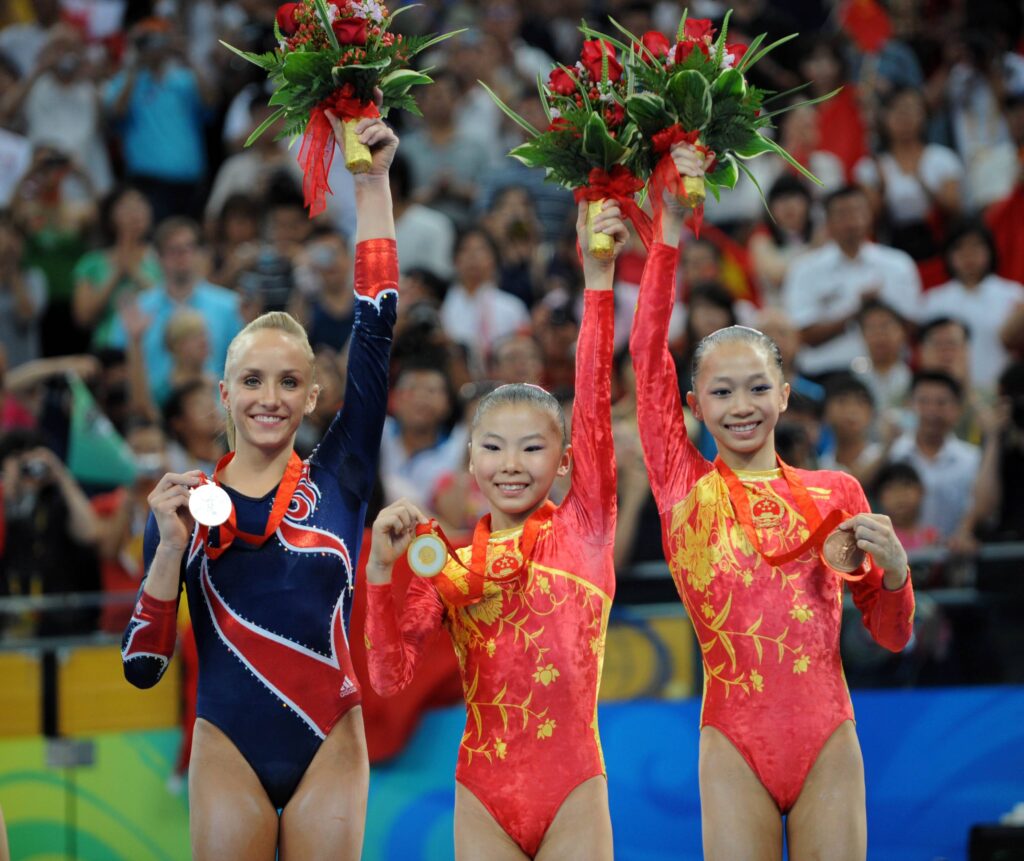
The question of Yang Yilin’s age did not begin with the source code, or even with her. It developed in the aftermath of a July 27, 2008, report by The New York Times, which highlighted discrepancies between official Chinese records and the passport birthdates of He Kexin and Jiang Yuyuan.
For He Kexin, the discrepancy was hard to ignore. Her passport, issued in February 2008, listed her birthdate as January 1, 1992 — making her sixteen and eligible. But multiple online registration lists told a different story. A 2007 national registry of Chinese gymnasts showed January 1, 1994. A January 2006 competition registration list from Chengdu showed the same date. Chinese newspaper profiles from earlier in 2008 had described her as fourteen years old.
Jiang Yuyuan’s case followed a similar pattern. Her passport, issued in March 2006, listed her birthdate as November 1, 1991. But in the autumn of 2006, she had told reporters her birth year was 1992, and a Zhejiang Province sports administration list of junior competitors included national identification numbers — into which birthdates are encoded — and Jiang’s number corresponded to October 1, 1993.
Chinese officials responded immediately, providing copies of passports showing both athletes were age-eligible. Zhang Hongliang of the Chinese Gymnastics Association suggested that “perhaps Chinese reporters and provincial sports authorities made mistakes in listing He’s and Jiang’s birth dates differently from the dates given on their passports.”
The FIG accepted those documents without hesitation. “We heard these rumors, and we immediately wrote to the Chinese gymnastics federation,” said Secretary General André Gueisbuhler. “They immediately sent a copy of the passport, showing the age, and everything is O.K. That’s all we can check.”
For the FIG, the matter was closed. For journalists, it was not. Juliet Macur of the New York Times went to the athletes’ village and photographed the Chinese gymnasts, inviting readers to judge for themselves.
Among gymnastics fans, the scrutiny continued as well. In the days after the report, discussions spread across Chinese message boards, where users debated the athletes’ appearances, questioned why some gymnasts had been singled out, and speculated about what made others—like Yang Yilin—escape similar scrutiny. On Baidu Tieba, one commenter wrote, “杨10因为长得高,这次没有被怀疑。不然更折腾了!” — “Yang Yilin wasn’t suspected this time because she’s tall. Otherwise, it would have been an even bigger fuss.” The remark was casual, even flippant, but it captured a broader awareness that the focus on He Kexin and Jiang Yuyuan might not tell the whole story.
Message boards are not journalistic evidence. But the question raised there—why Yang had been overlooked—would soon surface elsewhere. Within a week of the New York Times‘ initial report, reporters began to identify more concrete discrepancies in Yang Yilin’s records.
On August 3, the Associated Press reported thatYang Yilin had appeared on registration lists from 2004 through 2006 — hosted on the website of the General Administration of Sport of China — with a birthdate of August 26, 1993. That made her too young to compete in either Stuttgart or Beijing. On the 2007 list, her birthdate had changed to August 26, 1992, making her suddenly eligible for both the 2007 World Championships and the 2008 Olympics. The spreadsheets were saved and circulated widely — forwarded among journalists, preserved on foreign servers, and screenshot by Chinese expatriates who understood the files might not remain accessible for long.
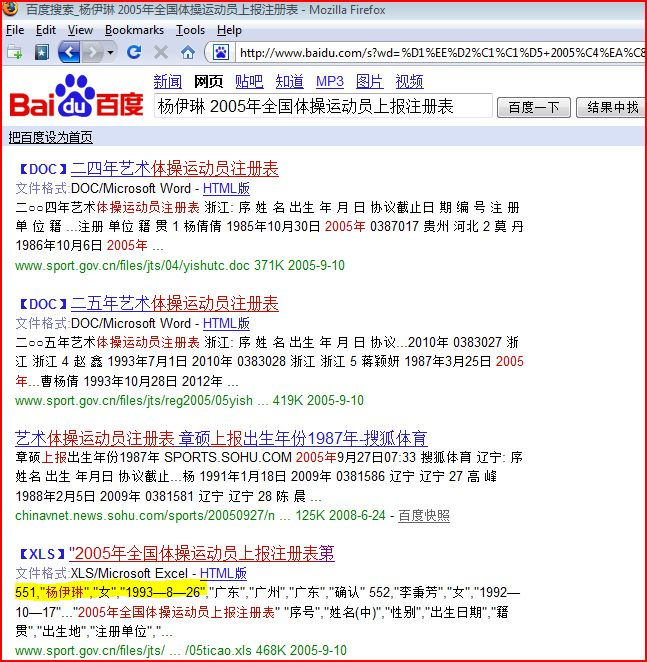
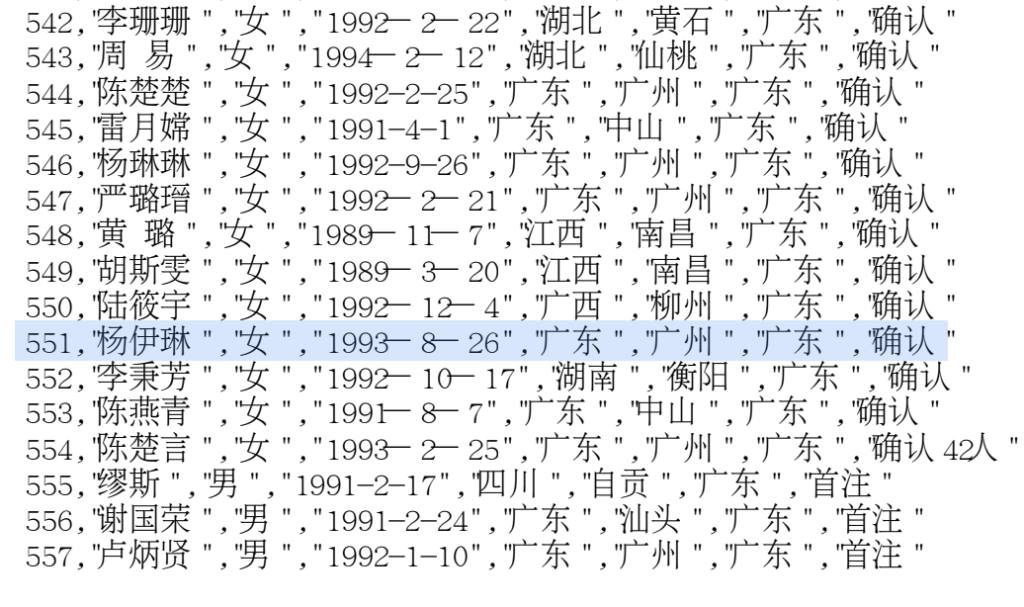
The highlighted text reads: 551, Yang Yilin, female, August 26, 1993, Guangdong, Guangzhou, Guangdong, Confirmed
On August 21, two days after the competition ended, the IOC asked the FIG to investigate further. Spokesperson Giselle Davies carefully framed the request: “We’ve asked the gymnastics federation to look into it further. If there is a question mark and we have a concern, which we do, we ask the governing body of any sport to look into it.” The timing made clear what those issues were: the accumulation of publicly circulating records — registries, cached files, archived articles. When files disappeared from Chinese websites, they were duplicated and mirrored elsewhere.
Wang Wei, Executive Vice President of the Beijing Organizing Committee, was unmoved: “The Chinese Olympic Committee has already provided information and evidence regarding the athletes, and these matters have been clarified. The athletes’ eligibility was strictly reviewed by both the relevant international federations and the Olympic registration authorities. If there had been any problems with the review, they would not have been allowed to compete.”
On October 1, the FIG announced its conclusion. After a five-week investigation, it declared that China’s women’s team at the Beijing Olympics had committed no age violations. Original passports, national ID cards, and household registration booklets had all been examined and found to be in order. (Though some in China suspected that those documents had been altered.)
“For the FIG, the age of the Chinese team is well documented and proven,” Gueisbuhler said. “Based on all the facts in our possession, we can indeed conclude that the Beijing Olympic Games case can be closed.”
No medals were stripped. No warnings were issued. No birthdates were changed. He Kexin’s, Jiang Yuyuan’s, and Yang Yilin’s official birthdates remain as recorded in the FIG’s database.
It was not the first time the FIG had closed a case this way. Twenty-seven years earlier, at the 1981 World Championships in Moscow, a foreign journalist confronted officials after the all-around awards ceremony with a start list from the USSR national championships. It showed that Olga Bicherova, who had just won the title, had not yet turned fourteen. The response was immediate: a typographical error.
During an interview with International Gymnast, FIG President Yuri Titov was unmoved. “We make the control with the passport, what else can we do?” The issue reached the IOC, which sent it back to the FIG with instructions to form a medical commission, and with time, the controversy faded.
In the early 1980s, evidence traveled only as far as the people who carried it.
In 2008, the institutional response was identical. The FIG accepted the passports; FIG President Bruno Grandi called the online documents “fake.” What had changed was not the logic but the documents themselves. They did not disappear when the competition ended.
Pages came down, registries were scrubbed, and links broke. The General Administration of Sport registration lists that had circulated so widely in August were gone from their original location. Profiles that had listed alternative birthdates returned no results. Much of it worked.
What it could not reach was what had already escaped — records mirrored on foreign servers, files saved by people who had anticipated exactly this — and what no one had thought to clean in the first place.
In 2014, Yang Yilin’s 1993 birthdate was circulating on Chinese social media, listed without comment in compilations of Olympic champions, apparently detached from any awareness of what it contradicted. The Baidu Zhidao thread remains accessible today.
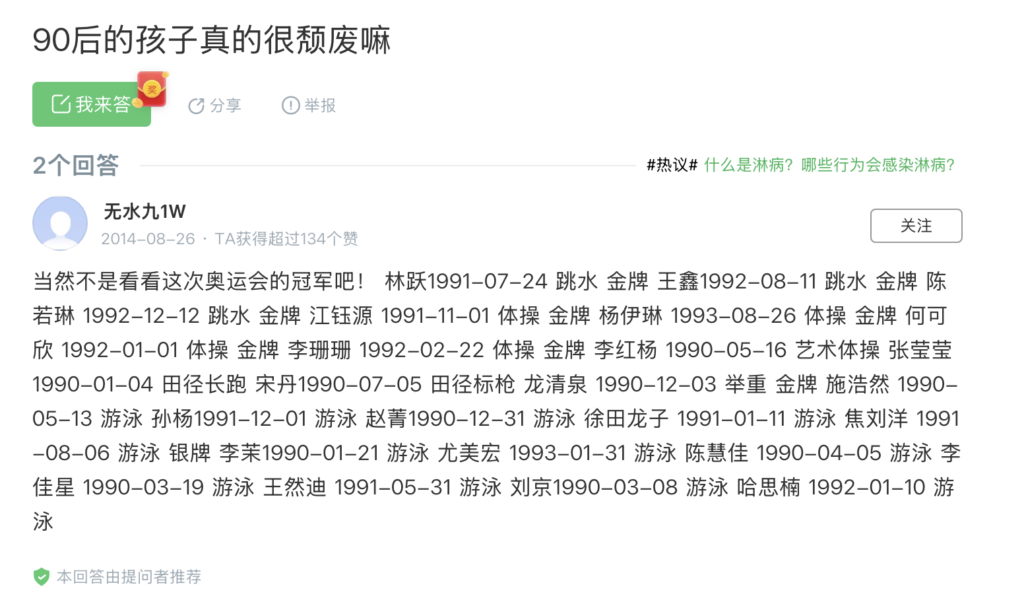
“Are kids born in the 1990s really that impressive?”
Answer (by user “Wushuijiu 1W”):
Of course, it’s not just about the champions from this Olympics!
[…]
Yang Yilin (1993-08-26) — Gymnastics, Gold
He Kexin (1992-01-01) — Gymnastics, Gold
Li Shanshan (1992-02-22) — Gymnastics, Gold
[…]
Archived here.
But the persistence of Yang Yilin’s alternative birthdate was not limited to user-generated spaces. Even within official media, traces remained—less visible, but no less revealing.
Nearly twenty years after Beijing, Yang Yilin’s athlete profile on CCTV’s website is no longer available. The page is gone. But the source code that once pointed to it was never updated. In a layer no casual reader would ever see, her birthdate remains embedded: August 26, 1993.
As CCTV reported in 2008, the case was closed. The data on its website did not follow.
Appendix A: Screenshots


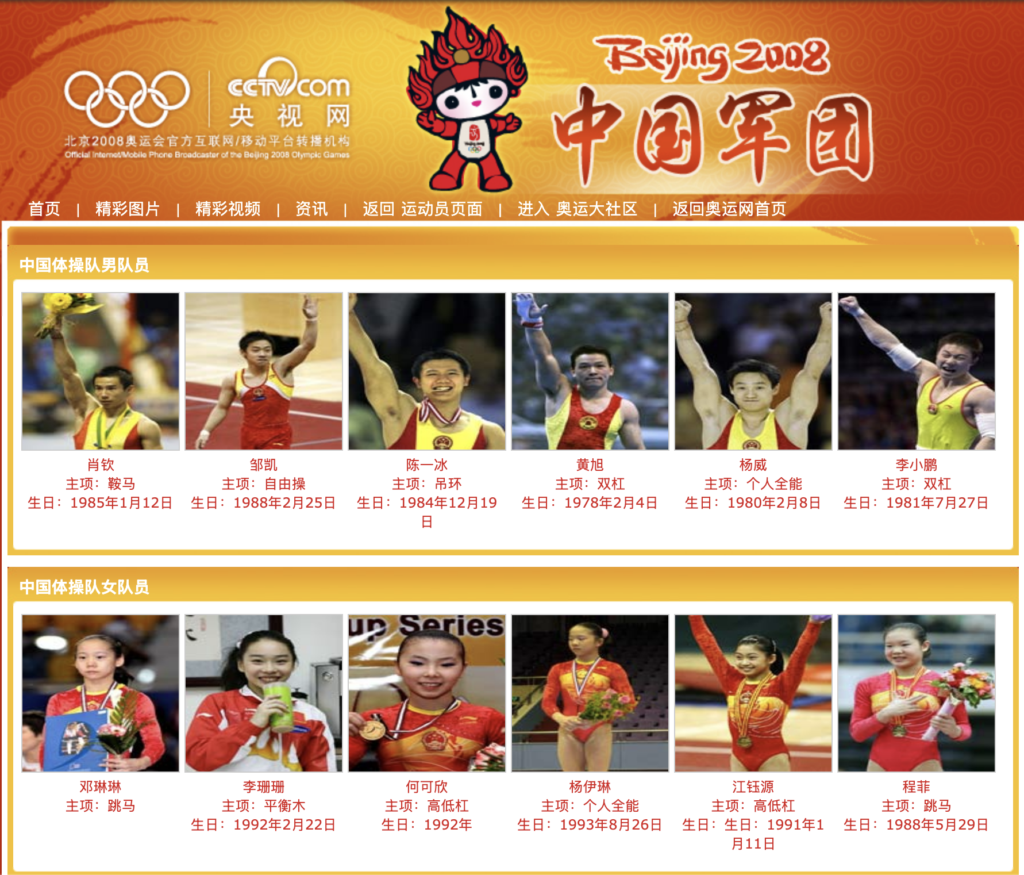
Based on the Wayback Machine’s history, this page was still available on January 1, 2009. Sometime between then and July 17, 2011, the page was taken down and replaced with the text: 该页面不存在!(The page does not exist!)
It took CCTV a while to realize that Yang Yilin’s birthdate was not supposed to be listed as August 26, 1993.
Appendix B: The Files
The 2005 registration.
The Source Code for CCTV’s website (as of May 15, 2026)
Her birthdate is in line 1176 of the code.
Appendix C: The Ambiguity of Yang Yilin’s Age
In 2008, several articles were notably imprecise about Yang Yilin’s age. One piece, for instance, described her as “six or seven” in 1999 — a formulation that could be read two ways. For a reader taking her official birth year of 1992 at face value, the range is simply explained by her August birthday: she would have been six before it and seven after. But for a reader alert to the age controversy, the same phrase carried a different implication — six pointing to a birth year of 1993, seven to 1992.
Guangdong Olympic Champion Yang Yilin: Called “China’s Khorkina” at Her International Debut
Yang YilinA native of Huadu, Guangdong, she won a gold medal in the women’s team gymnastics final on August 13th.
Early coaches: Kuang Jinxing (Guangzhou Huadu District Amateur Sports School), Yang Zhong (Guangzhou Weilun Sports School)
By Wu Yongjia, Shenzhen Press Group correspondent in Guangzhou
Discovering Raw Talent: She Thought She’d Been Selected to Dance
Yang Yilin was slight and slender, and unusually active from an early age. When her sports-loving father took her along to play football, she would entertain herself on the equipment beside the sports ground — and by around the age of two she could already climb a horizontal bar.
In 1999, Kuang Jinxing, a gymnastics coach at the Huadu District Amateur Sports School in Guangzhou, came to a kindergarten to scout for promising young talent. The six- or seven-year-old Yang Yilin was lively, cheerful, and physically exceptional, and quickly caught Kuang’s eye. “This child has a great physique and good strength, she’s pretty too — she’s excellent material.” After a brief initial assessment, Coach Kuang was quietly delighted and immediately got in touch with Yang Yilin’s parents.
Yang Yilin happily went home to tell her mother the exciting news, though at that young age she didn’t even know what “gymnastics” was. “She came home and told me: ‘Mum, I’ve been chosen to go and dance.'” It was only when her mother Deng Simei took her daughter to the sports school that she realized what her daughter had actually been selected for — a sport where a bunch of small children were crying through their stretches. Deng Simei described what she had seen to Yang Yilin’s father, Yang Dùzhèng, hoping he would cancel their daughter’s gymnastics training. But Yang Dùzhèng disagreed: “Whatever you say, gymnastics is still a sport!” And so Yang Yilin became a gymnastics student at the Huadu District Amateur Sports School in Guangzhou.
From that day on, she trained there for two hours every day. Because the training at that stage consisted of only the most basic gymnastics movements, and there were lots of other children to play with, Yang Yilin was very enthusiastic about gymnastics from the start, training diligently each day and making rapid progress.
Panning for Gold: She Immediately Climbed the Uneven Bars Out of Sheer Joy
Before long, the Huadu District Amateur Sports School put this promising youngster forward to the Guangzhou Weilun Sports School. Coach Yang Zhong looked Yang Yilin over carefully — well-proportioned and strong limbs, a slender and well-coordinated build, a pretty face, and a bright, energetic presence — and nodded his agreement to take her on. “What I didn’t expect was that the little girl gave a shout of delight and immediately climbed straight up onto the uneven bars.”
Though Yang Yilin was given to crying, she showed real toughness in front of her coaches. Yang Zhong recalled: “After the injury in April of this year, just before the World Cup in Germany, she was very worried it would affect her participation in the Olympics — she cried and cried on the phone. It was the first time I’d ever heard her cry.”
She gradually found her footing at Weilun Sports School, but for two years Yang Yilin did not enter a single major competition, and even at ordinary junior meets her best result was no higher than third place. “Can she really be cut out for this?” Her father Yang Dùzhèng began to have second thoughts about the choice he had made.
“With her ability, she definitely has a future — give her another chance.” Yang Zhong’s words kept Yang Dùzhèng going. Then, at the 13th Guangzhou Youth Games in 2001, Yang Yilin and her teammates took the team title together, and she placed third individually on the uneven bars. But at the Guangdong Provincial Games in December 2002, Yang Yilin — who had been expected to compete for Guangzhou — was relegated to the substitutes’ bench, and in the end didn’t get to compete at all. Yang Dùzhèng began to consider giving up again. Once more, Yang Zhong’s words restored his faith in his daughter: “Trust me — you have to keep going.”
Going International: China’s Own Khorkina
In September 2007, Yang Yilin was selected for the national team to compete at the World Gymnastics Championships in Stuttgart, Germany — her first time representing China at a major international competition. A European judge said in astonishment: “A new Khorkina has appeared in world gymnastics.” Her first coach Kuang Jinxing felt the same way: “She should have that potential. She had only been on the national team for a year and a half, and had already made astonishing progress. In technical terms, Yang Yilin and Khorkina do indeed share a number of things in common — both are tall and upright, both have their strengths in the individual all-around and on the uneven bars. Yang Yilin genuinely has the makings of the next Khorkina.”
“Her performance was completely on form — you could even say she surpassed herself a little, particularly on the uneven bars.” Speaking of Yang Yilin’s performance in the women’s all-around at these Olympics, her first coach Kuang Jinxing was full of praise. In his view, there is nothing to regret in the fact that his protégée did not win a gold medal in the individual events.
广东奥运冠军之杨伊琳:首战国际被称中国版霍尔金娜
http://2008.sina.com.cn 2008年08月26日15:24 深圳晚报
杨伊琳
广东花都人,在8月13日的体操女团决赛中获得金牌。
启蒙教练:邝锦星(广州花都区业余体校)、杨钟(广州市伟伦体校)
-深圳报业集团驻广州记者吴勇加
发现璞玉:以为自己被选中去跳舞
杨伊琳瘦瘦小小,从小就特别好动。喜爱体育的父亲去踢球带着她,她就在体育场一旁的体育器材上独自玩耍,才两岁左右就可以爬单杠了。
1999年,广州花都区业余体校体操教练邝锦星来幼儿园挑“好苗子”,年仅六七岁的杨伊琳活泼开朗,身体条件出众,很快引起了邝锦星的注意。“这个孩子身材、力量都很好,长相漂亮,是块好材料。”初步摸底后,邝教练心中暗喜,马上便与杨伊琳的家长取得联系。
杨伊琳乐呵呵地回家将喜讯告诉妈妈,年幼的她还甚至不知道什么是“体操”。“她回来告诉我,妈妈我被选中去跳舞了。”待到母亲邓四妹将女儿送到体校后才知道,原来女儿被选中要练的,是这个一堆小孩哭着压腿的体育项目。邓四妹将体校所见的情形讲给杨父杨杜正听,想让他取消孩子学体操的事,不料杨杜正却不赞成,“再怎么说,练体操也是从事体育嘛!”就这样,杨伊琳成为了广州市花都区业余体校的一名体操学员。
从那天起,她每天去练两个小时。因为只是些最基本的体操动作培训,还有众多的小朋友在一起玩,所以刚开始杨伊琳对体操非常感兴趣,每天训练都积极认真,进步较快。
沙里淘“金”:一高兴马上爬上高低杠
不久,花都区业余体校老师将这个苗子上报给了广州市伟伦体校。教练杨钟仔细端详杨伊琳:四肢匀称有力,身材修长协调,面容靓丽,精神饱满,便点头答应收下她。“没想到这小姑娘高兴地叫了一声,马上爬到高低杠上去了。”
爱哭的杨伊琳在教练面前却很坚强。杨钟回忆:“今年4月世界杯德国站比赛前的那次受伤,她很担心会影响参加奥运会,当时她在电话里哭个不停,这还是我第一次听见她哭呢。”
在伟伦体校逐渐步上正轨,但两年内,杨伊琳没参加过任何一项大赛,就连普通的少儿小比赛,她的最好成绩也不过第三。“难道她不是这块料?”杨杜正开始重新审视自己当初的选择。
“她条件这么好,肯定有前途,你再让她试试。”杨钟的话让杨杜正坚持下来。后来,在2001年的广州市第13届青少年运动会上,杨伊琳与队友们配合获得团体冠军,而她在高低杠上获得个人第三。可2002年12月的广东省运动会,原本计划代表广州市出战的杨伊琳被调整成了替补选手,后来连上场都没份。杨杜正又开始有了放弃的念头。杨钟的话再一次让杨杜正对女儿深信不疑:“相信我,一定要坚持!”
出征国际
成了中国的霍尔金娜
2007年9月,杨伊琳入选国家队出征德国斯图加特体操世锦赛,这是她第一次代表中国队出征世界大赛。当时一位欧洲裁判惊讶地说:“世界体坛出了新的霍尔金娜。”对此,邝锦星也有同感:“她应该有这个潜力。因为她加入国家队只不过是一年半的时间,已经有了突飞猛进的进步。从技术层面上说,杨伊琳和霍尔金娜的确有不少的共同点,例如身材都很修长挺拔,强项都是个人全能和高低杠。杨伊琳的确有成为下一个霍尔金娜的潜质。”
“发挥非常正常,应该说还有点超水准了,特别是在高低杠环节。”说起杨伊琳在本次奥运会女子体操全能比赛中的表现,启蒙教练邝锦星赞口不绝。在他看来,爱徒没有拿到个人比赛金牌并没有什么可以遗憾的。
Archived here.
In the next article, she is described as “not yet 16” on the eve of the Beijing Olympics and “not yet 14” at the 2006 National Championships — wording that is inherently ambiguous, since it could mean she was only days away from turning 16 or 14, or that she would not reach those ages until the following calendar year.
China’s Khorkina Emerges: Difficulty and Grace Combined, She Sets Her Sights on the All-Around Gold
July 27, 2008 · Oriental Sports Daily
Not yet sixteen, an age when many girls are still nestled in their mothers’ arms, one girl may very well become a new Olympic champion — that girl is Guangdong’s Yang Yilin, the new star of hope for China’s women’s team.
Only a little more than a year after joining the national team, she has already secured her footing among the formidable talent of China’s women’s gymnastics squad, and has earned one of the precious berths at the Beijing Olympics. This pretty young girl, not yet sixteen, has been hailed with astonishment as “China’s Khorkina.”
Yang Yilin’s gymnastics career is already the stuff of legend. At the 2006 National Gymnastics Championships in Wuxi, competing at nationals for the very first time, Yang Yilin got her first taste of a championship, stepping onto the podium alongside her teammates as women’s team champions — and she was not yet fourteen. Later that same year she was selected for the national team, becoming one of Beijing’s Olympic hopefuls. At the 2007 World Championships in Stuttgart, competing internationally for the first time, the fearless newcomer Yang Yilin claimed a bronze medal. Within a year, this rising star had become one of the contenders for the 2008 Beijing Olympics.
Yang Yilin’s distinguishing qualities are technical completeness, a solid foundation, and consistently high execution quality. On uneven bars in particular — an event on which she excels through her twisting skills — Yang Yilin possesses a routine with currently the highest D-score in the world, and has not compromised her execution quality in the slightest by raising the difficulty; her set consistently maintains an exceptionally high standard. On vault, floor exercise, and balance beam as well, she sustains high D-scores and execution quality across the board. Head coach Lu Shanzhen’s assessment of Yang Yilin: “The entire routine flows smoothly; her body lines are graceful; her saltos are open and extended; her connecting elements and twisting positions are beautiful.” In Lu Shanzhen’s eyes, Yang Yilin is Khorkina reborn: “She is well-rounded across all four events and has what it takes to go for the all-around gold. On bars especially — in both her physical appearance and the spirit of her movement — she resembles Khorkina. She has an ineffable quality, a gift for giving audiences a sense of beauty. She is the one most worth watching.”
At the Beijing Olympics now fast approaching, a powerful Chinese women’s gymnastics team will be capable of mounting a challenge for gold in all six individual events. Among those six individual golds in women’s gymnastics, the women’s individual all-around is the one fortress China has never captured — claiming that gold has been the dream of generations of gymnasts. We look forward to the possibility that this dream may be realized in this young girl.
Staff reporter: Che Li
中国版霍尔金娜横空出世 难度灵气兼具直指全能金牌
2008年07月27日09:27 东方体育日报
未满16岁,许多女孩还在妈妈的怀里撒娇,可是有一个女孩却很可能在这个年纪成为新的奥运冠军,这就是广东选手杨伊琳,中国女队新的希望之星。
进入国家队仅仅一年多的时间,就在高手如云的中国体操女队站稳了脚跟,并且获得了北京奥运会参赛名额中的宝贵一席,还未满16岁的漂亮小姑娘被惊叹为“中国的霍尔金娜”。
杨伊琳的体操生涯堪称传奇。2006年无锡的全国体操锦标赛上,第一次参加全国锦标赛的杨伊琳就品尝到了冠军的滋味,她和队友一起站上了女子团体冠军的领奖台,那时她还未满14岁。同年底,她入选国家队,成为了北京奥运会的希望之星。在接下来的2007斯图加特世界体操锦标赛中,第一次参加国际大赛的杨伊琳初生牛犊不怕虎,获得一枚铜牌。一年时间这颗希望之星已经成为2008年北京奥运会的竞争者之一。
杨伊琳的特点是技术全面,基本功扎实,动作的规格质量很高,尤其是高低杠,以转体见长的杨伊琳拥有一套目前世界上最高A分的动作,而且丝毫没有因为增加难度而降低完成质量,一直保持着高规格的成套动作。
另外,在跳马、自由体操和平衡木上,她也保持了很高的A分水平和完成质量。主教练陆善真对杨伊琳的评价是:“整个动作流畅、身体线条优美、空翻舒展、动作连接和转体姿势漂亮。”在陆善真的眼里,杨伊琳就是霍尔金娜的翻版:“她四个项目很全面,具备冲击全能金牌的实力,尤其是高低杠,无论是外形还是动作的神韵,都像霍尔金娜,有灵气,给人以美的享受,是最有看头的。”
在即将到来的北京奥运会上,实力强大的中国女子体操队将有能力向六个单项的金牌发起冲击,在女子体操的六枚单项金牌中,女子个人全能是唯一没有被中国队攻克的堡垒,夺取一块女子个人全能的金牌也是几代体操人的梦想,我们期待,这个梦想就很可能在这个年轻的女孩身上得到实现。
本报记者 车莉
Archived here.
More on Age