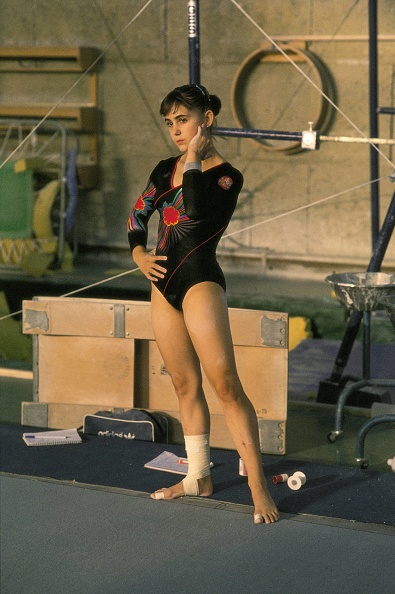
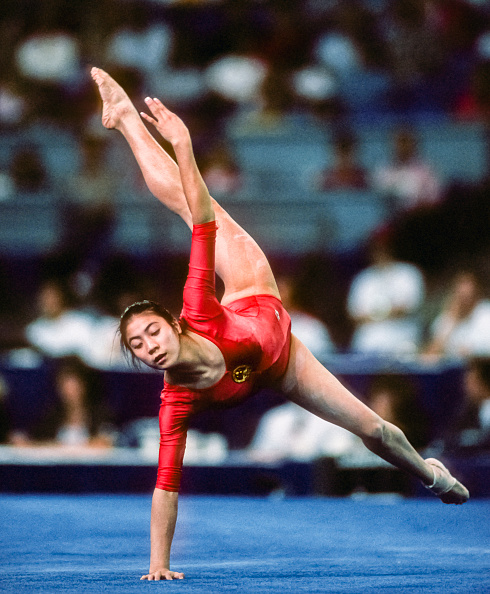
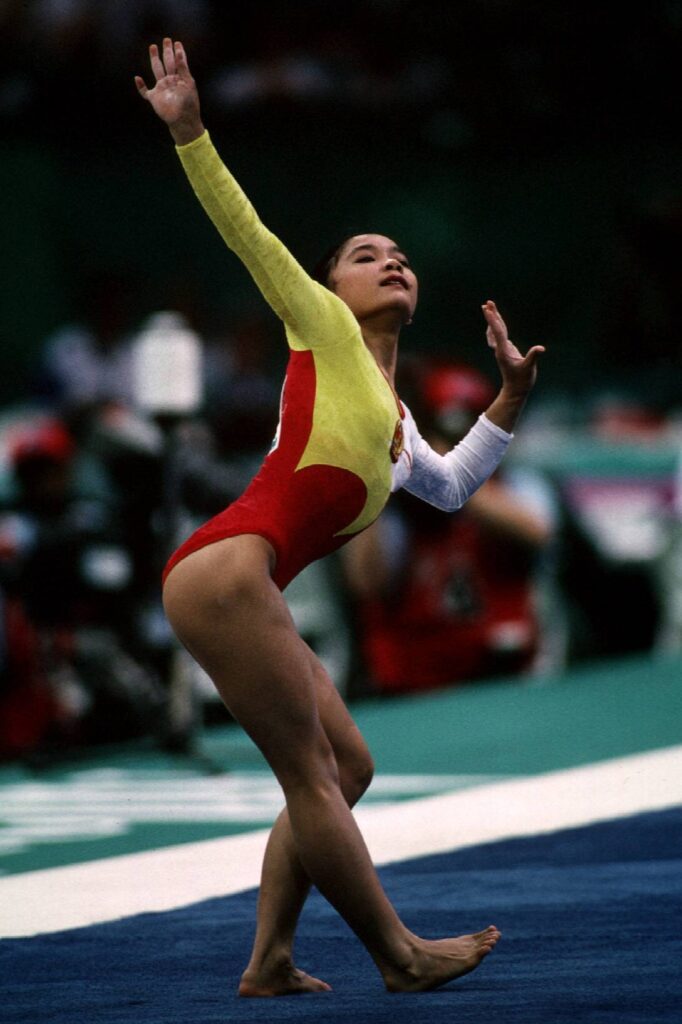
Tatiana Frolova had what Soviet journalists called “soft” gymnastics—a quality that made her stand out even among the technical virtuosos of the early 1980s. Blessed with “beautiful physical qualities,” her movements flowed with a natural grace that allowed her to combine power with lyrical expression. When she performed her floor exercise to Chopin’s “Impromptu,” she embodied a style reminiscent of an earlier generation—Kuchinskaya, Petrik, Karaseva—though with far greater difficulty.
She came from a working-class background in Bryansk, where her mother worked as a shop cashier and her father as a fitter at the city’s machine-building plant. Her coach, Vladimir Shishkin, was himself a former miner from Kemerovo who had moved west, married fellow coach Lyudmila Borisova, and formed a partnership that would produce one of the Soviet Union’s top gymnasts. Shishkin encouraged independent thinking in his pupil. Frolova, journalists noted, “liked to think things through herself” and engaged in deep analytical discussions with her coach.
When she burst onto the senior scene in April 1981 at the USSR Cup in Leningrad, her performance seemed to come from nowhere. She had placed eleventh at the 1980 junior championships; now she won silver behind Alla Mysnik and claimed vault gold. Josef Göhler, writing in International Gymnast, called it a “quantum leap.”
He noted that she had been born in 1967. Little did he know that Frolova wouldn’t just leap spots in the rankings; she would leap years, as well.
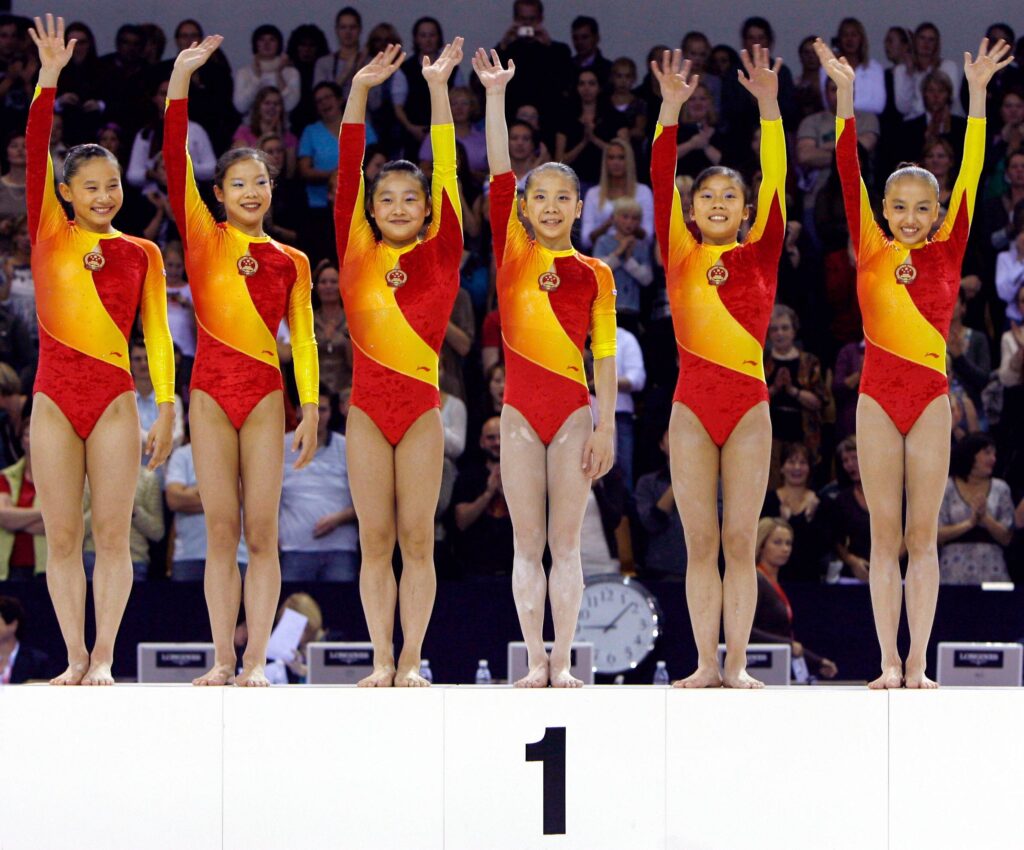
The Soviet team at the 1983 World Championships. From left to right: Bichukina, Mostepanova, Frolova, Shishova, Ilienko, Yurchenko
On October 30, 1983, the Budapest Sports Palace erupted as a Bulgarian gymnast in a red leotard stuck her first vault with textbook control. She shuffled back on her second vault, but her score was good enough. For the first time at a women’s World Championships, the Bulgarian anthem—Mila Rodino—played in the arena. Boriana Stoyanova had become the first Bulgarian woman ever to win a world championship gold medal in artistic gymnastics.
Back home, the press called it a zlatna nedelya, a golden Sunday. Bulgaria’s “golden account,” as one paper put it, had finally been opened.
The moment would be replayed, narrated, and commemorated for decades. What took longer to register was that Stoyanova was not 15 when she won gold.
Stoyanova on the front page of the October 31, 1983 edition of Naroden Sport, Bulgaria’s main sports newspaper.
Moscow, November 1981. A young gymnast takes her starting position at Luzhniki Sports Palace. When the opening notes of Rossini’s La Cenerentola (Cinderella) sound through the arena, fifteen-year-old Natalia Ilienko—so says her official biography—begins what Soviet journalists will soon call a “sparkling” performance, an “étude set to Rossini, in a minuet-gavotte style.”
The routine, choreographed by Natalia Alexandrovna Marakova, is “elegant, polished down to the smallest detail—to every movement of the flexible hands, to each glance—now languid, now playful.” When Ilienko completes her final tumbling pass, the crowd erupts. Moments later, she will stand on the podium as the floor world champion, one of her country’s newest gymnastics sensations.
But there was a problem with this triumph: Natalia Ilienko should never have competed at those World Championships.
How did people in the USSR feel about Olga Bicherova’s age falsification at the time?Did everyone simply accept that it was for the greater good of the Soviet Union?
In a 1987 essay published in Ogonyok under the provocative title “Don’t Lose the Person,” Tokarev returned to this episode not to litigate eligibility rules, but to imagine the human cost of the lie. He opened the article with the age-falsification case, identifying the gymnast only as “B” to spare her further harm. At the tournament’s final press conference, officials calmly insisted that the champion’s age complied with the rules. When a reporter produced not one but two start lists showing that she had not yet turned fourteen, officials dismissed them as “mistakes.” Only later did a federation insider admit to Tokarev that the documents had been deliberately swapped.
What haunted Tokarev was the position in which this placed the girl herself. Friends, relatives, classmates—everyone knew the truth. She was told that lying was necessary, that falsifying her age served “higher interests,” the honor and glory of the state. The burden of the deception, Tokarev suggested, fell not on officials or coaches, but on a child expected to live inside a public fiction.
(Tokarev would return to this case in 1989, writing again in Ogonyok and naming the gymnast explicitly as Olga Bicherova.)
The heart of Tokarev’s outrage, however, centers on the 1985 World Championships in Montreal. There, coach Vladimir Aksenov watched his protégé Olga Mostepanova—sitting in second place after two days of competition—be abruptly removed from the individual finals along with Irina Baraksanova. In their places, head coach Andrei Rodionenko inserted Oksana Omelianchik and Elena Shushunova, who would go on to share the gold medal. When Tokarev recounts this episode, he anticipates the response he knew so well: the medals were still Soviet medals, so what difference did it make whose names were attached to them?
Aksenov explained the reasoning to Tokarev in stark terms. Rodionenko, he said, was taking revenge. After Sovetskaya Rossiya (Soviet Russia) reported that people’s control inspectors at the Lake Krugloye training base had caught Rodionenko hoarding scarce food supplies meant for athletes, coaches were pressured to sign a letter denying the incident. Aksenov was the only one who refused. His punishment was swift: he was barred from accompanying his own athlete to Montreal, and Mostepanova was sacrificed in the finals as retribution. “Olga and Yurchenko hugged each other and burst into tears,” Aksenov recalled. “You could say that all the way back to Moscow, Olga’s eyes never dried.”
Tokarev recognizes that these individual injustices—the falsified documents, the stolen food, the vindictive substitutions—are symptoms of a deeper corruption. He challenges the notion that such deceptions serve “higher interests” or the “honor and glory of the state.” Through pointed examples, from the pentathlete Boris Onishchenko’s rigged épée at the 1976 Olympics to weightlifters caught trafficking anabolic steroids abroad, Tokarev argues that secrecy and complicity had rotted Soviet sport from within. The system demanded that witnesses sign false statements, that coaches look the other way, that everyone prioritize medals over human dignity. His closing plea is both moral and practical: sport cannot be reformed unless it embraces the same transparency and accountability reshaping Soviet society. “No medals,” he writes, “can replace for us what is most valuable—the person.”
What follows is a translation of Tokarev’s seminal essay.
On a November evening in 1981, in Moscow’s Olympic Stadium, a tiny gymnast with freckles and a turned-up nose stood atop the podium as the newly crowned world champion. Olga Bicherova had just pulled off a stunning upset, defeating the reigning Olympic champion with a perfect 10 on vault. She was, officials said, fifteen years old—barely. Her birthday had been October 26, just weeks earlier.
The American gymnasts watching from the stands didn’t believe it for a second. They had reason to be skeptical.
The year before, Bicherova had been left off the Soviet Olympic team because she was too young—not yet fourteen, the minimum age required at the time. Now, just over a year later, she had supposedly turned fifteen—just old enough to meet the new age requirements. The timeline was impossible unless someone had changed her birth year.
Among the brightest stars of Romanian gymnastics in the early 1980s, Lavinia Agache carved out a remarkable career despite controversies and heartbreak. Born February 11, 1968, in Onești—the same hospital that welcomed Nadia Comăneci into the world—Agache emerged as one of the era’s most decorated gymnasts, accumulating ten medals at major international competitions. Yet her path to prominence was shadowed from the start: Romanian officials altered her age, listing her birth year as 1966 instead of 1968. This deception allowed the thirteen-year-old Agache to compete illegally at the 1981 World Championships in Moscow, where she placed seventh all-around—two years before she would have been eligible under FIG’s minimum age of fifteen.
By 1983, Agache had established herself as a force in the sport, winning four medals at the European Championships in Gothenburg (including gold on balance beam and silver in the all-around) and three more at the World Championships in Budapest. She entered the 1984 Los Angeles Olympics as a legitimate contender for all-around gold, having finished third at the 1982 World Cup and consistently challenging teammate Ecaterina Szabó throughout their years training together at the Romanian national center in Deva.
Lavinia Agache’s gold-medal routine in 1983
First after compulsories, Agache’s Olympic dream disintegrated when a team doctor gave her a pill to combat jetlag. The next day, disoriented and lethargic, she fell four times during the optional round. The medication was legal, but its effects were devastating: Agache failed to qualify for the all-around final, watching from the sidelines as Szabó battled Mary Lou Retton for gold. What happened to Agache in Los Angeles—and the painful parallel she would later draw to Andreea Răducan’s 2000 Olympic ordeal, when a team doctor’s prescription cost the Romanian gymnast her all-around gold medal—forms a cautionary tale about the precarious intersection of medicine and athletic performance in elite gymnastics.
Here’s International Gymnast‘s piece on Agache from 2001, published before the age falsification scandal erupted in Romania in 2002.
In November 2003, Ziarul de Sibiu (The Sibiu Newspaper) published this profile of Mihaela Stănuleț, who won team silver at the 1983 World Championships and won Olympic gold with Romania’s team in Los Angeles in 1984. The article captures the harsh realities facing retired gymnasts in post-communist Romania. Even Olympic champions struggled to find work, were asked to return their competition tracksuits, and trained new generations in unheated gyms with decades-old equipment.
Like many of her contemporaries, Stănuleț had competed underage: born in 1967, she was only 14 when she placed fourth with Romania’s team at the 1981 World Championships in Moscow, a year before she would have been eligible under the age-15 minimum. By the time she reached the Olympics three years later, the system that had rushed her into elite competition as a child offered little in return for her gold medal—just 16,000 lei instead of the promised 100,000 and no car despite assurances. (Ecaterina Szabó made similar remarks about unfulfilled promises.) The article reveals how completely Romania’s gymnasts were discarded once their competitive value expired.
Oh, and there’s a story about Béla Károlyi’s dogs.
In the spring of 1990, just months after the Romanian Revolution, Ecaterina Szabó became one of the first Romanian gymnasts to publicly confirm what insiders had whispered about for years: the systematic age falsification of competitors by the Romanian Gymnastics Federation. Speaking to journalist Thomas Schreyer in Deva, Szabó revealed that she was born in 1968, not 1967 as her official gymnastics documents claimed—making her one year younger than the world had been told.
Despite the courage it took to come forward in a still-uncertain post-revolutionary Romania, Szabó’s confession was largely overlooked by the gymnastics community. Perhaps this was because the revelation didn’t retroactively change any of her competitive results. Even with her true birth year of 1968, Szabó would have been age-eligible for the 1983 World Championships in Budapest, where her international senior career began—she would have turned 15 that January, meeting the FIG’s minimum age requirement.
Ironically, this article would become a touchstone in gymnastics history not because of Szabó’s admission, but because of a single sentence about her close friend Daniela Silivaș. The article claimed Silivaș was “one year younger than previously stated,” and that news ricocheted around the globe. But the truth would prove even more dramatic: Silivaș was actually two years younger than her competitive age, making her age falsification far more consequential for the record books.
In this remarkable interview, Szabó discusses life after the Revolution, the mechanics of age falsification, and what it meant to be a gymnast in Ceaușescu’s Romania.
In 1970, the Women’s Technical Committee set the competitive age limit at 14, arguing that elite gymnastics was endangering children through uncontrolled, overly intensive training that treated them as “competitive animals” rather than developing athletes. Raising the minimum age was meant to ensure a slower, pedagogically sound progression that protected gymnasts’ physical and psychological development.
A decade later, the FIG voted again, this time raising the age limit to 15. Once more, the decision aimed to protect young girls. Here’s what the FIG Bulletin recorded at the time.
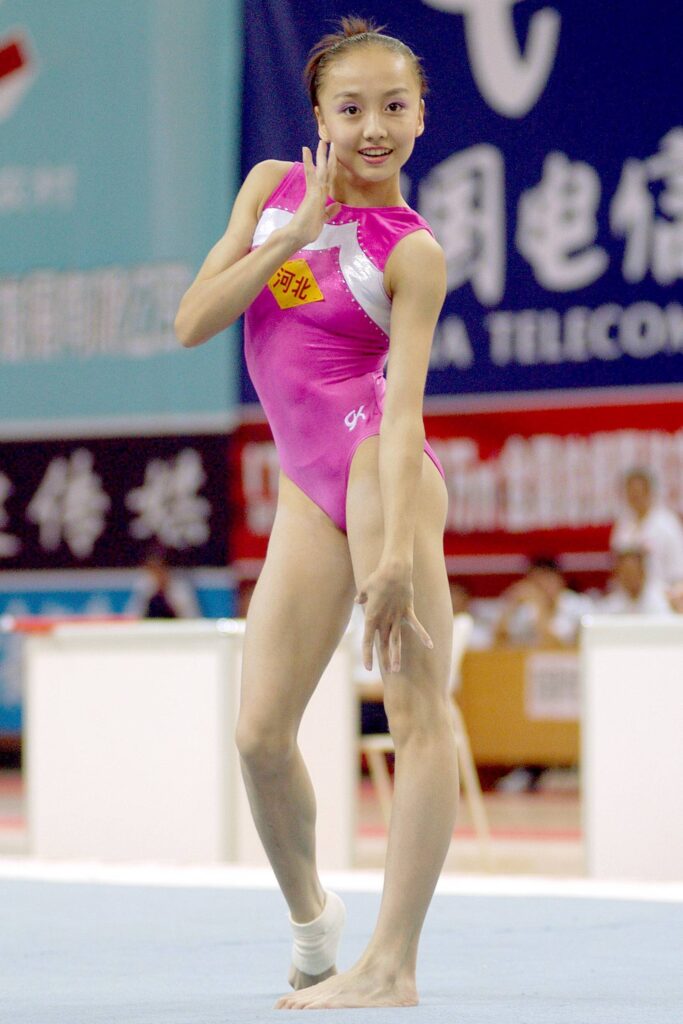
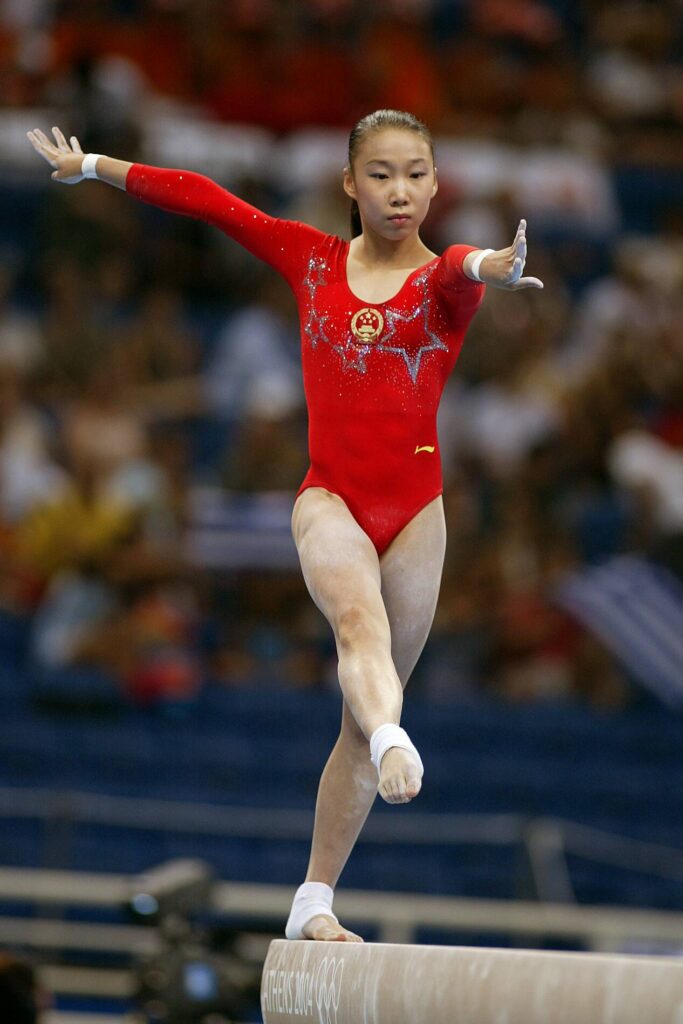
While gymnasts from North Korea and China have been penalized for age falsification, Romania never was. The logic was paradoxical: a consistent lie looked like the truth on paper.
“How should I put it… an uncaught thief is…”
Nicolae Vieru trailed off. It was early April of 2002, and the president of the Romanian Gymnastics Federation had just been confronted with a troubling contradiction: Gina Gogean’s birth certificate said 1978; her international competition records said 1977. Vieru, agitated, insisted he had never seen such a thing. When the ProSport journalist pressed—wasn’t this irregular?—Vieru laughed. “What sanctions could they take? I’m a vice president of the FIG, responsible for regulations and the statutes. There’s nothing in the rules about this.”
Weeks later, speaking on TVRM television, Vieru told a different story: “Altering ages was a worldwide practice. Just as others copied us, we copied others.”
Between those two statements, the evidence had piled up too rapidly to contain. Journalists located birth certificates in village archives. Former gymnasts confirmed that the documents submitted in their names did not match their actual birthdates. The denial collapsed within a month.
But what did that collapse mean? If passports submitted to international competitions had been accepted years earlier, did a confession in the press matter now? If the documents had been internally consistent when the FIG reviewed them, was there any mechanism to revisit what had already been approved?