Categories
1966 Books Czechoslovakia MAG World Championships

1966: Czechoslovak Coverage of the Golden World Championships in Dortmund

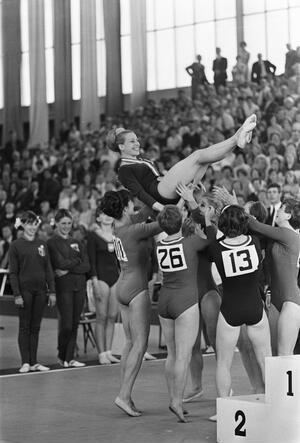
At the 1966 World Championships, the Czechoslovak women’s team finally defeated the Soviet team, and Čáslavská won the all-around title, defeating Kuchinskaya, who reportedly stated before the competition, “I will share the medals with Čáslavská!”

Stadión, a Czechoslovak sports magazine, dedicated several pages to the competition. The article’s tone was blunt in places. It criticized the complacency of the Czechoslovak men’s team, as well as the judges during the women’s event finals and Villancher’s interventions in the judging.

Note: Berthe Villancher, the President of the Women’s Technical Committee, was known for her interventions. For example, she intervened during Čáslavská’s beam routine at the 1968 Olympics and during Tourischeva’s beam routine at the 1969 European Championships.

It also provided interesting tidbits of information. For example, there were spies at the competitions in Czechoslovakia before the World Championships; the Czechoslovak pianist may have been the key to victory; and the Czechoslovak gymnasts’ shoes were believed to have magical powers.

Categories
1958 1960 1962 1964 1966 Books MAG USSR

Shakhlin on His Career from the 1958 Worlds through the 1966 Worlds

In the penultimate chapter of his autobiography, Boris Shakhlin takes us from the 1958 World Championships in Moscow to the 1966 World Championships in Dortmund. Along the way, he gives us a glimpse into his tactics as a competitor — ways that he and his teammates tried to throw their competitors off their game. He also shares little tidbits of information. For example, did you know that Soviet athletes received one cake for each gold medal that they won?

Here’s a translation of the fourth chapter of Shakhlin’s book.

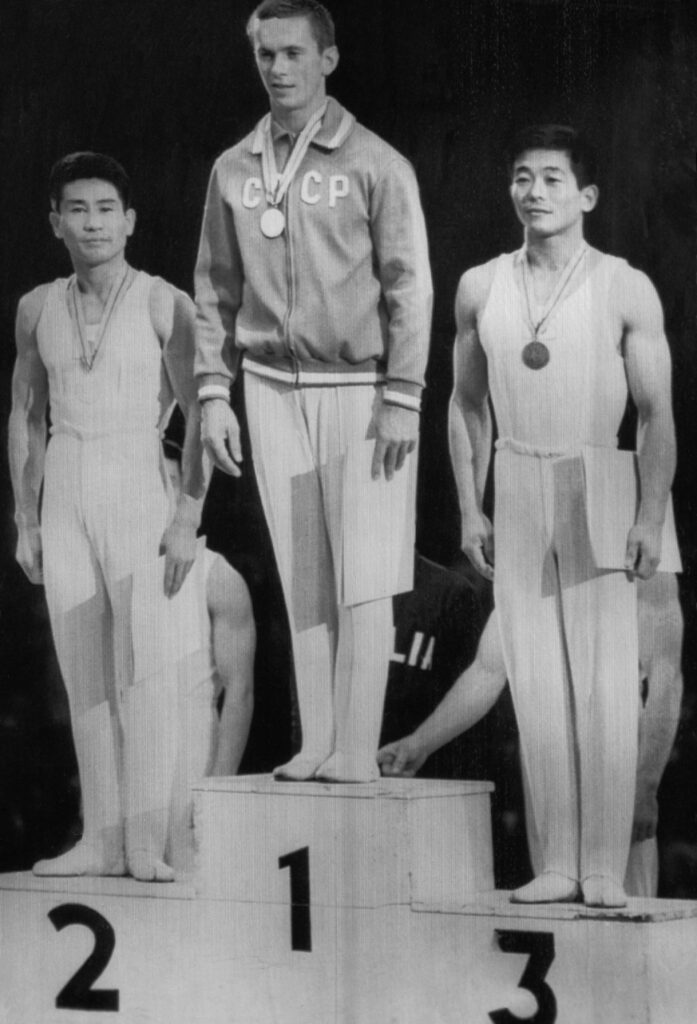
Left-right: Takashi Ono, Yuri Titov, Boris Shakhlin at the 1960 Olympics . 1960. Comitato Olimpico Nazionale Italiano.
Categories
1954 1955 1956 Books MAG USSR

Shakhlin on the 1954 Worlds, 1955 European Cup, and the 1956 Olympics

In the third chapter of My Gymnastics, Boris Shakhlin recalls his move to Kyiv, as well as his participation in the 1954 World Championships, the 1955 Cup of Europe, and the 1956 Olympics. Along the way, he tells some interesting stories:

  • How Yuri Titov learned to sing songs while doing pommel horse
  • How Viktor Chukarin survived a concentration camp during World War II
  • How the gymnasts burned their hands on high bar during the 1954 World Championships in the hot Italian sun
  • How he got the nickname the Russian Bear
  • How the all-around gold medal at the 1955 European Cup had a gymnast’s name pre-engraved on it (and it wasn’t his name)
  • How judging started during podium training — not on the first day of competition.
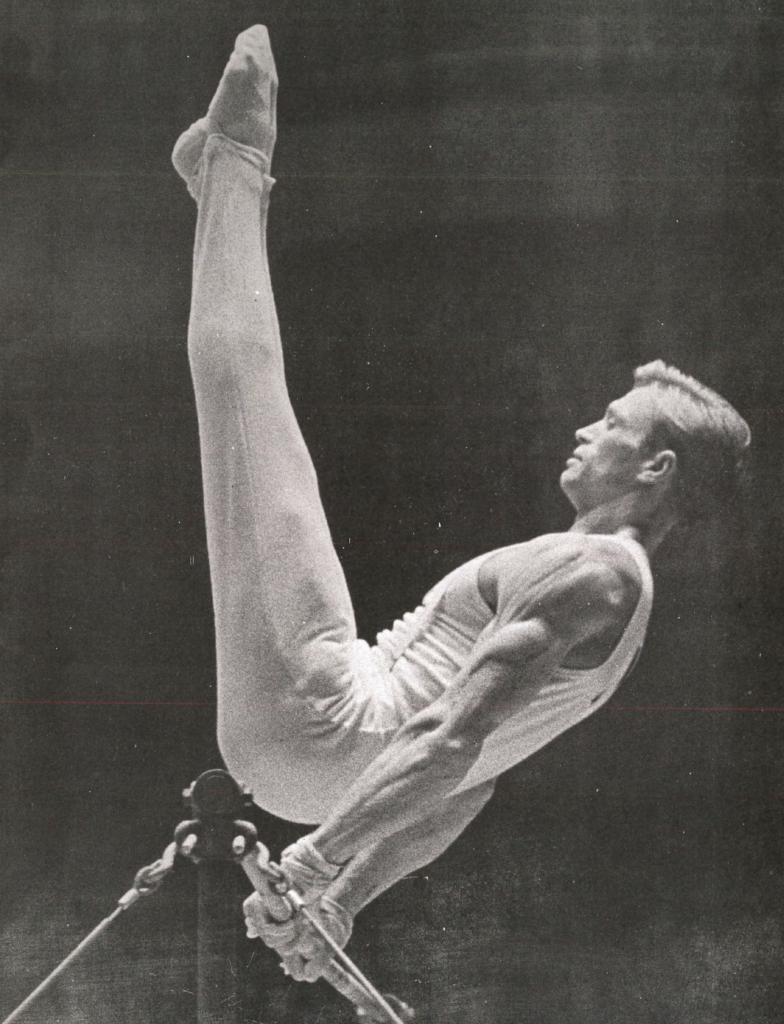
Shakhlin at the 1964 Olympic Games, source: Modern Gymnast
Categories
Books MAG USSR

Shakhlin on His Early Years in Gymnastics in “My Gymnastics”

In 1973, Boris Shakhlin published his autobiography titled My Gymnastics. It is a blend of genres: simultaneously an autobiography, an advice column, and a history of Soviet men’s gymnastics.

In the first two chapters of his book, he recalls his start in gymnastics, being orphaned after the death of his parents, his tiny gym with a ceiling so low that they had to bend their knees to do giants, his journey to becoming a Master of Sport, and, of course, sneaking into the gym to train vault without his coaches. (Čáslavská snuck into her gym, too!)

What follows is a translation of the first two chapters of his book…

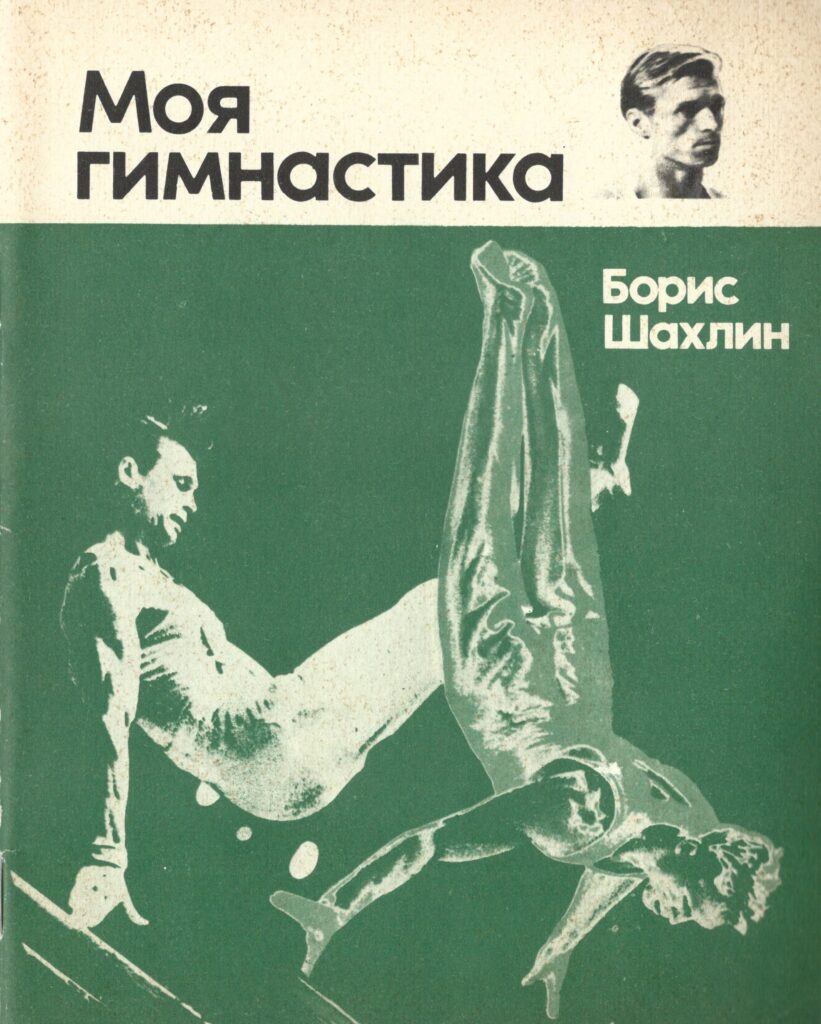
The cover of Shakhlin’s autobiography
Categories
1965 1967 Books Czechoslovakia European Championships

Čáslavská Remembers the 1967 Euros in “The Road to Olympus”

After Čáslavská’s disappointment in her performance in Dortmund, she debated if she should take a break from competing. Perhaps she had become too familiar to the judges, one coach suggested. (At one point in this section, Čáslavská recalls how the overly familiar Latynina was ignored during a press conference with Larisa Petrik in 1965.)

To make gymnastics exciting again, she and her coach Matlochová reworked all her routines, adding new elements to every routine. They made practice fun, with Matlochová riding a broom and trying to distract Čáslavská during her beam routines. They set her routines and training cues to music.

Čáslavská went on to compete at the 1967 European Championships. But Čáslavská had her doubts at the beginning of the competition. After a rough bar routine during the first rotation and an exceptional performance by Kuchinskaya on beam, Čáslavská was unsure if she would be able to defend her title. But right before beam, one of her superstitions happened. Someone broke a glass, and she had her lucky shards of glass. 

In the end, she became the only gymnast in the history of the European Championships to sweep all five events twice. She even scored two perfect 10.0s during the event finals.

Another interesting tidbit: For someone who ended up on top of the podium many times, Čáslavská disliked being on top of the podium. It made her feel awkward. 

So, with no further ado, here’s how Čáslavská recalls the 1967 European Championships in her autobiography from 1972.

Note: You can read more about the 1967 European Championships here and here.

European gymnastics championships, Vera Caslavska being jockeyed, May 28, 1967, championships, gymnastics, The Netherlands
Categories
1966 Books Czechoslovakia WAG World Championships

Čáslavská’s Reaction to the 1966 Worlds in “The Road to Olympus”

Even though Čáslavská won the all-around and vault titles, and even though the Czechoslovak team defeated the Soviet team, the 1966 World Championships were still a low point for her — one that she hardly remembers. When she returned home from the competition, she received many letters, some of which were hate mail.

What follows is a translation of The Road to Olympus (Cesta na Olymp), Čáslavská’s 1972 autobiography. Here’s how she remembers Dortmund…

Note: You can read the main article on the 1966 World Championships here.

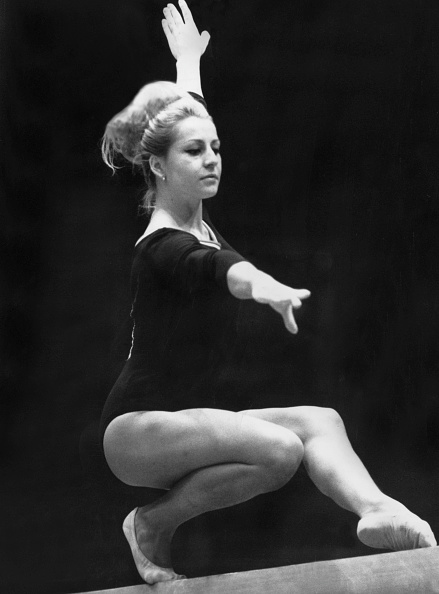
(GERMANY OUT) Die tschechische Kunstturnerin Vera Caslavska auf dem Schwebebalken, aufgenommen bei den Kunstturn-Weltmeisterschaften in Dortmund am 24.09.66. . (Photo by Schirner/ullstein bild via Getty Images)
Categories
1958 Books Czechoslovakia WAG World Championships

Čáslavská’s Early Years in “The Road to Olympus”

In 1972, Věra Čáslavská published her autobiography, The Road to Olympus (Cesta na Olymp). It provides a detailed recounting of her early days through the 1968 Olympics in Mexico City.

As a child, Čáslavská was a mischievous and funny child. Though a performer at heart, she struggled with stage fright until her mother helped her work through it, and as an adult, she came to see it as an asset. 

Čáslavská started with ballet, then added ice skating, and finally found gymnastics. Initially, she trained under Czechoslovak gymnastics legend Eva Bosáková, and when Bosáková was away with the national team, Čáslavská used to sneak into the gym to train. Given her relationship with Bosáková, Čáslavská found it difficult to beat her mentor.

From the start, the international crowd loved Čáslavská. At the age of 16, during her first World Championships in 1958, Čáslavská wowed the audience in Moscow — so much so that the public demanded a performance by Čáslavská, even though she didn’t make the floor finals.

Below, I’ve translated sections of Čáslavská’s autobiography, tracing her early years in sports through to her first World Championships in Moscow in 1958.

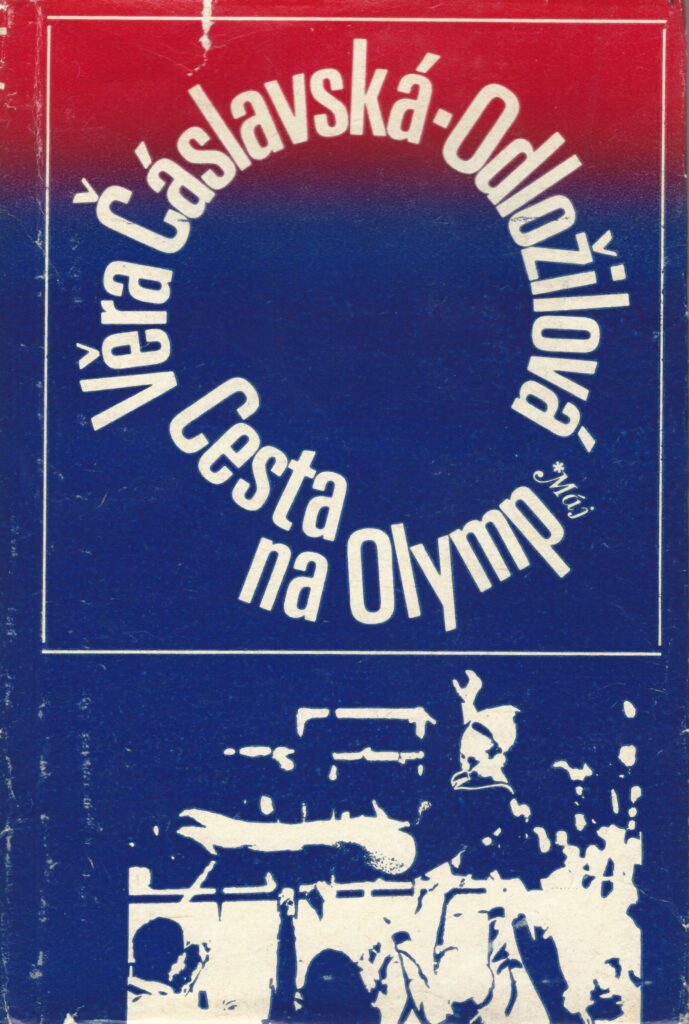
The cover of Čáslavská’s autobiography
Categories
Books Japan MAG

Kato Sawao Was a “Secret Gymnast” When He Started the Sport

Kato Sawao, the 1968 and 1972 Olympic gold medalist in the all-around, didn’t set out to become a gymnast. In fact, he originally wanted to be a baseball player. But his physical education teacher saw potential in him, and that’s how he became a “secret gymnast” who participated in gymnastics without telling his parents. 

In his autobiography, The Path of Beautiful Gymnastics: The Story of Kato Sawao (美しい体操の軌跡加藤沢男物語), Kato recounts his start in gymnastics. Below, I’ve translated and woven together a few chapters of his book to tell that story.

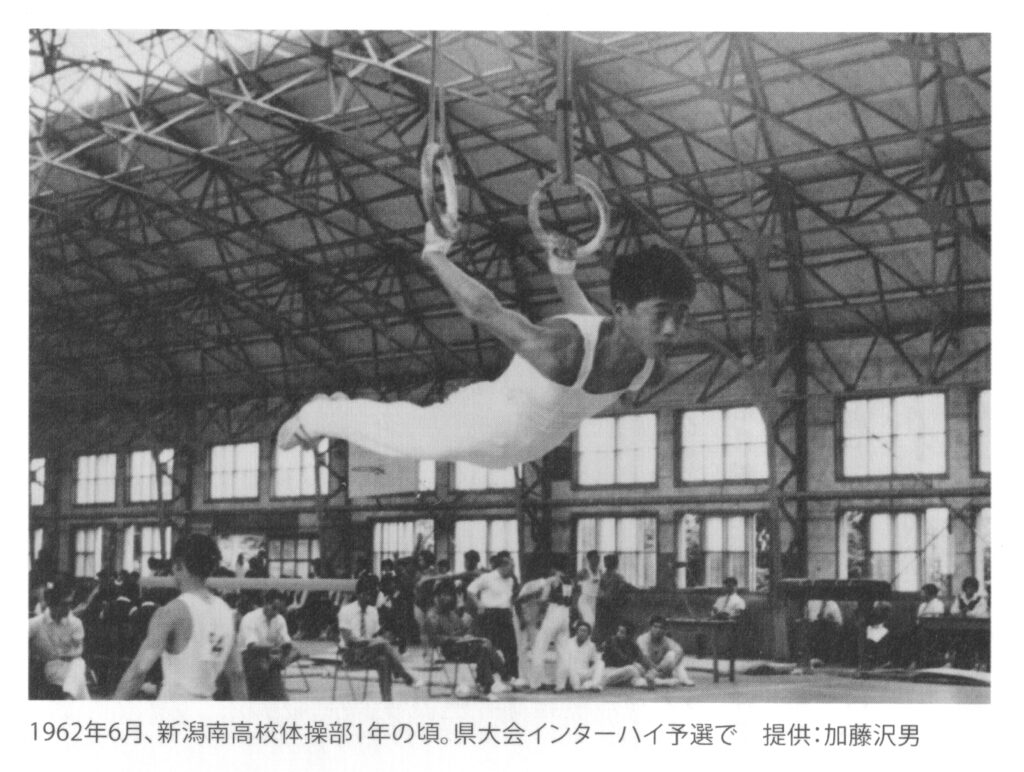
The caption reads: June 1962, around the time of the first year of the Niigata Minami High School gymnastics club. Prefectural tournament inter-high school preliminaries
Categories
1970 Books USSR

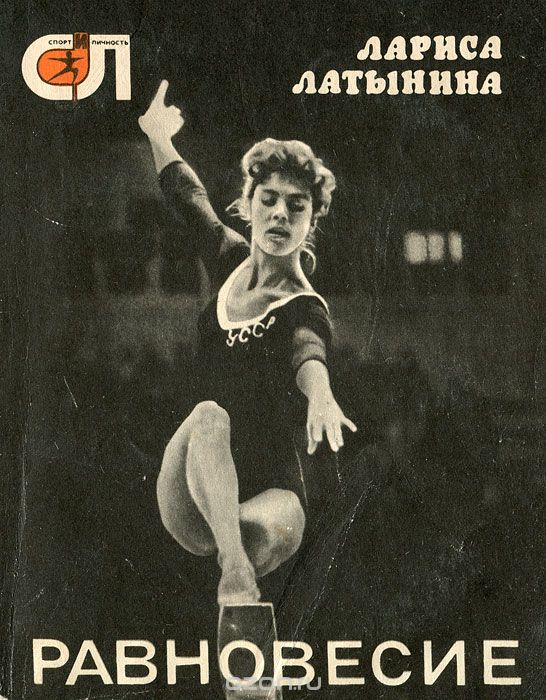
1970: A Book Review of Latynina’s Autobiography, Balance

In 1970, four years after her last World Championships, Latynina published her autobiography titled Balance. The book is somewhat meandering, but it captures Latynina’s mentality as a gymnast and as a coach.

What follows is a translation of a book review, as well as a few quotes from the book itself.