Categories
2001 Age Interviews & Profiles Romania WAG

2001: A Profile of Lavinia Agache – “Time on Her Side”

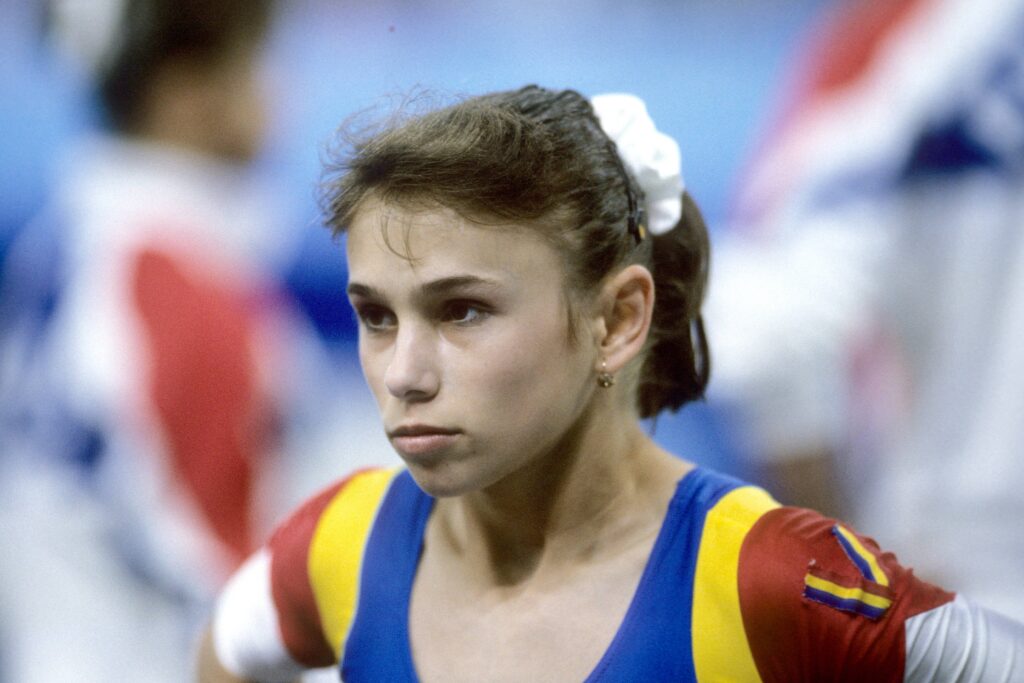
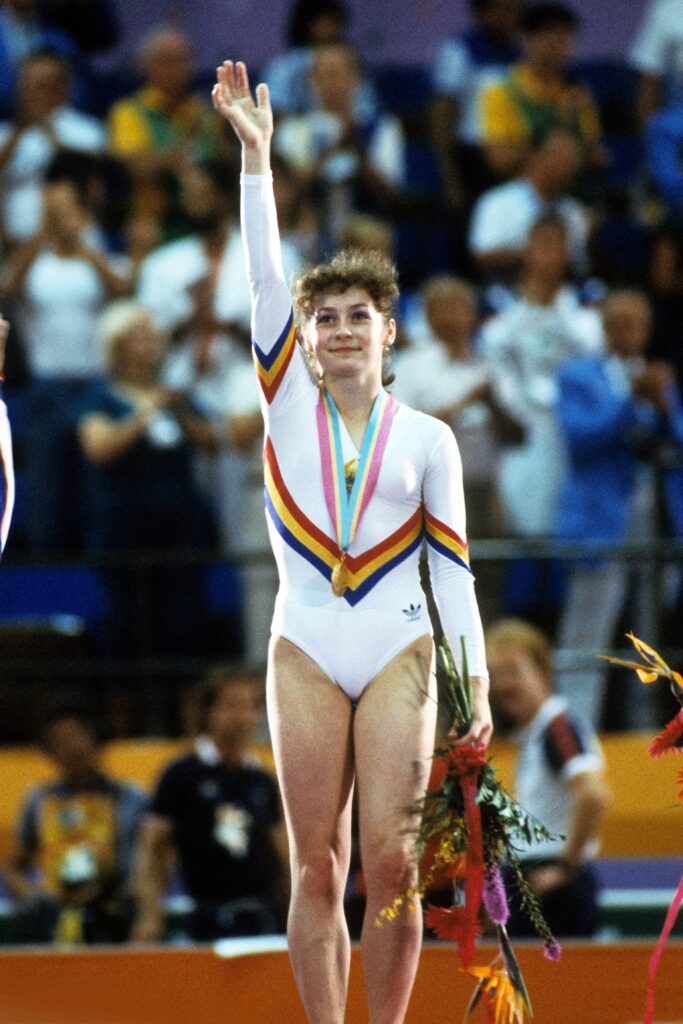
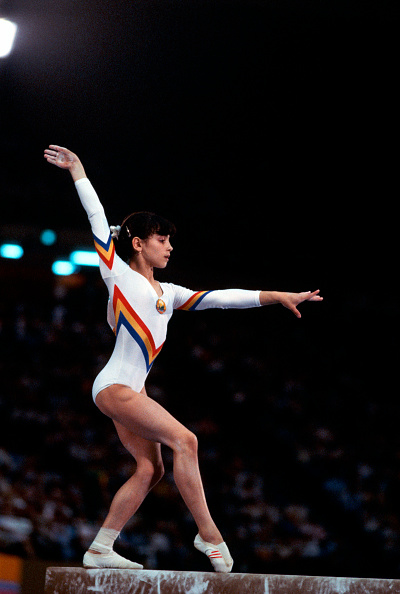
Among the brightest stars of Romanian gymnastics in the early 1980s, Lavinia Agache carved out a remarkable career despite controversies and heartbreak. Born February 11, 1968, in Onești—the same hospital that welcomed Nadia Comăneci into the world—Agache emerged as one of the era’s most decorated gymnasts, accumulating ten medals at major international competitions. Yet her path to prominence was shadowed from the start: Romanian officials altered her age, listing her birth year as 1966 instead of 1968. This deception allowed the thirteen-year-old Agache to compete illegally at the 1981 World Championships in Moscow, where she placed seventh all-around—two years before she would have been eligible under FIG’s minimum age of fifteen.

By 1983, Agache had established herself as a force in the sport, winning four medals at the European Championships in Gothenburg (including gold on balance beam and silver in the all-around) and three more at the World Championships in Budapest. She entered the 1984 Los Angeles Olympics as a legitimate contender for all-around gold, having finished third at the 1982 World Cup and consistently challenging teammate Ecaterina Szabó throughout their years training together at the Romanian national center in Deva.

Lavinia Agache’s gold-medal routine in 1983

First after compulsories, Agache’s Olympic dream disintegrated when a team doctor gave her a pill to combat jetlag. The next day, disoriented and lethargic, she fell four times during the optional round. The medication was legal, but its effects were devastating: Agache failed to qualify for the all-around final, watching from the sidelines as Szabó battled Mary Lou Retton for gold. What happened to Agache in Los Angeles—and the painful parallel she would later draw to Andreea Răducan’s 2000 Olympic ordeal, when a team doctor’s prescription cost the Romanian gymnast her all-around gold medal—forms a cautionary tale about the precarious intersection of medicine and athletic performance in elite gymnastics.​​​​​​​​​​​​​​​​

Here’s International Gymnast‘s piece on Agache from 2001, published before the age falsification scandal erupted in Romania in 2002.

Lavinia Agache, 1984
Categories
2003 Age Interviews & Profiles Romania WAG

2003: A Profile of Mihaela Stănuleț – “The Olympic Champion Is Freezing at the Sports School Club”

In November 2003, Ziarul de Sibiu (The Sibiu Newspaper) published this profile of Mihaela Stănuleț, who won team silver at the 1983 World Championships and won Olympic gold with Romania’s team in Los Angeles in 1984. The article captures the harsh realities facing retired gymnasts in post-communist Romania. Even Olympic champions struggled to find work, were asked to return their competition tracksuits, and trained new generations in unheated gyms with decades-old equipment.

Like many of her contemporaries, Stănuleț had competed underage: born in 1967, she was only 14 when she placed fourth with Romania’s team at the 1981 World Championships in Moscow, a year before she would have been eligible under the age-15 minimum. By the time she reached the Olympics three years later, the system that had rushed her into elite competition as a child offered little in return for her gold medal—just 16,000 lei instead of the promised 100,000 and no car despite assurances. (Ecaterina Szabó made similar remarks about unfulfilled promises.) The article reveals how completely Romania’s gymnasts were discarded once their competitive value expired.

Oh, and there’s a story about Béla Károlyi’s dogs.

Categories
1990 Interviews & Profiles Romania WAG

1990: Ecaterina Szabó Looks Back on Her Career

This lengthy profile of Ecaterina Szabó, published in Képes Sport (Sport in Pictures) in May 1990, offers a detailed firsthand account of life in Romanian gymnastics during the late 1970s and 1980s. The article, based on interviews conducted by Levente Deák for Romániai Magyar Szó (The Hungarian Voice of Romania), traces Szabo’s journey from a small village in Transylvania to Olympic glory at the 1984 Los Angeles Games, where she won four gold medals.

Notably, the article confirms Szabo’s actual birth date as January 22, 1968—making her 16 years old at the time of her Olympic triumph, not the older age sometimes claimed in contemporary sources. The narrative provides extensive detail about the grueling training regime at the Karolyi gymnastics school: wake-up calls at 6 AM, training sessions lasting until 10 PM as punishment, mandatory afternoon naps, and a schedule that prioritized gymnastics over traditional schooling.

As you’ll see, compared to today’s top gymnasts, Szabó competed non-stop, traveling to a total of 70 countries. It’s no wonder that, by the time the World Championships in 1985 rolled around, she “was simply exhausted.”

As was often the case at that time, gymnasts’ biographies were woven together with Béla Károlyi’s story. Throughout the piece, the writer includes several parenthetical statements that paint Béla Károlyi in a remarkably positive light, characterizing him as a dedicated coach who made tactical decisions in the best interests of his gymnasts.

However, this generous portrayal omits crucial context that we know today: before the Károlyis were transferred to General School No. 7 in Deva, the Romanian government’s patience with the Károlyis was wearing dangerously thin. In March 1977, Teodora Ungureanu fled during training in Cluj, boarding a train to Onești. The Securitate intercepted her at the Târgu Mureș train station and escorted her to Bucharest. According to the Securitate report: “The gymnast gave as the reason for leaving the fact that she could no longer stand working with coach Béla Károlyi,” who “persecutes her baselessly.”

The situation continued to deteriorate during a tour of Spain in 1977. Securitate officer Ioan Popescu reported that Béla Károlyi “showed inappropriate conduct towards Nadia Comaneci and Teodora Ungureanu, consisting of swearwords, insults, even beating them, because their weight was unsuitable for the competition.” Ilie Istrate, a National Council for Physical Education and Sport (NCPES) instructor and Securitate informant, reported that “the girls were found weeping in their rooms because of hunger.” (See Olaru’s Nadia Comăneci and the Secret Police for more.)

Read against this historical background, Szabó’s account becomes all the more poignant—a testament to both her remarkable athletic achievements and the complex, often contradictory relationships that defined elite Romanian gymnastics in this era.

In many ways, this set of articles becomes Szabó’s way of reclaiming her story—from her erased Hungarian heritage to her falsified age, from the name she was given to the one she was born with (Katalin), and from the rewards she earned to those she never received.

Ecaterina Szabó, 1984
Categories
1990 Age Romania WAG

1990: Ecaterina Szabó Admits Her Age Was Falsified

In the spring of 1990, just months after the Romanian Revolution, Ecaterina Szabó became one of the first Romanian gymnasts to publicly confirm what insiders had whispered about for years: the systematic age falsification of competitors by the Romanian Gymnastics Federation. Speaking to journalist Thomas Schreyer in Deva, Szabó revealed that she was born in 1968, not 1967 as her official gymnastics documents claimed—making her one year younger than the world had been told.

Despite the courage it took to come forward in a still-uncertain post-revolutionary Romania, Szabó’s confession was largely overlooked by the gymnastics community. Perhaps this was because the revelation didn’t retroactively change any of her competitive results. Even with her true birth year of 1968, Szabó would have been age-eligible for the 1983 World Championships in Budapest, where her international senior career began—she would have turned 15 that January, meeting the FIG’s minimum age requirement.

Ironically, this article would become a touchstone in gymnastics history not because of Szabó’s admission, but because of a single sentence about her close friend Daniela Silivaș. The article claimed Silivaș was “one year younger than previously stated,” and that news ricocheted around the globe. But the truth would prove even more dramatic: Silivaș was actually two years younger than her competitive age, making her age falsification far more consequential for the record books.

In this remarkable interview, Szabó discusses life after the Revolution, the mechanics of age falsification, and what it meant to be a gymnast in Ceaușescu’s Romania.

Ecaterina Szabó, 1984
Categories
Age Romania WAG

How Romania Broke the Age Rules and Why the FIG Looked Away

While gymnasts from North Korea and China have been penalized for age falsification, Romania never was. The logic was paradoxical: a consistent lie looked like the truth on paper.

“How should I put it… an uncaught thief is…”

Nicolae Vieru trailed off. It was early April of 2002, and the president of the Romanian Gymnastics Federation had just been confronted with a troubling contradiction: Gina Gogean’s birth certificate said 1978; her international competition records said 1977. Vieru, agitated, insisted he had never seen such a thing. When the ProSport journalist pressed—wasn’t this irregular?—Vieru laughed. “What sanctions could they take? I’m a vice president of the FIG, responsible for regulations and the statutes. There’s nothing in the rules about this.”

Weeks later, speaking on TVRM television, Vieru told a different story: “Altering ages was a worldwide practice. Just as others copied us, we copied others.”

Between those two statements, the evidence had piled up too rapidly to contain. Journalists located birth certificates in village archives. Former gymnasts confirmed that the documents submitted in their names did not match their actual birthdates. The denial collapsed within a month.

But what did that collapse mean? If passports submitted to international competitions had been accepted years earlier, did a confession in the press matter now? If the documents had been internally consistent when the FIG reviewed them, was there any mechanism to revisit what had already been approved?

Celestina Popa, 1988
Categories
Age Romania WAG

Daniela Silivaș and the Birthdate Romania Let Slip Away

Daniela Silivaș’s age falsification is the case every gymnastics fan can name, but few know that it took more than a decade for her real age to appear. It’s a story built on a false confirmation, an overlooked sidebar, and the quiet mystery of why no one bothered to look sooner.

In 1990, after years of rumors about age falsification, the world thought it had finally learned Daniela Silivaș’s real birth year: 1971. But that certainty turned out to be misplaced. The question of her actual age would remain unsettled for another twelve years. Only in 2002, when ProSport began collecting documents and retracing old accounts, did Romanian reporters finally dial Silivaș’s number to ask.

By then, the pattern had already revealed itself twice over. First came Gina Gogean, whose birth certificate told a story that contradicted a decade of official records—a contradiction she declined to acknowledge. Then Alexandra Marinescu, who did what Gogean would not: she confirmed that her passport had been altered and pointed to her damaged body as proof of what that alteration had cost.

And then came Silivaș. ProSport’s headline put it bluntly: “The Nightmare Continues: Silivaș’s Age Was Falsified, Too!

Three gymnasts. Three falsified ages. And for Silivaș—the most decorated of them all, with six Olympic medals from a single Games—the truth was finally being spoken in her own voice.

Here is the story that took more than a decade to come into focus.

Daniela Silivaș, 1988
Categories
Age Romania WAG

Stamped into Seniorhood: How Romanian Gymnastics Aged Alexandra Marinescu

The federation manipulated Alexandra Marinescu’s age on paper; the training regimen carved lasting injuries into her spine. Together, they shaped a career that ended far too soon.

The week after revealing Gina Gogean’s age falsification, ProSport published a second case. But where Gogean’s career had been “fulfilled” and “decorated with medals,” Alexandra Marinescu’s story ended in spinal surgeries and permanent pain. Between April 15 and April 17, 2002, the newspaper documented how the Romanian Gymnastics Federation falsified Marinescu’s birth date, who made the decision, and what it cost her. What follows is a synthesis of that three-day investigation.

But first, Romanian gymnastics goes to war…

Alexandra Marinescu, 1996
Categories
Age Romania WAG

“The Uncaught Thief”: Unraveling Gina Gogean’s Age

Gina Gogean’s birth certificate said 1978. The passport said 1977. And no one could explain where the truth went.

In April 2002, Romanian sports fans woke each morning wondering what ProSport would publish next. For the first set of articles, the sports daily had sent reporters to a small commune in the Eastern Carpathians, to village clinics and town halls, searching for birth certificates. What they found—tucked into green folders bound with string, recorded in yellowing registries—contradicted a decade of official documents for Gina Gogean.

The newspaper published its findings as the story developed, revelation by revelation. What follows is a distillation of the newspaper’s day-by-day reporting, the details of which did not circulate widely outside Romania. Revisiting them now offers a clearer sense of what the episode revealed and what it ultimately obscured.

Gina Gogean, 1996

Note: This is the first installment in a series on Romanian age falsification. Future pieces will examine other gymnasts’ cases, the relevant Romanian laws, and the FIG’s statutes and regulations.

Categories
1974 Romania WAG

1974: Comăneci and Ungureanu Win the Junior Masters Championships

Batman and Robin.
Simon and Garfunkel.
Woody and Buzz Lightyear.
Abbott and Costello.
Bert and Ernie.
Nadia and Teodora.

Nadia Comăneci and Teodora Ungureanu form one of the most iconic duos in gymnastics history — partly because of video footage like this:

And photos like this one:

(Original Caption) Romania’s brilliant young gymnast Nadia Comaneci, (front), and her teammate Theodora Ungureanu, who is almost as good as Nadia, enjoy a break from training at the boarding school they and other members of their Olympic team attend. The curtain was parted and you could get a glimpse of their life by watching the CBS-TV special, Nadia–From Romania With Love, on November 23, 1976. Flip Wilson was the host.

Did you know that, before their Olympic debut, the dynamic duo tied for the all-around title at the 1974 Romanian Junior Masters Championships? What follows are the results, as well as the newspaper coverage of the competition.

In the appendix, you can find a few articles on Comăneci and Ungureanu from the newspapers.

Categories
1973 Interviews & Profiles Romania WAG

1973: An Early Interview with Béla Károlyi

In 1973, one of the first profiles of the Károlyis was printed. It wasn’t published in the main sports newspaper in Romania, Sportul. Rather, it was published in A Hét, a Hungarian-language newspaper out of Bucharest. (Both Károlyis are ethnic Hungarians.)

The profile in A Hét calls the couple “heroes” and includes the basic contours of the Károlyis’ backstory, which differ from those found in a profile of Comăneci published weeks earlier in Sportul. In that profile, Károlyi suggests that he discovered Comăneci on a playground, a myth that has been repeated for decades. But here, in this Hungarian-language interview, the writer makes it clear that the Károlyis inherited already established groups of gymnasts when they moved to Oneşti. Though, Comăneci’s first coach, Marcel Duncan, is never mentioned by name.

The profile of Károlyi in A Hét was printed after Comăneci’s early success in 1973 — after she had won all the golds at the 1973 Romanian International as well as the all-around during a dual meet with the Soviets. And according to Károlyi, the best was yet to come. In fact, he insinuated that Comăneci might become the first woman to compete a triple twist. (Japan’s Kenmotsu had attempted the skill at the 1970 World Championships and 1972 Olympics.)

A short sidenote: In this article, we find out an interesting tidbit: One of Márta Károlyi’s names in Hungarian is reportedly Gyöngyi. (Erőss is her maiden name.)