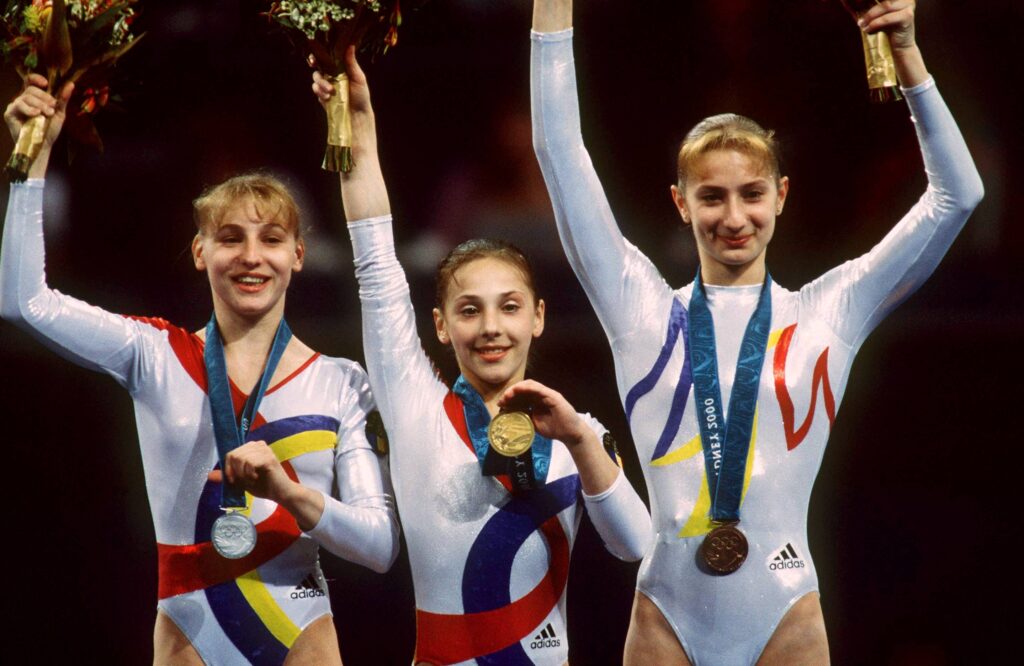
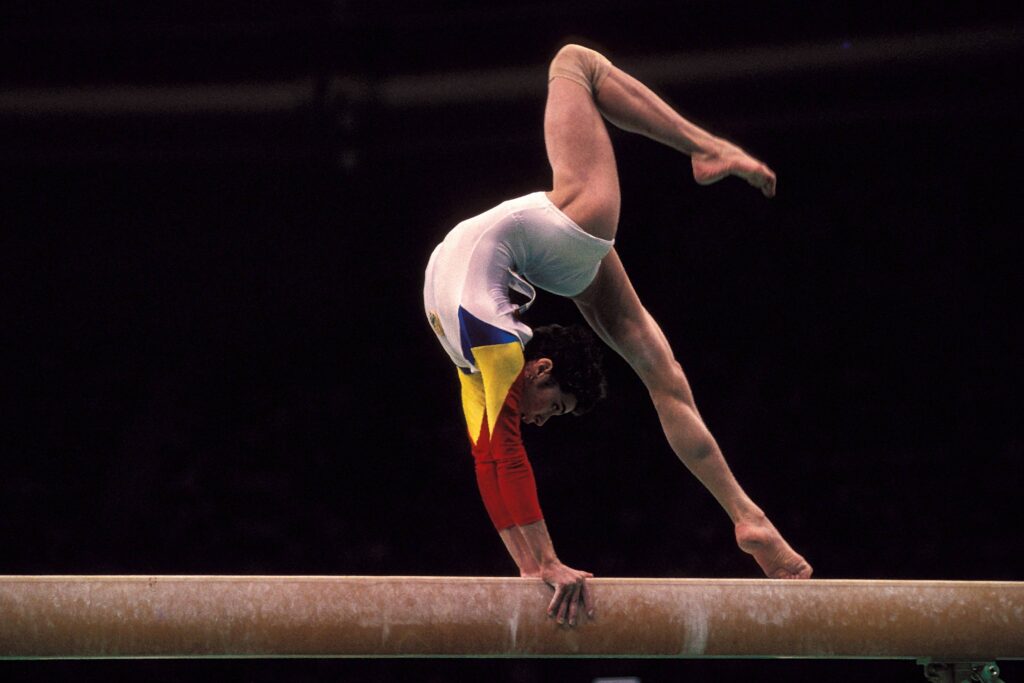
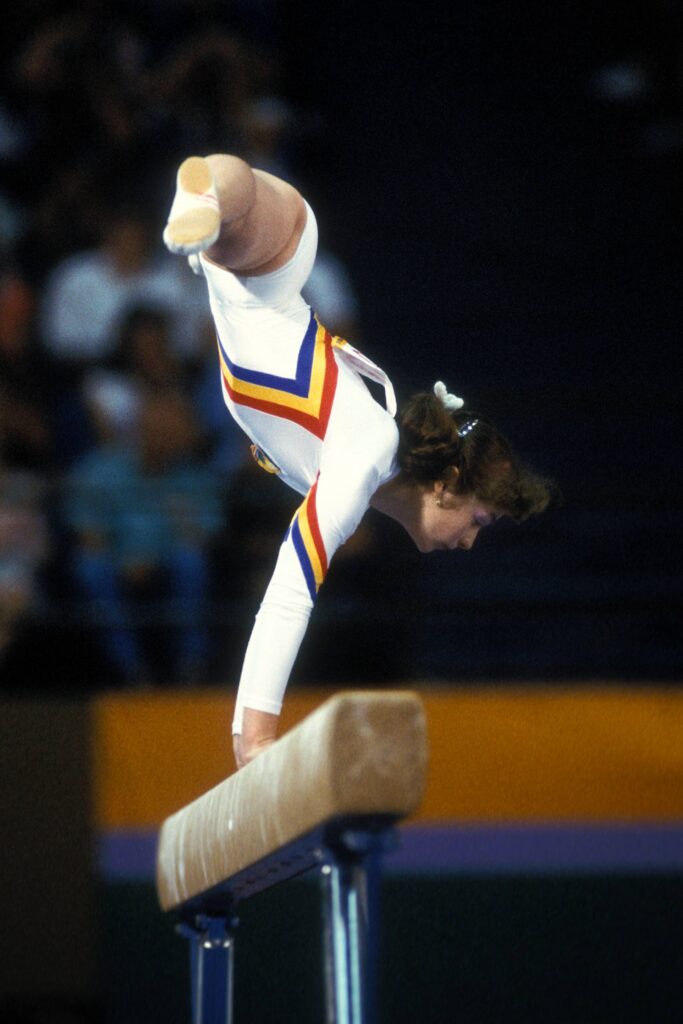
The women’s all-around final at the Sydney Olympics began at 7:00 p.m. on Thursday, September 21, 2000. Maria Olaru, competing for Romania alongside Simona Amânar and Andreea Răducan, had made a prediction before the competition started. She told her coaches that all three Romanians would make the podium. When Octavian Belu, Romania’s head coach, relayed this to reporters afterward, he added with affectionate exasperation: “She has the instincts of a witch. She scares me. From now on, anyone who wants to win the lottery should ask her what numbers will come up.”
By the end of the night, the witch had been proven right. Răducan stood atop the podium with a score of 38.893, flanked by Amânar (38.642) and Olaru (38.581). It was the first time since the 1960 Rome Olympics that a single nation had swept all three medals in the women’s all-around at the Games.
What Olaru could not predict—what no one in the SuperDome that night could have imagined—was what followed.
Simona Amânar, Andreea Răducan, and Maria Olaru, 2000 Olympics
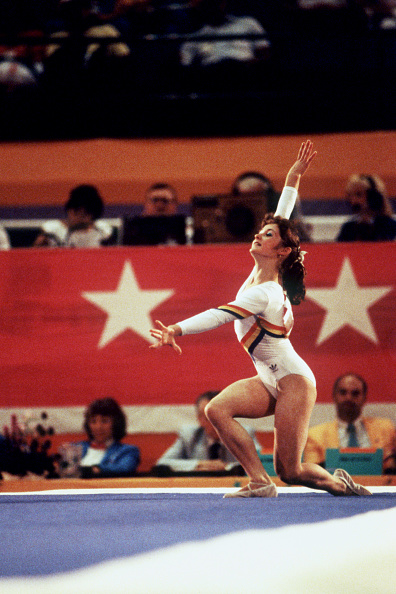
In the summer of 1984, Ecaterina Szabó achieved something that, even in an era of liberal scoring, stood out as exceptional: she recorded two perfect all-around totals of 40.00, months apart and in markedly different competitive settings. The first came in June, at a dual meet against Czechoslovakia in Prague, where Szabó received a 10.00 on all four of her optional routines—a feat that FIG officials publicly acknowledged as unprecedented. The second followed in August at the “40th Anniversary Cup” in Buzău, a domestic competition staged in the afterglow of the Los Angeles Olympics, where she again scored a perfect 40.00.
Here are a few newspaper articles about those competitions.
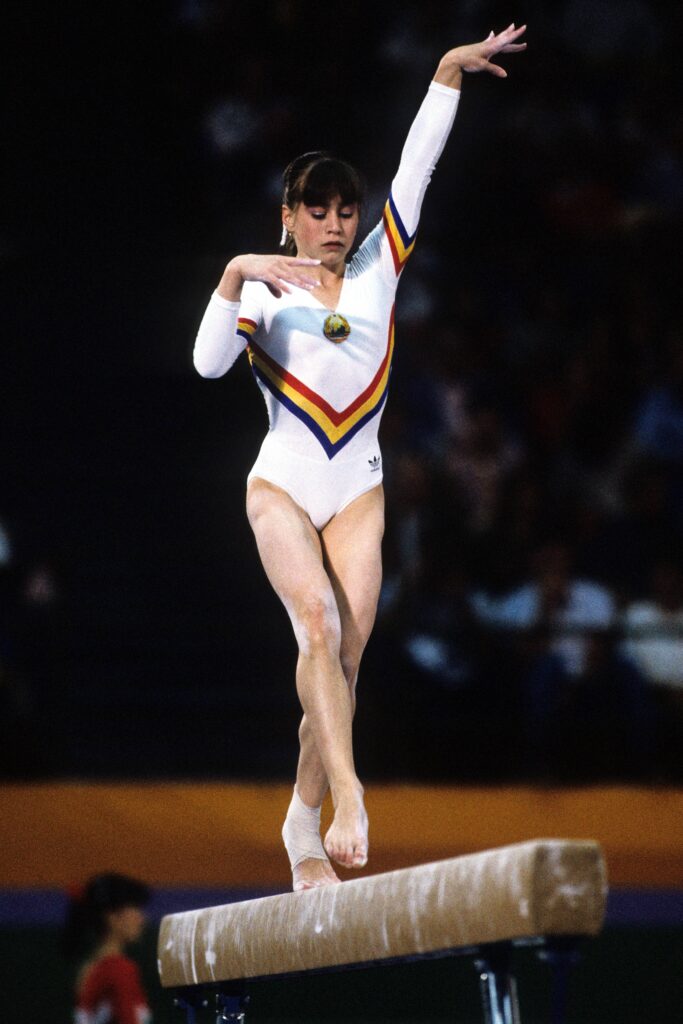
Ecaterina Szabo, Romania, gold medallist (Photo by S&G/PA Images via Getty Images)
In October 2002, more than two decades after Romania’s women’s gymnastics team won gold in Fort Worth, Rodica Dunca broke a long silence. Speaking to Pro Sport, the former international gymnast described daily life inside the Deva training camp not as a center of excellence, but as a place of hunger, surveillance, fear, and physical coercion. Her testimony names teammates whose faces became global symbols of grace—Nadia Comăneci, Melitta Rühn, Emilia Eberle (Trudi Kollar), Dumitrița Turner, Teodora Ungureanu—and places their medals alongside scenes of beatings, escapes intercepted by the Securitate, and bodies pushed beyond collapse. What Dunca recounts is not a single shocking incident, but a system: one in which control over food, water, movement, pain, and obedience defined her adolescence.
Like Eberhard Gienger, Dunca recalls being given an obscene number of pills and injections; unlike Gienger—who admitted to returning many of them to the pharmacy—she was compelled to take everything she was given. Dunca does not identify the substances involved, making it impossible to determine whether any appeared on the IOC’s banned list. She was competing, moreover, in an era when the FIG did not conduct systematic testing, and when the reliability of the drug controls at the 1980 Olympics remains questionable at best. Even had prohibited substances been involved, a positive test would have been unlikely.
Yet the absence of a positive test is not the absence of a problem. Dunca’s account instead directs attention to the medical regime under which Romanian gymnasts trained and competed. The forced ingestion of dozens of unidentified tablets each day, the routine administration of injections associated with prolonged amenorrhea, and the later emergence of drug dependence—all point to a system of non-therapeutic, coercive medical management that regulated young athletes’ bodies for performance, not health.
Set against official narratives of discipline, sacrifice, and triumph—most famously associated with Béla Károlyi—Dunca’s interview exposes the cost hidden behind the perfect smiles and historic scores. It is a reminder that Romania’s golden era in women’s gymnastics was built not only on innovation and talent, but also on practices that blurred the line between training and punishment, medicine and control, excellence and abuse.
Below, you’ll find a translation of ProSport‘s interview with Dunca from October 26, 2002.
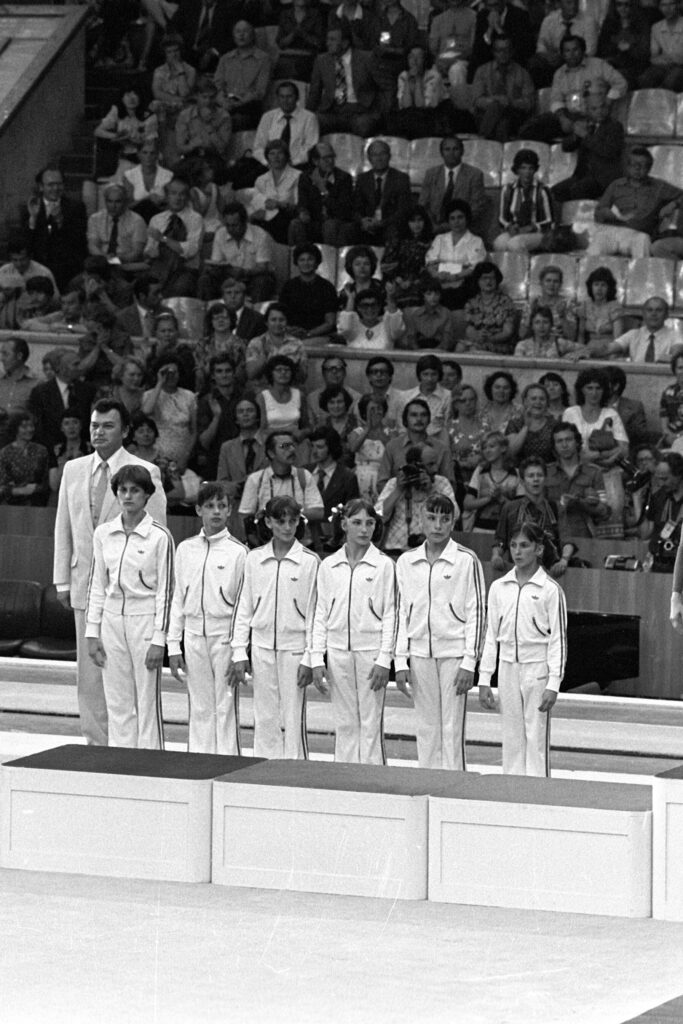
Rodica Dunca (the second gymnast from the left), 1980 Olympics
For gymnasts whose ages have been falsified, a single birthdate is never enough. Their careers must be read against two calendars: the date on which they were actually born, and the date under which they were permitted to compete. Only by holding those two timelines together can we understand not just that an age was altered, but why.
Take Eugenia Golea. She was born in 1971, yet her first senior World Championship medals came in 1985. To be fifteen at those championships, she would have needed a 1970 birth year. But that was not the date under which she competed. Instead, Golea was officially registered as having been born in 1969, making her eligible for the Los Angeles Games. However, for Golea, things never quite came together in 1984.
In December 1990, as Romania struggled to redefine itself after the fall of communism, Celestina Popa said something that should have forced a reckoning in international gymnastics. Speaking to Dutch journalist Hans van Wissen for De Volkskrant, she acknowledged openly that the Romanian federation had falsified her age.
“Sometimes people on the street asked me how old I was,” Popa said. “I didn’t know what to tell them: my real age or the age the federation gave me. Officially, I was one year too young to compete at the 1985 World Championships.”
It was not a vague admission or a rumor repeated secondhand. Popa, herself, was correcting the historical record. Her confession came on the heels of Ecaterina Szabó’s own admission and Aurelia Dobre’s divulgence of Daniela Silivaș’s age falsification, as well.
Together, their statements represented a breach in the Eastern Bloc’s code of silence: athletes speaking openly, shortly after their careers were over, about a system built on falsification and obedience.
When Béla Károlyi defected to the United States in 1981, he carried with him not only his reputation as Nadia Comăneci’s coach but also Romania’s secrets. Speaking to the New York Times in December 1981, after an age scandal erupted at the World Championships in Moscow, Károlyi made a stunning allegation: three members of the Romanian women’s team competed in Moscow despite failing to meet the 15-and-over age requirement. They were Lavinia Agache, who he said was 13 years old; Christina Elena Grigoraș, also 13; and Mihaela Stănuleț, 14.
It would have been easy to dismiss these claims as the bitter accusations of a defector. But Károlyi was telling the truth. Subsequent research has confirmed that Mihaela Stănuleț was born in 1967, making her 14 at the 1981 World Championships. Lavinia Agache was born in 1968 and was indeed 13 years old. And, as we’ll see in the archival record below, Cristina Elena Grigoraș, the young star who had dazzled audiences with her European Championship performance earlier that year, was also born in 1968—not 1966, as her official documents claimed.
That means she was only twelve years old when she competed at the 1980 Moscow Olympics, well below the minimum age requirement of fourteen. Romania’s silver-medal team performance thus relied, in part, on the participation of an underage athlete competing under an incorrect birthdate.
In late January 1981, a Romanian gymnast, who was competing at the International Gymnastics Classic in Los Angeles, was greeted with something unusual: birthday cake. During a dinner with the delegations, someone mentioned the petite Romanian had a birthday, and the Americans—ever genial hosts—sang “Happy Birthday, Ecaterina.” She smiled. She stood. She accepted the applause.
There was only one problem. The gymnast wasn’t Ecaterina Szabó. It was Lavinia Agache.
What happened in California that weekend became known as the “Szabó Substitution”—a scandal that would expose gaps in international athletic oversight, raise questions about Cold War-era sports diplomacy, and leave a young gymnast’s achievements erased from the record. The story unfolds differently depending on whose version you follow, but the timeline itself reveals how information traveled, how institutions reacted, and what remained unresolved.
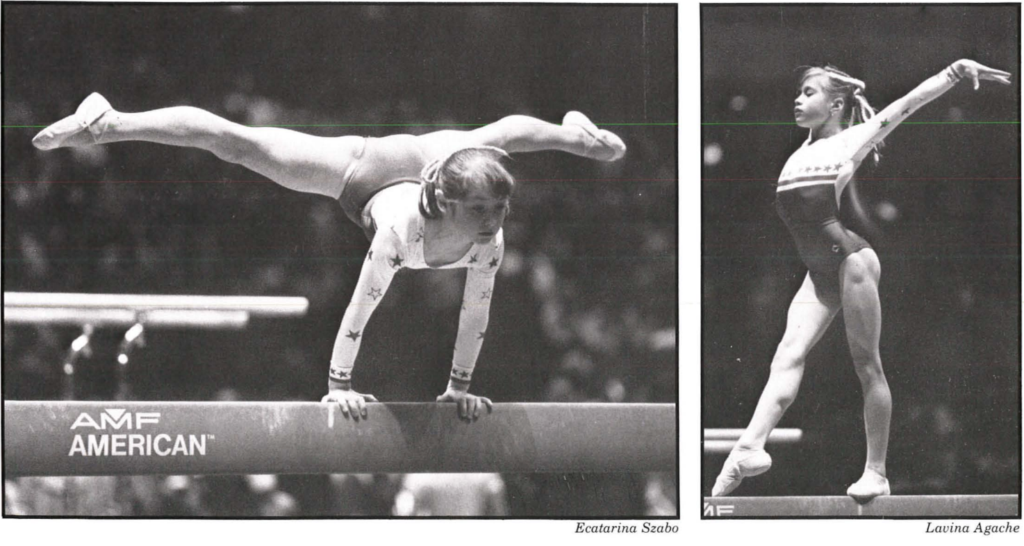
Ecaterina Szabó on the left, Lavinia Agache on the right USGF News, no. 2, 1981
Among the brightest stars of Romanian gymnastics in the early 1980s, Lavinia Agache carved out a remarkable career despite controversies and heartbreak. Born February 11, 1968, in Onești—the same hospital that welcomed Nadia Comăneci into the world—Agache emerged as one of the era’s most decorated gymnasts, accumulating ten medals at major international competitions. Yet her path to prominence was shadowed from the start: Romanian officials altered her age, listing her birth year as 1966 instead of 1968. This deception allowed the thirteen-year-old Agache to compete illegally at the 1981 World Championships in Moscow, where she placed seventh all-around—two years before she would have been eligible under FIG’s minimum age of fifteen.
By 1983, Agache had established herself as a force in the sport, winning four medals at the European Championships in Gothenburg (including gold on balance beam and silver in the all-around) and three more at the World Championships in Budapest. She entered the 1984 Los Angeles Olympics as a legitimate contender for all-around gold, having finished third at the 1982 World Cup and consistently challenging teammate Ecaterina Szabó throughout their years training together at the Romanian national center in Deva.
Lavinia Agache’s gold-medal routine in 1983
First after compulsories, Agache’s Olympic dream disintegrated when a team doctor gave her a pill to combat jetlag. The next day, disoriented and lethargic, she fell four times during the optional round. The medication was legal, but its effects were devastating: Agache failed to qualify for the all-around final, watching from the sidelines as Szabó battled Mary Lou Retton for gold. What happened to Agache in Los Angeles—and the painful parallel she would later draw to Andreea Răducan’s 2000 Olympic ordeal, when a team doctor’s prescription cost the Romanian gymnast her all-around gold medal—forms a cautionary tale about the precarious intersection of medicine and athletic performance in elite gymnastics.
Here’s International Gymnast‘s piece on Agache from 2001, published before the age falsification scandal erupted in Romania in 2002.
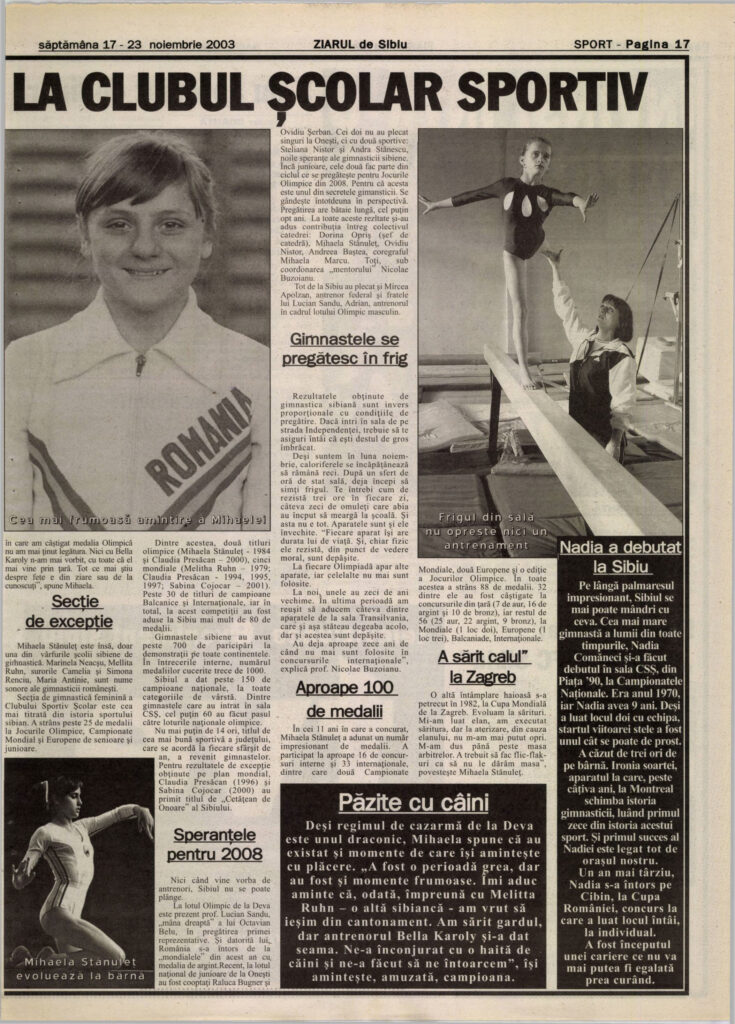
In November 2003, Ziarul de Sibiu (The Sibiu Newspaper) published this profile of Mihaela Stănuleț, who won team silver at the 1983 World Championships and won Olympic gold with Romania’s team in Los Angeles in 1984. The article captures the harsh realities facing retired gymnasts in post-communist Romania. Even Olympic champions struggled to find work, were asked to return their competition tracksuits, and trained new generations in unheated gyms with decades-old equipment.
Like many of her contemporaries, Stănuleț had competed underage: born in 1967, she was only 14 when she placed fourth with Romania’s team at the 1981 World Championships in Moscow, a year before she would have been eligible under the age-15 minimum. By the time she reached the Olympics three years later, the system that had rushed her into elite competition as a child offered little in return for her gold medal—just 16,000 lei instead of the promised 100,000 and no car despite assurances. (Ecaterina Szabó made similar remarks about unfulfilled promises.) The article reveals how completely Romania’s gymnasts were discarded once their competitive value expired.
Oh, and there’s a story about Béla Károlyi’s dogs.
This lengthy profile of Ecaterina Szabó, published in Képes Sport (Sport in Pictures) in May 1990, offers a detailed firsthand account of life in Romanian gymnastics during the late 1970s and 1980s. The article, based on interviews conducted by Levente Deák for Romániai Magyar Szó (The Hungarian Voice of Romania), traces Szabo’s journey from a small village in Transylvania to Olympic glory at the 1984 Los Angeles Games, where she won four gold medals.
Notably, the article confirms Szabo’s actual birth date as January 22, 1968—making her 16 years old at the time of her Olympic triumph, not the older age sometimes claimed in contemporary sources. The narrative provides extensive detail about the grueling training regime at the Karolyi gymnastics school: wake-up calls at 6 AM, training sessions lasting until 10 PM as punishment, mandatory afternoon naps, and a schedule that prioritized gymnastics over traditional schooling.
As you’ll see, compared to today’s top gymnasts, Szabó competed non-stop, traveling to a total of 70 countries. It’s no wonder that, by the time the World Championships in 1985 rolled around, she “was simply exhausted.”
As was often the case at that time, gymnasts’ biographies were woven together with Béla Károlyi’s story. Throughout the piece, the writer includes several parenthetical statements that paint Béla Károlyi in a remarkably positive light, characterizing him as a dedicated coach who made tactical decisions in the best interests of his gymnasts.
However, this generous portrayal omits crucial context that we know today: before the Károlyis were transferred to General School No. 7 in Deva, the Romanian government’s patience with the Károlyis was wearing dangerously thin. In March 1977, Teodora Ungureanu fled during training in Cluj, boarding a train to Onești. The Securitate intercepted her at the Târgu Mureș train station and escorted her to Bucharest. According to the Securitate report: “The gymnast gave as the reason for leaving the fact that she could no longer stand working with coach Béla Károlyi,” who “persecutes her baselessly.”
The situation continued to deteriorate during a tour of Spain in 1977. Securitate officer Ioan Popescu reported that Béla Károlyi “showed inappropriate conduct towards Nadia Comaneci and Teodora Ungureanu, consisting of swearwords, insults, even beating them, because their weight was unsuitable for the competition.” Ilie Istrate, a National Council for Physical Education and Sport (NCPES) instructor and Securitate informant, reported that “the girls were found weeping in their rooms because of hunger.” (See Olaru’s Nadia Comăneci and the Secret Police for more.)
Read against this historical background, Szabó’s account becomes all the more poignant—a testament to both her remarkable athletic achievements and the complex, often contradictory relationships that defined elite Romanian gymnastics in this era.
In many ways, this set of articles becomes Szabó’s way of reclaiming her story—from her erased Hungarian heritage to her falsified age, from the name she was given to the one she was born with (Katalin), and from the rewards she earned to those she never received.