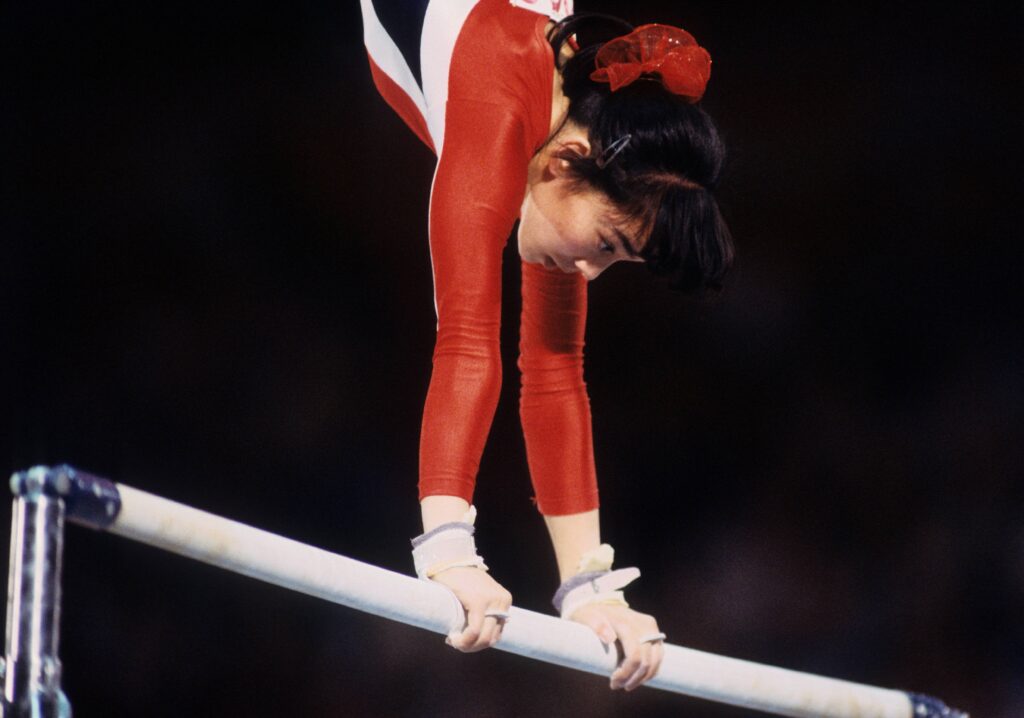
In 1978, the People’s Republic of China rejoined the FIG. A year later, at the World Championships in Fort Worth, Texas, Ma Yanhong tied East Germany’s Maxi Gnauck for the uneven bars title, becoming the first Chinese gymnast to reach the top of the world podium. Her success fueled hopes that China would make a strong showing at the 1980 Olympic Games, the country’s first Summer Olympics since its return to the Olympic movement. The optimism was evident in the pages of PLA Daily, the newspaper of the Chinese military:
During the competition, news arrived of China’s restoration of its seat at the Olympic Games, and Ma Yanhong was overjoyed beyond measure. She resolved to break through still more difficult movements and win even greater honor for her motherland. On the eve of her imminent participation in the Olympics, we wish to offer Ma Yanhong a line from Tagore: “Just keep walking forward — there is no need to pause and gather the flowers to preserve them, for along the way, the flowers will keep blooming.”
比赛期间,传来了我国在奥运会的席位恢复的喜讯,马艳红更是兴奋异常。她决心要突破难度更大的动作,为祖国争取更大的荣誉。在她即将参加奥运会的前夕,我们愿意在这里赠给小马一句泰戈尔的名言:“只管走过去,不必逗留着去采了花朵来保存,因为一路上,花朵是会继续开放的。
Wang Hua, Zeng Fanhua PLA Daily, January 7, 1980
Tagore refers to Rabindranath Tagore (1861–1941), the Bengali poet, novelist, philosopher, and educator who became the first non-European to win the Nobel Prize in Literature in 1913.
Yet those expectations for Moscow would never be realized. Three months after the article’s publication, in April 1980, the Chinese Olympic Committee officially joined the boycott of the Moscow Games. For gymnasts such as Ma Yanhong, Cai Huanzong, and Li Yuejiu, the decision meant the loss of an opportunity that many had spent years awaiting. This article examines the political circumstances behind China’s boycott and how athletes, coaches, and the Chinese media responded to a moment that reshaped the careers of an entire generation.
Copyright: imago/WEREK
The Willing Ally: Why China Boycotted the 1980 Moscow Olympics
China’s decision to boycott the 1980 Moscow Olympics was less a response to the Soviet invasion of Afghanistan than the culmination of two decades of worsening Sino-Soviet relations and Beijing’s growing alignment with the United States.
The relationship between China and the Soviet Union had begun as a close alliance. In 1950, the two countries signed the Treaty of Friendship, Alliance, and Mutual Assistance, and the Soviet Union provided extensive economic, technical, and military support to the newly founded People’s Republic of China. By the late 1950s, however, political and ideological disagreements had driven the two communist powers apart. The split deepened throughout the 1960s and culminated in armed clashes along the Sino-Soviet border in 1969. By the 1970s, Chinese leaders increasingly viewed the Soviet Union as their primary security threat. Soviet forces remained concentrated along China’s northern frontier, Soviet-backed Vietnam challenged China in the south, and the Soviet invasion of Afghanistan appeared to extend Moscow’s influence toward China’s western border.
As relations with Moscow deteriorated, Beijing sought closer ties with Washington. The process culminated in the normalization of diplomatic relations between China and the United States on January 1, 1979, just months before the Chinese Olympic Committee was readmitted to the International Olympic Committee. By the time Soviet forces entered Afghanistan in December 1979, China was already moving strategically toward the United States and away from the Soviet bloc.
Yet China’s decision about the Olympics was not predetermined. After its readmission to the International Olympic Committee in 1979, China fully expected to attend the Moscow Games. Sports officials established ambitious performance goals, athletes entered Olympic training camps, and the Chinese Olympic Committee publicly confirmed its intention to participate.
The situation changed during the first months of 1980 as the Carter administration sought international support for a boycott. On February 1, China’s Ministry of Foreign Affairs publicly declared that Moscow was no longer an appropriate host for the Games while Soviet troops remained in Afghanistan and suggested that the Olympics should be moved or canceled. Over the following weeks, Beijing’s position hardened. On April 21, Premier Hua Guofeng publicly stated that attendance was inappropriate, and the next day, the Chinese Olympic Committee formally voted to boycott the Games. The sequence demonstrated that major Olympic decisions in China were ultimately matters of state policy rather than athletic policy.
For China’s athletes, the decision brought an abrupt end to years of Olympic preparation. For the Chinese government, however, the boycott became part of a broader strategic realignment already underway. Over the following four years, Chinese officials reorganized elite sport, expanded scientific training methods, and concentrated resources through the “Whole Nation System” and the “Olympic Gold Medal Strategy.” Between 1981 and 1983, Chinese athletes won 77 world championships and set 36 world records. When China returned to Olympic competition at the 1984 Los Angeles Games, its athletes won 15 gold medals and finished fourth overall. The absence from Moscow thus became an unexpected bridge between China’s diplomatic reorientation and its emergence as a major Olympic power.
Inside China’s Gymnastics Team
The boycott created an immediate challenge for Chinese sports officials and the state media. Having spent months preparing athletes and the public for Olympic participation, they now had to explain why China would not attend the Games and what would come next. One way they did so was through stories about the national teams themselves. As the Moscow Olympics were underway, People’s Daily visited the national gymnastics team in Beijing and used its athletes as a lens through which to explain the boycott and China’s sporting future.
Published on July 29, 1980, the following feature is reproduced in full below.
After the Decision Not to Participate in the Moscow Olympics — A Visit to the Chinese Gymnastics Team
The Chinese gymnastics team — which at last year’s World Gymnastics Championships won fifth place in the men’s team event, fourth place in the women’s team event, and the world championship on the uneven bars — what are they thinking and doing as the Moscow Olympics open?
We recently went to visit them. Entering the Beijing Gymnastics Training Hall, we saw male and female athletes training with explosive energy and tremendous enthusiasm, each one drenched in sweat, the atmosphere charged with the tension of the eve of a major competition. “Aren’t they skipping the Olympics? Why are they still training so hard?” Gymnastics team leader Chen Fengping said: “The Olympics are a great opportunity for athletes from all countries to exchange skills and learn from one another. But because the Soviet Union sent troops into Afghanistan, violating the Olympic spirit of peace and friendship, we therefore refused to participate. However, the athletes’ resolve to train diligently, scale new heights, bring glory to the nation, and contribute to the world gymnastics movement has not changed.” He also told us that the national gymnastics team would soon participate in two competitions boycotting the Moscow Olympics: an international gymnastics invitational to be held in the United States on August 21, and a gymnastics competition to be held in Switzerland on October 20. In addition, a “World Cup” competition would be held in Canada on October 24, originally scheduled for the top sixteen male and female gymnasts from the current Olympics, but since the Moscow Olympics had become an empty formality, it was changed to include the top sixteen athletes from last year’s World Championships. Coaches and athletes were training hard in preparation for these three major international competitions.
The celebrated athlete Cai Huanzong was already thirty-one years old, yet in order to compete at his best, he continued to train with meticulous care. He and the noted gymnastics athlete Ning Xiaolin had been in a relationship for many years and should long since have married, but for the honor of the nation, he once again postponed their wedding. During the training camp, athletes also overcame difficulties and mastered numerous high-difficulty moves rarely seen internationally. Li Yuejiu, who had placed fifth in the men’s floor exercise at the World Gymnastics Championships, developed a new signature move featuring a 720-degree twist. His performance combined high difficulty with distinctly Chinese characteristics, earning him a perfect score of ten in this year’s national divisional competition — the only perfect score achieved by a Chinese gymnastics athlete to date. Eighteen-year-old Tong Fei had placed fifth on the horizontal bar at the World Gymnastics Championships with a 720-degree dismount, and he had now developed this into a “1,080-degree dismount,” with greater difficulty and greater stability.
The female athletes were no less impressive. Uneven bars world champion Ma Yanhong’s technique achieved a new breakthrough, adding a “front somersault catch,” making her entire routine even more breathtaking and beautiful. In order to ensure that athletes’ movements were steady and their form elegant, the gymnastics team intensified training on the stability of all landings, as well as cultivating artistic qualities in music and dance, achieving remarkable results. It can be expected that they will achieve outstanding results in the upcoming alternative competitions to the Olympics.
Yan Naihua
在决定不参加莫斯科奥运会之后——访中国体操队
July 29, 1980, People’s Daily, page 3
曾在去年世界体操锦标赛上获得男子团体第五名,女子团体第四名和高低杠世界冠军的中国体操队,在莫斯科奥运会开幕的时候,想些什么,做些什么呢?
最近,我们去访问了他们。走进北京体操训练馆,就看到男女选手们正在龙腾虎跃,热火朝天地进行训练,个个练得汗流浃背,充满了重大比赛前夕的紧张气氛。“不是不参加奥运会了吗?怎么还练得这样苦”?体操队领队陈凤平说:“奥运会是各国体育健儿交流技艺,互相学习的好机会,但由于苏联出兵阿富汗,违背了奥运会和平友好的宗旨,因此我们才拒绝参加,然而运动员们刻苦训练,勇攀高峰,为国争光,为世界体操运动做出贡献的决心并没有变”。他还告诉我们,国家体操队不久将参加两个抵制莫斯科奥运会的比赛,即八月二十一日在美国举行的国际体操邀请赛和十月二十日在瑞士举行的体操对抗赛。另外,十月二十四日在加拿大还举行一个“世界杯”赛,本来规定由本届奥运会体操比赛男女前十六名参加,但由于莫斯科奥运会有名无实,所以改由去年世界锦标赛的前十六名选手角逐。教练员、运动员为迎接这三项重大国际比赛正在刻苦训练。著名运动员蔡焕宗已经三十一岁了,为了赛出水平,仍一丝不苟地认真进行训练。他和著名体操选手宁小琳恋爱多年,早该结婚,但为了国家荣誉,又一次推迟了婚期。集训中,运动员们还克服困难,攻下了不少国际上罕见的高难动作。曾在世界体操锦标赛获男子自由体操第五名的李月久,又练出了一个七百二十度旋的新绝招。他的表演既有难度,又富中国特色,使他的自由体操在今年全国分区赛中得了十分,这是我国体操选手至今仅有的一个满分。十八岁的童非在世界体操锦标赛中曾以七百二十度旋下获单杠第五名,他在这一基础上又发展成
“一千零八十度旋下”,难度更大,动作更稳。女选手也不示弱。高低杠世界冠军马艳红的技术又有了新的突破,增加了“前空翻抓杠”,使全套动作更加惊险优美。为了使运动员做到动作稳、姿态美,体操队更狠抓了各项落地动作的稳定性训练及音乐、舞蹈等美的素养,并取得了显著效果。可以预期,他们在即将举行的奥运会替代性比赛中,会取得优异成绩。 阎乃华
Note: Cai Huanzong is not well known to modern gymnastics fans, but he was one of China’s leading gymnasts of the 1970s. At the 1974 Asian Games, he won team, pommel horse, and high bar gold medals, along with silver in the all-around, vault, and parallel bars. Four years later, at the 1978 Asian Games, he added team, all-around, and pommel horse titles, as well as a silver medal on parallel bars.
Li Yuejiu would later become China’s first men’s world champion, winning floor exercise gold at the 1981 World Championships (among other accolades). Before that breakthrough, he was already among China’s top performers at the 1978 Asian Games, where he won team and floor exercise gold medals, silver on high bar, and bronze in the all-around.
A Retrospective on China’s Boycotts
China’s boycott of the 1980 Moscow Olympics was not unprecedented. The country had also withdrawn from the 1956 Melbourne Games. In both cases, Chinese athletes who had spent years preparing for the Olympics saw their dreams abruptly dashed.
The following retrospective was published in 2007, as China was preparing to host the 2008 Beijing Olympics. At the time, the Beijing Games were facing growing international criticism and calls for a boycott over China’s human rights record and other political issues. Against that backdrop, the article looked back at China’s own Olympic boycotts of 1956 and 1980, reflecting on the political decisions that kept two generations of Chinese athletes from competing on sport’s biggest stage and the lasting impact those decisions had on their lives.
Note: This article presents China’s official perspective on these boycotts. Both the 1956 and 1980 Olympic boycotts were intertwined with the issue of Taiwan’s international status. Consistent with its longstanding position, the Chinese government regards Taiwan as part of China rather than as a separate sovereign state.
Chinese Athletes Twice Brushed Past the Olympics — Changing the Fates of Two Generations of Elite Athletes
September 7, 2007, — China Newsweek (中国新闻周刊)
Before the Chinese delegation appeared for the first time in Los Angeles in 1984, the Chinese had two opportunities to participate, yet brushed past the Olympics both times. What was also changed were the lifelong fates of two generations of elite Chinese athletes.
By Chen Yuanyuan
If the Taiwan authorities had not interfered in the 1956 Melbourne Olympics; if the 1980 Moscow Olympics had not been boycotted by more than 100 countries because of the invasion of Afghanistan — China’s Olympic history would have been rewritten.
In those capricious, fleeting moments, the lives of a cohort of athletes were transformed. Today, without the halo of Olympic champions around them, their names and whereabouts are hard to find in the media. The heroes of yesterday, once leaders of their era, have been lost in the star-studded world of sports.
Times have changed, and when they recall those near-misses with the Olympics now, all that remains is a faint sigh and a wry smile on weathered faces: missing out was the regret of a lifetime.
The Broken Appointment with Melbourne
The 1956 Melbourne Olympics was the first Olympics for which New China systematically prepared. Although four years earlier the Chinese government had also sent athletes to the Helsinki Olympics, because the International Olympic Committee’s invitation letter was sent too late, by the time the 40-member Chinese delegation arrived in Helsinki, the competition schedule was already half over. Only Wu Chuanyu made it in time for the 100-meter backstroke, finishing fifth.
Facing the invitation to the Melbourne Olympics, China made thorough preparations. A large group of elite athletes who had earlier been sent to Hungary for training, including the swimming team, were ordered home to prepare — among them the then-21-year-old “100-meter Breaststroke King” Mu Xiangxiong, and the 26-year-old first captain of the gymnastics team, Lu Enchun.
After several years of development following Liberation, and especially the all-around flourishing of the sports world in 1955, Chinese sport had attained considerable strength. On October 21, the State Sports Commission organized a formal selection trial at the Beijing Gymnasium, choosing 92 athletes in seven events — weightlifting, swimming, gymnastics, football, and others — from more than 1,400 athletes nationwide to form a delegation. They trained together in Beijing in preparation for the Olympics two months later. This was the first Olympic training squad in Chinese history.
That same year, the State Sports Commission also announced China’s first group of 49 “Masters of Sport.” Premier Zhou personally conferred the “Master of Sport” badges on them and shook hands with each one.
Chen Jingkai, who had broken the clean-and-jerk world record with 133 kilograms, basketball star Yang Boyong, and track-and-field star Zheng Fengrong all made the Olympic team with impressive results. At that selection trial, Lu Enchun alone took second place in three events: the individual all-around, parallel bars, and pommel horse. Mu Xiangxiong, meanwhile, swam 2:38.9 in the 200-meter breaststroke, once again drawing the attention of the international swimming world.
“I was ranked second in the world at the time — you could say I had a real shot at gold,” recalled the now silver-haired Mu, still rather rueful about those days. As early as 1951, Mu Xiangxiong had broken the national record in the 100-meter breaststroke, and in 1954 he won his first international title. At 21, Mu was at his peak, the Chinese swimming team’s best hope for gold.
As the competition approached, the athletes’ Olympic enthusiasm was at an unprecedented high. As Lu Enchun recalled, the delegation had already tried on their Olympic competition uniforms at the Beijing Gymnasium: “I served as the model. Marshal He Long, then director of the State Sports Commission, paced back and forth beside me, examining us closely and repeatedly exhorting us: ‘You must display the spirit of Chinese athletes!’ Thinking that we were about to compete in the Olympics, we were all tremendously excited.”
Everything was ready. In early November, each team held its pre-competition mobilization, and the athletes assembled in Guangzhou, quietly awaiting departure. Huang Zhong, deputy head of the Chinese sports delegation, and IOC member Dong Shouyi had already arrived in Melbourne as the advance party.
But a few days later came the news that the Taiwan side had arrived in Melbourne first and raised the Blue Sky with a White Sun flag — the International Olympic Committee, while inviting the mainland Chinese delegation, had also sent an invitation to the Taiwan authorities. The advance party lodged protests with the organizing committee and the IOC, to no effect.
On November 22, 1956, the opening day of the 16th Melbourne Olympics, the Chinese government decided to boycott the Games in protest. Dong Shouyi and Huang Zhong left Melbourne in indignation, and the sports delegation assembled in Guangzhou was ordered to disband.
To test their strength, the State Sports Commission held an “Olympic counterpart competition” in Shanghai at the same time as the Olympics. At that meet, Mu Xiangxiong’s time in the 200-meter breaststroke was 1.6 seconds faster than that of the Melbourne Olympic champion. “It’s a great pity. If I had taken that gold medal, the history of China’s Olympic gold medals would have started at least twenty-some years earlier.”
The following year, Mu Xiangxiong achieved the miracle of breaking the 100-meter breaststroke world record three times within a single year. But because the Chinese government completely severed relations with the IOC and the international single-sport federations in 1958 — and under the rules, after withdrawing from a single-sport federation one cannot compete in events recognized by that federation — Chinese athletes lost the chance to compete in virtually all major international competitions from then on.
In the early 1960s, this cohort of athletes retired one after another and took up coaching work, but their pupils likewise had few opportunities to appear in international arenas before they, too, moved toward retirement. This generation — whether as athletes or as coaches — was gradually forgotten in the passage of time.
Boycotting the Moscow Olympics
It was not until 1974, on Deng Xiaoping’s instructions, that a small group of six or seven people from the International Department of the State Sports Commission began the sports “public relations” campaign to win back China’s place in the International Olympic Committee. Propelled by the great hand of politics, Chinese athletes returned to the international stage.
In 1974, China fielded a team for the first time at the 7th Asian Games in Tehran, winning 33 gold medals and placing third in the overall team standings. From 1974 to 1978, through mediation on many fronts, China gradually recovered its member-state status in the individual federations for basketball, swimming, athletics, gymnastics, and other sports.
After a 20-year absence from international sport, China’s lawful seat was restored at the 56th Congress of the International Gymnastics Federation in October 1978. Zhang Jian recalled: “The moment the voting result was announced, the Taiwan representatives stood up, took their briefcases, and walked out. We hurried into the hall, sat down in their former seats, took out the ‘People’s Republic of China’ placard we had prepared in advance, and swapped it in.” History pivoted, like a scene from a play, in the instant the two parties brushed past each other. This was a scene played out in nearly every sport as China returned to the individual sports federations.
At the end of 1979, the Nagoya Resolution was signed, and China’s lawful seat in the International Olympic Committee was restored. By then, the door to the Olympics had been closed to the Chinese for nearly 20 years.
The State Sports Commission immediately established a training squad to prepare for the 1980 Olympics. China’s third and fourth generations of athletes began to rekindle their hopes for the Olympic Games.
Professor Xiong Xiaozheng of Beijing Sport University told this reporter that the athletes of this period came mainly from two groups: one part were veteran athletes left over from before the Cultural Revolution; others, like Lang Ping, had grown up through the amateur sports schools during the Cultural Revolution. During the Cultural Revolution, most sports were at a standstill; after it ended, Chinese sport welcomed its second period of great development.
Diving saw its first golden age, led by Chen Xiaoxia and Li Kongzheng. The Chinese men’s volleyball team, with Wang Jiawei — “the world’s number one quick attacker” — and Shen Fulin, defeated Japan and South Korea at the 2nd Asian Championships to win its first Asian title; the same year, the women’s volleyball team also won the Asian championship, earning a ticket to the Olympics.
Just as before the 1956 Olympics, the Chinese teams completed their pre-competition mobilization and had their measurements taken for custom-made uniforms. And once again, complications arose. Before the Games, the host country, the Soviet Union, suddenly sent troops into Afghanistan. At the initiative of the United States, 64 countries and regions, including Japan, Canada, and West Germany, boycotted the 1980 Moscow Olympics. Two months before the opening ceremony, the Chinese government also announced it would boycott the Games.
Zhou Lumin, a member of that year’s Chinese women’s volleyball training squad, recalled the disappointment: “Although I had never competed in the Olympics before, I knew how important the Olympics were. When I heard the news, I was shocked.”
The gymnastics team had been preparing for the Olympics ever since China’s seat in the FIG was restored in 1978. In the spartan Beijing gymnastics hall, veterans Cai Huanzong and Li Yuejiu, together with the newly rising Li Ning, Tong Fei, and others — more than 140 male and female athletes in all — trained together with pent-up determination for two years.
Zhang Jian said: “That team had been holding it in for far too long. At the mere mention of competing in a major international event, they had an indescribable energy — exceptionally fierce, full of fighting spirit.”
Two months later, the Chinese gymnastics team found its release at the “anti-Olympics” held in the United States [the Olympic boycott meet].
Zhang Jian recalled that the competition did not go entirely smoothly, but the athletes’ hunger for major competition and their spirit were astonishing. In the third event, the horizontal bar, Li Yuejiu — trying to guarantee the success of a release-and-regrasp flight element — came in too close to the bar, and his mouth slammed straight into it. “I was standing under the bar spotting. I heard a very loud bang and figured the impact was serious. I only heard him shout ‘spot me!’ and then he finished the routine. Only after he came down did everyone discover that the corner of his mouth was bleeding — an entire row of teeth had snapped off at the roots.” But Li Yuejiu absolutely refused to withdraw. With gauze clenched in his mouth and tape applied, he persevered through the rest of the competition. As Zhang Jian described it: “On vault, with each twist and rotation, the blood would spray out of his mouth.” The 27-year-old veteran Cai Huanzong likewise endured his injuries and completed all his events.
That time, China defeated the mighty Japanese team for the first time, winning the team title. Although it was not a real Olympic gold medal, the athletes were so moved they could not sleep that night.
China and the Olympics had missed each other once again, and afterward a group of older athletes retired in succession. At the “advanced age” of 27, Zhou Lumin could not wait for the next Olympics. After retiring, she returned to Shanghai and became a coach. Gymnastics veteran Cai Huanzong, after leaving competition, went abroad to coach.
In 1984, the Chinese team finally appeared at the Los Angeles Olympics. But by then the gymnastics arena belonged to the younger generation — Li Ning and Tong Fei. The somewhat older Li Yuejiu and Huang Yubin were already past their peaks and were unable to make their mark at those Games.
中国人两次与奥运擦肩 改变两代优秀运动员命运
1984年,中国代表团第一次出现在洛杉矶之前,中国人曾经有两次参与机会,却与奥运会擦肩。而被改变的,还有中国两代优秀运动员一生的命运
文/陈园园
假如1956年墨尔本奥运会,台湾当局没有从中介入;假如1980年莫斯科奥运会,没有因为侵略阿富汗而遭到100多个国家的抵制,中国奥运的历史将会重写。
翻云覆雨的一瞬间,一批运动员的人生因此改变。如今,没有奥运冠军的光环笼罩,媒体上已很难找到他们的名字和踪迹。领袖一时的昔日英雄已经失落在星光熠熠的体育圈里。
时过境迁,再回忆当年与奥运会的失之交臂,只剩一声淡淡的叹息,和沧桑脸上的一丝苦笑:错过了,是一生的遗憾。
失约墨尔本
1956年墨尔本奥运会是新中国第一次系统备战的奥运会。虽然在4年前,中国政府也曾派队员参加了赫尔辛基奥运会,但由于国际奥委会发出邀请信过迟,中国一行40人的代表团抵达赫尔辛基时,赛程已过半,只有吴传玉赶上了百米仰泳的比赛,获得第五名。
面对墨尔本奥运会的参赛邀请,中国作了充分的准备。之前派往匈牙利训练的游泳队等一大批精英奉命回国备战,其中包括当年21岁的“百米蛙王”穆祥雄,和26岁的体操队首任队长陆恩淳。
解放后的中国体育经过几年的发展,尤其是1955年体育界的全面繁荣,已具备相当实力。10月21日,国家体委在北京体育馆里组织了一次正式的选拔赛,从全国1400多名运动员中选拔出举重、游泳、体操、足球等7个项目的92名运动员组成代表团,在北京集训,以备战两个月后的奥运会,这是中国历史上的首支奥运集训队。
国家体委还在这一年公布了我国第一批共49名“运动健将”名单,周总理亲自将“运动健将”的证章授予他们,并和他们一一握手。
以133公斤打破挺举世界纪录的陈镜开,篮球名将杨伯镛、田径名将郑凤荣都以不俗成绩入选了奥运会。在那次选拔赛上,陆恩淳独得个人全能、双杠、鞍马3项亚军。而穆祥雄在200米蛙泳中游出了2分38秒9的成绩,再次引起国际游泳界关注。
“我当时排名世界第二,可以说冲金有望”,如今满头银发的穆老追忆当年,依然颇为惋惜。早在1951年,穆祥雄就打破了全国100米蛙泳纪录,1954年首次夺得国际比赛冠军。当年21岁的穆祥雄,正值巅峰时期,是中国游泳队最有希望的夺金点。
临近比赛,队员们的奥运热情空前高涨。据陆恩淳回忆,当时代表团已经在北京体育馆试穿了奥运会比赛服,“我当模特儿,当时的国家体委主任贺龙元帅在旁边走来走去,仔细端详,不断叮嘱我们‘一定要表现出中国运动员的精神!’想着就要参加奥运会了,当时我们的心情都非常激动。”
一切准备就绪。11月初,各队做赛前动员,运动员们集结广州,静待出发。中国体育代表团副团长黄中和国际奥委会委员董守义作为先遣队伍已抵达墨尔本。
但几天后,传来台湾方面已经先期到达墨尔本升起青天白日旗的消息——国际奥委会在邀请中国大陆代表团的同时,也向台湾当局发送了邀请函。先遣团向组委会和国际奥委会提出抗议,但没有效果。
1956年11月22日,第16届墨尔本奥运会开幕当日,为了表示抗议,中国政府决定抵制本届奥运会,董守义和黄中愤然离开墨尔本,集中在广州的体育代表团奉命解散。
为了检验实力,在奥运会举办的同时,国家体委在上海举办了奥运对抗赛。那次对抗赛上,穆祥雄200米蛙泳的成绩比墨尔本奥运会冠军还快了1.6秒。“很遗憾,如果当时我拿下了那块金牌,中国奥运夺金的历史至少要提前二十几年”。
第二年,穆祥雄创造了一年之内三破100米蛙泳世界纪录的奇迹。但由于中国政府在1958年全面断绝和国际奥委会及单项体育联合会的关系,按照规定,退出单项联合会之后,即不能参加单项联合会承认的比赛,中国队员从此失去了几乎所有国际大赛的参赛机会。
60年代初,这一批运动员纷纷退役,担任教练工作,但他们的弟子仍没有太多国际赛场上露面的机会,就走向退役。这一代人,无论身为运动员或是教练员,都在岁月的流转中,渐渐被人们遗忘。
抵制莫斯科奥运会
直到1974年,在邓小平的指示之下,当时由国家体委国际司六七个人组成的小组开始了争取重回国际奥委会的体育“公关”,在政治这只大手的推动下,中国运动员重新回到国际舞台。
1974年,中国首次组队参加第7届德黑兰亚运会,获金牌33枚,列团体总分第三。从1974年到1978年,多方斡旋下,中国逐步恢复了在篮球、游泳、田径、体操等各单项体操联合会中的会员国地位。
阔别国际体坛20年之后,1978年10月的国际体联第五十六次代表大会上,中国恢复了合法席位。张健回忆说,“投票结果一宣布,台湾方面的代表站起身,拿了皮包就往外走,我们就赶紧走进会场,坐在他们原先的席位上,拿出事先准备好的‘中华人民共和国’的牌子换上。”历史在两队人马擦肩而过的一刹那,戏剧般的转合。这是几乎所有项目回到体育单项协会时都曾上演的一幕。
1979年底,《名古屋协定》签署,中国恢复了在国际奥委会的合法席位。而中国人进入奥运会的大门已关闭了近20年之久。
国家体委随即成立了备战1980年奥运会集训队。中国体育的第三代、第四代运动员们开始重燃起对于奥运会的期盼。
北京体育大学熊晓正教授告诉记者,这时期的运动员主要有两部分组成:一部分是文革前留下来的老运动员;还有一些是像郎平这样,在文革期间,从业余体校成长起来的。文革期间,大多数体育项目处于停滞阶段,文革之后,中国体育界迎来了第二个大发展的时期。
跳水迎来陈肖霞、李孔政领衔的第一次辉煌;拥有“世界第一副攻手”汪嘉伟和沈富麟的中国男排,在第二届亚洲锦标赛上击败日本、韩国,首夺亚洲冠军;同年,女排也获得亚洲冠军,赢得奥运会入场券。
和1956年的那次奥运前一样,中国队做完赛前动员,量好了定做衣服的尺寸。却再次横生枝节。奥运会前,主办国前苏联突然出兵阿富汗,在美国的倡议之下,日本、加拿大、西德等64个国家及地区抵制1980年莫斯科奥运会。开幕前两个月,中国政府也宣布抵制本届奥运会。
当年中国女排集训队成员周鹿敏回忆当时的失落:“虽然之前没参加过奥运会,但也知道奥运会的重要性,听到这个消息时感觉很震惊。”
体操队从1978年恢复国际体联的席位之后,就开始备战奥运会。在简陋的北京体操馆里,老将蔡焕宗、李月久,和刚成长起来的李宁、童非等男女一共140多名运动员憋着劲一起准备了两年。
张健说:“当时的那支队伍是憋了太长时间了,只要说参加国际大赛,就有说不出的劲头,特别勇猛,斗志昂扬。”
两个月之后,中国体操队在美国举行的“抗奥”运动会上,找到了释放的机会。
张健回忆说,当时的比赛并不十分顺利,但队员们对大赛的渴望和精神令人震惊。李月久在第三项单杠比赛中,为了保证成功率,做空翻抓杆动作时,离杆过近,嘴一下子磕到了杠上。“当时,我站在杠下保护,听到很大的一声响,估计撞得不轻,只听他喊了声‘注意保护’,然后接着做完了动作,下来之后,大家才发现他嘴角流血了,整排牙已经齐根断掉”。但李月久执意不肯放弃比赛,在嘴里咬着纱布,贴上胶条,仍坚持完了比赛。张健描述说,“跳马的时候,一翻转,嘴里的血都能飞溅出来。”27岁的老将蔡焕宗也忍住伤痛,坚持完成了所有的比赛。
那次,中国首次击败了强大的日本队,获得团体冠军。虽然不是真正的奥运金牌,队员们仍激动地一夜无眠。
中国和奥运会再一次错失,这之后一批老队员相继退役。27岁“高龄”的周鹿敏没能等到下一届奥运会。退役后,周回上海做了教练。体操老将蔡焕宗离开赛场后,到海外执教。
1984年,中国队终于出现在洛杉矶奥运会赛场上。而当时体操赛场已经是小字辈李宁、童非的天下,年长一些的李月久、黄玉斌,都已经过了巅峰期,未能在奥运会上有所建树。
Archived here.
Note: There is no connection between China Newsweek and the U.S. magazine.
Academic References
Yu, Xiaowei. “Eligible to Go but No!: Why China Boycotted Moscow, and Los Angeles Became Its Olympic Debut in 1984.” Asian Journal of Sport History & Culture 4, no. 3 (2025): 296–312. https://doi.org/10.1080/27690148.2025.2464594.
Eaton, Joseph. “Reconsidering the 1980 Moscow Olympic Boycott: American Sports Diplomacy in East Asian Perspective.” Diplomatic History 40, no. 5 (2016): 845–864. https://doi.org/10.1093/dh/dhw026.
More on 1980