After the 1976 Chunichi Cup, the organizers published an entire commemorative book dedicated to Nadia Comăneci’s trip to Japan. The volume — titled Everything about Comăneci — captures both the sporting spectacle and the cultural phenomenon surrounding her five-day stay in the country. It was a brief visit by any measure: she arrived at Haneda on November 11, competed on the 13th and 14th, and was on a JAL flight to Hamburg by the morning of the 15th. Yet in that span, she scored two perfect 10s, set an all-time competition record of 39.75, and sent Japan into what the book calls a “white fairy” craze. More than 6,000 tickets had sold out on the day they went on sale, and an additional 1,000 walk-up tickets vanished in two hours to fans who had queued through the night.
The book blends competition reporting with intimate biographical detail: her spartan diet of juice, bread, and apples; the cramped taxi rides with Károlyi and her teammates; her birthday dinner on November 12 — her first celebrated outside Romania — at which she was presented with a Japanese doll and the radio cassette player she had been hoping for. It is a portrait of a 15-year-old navigating the full weight of global celebrity with what the authors describe as a guileless, unaffected ease. Below, you can find select pages and translations from the book.
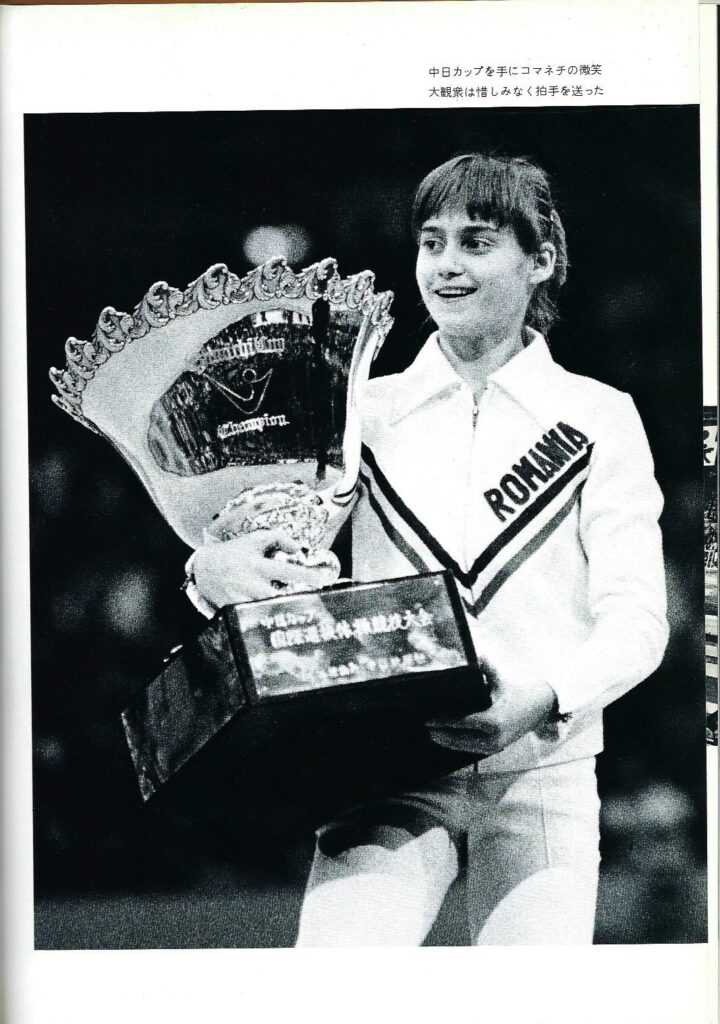
The caption reads: Comăneci smiles, Chunichi Cup in hand —
The great crowd gave her their unsparing applause.
中日カップを手にコマネチの微笑
大観衆は惜しみなく拍手を送った
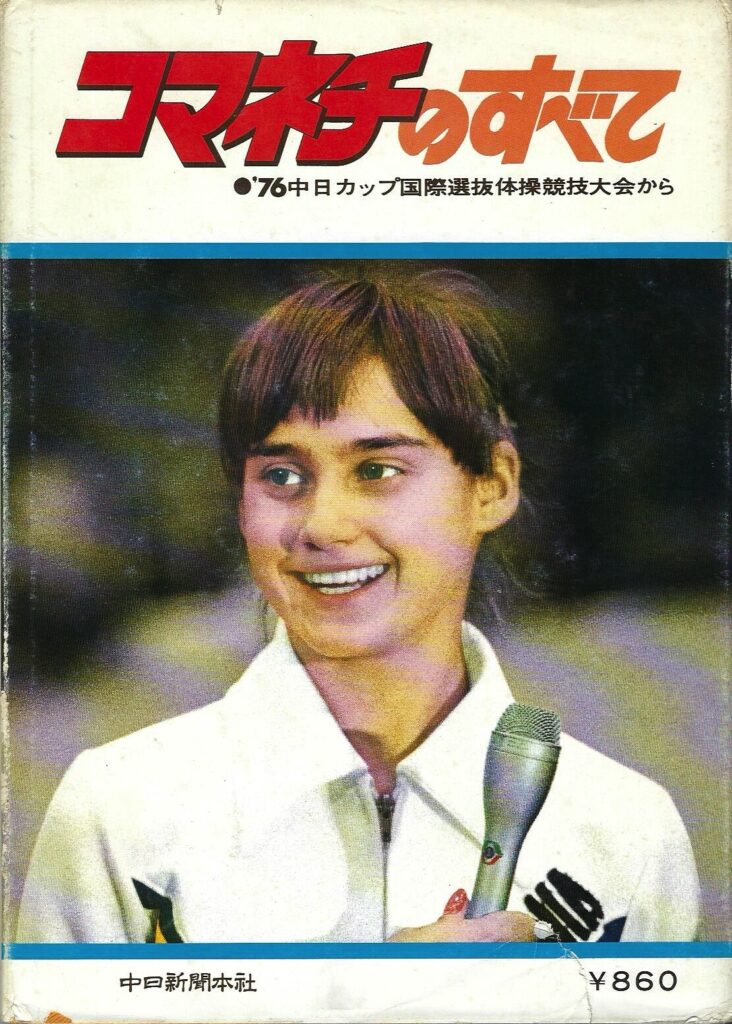
The cover reads: Everything about Comăneci
● From the ’76 Chunichi Cup International Invitational Gymnastics Competition
The original: コマネチのすべて
●’76中日カップ国際選抜体操競技大会から
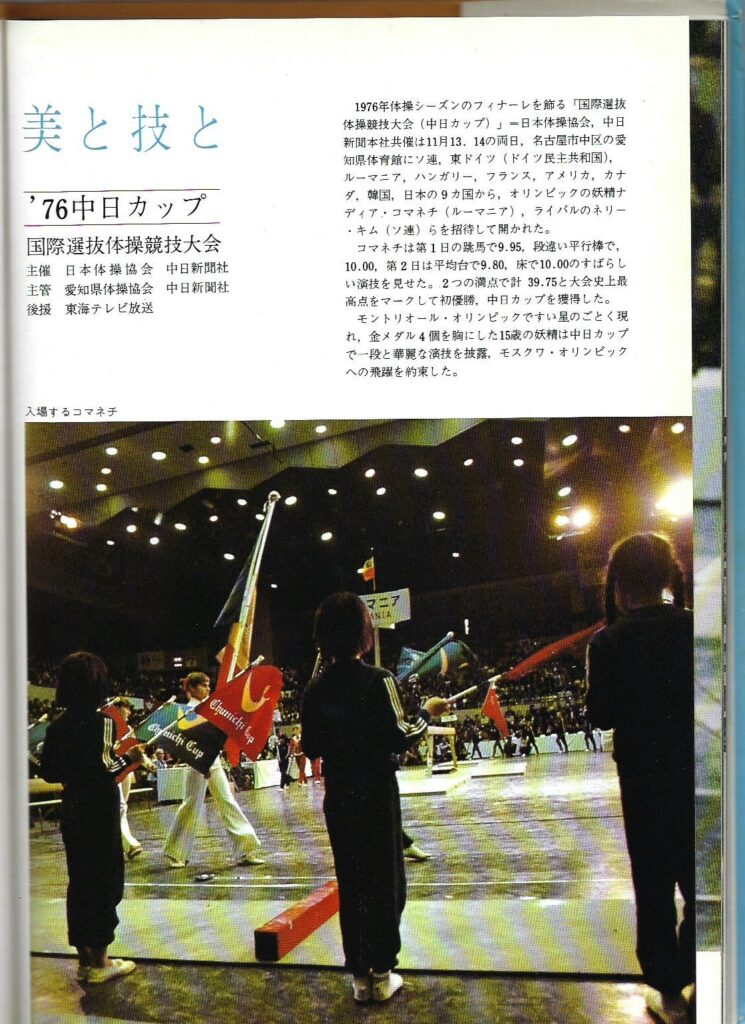
Beauty and Skill
’76 Chunichi Cup International Invitational Gymnastics Competition
Organizers: Japan Gymnastics Association / Chunichi Shimbun Management: Aichi Prefecture Gymnastics Association / Chunichi Shimbun Supported by: Tokai Television Broadcasting
The “International Invitational Gymnastics Competition (Chunichi Cup),” closing out the 1976 gymnastics season, was co-hosted by the Japan Gymnastics Association and the Chunichi Shimbun head office on November 13 and 14 at the Aichi Prefectural Gymnasium in Naka Ward, Nagoya. Invited from nine countries — the Soviet Union, East Germany (the German Democratic Republic), Romania, Hungary, France, the United States, Canada, South Korea, and Japan — were the fairy of the Olympics, Nadia Comăneci (Romania), and her rival, Nelli Kim (Soviet Union), among others.
On day one, Comăneci scored 9.95 on vault and a perfect 10.00 on uneven bars; on day two, 9.80 on beam and a perfect 10.00 on floor. With two perfect scores, her total of 39.75 set an all-time competition record, earning her first-ever Chunichi Cup victory.
Having burst onto the scene like a comet at the Montréal Olympics and wearing four gold medals, the 15-year-old fairy delivered an even more dazzling performance at the Chunichi Cup, giving a promise of even greater things to come at the Moscow Olympics.
Photo caption: Comăneci entering the arena
美と技と
’76中日カップ 国際選抜体操競技大会
主催 日本体操協会 中日新聞社 主管 愛知県体操協会 中日新聞社 後援 東海テレビ放送
1976年体操シーズンのフィナーレを飾る「国際選抜体操競技大会(中日カップ)」-日本体操協会、中日新聞本社共催は11月13.14の両日、名古屋市中区の愛知県体育館にソ連、東ドイツ(ドイツ民主共和国)、ルーマニア、ハンガリー、フランス、アメリカ、カナダ、韓国、日本の9カ国から、オリンピックの妖精ナディア・コマネチ(ルーマニア)、ライバルのネリー・キム(ソ連)らを招待して開かれた。
コマネチは第1日の跳馬で9.95、段違い平行棒で10.00、第2日は平均台で9.80、床で10.00のすばらしい演技を見せた。2つの満点で計 39.75と大会史上最高点をマークして初優勝、中日カップを獲得した。
モントリオール・オリンピックですい星のごとく現れ、金メダル4個を胸にした15歳の妖精は中日カップで一段と華麗な演技を披露、モスクワ・オリンピックへの飛躍を約束した。
Note: The chronology below follows the book’s chronology. The order does not follow the rotation order at the competition.
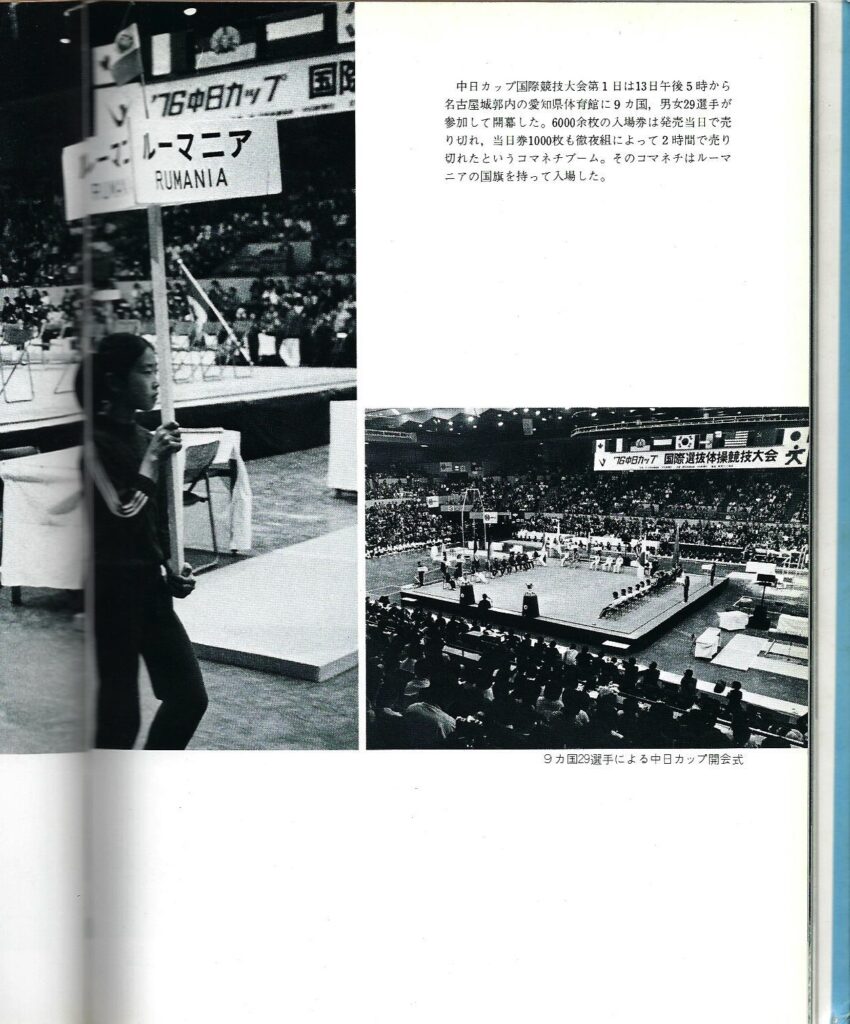
Day one of the Chunichi Cup International Competition opened on the 13th at 5 p.m. at the Aichi Prefectural Gymnasium within the Nagoya Castle grounds, with 29 male and female athletes from nine countries participating. Such was the Comăneci boom that more than 6,000 tickets sold out on the day they went on sale, and an additional 1,000 walk-up tickets were snapped up in two hours by people who had queued through the night. Comăneci herself entered the arena carrying the Romanian flag.
中日カップ国際競技大会第1日は13日午後5時から名古屋城郭内の愛知県体育館に9カ国、男女29選手が参加して開幕した。6000余枚の入場券は発売当日で売り切れ、当日券1000枚も徹夜組によって2時間で売り切れたというコマネチブーム。そのコマネチはルーマニアの国旗を持って入場した。
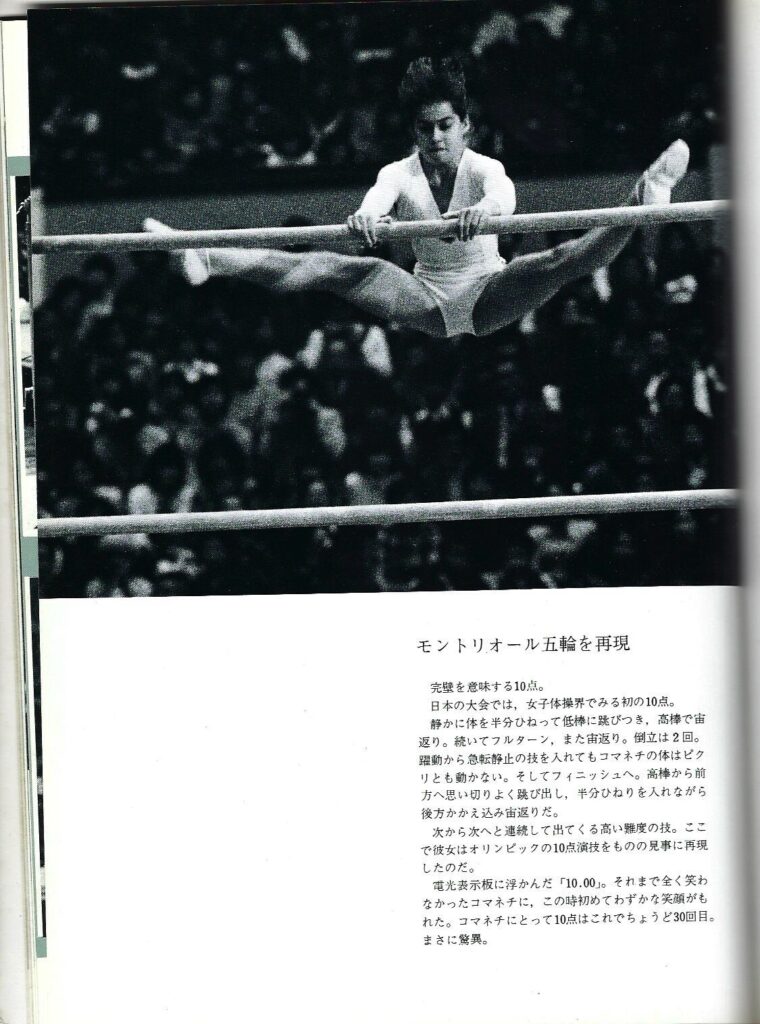
Recreating the Montréal Olympics
A 10 — the score that means perfection.
At a competition in Japan, the first 10 ever seen in women’s gymnastics.
She quietly half-twists and catches the low bar, then swings to a somersault on the high bar. A full pirouette follows, then another somersault. Two handstands. Even when she incorporates an abrupt stop from full momentum, Comăneci’s body does not twitch so much as a hair. Then the dismount: she launches boldly forward off the high bar, executing a tucked back somersault with a half twist. One high-difficulty element after another, in continuous succession.
Here, she had magnificently recreated her Olympic 10-point routine. “10.00” lit up on the electronic scoreboard.
For the first time, a faint smile crossed Comăneci’s face — she had shown none at all until that moment. This was exactly her 30th perfect 10. Truly astonishing.
モントリオール五輪を再現
完璧を意味する10点。 日本の大会では、女子体操界でみる初の10点。 静かに体を半分ひねって低棒に跳びつき、高棒で宙返り。続いてフルターン、また宙返り。倒立は2回。躍動から急転静止の技を入れてもコマネチの体はピクリとも動かない。そしてフィニッシュへ。高棒から前方へ思い切りよく跳び出し、半分ひねりを入れながら後方かかえ込み宙返りだ。 次から次へと連続して出てくる高い難度の技。ここで彼女はオリンピックの10点演技をものの見事に再現したのだ。 電光表示板に浮かんだ「10.00」。それまで全く笑わなかったコマネチに、この時初めてわずかな笑顔がもれた。コマネチにとって10点はこれでちょうど30回目。まさに驚異。
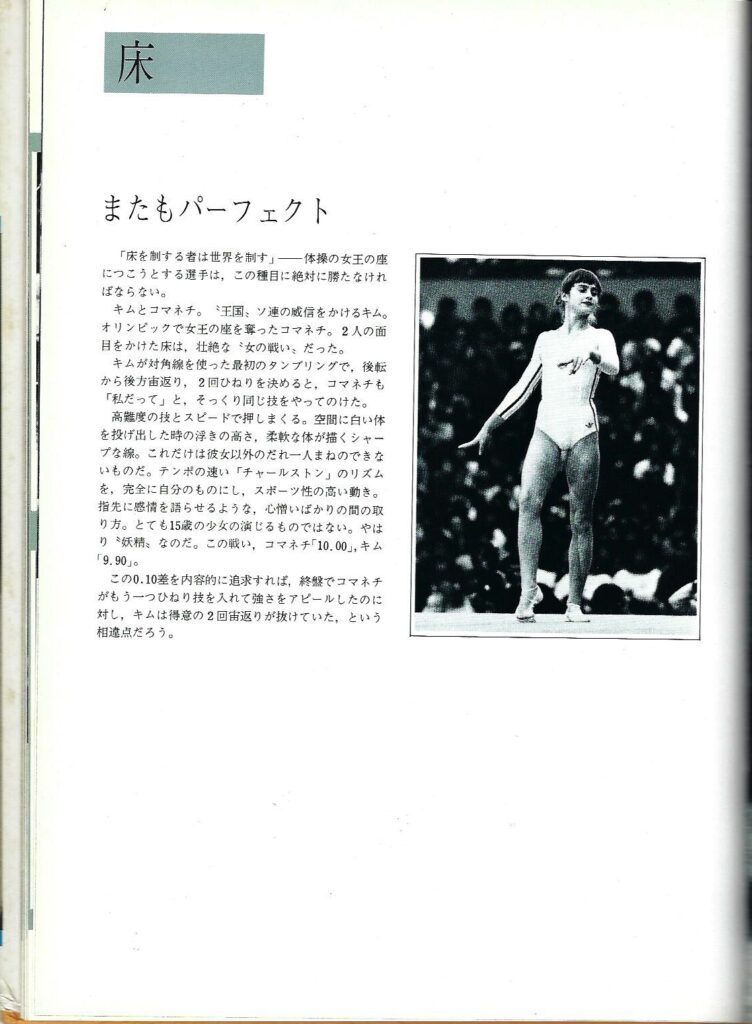
Perfect Again
“He who masters the floor masters the world” — any gymnast seeking the throne as queen of gymnastics must win this event without fail.
Kim and Comăneci. Kim, staking the prestige of the Soviet “empire.” Comăneci, who had seized the queen’s throne at the Olympics. The floor exercise, fought for the honor of both, was a ferocious “battle of women.”
When Kim opened her first tumbling pass on the diagonal — a back handspring into a back somersault with a double twist — Comăneci responded with an attitude of “oh, I can do that too,” executing precisely the same combination. She presses forward with high-difficulty elements and speed. The height she achieves launching her white body into the air; the sharp lines her supple body traces. This is something no one else on earth can replicate. She has made the fast-tempo Charleston rhythm entirely her own — movement of supreme athleticism. The way she speaks with her fingertips, the timing of her pauses so achingly precise. This is not a performance one expects from a 15-year-old girl. She truly is a “fairy.”
The result: Comăneci 10.00, Kim 9.90. If one looks into that 0.10 difference, the key distinction is that Comăneci added an extra twist element late in the routine to assert her dominance, while Kim’s signature double somersault was missing.
「床を制する者は世界を制す」——体操の女王の座につこうとする選手は、この種目に絶対に勝たなければならない。 キムとコマネチ。〝王国〟ソ連の威信をかけるキム。オリンピックで女王の座を奪ったコマネチ。2人の面目をかけた床は、壮絶な〝女の戦い〟だった。 キムが対角線を使った最初のタンブリングで、後転から後方宙返り、2回ひねりを決めると、コマネチも「私だって」と、そっくり同じ技をやってのけた。 高難度の技とスピードで押しまくる。空間に白い体を投げ出した時の浮きの高さ、柔軟な体が描くシャープな線。これだけは彼女以外のだれ一人まねのできないものだ。テンポの速い「チャールストン」のリズムを、完全に自分のものにし、スポーツ性の高い動き。指先に感情を語らせるような、心憎いばかりの間の取り方。とても15歳の少女の演じるものではない。やはり〝妖精〟なのだ。この戦い、コマネチ「10.00」、キム「9.90」。 この0.10差を内容的に追求すれば、終盤でコマネチがもう一つひねり技を入れて強さをアピールしたのに対し、キムは得意の2回宙返りが抜けていた、という相違点だろう。
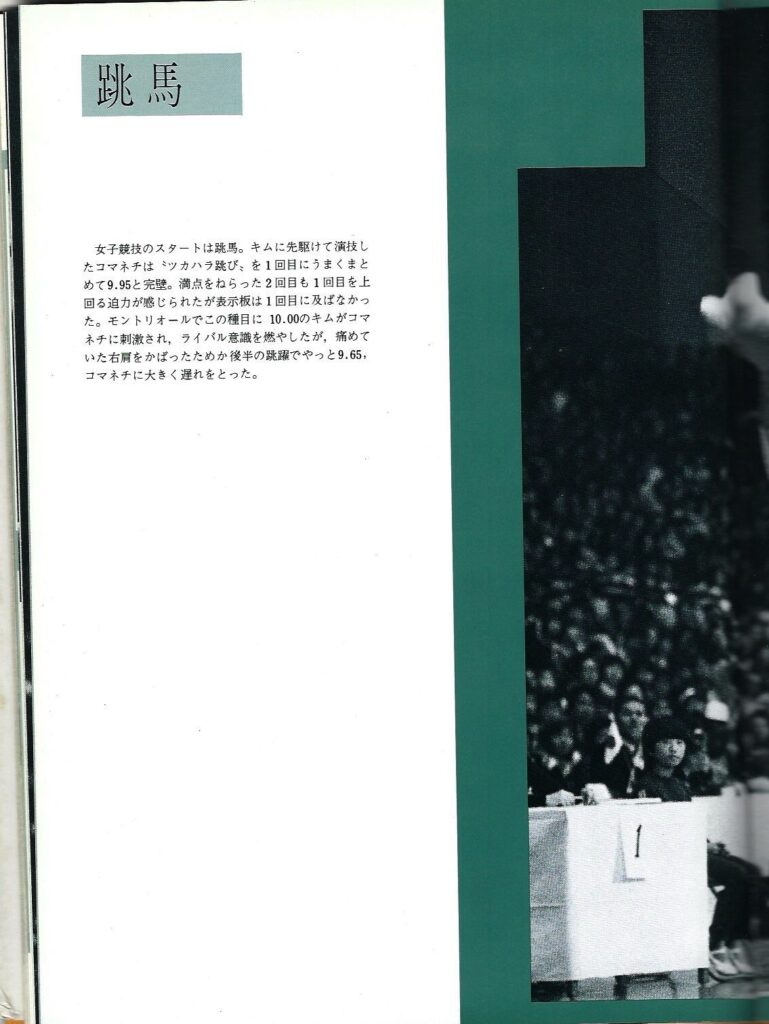
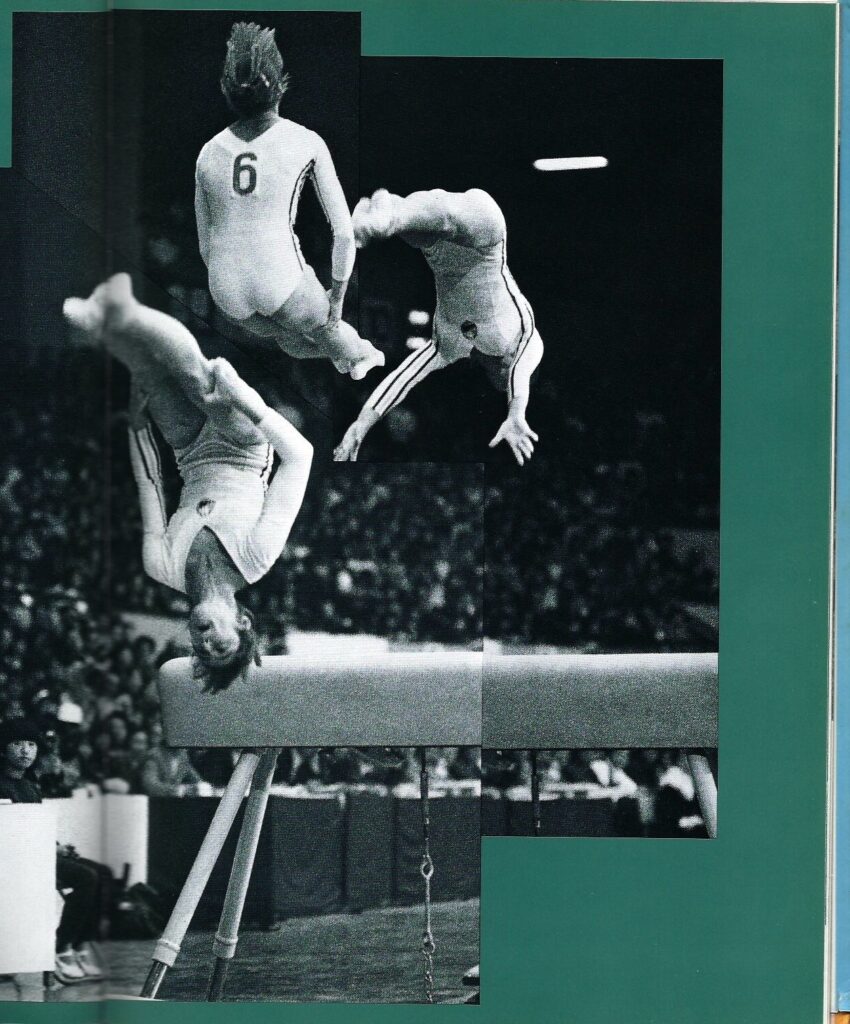
Vault
The women’s competition opened with vault. Competing ahead of Kim, Comăneci neatly executed a Tsukahara vault on her first attempt for a near-perfect 9.95. Her second attempt felt even more powerful than the first, yet the scoreboard did not match it. Kim, who had scored 10.00 on this event at Montréal, was fired up by Comăneci’s performance and brought her full competitive spirit to bear — but apparently protecting an injured right shoulder, she managed only 9.65 on her second vault and fell well behind Comăneci.
跳馬
女子競技のスタートは跳馬。キムに先駆けて演技したコマネチは〝ツカハラ跳び〟を1回目にうまくまとめて9.95と完璧。満点をねらった2回目も1回目を上回る迫力が感じられたが表示板は1回目に及ばなかった。モントリオールでこの種目に10.00のキムがコマネチに刺激され、ライバル意識を燃やしたが、痛めていた右肩をかばったためか後半の跳躍でやっと9.65、コマネチに大きく遅れをとった。
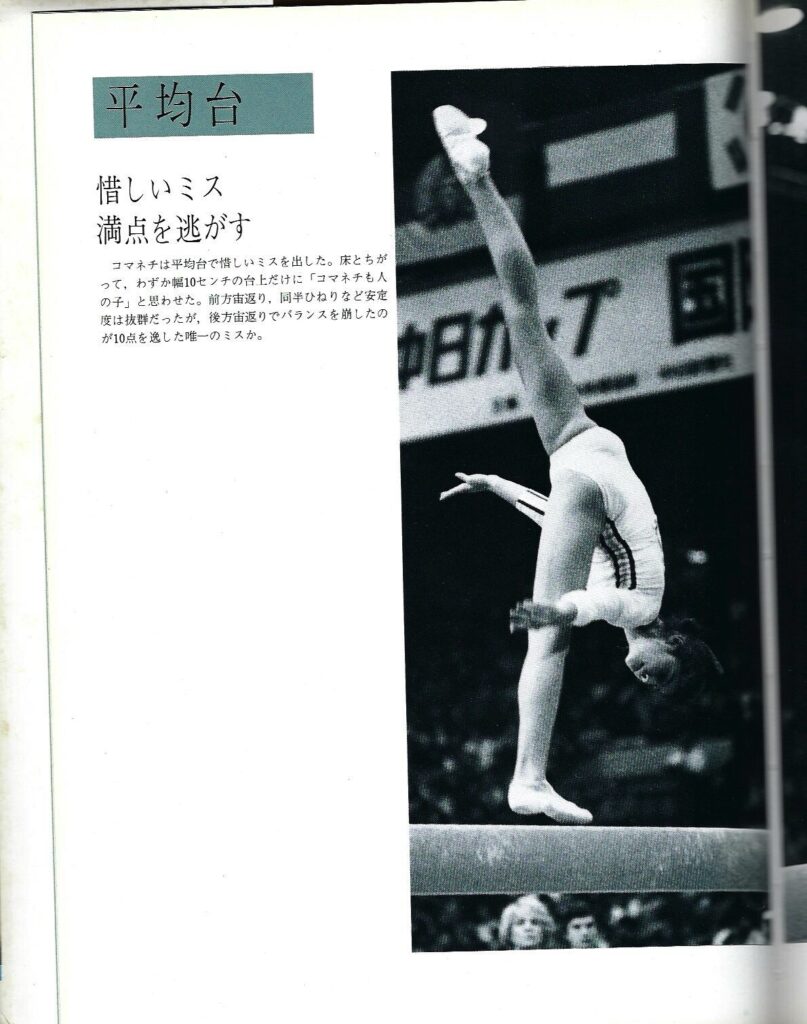
Balance Beam
A Costly Mistake — the Perfect Score Slips Away
Comăneci made an uncharacteristic error on beam. Unlike the floor, where she had been flawless, the ten-centimeter-wide apparatus reminded the audience that “even Comăneci is only human.” Her aerial walkover and aerial cartwheel combinations showed outstanding stability, but losing her balance on a back somersault was perhaps the single mistake that cost her the perfect score.
平均台
惜しいミス 満点を逃がす
コマネチは平均台で惜しいミスを出した。床とちがって、わずか幅10センチの台上だけに「コマネチも人の子」と思わせた。前方宙返り、同半ひねりなど安定度は抜群だったが、後方宙返りでバランスを崩したのが10点を逃した唯一のミスか。
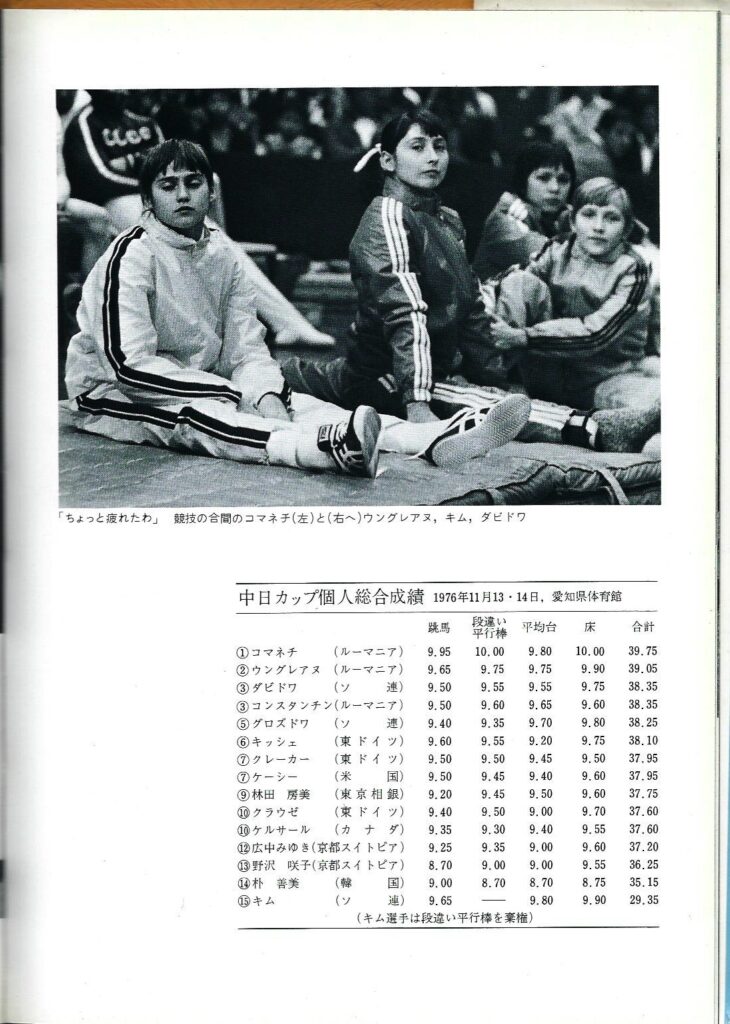
Chunichi Cup Individual All-Around Results
November 13–14, 1976 — Aichi Prefectural Gymnasium
| Rank | Surname | Nation | VT | UB | BB | FX | AA Total |
|---|---|---|---|---|---|---|---|
| 1 | Comăneci | ROM | 9.95 | 10.00 | 9.80 | 10.00 | 39.75 |
| 2 | Ungureanu | ROM | 9.65 | 9.75 | 9.75 | 9.90 | 39.05 |
| 3 | Davydova | URS | 9.50 | 9.55 | 9.55 | 9.75 | 38.35 |
| 3 | Constantin | ROM | 9.50 | 9.60 | 9.65 | 9.60 | 38.35 |
| 5 | Grozdova | URS | 9.40 | 9.35 | 9.70 | 9.80 | 38.25 |
| 6 | Kische | GDR | 9.60 | 9.55 | 9.20 | 9.75 | 38.10 |
| 7 | Kräker | GDR | 9.50 | 9.50 | 9.45 | 9.50 | 37.95 |
| 7 | Casey | USA | 9.50 | 9.45 | 9.40 | 9.60 | 37.95 |
| 9 | Hayashida | JPN | 9.20 | 9.45 | 9.50 | 9.60 | 37.75 |
| 10 | Krause | GDR | 9.40 | 9.50 | 9.00 | 9.70 | 37.60 |
| 10 | Kelsall | CAN | 9.35 | 9.30 | 9.40 | 9.55 | 37.60 |
| 12 | Hironaka | JPN | 9.25 | 9.35 | 9.00 | 9.60 | 37.20 |
| 13 | Nozawa | JPN | 8.70 | 9.00 | 9.00 | 9.55 | 36.25 |
| 14 | Park | KOR | 9.00 | 8.70 | 8.70 | 8.75 | 35.15 |
| 15 | Kim | URS | 9.65 | — | 9.80 | 9.90 | 29.35 |
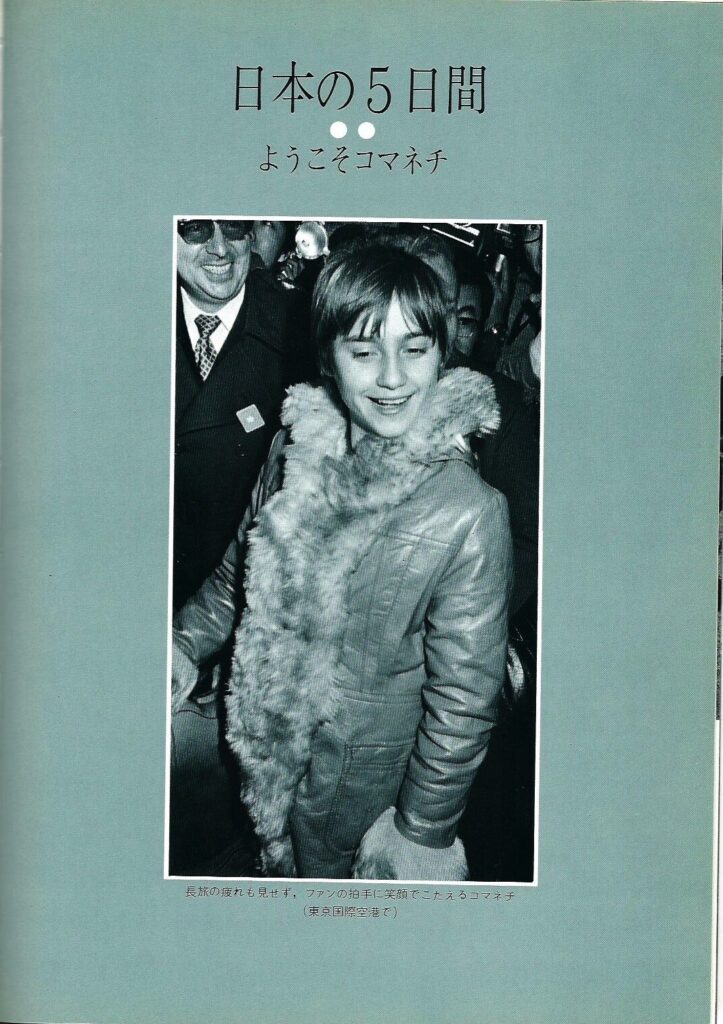
Five Days in Japan
Welcome, ComăneciShowing no sign of fatigue from the long journey, Comăneci responds to the fans’ applause with a smile. (At Tokyo International Airport)
日本の5日間 ようこそコマネチ
長旅の疲れも見せず、ファンの拍手に笑顔でこたえるコマネチ (東京国際空港で)
A Rigorous Daily Schedule
Comăneci arrived at Haneda on British Airways at 6:05 p.m. on November 11. To avoid chaos at the airport, her flight details were kept entirely confidential. Heavy morning fog and a labor strike had disrupted schedules, and she arrived an hour and twenty minutes late — yet the airport was already mobbed by young fans and ordinary members of the public. For a moment, Comăneci’s cherubic face tensed at the rough reception, but she eventually pushed through the crowd, transferred to a domestic flight, and touched down at Nagoya Airport at 8:25 p.m. There too she ran a gauntlet of fans before reaching her lodgings. On the 12th she trained in Nagoya; on both the 13th and 14th she competed at the Chunichi Cup (Aichi Prefectural Gymnasium). On the 15th she took the Shinkansen from Nagoya to Tokyo, then at 11 a.m. boarded a Japan Airlines flight from Haneda to her next competition venue: Hamburg, West Germany.
Having scored two perfects at the Chunichi Cup and swept all of Japan up in a “white fairy” craze, Nadia Comăneci offered glimpses of her unaffected mid-teenage self during her roughly five-day stay.
Her daily schedule in Nagoya was demanding. For three days from the 12th, morning practice began just after 8 a.m. and ran for about an hour and a half; on the 12th there was an afternoon session as well. Wherever she went, a wall of cameras and the eyes of fans followed. She could not even yawn in peace.
Her room was number 1010 on the tenth floor of the Nagoya Miyako Hotel in Nakamura Ward. Once back there, she rarely ventured out — taking naps, listening to music with her roommate Ungureanu, reading. Occasionally Constantin or Coach Károlyi would stop by for a chat.
She ate in the hotel dining room only for dinner on the 11th and perhaps three meals on the 12th. Dinner on the 11th was a small slice of roast beef and a few vegetables. Breakfast and lunch on the 12th were juice, milk, and a small amount of bread. Other meals were taken in her room — not room service, but nutritional food prepared by Coach Károlyi. She did, however, eat three or four apples a day, and also took a French vitamin C solution in ampoule form.
On the morning of the 12th, after practice, when they walked from the Aichi Prefectural Gymnasium to the nearby Chunichi Shimbun head office, she was biting right into an apple as she went.For the taxi rides to and from the gymnasium for practice and competition, she traveled with Coach Károlyi, Ungureanu, and Constantin — all four always crammed into the back seat. It was a tight squeeze to begin with, and Coach Károlyi would occasionally poke her cheeks or play other little pranks, sending Comăneci and the other two into squealing fits of laughter.
In the early morning of the 15th, after their departure, one corner of the room was piled high with gift wrapping. Fans had left more than a hundred presents at the hotel. The night before, savoring her memories of Japan, Comăneci had packed every single one into her bags. “It looks just like after a middle school class trip,” remarked the housekeeper.
The only times Comăneci went out were a midday “stroll” to visit the Chunichi Shimbun head office on the 12th, and a shopping trip after morning practice on the 14th.Slipping out through the hotel’s back elevator with Coach Károlyi, Ungureanu, and Constantin, she headed straight to a nearby electronics shop. After an hour and a half of racing around the floor-to-ceiling displays across three floors, she bought a portable radio, cassette tapes, recording tape, and a voltage transformer.
At her birthday celebration on the evening of the 12th, she was presented with a Japanese doll and a radio cassette player — exactly what she had wanted — and smiled broadly, raising her glass of juice as everyone sang “Happy Birthday to You.”
On the evening of the 14th, a farewell party doubling as a social gathering. During the entertainment portion, the entire Romanian team took the stage and, notes in hand, sang “Haru ga Kita” in halting Japanese. As they were about to leave the stage, Ungureanu drifted over to the piano. Comăneci followed as if drawn along, and the two sat side by side and played “Neko Funjatta” (Chopsticks).
[Note: “Haru ga Kita” (春が来た) is a classic Japanese children’s song whose title translates as “Spring Has Come.”]
An encore was called, and they played another piece. When it was over, American judge Ms. Dalman held up a piece of paper with “10.00” written on it, bringing the house down. Comăneci broke into a grin — but the fact that she had felt at ease enough to show off her piano playing was, after all, entirely in keeping with her guileless 15-year-old self.
A 15th Birthday Celebrated in Nagoya“Happy birthday, Nadia.” On November 12, 1976, while competing at the International Invitational Gymnastics Competition (the Chunichi Cup), Nadia Comăneci celebrated her 15th birthday in Nagoya. The fairy’s radiance shone all the brighter. At a dinner held at the hotel where the team was staying in Nagoya, officials presented her with a Japanese doll and a radio cassette player as a birthday gift. She had been hoping for exactly those things, and her delight showed — her cheeks flushed with joy.
It was a dinner gathering of the Romanian team under team leader Popescu, along with several of the Chunichi Cup organizers. When a candle-lit cake and birthday gifts were brought out by the hosts, Comăneci was visibly surprised. It was the first birthday she had celebrated outside her homeland, Romania, and she had had no idea that anyone would celebrate it for her. That very afternoon, after practice, she had told reporters at a press conference, “Birthdays are really something you want to spend with your family…” And yet here before her were birthday presents — the very things she had been wishing for.
After accepting them with a “thank you,” she cut the cake. “This has become a birthday I will always remember,” she said. “I’ll do my best at the Chunichi Cup.”
A Portrait of Comăneci
Nadia Comăneci — the “white fairy” of women’s gymnastics (Romania). At the Montréal Olympics she scored a perfect 10 seven times (on uneven bars and beam), a feat unprecedented in Olympic history. Her breathtaking performances, seemingly beyond human capability, earned her the nickname “white fairy” and made her the undisputed star of the Games.Comăneci was born and raised in Gheorghe Gheorghiu-Dej, a city about 300 kilometers north of the Romanian capital Bucharest, roughly four hours by train. She lives with her parents and younger brother — a family of four — in a four-room apartment in this quiet town of 60,000 people.
When she returned home with four gold medals, the entire town erupted in celebration. Large portrait photographs of Comăneci, seven or eight meters tall, were displayed on street corners, and President Ceaușescu awarded her one of the country’s highest honors: the Hero of Socialist Labor medal.
Her father’s name is Gheorghe; her mother is Alexandra. Both work as factory laborers. Growing up in an ordinary household, Comăneci was spotted as a child of extraordinary talent by gymnastics coach Károlyi while she was still attending kindergarten, and was trained as a gymnast from that age.
The school she attends is a 12-year specialist gymnastics school in the same town; she is currently in year 9 — the equivalent of ninth grade in Japan. The school has approximately 350 students, all girls. Ungureanu, who placed fourth in the individual all-around at the Olympics, attends the same school. Despite being a gymnastics school, students do not do gymnastics all year round — there are regular classes, and gymnastics practice amounts to three or four hours a day. Her favorite subjects, after gymnastics, are French and English. Her overall academic record, expressed in gymnastics scoring terms, would be a 9.5 — reportedly second or third in her class.
In September: England, the Soviet Union, East Germany. October: France. November: Greece, then the Chunichi Cup — just five days in Japan before flying straight on to a competition in West Germany. A schedule of relentless activity.
At the Headquarters of the Chunichi Shimbun
On November 12, Comăneci and the five other members of the Romanian team walked the approximately one kilometer from the gymnasium to the Chunichi Shimbun head office after morning practice, while athletes from the Soviet Union, France, and other countries came by bus from their lodgings. They enjoyed a relaxed conversation with company executives, and each athlete received a commemorative bag.
Video
Appendix A: Sovetsky Sport’s Coverage of the Competition
FOR THE CHUNICHI CUP
TOKYO, November 15. (TASS correspondent D. Solovyev). The competitions for the Chunichi Cup in the Japanese city of Nagoya concluded today with victories by the Montréal Olympic all-around champion, Romanian gymnast Nadia Comaneci, and Muscovite Vladimir Markelov.
These international competitions, held for the seventh time at the initiative of the Chunichi Shimbun newspaper, brought together 29 athletes from the USSR, GDR, Romania, Hungary, Japan, Canada, the USA, and other countries.
Having received two perfect tens — on the uneven bars and in floor exercise — Comaneci accumulated an excellent total score of 39.75. Second place went to her teammate Teodora Ungureanu — 39.05. The third step of the podium was claimed by young gymnast Elena Davydova from Voronezh, who tied with another Romanian athlete, Mariana Constantin (38.35). Olympic team champion Svetlana Grozdova from Rostov took fifth place with 38.25.
The head coach of the Soviet men’s gymnastics team, Leonid Arkayev, told the TASS correspondent: “I am satisfied with my athletes’ results. Not only Vladimir Markelov (57.20), but also Vladimir Tikhonov (56.65) from Rostov-on-Don, who finished second, and Voronezh athlete Alexander Tkachev (55.50), who was edged out only by young Japanese gymnast Yoshito Teramoto (55.90) in third place — all performed well, despite the fact that the main competitions of the season are already behind us.
The women’s all-around competition lacked a particular competitive edge, since our Olympic champion Nelli Kim was forced to withdraw from the uneven bars: during warmup, a shoulder injury made itself known — one sustained recently during competitions in London.”
In a brief television interview, Comaneci said she considers the current Chunichi Cup competitions a good test of strength ahead of the 1977 European Championships.
On November 16 and 18, athletes will give exhibition performances, and on November 20 and 21 in Tokyo, medals will be contested in individual apparatus events.
Sovetsky Sport, November 16, 1976
НА КУБОК «ТЮНИТИ»
ТОКИО, 15 ноября. (Корр. ТАСС Д. Соловьев). Победами абсолютной чемпионки Олимпиады в Монреале румынской гимнастки Нади Команечи и москвича Владимира Маркелова завершились сегодня в японском городе Нагое соревнования на Кубок «Тюнити».
Эти международные состязания, проводившиеся в седьмой раз по инициативе газеты «Тюнити симбун», собрали 29 спортсменов из СССР, ГДР, Румынии, Венгрии, Японии, Канады, США и других стран.
Получив две «десятки» — на брусьях и в вольных упражнениях, Команечи набрала отличную сумму баллов — 39,75. Второй стала ее подруга по команде Теодора Унгуряну — 39,05. На третью ступеньку пьедестала почета поднялась юная гимнастка из Воронежа Елена Давыдова, «поделившая» ее с еще одной спортсменкой из Румынии — Марьяной Константин (38,35). Олимпийская чемпионка в командных соревнованиях ростовчанка Светлана Гроздова заняла пятое место — 38,25.
Старший тренер мужской сборной команды советских гимнастов Леонид Аркаев сказал корреспонденту ТАСС: «Результатами своих подопечных я доволен. Не только Владимир Маркелов (57,20), но и Владимир Тихонов (56,65) из Ростова-на-Дону, занявший второе место, и воронежский спортсмен Александр Ткачев (55,50), который пропустил вперед только молодого японского гимнаста Иосито Терамото (55,90), оказавшегося третьим, выступили хорошо, несмотря на то, что главные соревнования сезона уже позади.
Соперничество гимнасток в многоборье было лишено особого спортивного азарта, поскольку наша олимпийская чемпионка Нелли Ким вынуждена была отказаться от выступлений на брусьях: на разминке дала себя знать травма плеча, полученная недавно во время выступлений в Лондоне».
В кратком телевизионном интервью Команечи сказала, что считает нынешние состязания на Кубок «Тюнити» хорошей проверкой сил перед чемпионатом Европы 1977 года.
16 и 18 ноября спортсмены проведут показательные выступления, а 20 и 21 ноября в Токио разыграют награды на отдельных снарядах.
Appendix B: Sportul‘s Coverage
“NADIA COMĂNECI CAPTIVATED THE JAPANESE PUBLIC WITH HER PERFECT MASTERY”
The Japanese press offers glowing commentary on the participation of Romanian gymnasts in the international competition for the “Chunichi Cup”
TOKYO, 15 (by telex, from the Agerpres correspondent). — The great international gymnastics competition for the “CHUNICHI CUP,” held over two days in Nagoya, continues to receive extensive coverage in the major Japanese dailies, with particular emphasis on the brilliant results achieved by the three Romanian gymnasts in the competition: Nadia Comăneci, Teodora Ungureanu, and Mariana Constantin, who finished in that order in the top three places in the all-around. As is only natural, numerous photographs and extensive reports are devoted to the exceptional result of Nadia Comăneci, who performed before packed halls of some 7,000 spectators each time, once again earning perfect scores, fully confirming her brilliant successes at the Montréal Olympics.“TOKYO CHUNICHI SPORTS” publishes several pieces on the Nagoya competition, noting that “Nadia Comăneci captivated the spectating public with her perfect mastery. The face and fingers of this great gymnast express beauty, and the beauty of Nadia’s movements is revealed by the unparalleled rhythm with which she executes the most difficult combinations.” In the same newspaper, the Kasamatsu couple — renowned gymnasts — declare of the triple Olympic champion from Montréal: “Nadia Comăneci is a gymnast of consummate technique; the composition of her exercises is excellent and the endings of her routines are executed with unmatched virtuosity. A score of 10 is entirely natural for her, because her performances are quite simply perfect.” Another daily, “NIKKAN SPORTS,” highlights “the perfect style with which she presents her uneven bars routine, an apparatus on which she was scored, as at Montréal, with a 10.” The same paper notes that “it is for the first time in the history of this competition that the winner has achieved such a high score — 39.75 — which speaks eloquently to Nadia Comăneci’s supreme mastery.” The article goes on to remark on the performance of Teodora Ungureanu, who scored 9.90 on floor exercise and earned a worthy second place in the all-around, as well as that of Mariana Constantin, who placed third, tied with Soviet athlete Elena Davidova. “DAILY SPORTS” analyzes Nadia Comăneci’s floor exercise performance, where she received the top score, and notes that “the winner’s overall total is astoundingly high — unprecedented in the Chunichi Cup.”
“Nadia Comăneci brought her participation in the Nagoya competition to a brilliant close, earning her 31st perfect 10, this time on floor exercise, with a flawless performance that delighted the audience” — reports “ASAHI SHIMBUN,” also highlighting the performances of the other two Romanian gymnasts, Teodora Ungureanu and Mariana Constantin. The same paper writes that “Nadia Comăneci abundantly demonstrated her great sporting artistry, earning the top score on the uneven bars before a public that acclaimed her.” “The Chunichi Cup this year was luminous,” writes “TOKYO SHIMBUN,” “thanks to Nadia Comăneci, who demonstrated a supreme technique and a relentless execution tempo. No one can match the height of her flight or the graceful line drawn by her supple body. The mastery of this 15-year-old gymnast is quite simply astonishing.”
Sportul, November 16, 1976
Paul Diaconu
„NADIA COMĂNECI A FASCINAT PUBLICUL JAPONEZ PRIN MĂIESTRIA EI PERFECTĂ”
Presa niponă comentează elogios participarea gimnastelor române la concursul internațional dotat cu „Cupa Kuniki”
TOKIO, 15 (prin telex, de la corespondentul Agerpres). — Marele concurs internațional de gimnastică dotat cu „CUPA KUNIKI”, desfășurat timp de două zile la Nagoya, continuă să fie comentat pe larg de marile cotidiene nipone, subliniindu-se cu deosebire strălucitele rezultate repurtate de cele trei gimnaste române prezente în concurs: Nadia Comăneci, Teodora Ungureanu și Mariana Constantin, clasate în această ordine pe primele trei locuri la individual compus. Cum este și firesc, numeroase fotografii și ample reportaje sunt consacrate rezultatului excepțional al Nadiei Comăneci, care în fața unor săli pline de fiecare dată cu cite 7 000 de spectatori, a obținut, din nou, note maxime, confirmându-și pe deplin strălucitele succese de la J.O. de la Montreal.
„TOKYO KUNIKI SPORTS” publică mai multe materiale pe marginea concursului de la Nagoya, subliniind că „Nadia Comăneci a fascinat publicul spectator prin măiestria ei perfectă. Fața și degetele acestei mari gimnaste exprimă frumusețe, iar frumusețea mișcărilor Nadiei este relevată de ritmul nemaiîntâlnit în care ea execută combinații dintre cele mai dificile”. În același ziar, soții Kasamatsu, renumiți gimnaști, declară despre tripla campioană olimpică de la Montreal: „Nadia Comăneci este o gimnastă cu o tehnică desăvârșită, compoziția exercițiilor ei fiind excelentă iar finalurile de exerciții executate cu o virtuozitate de neegalat. Nota 10 este un lucru foarte firesc pentru ea, deoarece și execuțiile ei sunt pur și simplu perfecte”. Un alt cotidian, „NIKKAN SPORTS” relevă „stilul perfect în care ea își prezintă exercițiul la paralele, aparat la care a fost notată, ca și la Montreal, cu 10″. Același ziar notează că „este pentru prima oară în istoria acestei competiții când învingătoarea realizează un punctaj atât de înalt, 39,75, care este elocvent în ceea ce privește înalta măiestrie a Nadiei Comăneci”. În continuare, este remarcată comportarea Teodorei Ungureanu, care a fost notată cu 9,90 la sol și a obținut un meritoriu loc secund la individual compus, precum și cea a Marianei Constantin, clasată pe locul trei, la egalitate cu sportiva sovietică Elena Davidova. „DAILY SPORTS” analizează evoluția Nadiei Comăneci la sol, unde ea a primit nota maximă, și subliniază că „punctajul general al învingătoarei este uluitor de înalt, nemaiîntâlnit în «Cupa Kuniki»”.
„Nadia Comăneci a încheiat în mod strălucit participarea ei la competiția de la Nagoya, obținând cel de-al 31-lea 10, de data aceasta la sol, cu o execuție perfectă care a încântat publicul” — relatează „ASAHI SHIMBUN”, subliniind și performanțele celorlalte două gimnaste române, Teodora Ungureanu și Mariana Constantin. Ziarul citat scrie, de asemenea, că „Nadia Comăneci și-a demonstrat cu prisosință marea ei artă sportivă, obținând calificativul maxim la paralele inegale în fața unui public care o aclama”. „Cupa Kuniki” a fost în acest an strălucitoare — notează „TOKYO SHIMBUN” — grație Nadiei Comăneci, care a dovedit o tehnică înaltă și un ritm infernal în execuție. Nimeni nu poate egala înălțimea saltului ei și linia fină desenată de corpul ei flexibil. Măiestria acestei gimnaste de 15 ani este pur și simplu uimitoare”.
Appendix C: USGF’s Coverage of the Competition
Chunichi Cup International Elite Gymnastic Competition
Chinuchi Cup — November 13–14 Sabae Exhibition — November 16 Nigatta Exhibition — November 18 Tokyo Invitational — November 19–20
Report By Shirley RuhlmanThe USA Delegation was made up of Kolleen Casey and Wayne Young, gymnasts; Jim Fountaine, coach; and Shirley Ruhlman, Delegation Leader and Judge.
Our original departure was scheduled for November 10th but due to a Japanese ground crew strike against Pan Am Airlines our departure was cancelled through the USGF office and rescheduled for the next day. When it was cancelled again we were re-routed to Northwest Orient.
We arrived at the Tokyo Airport at 10:30 Friday evening and were greeted by enthusiastic, but somewhat worn out hosts. They had met every plane from the USA for the past 36 hours!
Because of the late hour we were taken to a nearby hotel. We were up at 5:00 a.m. the next morning to travel by train to Nagoya where the Chinuchi Cup was being held that afternoon at 5:00 p.m. The rest of the teams were having short workouts, but Wayne and Kolleen decided to rest and arrive at the competition site two hours before the Opening Ceremonies.
With my new gray skirt at the stylish length, I waited for Madame Berger to arrive and impart any information I had missed at the Judges’ Meeting on Friday. At approximately 4:45 when the judges assembled, I was informed I would not be allowed to judge. Reason: I did not attend the judges’ meeting the day before. Anguish! I could not convince them differently. The Judging Panel consisted of Madame Berger, GDR, superior judge; Maria Simeonescu, Rumania; Galina Shamrai, USSR; Fay Weiler, Canada; and Masaaki Yamazaki, Japan.
CBS filmed the meet with Muriel Grossfeld commentating and it was to be billed as the head-on-clash between Nadia and Nelli. Please watch CBS in January to see how it really happened. Contrary to rumor, Naadia never looked better, a couple inches taller and a few pounds spread out in the right places — she was lovely and as confident as always.
After an impressive opening ceremony with the Chinuchi Cups dramatically displayed, the two day meet began. There were good crowds both days and many waited after the meet to catch glimpses of the female stars.
A dinner party was held immediately following the competition with our Japanese hosts displaying their appreciation by many speeches and gift giving. The big surprise came when the official translator informed each delegation leader that it was customary for each country to perform a song or dance as a courtesy to our hosts. Panic among the USA Delegation! Wayne wanted Mickey Mouse, Kolleen wanted “You Are My Sunshine”, Coach Fountaine wanted to hide under the table and Ruhlman opted for teaching the Hokey Pokey. Wayne and Ruhlman triumphed. I’m happy to report the first 10.0 by an American team. Yan Viltsan, Russian delegation chief held up a 10.0 as we hastily rushed from the stage.
Naadia and Theodora played a duet and sometime in the early morning hours the Rumanian party left the hotel for home.
The next five days were spent on trains, busses, motels and very cold gymnasiums. The Japanese being more energy conscious believe that wrapping in blankets will keep you warm. Our first exhibition was in Sabae and in this gym Markelov fell on the back of his head out of a double back and gave everyone a real scare. He did not perform the remainder of the tour but he appeared healthy.
Kolleen performed in exhibition as she would in a meet. All out! The same was not true of the star of the tour. I’m sure the Japanese were a little disappointed in the lack of polished performances accompanied by expressions that came across as boredom.
On to Nigatta for our second exhibition and two receptions, then for a six hour train ride to Tokyo. Except for the roofs of the houses, the countryside looked much like Oregon in November.
We arrived in Tokyo, Friday afternoon and were taken directly to the Palace Hotel. Several foreign embassies met their gymnastic delegations, most prominent being the Russians. We found on this trip the Russian group very friendly. There were seventeen in all, six gymnasts, but also a man and a woman judge, a security person and a beautiful young female translator.
The Tokyo Invitational was minus the Rumanian women and Markelov, but they replaced the Japanese men with Olympians, Tsukahara, Horide and Okamura. They ran men’s competition Saturday and women on Sunday. Just like home, the crowd was sparse for men’s competition but large and appreciative for the women. The meet was held in the 1964 Olympic Swim Stadium, which is used for ice hockey this time of year. The ice was covered with a thin plastic sheet and the gymnasts performed on a podium. All personnel were wrapped in blankets except for the gymnasts.
Kolleen had an excellent trip, performance wise. She had good draws, seemed to have recuperated from being in China with only two days rest before leaving for Japan. Her handspring full was excellent but she couldn’t stick it. She placed 3rd in the Tokyo meet with this vault. Coach Fountaine said it was the best bar routine he had seen her do. She placed 4th. Solid beam routines, with excellent foot work, and the only gymnast to perform more than a full turn. Nelli complimented her on her beam style. Music-wise her floor was superior. The audience related to her music and expression but as Kolleen said, it wasn’t the same without Art playing for her.
Wayne seemed to suffer somewhat from our late arrival and little rest prior to competition. His performance was excellent except for a break on pommell horse which dropped him from 4th to 12th in the Chinuchi Cup. Wayne had everyones attention in Nigatti when he executed a 1-1/2 twisting 1-3/4 on Floor. At that point, I’ve never seen so many cameras. By the meet in Tokyo, Wayne was really ready, as he placed 5th on pommell horse and 4th on parallel bars. He was very popular with the Japanese since he spoke their language.
The young Russian men at this stage are doing superior difficulty with equal execution to the older Japanese and the next time out the Russians will be near impossible to beat. Markelov won the Chinuchi Cup with Tikhnov 2nd and Tkachev 4th.
Out of 14 competitors, only two didn’t do a double back on floor. There was one triple twist, and at least four full in doubles. On side horse, Magyar of Hungary cannot be touched. There was a lot of back work by everyone, but scissors were generally low and poorly done. Rings had all straight swing but strength was only adequate. On vault everyone did a full twist tsukahara, kasamatsu or double front. Wayne felt the judging was good as compared to Montréal. The men’s judging panel was made up of Hungary, France, Russia and Japan.
Nadia’s routines were the same as Montréal except for a back tuck on beam. Her floor was much more polished and received a 10.0. Theodora was a little heavier with basically the same routines. The Rumanian’s third girl was Constantin, a good vaulter and tumbler with an excellent double full, but worked beam flat footed and without expression as do her teammates. The East Germans were new except for Kische. She had an original beam routine including a side handstand immediate drop to chest stand in stag position. Kraker, her teammate, had a free hip to full twist on bars. Both Kische and Kraker used abstract floor music with percussive movement. The music and routines did not fit the girls, and they used all backward tumbling, but the scores were generous.
Davydova, USR, was the most exciting performer and certainly the most happy, bubbly personality. Her vaults were handspring front and full, on full off. Her tumbling passes were a double back, a double full, and an excellent arabian. She was a 4’7″ pixie looking girl built similar to Filatova, but less mechanical. Grozdova, USR, had the most original and exciting beam and floor, but is weak in the lower back and is a poor vaulter. As we all know by now archy bar routines are acceptable internationally and in the Tokyo meet she was 1st. She had an exciting combination, a straddle drop to handstand from HB to LB, immediately bouncing, front flip back to HB. She worked beam like Kyle Gaynor, with many super flexibility moves.
Nelli had been vacationing prior to this trip and was much heavier. She turned-on only during competition. Her vault was a rudy and she did not perform bars the entire trip due to a sore shoulder. She is training a full in back out in tumbling. Interesting note — she wore a gold necklace at every performance and during the Tokyo meet, her necklace got caught in her earring and took some time before it worked loose.
By the end of the tour all the gymnasts, including the GDR women, were friendly and helpful on the floor and off. As I mentioned before, the Russians seemed to have taken a turn about since their last trip to Japan. Their entire delegation was warm and showed a good sense of humor. Madame Berger, our new FIG President, was an imposing in deed! In contrast to Madame Nagy, she is young and robust. The three GDR girls looked to her constantly during workouts and after a performance they appeared to be looking for her approval even though they had a woman trainer on the floor with them at all times.
The USA group of four were a very compatible group and thank goodness, the USGF decided to send a coach. Jim Fountaine was quite evident on the floor, not only with Wayne and Kolleen, but with Karen Kelsall, who represented Canada, but trains with the Mulvihills. We all felt that an earlier arrival in Japan would have effected a different outcome, at least for the Chinuchi Cup.
USGF News, January/February, 1977
Appendix D: East Germany’s Coverage
Olympic Revenge Match Falls Through
Nagoya. ADN/BZ
All-around Olympic champion Nadia Comăneci (Romania) and Vladimir Markelov (USSR) secured the top places at the international gymnastics competitions for the Chunichi Cup in Nagoya, Japan. Twenty-nine gymnasts from eight countries took part. Among the 15 female competitors, the 15-year-old Nadia was in a class of her own. The anticipated rematch with Nelli Kim, the Olympic runner-up in the all-around, fell through, however, as the great Soviet gymnast had suffered a painful shoulder injury on the vault.
The Romanian missed the ideal all-around score of 40.00 by only 0.25 points, finishing with 39.75, and received a “10” for her uneven bars routine. The following places went to Ungureanu (39.05), Constantin (both Romania), and Davydova (USSR, 38.85 each).
In the men’s optional six-event competition, the young Soviet gymnast Markelov triumphed with 57.20 points ahead of his compatriot Tikhonov (56.65) and Teramoto (Japan/55.90). The participating East German athletes were well placed after the first day through Marion Kische (3rd) and Lutz Mack (5th), but were ultimately unable to finish in the rankings.
Berliner Zeitung, November 15, 1976
Olympia-Revanche fiel aus
Nagoya. ADN/BZ
Mehrkampf-Olympiasiegerin Nadia Comaneci (Rumänien) und Wladimir Markelow (UdSSR) sicherten sich die ersten Plätze bei internationalen Turnwettbewerben um den Chunichi-Pokal in Nagoya/Japan. Beteiligt waren 29 Turnerinnen und Turner aus acht Ländern. Unter den 15 weiblichen Startern war die 15jährige Nadia eine Klasse für sich. Das erwartete Duell mit Nelli Kim, der Olympiazweiten im Mehrkampf, fiel allerdings aus, da sich die großartige sowjetische Turnerin beim Pferdsprung eine schmerzhafte Schulterverletzung zugezogen hatte.
Die Rumänin verfehlte die Kür-Vierkampfidealnote mit 39,75 Punkten nur um 0,25 Punkte und erhielt für ihre Übung am Stufenbarren eine „10″. Auf den Plätzen folgten Ungureanu (39,05), Constantin (beide Rumänien) und Dawydow (UdSSR, je 38,85).
Im Kür-Sechskampf der Männer triumphierte der junge sowjetische Turner Markelow mit 57,20 Punkten vor seinem Landsmann Tichonow (56,65) und Teramato (Japan/55,90). Die beteiligten DDR-Aktiven lagen nach dem ersten Tag durch Marion Kische (3.) und Lutz Mack (5.) gut im Rennen, konnten sich dann aber nicht plazieren.