Liu Xuan is remembered as one of Chinese gymnastics’ most enduring figures: an Olympic balance beam champion at twenty years old, the first Chinese female gymnast to compete at two Olympic Games, and a gymnast who refused to follow the sport’s unwritten rule that a woman’s competitive prime ends in her teens. This 2007 Southern People Weekly profile captures her at a moment of reinvention—now seated at the judges’ table.
What the profile does not mention is that Liu Xuan’s longevity came with a hidden asterisk. During her career—and even today—two different birthdays appear in the record. For competition purposes, she was registered with a 1979 birth year, and journalists sometimes used that date when calculating her age. Yet some sources, including the article translated below, use 1980 as her birth year.
The difference of a single year carried real consequences at the beginning of her career. Under the age rules in effect in 1994, a gymnast born in 1980 would have been too young to compete at the Hiroshima Asian Games, where Liu won team gold and a silver on uneven bars, and too young for the Dortmund World Championships, where China finished fourth as a team. With a birth year of 1979, she cleared the eligibility threshold in both cases. By the end of her career, the discrepancy had become little more than a statistic. Was she twenty or twenty-one when she won beam gold and the all-around bronze in Sydney? The answer does not matter all that much.
Liu herself preferred to frame her career less in terms of numbers than in terms of curiosity and experimentation. “I like trying new things. At first, you don’t know where your potential lies, so you have to try,” she remarked in Southern People Weekly. That spirit runs through the articles below. From experimenting with one-armed giants to competing in two Olympic Games to pursuing a career in the entertainment industry to judging elite gymnastics, Liu was always trying something new.
What follows is a translation of the Southern People Weekly profile, along with several People’s Daily articles that trace the contours of her career.
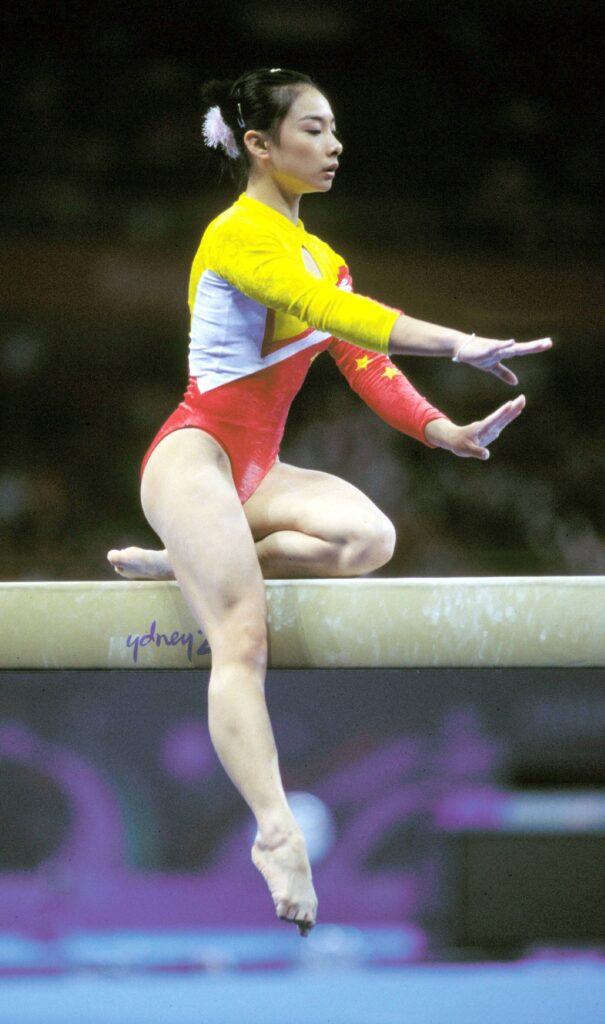
Liu Xuan, the Judge
Originally published in Southern People Weekly, issue no. 26, 2007,
Republished by China News Service, January 16, 2008
By Yi Lijing
There are rules in the world of sports—very simple ones: as long as you can endure hardship, that’s enough. But in the entertainment world, there has never been a universally accepted standard of judgment. Still, whether in sports or entertainment, only those who produce results earn recognition.
I Will Continue to Be “Picky”
“Women’s balance beam Group B, judge number one—Liu Xuan.”
The announcer’s voice rang out through the arena during the Women’s Artistic Gymnastics All-Around Final at the Sixth National City Games.
Former Olympic gymnastics champion Liu Xuan appeared at the judges’ table in a gray suit. Her eyes were fixed intently on the athletes competing as she calculated scores with a pen and raised her scoring card.
In the women’s qualification round, Fan Ye was the only competitor from the Chinese national gymnastics team. Although she made no major mistakes across the four events, her overall performance was not very strong. On balance beam, especially, many elements were judged to be incomplete, and deductions were taken. When she saw her scores, Fan Ye burst into tears on the spot.
After the competition ended, Liu Xuan left the judging table and walked into the athletes’ area to comfort Fan Ye, using her professional judging knowledge to explain the reasons for the deductions.
This was the third time Liu Xuan had served as a judge since earning her judging certification.
She still remembers how she felt the first time: “I was a little nervous. When the first gymnast went up, I was afraid of scoring incorrectly, because I’m the type of person who gets dizzy looking at numbers.” To avoid mistakes, Liu Xuan carefully recalculated several times before confidently raising the scorecard.
Her first judging assignment resulted in her being rated Outstanding Judge.
“Before, others evaluated me; now I evaluate others—it’s very different. After becoming a judge, I realized that many movements spectators think look good still appear imperfect and imprecise to judges. Following the principle of strictness, we have no choice but to deduct. For national team athletes, we must be even stricter; they need greater challenges.”
When speaking about judging, Liu Xuan’s expression became serious and her words precise.
“I’m a living example. At the 1999 World Championships in Tianjin, my jump connection on balance beam was borderline—whether it counted or not. The judges ruled it didn’t connect, and I lost my chance to reach the final. The gymnastics center leadership had specifically emphasized that everything at that competition should be judged strictly: if an element was borderline countable, it would not be counted; if a deduction might or might not apply, it would be taken; if a deduction could be 0.3 or 0.5, they would apply 0.5. The goal was only one: to identify problems early and avoid mistakes at the Olympics.”
Liu Xuan said that in preparation for the 2008 Olympics, she would continue to be “picky.”
For many retired athletes, becoming a coach or judge seems a natural choice. But Liu Xuan had already been thriving in the entertainment world, frequently appearing on stages and at fashion events. Seeing her set aside the glamour and return to the arena surprised many people.
“Compared with the entertainment industry, being a judge offers no real material benefit. I became a judge for two reasons. First, after more than ten years in gymnastics, I’ve never been able to let it go, but I had no other way to stay involved; the only option was to pursue a judging license. Second, when I competed as an athlete, there were almost no Asian judges at the events. If a judge from your own country is present, athletes from that country feel psychologically different.” She added that as a former athlete, contributing something to gymnastics was also her responsibility.
Most importantly, sitting inside a sports arena made her feel that “this is the place where I most belong and where I feel most at ease.”
Liu Xuan said frankly that when she first decided to pursue a judging license, it was a major challenge, because “gymnastics rules have changed so dramatically in recent years that even those of us trained as gymnasts find it hard to adapt. There is so much to memorize and so much to change.”
Having already obtained an international judging license, Liu Xuan’s goal was a seat on the judging panel at the 2008 Olympic gymnastics competition.
Scenes of Defeat Appearing in My Dreams Every Day
September 2000, Sydney. Just minutes before the balance beam final, Liu Xuan felt in excellent condition—though slightly nervous. China had two athletes in the event, and the first to compete, Ling Jie, did not perform very successfully.
“If Ling Jie had done well ahead of me, there might have been a little less pressure on me. We were strong contenders for the gold on balance beam.” Coach Lu Shanzhen noticed her nervousness: “Just go for it today. Holding back gives you a fifty percent chance of success; going all out and performing your best routine also gives you fifty percent. At worst, you fail. If you dare to risk it today, you’ll succeed.”
Liu Xuan thought to herself: “At worst, I’ll finish eighth.”
Her routine lasted one minute and twenty-one seconds—she remembers it very clearly.
When she stuck a beautiful somersault dismount, the entire world saw her confident smile.
As the national flag rose during the medal ceremony, Liu Xuan stood on the podium, unable to stop her tears. The five-meter balance beam had taken her fifteen years to cross before she reached the Olympic champion’s podium.
Born in 1980 in Changsha, Hunan, Liu Xuan began gymnastics at age five, entered the Hunan provincial team at eight, and joined the national team at thirteen. She was one of the core members of the Chinese women’s team during its dominant years in the 1990s, competing alongside Mo Huilan, Zhou Duan, Qiao Ya, Ye Linlin, Ji Liya, Bi Wenjing, Meng Fei, Kui Yuanyuan, and others.
Liu Xuan became the first Chinese female gymnast to compete in two Olympic Games and set the record as the oldest member of the Chinese women’s gymnastics team. While the optimal age for success in women’s gymnastics is generally fourteen to seventeen—and world champions tend to be younger still—Liu Xuan was an exception.
She had a chance to win a world title at the ideal age during the 1996 Atlanta Olympics. “That is my deepest pain,” she said. “That year, both my age and my physical condition should have produced my best results. But somehow, an element, which I had successfully completed a hundred times on bars, failed me at the most crucial moment.”
After the Olympics, the blow of defeat combined with years of accumulated injuries—a damaged knee, a herniated disc, a torn ligament in her right foot—and the departure of two coaches who had trained her for years left her feeling a loneliness she had never known before. “During that period, I felt like an orphan, with nothing and no one to depend on. The scenes of that failed competition appeared in my dreams every day for a long time.” For many athletes, competing in one Olympics is already an achievement. In Liu Xuan’s mind at that time, her gymnastics career was finished.
After retiring, Liu Xuan stayed on with the national team briefly as a coach. When the National Games were approaching, the Hunan team—which had developed her—hoped she would compete for them, so Liu Xuan returned to the training floor.
“Wake up at 5:30 a.m., one hour of morning exercises, then training from 6:30, one hour of rest at midday, then training again in the afternoon—more than ten hours of practice a day.” To build her strength, she repeatedly shouldered barbells that even male athletes found daunting; to build arm strength, she often hung from the uneven bars one-handed until she could no longer hold on and fell; to increase difficulty, she sometimes incorporated elements from men’s gymnastics. Falls from apparatus were an everyday occurrence.
“During that time, the first thing I thought every morning was: what day is it? What do I train today? Honestly, I had trained enough.”
After more than a year of this, one day, something changed. “There was no special reason. It was like training in martial arts, where you suddenly reach a certain level and attain enlightenment,” Liu Xuan said with a laugh. “After that, life got much easier. My body was exhausted, but my heart was very happy. Even though I was repeating the same movements every day, I could feel the subtle differences. My technique improved dramatically. That feeling was truly beautiful.”
Liu Xuan had not expected that this return would eventually bring her back to the world stage. When she stood on the Olympic podium at twenty years old, what she most wanted to tell her younger teammates was: to defeat others, you must first defeat yourself.
“I Don’t Want to Give Up My Identity as an Athlete”
After retiring, Liu Xuan—like many world champions—chose to return to school. She enrolled in the journalism department at Peking University. “Supplementing my cultural education was the most urgent priority. Even a world champion will be left behind by society if she doesn’t keep learning.” She chose Peking University for its reputation, and chose journalism because she was already familiar with sports; she figured she could become a sports journalist after graduating.
In her first year, Liu Xuan felt anxious. “I felt like I had energy but nowhere to direct it—like bungee jumping, where it’s easy to miss your footing. That year, I studied extremely hard, constantly making up missed lessons, and I even thought about dropping out. So many years away from school had left too large a gap in my foundational knowledge.” Taking lecture notes was her biggest headache—she could not keep up with the pace of the teachers’ lectures. But more than ten years in gymnastics had forged in her a character that refused to accept defeat: “The more people say I can’t do something, the more determined I am to do it well.” Liu Xuan particularly admires Liu Dehua [Andy Lau]: “Whatever he has achieved, he got through diligence and hard work.”
In 2000, while winning gold in Sydney, Liu Xuan appeared in the television series A Family Touring Australia, a documentary project involving Olympic champions. Although she filmed for only one day, she became captivated by the feeling of being in front of a camera. In early 2002, she appeared in the film My Beautiful Nostalgia. After that, she became a multi-platform celebrity—singing, acting, hosting, and appearing in advertisements.
Liu Xuan describes her own personality as quiet and slow to warm up—not naturally suited to hosting. “Being a host is like being a madwoman; you have to constantly adjust your emotional state. One moment you’re crying with children, and the next you have to smile and carry on.” When she first started hosting, “I didn’t dare watch myself. I seemed so frantic, nothing like myself at all. It was very strange.” Now she has not only grown accustomed to that life but actually enjoys it.
“Everyone has things they love. I like trying new things. At first, you don’t know where your potential lies, so you have to try.”
In Liu Xuan’s view, the world of sports is simpler than the entertainment world. “In sports, my goal is the championship—train hard, and that’s enough. A ten is the highest score; get a ten, and you’re champion. In the entertainment world, if you want to stand out and become a star, you have to follow its rules. Sports also have rules—very simple ones: as long as you can endure hardship, that’s enough. But in the entertainment world, there has never been a universally accepted standard. Still, in both worlds, only those who produce results earn recognition. Don’t expect others to know the suffering of honing your sword for ten years.”
In 2005, after careful consideration, Liu Xuan signed with a management company under Li Ning. Together with Li Ning and other prominent former athletes, she also helped establish an Athlete Education Foundation, “with the goal of helping athletes find new paths in life after retirement.”
On her blog, she wrote: “I have always hoped to open up a new road for athletes after they transition out of sport.” She emphasized that she was only someone on the periphery of the entertainment world, and the identity she was least willing to abandon was her identity as an athlete.
Appendix A: A Note on Liu Xuan’s Age
During her competitive career, newspaper articles often matched her competitive birth year of 1979. For example, when she won gold on balance beam at the Sydney Olympics, the article in the People’s Daily emphasized that she was 21, repeating her age twice.
Xuan Outshines the Big Dipper, Leaving a Thousand Stars Dim
People’s Daily, September 26, 2000, Page 8 (Olympic Special Edition)
By Xue Yuan
This was Liu Xuan’s first Olympic gold medal—and also her last. It was also the first-ever Olympic balance beam gold for the Chinese gymnastics team.
In the balance beam final, two Russian gymnasts posted high scores of 9.787 and 9.775. Liu Xuan competed last. She may not have realized then that this would be her final Olympic appearance.
During warm-ups, her coach, Li Xiaoqing, told her:
“Xuan, today let it go. If you hold back, your success rate is 50 percent; if you open up and do a high-quality routine, it’s also 50 percent. At worst, you fail—but it depends on how you choose. If you go all out, you’ve got a chance.”Six judges scored her routine; five awarded her 9.8 or higher.
“My mind went completely blank,” said Liu Xuan—usually eloquent—using the only words she could find to describe that moment.
“I fulfilled my mother’s dream,” she said. Liu’s mother, once a gymnast herself, was the one who first led her into the sport.
“My gold medal belongs to my coach,” she added. After the Atlanta Olympics, when Liu’s performances were unremarkable, she had planned to retire. It was head coach Lu Shanzhen who persuaded her to stay and designed a training plan tailored specifically to her strengths. “My gold medal belongs to everyone who has helped me.”From stepping off the beam to standing on the podium, the 21-year-old Liu Xuan never forgot to thank everyone she could think of.
For female gymnasts, 20 is often seen as the upper limit of an athletic career. Weight gain, changes in body shape, and injuries had long plagued her. “Liu Xuan paid a tremendous price for today,” Lu Shanzhen said. “She was outstanding—her choreography, rhythm, tempo, and the beauty she expressed on the beam were all unique.”
“Twenty-one is indeed old for a female gymnast,” Liu Xuan said. “But what matters most is whether you still want to do it. I love this sport deeply. Today, I reached the most perfect ending.”
(Sydney, September 25 dispatch)
璇耀北斗千星黯
本报记者 薛原
这是刘璇的第一枚奥运会金牌,也是她的最后一枚奥运会金牌,同时还是中国体操队的第一枚奥运会平衡木金牌。
平衡木比赛,两名俄罗斯选手先后拿下9.787和9.775的高分。刘璇最后一个出场,刘璇大概并没有意识到,这也许是她人生中的最后一次奥运出场。
做准备活动时,教练李晓青对她说:“璇,我们今天放开做。你捏着劲做是50%的成功率,放开了做个优质套路也是50%的成功率。大不了就是失败,看你怎么把握了,豁出去就有。”
六名裁判,有五个给了她9.8以上的高分。“我的脑中一片空白,”平时很能说的刘璇,此时只找到了这句话来形容她那一刹那的心情。“我为我妈妈圆了梦想,”刘璇的母亲曾是一名体操运动员,也是将刘璇带入这扇大门的人。“我的金牌属于教练,”亚特兰大奥运会后,表现一般的刘璇打算退役,是陆善真教练苦劝她留下,并按照她的特点制定了专门的训练计划。“我的金牌属于所有帮助过我的人。”从走下体操台到登上领奖台,21岁的刘璇始终没忘了感谢她想起来的每个人。
对一个体操女选手来说,20岁似乎是一个运动生命的极限。体重的增加、体形的改变和伤病一直困扰着她。“为了今天,刘璇付出了很多,”教练陆善真说,“她今天非常出色,她的跳步,动作的韵律、节奏,还有她在平衡木上表现出的美感,都是独特的。”
“21岁对一名体操女运动员来说的确老了。但最关键的,还要看她想不想干。”刘璇说,“我深爱这项运动。今天,我有了最完满的结局。”(本报悉尼9月25日电)
But sometimes, the Chinese press has made Liu Xuan one year younger than her competitive age. For example, in 1999, the People’s Daily described Liu Xuan as one year younger than Khorkina, but according to their birthdates for competition, both Khorkina and Liu were born in 1979—unless, of course, Liu was born in 1980, as the Southern People Weekly profile states above.
A Matter of Form and Strength
— Reflections on China’s Gymnastics Team Winning No Gold MedalsBy staff reporters Zheng Hongshen and Wang Xiaguang
People’s Daily, July 8, 1999The gymnastics competition at the World University Games has concluded. Gymnastics powerhouse China failed to win a single gold medal among the 14 events on offer, earning only two silver and four bronze medals, while another gymnastics powerhouse, Russia, swept eight golds. Figures within the gymnastics community explained the reasons behind this outcome to reporters.
China sent a second-tier team to the competition. Its top athletes—such as Zhang Jinjing, Wang Xu, and Li Xiaopeng—were all at home preparing for the Tianjin World Championships. Among the women, Ling Jie—who had just won the uneven bars and balance beam titles at the Busan World Cup qualifying event in South Korea—also did not compete for this reason. By contrast, teams from Russia, Belarus, and Japan competed in the Korean event and then immediately went on to the Universiade. Their ability to compete continuously and use competition as training is something China can learn from. Russian star Khorkina, for example, maintained excellent competitive form and captured four gold medals at this meet.
In addition, gymnastics competitions at the Universiade are somewhat special in that athletes must be at least 18 years old. In China, many female gymnasts are already considering retirement by that age. It was difficult even to assemble the five women who competed in this event. World champions such as Liu Xuan, Bi Wenjing, and Kui Yuanyuan have all gained some weight, with declines in strength and technical execution. Shi Jia was temporarily brought in from Zhejiang, while Ji Liya’s weight has reached 52 kilograms. This highlights an important issue for Chinese women’s gymnastics: how to maintain physique and competitive condition and extend athletic careers. Russia’s Khorkina, for instance, is a year older than Liu Xuan and more than 10 centimeters taller, yet has consistently maintained strong competitive form.
(Filed from Palma, July 6)
状态与实力使然
——从中国体操队一金未得谈起
本报记者郑红深王霞光
世界大运会体操赛结束了,体操强国中国在14枚金牌的争夺中竟未获一金,仅获2银4铜,而另一体操强国俄罗斯队则掠走8金。体操界人士向记者解释了其中缘由。
本次中国队派出的是二流队伍。而一流选手如张津京、王旭、李小鹏等正在国内备战天津世锦赛。女选手中刚在韩国釜山世界杯外围赛上夺得高低杠、平衡木冠军的凌洁等也都因此没来参战。而俄罗斯、白俄罗斯、日本等队参加了韩国的比赛后,又马上投入大运会,其连续作战、以赛带练的能力值得中国队借鉴。如俄罗斯名将霍尔金娜,她的竞技状态一直挺好,在本次比赛中连夺4金。
另外,体操项目在大运会上有些特殊,参赛选手必须年满18岁,而中国的女选手到这个年龄都在考虑退役了。此次参赛的5名女选手好不容易才配齐。刘璇、毕文静、奎媛媛等世界冠军现在都有些发胖,力量和技术动作都走下坡路。而施佳是从浙江临时抽来的,吉丽雅的体重已达52公斤。从中可以看出,中国体操女选手如何保持体形和竞技状态,延长运动寿命是一个重要课题,像俄罗斯的霍尔金娜比刘璇还大一岁,身高高出10多厘米,却始终保持着良好的竞技状态。(本报帕尔玛7月6日电)
During coverage of the 2016 Rio Olympics, the People’s Daily, China’s main newspaper, said that she was 20 when she won her gold medal on beam, but with her competitive birth year of 1979, she should have been 21. Once again, it appears that the People’s Daily was using a 1980 birth year.
“Reflections on Chinese Gymnastics after Rio”
By our reporter Zhang Baoshu
On the evening of August 15, at the Rio Olympic gymnastics arena, one Dutch tricolor flag and two American Stars and Stripes slowly rose into the air. Wevers, Hernandez, and Biles stood on the podium, savoring the joy of winning medals on the balance beam. On one side of the arena, however, Chinese gymnast Fan Yilin looked somewhat forlorn. On that same day, Liu Yang and You Hao also tasted bitterness at this venue, as they failed to win medals in the men’s rings event.
Those feeling dejected were not only these athletes, but the entire Chinese gymnastics team. Once upon a time, rings and balance beam were shining hallmarks of Chinese gymnastics—sources of pride that produced Olympic champions generation after generation. In the past, there were Li Ning, Li Xiaoshuang, and Liu Xuan; more recently, Chen Yibing and Cheng Fei. Yet at the Rio Olympics, Chinese gymnasts were clearly out of form. One cannot help but ask: What has gone wrong with Chinese gymnastics?
[…]
Development and reform begin at one’s feet
In response to China’s setbacks in Rio, some have argued that unfair judging played an important role, citing professional and technical reasons to support their claims.
Judging fairness can certainly be questioned. But on reflection, if judging reduced the weight placed on technical difficulty, does this not also reflect the international gymnastics community’s growing emphasis on aesthetics? After venting our doubts and indignation, it may be wiser to embrace modern gymnastics trends and accelerate reform within Chinese gymnastics.
Now is the time to say goodbye to the practice of selecting very young, underdeveloped, and diminutive athletes solely to raise difficulty levels. Experience has shown that China is fully capable of catching up: Ma Yanhong, China’s first women’s world gymnastics champion, was already a grown woman when she won her title, and Liu Xuan captured Olympic gold at the age of 20. Chinese women possess exceptional technique, ideal physiques, and mature feminine grace—qualities fully capable of surpassing their European and American counterparts.
As for young athletes’ lack of competition experience, this is a relatively manageable issue, though it requires time. In the long run, the Rio Olympics provided valuable top-level competition exposure for China’s younger gymnasts. At these Games, newcomers Lin Chaopan and Deng Shudi advanced to the men’s all-around final and demonstrated real potential. Over the next four years, they are expected to shoulder the main responsibility of China’s gymnastics team.
(Dateline: Rio de Janeiro, August 16 — this newspaper)
People’s Daily, August 17, 2016现 在 到 了 与 选 拔 低 龄 、 未 发 育、身材娇小运动员,以提高动作 难度的做法说再见的时候了。经验 证明,我们完全有能力迎头赶上: 中国女子体操第一个世界冠军马燕 红夺冠时就是“大姑娘”,刘璇也是 在 20 岁时获得奥运金牌。中国女孩 高超的技巧,完美的身材,成熟女 性的魅力,完全有超过欧美女孩的 实力。
Appendix B: Remembering Liu Xuan’s One-Armed Giants
At the 1996 World Championships, Liu Xuan borrowed a move from men’s high bar and did two one-armed giants connected to an immediate Gienger. But the Women’s Technical Committee decided that the skill was not appropriate for women’s uneven bars. Here’s what the People’s Daily recorded at the time:
World Gymnastics Championships Hit Their Stride
China’s Liu Xuan and Kui Yuanyuan Advance to the Finals
Page 4 (Sports)San Juan, April 18 — Report by Miao Lu
People’s Daily, April 20, 1996Today, the 32nd World Gymnastics Championships suddenly picked up speed here, with all ten event semifinals completed within just four hours. As a result, all three Chinese male gymnasts were eliminated at the second round of the competition.
Chinese gymnast Kui Yuanyuan scored 9.800 in the floor exercise, placing second among the eight athletes who qualified for the final. Liu Xuan, who has been competing through injury, continued her winning streak in both events she entered and topped the balance beam semifinal standings, emerging as China’s leading hope for a gold medal at these championships.
In today’s competition, the importance of competition experience became increasingly evident, with most veteran athletes fully displaying their advantages in this regard. Belarusian star Shcherbo made strategic choices: although he withdrew from pommel horse, he placed first in the floor exercise semifinals with a score of 9.712, tied for second on the horizontal bar with the same score, and successfully retained qualification spots for the vault and parallel bars finals. Seasoned North Korean star Bae Gil-su once again demonstrated his exceptional strength in his specialty, the pommel horse. Italy’s “King of Rings,” Checchi, once more left his fifteen rivals far behind in that event. Romania’s two standouts claimed first place in the women’s vault and floor exercise semifinals, respectively.
Because Liu Xuan’s single-arm giant swing connected to a Jaeger was judged as “not in line with the developmental direction of women’s gymnastics” and therefore did not receive a high score, Russia’s Khorkina seized the opportunity to take first place in the uneven bars semifinals.
The finals for all ten events will be held over the next two days.
People’s Daily, April 20, 1996, page 4
世界体操大赛渐入佳境
中国刘璇奎媛媛获决赛权
本报圣胡安4月18日电记者缪鲁报道:今天,第32届世界体操锦标赛在此间骤然加速,短短四个小时进行了全部十个单项的半决赛。结果,三名中国小伙子被尽数挡在大赛的第二道关外。
中国姑娘奎媛媛在自由体操中取得了9.800分,在八名获得决赛权的选手中居第二位。一直带伤拚搏的刘璇则在自己参加的两个项目中连续告捷,并高居平衡木半决赛的得分榜首,成为中国队此次大赛夺冠的希望所在。
在今天的比赛中,赛场经验的作用明显增强,大多数老将充分显示了自己这方面的优势。白俄罗斯的谢尔博争长舍短,虽放弃了鞍马,却在自由体操中以9.712分获半决赛第一,又以同样的得分列单杠第二,并保住了跳马和双杠的决赛权。经验老道的朝鲜名将裴吉洙在自己所擅长的鞍马项目中继续证明了超群实力。意大利的“吊环王”契奇又一次在这个项目上令他的15位对手望尘莫及。罗马尼亚的双秀分列女子跳马和自由体操的第一名。由于刘璇的单臂大回环接京格尔被视为“不符合女子体操发展方向”而未能拿到高分,俄罗斯的乔尔金娜趁机坐上了高低杠半决赛首席。
10个项目的决赛,将分别在明后两天进行。
体操潮流国际化
第4版(体育)
专栏:记者观察
体操潮流国际化
本报记者缪鲁
长期以来,体操和其它体育竞技运动一样,是在一种不平衡的状态下发展的,常常是一枝独秀,一马当先,由少数几个国家和地区轮流坐庄,独占鳌头,领导潮流,而绝大多数参与者只是叨陪末座的配角。
而在第32届世界体操锦标赛上,大批名不见经传的新人风起云涌,相当数量的中小国家和地区异军突起,在风光绮丽的波多黎各首府构成了一道令人耳目一新的风景线。
体操运动以往的规律何以会被打破?其实略作分析,答案早已摆在人们面前。
在常规下,体操运动的技术发展是一个自身经验的积累过程,积累需要时间。于是先进者总是领先,后来者只有打破常规,才有望后来居上。而今天的世界体操界,这种常规已难寻踪影。
由于各种国际赛事日益频繁,一种长期酝酿而成的新动作一经问世,便很快成为公共财产;由于爱好者日增,发展资金随社会关注滚滚流入,使许多国家和地区的体操运动,不仅有能力改善训练条件,还有财力网罗和雇佣人才。此次参赛各队的“洋教练”为数众多,其中仅中国人就近十位,甚至还有从中国找来的世界冠军。
技术的发展加之商业化和职业化的推波助澜,常规已不再成其为常规,垄断自然也就难以维持下去。于是就有了整体的进步,就有了眼前的一派繁荣。
这种繁荣同时也将给体操运动带来更多的观众,因为比赛将因此而更富悬念,更具欣赏性,更具社会效益。
也许,体操的这种嬗变并非体育领域的个例,我们将在更多的项目上看到同样的变化和同样的进步。
(本报圣胡安4月19日电)
Appendix C: An Interview with Forbes China
Published by Forbes China, the interview below revisits Liu Xuan’s life two decades after her Olympic triumph, reflecting on her transition from elite athlete to actress, entrepreneur, and mother of two. The article looks back to the 2000 Sydney Olympics, where—according to the profile—Liu competed in the balance beam final at twenty years old, winning gold with a score of 9.825. It then follows the many paths she pursued after retiring from gymnastics in 2001, from studying journalism at Peking University to building a career in entertainment and business. Much of the conversation centers on her current life as a parent and the ways her years in sport continue to shape her outlook on work, family, and discipline.
From Olympic Champion to Supermom: The Many Lives of Liu Xuan
Author: Forbes China
December 26, 2020This year, the hit parenting reality show New Life Diary 2 brought Olympic gymnastics champion Liu Xuan back into the public eye. This time, her identity is that of a mother of two.
Turning the clock back twenty years, to the women’s balance beam final at the 27th Olympic Games in Sydney, Liu Xuan—then twenty years old—was the last gymnast to compete. With a high-difficulty routine and a steady performance, she ultimately won the Olympic gold medal with a score of 9.825. The victory broke China’s long-standing absence of an Olympic champion on women’s balance beam and set a new record.
That smiling figure with two dimples, dancing lightly across the gymnastics floor, left a deep impression on generations of spectators.
Life After Retirement
In 2001, Liu Xuan officially retired from the “altar” of gymnastics. Yet she did not fade into an ordinary life. Instead, she opened up new paths for herself across many arenas.
After retiring, she enrolled in further study in the Department of Journalism at Peking University, while also beginning to explore an acting career. She made her big-screen debut in My Beautiful Nostalgia, starring alongside Xu Jinglei and Daniel Chan, and won a Bronze Award for Most Popular Actress, launching her transformation with a strong start.
Since then, more and more labels have attached themselves to Liu Xuan: actress, singer, autobiographical author, founder of a sports brand, studio owner, wife, and mother. Like her former identity as a gymnast, each new attempt has been pursued with full commitment, and as a result, every role she has taken on has flourished.
Lessons Learned Over Twenty Years
“It’s been almost twenty years from the time I retired, to when I became a mother, to now when we’re having this conversation,” she said.
“I’ve learned one thing: I can choose not to do things I don’t like or don’t want to do. But once I choose something, I hope I can fall in love with it and enjoy it. That’s one of the most important ways of approaching life that I’ve learned over these twenty years.”
At the root of this attitude is the foundation and discipline that sport instilled in her character. Her strictness with herself and her pursuit of perfection are also reflected in how she raises her children.
On New Life Diary 2, viewers were surprised—and often moved—by her meticulous approach to parenting her son Jiujiao. Her eight stacks of parenting journals, filled with detailed notes, astonished many viewers.
Now, after giving birth to a daughter, Liu Xuan has a son and a daughter—forming the Chinese character “好” (good), symbolizing a complete family. Though work keeps her busy, she still tries to center her life around her family. Watching her children grow up is, she says, a source of great happiness.
[Note: The Chinese character 好 (hǎo, “good”) is composed of two parts: 女 (woman/daughter) and 子 (son/child). The phrase plays on this structure, observing that one son and one daughter together “form the character 好” — that is, make things good. The wordplay encodes a traditional Chinese ideal of family completeness within the very shape of the character itself.]
As New Life Diary 2 approached its finale, Liu Xuan spoke with Forbes China between work commitments and caring for her baby. When discussing parenting and family, her voice was filled with enthusiasm and joy.
“Besides accompanying my children through every step of their growth,” she said, “I feel that I must work even harder—to become a role model for them.”
Interview with Liu Xuan
Forbes China: Why did you initially choose to participate in the reality show New Life Diary 2?
Liu Xuan: We had our second baby during the pandemic, and around that same time the program invited us. What moved me most about the show was its warm message—that having a family and children is something very happy and meaningful.
Also, because our second baby arrived during the pandemic, which was a particularly difficult time, I wanted to leave a special and unforgettable memory for our child and our family through this program.
When I watched the show afterward, I felt we had made the right decision. Even though I know my child very well and spend a lot of time with him, it’s impossible for me to watch him like a pair of eyes twenty-four hours a day. The program captured many sides of him that I had never noticed before. So I’m really grateful to the show for leaving us such unforgettable memories.
Normally parents focus more on the older child, especially when the second child is born during a pandemic. Without the show, we might not have recorded so many detailed moments of our second child’s life. Memories, no matter how vivid, can fade—but with video they can be preserved much more completely and for much longer.
Forbes China: Many viewers thought your parenting style toward your son Jiujiao seemed too strict. How do you view those comments?
Liu Xuan: I’ve never felt that I’m a particularly harsh mother. I’m strict, but I’m also warm, and I think I strike a balance between firmness and flexibility.
My parenting style feels very normal to me; it’s not excessive. Many things are simply what work for our own child. Every family has a parenting approach that suits them, so I never interfere in how other people raise their children. If someone wants to hear my experience, I’m happy to share.
When I first saw those comments, I found them a bit strange. But later I understood: there isn’t only one correct parenting method. Everyone has their own standards, and their ideas may differ from mine.
Education isn’t like gymnastics scoring, where ten points is the standard. There’s no absolute standard in parenting—only relative ones. As long as children grow up with basic manners and good character, any method that suits the child can be considered good parenting.
For example, my husband Wang Tao’s style is quite different from mine. But I think that’s actually good. In one family, having different parenting approaches allows children to experience early on that people in society are not all the same. When they grow up, they’ll need to adapt to different ways of interacting with others.
Ultimately, although Wang Tao and I may behave differently, our core values are the same; we both hope our children grow up healthy and well.
Forbes China: What is your ideal parenting approach? Will you set a direction for your children’s future?
Liu Xuan: I might set a general direction. For example, I’ll let them try sports, music, instruments, and drawing. Parents usually plan the first steps for their children, but I won’t limit what they eventually become.
As long as they follow basic moral standards, I won’t interfere too much with their life choices or interests. At most, I’ll provide guidance.
Forbes China: Many people were surprised by your eight stacks of parenting journals. What do these records mean to you?
Liu Xuan: Actually, it’s not eight notebooks; it’s eight stacks. Each stack contains many notebooks.
They record everything from the day Jiujiao was born until he was five years old. At first I wrote them because I was a new mother and everything was unfamiliar. Also, Jiujiao has allergies, so I had to record many details—what he could eat, what he couldn’t eat, his sleep quality, and his growth milestones.
Later I kept writing because these records became beautiful memories. When I flip through them, I can instantly remember each stage of his life—for example, when he learned to roll over at 88 days old, or when his umbilical cord fell off at 17 days. Those memories feel incredibly warm and vivid.
I’ll keep writing in the future. These diaries are experiences for us as parents, and someday when our children grow up, they can read them. Perhaps when they become parents themselves, they will understand both the difficulty and the happiness of being a parent.
Forbes China: How do you balance work and family life?
Liu Xuan: From childhood until university, my life was almost completely filled with sports. We didn’t experience much of ordinary social life.
After retiring, I set myself a goal: I needed to learn how to become a “social person.” Every opportunity that came my way was something I wanted to treasure, because I was eager to learn different skills and experience different aspects of life.
So over these twenty years, the most important thing I’ve learned is to enjoy whatever I do.
Forbes China: Are your choices always intentional? What motivates you to keep challenging yourself?
Liu Xuan: I think I just have a strong sense of purpose. As I said earlier, either I don’t do something, or if I do it, I must have a goal.
The goal doesn’t necessarily have to be perfection, but once I choose something, I can’t just do it half-heartedly for a few days and then quit. Given my personality and the training I received growing up, if I do something, I want to do it well. Otherwise I simply won’t choose it.
Some people say that even after retiring from gymnastics for so many years, I still carry the imprint of sports. But I think that’s natural. The period people remember most vividly is their youth. That’s when we’re like blank sheets of paper. We began training at that age, learning to pursue goals and persevere to the end.
Today I might not use gymnastics techniques anymore, but the experience shaped the way I approach life—with clear goals and a pursuit of excellence.
Forbes China: Looking back, is there anything in your life or career you regret?
Liu Xuan: My biggest regret is leaving home at such a young age and spending so little time with my parents. That’s something I can never make up for.
I started gymnastics at five, entered the provincial team at seven, and joined the national team at twelve. I lived in the training center most of the time and rarely went home.
Because of that, I deeply cherish family life. After becoming a mother, I hope my children won’t have that same regret.
If my income were enough to support my life, I’d even be willing not to work and stay at home with my family.
Forbes China: What does being a mother mean to you?
Liu Xuan: After having my daughter, my first thought was: I need to take good care of my health.
When she turns twenty and hasn’t even graduated from college yet, I’ll already be in my sixties (laughs). You can’t deceive yourself about age. It’s not that I’m afraid of getting older; I just want to live longer with my children and see their future.
So I feel it’s very important to maintain my health.
I always thought that if I got married and had children, I’d want two, because I have an older brother and I always felt that was very happy. I believe strongly in the bond between parents and children.
Forbes China: What has changed most about you over the years?
Liu Xuan: My son Jiujiao is five now. As I raise him, I’m learning at the same time. We’re growing together.
As parents, we guide our children with experience. But in today’s rapidly changing society, our ability to learn may not always surpass theirs. Children grow from 0 to 1, while we sometimes feel like we’re going from 100 downward.
So I feel I must work harder and prepare more knowledge in advance in order to give them better guidance.
Growing and learning together with them is a very happy experience. When I was young, I barely had time to play. I joined the gymnastics team before I even grew up. Now, accompanying my son as he grows up feels like it makes up for my own childhood.
Forbes China: You’ve moved from gymnastics to acting, then entrepreneurship and founding your own sports brand. Do you plan to explore other fields?
Liu Xuan: In 2016, I founded a sports brand. That was my first entrepreneurial venture. Since then, I’ve also done many other things. For example, I created a women’s health and beauty nutrition product called Rumi (如谜).
My first business happened somewhat by chance. After learning more about the market, I realized there’s strong demand for health foods. So I started this brand with friends to encourage people to care about their health because our bodies determine our age.
In the business world, I’m still learning, since moving from sports to entertainment and then to business is quite a big transition. But I personally believe strongly in healthy living, so I hope to develop more in the health and wellness sector.
For example, the yoga-style sportswear I produced before, and the “Rumi” beauty products now, both belong to this field.
Now that I’m a mother, I’m also interested in children’s education and family education. I hope to learn from professionals and perhaps explore development in that area in the future.
The original Forbes China interview can be found here.
More on Age