In 2008, Cheng Fei was widely reported to be 20 years old. CCTV.com—the website of China’s state broadcaster—underscored that point in a retrospective on the 2008 season published on December 23, 2008:
As is widely known, gymnastics is a sport that demands enormous investment and carries high costs, yet produces relatively few elite athletes. For a female competitor, a gymnast makes her debut at around sixteen and has essentially passed the peak of her athletic career by twenty — the golden window is just four short years, and the athletes who manage to last through it are vanishingly rare. Cheng Fei, currently the oldest member of the Chinese women’s team, is exactly twenty; young talents such as Yang Yilin and He Kexin are around seventeen. If they can stay healthy and maintain their form, competing at the London Olympics is entirely within reach.
众所周知,体操是一项投入大、成本高,但成材率较低的项目。对于一个女子运动员来说,16岁初出茅庐,到20岁已经基本过了运动生涯的巅峰,黄金时期只有短短四年时间,能坚持下来的队员凤毛麟角。目前中国女队年龄最大的程菲正好20岁,杨伊琳、何可欣等小将都在17岁左右,如果能避免伤病保持状态,出战伦敦奥运会完全有可能。
Archived here.
Even the New York Times, which was at the forefront of Olympic age scrutiny in Beijing, did not challenge Cheng Fei’s stated age. In “A Life of Sacrifice for a Vault of Gold,” David Barboza wrote:
Today, all grown up at 20, Cheng is not simply promising. She is China’s top female gymnast and the country’s best hope of winning a gold medal in that sport at the Olympic Games in Beijing…
Yet the available paper trail suggests that Cheng Fei, like a number of Chinese gymnasts over the decades, may not have been born in the year listed in her FIG registration. Even CCTV.com—which said she was “exactly twenty” in 2008—had previously published an article that used a different birth year to calculate her age.
What follows is a closer look at the evidence indicating that Cheng Fei was likely not born in 1988.
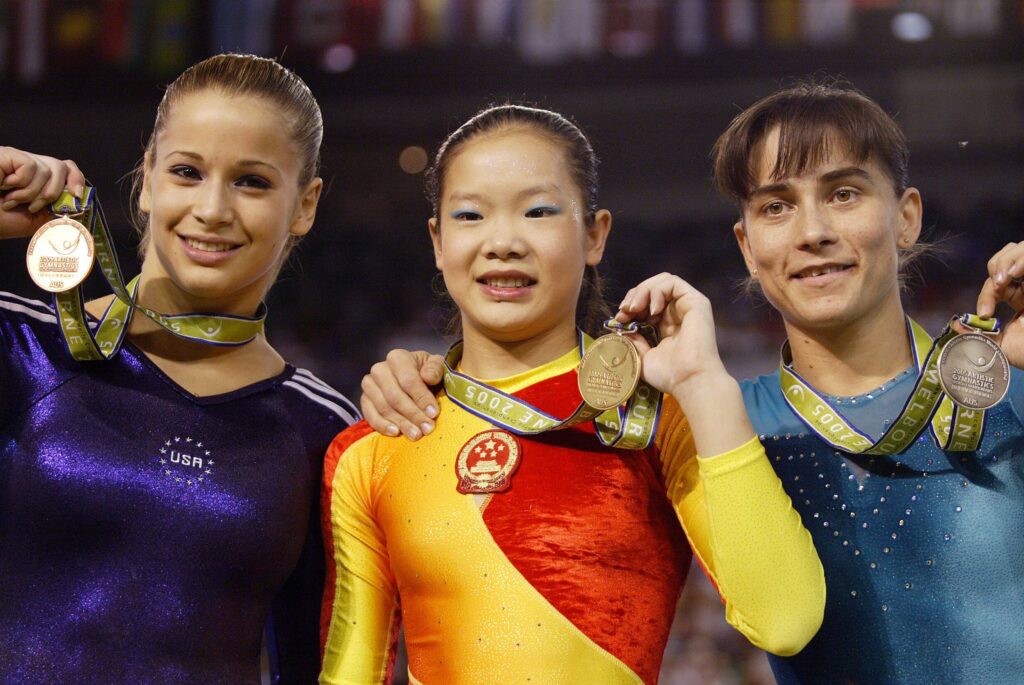
The Case for a 1989 Birth Year
One revealing example comes from coverage surrounding the 2006 Asian Games. In December 2006, CCTV reposted a feature originally published by the Shanghai newspaper Shenjiang Service Guide. It was not an investigative report or eligibility dispute; it was human-interest coverage meant to bring Chinese stars closer to readers.
In its section on Cheng Fei, the writer marveled at the contrast between her competitive reputation and youthful appearance, explicitly describing her as seventeen years old. With a 1988 birthdate registered with the FIG, she should have been eighteen:
Up in the stands, Cheng Fei wore no makeup, her shoulder-length hair loosely tied behind her head. When she turned around for a moment, the reporter was taken aback: small nose, small eyes, small face — could she really be 17? She looked at most 13… A minute later, without a word, the look in her eyes immediately proved my underestimate wrong. Perhaps the comparison is a bit far-fetched, but I clearly detected in her brow something familiar — a kind of stubbornness and weariness — somewhat resembling the actor Wang Zhiwen.
看台上的程菲素面朝天,齐肩的头发松散着扎在脑后,在她一回头的瞬间,记者不由吃惊:小鼻子小眼睛小面孔,她有17岁吗?顶多13岁……1分钟后,程菲用不着开口,她的眼神立马否定了我的“小瞧”。或许这个比喻有点离谱,可我分明在她的眉宇间寻到似曾相识的倔强和疲惫的神态……好像与演员王志文有几分神似。
Archived here.
Note: Wang Zhiwen is a male actor, who starred in moves like Ai Zuozhan (2004) and A Battle of Wits (2006).
That matters because it suggests that, at least in routine domestic media coverage, a 1989 birth year could be openly implied at the very moment Cheng Fei was already one of China’s biggest gymnastics stars.
And this was not a lone anomaly. That same year, another mainstream Chinese outlet repeated the same age.
A lengthy retrospective by the Southern Metropolis Daily, written by Sun Xiaomei, chronicled China’s rebound from the disappointment of the 2004 Summer Olympics to its triumph at the 2006 World Artistic Gymnastics Championships. Under the heading “Vault Prodigy,” it profiled Cheng Fei as follows:
The Vault Prodigy: Cheng Fei
Seventeen-year-old Cheng Fei hails from Huangshi, Hubei. She was sent by her parents to an amateur sports school to learn gymnastics at the age of four and a half, and after entering Wuhan Sports Institute in 1996, her level improved rapidly and she was soon selected for the provincial team. At the national junior gymnastics training camp at the end of 2001, the physically exceptional and quick-witted young Cheng Fei was immediately identified by women’s national team head coach Lu Shanzhen, who took her under his wing. Under his careful guidance, her technical level advanced in leaps and bounds. In 2003, she traveled with the Chinese national team to Japan for the Japan International Invitation and won the vault title outright.
At the 2005 Melbourne World Championships, Cheng Fei and her “Cheng Fei” vault appeared before the world, instantly creating two “firsts”: she became the first Chinese female athlete to vault with a base start value of 10.0, and the “Cheng Fei” became the first women’s vault skill in history to be named after a Chinese person. In the final she won the women’s vault title at the 2005 World Championships by a substantial margin — also the first women’s vault world title in the history of Chinese gymnastics.
In a series of subsequent domestic and international competitions, Cheng Fei’s dominance in vault and floor exercise was repeatedly confirmed, reaching a point that could only be described as unstoppable. Senior teammate Xing Aowei dubbed her “the vault prodigy.” At this year’s World Championships, her “Cheng Fei” was attempted by foreign competitors, and in the floor and vault finals she made on-the-fly adjustments to her difficulty and choreography, ensuring the gold medals remained secure. In the end, like Yang Wei, she walked away with three gold medals.
跳马天才:程菲
今年17岁的程菲来自湖北黄石,她从4岁半就被父母送到业余体校学体操,1996年进入武汉体院之后水平提高很快,不久就入选省队。在2001年底的全国少年体操选手大集训中,身体素质出众、聪慧伶俐的小程菲被国家女队总教练陆善真一眼相中,收入门下。在他的悉心指导下,小程菲的技术水平得到突飞猛进的发展。2003年,她随中国国家队出访日本参加了日本国际邀请赛,一举夺得跳马冠军。
2005年墨尔本世锦赛,程菲带着她的“程菲跳”亮相在世人面前,一下子创造了两个“第一”:她成为第一个跳马达到10分起评的中国女运动员,“程菲跳”成为第一个以中国人命名的女子跳马动作。决赛中,她最终以较大的优势获得2005年世锦赛女子跳马冠军,也是中国体操史上的第一个女子跳马世界冠军。
在此后的一系列国内、国际比赛中,程菲在跳马和自由操的优势屡屡得以体现,几乎到了所向披靡的程度。大师兄邢傲伟更称她为“跳马天才”。本届世锦赛,她的“程菲跳”被国外对手复制,自由操和跳马决赛,她分别临时调整了动作难度和编排,确保金牌不失。最终,她和杨威一样,夺得了三枚金牌。
Note: The full article is well worth reading. It also includes details about Li Yuejiu, who returned to help train the 2008 team but could not hold an official title because he had become a U.S. citizen and was no longer recognized as a Chinese national (China does not allow dual citizenship).
When we read the Southern Metropolis Daily piece alongside the CCTV Asian Games feature, the pattern becomes harder to dismiss as a simple typo. Multiple prominent Chinese media outlets, publishing celebratory profiles within weeks of one another, casually presented Cheng Fei as seventeen. That sits uneasily beside the May 1988 birthdate under which she was registered internationally.
By the time of the 2008 Summer Olympics, the contradiction had become more direct. Yilin Magazine ran a piece on Cheng Fei, which framed her Olympic success through the sacrifices of her father, recounting family hardship, homemade training equipment, long bus rides, and years of labor to sustain her gymnastics career. Yet buried within that sentimental profile was a blunt statement of birth year: 1989.
[…]
Cheng Ligao, 45 years old, is an ordinary traffic dispatcher at Huangshi Port in Hubei Province. He never imagined, at the time, that he would one day be the father of a world champion.
Cheng Fei was born in 1989. Because she was naturally thin and severely malnourished, young Cheng Fei was frequently hospitalized, causing her parents endless worry. By the time she finally reached age two, she was still gaunt and a full head shorter than children her age. Her father began to worry about her health. When Cheng Fei was four and starting kindergarten, Cheng Ligao enrolled her in a gymnastics program. To his surprise, the coach was delighted at the sight of her, telling him: “This child is made for gymnastics!”
[…]
Yilin Magazine, 2008, Issue 18
[…]
2008年8月13日,中国体操女团创造历史,首次夺得女团冠军,队长程菲振臂欢呼,其精彩表现世人难忘。作为现时中国女子体操队领军人物的程菲,其“绝技”毽子后手翻转体180度接前直空翻540度,更是史无前例的动作,国际体操协会便将其命名为“程菲跳”,这亦是第一个以中国女运动员名字命名的体操动作。
45岁的程立高是湖北省黄石港口的一名普通调度员。当初他无论如何也没有想到,他会是将来世界冠军的父亲。
1989年程菲出生。因为天生身体瘦削,严重营养不良,小程菲时常生病住院,令父母操心不已。好不容易长到两岁,程菲仍然面黄肌瘦,身材也比同龄的孩子矮一大截。父亲开始为女儿的身体担忧了。程菲4岁上幼儿园时,程立高就把女儿送到体操队学习。没想到,教练看到她非常高兴,对程立高说:“这孩子是块练体操的料!”
[…]
That matters not only because of the date itself, but because of when it was published. The inconsistency was no longer confined to stray age references from 2006. This piece was published in the middle of 2008, when scrutiny of Chinese gymnasts’ ages was reaching its global peak. Even then, a domestic publication could still state openly that Cheng Fei was born in 1989, even though official documents placed her birthdate in 1988.
What the Paper Trail Shows
No single clipping definitively resolves Cheng Fei’s true birth year. But the surviving record makes one point difficult to overlook: repeated, mainstream, contemporaneous Chinese coverage that consistently places her age at odds with her official FIG registration.
In 2006, at least two media outlets described her as seventeen. In 2008, a national magazine stated she was born in 1989.
The issue, then, is not one mistaken article. It is a recurring documentary pattern—one in which the official date of 1988 repeatedly fails to match the paper trail left behind. And even the one gymnast whose age was widely accepted may have been competing under an altered birthdate.
Note
- On Chinese-language message boards and Quora-style platforms, users often claim that Cheng Fei was born in 1990. From outside China, however, it is difficult to find conclusive evidence supporting that date. Even so, alongside the stronger indications pointing to 1989, there are smaller inconsistencies that gesture toward a birth year closer to 1990. A cnhubei.com biography, for example, described Cheng Fei as seven years old in 1997, a timeline that would place her closer to 1990 than 1988. (Two-year discrepancies of this kind are relatively common across her online profiles.) After the 2008 Summer Olympics, one newspaper likewise celebrated all six of China’s champions as a “post-’90s generation” while omitting Cheng Fei’s specific birth year. (The title reads, “The ‘post-90s’ six golden flowers move China — many public figures: salute them and learn from them.”) Individually, these references are too imprecise to establish an alternative date. Taken together, however, they support a narrower conclusion: even in routine domestic coverage, the official 1988 birth year was not always consistently maintained.
- With a 1989 birth year, Cheng Fei would have been underage at the 2004 Olympics. With a 1990 birth year, she would have been underage at the 2004 Olympics and 2005 World Championships.
Appendix A: The Yilin Magazine Article
“Fangfei” is a poetic play on Cheng Fei’s given name, since the character 菲 (Fei) also appears in 芳菲, a word meaning “lush blossoms” or “flourishing beauty.” In this passage, it turns her life story into a metaphor, suggesting her journey is like a flower struggling through hardship to bloom. In other words, it frames her career as a difficult but ultimately rewarding path to growth and fulfillment.
Father Takes Me on the Journey of Fangfei
On August 13, 2008, the Chinese women’s gymnastics team made history by winning the team gold for the first time. Team captain Cheng Fei threw her arms up in triumph, a moment the world would not forget. As the current leading figure of China’s women’s gymnastics team, her signature skill — a sheep jump back handspring with 180-degree twist into a front layout with 540-degree turn — was an unprecedented move, and the International Gymnastics Federation named it the “Cheng Fei,” making it the first [vault] named after a Chinese female athlete.
Cheng Ligao, 45 years old, is an ordinary traffic dispatcher at Huangshi Port in Hubei Province. He never imagined, at the time, that he would one day be the father of a world champion.
Cheng Fei was born in 1989. Because she was naturally thin and severely malnourished, young Cheng Fei was frequently hospitalized, causing her parents endless worry. By the time she finally reached age two, she was still gaunt and a full head shorter than children her age. Her father began to worry about her health. When Cheng Fei was four and starting kindergarten, Cheng Ligao enrolled her in a gymnastics program. To his surprise, the coach was delighted at the sight of her, telling him: “This child is made for gymnastics!”
Hearing that his daughter had a talent for gymnastics, Cheng Ligao was overjoyed. The family’s circumstances were difficult at the time, so he had to improvise with homemade solutions. When the proper conditions didn’t exist, he simply created them. He fashioned a set of training equipment from whatever was available at home — including the large wok lid, lengths of rope, and anything else that could be pressed into service — and used these to help Cheng Fei practice spinning and balance.
To save enough for their daughter’s training fees, the couple would sit up through entire nights at a knitting machine doing piecework for a private glove factory. The work required constant bending at the waist, arms pushing and pulling the machine back and forth — they would even lie under their quilts to work — the pain so severe their backs could not straighten. Their apartment was under 40 square meters and had neither air conditioning nor heat. In winter the air in the entire flat seemed to freeze solid. Sitting at the knitting machine at night was like sitting in an ice cellar; their hands and legs went numb and rigid, and both eventually developed serious rotator cuff problems and chronic lumbar strain.
Despite this hardship, they could not bring themselves to spend a single yuan improving their own diet. Only when their daughter came home would they prepare something good to eat. Every weekend, Cheng Ligao would take a long-distance bus from Huangshi to Wuhan to visit his daughter. To save money, he always packed his own food, and no matter how hot the weather outside, he would not buy himself a bottle of water on the bus — yet he was extremely generous with his daughter, never failing to arrive with a large bag of fruit. The food at her school was poor, so each time he visited he would go to a restaurant outside and buy her a bowl of chicken soup.
Young Cheng Fei trained with extraordinary dedication. Her palms were constantly covered in blood blisters, and her arms and knees were perpetually bruised. She was a sensible child who always endured in silence, never making demands of her parents. While the other children on the gymnastics team liked to go out to buy popsicles after training, she had no pocket money and could only tag along, watching the others eat, and would ask innocently: “Is it good?” Her father saw all this and it pained his heart — yet the greatest reward he could offer her was to go out and buy a few skewers of glutinous rice balls, three to a skewer for one yuan, because she loved them.
During the winter break of 1997, Cheng Fei came home and showed her mother the blood blisters on her palms, saying she could not bear to continue with the exhausting and monotonous sport. Her father’s heart ached for her — yet he steeled himself and asked her to give him a massage instead. She quickly discovered that his entire back was covered in medicinal plasters and bore the small scars left by self-administered acupuncture. Cheng Fei finally wept. She finally understood that in order to keep her from dropping out, her parents had been knitting gloves day and night, and that to save on medical costs they had been heating cupping jars with alcohol and doing their own acupuncture. She finally understood that her parents’ suffering was the one thing she could not bear to see — and that her own physical pain was nothing compared to the pain her parents carried inside. What did it matter?
From childhood through to adulthood, her father was always at Cheng Fei’s side, taking gymnastics as seriously as if it were his own vocation. As Cheng Fei gradually grew, this long and arduous yet fulfilling journey — the journey of fangfei — was one that her father carried her through on his shoulders, step by step over every obstacle. All the brilliance on the stage came from the sweat and tears of father and daughter behind the scenes. In 2004, Cheng Fei won gold medals in both floor exercise and balance beam at the National Championships, causing a sensation across the country, and everyone became convinced she would emerge as a dark horse in Chinese women’s gymnastics.
On August 13, 2008, Cheng Fei led five young teammates to fight through every challenge on the competition floor, winning China’s first-ever Olympic women’s gymnastics team gold. Standing on the podium, the girls wept. Cheng Fei stood at the back of the group, her gaze focused and intent, seemingly lost in thought — perhaps remembering the long journey, or perhaps thinking of her beloved father.
Yilin Magazine, 2008, Issue 18
父亲带我实现芳菲之旅
2008年8月13日,中国体操女团创造历史,首次夺得女团冠军,队长程菲振臂欢呼,其精彩表现世人难忘。作为现时中国女子体操队领军人物的程菲,其“绝技”毽子后手翻转体180度接前直空翻540度,更是史无前例的动作,国际体操协会便将其命名为“程菲跳”,这亦是第一个以中国女运动员名字命名的体操动作。
45岁的程立高是湖北省黄石港口的一名普通调度员。当初他无论如何也没有想到,他会是将来世界冠军的父亲。
1989年程菲出生。因为天生身体瘦削,严重营养不良,小程菲时常生病住院,令父母操心不已。好不容易长到两岁,程菲仍然面黄肌瘦,身材也比同龄的孩子矮一大截。父亲开始为女儿的身体担忧了。程菲4岁上幼儿园时,程立高就把女儿送到体操队学习。没想到,教练看到她非常高兴,对程立高说:“这孩子是块练体操的料!”
听说女儿有体操天赋,程立高心里不由乐开了花。那个时候家里条件差,爸爸就只能自己想些土办法。在条件不允许的情况下,就只能自己创造条件了。程爸爸制作了一套训练器械,包括家里的大锅盖、绳子什么都用上了。通过这些,帮助程菲练习转体和平衡等。
为了给女儿攒足学费,程立高夫妇时常一整夜坐在编织机旁为一家私营手套厂赶货,由于干这种活需要长期弯腰,用手臂不停地来回推拉机器,躺在被窝里,腰痛得伸不直。他们住的那套不足40平方米的旧房里,既没空调也没暖气,一到冬天,整个房间的空气仿佛都凝固了。晚上编织手套时,他们如同坐在冰窖里,双手、双腿冻得麻木僵直,夫妇俩都患上了严重的肩周炎和腰肌劳损。
即便生活如此辛苦,但他们仍然舍不得花一分钱为自己改善伙食。惟有女儿回家时,他们才会弄点好吃的。每到周末,程立高都会从黄石乘长途汽车去武汉看望女儿,为了节约费用,他总是自备干粮,外面的天气再热,他也舍不得在车上买一瓶矿泉水喝,但对女儿却十分大方,每次去时都不忘提一大袋水果。女儿学校的伙食差,他每次去时都会到外面的餐馆买一碗鸡汤给她喝。
小程菲训练极其刻苦,经常磨得手心都是血泡,手臂、膝盖都摔得乌青。程菲很懂事,从来都是隐忍坚强,不会和父母提出任何要求,体操队的小朋友训练之余,总是喜欢到街头买冰棍,她没有零花钱只能跟着别人去,看别人吃的时候还天真地问别人:好吃吗?爸爸看在眼里疼在心里,可他能给孩子最高的奖励,就是到街上买几串一元三串的糯米团子。因为女儿喜欢吃。
1997年寒假,程菲回到家,给妈妈看手心的血泡,无论如何也不想继续练枯燥而劳累的体操,爸爸心疼,却狠下心来让女儿替自己按摩。女儿很快发现父亲的后背贴满了膏药,还有大大小小的做针灸时留下的伤痕,程菲终于哭了,她终于知道父母为了不使她中途辍学,每日每夜编织手套,为了省下看病的钱,他们把火罐用酒精烧热,自己做针灸。她终于明白,父母的心痛才是自己最不想看到的事情,自己的皮肉之苦与父母内心的疼痛相比,又算得了什么呢?
从小到大,爸爸一直陪伴在程菲身边,把体操当做是自己的事业一样认真,程菲渐渐长大,这一路苦难而又充实的芳菲之旅,是爸爸把程菲扛在肩膀上一路踏遍坎坷而过,台上的种种风采,来自台下父女俩的汗与泪。2004年,程菲在全国锦标赛夺得自由体操和平衡木两块金牌,一时间全国哗然,都认定她将会成为中国女子体操队的一匹黑马。
2008年8月13日,程菲带领5名年轻的师妹,在赛场上一路劈荆斩棘,历史上首次获得了中国历史上奥运会团体女子体操冠军,站在领奖台上,女孩儿们哭了,程菲在队伍的最后,眼神专注,似乎在思索什么,也许,在怀念这段旅程,或者,她是在想念亲爱的爸爸。
(摘编自百度“程菲吧”)
Appendix B: The Southern Metropolis Daily Feature
2004–2006: Chinese Gymnastics — From Deficit to “震撼” (Stunning the World)!
Date: October 25, 2006
Source: Southern Media Group – Southern Metropolis Daily
Feature written by: Sun Xiaomei
At the 2004 Athens Olympics, with the Chinese delegation having already surpassed its overall targets, the Chinese gymnastics team — which had gone in with seven projected gold medal opportunities — became the delegation’s biggest failure. After returning home, the Chinese gymnastics team began rebuilding from a deficit: rigorous reform, attending to every detail, from the fine points of individual skills and daily habits all the way up to restructuring the coaching staff’s division of responsibilities… Until October 2006, in Aarhus, Denmark, a Chinese gymnastics program that had started from negative ground finally stunned the world with eight gold medals.
2004 · The Athens Disaster
From seven projected gold medal targets to just one gold wonIn March two years earlier, with the Athens Olympic Games still nearly five months away, good news had arrived from Athens: China’s men’s gymnastics team had drawn the most favorable lot in the team competition — an evening session, which would favor the athletes’ performance; the grouping was also favorable, with formidable opponents whose strong scores would help increase the number of athletes advancing to individual event finals.
In the months before the Games, the news that circulated in the media was uniformly upbeat: Gao Jian, director of the Gymnastics Administrative Center, declared that the Chinese team had seven gold medal opportunities; head coach Huang Yubin proclaimed that the men’s team was going for gold.
But when the competition was over, China’s men’s gymnastics team had finished only fifth in the team event at Athens, with the team’s sole gold medal going to young Teng Haibin — who had committed serious errors throughout the team competition — on pommel horse. Compared to the three gold medals won at the Sydney Olympics, the result was conspicuously poor; measured against the team’s performances at several previous World Championships, it was jaw-dropping. The Chinese team, which had reigned over world gymnastics for years, had been utterly unprepared to face such an outcome.
According to Gao Jian, on the night the men’s team final ended, head coach Huang Yubin ran to his hotel room and wept openly in his arms. In the words of Xing Aowei, Huang Yubin’s former protégé: “He hadn’t completed his mission — the weight of it was crushing him.”
In the nearly one year that followed, Gao Jian — head of Chinese gymnastics — publicly apologized to the nation on five separate occasions, taking the responsibility for Athens squarely on his own shoulders. Xing Aowei, a fellow Shandong native who counts himself among Gao Jian’s extended coaching lineage, said: “He shouldered the responsibility a man ought to shoulder.”
Returning from Defeat · Laying Bare the Root Problems
Falling behind in the information war — the men’s team collapse triggered a total breakdownCrushed at Athens, facing skepticism from media across the country and the disappointment of gymnastics fans, the Chinese gymnastics team had no grounds to defend itself. The urgent task was to find the root of the illness — to cut away the rot, piece by piece, and grow strong again.
Although before the Games China had always regarded Japan’s men’s team as their chief rival, Japan’s performance in the team qualifying round still shocked Huang Yubin and the entire Chinese contingent. Xing Aowei said: in the final, if China hadn’t committed so many errors, the gold medal would still have been ours. But when two teams are nearly equal in strength, each additional error moves you further from the championship. Three Chinese athletes made serious mistakes, and Teng Haibin — competing in his first Olympic Games — turned in a shockingly flat performance across three events. It can be said that the men’s team’s defeat was largely self-inflicted.
Looking at their rivals in Japan, on the other hand — and this, of course, only became known afterward — the Japanese had invested enormous effort in collecting, studying, and cross-referencing information. They had video footage of every Chinese athlete competing in major international events; when filming was prohibited, they hand-recorded the Chinese team’s routines in writing. Internally, the Japanese team had installed multiple cameras throughout their training hall, reviewing and analyzing every skill the moment it was executed, identifying problems in real time. They had studied China deeply and fought a brilliant information war. By comparison, China’s intelligence pipeline was sluggish — their materials lagged behind, their understanding of their opponents was insufficient — which meant they tactically underestimated the progress Japan had made.
Li Xiaopeng, who had claimed the vault and parallel bars titles at virtually every World Championship for years running, was entirely off form in both of those individual events at Athens. Xing Aowei noted: “Xiaopeng is human — he can get nervous too. His individual titles in the past had always come after the men’s team had won gold and morale was soaring. Because the team had won and the bottom line was secured, everyone already had a gold medal and could compete freely in the individuals. When the team loses, the individual events naturally suffer — technical execution starts to unravel — and that only further illustrates how critical the team competition is.”
Teng Haibin experienced a journey from hell to heaven at Athens. His dismal team performance made him the target of widespread condemnation; yet after pommel horse king Xiao Qin fell on his own best event, Teng calmly claimed that gold medal for himself, replicating his result from the previous year’s World Championships in Anaheim.
The image of master Huang Yubin and senior teammate Xing Aowei embracing Teng Haibin tightly the moment the pommel horse competition ended was captured by photographers and became a classic image in the history of Chinese gymnastics. One can only imagine: had it not been for that gold medal — the one that rescued Teng Haibin and the entire Chinese gymnastics team — what pressure would have fallen on Gao Jian, Huang Yubin, and Teng Haibin. Xing Aowei put it plainly: “Without it, that shadow would have followed Haibin for the rest of his life. That gold medal rescued a great many people.”
Late 2004: The Reform Begins
The new Gao–Huang–Li combination takes its place — master and two disciples build success togetherHaving understood their own weaknesses and the strengths of their rivals, the next task was to compensate for those weaknesses, and to carry out reform boldly. Reform, in any domain, always carries both risk and opportunity in equal measure.
In November 2004, under the leadership of Gymnastics Center director Gao Jian, China’s gymnastics team reorganized its coaching staff. Huang Yubin assumed the role of deputy center director and head coach, overseeing overall training and a portion of administrative work, but no longer personally coaching individual athletes; the athletes who had previously trained under him were distributed among different coaches.
In December 2004, Li Yuejiu — Gao Jian’s top disciple, absent from Chinese gymnastics for nearly twenty years — quietly appeared in the national team’s training hall, tasked with guiding the overall direction of training and providing strategic advice for the whole team. The Gymnastics Center, however, gave him no formal title. Word spread rapidly that Gao Jian and his protégé Huang Yubin had fallen out, and that Huang had been sidelined and stripped of real power. Li Yuejiu in particular was widely suspected in the press of having returned to “replace” Huang Yubin.
Those who were hoping for chaos should have paid attention to the fact that, right through to today — as the Chinese gymnastics team stands in Aarhus, Denmark, with eight gold medals in hand — the leadership structure has remained exactly what it was two years ago, unchanged in the slightest. If results must speak, today’s victory provides the best possible vindication of the arrangement made at that time.
Xing Aowei reflected objectively: Huang’s coaching a group directly had its advantages and disadvantages. The advantage was that most of the top-line athletes had come up under him, creating intense mutual competition and plenty of drive. The disadvantage was that all the best athletes were in his hands, while the athletes coached by others rarely had opportunities to compete at the Olympics or World Championships — they trained without motivation or spirit. No pressure means no drive. Distributing strong athletes across different coaches provides a spur to everyone. And Gao Jian’s emphasis on “unity” within the gymnastics team meant that even athletes training in different groups should avoid any clique mentality, but instead regard the entire Chinese team as a shared collective, competing and contributing to Chinese gymnastics as one. Under different coaches, they were still expected to communicate constantly and compete with one another.
Li Yuejiu’s return from abroad was also proven over time to be entirely free of self-interest. Xing Aowei said from the heart: “Coach Li was earning 4,000 US dollars a month in the United States. Coming back, he makes 1,000 RMB a month. His wife and daughter are still abroad. He’s living alone in a dormitory at the national team. What’s he in it for? He didn’t come back for a comfortable life — he came back to work. He chose to return at the moment when Chinese gymnastics was in its greatest difficulty. Doesn’t that say everything?”
“Coach Li holds American citizenship — it’s simply not possible for him to hold any administrative position on the Chinese team. Right now, he’s here as a foreign expert, coordinating all kinds of affairs within the team, guiding training, and providing psychological counseling. The badminton team can hire foreign experts — why can’t we? All those rumors were completely wide of the mark,” Xing Aowei said.
As for the historic breakthrough achieved by the Chinese women’s team at the World Championships in Denmark this year, everyone — including Xing Aowei — considered it inseparable from Li Yuejiu’s efforts over the past two years, indeed to have a “direct connection.”
In the United States, Li Yuejiu had specialized in coaching women’s gymnastics, and his own eldest daughter is a professional gymnast. After returning to China, he transplanted wholesale into the national team the advanced training philosophy and methods he had accumulated over twenty years. For example: in training, offering “more praise, less criticism” to build athletes’ confidence; after a training session, not asking “did it go well?” but instead “did you enjoy the training?”… He brought back unreservedly both the management experience he had gained running his own operation in the United States and the coaching experience he had built up there. For the women’s team to have delivered such consistent performances this time around, Coach Li deserves the most credit.
Xing Aowei noted that Coach Li got along exceptionally well with everyone, was very adept at communicating and chatting with athletes and coaches, and constantly relayed problems he identified up to the center and the team management. Many of the younger women’s team athletes called him “Daddy.” Sometimes Xing Aowei would tell him: “Coach, when you have a moment, could you pay a bit more attention to the men’s team too?”
On the delicate relationship among the trio of Gao, Huang, and Li, Xing Aowei kept returning to the same phrase: “They’re men, and they’re all in sports — how complicated can it really be? As long as you communicate, there’s no knot that can’t be untied.”
Beyond these two pivotal figures, over the course of two years, Gao Jian can be said to have given more to Chinese gymnastics than anyone. He traveled tirelessly to give lectures to grassroots coaches across the country, invited famous former national team coaches back to teach the younger generation, brought in psychology specialists and nutrition specialists to provide guidance to the team, and poured enormous energy into the effort.
At Gao Jian’s initiative, the management of the Chinese gymnastics team became increasingly humane. For example, a preferential policy for veteran athletes — including material benefits for senior athletes such as Yang Wei and Li Xiaopeng, monthly salaries well above ten thousand yuan, and greater personal time outside of training; and on the management side for coaches, any national team coach of a certain seniority who had family matters or ailing parents was granted leave without question, with round-trip transportation reimbursed. All of this mobilized enthusiasm throughout the team.
Head coach Huang Yubin served as delegation chief for the Chinese team at the Aarhus World Championships, bearing pressure several times heavier than before the Athens Olympics. A victory and everything could be said easily; a defeat would very likely have revived all the voices of criticism. But fortunately, he and his “delegation” all held firm.
Adopting, as the Japanese had done, a comprehensive video analysis methodology — constantly monitoring and gathering information and intelligence on rivals’ training and competition — and implementing digital management within the gymnastics program, refining and making more precise the daily assessment system that had already been in place, also laid the foundation for today’s victory. “Take landing stability, for example: every day there are specified quotas of landings each person must complete before they’re allowed to stop. Yang Wei was able to beat Tomita Hiroyuki on parallel bars this time precisely because he stuck his landing. Without that, it would have been a very close call,” Xing Aowei said.
Stars of Aarhus
The Eastern Beauty: Pang Panpan
In 1997, a young girl attending a primary school in Shijiazhuang, Hebei, was spotted by a sharp-eyed sports school teacher and stepped into the world of gymnastics. She entered the provincial team in 2001, and by the end of 2002 had been called up to the national gymnastics team — but recurring problems with her elbow and knee joints required a full nine months of recuperation before she could begin training in earnest. In 2005, just having turned fifteen, Pang Panpan won the balance beam silver medal at the World Cup in Brazil, then swept two golds — balance beam and floor exercise — at the Dutch Open, and added an all-around silver to her collection. Multiple local media outlets bestowed on her the title “Eastern Beauty.”
Now sixteen, Panpan tends to lack self-confidence in daily life and is a little timid. She deeply admires her fellow Hebei gymnast and senior teammate Fan Ye, and hopes one day to stand alongside her on the world champion podium. Someone once joked: “Fan Ye is beautiful, Panpan is beautiful too — watching the two of them do floor exercise is a feast for the eyes. But Fan Ye’s beauty is like a qingyi — the refined, restrained heroine of traditional opera — while Panpan is more like a huadan, the vivacious, spirited ingénue.” In Aarhus, Denmark, this little huadan was given the chance to step into the spotlight and show her signature skills. But the belief is that her most beautiful performance is still to come.
[Note: Pang Panpan was officially registered with a 1988 birth year, but Chinese media regularly used a 1990 birth year.]
The Vault Prodigy: Cheng Fei
Seventeen-year-old Cheng Fei hails from Huangshi, Hubei. She was sent by her parents to an amateur sports school to learn gymnastics at the age of four and a half, and after entering Wuhan Sports Institute in 1996, her level improved rapidly and she was soon selected for the provincial team. At the national junior gymnastics training camp at the end of 2001, the physically exceptional and quick-witted young Cheng Fei was immediately identified by women’s national team head coach Lu Shanzhen, who took her under his wing. Under his careful guidance, her technical level advanced in leaps and bounds. In 2003, she traveled with the Chinese national team to Japan for the Japan International Invitation and won the vault title outright.
At the 2005 Melbourne World Championships, Cheng Fei and her “Cheng Fei” vault appeared before the world, instantly creating two “firsts”: she became the first Chinese female athlete to vault with a base start value of 10.0, and the “Cheng Fei” became the first women’s vault skill in history to be named after a Chinese person. In the final she won the women’s vault title at the 2005 World Championships by a substantial margin — also the first women’s vault world title in the history of Chinese gymnastics.
In a series of subsequent domestic and international competitions, Cheng Fei’s dominance in vault and floor exercise was repeatedly confirmed, reaching a point that could only be described as unstoppable. Senior teammate Xing Aowei dubbed her “the vault prodigy.” At this year’s World Championships, her “Cheng Fei” was attempted by foreign competitors, and in the floor and vault finals she made on-the-fly adjustments to her difficulty and choreography, ensuring the gold medals remained secure. In the end, like Yang Wei, she walked away with three gold medals.
The Dark Horse: Chen Yibing
Before the Aarhus World Championships, almost no one had heard the name Chen Yibing. The twenty-two-year-old has developed with remarkable speed: a year ago he had placed eighth on rings at the World Championships; now he had claimed the title. As a fellow member of the Tianjin team — sharing that affiliation with the reigning “Rings King” Dong Zhen — he was being spoken of as Dong Zhen’s successor.
Chen Yibing began gymnastics training at age five and a half; Zhao Qi, Dong Zhen’s coach, was also his first teacher. In October 1994, Chen Yibing was officially transferred into the Tianjin gymnastics team, training under Coach Li Quan. Under Li Quan’s careful guidance, his technical level improved rapidly, and he won the rings title at the national junior championships on multiple occasions. In 2001, the immensely promising Chen Yibing was selected for the national gymnastics squad, beginning his pursuit of a world title.
At the 2005 National Gymnastics Championships, Chen Yibing won the all-around title, and at the World University Games he also claimed the rings gold medal. In 2006, he won the rings title again at the World Cup China leg in Shanghai. At this year’s World Championships men’s team competition, Chen Yibing competed on four events as the leadoff performer and came through cleanly on all of them — his composure under pressure was outstanding. Those who know how hard he trains have described him as an “all-around performer who rises to the occasion.” “Give him two more years, and Chen Yibing will definitely become something truly exceptional!” said Xing Aowei.
An Inspiration to All: Yang Wei
Throughout the live broadcast of this World Championships, CCTV’s commentators could not mention Yang Wei without pairing his name with another two characters: gǎndòng — “deeply moved.” From the time he won his first national gymnastics men’s all-around title in 1999, Yang Wei began his quest to claim the world’s top spot in the men’s all-around — a journey that has now spanned nearly eight years.
At the Sydney Olympics, Yang Wei lost the all-around to the celebrated Russian athlete Nemov. At the 2003 World Championships in the United States, he lost the all-around to American Paul Hamm, who held the advantage of competing on home soil. At the Athens Olympics, again in the all-around final, Yang Wei once again narrowly lost to Paul Hamm of the American team, tasting the bitterness of the runner-up position alongside the Chinese team’s broader struggles. At the Aarhus World Championships, Yang Wei finally ended his history of all-around silver medals, claiming the long-coveted all-around gold. Yet everyone felt he had waited too long, and the waiting had been too hard.
The Beijing Olympics two years from now remains Yang Wei’s goal — the all-around gold there will hold even greater appeal for him. And whether coaches or teammates, no one doubts this goal: Yang Wei’s physical condition and overall ability present no obstacles; what matters is his performance on the day.
A note of caution
Why isn’t this year 2008?
This headline will obviously invite ridicule. In Aarhus, Denmark — where not all of our best athletes were deployed — the Chinese gymnastics team still won 8 gold medals. Is there really any need to worry about the Olympics to be held on home soil two years from now? By then, we will surely field an even stronger lineup, mobilize every force available, and absolutely not disgrace China. Most people probably think along these lines.
But consider carefully: at several World Championships before the Athens Olympics, we also competed very well — the identification of seven gold medal targets was not baseless speculation. Yet before competition officially begins, who would willingly predict such a poor outcome as actually occurred? The Chinese gymnastics team of that era certainly wished that one of those preceding World Championships could simply have been the Olympics — but none of them were.
The Chinese gymnastics team has always been a formidable squad — that goes without saying. But in any team sport, victory and defeat are inevitable. Even if a team wins every international competition over consecutive years before the Olympics, that cannot guarantee the same result at the Games themselves. And besides, the competition arena is like a battlefield: we may have thirty-six stratagems, but who can guarantee that our opponents won’t have seventy-two moves of their own? Keeping one’s true capabilities hidden from the enemy until the very last moment is a timeless military tactic. Even the World Championships the year before the Olympics, while theoretically indicating the direction of gold medals the following year, remains just that — theoretical. History cannot be extrapolated from or replicated, and therein lies the very charm of competitive sport.
We won 8 gold medals at this World Championships, and the media outlets that voiced all manner of criticism after the 2004 Athens Olympics have now begun speaking in unison of praise: “China’s women’s gymnastics has boundless potential”… “China’s gymnastics is invincible and dominates the world”… The turnaround came fast enough! Even as a fellow member of the media, I have followed Chinese gymnastics for several years now and must say plainly: don’t let them mislead you with their hype. 2006 can give confidence to 2008, but it absolutely cannot guarantee 2008. That is my position.
As Xing Aowei himself said, Cheng Fei’s outstanding performances in vault and floor exercise do not mean that China’s women’s team has undergone a qualitative transformation in those two events. If a whole crop of team members were vaulting at a high level, that would indicate our overall standard had improved. Cheng Fei is a genius, but for a Chinese gymnastics program on such a long and arduous road, she is only one genius. Waiting for a second Cheng Fei to emerge — fifty years might not be enough.
Yet if one thinks “optimistically,” the genius Cheng Fei happens to be able to showcase herself at the special moment of 2008 — is that not a stroke of heaven-sent fortune for Chinese gymnastics, and for the women’s team in particular? After 2008, who knows whether China will host the Olympics again within fifty years?
Others will study and apply the new rules as well. Others will catch up in developing difficulty. Others will not let their guard down in pursuit of consistency. Standing where we are today, we dare not guarantee even next year — let alone the year after. The 8 gold medals are in hand, and now they belong to the past. The Chinese gymnastics team still needs to regard itself as the underdog, training diligently and fighting every battle ahead with everything it has.
But how wonderful it would be if this year were already 2008! I still can’t help thinking that…
The Keys to Victory
Victory Through the New Rules
Thorough study, intelligent application, guaranteed quality
Naturally, the historic victory achieved by the Chinese gymnastics team in Aarhus was also closely connected to the fact that this World Championships marked the first time the new scoring rules were used.
At the Athens Olympics, the judging in gymnastics drew widespread criticism from commentators and the public alike, and the International Gymnastics Federation resolved to eliminate, through rule changes, the influence of human subjectivity on athletes’ scores. The new rules came into effect on January 1, 2006. The scoring system under the new rules abandoned the old practice of a maximum score of 10.0, making scoring more granular so as to better reflect the differences between athletes. The specifics of the new system are as follows: a judge’s score consists of two components — a Difficulty score (the D score) and an Execution score (the E score). The D score is calculated based on the ten best-executed elements in the athlete’s routine, with a starting value of zero. The E score has a maximum of 10.0; two or four judges deduct from 10.0 based on the athlete’s technical execution, artistic expression, completion of elements, combination of skills, and aesthetic quality — though an athlete can still receive a perfect 10.0 with a flawless performance. The athlete’s final score is the sum of the D and E scores. Because the D score has no upper limit, gymnastics scores can be expected to be continually reset.
At this World Championships, the Chinese team demonstrated a thorough grasp and effective application of the new rules, and the results reflected this. Take the men’s team final as an example: our team also had three athletes make errors at these championships, but because only the ten best-executed elements in each routine count toward the score, the impact on the final result was minimal.
Under the old 10.0 maximum, a team like China’s — one that wins through high-difficulty skills — always felt somewhat constrained. Under the new system, however, small connecting movements within a routine that might previously have gone unnoticed can also add to the score. “Chinese people are quick-witted,” and the team quickly figured out how to make the new rules work in their favor.
“By comparison, foreign athletes tend to be more relaxed and free-spirited, and may not have paid sufficient attention to the new rules — which is why we were the first to reap the rewards. But I expect next year’s World Championships will look quite different from this year. Our experience will certainly be studied and replicated by other teams. And the World Championships in the year before the Olympics will more clearly indicate the direction of Olympic gold medals, so next year’s task will be even harder and the pressure even greater.” So said Xing Aowei.
Head coach Huang Yubin also believed that China’s success in Aarhus was inseparable from the team’s research and understanding of the new rules. “We targeted the new rules, raised our overall difficulty, and choreographed new elements for our athletes. Our research on the new rules was ahead of others, and that is why we were able to achieve such success this time.”
The new rules have brought obvious changes to world gymnastics: competitions are becoming more and more exciting, and skills increasingly difficult. “Faced with the new rules, all countries have begun pursuing higher difficulty scores while ensuring execution quality. Of course, many athletes from various countries have pushed their difficulty upward, but their execution quality has not kept pace, and there have been quite a few errors. But the general trend is toward greater difficulty — competing for the advantage of a higher starting difficulty score in competition.” So Huang Yubin analyzed.
Victory Through Roster Depth
New faces prove themselves with ability
Among the team members who set out for these World Championships, quite a few were new faces who had never competed at a world-level event before. Meanwhile, veterans like Li Xiaopeng and Huang Xu, along with Olympic champion Teng Haibin, did not appear on the competition floor.
Aside from Xing Aowei, who transitioned after the Athens Olympics into a coaching role with the national team’s junior squad, the former stalwarts under Huang Yubin — Huang Xu, Yang Wei, Teng Haibin, and Li Xiaopeng from Chen Xiong’s group — were all still in training. Li Xiaopeng had been plagued by a loose bone fragment in his ankle, and on January 17 of this year he finally had it removed at Peking University Third Hospital. But because recovery is a systematic and lengthy process, he was effectively ruled out of all major international competitions for the entire year.
After Huang Xu withdrew due to injury, Yang Wei took on the responsibilities of men’s team captain. And judging by his performance, acting captain Yang Wei was more than fully qualified for the role — in fact, he excelled at it, setting an exemplary standard for the entire team.
Newcomers Chen Yibing and Pang Panpan made a strong impression at the World Championships. As athletes who both come from Tianjin, Chen Yibing was once called the successor to Dong Zhen, the “Rings King” — but Chen’s all-around versatility is something Dong Zhen simply cannot match. Furthermore, having been tempered by last year’s World Championships, Chen Yibing is currently in peak form.
Pang Panpan, due to a vault error, ultimately missed out on the women’s all-around gold medal. As the national championships women’s all-around champion, she is undoubtedly one of the most representative examples in the current Chinese women’s team of an athlete who combines genuine strengths with well-rounded development across events. Although vault has always been a relatively weaker event for her, the women’s team’s ability to claim the team gold this time still owed much to the outstanding performances of athletes like her.
After two years of tempering, Cheng Fei has become a fully deserving “second Chusovitina.” The gold medal in women’s vault at international competitions is almost exclusively hers to claim — similar to Xiao Qin on the men’s side, her mere appearance at a competition all but guarantees at least one individual event gold medal.
As for the non-selection of Teng Haibin and Fan Ye, the gymnastics team’s explanation was that both of them already had experience at major competitions; since this year’s World Championships carries no direct link to the Olympics, and with the aim of developing new talent, the spots were ultimately given to several younger athletes. Simply put, the selection process this time around was more transparent: whether veteran or newcomer, performance and ability were the only things that mattered. Whoever could contribute to the team’s results competed; conversely, no matter how big a name you had, that alone was not enough.
2004年雅典,在代表团超额完成任务的情况下,带着7个夺金点出征的中国体操队成了最失败的团队。归国后,中国体操队从负开始,励精图治,从点滴抓起,小到每个动作和生活细节,大到教练班子分工的调整……直到2006年10月,在丹麦阿胡斯,从负数起步的中国体操终于以8枚金牌震惊了世界!
专题撰文/孙小美
2004年·雅典惨败
从7个夺金点到仅1金入账
两年前的三月,在离雅典奥运会开幕还有近五个月的时间,从雅典传来好消息:中国体操男队在奥运会体操团体比赛中抽得了“上上签”:晚场比赛,将有利于队员发挥,分组的情况也比较好,对手实力不俗,会促使得分偏高,使得进入单项决赛的人数增加。
而在出征前的几个月内,媒体得到和发布的消息都是:体操管理中心主任高健称中国队有7个夺金点,黄玉斌总教练称中国男团志在夺金!
但一路比赛下来,雅典奥运会中国体操队男子团体决赛仅列第五,惟一的金牌是在团体赛中不断出现重大失误的小将滕海滨在鞍马项目中得到的。这个结果,相比悉尼奥运会的三枚金牌自是差距明显,相比之前的几届世锦赛成绩也让人咋舌。几年来一直称雄世界体操界的中国队根本没有面对这样一个结果的思想准备。
据高健说,雅典奥运会男团比赛结束的当晚,总教练黄玉斌就跑到他的房间里搂着自己放声大哭。用黄玉斌的徒弟邢傲伟的话来说:没有完成任务,黄导心里太压抑了。
在那天之后近一年时间里,中国体操掌门人高健先后5次在公开场合向全国人民道歉,把雅典奥运失利的责任揽在自己一个人身上。同为山东人、也算是高健徒孙的邢傲伟说:他承担了一个男人应该承担的责任。
兵败归来·痛陈病根
信息战落后 男团失利导致崩盘
雅典兵败如山倒,面对全国各地媒体的质疑,体操迷的失望,中国体操队没有立场为自己辩解,而是必须抓紧时间找病根,一点一点除去腐肉,让自己强大起来。
虽然出征前中国男队一直视日本男队为最大的敌人,但男团预赛时,日本队的表现还是让黄玉斌和所有的队员、教练员吃了一惊。邢傲伟说,决赛中,如果中国队没有出现那么多次失误,冠军依然会是我们的。可在两支队伍实力相差无几的情况下,多一次失误就离冠军更远一步。中国队三人出现重大失误,初次征战奥运赛场的滕海滨更在三个项目中呈现出让人大跌眼镜的低迷状态。可以说,男团的失利更多的原因在于自己。
反观对手日本(当然,这都是事后才知道的),他们在信息的收集、研究、比对上下了巨大的工夫。中国队队员参加国际大赛的录像他们全都有,如果不允许摄像,他们就用手记中国队的动作;内部训练,日本队在训练馆里安装了多台摄像机,每一个动作完成后都会回放、研究,找出问题。他们把中国研究得很透,打了一场漂亮的信息战。在这一点上,中国队相对信息不畅,资料跟不上,对对手的了解不够,所以导致战术上忽略了对手的进步。
连续几届世锦赛跳马、双杠冠军几乎不旁落的李小鹏,在雅典奥运会这两个单项的比赛上也完全不在状态。邢傲伟说,小鹏也是凡人,也会紧张。以前他拿单项冠军,也都是在男团夺金、士气大振之后。因为团体赢了,保底了,大家都有金牌了,下面可以放开比;团体输了,单项自然会受影响,技术出现“跑范儿”,这更加说明了团体比赛的重要性。
滕海滨在雅典奥运会算是经历了从地狱到天堂转变的人。团体比赛他的糟糕表现让他成了千夫所指的对象,而鞍马王肖钦在自己最擅长的项目上摔跤之后,却顺利地将这枚金牌收入囊中,复制了一年前阿纳海姆世锦赛的赛果。
当时鞍马比赛结束,师父黄玉斌、师哥邢傲伟将滕海滨紧紧抱在怀里的镜头被记者定格,成了中国体操历史上经典的画面。可以想象,假如没有这枚解救滕海滨和整个中国体操队的金牌,高健、黄玉斌、滕海滨将面临的又会是怎样的压力。邢傲伟说,那样阴影会笼罩海滨一辈子。这枚金牌解救了许多人。
2004年底·革新启动
高、黄、李新组合就位 师徒三人共建功
了解了自己的短处、对手的长处后,接下来的任务就是取长补短,大胆地进行改革。而改革,无论是在哪个领域进行,都是风险和机遇并存的。
2004年11月,在体操中心主任高健的主持下,中国体操队重组教练班子。黄玉斌担任中心副主任和总教练,把握整体训练和部分行政工作,不再亲自带队员,原来他手下的队员分别由不同的教练接手。
2004年12月,远离中国体操20年之久的高健大弟子李月久悄然出现在国家队训练馆,并负责为全队的训练掌握方向,出谋划策。只是,体操中心并没有给他一个确切的名分。关于高健和黄玉斌师徒不和、黄玉斌被夺权架空的消息不胫而走。而李月久更被诸多媒体怀疑是回来预备“顶替”黄玉斌位置的人。
可当时惟恐天下不乱的人应该看到,直到今天,中国体操队在丹麦阿胡斯拿下8块金牌,中国体操领导者的格局还是两年前的那个格局,没有丝毫变化。如果一定要靠金牌说话,今天的胜利已经为当年的安排做了最好的解释。
邢傲伟说,客观地讲,黄导亲自带组有利有弊。有利的是,一线队员大部分出自他的手下,互相竞争,劲头十足;弊处就是,好队员都在他手下,其他教练带的队员大都没有参加奥运会、世锦赛的机会,大家训练也就没有劲头,比较消极。没有压力,也就没有动力。将优秀队员分配给不同的教练,对大家都是激励。而高健强调体操队内部一定要“团结”,就是说即使大家不在同一组训练,也不要存在小团体的意识,而是要把整个中国队当成一个共同的集体,为中国体操拼搏、争光。大家在不同的教练手下,照样要多沟通、多竞争。
李月久的“海归”经过时间证明也毫无功利的成分。邢傲伟由衷地说:“人家李指导在美国一个月赚4000美金,回国每月只赚1000美金,而且妻子女儿都在国外,自己一个人在国家队住宿舍,人家图什么?他回来不是吃喝玩乐来的,而是来工作的。在中国体操队最困难的时候,他选择了回来,这还不说明问题吗?”
“李指导是美国国籍,根本不可能在中国队担任什么行政职务。现在他是以外国专家的身份在队里协调各种事务,指导训练,负责心理辅导。羽毛球队可以请外国专家,我们为什么不能?那些猜测太不着边际了。”邢傲伟说。
至于这次中国体操女队在丹麦世锦赛取得的历史性突破,包括邢傲伟在内,大家都认为这与李月久近两年来的努力分不开,甚至有着“直接的关系”。
在美国,李月久就专门训练女子体操,自己的大女儿也是专业体操运动员。回国后,他把自己20年来积累的先进训练经验和理念全盘移植到中国队。比如在训练中“多表扬、少批评”,提高队员的自信心;在训练结束后不问练得好不好,而是问“练得开心吗”……他把自己在美国当老板获得的管理经验、当教练获得的训练经验都毫无保留地带到了中国队。女队这次能有这么稳定的发挥,李指导是最大的功臣。
邢傲伟说,李指导人缘特别好,非常善于与队员、教练沟通、聊天,不断把了解到的问题反映到中心、队里,很多女队的小队员都叫他“爹地”。有时邢傲伟就和他说,“您没事儿的时候能不能也关心关心男队啊”。
而谈到高、黄、李师徒三人的微妙关系,邢傲伟还是那句话:男人嘛,又都是搞体育的,哪有那么复杂!只要多沟通,没什么结解不开。
除了这两个关键性人物,两年当中,高健可以说是为中国体操付出最多的人。他不辞辛苦地去各地为基层教练讲课,并把过去国家队著名的老教练请回来给年轻教练上课,还请心理专家、饮食专家来队里做辅导,花了许多的心血。
在高健的倡议下,中国体操队的管理更趋于人性化。比如优待老队员的政策,包括给杨威、李小鹏等老队员物质上的优待,月薪上万,允许他们训练之外有更多的私人空间等;对教练员的管理方面,凡是在国家队执教的年龄达到一定程度的教练员,但凡家里有事或是父母生病,队里会毫无商量地批准假期,并为其报销往返的交通费。这些都调动了全队上下的积极性。
黄玉斌总教练在这次阿胡斯世锦赛担任了中国代表团的团长,可以说承受了比雅典奥运会之前大上几倍的压力。胜了固然一切都好说,败的话很可能让很多质疑的声音重新发出。但好在他和他的“团员”们都顶住了。
而像日本队一样采用全方位录像分析法,随时关注并搜集对手训练比赛的信息、情报,在体操队推行数字化管理,让之前就存在的每日考核制度更加完善、精确,也为今天的胜利奠定了基础。“就拿落地稳定性来说吧,规定每天谁完成多少个才能下课。杨威这次在双杠比赛中能战胜富田洋之,就是因为落地站住了,否则就悬了。”邢傲伟说。
阿胡斯之星
东方美人:庞盼盼
1997年,在河北石家庄一所小学读书的庞盼盼被体校老师慧眼相中,踏进了体操圈。2001年进省队,2002年底就进入了国家体操队。但由于肘关节、膝关节老毛病复发,整整休养了9个月才开始训练。2005年,刚满15岁的庞盼盼一举夺得世界杯巴西站平衡木亚军和荷兰公开赛的平衡木、自由操两枚金牌,还在全能项目上揽得一银。当地多家媒体更是给她冠上了“东方美人”的称号。
今年16岁的盼盼平时不太自信,有点胆小。她很崇拜同是来自河北的师姐范晔,希望有一天像她一样登上世界冠军榜。有人开玩笑说:范晔美、盼盼也美,看她俩的自由操是一种美的享受。但范晔美得像个青衣,盼盼则更像个花旦。丹麦阿胡斯,给了这个小花旦亮相和表演绝活的机会,但相信更美的表演还在后头。
跳马天才:程菲
今年17岁的程菲来自湖北黄石,她从4岁半就被父母送到业余体校学体操,1996年进入武汉体院之后水平提高很快,不久就入选省队。在2001年底的全国少年体操选手大集训中,身体素质出众、聪慧伶俐的小程菲被国家女队总教练陆善真一眼相中,收入门下。在他的悉心指导下,小程菲的技术水平得到突飞猛进的发展。2003年,她随中国国家队出访日本参加了日本国际邀请赛,一举夺得跳马冠军。
2005年墨尔本世锦赛,程菲带着她的“程菲跳”亮相在世人面前,一下子创造了两个“第一”:她成为第一个跳马达到10分起评的中国女运动员,“程菲跳”成为第一个以中国人命名的女子跳马动作。决赛中,她最终以较大的优势获得2005年世锦赛女子跳马冠军,也是中国体操史上的第一个女子跳马世界冠军。
在此后的一系列国内、国际比赛中,程菲在跳马和自由操的优势屡屡得以体现,几乎到了所向披靡的程度。大师兄邢傲伟更称她为“跳马天才”。本届世锦赛,她的“程菲跳”被国外对手复制,自由操和跳马决赛,她分别临时调整了动作难度和编排,确保金牌不失。最终,她和杨威一样,夺得了三枚金牌。
黑马王子:陈一冰
在阿胡斯世锦赛之前,根本没有几个人知道陈一冰这个名字。22岁的陈一冰成长非常迅速,去年世锦赛还在吊环项目上列第八,今年却已问鼎冠军。由于和“吊环王”董震同属天津队,因此他又被认为是董震的接班人。
陈一冰从5岁半开始练习体操,董震的教练赵奇就是他的启蒙教练。1994年10月,陈一冰被正式调入天津体操队,师从李泉教练。在李泉教练的悉心指导下,陈一冰技术水平提高得很快,多次获得全国青少年锦标赛吊环冠军。2001年,潜力十足的陈一冰入选国家体操集训队,开始了自己冲击世界冠军的征程。
2005年,全国体操锦标赛上,陈一冰获得了全能冠军,在世界大学生运动会上也将吊环金牌摘下。2006年,他又在上海夺得世界杯中国站吊环冠军。在本届世锦赛男团比赛中,陈一冰在4个项目上打头炮并且都没有失败,心理素质超佳。平时训练刻苦的他被评价为“全能型、发挥型”的选手。“再给他两年时间,陈一冰一定会成大器的!”邢傲伟说。
众人榜样:杨威
在本届世锦赛直播的过程中,央视的评论员每次提到杨威都禁不住牵出另外两个字:感动。从1999年获得第一个全国体操赛男子全能冠军的时候起,杨威就开始了挑战世界男子全能第一的征程,至今,已经过去了近8年。
悉尼奥运会,杨威在全能比赛上输给了俄罗斯著名选手涅莫夫。2003年美国世锦赛,杨威在全能比赛中输给占有天时地利优势的美国选手保罗·哈姆。雅典奥运会,同样是全能决赛,杨威再次惜败于美国队的保罗·哈姆,伴着中国队的整体失利,再次品尝了屈居亚军的苦果。阿胡斯世锦赛,杨威终于结束了自己全能亚军的历史,获得了梦寐以求的全能金牌。可是,所有人都觉得他等待得太苦、太长了。
两年后的北京奥运会依然是杨威的目标,那时的全能金牌对他来说才最有诱惑力。而不管是教练还是队友,都对他的这个目标毫不怀疑:杨威的身体条件和整体能力都没问题,关键看到时的发挥了。
居安之思
为什么今年不是2008?
这个标题显然是要遭到嘲笑的。在没有使用所有良将的丹麦阿胡斯,我们中国体操队都拿到了8枚金牌,难道还用担心两年后家门口举行的奥运会?到时候,我们肯定会派出比今天更强大的阵容,调动一切可能调动的力量,绝对不会给中国人丢脸。估计大部分人都这么想。
但仔细想想,雅典奥运会之前的几届世锦赛我们比得也都很好,当时7个夺金点的确定并非空穴来风。可在比赛没有正式开始之前,谁又愿意去预料会出现那么差的结果?当时的中国体操队,肯定希望之前的几届世锦赛随便哪一届就是奥运会,可偏偏不是。
中国体操队一直是一支有战斗力的队伍,这本毋庸置疑。但既然称之为队伍,胜败就在所难免。即使奥运会之前连续若干年、若干国际大赛都大获全胜,也不能担保奥运会会有同样的结果。更何况,赛场如战场,我们有三十六计,谁能保证对手会不会七十二变?不到最后一刻不让敌人摸清战斗力也是兵家常用的手段。即使是奥运会前一年的世锦赛,虽然理论上代表了下一年金牌的走向,但毕竟还是停留在理论上,历史没法推理或者复制,竞技体育的魅力也正在于此。
这届世锦赛我们拿了8块金牌,曾经在2004年雅典奥运会后发出各种声音的媒体们开始异口同声地赞叹,“中国女子体操潜力无穷”……“中国体操所向披靡统治世界”……变得可真够快的!虽然也是媒体从业者,但已经关注中国体操好几年的我还是想说一句:别听他们瞎忽悠!2006年可以给2008年信心,但绝对不能给2008年保证。这是我的论调。
正如邢傲伟所说,程菲在跳马和自由操上的突出表现并不代表中国女队在这两个项目的水平上有了质的转变,如果女队冒出一大堆跳马跳得好的队员,这才说明我们整体水平提高了。程菲是个天才,但对于路途无比漫长的中国体操队来说,她也不过是个天才。等待第二个程菲出现,也许50年都不见得够。
可是如果“乐观”地来想,天才程菲恰好可以在2008年这一特殊的年份展示自己,对中国体操尤其是女队来说,难道不是天助我也的大好机缘么?2008年之后,谁知道50年内中国还办不办奥运会?
对新规则的领会和运用别人会学习,对动作难度的钻研别人也会赶上,对动作稳定性的追求别人也不会放松。我们站在今年并不敢担保明年,更何况是后年。8枚金牌到手了,也便是过去式了。中国体操队还需把自己当做哀兵,扎扎实实地训练和打好今后的每一仗。
但如果今年就是2008年该有多好啊!我还是忍不住这么想……
Archived here.
More on Age