In 2011, the Chinese women’s team finished third, but it faced a structural problem. According to Lu Shanzhen, the coach who “single-handedly built China’s women’s team to its 2008 glory,” the pool of age-eligible athletes was dangerously shallow. As a result, the team’s future hinged on just two young gymnasts: Yao Jinnan and Tan Sixin. Here’s what Lu Shanzhen said to the China Youth Daily during the 2011 World Championships:
“China’s women’s team currently has very few age-eligible young athletes available for London 2012 preparations; it simply cannot be compared to the American or Russian teams. We have only two young athletes we are developing as priority targets: one is Yao Jinnan, and the other is Tan Sixin. Tan Sixin’s underperformance tonight will certainly have an impact on our London preparations. Athletes who compete at the Olympics must have strong consistency.”
Ci Xin, China Youth Daily, October 12, 2011, p. 4
“中国队目前可以用于备战2012年伦敦奥运会的适龄年轻选手非常少,完全不能同美国队和俄罗斯队相比,我们只有两名年轻队员为重点培养对象,一个是姚金男,一个就是谭思欣。谭思欣今晚的失常表现,对我们备战伦敦奥运会肯定会有影响,参加奥运会的队员必须具有良好的稳定性。”
On paper, this made sense: with an official February 8, 1995, birthdate, Yao Jinnan would have turned sixteen in 2011 and thus been age-eligible for London. But was she?
The answer to that question turns, unexpectedly, on the age of her twin sister, Yao Jianan, who had also trained as a gymnast, and whose recorded birthdate did not align with 1995.
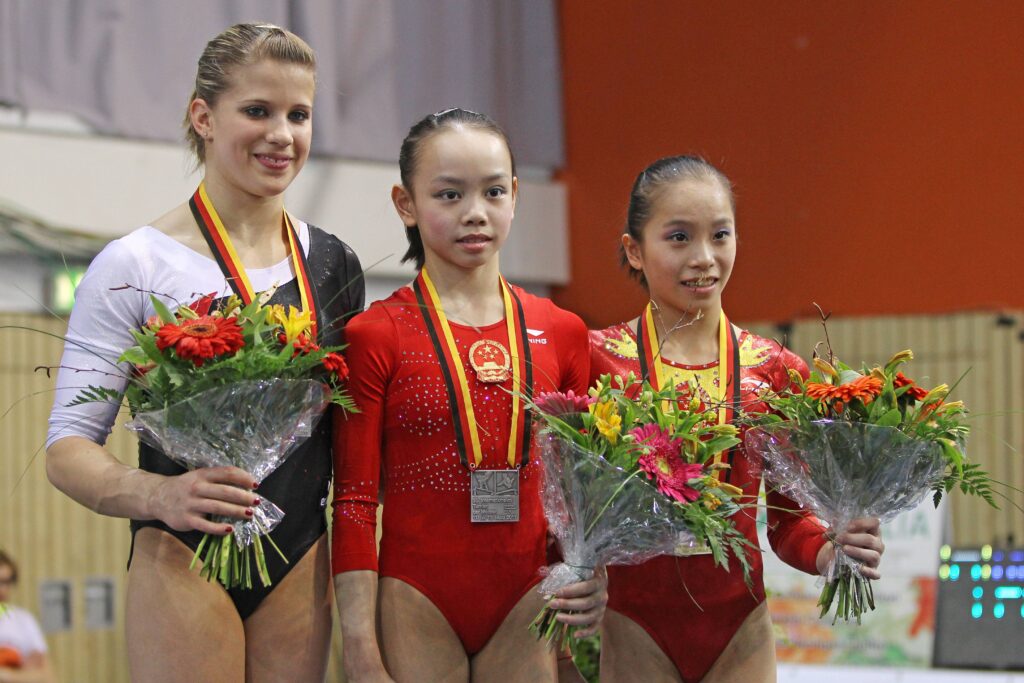
The Question of Age in 2013
The issue surfaced publicly in 2013, when Márta Károlyi, then head of the U.S. women’s team, openly questioned the ages of Yao Jinnan and Shang Chunsong. Chinese media quickly framed the dispute as an international confrontation:
The Age Dispute
Károlyi’s position: Károlyi maintained that among the Chinese athletes competing in Antwerp, some had not met the minimum age standard (no less than 16 years old), and she hoped that everyone could compete on a level playing field.
China’s position: “All male and female athletes participating in this World Championships on behalf of China have undergone strict vetting by the Chinese Gymnastics Association and meet the age requirements set out in the FIG’s technical regulations. Regarding the groundless and irresponsible accusations made by the U.S. women’s team coach against our athletes, we reserve the right to pursue legal accountability.”
The American Accusations: Alleging Chinese Age Fraud
At this year’s World Championships, women’s qualifying concluded on the 3rd. American athlete Simone Biles advanced to the women’s all-around final ranked first, while Chinese athletes Yao Jinnan and Shang Chunsong qualified in third and seventh place respectively. Despite her own team’s strong performance, Károlyi insisted that the Chinese women’s team was involved in age fraud, claiming athletes were competing under the minimum age of 16.
Under FIG rules, athletes must be at least 16 years old to compete in major international competitions…
Huaxi Metropolis Daily, October 5, 2013, republished on the People’s Daily website
交锋年龄门
>>>卡罗利坚称,中国此次来到安特卫普参赛的选手中有人的年龄没有达到标准(不得低于16岁),她希望每个人可以在公平的环境中竞争。
>>>“参加本次世锦赛的中国男女选手均经过中国体操协会的严格审查,符合国际体联技术规程的年龄要求,对于美国女队教练对中国选手发表毫无根据不负责任的指责,我们将保留法律追责的权利。”
美方炮轰>>>
质疑中国队年龄造假
本届体操世锦赛,于3日结束了女子组预赛的争夺,美国黑人选手比勒斯以排名第一的成绩闯入女子全能决赛,中国选手姚金男和商春松也分别以第三和第七的身份晋级。尽管本国运动员成绩出众,但美国队领队卡罗利坚称中国女队涉嫌年龄造假,低于16岁的参赛标准。
按照国际体操联合会规定,运动员要满16周岁才能参加大型国际比赛。之所以要杜绝运动员“以小充大”,是因为年龄小的运动员身体灵活,容易完成高难度动作。而卡罗利在美国队成绩出色的情况下还指称中国队年龄犯忌,则着实让人匪夷所思。
In response, Chinese journalists sought to rebut the allegation not through documentation but through family testimony. Yao Jinnan’s father offered what he presented as decisive proof: the twin sister.
Yao Jinnan’s Father Responds to American Team Leader’s Age Doubts: Twin Sister Can Prove Her Innocence
Staff Reporter Huang WenlongAfter 10 p.m. the night before last, at the World Gymnastics Championships women’s uneven bars final, Yao Jinnan once again deployed her signature move, the “Mo salto,” but applied too much force and failed to catch the bar, crashing to the ground, ultimately finishing in sixth place. Regarding the American gymnastics team leader’s earlier attack on Yao Jinnan and other Chinese team members over alleged age falsification, Hong Kong media again published articles yesterday joining the criticism. In response, Yao Jinnan’s father Yao Jianping stated that Yao Jinnan’s age is genuine, and that she also has a twin sister, Yao Jianan — if they truly do not believe it, they are welcome to come to Fuzhou and see the twin sister for themselves.
In the women’s all-around, Yao Jinnan, from Yongtai, Fuzhou, is unquestionably the leading figure domestically, though in the early-morning competition the day before yesterday she finished only fifth. In the uneven bars competition, Yao Jinnan executed her trademark “Mo salto” to its fullest effect, sticking the landing without a single step. This routine, with a difficulty score of 6.9, earned her the highest score of the evening, 15.333. However, because Yao Jinnan fell off the balance beam during that event, she ultimately finished fifth among all athletes who had advanced to the finals, with a score of 57.632, and missed the podium.
Although she missed an all-around medal, Yao Jinnan still had the opportunity to contend for an uneven bars medal. At the bars final at 10:30 p.m. the night before last, Yao Jinnan, performing first, again attempted the “Mo salto,” but this time applied too much force, failed to catch the bar, and fell hard to the floor, ultimately claiming only sixth place.
When Yao Jinnan fell from the bar, she landed face-down with great force, which caused many gymnastics fans to worry about injury. Her father Yao Jianping said: “Nannan should not be injured, because after falling she remounted the bar and completed the remaining elements quite smoothly. It’s just that the mistake caused Nannan to once again narrowly miss the gold — it really is a pity.”
One of the biggest stories at this World Gymnastics Championships has been the American team leader’s renewed attacks on the Chinese team over age falsification. Under the rules, World Championships participants must be at least 16 years of age. When athletes are older, they tend to be taller and larger in build, and certain skills become less fluid, coordinated, and aesthetically pleasing. Yesterday, Hong Kong media also published further articles assailing the “age scandal” in the sport.
Regarding the American team leader’s attacks and the Hong Kong media’s doubts, provincial gymnastics team leader Wang Li said that they were simply overthinking it. Eastern girls are not as tall and large as Europeans or Americans, and the American team leader cannot measure Chinese athletes by Western standards. Yao Jinnan is genuinely 18 years old this year. The American team leader probably feels that Yao Jinnan and athletes like Shang Chunsong look young for their age — a bit “loli”-ish.
In fact, the best answer to the American team leader’s suspicions is Yao Jinnan’s twin sister, Yao Jianan. Yao Jianan trained at the gymnastics team alongside Yao Jinnan in their early years, but eventually did not continue. Now 18 years old, she failed to gain admission to the local number-one high school the previous year and has since enrolled in a preschool education program in Fuzhou, with the hope of becoming a kindergarten teacher after graduation. Yao Jianping noted that Jianan is currently at a level equivalent to second-year senior high school — entirely normal for an 18-year-old.
When Yao Jinnan returned to Fuzhou after the conclusion of last year’s Olympics, Yao Jianping brought Yao Jinnan’s twin sister, Yao Jianan, to the airport to meet her. At that time, Yao Jinnan, the elder sister, was nearly half a head shorter than Yao Jianan. The gymnastics team’s coaches explained at the time that because Yao Jinnan had been with the sports program continuously, years of high-intensity training and weight control had caused her physical development to lag somewhat, which is why she is shorter than her twin sister.
On the question of the “age scandal,” Yao Jinnan’s father Yao Jianping concluded: if they truly do not believe it, they are welcome to come to Fuzhou and see the twin sister, Yao Jianan — one look and everything will be clear.
Archived here
“Loli” (萝莉): A colloquial Chinese term borrowed from Japanese, referring to a childlike or young-looking appearance.
“Nannan” (男男): An affectionate diminutive form of Yao Jinnan’s given name, used by her father.
Southeast Express (东南快报), October 7, 2013
姚金男父亲回应美领队质疑年龄:双胞胎妹妹可证清白
□本报记者黄文龙
前晚10点多的体操世锦赛女子高低杠比赛,姚金男再次亮出杀手锏“莫空翻”,但是发力过猛,没有抓紧杠,整个人砸到地上,最终只收获第6名。对于此前美国体操领队炮轰姚金男等中国队员年龄不实的情况,昨天香港媒体也再次发文抨击,对此姚金男的父亲姚建平表示,姚金男年龄真实,而且她还有个双胞胎妹妹姚佳男,如果他们实在不信,可以到福州看看姚金男的双胞胎妹妹。
在女子全能方面,来自福州永泰的姚金男是国内当之无愧的领军人物,不过前天凌晨的比赛姚金男只获得第五的成绩。在高低杠角逐中,姚金男把拿手动作“莫空翻”发挥得淋漓尽致,落地后也纹丝不动。这套动作难度分达到6.9分的高难度动作,让姚金男拿到了15.333分的全场最高分。但是由于姚金男在平衡木中失误——掉木了,最终姚金男以57.632分在所有晋级决赛的选手中名列第五,无缘奖牌。
虽然无缘全能的奖牌,但是姚金男还有机会冲击高低杠奖牌的机会。前晚10点半的高低杠决赛,首位出场的姚金男再次使出“莫空翻”,但是这次姚金男发力过猛,没有抓紧杠,整个人砸到地上,最终只收获第六名的成绩。
姚金男掉杠时,是整个人重重地趴着落地,这也让很多体操迷担心,是否会受伤。姚金男的父亲姚建平表示:“男男应该没有受伤,因为掉杠之后,男男还重新上杠,动作还完成得很流畅。只是失误让男男再次与金牌擦肩而过,确实可惜。”
本次体操世锦赛最大的新闻之一,是美国领队又在炮轰中国队的年龄造假。按照规定,世锦赛需要16岁以上的选手才能参赛,年龄太大了,身材就会高大,一些动作做起来不会那么流畅、协调、有美感。而昨日,香港媒体也再次撰文炮轰体坛年龄门。
对于美国领队的炮轰和香港媒体的质疑,省体操队领队王莉表示,这其实是他们想多了,东方女孩子不像欧美人那么高大,美国领队不能以他们的标准来衡量我们的队员,姚金男今年确实18岁了。美国领队可能觉得姚金男和商春松等队员长相显小,显得“萝莉”一些。
其实对于美国领队的质疑,最好的答案是姚金男的双胞胎妹妹姚佳男。姚佳男早年是和姚金男一起到体操队训练,后来没有坚持下来,今年18岁的她因为去年没考上当地的第一中学,后来到了福州就读幼师专业,希望毕业后能当幼教。姚建平表示,佳男现在的学业相当于上高二,18岁很正常的。
去年奥运会结束时,姚金男回福州,姚建平曾领着姚金男的双胞胎妹妹姚佳男到机场接机。当时当姐姐的姚金男比姚佳男矮了将近半个头。当时体操队的教练解释,姚金男一直在运动队,常年的高负荷运动和体重控制,让她发育比较迟缓,所以会比双胞胎妹妹矮一些。
而关于“年龄门”,姚金男的父亲姚建平最后表示,如果他们实在不信,可以到福州看看双胞胎妹妹姚佳男,这一看就明白了。
The Twin as Evidence and Its Problems
The father’s argument was simple: Yao Jinnan must be eighteen because her twin sister was eighteen. Since twins share a birthdate, establishing Yao Jianan’s age would necessarily establish Yao Jinnan’s. If skeptics doubted this, they were invited to come to Fuzhou and see for themselves. Simply seeing Yao Jianan would resolve any doubts because Yao Jianan, unlike her sister, did not look young.
At first glance, the appeal to a twin sibling seems reasonable. Disordered eating and overtraining can delay menarche and suppress growth, so perhaps Yao Jinnan’s youthful appearance was a physiological artifact of elite sport rather than evidence of a falsified age.
But read closely, the father’s account begins to undercut his own argument. He notes that Yao Jianan failed to gain admission to a top local high school “the previous year,” placing her entrance exam in 2012. By October 2013, she would therefore be in her second year of senior high school—高二—exactly as he describes. Yet he goes on to insist that this trajectory was “entirely normal for an 18-year-old.”
But it was not normal; a February 1995 birthdate would point to a different timeline altogether. Someone born then would have taken the senior high entrance examination in 2010, not 2012, and by the fall of 2013 would be entering university, not beginning the equivalent of her second year of senior high. The father’s own details about her failed admission thus align neatly with a February 1997 birthdate, not a 1995 birthdate.
Typical Timeline for School
| School Year | Father’s Account | Grade Level if Born Feb. 1995 | Grade Level if Born Feb. 1997 |
| 2011-2012 | 高二 Second Year Senior High | 初中 Last Year Middle School | |
| 2012-2013 | Did not gain admission to the top senior high | 高三 Final Year Senior High | 高一 First Year Senior High |
| 2013-2014 | Currently at the equivalent of 高二 Second Year Senior High | 大一 First Year University | 高二 Second Year Senior High |
Note: On mobile, you can scroll left and right to see the full table.
On its own, this would be suggestive but not conclusive. School trajectories in China’s sports system are often irregular, and a determined defender of the 1995 birthdate might find ways to account for the discrepancy. But the schooling detail does not stand alone. There is also a documentary record.
Yao Jianan, the twin, was once a competitive gymnast; although she later quit, she had been registered with the General Administration of Sport of China. In the 2007 gymnastics registration data, published on the agency’s website and cached by Baidu, Yao Jinnan does not appear, but her twin sister does. There, Yao Jianan’s birthdate is recorded not as February 8, 1995, but as February 8, 1997.
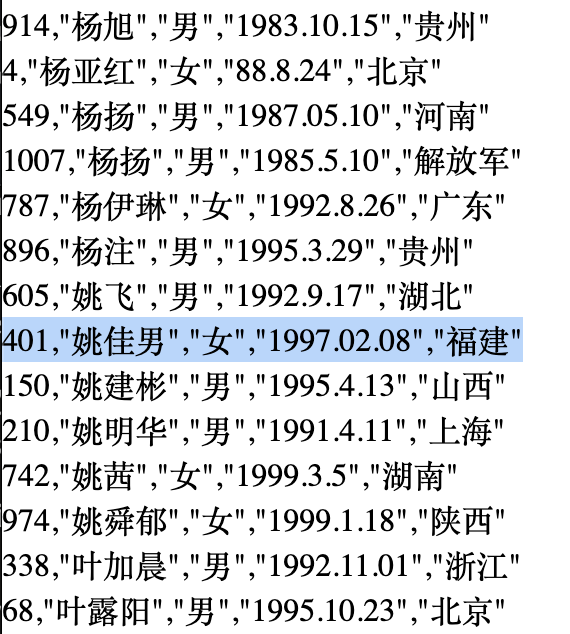
Because Yao Jinnan and Yao Jianan are twins, they share a birthdate. That much of the father’s argument holds. But the record shows that Yao Jianan herself was registered by Chinese sports authorities as born in 1997, which, by extension, means that Yao Jinnan also was born in 1997.
The twin, offered as proof of a 1995 birth year, instead points elsewhere. The schooling timeline aligns with a 1997 birthdate; the cached official document confirms it. The father invited skeptics to come to Fuzhou and see for themselves. But the question of Yao Jinnan’s is not resolved by appearance; it is resolved by the record, and there is an unavoidable discrepancy in that record.
Notes
If Yao Jinnan were in fact born in 1997, she would have been underage for both the 2011 World Championships — where she won silver on beam, bronze in the all-around, and bronze with the team — and the 2012 Olympics. Yet any such violation is now time-barred and no longer subject to review by the FIG’s disciplinary committee.
Whether 1997 represents Yao Jinnan’s true birth year or simply one point in a longer series of revisions is impossible to say with certainty. As cases like Sun Xiaojiao, Jiang Yuyuan, and Huang Qiushuang suggest, gymnasts’ registered birthdates could shift more than once across different databases, competition rosters, and newspaper articles. What can be said, however, is that the defense of Yao Jinnan’s 1995 birth year rested on evidence that, when examined, pointed in the opposite direction.
Also, please take a moment to recognize the brilliance of the Mo Salto on bars.
When Yao Jinnan won gold in 2014, she removed the Mo Salto.
More on Age