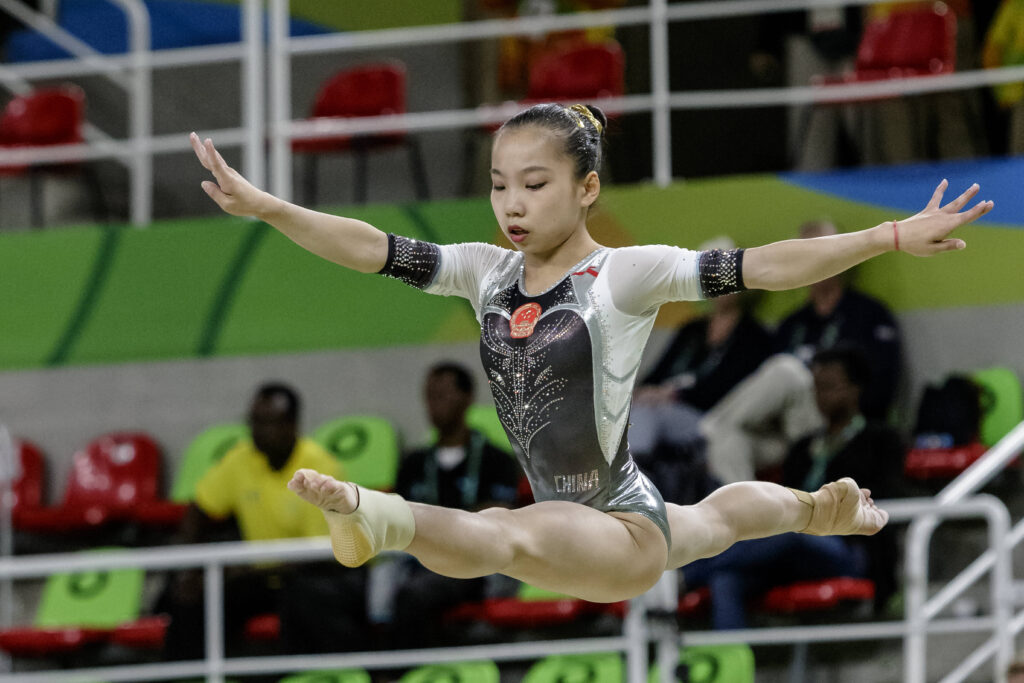
At the 2016 Rio Olympics, Chinese gymnasts again faced questions about their ages. Although the controversy received little attention in the United States — likely overshadowed by the emerging abuse scandal surrounding USA Gymnastics — it was widely discussed in China.
One exchange, in particular, stood out after the team final, where the Chinese team won bronze. “Many viewers watched the competition and were surprised by how young the Chinese team members look” (“很多观众看了比赛,他们对中国队员的年轻感到吃惊”), a foreign reporter remarked. “They seem very small, as if they might not quite be of eligible age” (“感觉看起来很小,似乎不是很够(参赛)年龄?”).
The question placed the gymnasts in an uncomfortable position. Any careless or ambiguous wording could easily have been amplified by foreign media and turned into another international controversy. But, according to Chinese media, the athletes responded calmly and confidently.
“We just look relatively young” (“我们只是看起来比较年轻”), team captain Shang Chunsong answered first.
“We do look young” (“我们就是看起来比较小”), Fan Yilin added, “but one of the American team members is actually younger than us” (“但是美国一名队员比我们还要小呀”).
Then Shang Chunsong concluded matter-of-factly: “Tan Jiaxin is from 1996; the rest of us are from 1999” (“谭佳薪是96年的,其余都是99年的”).
There was only one problem with that response: in the weeks leading up to Rio, Chinese state media had repeatedly described Wang Yan as belonging to the “post-2000s generation.”
During the Games, Chinese outlets frequently contrasted the extraordinary longevity of Oksana Chusovitina with the youth of the Chinese delegation. In one widely circulated article, China News Service described Rio as the first Olympics in which athletes born in the new century — the “post-2000 generation” — would appear on the Olympic stage. The article specifically identified Wang Yan, along with rhythmic gymnast Shang Rong, as part of that generation.
Rio Olympics: Ageless Legends Reassemble — “Gymnastics Grandma” May Be Taking Her Final Bow
China News Network, Beijing, July 30, 2016. Author: Yue Chuan
In a few days, the Rio Olympics will sound its drums. Every Games brings many new faces — and plenty of familiar ones. Rio this year is no exception.
It’s easy to notice that “post-2000” athletes have appeared in several delegations heading to Rio, meaning the generation born in the new century will be stepping onto the Olympic stage for the first time. Take the Chinese delegation: among its 416 competitors, the youngest is fourteen-year-old swimmer Ai Yanhan, with Wang Yan of the gymnastics team and Shang Rong of the rhythmic gymnastics team also among those making their first Olympic appearance as members of this generation. The rise of the young is cause for celebration — but it also throws into relief just how remarkable it is that the veterans are still standing.
The moving story behind “gymnastics grandma” Oksana Chusovitina is by now well known to everyone. More than a decade ago, to raise the enormous sums needed to treat her gravely ill son, the already-retired Chusovitina made the resolute decision to come back. What surprises people is that even after her life returned to calmer waters, her love of gymnastics has continued to carry this woman — now past forty — through competition at the international level. Rio will be this great mother’s seventh Olympic journey.
Across a gymnastics career now spanning twenty-five years, Chusovitina has accumulated honors beyond counting — not only an Olympic gold medal, but multiple skills named after her. Even at last year’s World Championships, the forty-year-old was still attempting to raise her difficulty level, giving genuine meaning to the idea of sporting spirit. At Rio, she still has the ability to claim a medal in competition against girls a fraction of her age.
Those close to Chusovitina have indicated she will not appear at the Tokyo Games four years from now — meaning the story of this “gymnastics grandma” will very likely reach its final chapter in Rio.
[…]
里约奥运”不老传说”再集结 “体操奶奶”或迎谢幕演出
2016年07月30日 08:28 | 来源:中国新闻网
中新网北京7月30日电(岳川) 还有几天时间,里约奥运就将擂响战鼓。每届奥运会,都能看到许多新面孔,也会有不少“老熟人”,今年的里约也不例外。
不难发现,在奔赴里约的多个代表团中都出现了“00后”的身影,这意味着出生于新世纪的一代,将首次站上奥运舞台。以中国代表团为例,在征战里约的416名参赛选手中,年龄最小的是游泳队14岁小将艾衍含,此外体操队的王妍、艺术体操队的尚蓉等,也都是初登场的“00后”。
年轻人的上位固然令人欣喜,而另一方面这也说明,仍在坚守的老将们有多么不易。
发生在“体操奶奶”丘索维金娜身上的感人故事已经家喻户晓。十余年前,为了给身患重症的儿子筹集高昂的治疗费用,已经退役的丘索维金娜毅然决定回归。令人惊讶的是,即便当生活归于平静,但对体操的热爱,仍支撑着年过四旬的丘索维金娜继续征战在国际赛场上。里约,将是这位伟大母亲的第七次奥运之旅。
在迄今为止25年的体操生涯中,丘索维金娜荣誉等身,不仅贵为奥运冠军,还拥有多个以自己名字命名的技术动作。即便是在去年的体操世锦赛上,40岁的她仍在尝试提高难度,真正诠释了体育精神的含义。在里约,丘索维金娜仍有实力,在与少女们的竞争中收获一枚奖牌。
丘索维金娜身边的人曾表示,她将不会出现在四年后的东京赛场上,因此关于这位“体操奶奶”的故事很可能在里约写完终章。
This article was printed on the website for the Chinese People’s Political Consultative Conference (CPPCC), an advisory body in China’s political system.
That characterization was significant because, in Chinese usage, “post-2000s” (00后) refers to people born between 2000 and 2009. And it came from the China News Service, which meant that an article from a major state-run news agency directly conflicted with Wang Yan’s official FIG birth year of 1999.
This was not an isolated example. For example, the Shanghai-based newspaper Jiefang Daily published another article describing Wang Yan as part of the “post-2000” generation heading to Rio. The wording again implied that she had been born in 2000 or later, despite the fact that her official FIG documents listed her birth year as 1999.
Rio Olympics: Young Heroes Ready to Shine — Who Will Be the First of the “Post-2000” Generation?
Shangguan News (纵览), July 31, 2016. Author: Yue Chuan
In a few days, the Rio Olympics will open. Among the competitors at every Games, you can always spot many young faces — some barely more than children. Don’t let their age fool you: heroes have always emerged young.
[…]
Heading to Rio, several young Chinese athletes have the ability to produce surprises. Fan Yilin, born in 1999, is the reigning World Champion on uneven bars. Xin Xin, not yet twenty, finished first in the Olympic qualifying event for the women’s 10km open water marathon swim — two full minutes faster than the London Olympic champion.
Worth mentioning is that Rio will mark the first time athletes born in the new century — the “post-2000 generation” — take the Olympic stage. The youngest Chinese competitor is fourteen-year-old swimmer Ai Yanhan; Wang Yan of the gymnastics team and Shang Rong of the rhythmic gymnastics team are also among those making their first Olympic appearance as members of this generation. And don’t overlook Ren Qian: fifteen years old, she is about to compete on the ten-meter platform — in diving, that speaks for itself.
[…]
再过几天,里约奥运就将拉开大幕。在每届奥运会的选手中,总能看到许多年轻人的面孔,有些甚至还是“孩子”。别看他们年纪小,当真自古英雄出少年。
[…]
此番出征里约,多位中国小将有能力制造惊喜。比如1999年出生的范忆琳,她是去年世锦赛高低杠的冠军;再比如未满20岁的辛鑫,她在10公里公开水域女子马拉松这个新兴项目的奥运资格赛上获得了第一名,成绩比伦敦奥运会冠军还快了两分钟……
值得一提的是,在里约,出生于新世纪的“00后”将首次站上奥运舞台。中国选手中年龄最小的是游泳队14岁小将艾衍含,此外体操队的王妍、艺术体操队的尚蓉等人,也都是初登场的“00后”。别忘了任茜,今年15岁的她即将出战十米台,跳水这个大项,不言自明。
[…]
Archived here.
This article even juxtaposed the ages of Fan Yilin and Wang Yan. Officially, both gymnasts were born in 1999, yet the article clearly framed Wang Yan as belonging to a younger generation.
That framing carried real stakes. At the 2015 World Championships in Glasgow, senior gymnasts were required to turn sixteen during the calendar year in order to compete. Wang Yan’s birth year was registered as 1999 — the latest year that still made her eligible. Had she actually been born in 2000 or later, she would have been underage and therefore ineligible for the competition in which China won team silver.
To be sure, the language in those media reports was imprecise. They do not establish exactly when Wang Yan was born. She may have been born in 2000, 2001, 2002, or another year entirely. But that uncertainty is beside the point. What matters is that mainstream Chinese reporting repeatedly contradicted the official age narrative during the Olympic cycle itself.
Those references are not the same thing as a state-issued passport. But the reporting reveals something more important than any single document could: contradictions about an athlete’s age circulated simultaneously in official and semi-official channels without prompting clarification, correction, or apparent concern. If she had truly been born in 1999, it is difficult to explain why those “00后” descriptions appeared so consistently — or why they have remained publicly accessible, without correction, for nearly a decade.
Notes
1. The People’s Daily even criticized the strategy of the women’s team. Though the paper of record stopped short of stating that the gymnasts were underage, it argued that the gymnasts were too young and inexperienced to be successful:
[…]
Change Must Begin Now
Some observers have pointed to biased judging as a significant factor in China’s Rio setbacks, citing specific technical grounds for why certain scores were unfair.
Judging impartiality can certainly be questioned. But on reflection — if the scoring has in fact reduced the weight given to technical difficulty, does that not also reflect, from one angle, the international gymnastics community’s growing emphasis on artistry? Rather than stopping at complaint and resentment, it would be better to follow the direction modern gymnastics is moving and push China’s program to adapt as quickly as possible.
The time has come to say goodbye to the approach of selecting undeveloped, very young athletes of small stature in order to maximize difficulty. Experience shows that China is fully capable of a different path: China’s first women’s world champion, Ma Yanhong, was already a fully grown young woman when she claimed that title, and Liu Xuan won her Olympic gold at twenty. Chinese girls’ exceptional technique, physical development, and the appeal of mature athletic femininity give them every capacity to surpass their European and American counterparts.
As for the new generation’s lack of major competition experience — that is a relatively solvable problem, though one that takes time. Looking ahead, Rio has already given the young athletes valuable exposure at the highest level. At these Games, newcomers Lin Chaopan and Deng Shudi reached the individual all-around final and showed genuine promise. Over the next four years, they are expected to carry the team on their shoulders.
Archived here.
[…]
发展变革始于足下
面对中国体操在里约经历的挫折,有人提出,裁判不公是一个重要原因,并且从专业技术角度指明了裁判判罚不公的理由和证据。
裁判的公正性当然可以质疑,但仔细想来,如果其判罚降低了技术难度的权重,不也从一个侧面反映了国际体操界日益重视体操审美的趋势吗?我们在质疑和愤懑过后,不如顺应现代体操发展潮流,推动我国体操尽快实现变革。
现在到了与选拔低龄、未发育、身材娇小运动员,以提高动作难度的做法说再见的时候了。经验证明,我们完全有能力迎头赶上:中国女子体操第一个世界冠军马燕红夺冠时就是“大姑娘”,刘璇也是在20岁时获得奥运金牌。中国女孩高超的技巧,完美的身材,成熟女性的魅力,完全有超过欧美女孩的实力。
至于新人大赛经验不足,这是相对容易、但需要时间才能解决的问题。从长远来看,里约奥运会增强了年轻队员顶级大赛经验。此次奥运会,新人林超攀、邓书弟已经闯入个人全能决赛,并表现出一定实力。未来的4年,他们有望挑起中国体操队的大梁。
2. The CPPCC article has since been removed. Although the Internet Archive did not capture the page, I was able to preserve a screenshot.
More on Age