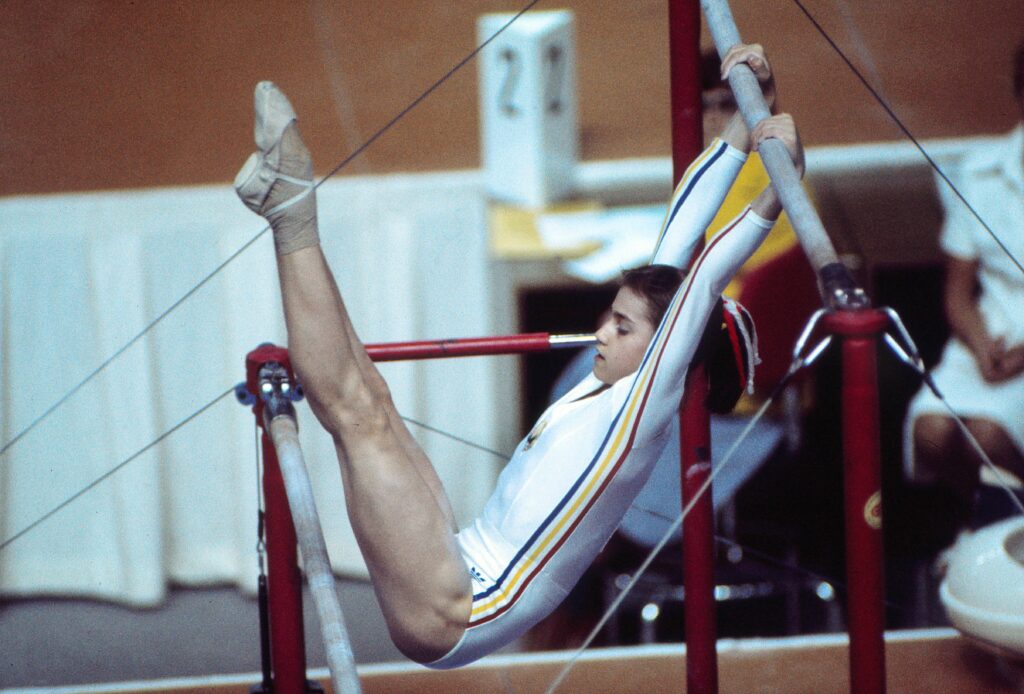
When the scoreboard at the 1976 Montréal Olympics repeatedly flashed 1.00 — the display’s rendering of a perfect 10.0 — Ellen Berger, the newly elected president of the FIG’s Women’s Technical Committee, was among the officials prepared to defend the judges’ decisions. The marks, she insisted, had been rightfully awarded: they reflected routines of the highest possible perfection. Each 10.0 also signaled, in Berger’s reading, a new stratum of performance quality — an elevation into territory above the 9s that reflected just how dramatically the sport had advanced.
Not everyone agreed. Sovetsky Sport noted at the time that Larisa Latynina had disputed the judgment of the panel — headed by Berger herself — over Comăneci’s perfect 10.0 on compulsory bars, with slow-motion television replays suggesting her dismount landing had not been entirely flawless. For Berger, however, the tens were not an aberration. The path forward for women’s gymnastics, she argued, ran through the pursuit of ever-greater difficulty paired with flawless execution — and Montréal had proven the point.
Performing the Most Difficult Elements Perfectly
Ellen Berger on Montréal and Trends in International Women’s Gymnastics
The enormous development in international women’s gymnastics at Montréal could not be measured by extremely high scores alone — the performances on offer rightfully provoked thunderous applause. Difficult C-elements were seen in an unbroken stream, performed above all with attractiveness, elegance, and a supreme degree of mastery. Particularly striking was the fact that athletes who had only just left childhood behind — such as the Romanian Nadia Comăneci or Masha Filatova from the USSR — dared to attempt the greatest difficulties, and in the case of the three-time Olympic champion, already executed them without error.
The pursuit of ever-new difficulties will also define women’s gymnastics in the near future. This was pointed out by the President of the Technical Committee of the International Gymnastics Federation, Ellen Berger, who is herself closely connected with the development of East German gymnastics. Asked for her assessment of the performances in Montréal, she said:
“The competitions were at an outstanding level. Performances have improved enormously across the board. Nadia Comăneci performed so perfectly that it is difficult to imagine how it could be done any better. She also demonstrated an impressive composure, proving herself extremely strong mentally as well. The Soviet gymnasts, too, showed themselves to be in excellent form in Montréal. Nelli Kim demonstrated her great talent, Ludmilla Tourischeva presented herself with her customary authority, and Olga Korbut has regained her former level of performance. The Czechoslovak gymnasts, and even teams like Canada and the Netherlands, who until now had always stood in the shadow of others, presented themselves with strong performances.”
Ellen Berger then turned to the performances of the East German gymnasts, who, with a very young squad (average age 18.5 years), were able to win silver through Carola Dombeck in the vault and bronze in the team competition.
“Our gymnasts, too, made their contribution to the high standard of these Olympic competitions. Their routines were difficult and original. On beam, during optionals, however, they did not fully exhaust their possibilities. In the compulsory exercises, steadiness did not always meet the ideal. In the battle for the silver medals, the Romanians benefited from the fact that Nadia Comăneci and Teodora Ungureanu, with their world-class performances, inevitably raised the scores of their four teammates, as well. That should in no way diminish the visible progress of this squad and the achievement of second place.”
[Note: Apparently, the adage “a rising tide lifts all boats” applied to team scores, as well.]
On the subject of future development, the internationally recognized gymnastics expert said: “It is only through the constant pursuit of ever-greater difficulty that it is possible to continue advancing. We have already seen that in Montréal. As examples, I would mention only Nelli Kim’s full-twisting Tsukahara and Carola Dombeck’s piked Tsukahara on vault, Kerstin Gerschau’s butterfly on the balance beam, and the double somersaults of Olga Korbut, Maria Filatova, and Nelli Kim in the floor exercise. These super-difficult elements must be paired with perfect execution, because only when they are presented elegantly and beautifully do they serve the advancement of the sport.”
On the subject of the repeatedly awarded maximum score of “10,” Ellen Berger said that these had been rightfully given for routines of the highest perfection, and that they also expressed an elevation into the territory above “9.”
Berliner Zeitung, August 7, 1976
Notes
1. Ellen Berger reportedly gave Comăneci a 9.90 for one of her routines on uneven bars.
Ellen Berger of East Germany, president of the FIG Women’s Technical Committee and head of the panel of judges, explained, “On one apparatus, four judges awarded a score of 10. I had assessed it at 9.90. As president of the jury, I had to maintain a somewhat more detached attitude, but my personal conviction was that the verdict ultimately given—the score of 10—was the correct one. Nadia’s performance was unique and unsurpassable.”
Sportul, July 23, 1976
Note: The article does not specify which bars routine.
The conflict between Romanian gymnastics and Ellen Berger is its own dissertation.
2. Here is the quote from Sovetsky Sport about Comăneci’s 10 on compulsory bars:
On beam, Nadia received a score of 9.9 — exceptionally rare for a compulsory. And on bars she was given a perfect 10.0. True, some specialists, including Larisa Latynina, disagreed with the judging panel headed by referee Ellen Berger (GDR). And even our slow-motion television replay showed that Nadia’s dismount landing was not flawless. In a word, it is not the ideal. But it is very close to it — very close…
На бревне Надя получила редчайший для обязательной балл — 9,9. А за брусья ей выставили абсолютную оценку — 10,0. Правда, кое-кто из специалистов, в том числе и Лариса Латынина, расходятся во мнениях с судейской бригадой, возглавляемой арбитром Элен Бергер (ГДР). Да и нам замедленный телевизионный повтор показал, что приземление у Нади не было безупречным. Словом, это не идеал. Но очень к нему близко, очень…
Sovetsky Sport, July 20, 1976
This quote, however, is not representative of Sovetsky Sport‘s coverage, which was largely laudatory.
Das Schwierigste perfekt darbieten
Ellen Berger zu Montreal und Entwicklungstendenzen im internationalen Frauenturnen
Berlin. ADN/BZ
Die enorme Entwicklung im internationalen Frauenturnen ließ sich in Montreal nicht allein an extrem hohen Noten ablesen, die gebotenen Leistungen riefen zu Recht stürmischen Beifall hervor. Man sah schwierige C-Teile am laufenden Band, vor allem auch mit Attraktivität, Eleganz und einem Höchstmaß an Beherrschung vorgetragen. Verblüffend dabei die Tatsache, daß gerade erst dem Kindesalter entwachsene Sportlerinnen wie die Rumänin Nadia Comaneci oder Mascha Filatowa aus der UdSSR sich an die größten Schwierigkeiten heranwagten und im Falle der dreifachen Olympiasiegerin auch schon fehlerfrei darboten.
Das Ringen um immer neue Schwierigkeiten wird auch in nächster Zeit das Frauenturnen bestimmen. Darauf verwies die Präsidentin des technischen Komitees des internationalen Turn-Verbandes, Ellen Berger, die selbst eng mit der Entwicklung des DDR-Turnsports verbunden ist. Nach ihrem Urteil zu den Leistungen in Montreal befragt, sagte sie:
„Die Wettbewerbe standen auf einem hervorragenden Niveau. Die Leistungen haben sich generell enorm verbessert. Nadia Comaneci turnte so perfekt, daß man sich nur schwer vorstellen kann, es noch besser machen zu können. Dabei wartete sie mit
einer imponierenden Nervenstärke auf, erwies sich auch im psychischen Bereich als äußerst stark. Auch die sowjetischen Turnerinnen zeigten sich in Montreal in ausgezeichneter Verfassung. Nelli Kim bewies ihr großes Talent, Ludmilla Turistschewa stellte sich mit der gewohnten Souveränität vor, Olga Korbut hat ihr altes Leistungsvermögen wiedererreicht. Die CSSR-Turnerinnen, selbst Mannschaften wie Kanada und die Niederlande, die bisher immer im Schatten anderer standen, stellten sich mit guten Leistungen vor.”
Ellen Berger ging dann auf die Leistungen der DDR-Turnerinnen ein, die mit sehr junger Riege (Durchschnittsalter 18,5 Jahre) Silber durch Carola Dombeck im Pferdsprung und Bronze in der Mannschaftswertung erorbern konnten.
„Auch unsere Turnerinnen haben ihren Anteil am guten Niveau dieser Olympia-Wettbewerbe. Ihre Übungen waren schwierig und originell. In der Kür am Schwebebalken schöpften sie ihre Möglichkeiten allerdings nicht im vollen Umfang aus. In der Pflicht entsprach die Standsicherheit nicht in jedem Fall den Idealvorstellungen. Den Rumäninnen kam im Zweikampf um die Silbermedaillen die Tatsache zugute, daß Nadia Comaneci und Teodora Ungureanu mit ihren Weltklasseleistungen auch die Noten ihrer vier Mannschaftskameradinnen zwangläufig anhoben. Das soll die sichtbaren Fortschritte dieser Riege und das Verdienst des zweiten Platzes allerdings keinesfalls schmälern.”
Zur weiteren Entwicklung sagte die in der Welt anerkannte Turnexpertin: „Nur über das Ringen um immer höhere Schwierigkeiten ist es möglich, weiter voranzukommen. Das haben wir bereits in Montreal gesehen. Als Beispiel möchte ich nur den Tsukahara mit ganzer Drehung von Nelli Kim und den gebückten Überschlagsalto von Carola Dombeck im Pferdsprung, den Schmetterling von Kerstin Gerschau auf dem Schwebebalken und die Doppelsalti von Olga Korbut, Maria Filatowa und Nelli Kim im Bodenturnen erwähnen. Dabei müssen diese Superschwierigkeiten mit einer perfekten Ausführung gepaart sein, denn nur wenn sie elegant und schön dargeboten werden, dienen sie der Weiterentwicklung.”
Zur wiederholt gezogenen Höchstnote „10″ sagte Ellen Berger, daß sie für Übungen in höchster Vollendung zu Recht gegeben wurden, und dabei auch das Anheben in den Bereichen über „9″ zum Ausdruck käme.