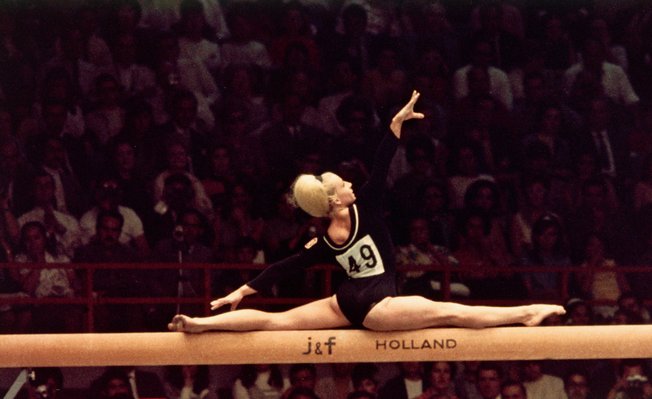
History is a matter of perspective, and, by extension, so are gymnastics results. As we’ll see, the women’s event finals were highly contested at the 1968 Olympic Games.
Let’s take a look at what happened…

History is a matter of perspective, and, by extension, so are gymnastics results. As we’ll see, the women’s event finals were highly contested at the 1968 Olympic Games.
Let’s take a look at what happened…

On Wednesday, October 23, 1968, the Olympians in women’s artistic gymnastics competed in the optionals portion of the competition. As far as gold medals were concerned, there weren’t any surprises. The Soviet team was leading after the compulsories, and they ended up with gold. Čáslavská was leading the all-around after compulsories, and she won gold.
But the competition had its fair share of drama, especially on the podium. Let’s take a look at what happened.

Čáslavská’s beam routine during the optionals portion of the (1B) competition caused quite the stir.
Here are the basics:
There was a lot on the line. These scores counted towards:
Let’s get into the nitty-gritty and discuss how this one routine illustrated so much of the judging dysfunction that existed in the 1960s.

On Monday, October 21, 1968, the women’s compulsories opened the gymnastics competition at the Olympics in Mexico City.
And, as we’ll see, the crowd was very invested in the competition.

In 1968, the men’s event finals took place on Saturday, October 26, the very last day of competition at the Olympic Games.
Let’s take a look at what happened…

The Swiss newspaper L’Express summarized it best:
Until the last moment, it was impossible to predict who would win the individual all-around victory. However, since the start of the evening, it was certain that the Japanese would win the team competition.
Jusqu’au dernier moment, il était impossible de prédire à qui irait la victoire individuelle. Par contre, depuis le début de la soirée, il était certain que les Japonais l’emporteraient par équipes.
L’Express, Saturday, October 26, 1968
Let’s take a look at what happened.

When we think of the 1968 Olympics in Mexico City, we think of the questionable judging in women’s gymnastics and the political protest of Věra Čáslavská on the podium after the floor finals.
Over the years, a piece of FIG gossip has been forgotten. It happened after the men’s compulsories. Arthur Gander, the FIG president, threatened to ban a coach from competition.
So, let’s dive into the men’s compulsories, eh?

In Věra ‘68, Čáslavská returned to the National Auditorium in Mexico City, the place where she won four gold medals. While there, the tour guide said:
[Čáslavská] was an icon for us. We felt she was one of us, because at that time, in both our countries, there were student uprisings. That is why she was so dear to us. The fact that she won — it strengthened the bond between all the oppressed people. You will always be in our hearts.
During the 1968 Olympic Games, the Czechoslovak athletes meant a lot to a large portion of the Mexican audience. To understand why, you have to understand what happened in Mexico City ten days before the Olympics commenced.

Let’s take a look at the compulsories for the 1968 Olympic Games in Mexico City, including the piano sheet music!
The bar routine turned out to be brutal. Every single team had at least one gymnast score in the 8s (or lower) — even the Soviet Union.
In July of 1976, newspapers around the world reported that Nadia Comăneci scored the first 10 in Olympic history.
Nadia Comaneci, a 15‐year‐old Rumanian girl, scored the first perfect 10 in Olympic gymnastic history in the women’s uneven parallel bars competition.
New York Times, July 19, 1976
Nadia received a perfect score of 10.00 — the first perfect 10 in Olympic history.
The Daily Yomiuri, July 20, 1976
Unfortunately, what they reported was wrong.
Comăneci was the first female gymnast to score a 10 in Olympic history, but she was not the first gymnast to score a 10. (To be fair, information was much harder to come by in the 1970s.)