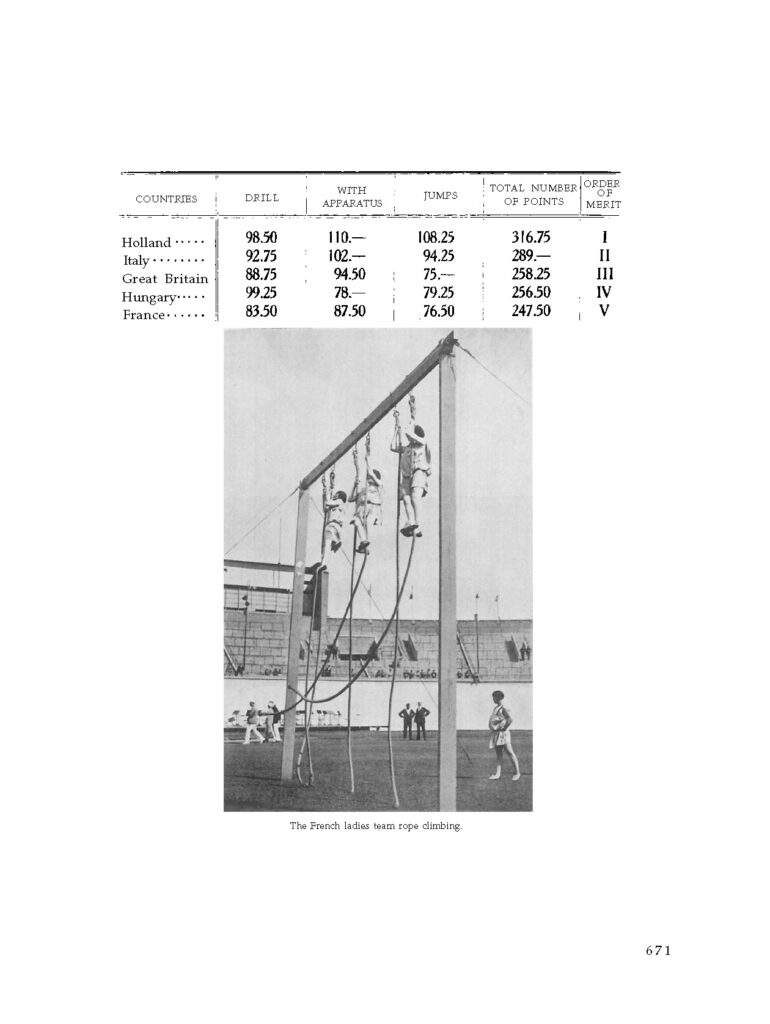
In 1928, women finally competed in gymnastics at the Olympic Games. Previously, they had been allowed to perform exhibitions, but they weren’t part of the competitive program.
The rules for the women’s competition at the 1928 Olympic Games were vague at best. After reading this post, you’ll probably have more questions than answers.
Over the years, there have been many versions of the Olympic Games. One version was the International Workers’ Olympiads, which positioned itself in opposition to the “bourgeois” Olympics.
(For a list of Olympics that happened before the 1896 Olympics in Athens, check out this post.)
As I stated in my previous post, the International Workers’ Olympiads gave Swiss women the opportunity to compete internationally at a time when the FIG didn’t allow women to compete. (At the Olympic level, women first competed in gymnastics at the 1928 Olympics.)
So, let’s take a look at what happened at the First International Workers’ Olympiads in 1925.
Nowadays, we see the Olympic Games as the pinnacle of sports, and we have romanticized the first modern Olympics in Athens.
But, to understand the gymnastics competition at the 1896 Olympic Games, we need to set aside those notions.
By and large, the gymnastics community didn’t see the first Olympic Games as a glorious revival of an ancient tradition. In fact, most of the European gymnastics federations turned down their invitations.
In 1948, the Soviet Union was invited to the Olympics, but they chose not to send any athletes. That same year, the Soviet Union attempted to join the FIG, and it was quite the fiasco.
In this post, we’ll take a look at a news report from the 1948 FIG Congress. In addition, we’ll look at a Swiss report on the Soviet appearance at the 1948 Sokol Fest, as well as what was being written about gymnastics in the Soviet press at the time.
Let’s jump in…
Helsinki. Finland. The 15th Summer Olympics. Soviet gymnast Viktor Chukarin.
Note: The Soviet Union had participated in international gymnastics competitions before their attempt to join the FIG in 1948, but those competitions were not FIG events. For example, they participated in the 1937 Workers’ Summer Olympiad in Antwerp, where the Soviet teams finished first.
The men’s gymnastics competition at the 1948 Olympics was a bit chaotic, but by all accounts, it was an exciting competition between the Swiss and the Finnish teams. (Though, there were a fair amount of complaints about the judging.)
At the time of this writing, I have not found any extant competition footage. But the newspaper accounts paint a fairly clear picture of the competition and its controversies.
In 1948, the men were one year away from having their very first Code of Points. Surprisingly, the technical committee didn’t simply copy and paste the rules for the 1948 Olympics into the 1949 Code of Points. The two documents look surprisingly different.
Let’s take a look at the rules that were in place for the London Olympics.
The London Olympics were only the third official Olympic competition for women. (Previously, women had competed at the 1928 and 1936 Olympics. There had been exhibitions at previous Olympics, and they had competed at the 1934 and 1938 World Championships.)
Needless to say, women’s gymnastics was still in a state of flux. So, let’s dive in and see what happened at this competition with rhythmic ensemble routines and flying rings.
Gold medal and photographs of former Czech gymnast Vera Ruzickova, Olympic winner in London 1948, pictured during the press conference prior to Olympic games in London, Prague, Czech Republic, on Tuesday, July 17, 2012. Photo/Stanislav Peska (CTK via AP Images)
1948 was a different time in women’s gymnastics. 15 points as the maximum score for optional routines. Flying rings. Ensemble exercises. No all-around competition.
Let’s take a look at the rules.
Cissie Davies of Great Britain on the balancing bar, during the Summer Olympic Games gymnastics event (transferred from the Wembley Stadium) at the Empress Hall, Earl’s Court in London, United Kingdom on August 12, 1948. Eleven countries have entered the women’s team competition. The competition is carried out on similar lines to the men’s and comprises voluntary and compulsory exercises on swinging ring and beam, and springboard vaults over the pommel-horse. (AP Photo)
It’s no secret that Marie Provazníková of Czecholoslovakia was one of the first known political defectors at an Olympic Games.
However, what has been lost over the years is the context of her defection, particularly the role that gymnastics played in her desire to seek political asylum.
So, let’s take a closer look at her story, starting with the Sokols in the 1940s.
Marie Provaznikova, leader of the Czech women’s Olympic team, joining a group of six other Czechoslovakian and two Hungarian Olympic performers who have refused to return to their homelands, declared in London, Aug. 18, 1948, “I am a political refugee and proud of it.” She told reporters in London: “When I left Czechoslovakia I did not intend to return. I am a member of the Benes party.” She said she plans to get a physical education job in the U.S. (AP Photo/John Rider-Rider)
Note: On August 16, 1948, the Dutch newspaper Het nieuws, like the AP, reported that there were other defectors at the Olympics.