Elena Mukhina is buried in Troyekurovskoye Cemetery in Moscow. Her gravestone gives her birth year as 1960. It looks like the sort of detail that should settle a question permanently — stone pretending to be certainty. Yet in the mid-1970s, that was not always the year attached to her name.
When people discuss age falsification in Soviet gymnastics, the story usually begins in the 1980s, when the practice became widespread enough to provoke international controversy and leave behind clearer paper trails. But the foundations of that system were laid earlier. In Mukhina’s case, we can watch the process unfold almost in real time, source by source, over roughly 31 months.
I cannot say with certainty when Elena Mukhina was born. I emailed several of her former teammates to ask whether they knew, but none replied. The purpose of this article, however, is narrower than establishing her true birth year. Nor is it to speculate about why her age changed or who may have altered it. Rather, my aim is simply to trace what the public record said, when it said it, and how that number shifted over time.
So, here are the many birth years of Elena Vyacheslavovna Mukhina, according to the Eastern Bloc press.
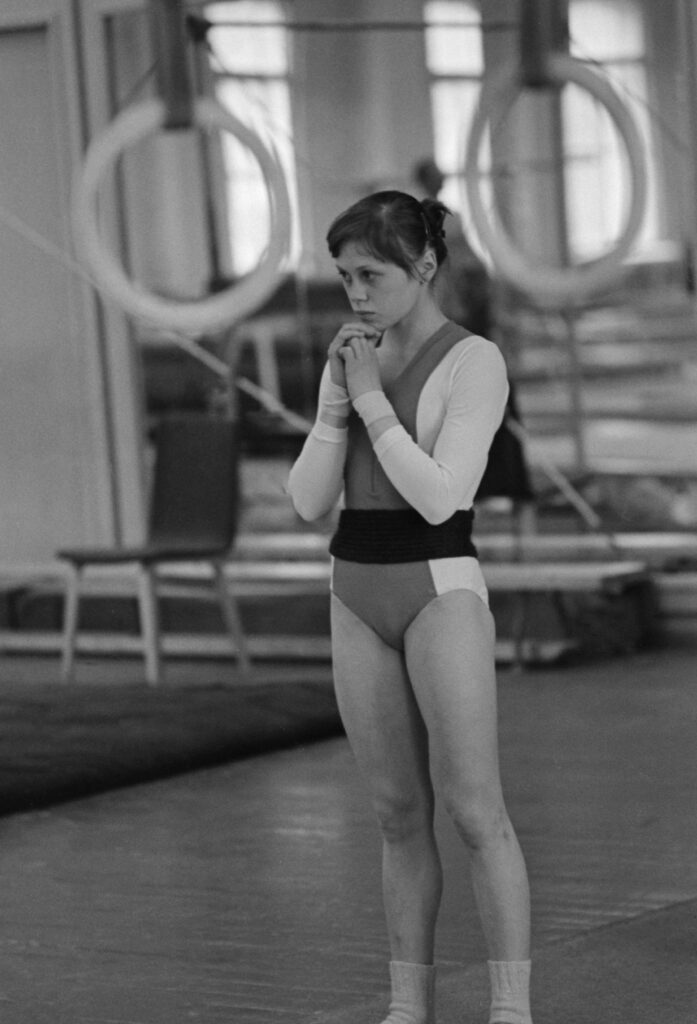
1959 in 1974
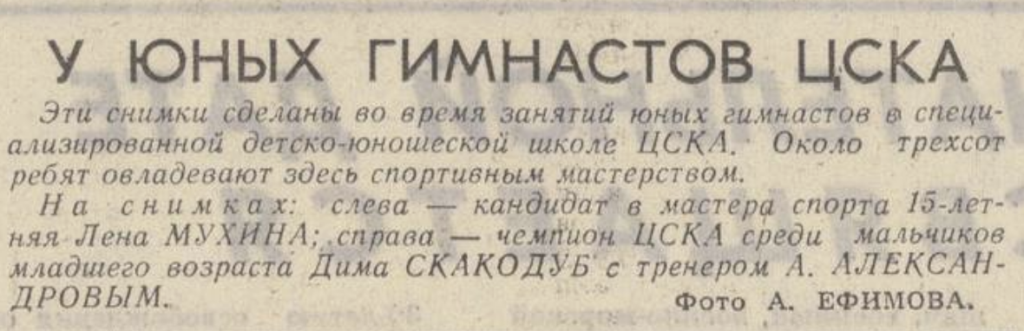
In October 1974, Krasnaya Zvezda, the official newspaper of the Soviet military, published a photograph from a training session at the specialized CSKA children’s and youth sports school. The caption identified “Candidate for Master of Sport, 15-year-old Lena Mukhina.” A fifteen-year-old in October 1974 would have been born in 1958 or 1959. (With a June birthday, 1959 makes the most sense.)
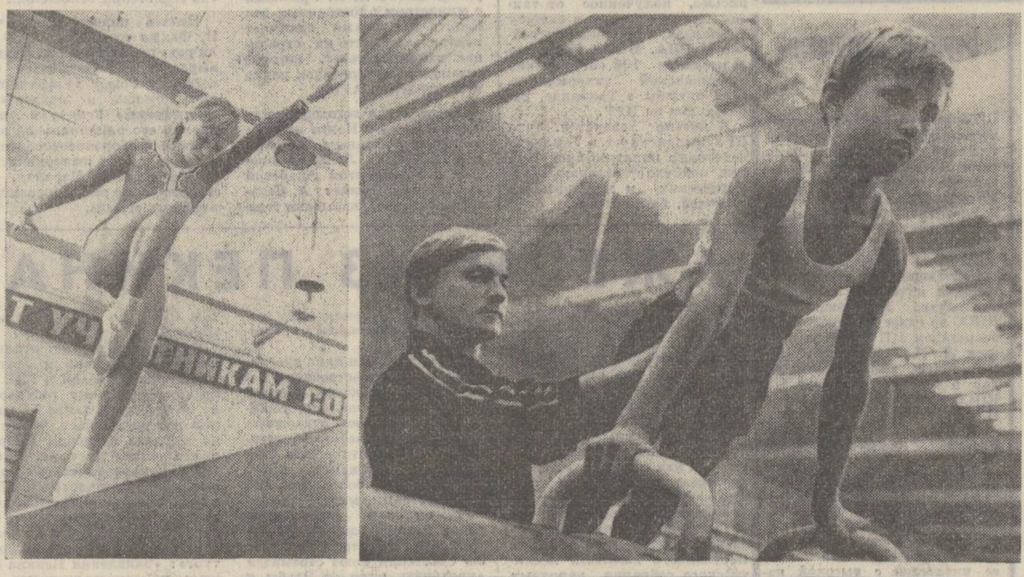
Mukhina next appears in the record in February 1975, when Leninskaya Smena covered the Armed Forces Cup in Alma-Ata (Kazakh Soviet Socialist Republic). The head coach of the USSR Armed Forces gymnastics team assessed the competition by naming several rising athletes:
“The army team holds the traveling trophy for the country’s best team. Its lineup includes the Munich Olympic champion Viktor Klimenko, world championship medalist Vladimir Safronov, world champion Olga Korbut, national champion Svetlana Grozdova, and others. As the tournament in Alma-Ata shows, Vyacheslav Boyko, Aleksandr Maleev, Nikolai Nedbalsky, Leonid Pavlovsky, Anatoly Sedykh, Raisa Bichukina, and Elena Mukhina have now drawn very close to them.”
Two months later, Moskovsky Komsomolets reported on the Moscow City Championship: “Galina Aleutdinova, Svetlana Shelenkova, Olga Yakovleva, and Elena Mukhina also deserve kind words.” In both accounts, she is presented as a rising talent, but her name is not attached to a specific age.
1961 in 1976
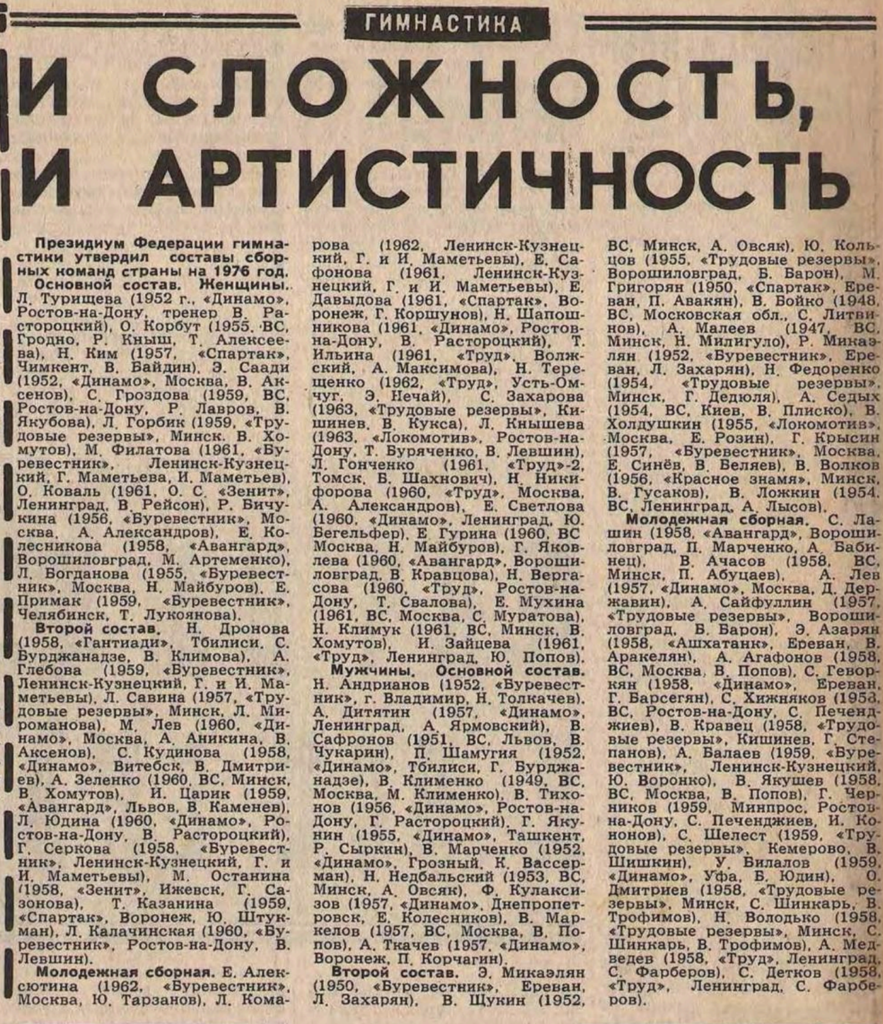
Then, on March 3, 1976, Sovetsky Sport — the official newspaper of the State Committee for Physical Culture and Sports of the USSR, the highest sports authority in the Soviet Union — published a complete roster of the Soviet national gymnastics teams, from the senior ranks down through the youth squads, with each athlete’s birth year listed beside her name. This was not an offhand reference or a casual profile. It was a comprehensive official document, the kind of publication intended to establish and standardize the record.
Mukhina appeared on the Youth National Team roster:
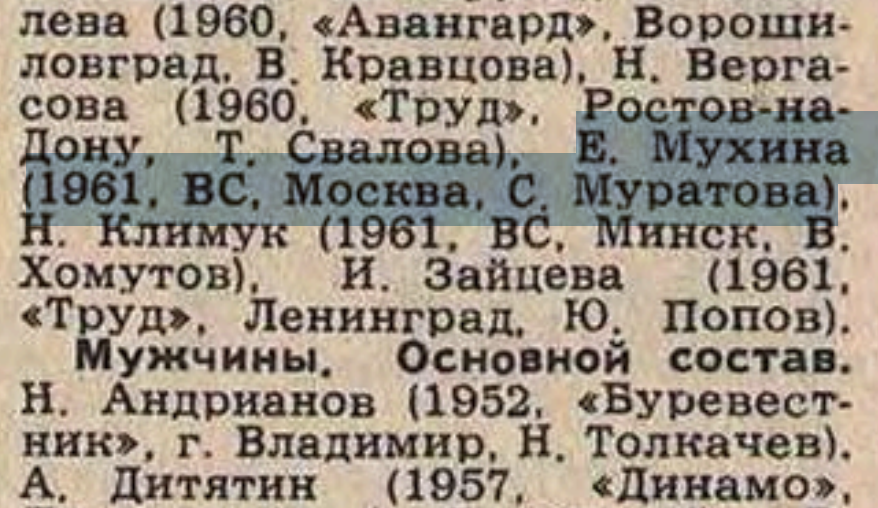
According to this document, she was born in 1961. With a June birthday, that would have made her fourteen at the time of publication — and thirteen when Krasnaya Zvezda had described her as fifteen in 1974. Two years, in effect, had been shaved off her age.
For several months afterward, the sources remain consistent with a 1961 birth year. At the USSR–Czechoslovakia meet in Minsk in June 1976, Mukhina’s floor exercise caused what the Sovetsky Sport correspondent called a sensation. The article pauses to explain her rapid rise:
Yet even in this fireworks display of difficulty, there was a performance that can, without exaggeration, be called sensational: the optional program of 15-year-old Muscovite Elena Mukhina. A year and a half ago, this girl was about to be dismissed from the CSKA school as ‘unpromising.’ The well-known coach Mikhail Yakovlevich Klimenko stood up for her and began working with her. He had no prior experience coaching women — until then, he had always trained men — but he possessed bold, original ideas in gymnastics and worked creatively with complete dedication. In an extremely short time — one year and five months — he taught his new pupil the most difficult combinations on all apparatus.”
June 22, 1976
The March roster had identified Muratova, a two-time Olympic gold medalist, as her coach. By June, the narrative had shifted: Mikhail Klimenko — a men’s coach with no previous experience coaching women — was now presented as the architect of her development. But one thing remained consistent: her birthdate. In June, she was still “15-year-old Muscovite Elena Mukhina,” an age consistent with a 1961 birthdate.
That same age appeared in foreign coverage of the meet. Writing in Československý Sport after the USSR–Czechoslovakia competition in Minsk, one correspondent introduced Mukhina as “an inconspicuous 15-year-old from Moscow” whose floor exercise had given the Soviet coaching staff “serious reason for reflection.” The article framed her emergence alongside the earlier breakthroughs of Olga Korbut and Nadia Comăneci, suggesting that another major gymnastics star might be arriving.
The 1961 birth year was therefore no longer confined to Soviet sources. It was now appearing in the wider Eastern Bloc press.
And it did not stop there. In September, the Bulgarian newspaper Narodna Mladezh published a profile under the headline “A New Gymnastics Star Is Rising,” describing Mukhina as “the fifteen-year-old schoolgirl from Moscow.” The article repeats the story of her near-dismissal from gymnastics school: “During entrance exams at the gymnastics sports school a year and a half ago, Lena Mukhina was rejected as ‘insufficiently talented.’ This, however, only spurred her coach, Mikhail Klimenko, who took the girl under his wing.”
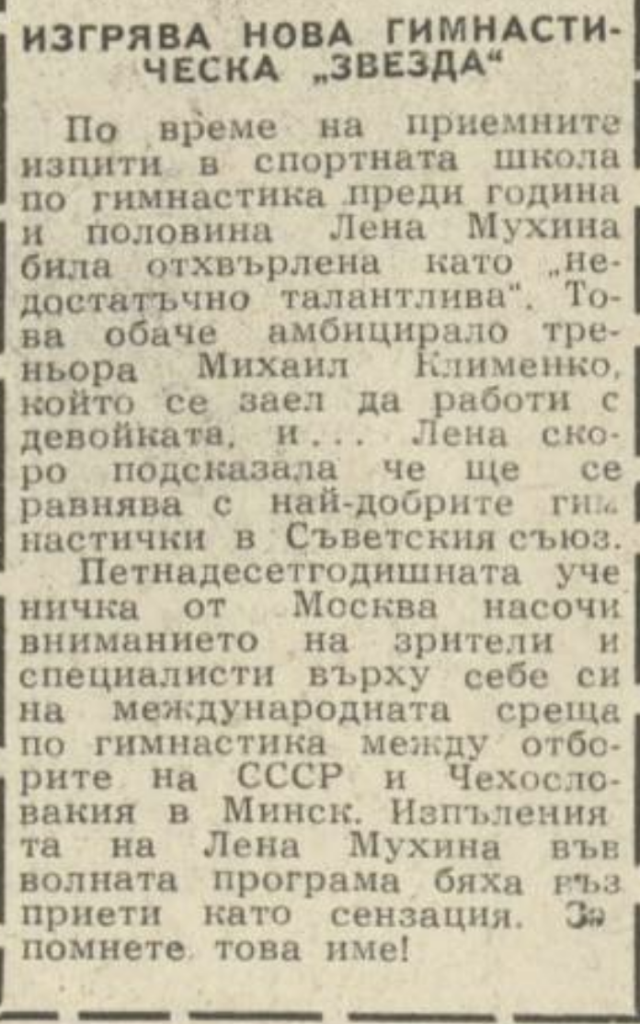
So by late 1976, the available evidence pointed overwhelmingly toward a 1961 birth year. Soviet officials, Soviet journalists, and reporters elsewhere in the Eastern Bloc were all telling the same story. But the chronology would not remain stable for long. Before the year was over, the public record would shift again, and Mukhina would suddenly become a year older with a 1960 birth year.
1960 in 1976 and 1977
After winning the all-around title at the All-Union Spartakiad of Schoolchildren in Lviv that summer, Mukhina went on to capture the USSR Youth Championship in Odesa in December. Her winning total of 81.75 points included extraordinary bonus-system scores of 10.7 on bars and 11.2 on floor exercise. Writing in Sovetsky Sport, correspondent Vladimir Golubev observed:
“Sixteen-year-old schoolgirl Lena Mukhina surpassed her peers in every component of mastery. Her coach, Mikhail Klimenko — a farsighted man and an excellent connoisseur of technique — designed routines for his pupil with an eye to the future.”
Sovetsky Sport, December 15, 1976
The description marked a notable departure from earlier reporting. If Mukhina was sixteen in December 1976 and celebrated her birthday in June, the implied birth year was 1960.
More importantly, this was not an isolated reference. As Mukhina’s star continued to rise, Soviet sports journalists repeatedly described her in terms consistent with a 1960 birth year. Reporting from the Moscow News tournament four months later, in April 1977, Golubev again wrote in Sovetsky Sport:
“Sixteen-year-old Muscovite Elena Mukhina, the national youth champion, dazzled on floor exercise (the most difficult acrobatics in the world!), and on the uneven bars (“Korbut loop” with a twist!). But she could not avoid a fall on the balance beam. Stella Zakharova also came off the apparatus there, as did Shaposhnikova. The girls were nervous.”
Sovetsky Sport, April 3, 1977
Outside the Soviet Union, however, the earlier chronology was not rewritten as quickly. After the 1977 Moscow News tournament, Československý Sport published a profile of the competition’s rising stars. There, Mukhina was still described as fifteen years old, which was consistent with a 1961 birth year:
“The third young talent is 15-year-old Muscovite Elena Mukhina of the Armed Forces club, where she is coached by the famous gymnast of earlier years, Sofia Muratova.”
April 9, 1977
The discrepancy is particularly curious because the article was not based on independent Czech reporting. The byline noted that “the dispatch was filed for Československý Sport by Stanislav Tokarev, an editor at Sovetsky Sport in Moscow.” Even as Sovetsky Sport‘s own coverage had begun presenting Mukhina as sixteen, traces of the earlier birth year remained visible elsewhere in the reporting network.
Just weeks later, however, Tokarev presented a very different chronology in Československý Sport. Writing ahead of the 1977 European Championships in Prague, Tokarev profiled the Soviet team’s leading contenders. This time, he supplied not merely an age, but a precise birthdate:
Another candidate for the trip to Prague, Elena Mukhina, was born on 1 June 1960. She lives in Moscow, attends the tenth grade, and is coached by Mikhail Klimenko. At the USSR Championships, she won second place.
May 5, 1977
The shift is difficult to overlook. Someone born on 1 June 1960 could not have been fifteen years old a few weeks earlier in April 1977. Whatever biographical information Tokarev had relied upon in his earlier report had now been replaced by something new. And by the time the 1977 European Championships opened in Prague—where Mukhina would go on to win the all-around silver medal behind Nadia Comăneci—the public record was increasingly converging on the birth year now engraved on her gravestone.
Yet the path to that apparent consensus was anything but straightforward. The October 1974 report implying a 1959 birth year, the March 1976 national team roster listing 1961, the subsequent press coverage that followed suit, and the contradictory accounts that persisted into 1977 do not fit neatly into a simple 1960 chronology.
In 1989, as the Soviet Union began to unravel, glasnost opened space for a more candid reckoning with the past. That year, journalist Stanislav Tokarev published an article in Ogoniok examining the Soviet sports system. Tokarev wrote that age falsification had existed in Soviet sport since at least the 1960s. For some athletes, that meant living with entirely new identities after their birth certificates were rewritten. For others, it was less drastic; it meant competing under newly issued passports.
What happened in Mukhina’s case, I cannot say. I do not know whether new passports were issued, whether her birth certificate was rewritten, or whether something else entirely occurred behind the scenes. But the public record makes one thing difficult to deny: in the Soviet gymnastics system of the 1970s, birthdates could change with ease. Mukhina’s certainly did.
One can only hope that Mukhina’s true birthdate found its way onto her gravestone.
Note
1. Should one of Mukhina’s teammates ever respond, I will update this article accordingly. info@gymnastics-history.com.
2. Vladimir Golubev, the other Sovetsky Sport writer who covered gymnastics in the 1970s and 80s, wrote:
And yes, I know about the fake birth certificates. Not only Olga [Mostepanova], but other young gymnasts had their ages “adjusted.” The goal was victory—at any cost—to beat the Romanians and East Germans at the Olympics that never happened for us.
It should be stipulated that Soviet gymnasts’ ages were not altered solely in preparation for the 1984 Olympics. It appears that Natalia Ilienko’s birthdate, for example, was altered to make her eligible for the 1980 Olympic Games. Why Mukhina’s birthdate shifted so many times is not immediately evident based on the public record.
3. For more on Mukhina, see:
- 1980: What the Soviet Union Printed about Mukhina’s Accident
- 1980: What the Rest of the World Printed about Mukhina’s Accident
- 1988: Elena Mukhina Breaks Her Silence in “Grown-up Games”
- 1989: Elena Mukhina Addresses the Myths in “After Fame, after Tragedy”
Appendix A: The Roster
Appendix B: The Full 1976 Československý Sport Profile
“Will She Eclipse the Glory of Comăneci?”
I had the great fortune in life to witness the beginning of Olga Korbut’s world competitive career in 1969 in Moscow, and then the rise of the emerging star Nadia Comăneci in 1973 in Gera. In both cases, the predictions came true. The Romanian Comăneci is still awaiting her great opportunity in Montreal.
At the end of last week, we had the opportunity to glimpse the final Olympic preparations of the USSR in Minsk. In the Soviet team that competed against our Czechoslovak representatives appeared an inconspicuous 15-year-old, Elena Mukhina of Moscow. She had not yet officially been included in the national team. Nevertheless, her performance in the floor exercise during the meet with Czechoslovakia gave the Soviet coaching council serious reason for reflection.
If Mukhina received from the judges — in an internationally composed panel — the highest score of the entire competition for her floor routine, a 9.95, then it was neither courtesy nor momentary excitement. Mukhina performed a routine such as even the world’s male specialists had not yet dared to boast of!
Rejected as “lacking prospects”
In her other routines as well, one finds in Mukhina an originality that overshadows the daring and inventiveness of both Korbut and Comăneci. Soviet colleagues told me that Mukhina, despite being a talented child, had been removed from the state training system as “without prospects.” However, she was taken in by Mikhail Klimenko (the brother and coach of European champion Viktor Klimenko). It is now said of him that he wants to surpass such masters of coaching as Rastorotsky, Knysh, and others.
I do not know how the situation will develop. The coaching council reserved the right to decide on two members of the team only shortly before departure for Montreal. It would not be surprising if Mukhina were included as a reserve gymnast.
The role of reserve gymnasts at world competitions is to serve as demonstrators during judges’ instruction sessions. One can imagine what it would mean if a “reserve” gymnast stunned all the judges with astonishing performances and elements no one had ever seen before the Olympic competition had even begun.
I would also like, with this remark, to return to the result achieved in Minsk by the Czechoslovak gymnasts in their meet with the USSR. To lose to such a strong team by only 6.25 points in the current circumstances is an honor. Let us recall that at the last Olympic Games and World Championships, the margins were around 15 points.
Tiny differences
I do not mean to claim that the result in Minsk guarantees our team a place among the top six in Montreal. But by its performance, it unquestionably belongs among the six best teams in the world.
For years now, only very small differences have separated the teams of Czechoslovakia, Hungary, the United States, Romania, and Japan. Often a bronze medal was decided by one or two mistakes from an individual gymnast. The Japanese, for example, fell as low as seventh place because of this, and we too have unpleasant memories of similar situations.
Pohludková, Holkovičová, Knopová, Smolíková, Pořádková, Černohousová, and Tunová delivered a solid standard in Minsk. None of them is a star, but as a collective they may well preserve the good reputation of Czechoslovak gymnastics in Montreal.
— M. Fišer, Minsk
June 26, 1976
Zastíní slávu Comaneciové?
Měl jsem životní štěstí vidět začátek světové závodní dráhy Olgy Korbutové v roce 1969 v Moskvě, pak vycházející hvězdu Nadi Comaneciové v roce 1973 v Geře. U obou se splnily předpovědi, Rumunka Comaneciová čeká ještě na svou velkou příležitost v Montrealu.
Koncem minulého týdne jsme měli možnost nahlédnout do závěrečné olympijské přípravy SSSR v Minsku. V družstvu SSSR, které nastoupilo proti našim reprezentantkám, nastoupila nenápadná 15letá Jelena Muchinová z Moskvy. Zatím nebyla oficiálně zařazena do sborné. Nicméně její výkon ve volných sestavách v utkání s ČSSR dal významný podnět k přemýšlení trenérské radě SSSR. Jestliže Muchinová získala od rozhodčích (v mezinárodním složení!) za volná prostná nejvyšší známku celého utkání 9,95, pak to nebyla ani zdvořilost, ani okamžité vzrušení. Muchinová předvedla sestavu, jakou se dosud nepochlubili ani světoví specialisté-muži!
Vyřazena jako neperspektivní
I v dalších sestavách najdeme u Muchinové originality, které zastíní odvahu a nápaditost jak Korbutové, tak Comaneciové. Vyprávěli mi sovětští kolegové, že Muchinová jako talentované děcko byla vyřazena ze státního výběru jako neperspektivní. Ujal se jí však Michail Klimenko (bratr a trenér mistra Evropy Viktora). Říká se nyní o něm, že chce porazit v trenérské práci takové mistry, jakými jsou Rastorocký, Knyš a další.
Nevím, jak se situace vyvine. Trenérská rada si nechala právo rozhodnout o dvou členkách družstva až těsně před odjezdem do Montrealu. Nepřekvapilo by, kdyby Muchinová byla zařazena jako náhradnice. Úkolem náhradnic ve světových soutěžích je dělat demonstrátorky při školení rozhodčích. Umíme si představit, co to znamená, když »náhradnice« svými překvapujícími a dosud nikým nepředvedenými výkony vyrazí dech všem rozhodčím ještě než začne olympijský závod.
Rád bych touto poznámkou uvedl znovu výsledek, kterého v Minsku v utkání s SSSR dosáhly čs. gym-nastky. Prohrát s tak silným družstvem jen o 6,25 v současné situaci je vyznamenáním. Připomeňme si, že na posledních OH a MS rozdíly dělaly kolem 15 bodů.
Nepatrné rozdíly
Nechci tím tvrdit, že výsledkem z Minska má naše družstvo zajištěné postavení do šestého místa v Montrealu. Ale svým výkonem mezi šest nejlepších na světě nesporně patří. Léta už jsou jen nepatrné rozdíly mezi družstvy ČSSR, Maďarska, USA, Rumunska a Japonska. O bronzové medaili často rozhodly jeden nebo dva nezdary jednotlivkyně. Japonky tím např. klesly až na 7. místo, podobně nepříjemné vzpomínky máme i my.
Pohludková, Holkovičová, Knopová, Smolíková, Pořádková, Černohousová, Tunová odvedly v Minsku dobrý standard. Žádná z nich není hvězda, ale jako celek mohou v Montrealu uhájit dobrou pověst čs. gymnastiky.
M. FIŠER, Minsk Kresba M. MED
More on Age
One reply on “Notes on Elena Mukhina’s Shifting Age”
Now that you raised the question, I recall having seen her age at the time of the house fire which took her mother’s life being reported as 3, 4 and 5 years old depending on the source. Although I’m not sure I’m remembering those sources correctly, I THINK they were: an article written for a Soviet/Russian newspaper, a Russian documentary on her story, a statement from one of her fellow gymnasts and/or former Soviet team gymnastics coach, and the physical therapist who treated her at the hospital in Moscow. They seemed to be reliable, and committed to provide accurate information to the best of their knowledge. It was something that caught my attention, and always left me wondering why they came up with different ages. Maybe it is tied to her birthdate being ‘adjusted’ to the Soviet’s team convenience. If it really happened, most likely she wouldn’t be the only one, so former team mates and coaches might be implicated in one way or another in this practice, so it wouldn’t be surprising they would keep quiet about it.