On March 15, 2010 — global Consumer Rights Day — the Beijing News published a piece of institutional satire disguised as an investigative report on the Dong Fangxiao age fraud case. Its target was not the gymnast herself, but the official explanation that she had reduced her own age after retirement — a claim so implausible that the article treats it as a joke and follows it to its logical conclusion.
Framed as a mock “anti-counterfeiting” report, the piece recasts Dong’s age as a defective product, Sydney as its place of origin, and the Gymnastics Center director as its “quality inspector.” The implication is mordant: the same authority responsible for the irregularity is now certifying the investigation into it.
From there, the satire widens. What begins as a single case becomes a broader portrait of a sporting world full of “counterfeits,” including members of the 2008 team, and it culminates in a deliberately absurd proposal: implant electronic chips in newborns to prevent age fraud. “That way, there would be no fear of athletes changing their ages — and no worry about officials changing them either.” The line gives the game away: the power to falsify records does not belong to the athlete, yet it is the athlete who is to be controlled.
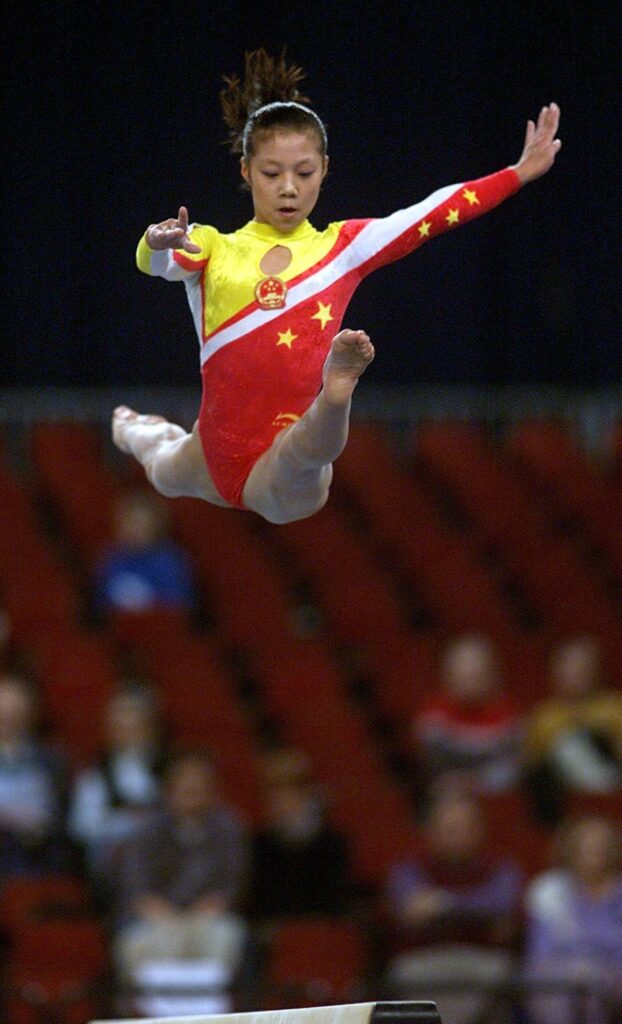
3/15 and Fake Ages in Sports: Is Playing Rashomon a Chinese Tradition?
Beijing News, official account — March 15, 2010
Today is the 28th “International Consumer Rights Protection Day.” Wu Gaohan, deputy secretary-general and spokesperson for the China Consumers Association, declared that those who produce and sell counterfeit and substandard goods should be made to “pay back from uncle’s house all the way to grandma’s house” [i.e., bankrupted completely]. In other industries, counterfeits can at least be exposed once a year on “3/15,” but the “counterfeits” in the sports world are so hard to track down that not even their own parents can find them — let alone the uncles and grandmas — and the problem of protecting sports fans’ rights is not going to be solved anytime soon. In Chinese sports circles, ages are faked, competitions are fixed, referees are corrupt, contracts are fraudulent — though there is one exception: doping is real. All we can do is present the “counterfeits” we have found, then wait — and wait to offer thanks to the state.
At the Sydney Olympics, Dong Fangxiao was born in 1983. By the time of the Beijing Olympics, this gymnast had somehow been born in 1986. The FIG consequently stripped her of her results from the 2000 Olympics and the 1999 World Championships. The China Gymnastics Center’s official explanation was that Dong Fangxiao reduced her own age by three years after retiring. Do you believe that?
Investigation Report
[Title] Age Investigation: Rashomon
[Background music and captions]
“You say you see an apple, I say I see a spark of fire — in the end, which of us is wrong? We only see the outcome we want to see, and cannot see the ugliest demon in the heart.” The music of Xie Tingfeng’s [Nicholas Tse’s] song Rashomon begins to play.
[Shot One] To the accompaniment of light, cheerful music, Chinese gymnast Dong Fangxiao — known as the “gazelle of gymnastics” [体操灵鹿, “spirit deer of gymnastics”] — runs briskly up to the podium. The presenter smiles and hangs the bronze medal around the necks of Dong and her teammates.
[Voice-over] At the women’s team gymnastics medal ceremony at the 2000 Sydney Olympics, Dong Fangxiao of Tangshan worked together with her teammates to win the bronze medal in the women’s team event. At that time, Dong Fangxiao’s registered birthdate with the IOC was January 23, 1986.
[Shot Two] On the FIG’s official website, the camera zooms in on a prominent headline: “Due to suspected age-related competition violations, the FIG is currently investigating two Chinese gymnasts, Dong Fangxiao and Yang Yun; if violations are confirmed, their Olympic medals will be revoked.”
[Voice-over] On June 23, 2009, the FIG decided to launch an investigation into whether two Chinese female gymnasts who competed at the 2000 Sydney Olympics — Dong Fangxiao and Yang Yun — had violated the minimum competition age requirement of 16. In response, Lu Shanzhen, deputy director of the General Administration’s Gymnastics Management Center and head coach of the Chinese women’s gymnastics team, stated that the FIG’s notification had been received and that China would cooperate fully with the investigation. Lu Shanzhen stated that both Yang Yun’s and Dong Fangxiao’s registrations had followed the FIG’s procedures for Olympic participation and that both met the age requirements for competition.
[Shot Three] The camera focuses on the current FIG President, Italian Bruno Grandi. He stated that after conducting its investigation, the FIG determined that Dong Fangxiao was 14 years old when she competed at the Sydney Olympics. The FIG decided to strip Dong Fangxiao of the results she had obtained at the 2000 Olympics and the 1999 World Championships.
[On-camera statement] “The FIG will deal severely with age fraud cases. Underage athletes will be strictly prohibited from participating in gymnastics, and young athletes must be protected.”
[Shot Four] Inside the gymnastics center training hall, banners reading “Train hard, create new glory” hang on the walls. Team members train as usual.
[On-camera statement] A spokesperson for the China Gymnastics Association stated that China had already learned of the FIG’s decision, that the China Gymnastics Association had been cooperating with the FIG investigation all along, and that to date there was insufficient evidence to prove any problem with Dong Fangxiao’s competition-year age in 1999 and 2000 — therefore China deeply regrets this FIG disciplinary decision.
Counterfeit Verification Report
Dong Fangxiao Made Herself Younger
- Inspector: Luo Chaoyi (Director of the Gymnastics Center)
- Product name: The Dong Fangxiao Age Fraud Incident
- Product origin: Sydney
[Appraisal report] According to FIG regulations, athletes must be 16 years of age to compete in Olympic gymnastics. Prior to the Sydney Olympics, Dong Fangxiao’s registration information showed her as born on January 20, 1983, which met the competition standards. Regarding Dong Fangxiao’s age when she competed at the 1999 World Championships and the 2000 Sydney Olympics, the Chinese team is confident there was no age falsification whatsoever. Dong Fangxiao’s age was reduced by three years after her retirement, and this was her own personal act. The China Gymnastics Association has already explained this to the FIG on multiple occasions and hopes the FIG will withdraw its disciplinary decision against Dong Fangxiao.
[Penalty outcome] Pending (Note: the Gymnastics Center has not yet issued a final ruling on this matter)
[Similar cases] During the Beijing Olympics, foreign media questioned whether Jiang Yuyuan and He Kexin of the Chinese women’s gymnastics team met the minimum competition age. Following the investigation, both were found to have been registered using valid identity documents provided by their respective provincial authorities, and both met the Olympic registration standards.
Talk Show Segment
No Legal Provisions Constrain Age Modification
- Guest: Zhuge Chenhui (Australia-based lawyer)
[Interview prompt] Can citizens freely change their age? What procedures must be followed to change an identity card? Attorney Zhuge Chenhui provided a detailed response.
Beijing News: For what reasons may Chinese citizens change their identity cards or related documents? What information can be changed — for example, residential address, birth month, birth year, or name?
Zhuge Chenhui: According to the Resident Identity Card Law of the People’s Republic of China, passed at the Third Session of the Standing Committee of the Tenth National People’s Congress on June 28, 2003, citizens must apply to the public security organ at their place of regular household registration within three months of turning 16 to obtain a resident identity card. For citizens under 16, a guardian applies on their behalf. When a resident identity card expires, when a citizen’s name changes, or when the card is so severely damaged that it can no longer be read, the citizen must apply for a replacement card. If an error appears in the registered information on a resident identity card, the public security organ must promptly correct it and issue a new card.
Beijing News: What procedures are required to change an identity card? Which departments must approve the change?
Beijing News: At which stages in the change process is there the possibility and means for fraud?
Zhuge Chenhui: For example, by bribing public security personnel.
Beijing News: Chinese sports circles frequently see false-age incidents — for instance, gymnasts increasing their age to qualify for the Olympics, or football players reducing their age, and so on. What laws does this kind of age modification potentially violate?
Zhuge Chenhui: Currently, China has no specific legal provisions to constrain and punish age modification. Football players commonly modify their ages, yet to this day, there is no legal provision to constrain it.
Beijing News: After a fake age is discovered, should legal liability also be pursued? Do we have relevant legal provisions for this?
Zhuge Chenhui: In the specific case of Dong Fangxiao, the identity card she held was issued by the public security authority — a state-issued document. If she had obtained a forged document she fabricated herself, then that would be her own responsibility. However, in cases like hers — and also Yi Jianlian’s fake-age case — they should in fact not be held responsible. As long as the document was obtained from a public security authority, there is no basis for criminal suspicion, and the individual should not be held legally liable for anything.
■ Anti-Fraud Measures
[Official response]
The China Gymnastics Association has continuously been strengthening and improving athlete management, rigorously implementing the FIG’s relevant statutes and regulations, and maintaining strict oversight at every stage, including athlete competition registration.
[Unofficial / popular suggestion]
In the future, all newborns should have their date of birth branded onto some part of their body or have an electronic chip implanted that records their birth certificate. That way, there would be no fear of athletes changing their ages — and no worry about officials changing them either.
Notes
1. This article can be read alongside the others in “Who Bears the Responsibility for Age Falsification in Chinese Gymnastics?” The tone and tenor of this Beijing News piece are distinct enough to warrant separate treatment.
2. Beijing News occupies a middle ground in the Chinese media landscape: it is a state-affiliated metropolitan daily, ultimately under Party supervision, but with a reputation—especially in the 2000s and early 2010s—for relatively bold investigative reporting and sharper editorial voice than more tightly controlled outlets like Xinhua News Agency. That positioning allows it, at times, to push criticism further than official organs—often through indirect forms like satire—while still operating within the broader boundaries of the state media system.
3. Rashomon is a 1950 Japanese film directed by Kurosawa Akira that presents a single crime through multiple, conflicting eyewitness accounts. It has come to symbolize the idea that truth is subjective and shaped by perspective, a concept often referred to as the “Rashomon effect.”
In the early 2000s, Nicholas Tse released a song titled “Rashomon,” which uses shifting perspectives to explore how two people can experience the same relationship in completely different ways. The lyrics emphasize emotional misrecognition; each person believes their own version of events, even as they misunderstand the other. Like its namesake, the song suggests that truth is fragmented and shaped by perspective rather than fixed.
4. The article is structured as a parody of CCTV’s annual 3/15 Gala, a primetime consumer-rights exposé broadcast on March 15 (International Consumer Rights Day) in which companies selling counterfeit goods are publicly shamed. (Yes, CCTV publicly shames companies every year on March 15. That part of the satire is true.) The mock camera directions, voiceovers, “quality inspection report,” and “guest lounge” interview all mimic that show’s format — treating age falsification in sport as just another defective product.
5. The lawyer consulted on the legality of age falsification in Chinese sport is named Zhuge Chenhui. His surname evokes the legendary wise man Zhuge Liang, while his given name contains 辰 (chén), a character from the traditional timekeeping calendar. The keeper of time, channeling China’s greatest sage, delivers his verdict on one of Chinese sport’s most persistent scandals: there is no specific law prohibiting it, athletes who obtain fraudulent birth dates through complicit police officials cannot be held personally liable, and the state-issued ID is its own absolution. Impunity, certified by the wisest man in the room.
3.15之体坛假年龄:演绎《罗生门》是中国传统?
新京报官方账号 2010.03.15 04:24
今日是第28个”国际消费者权益保护日”,中国消费者协会副秘书长、新闻发言人武高汉表示,要让生产销售假冒伪劣商品的经营者”从舅舅家赔到姥姥家”。其他领域,假货还可以借助一年一次的”3·15″露一下脸,可体育领域的”假货”连其亲爹亲娘都很难找到,更别提”舅舅和姥姥”了,体育迷的权益保护问题一时半会儿难以解决。中国体育圈里,年龄有假,比赛有假,裁判有假,合同有假,不过也有例外:兴奋剂是真的。我们所能做的,就是将已发现的”假货”呈上,然后等待,然后等着感谢国家。
悉尼奥运会时,董芳霄生于1983年,北京奥运会时,这个体操女孩却生于1986年。国际体联因此取消她2000年奥运会、1999年世锦赛的成绩。中国体操中心的官方说辞是,董芳霄退役后自己改小了三岁。你信吗?
调查报告
【片名】年龄调查之《罗生门》
【背景音乐及字幕】
“你说看到一个苹果,我说看到一点星火,到底我们谁看错,我们只看到自己爱看的结果,看不到最丑陋的心魔。”谢霆锋的《罗生门》音乐响起。
【镜头一】伴随着轻快欢喜的乐曲声,有”体操灵鹿”之称的中国姑娘董芳霄快步跑上了领奖台,负责颁奖的嘉宾面带微笑,将铜牌挂在她和队友们的脖子上。
【画外音】2000年悉尼奥运会体操项目女子团体赛颁奖现场,唐山姑娘董芳霄和队友们通力合作获得女子团体铜牌。此时董芳霄在国际奥委会的注册生日为1986年1月23日。
【镜头二】国际体操联合会(FIG)的官网,镜头拉近,可见显著位置的新闻:”因涉嫌年龄违规参赛问题,国际体操联合会正在对董芳霄和杨云两名中国体操运动员进行调查,一旦查明违规,将被吊销奥运奖牌。”
【画外音】2009年6月23日,国际体操联合会决定,就参加2000年悉尼奥运会的两名中国女子体操运动员董芳霄和杨云违反最低参赛年龄规定(16岁)的问题展开调查。对此,总局体操管理中心副主任、中国体操女队主教练陆善真表示,已经接到国际体联通知,将积极配合调查。陆善真表示,杨云和董芳霄的报名都是按国际体联关于参加奥运会的程序进行的,年龄也都符合参赛要求。
【镜头三】镜头对准国际体联现任主席意大利人格兰迪,他表示,国际体联在进行调查后认为,董芳霄在悉尼奥运会参赛时的年龄为14岁。国际体联决定取消董芳霄2000年奥运会、1999年世锦赛上获得的成绩。
【同期声】”国际体联对年龄造假事件将严惩不贷,年龄小的运动员将严禁参加体操运动,必须保护小运动员。”
【镜头四】体操中心训练馆内,悬挂着”刻苦训练,再创辉煌”的标语,队员们训练,一如平常。
【同期声】中国体操协会新闻发言人表示,已经从国际体联获悉这一消息,中国体协一直在配合国际体联调查,到目前为止并无充分证据证明董芳霄1999年和2000年的参赛年龄有问题,因此对国际体联这一处罚决定感到非常遗憾。
验假报告
董芳霄系自己变小
●质检员 罗超毅(体操中心主任)
【产品名称】董芳霄年龄造假事件
【产品产地】悉尼
【鉴定报告】根据国际体操联合会规定,运动员达到16岁方可参加奥运会体操比赛。悉尼奥运会之前,董芳霄的注册信息显示她生于1983年1月20日,这符合参赛标准。对于董芳霄参加1999年世锦赛、2000年悉尼奥运会的年龄,中国队确信是没有任何造假情节的。董芳霄的年龄在退役后被改小了三岁,是她个人行为。中国体协已经就此向国际体联作出过多次解释,希望国际体联能够收回对董芳霄的处罚决定。
【处罚结果】暂缺(备注:体操中心尚未对此做出最终判罚)
【同类事件】北京奥运会期间,外媒质疑中国体操女队中的江钰源和何可欣的年龄不够参赛的最低标准。经调查,她们都是按照所在省市提供的有效身份证件登记的,均达到奥运报名标准。
会客厅
没有法律条文约束修改年龄
●嘉宾 诸葛辰晖(旅澳律师)
【对话提示】公民个人能否随意更改年龄?更改身份证要经过什么样的程序?律师诸葛辰晖进行了详细解答。
新京报:我国公民因为哪些原因方可改变身份证或者相关证件?能够变更的内容是什么?例如住址?生日月份?生日年份?姓名?
诸葛辰晖:根据2003年6月28日第十届全国人民代表大会常务委员会第三次会议通过的《中华人民共和国居民身份证法》规定,公民应当自年满十六周岁之日起三个月内,向常住户口所在地的公安机关申请领取居民身份证。未满十六周岁的公民,由监护人代为申请领取居民身份证。居民身份证有效期满、公民姓名变更或者证件严重损坏不能辨认的,应当申请换领新证;居民身份证登记项目出现错误的,公安机关应当及时更正,换发新证。
新京报:更改身份证需哪些程序?需要经过哪些部门审批?
新京报:更改过程中,哪些环节有造假的可能和手段?
诸葛辰晖:比如收买公安机关人员。
新京报:中国体育届经常发生假年龄事件,比如体操运动员把年龄改大,以获得参加奥运会的资格,足球运动员将年龄改小等等。这样修改年龄,涉嫌触犯了哪条法律?
诸葛辰晖:目前我国还没有具体的法律条文,来约束和惩罚修改年龄。像足球运动员普遍会修改年龄,但至今没有一个法律条文来约束。
新京报:被查出假年龄后,是否还应追究法律责任?我们是否有相关法律条文?
诸葛辰晖:具体到董芳霄的案例,她所持有的是公安机关给的身份证,是国家赋予的证明。如果说,她拿的是自己伪造的假证,那么是她自己的责任。可是像她,还有易建联的假年龄事件,事实上不应该由他们承担责任,只要从公安机关拿到证件,那么就不存在她有犯罪的嫌疑,她本人不应该被追究任何法律责任。
■ 防假措施
【官方】
中国体操协会一直在不断加强和完善运动员的管理,认真执行国际体操联合会的相关章程和规章,对运动员参赛等环节严格把关。
【民间】
以后所有新生儿都在身体的某一部位烙上出生日期,或者植入记录出生档案的电子芯片。这样,既不怕运动员改年龄,也不担心官员改年龄。
More on Age