In Japan, athletes selected for the 1980 Moscow Olympics are sometimes described as maboroshi no orinpian—”phantom Olympians.” The phrase is remarkably apt. A phantom occupies a liminal space between presence and absence: real enough to leave traces, yet impossible to grasp; gone, yet somehow still there.
For years, thousands of people had organized their lives around a single, concrete destination. Athletes qualified. Teams were selected. Training camps began. Then, weeks before the opening ceremony, politics intervened. The Games went on without them, but the Olympic future they had spent years building toward vanished. What remained was an absence that would linger for decades.
Most histories of the 1980 boycott focus on diplomacy—the Soviet invasion of Afghanistan, the Carter administration’s campaign for international support, and the calculations of governments caught between alliance politics and Olympic ideals. Those stories matter. But they cannot fully explain the haunting. They cannot explain why Moscow continues to linger in the memories of so many who never competed there.
More than four decades later, many of those athletes still speak about Moscow in the language of loss, regret, and unfinished business. This is the story of what politics looks like to the people whose lives it has disrupted.
The Birth of the Phantom Olympians
When Soviet troops entered Afghanistan in December 1979, Japan found itself caught between two competing commitments. On one hand, the country had a strong attachment to the Olympic movement. Japan had hosted the 1964 Tokyo Olympics and had become one of Asia’s leading Olympic powers. On the other hand, Japan was one of the United States’ closest allies, and President Jimmy Carter was determined to build international support for a boycott of the 1980 Moscow Games.
The issue became one of the most difficult foreign-policy challenges faced by Prime Minister Ōhira Masayoshi, who had led Japan since 1978. Like many Japanese officials, he condemned the Soviet invasion and supported diplomatic measures against Moscow. In conversations with Australian Prime Minister Malcolm Fraser, one of the boycott’s strongest supporters, he expressed reservations about portraying the Soviet Union as an inherently aggressive state. Yet Japan’s close alliance with the United States left Ōhira with limited room to maneuver. As Washington pressed its allies to support the boycott, non-participation increasingly became the most practical way for Japan to demonstrate solidarity with the United States.
American pressure began almost immediately. In January 1980, senior U.S. diplomat Philip Habib traveled to Tokyo to discuss the crisis with Japanese leaders. At the same time, the Japanese government began signaling that participation in the Games would be difficult. Although the Japanese Olympic Committee (JOC) initially hoped to preserve its independence, it depended heavily on government support. Foreign Minister Okita Saburō suggested that the state could withhold a 60-million-yen travel subsidy (about $260,000 USD), and the Japan Sports Association, the JOC’s parent organization, depended on public funds for more than half of its budget. In practice, the Olympic movement had little ability to ignore government wishes.
Public opinion remained divided. A Yomiuri Shimbun poll conducted in late February found that about 40 percent of respondents supported a boycott, while 34 percent opposed one. Other surveys showed support for a boycott gradually increasing as the international crisis deepened. Japan’s major newspapers also split on the issue. The Asahi Shimbun consistently opposed the boycott, while the Yomiuri Shimbun argued that participation had become difficult under the circumstances. Political parties were similarly divided. The ruling Liberal Democratic Party generally supported the government’s position, while the Japan Socialist Party and the Japanese Communist Party criticized political interference in Olympic participation.
The final decision came at an emergency meeting of the Japanese Olympic Committee on May 24, 1980. Representatives from twenty-seven sports federations spoke before JOC President Shibata delivered his conclusion: non-participation was unavoidable. Shibata emphasized that many of Japan’s allies and partners—including the United States, West Germany, and several Asian countries—had already decided not to attend. He also stressed that the decision should be presented as an independent judgment by the Olympic movement rather than a response to government pressure. When the vote was held, the result was decisive: twenty-nine delegates supported non-participation, and thirteen opposed it.
In the end, Japan joined the boycott. The JOC chairman resigned in protest, and the decision remained controversial. Many athletes and sports officials doubted that staying home would alter Soviet behavior, and critics argued that the Olympic movement had yielded to political pressure from both Tokyo and Washington.
“The Olympics Must Not Be Such a Great Competition After All”
Tsuda Katsura (née Uchida) had begun gymnastics at the age of eight. By the third year of junior high school, she had won a national championship; she then enrolled at a prestigious gymnastics high school in Tokyo. In early May 1980, just weeks after starting there, she squeezed into the seventh and final berth at the Moscow Olympic final selection trials. She was fifteen years old, and she had made the national team.
At the time, the political situation was already serious. The United States had called for a boycott, and Japan’s government was moving in the same direction. But Tsuda trusted what her coaches told her: the Olympics would go ahead. When the national team camp began about two weeks after her selection, however, the atmosphere felt strangely heavy. Looking back four decades later, she came to believe that the coaches and older athletes already knew participation was unlikely. At fifteen, she sensed only the tension, not its cause.
On May 24, the day of the JOC’s vote, a man in a suit arrived at the gymnasium in Shinagawa where the team was training and gathered the athletes. “The boycott has been decided,” he told them, “so there will be no Olympic participation.”
Her first reaction, she later recalled, was relief. The mentally grueling camp was finally over. Then the meaning of the announcement caught up with her: “We can’t go to the Olympics?” Until that moment, despite the heaviness around her, she had still believed the coaches’ assurances. Only after the immediate relief passed did the reality of what had been lost begin to register.
Her passion for the sport vanished, and a lingering estrangement from the Olympic movement marked the years that followed. She went through vocational school, work, and marriage, eventually becoming a primary school teacher. But something had not been resolved. Each Olympic cycle brought a low-grade dread — that time of year again — and Olympic news on television stirred only aversion. She could not cheer for the athletes. She hated herself for it, and she told no one.
The turning point came in the summer of 2017, at a Tokyo hotel restaurant, over dinner with a teammate from the Moscow squad. After years of talking about training and old times, the conversation turned to Tokyo’s successful Olympic bid. For the first time, they talked about what they had never spoken of directly. “Somehow I can’t bring myself to cheer for the Olympics straightforwardly,” one of them said. “Really? Me neither.” Thirty-seven years after their Olympic berths had vanished, feelings that had been sealed away came flooding out.
From that conversation grew a determination to do something before the memory faded entirely. Tsuda consulted Sasada Yayoi, a senior teammate who had also been a Moscow representative, and in October 2017, they organized a symposium to keep the experience alive and allow the athletes’ voices to be heard. The event gathered testimony from former representatives and gave rise to a petition campaign calling for the “phantom representatives” — 178 athletes in total across all sports — to be given a role in the Tokyo Games. Many eventually became torchbearers. Tsuda applied and was selected to carry the flame in Kanagawa Prefecture; she did so, she said, because she wanted to tell children that the Olympics is a festival of peace, and that pouring yourself into a challenge, even when the outcome is not in your hands, becomes a source of strength.
Reflecting on the Moscow boycott in 2022, she said it had taught her a lasting lesson. “If there is a boycott, the Olympics ceases to be a festival of peace,” she told the Mainichi in an interview published in January 2022, as the diplomatic boycott of the Beijing Winter Olympics dominated the news. “That must never happen again.” Athletes, she noted, spend years preparing for the Games and come to them with a pure desire to perform their best. She had been one of them. She knew what it cost when decisions made far from the gymnasium could nullify years of preparation in an instant.
“What Had Been the Point?”
By the time Japan’s boycott was announced, Gushiken Kōji had already spent years fighting his way back from injuries that should have ended his gymnastics career. In his third year at Nippon Sport Science University, a landing from the rings had twisted his left foot sole-side up. Looking at his torn ligaments and fractured fibula, a hospital doctor had told him he might never do gymnastics again. He had spent three months in that hospital building upper-body strength with dumbbells and rubber bicycle tubes, emerging with arms so enlarged his old T-shirts no longer fit. A year after that, during floor exercise practice, he ruptured his right Achilles tendon. It was the first time since he had taken up gymnastics that he had thought about quitting, but he stayed, encouraged by his coaches and teammates.
Through all his trials and tribulations, Moscow 1980 was supposed to be the destination. When the boycott came, what he felt was not anger so much as loneliness and emptiness. “Are we really going to be unable to perform because of something political like this?” he later wrote. He had fought his way back from two serious injuries, only to see his Olympic dream taken away by forces beyond his control. “What had been the point of fighting back so desperately from two major injuries?” he asked. “Were we left with no choice but to give up our dream, unable to resist a decision made somewhere completely unrelated to our efforts?” The more he thought about it, the further he sank.
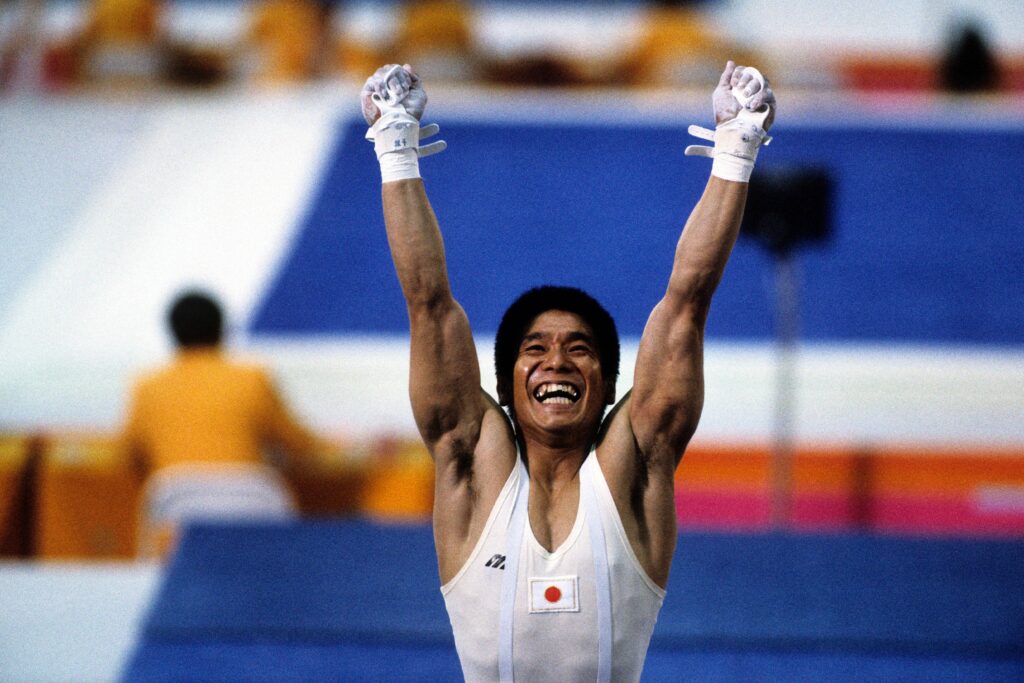
Four years later, on August 2, 1984, at Pauley Pavilion in Los Angeles, Gushiken stood in front of a cheering crowd and did not try to wipe away his tears. He had just won the individual all-around gold medal by 0.025 points over America’s Peter Vidmar. He was twenty-seven years old, and he had been competing in gymnastics for sixteen of them. “What made me even happier than winning the gold medal,” he wrote, “was that I had been able to pour out everything in the gymnastics I had devoted those sixteen years to — without a single regret.”
In 2020, as Gushiken reflected on his career, he viewed the boycott not as a detour but as part of what had made him the athlete he became. “The two injuries and the Moscow Olympics boycott were sufficient material to forge me,” he wrote. “If those injuries and the boycott had not happened, perhaps I would not have won the gold medal.”
At the same time, he would not have wished that experience on anyone else. In 2021, with the question of whether the Tokyo Games could safely proceed under COVID conditions a matter of open public dispute, Gushiken was asked for his view. There was no guarantee, he acknowledged, that the spread of infection could be prevented; it was only natural that people opposed holding the Olympics at all. But as someone inside the sport, he wanted them held, and the reason he gave was Moscow. He had been selected at the trials for the Games he had so wanted to experience — “What would the Olympics taste like? What would they smell like?” — and then had come the boycott. “That is why I understand, more than most, how an athlete who cannot compete at the Olympics feels. And so I do not want the athletes of today to go through that same experience.”
The point that both Gushiken and Tsuda arrived at was the same: what the boycott had taken was not reducible to a single missed competition. It was years of preparation directed toward a goal that vanished for reasons that had nothing to do with sport.
Perhaps that is why Tsuda and her teammates worked to keep the memory of the phantom representatives alive. They could not reclaim the Olympic experience that had been denied them. But they could insist that it be remembered.
References
Academic References
Ikei, Masaru 池井優. “Mosukuwa Orinpikku, boikotto no seiji katei” モスクワオリンピック、ボイコットの政治過程 [The political process of the Moscow Olympics boycott]. Keiō Gijuku sōritsu 125-shūnen k記念論文集: Hōgakubu seijigaku kankei 「慶應義塾創立一二五周年記念論文集: 法学部政治学関係 (October 1983): 77–100.
Eaton, Joseph. “Reconsidering the 1980 Moscow Olympic Boycott: American Sports Diplomacy in East Asian Perspective.” Diplomatic History 40, no. 5 (2016): 845–864. https://doi.org/10.1093/dh/dhw026.
Additional Articles
Gushiken, Kōji 具志堅幸司. “Medarisuto e no kiseki: Gushiken Kōji” メダリストへの軌跡─具志堅幸司─ [The path to a medalist: Kōji Gushiken]. Orinpikku supōtsu bunka kenkyū オリンピックスポーツ文化研究 [Olympic sports culture research], no. 5 (June 2020): 203–207.
Gushiken, Kōji 具志堅幸司. “[Taisō medarisuto] Gushiken Kōji × [Nihon dōgi shugi no kai] Hayakawa Mikio” 【体操メダリスト】具志堅幸司×【日本道義主義の会】早川幹夫 [(Gymnastics medalist) Kōji Gushiken × (Japan Moral Principles Association) Mikio Hayakawa]. Dialogue with Mikio Hayakawa. Ēru エール, Summer 2021. Reposted on the website of Saigōtō 西郷党 [Saigou Party of Japan], June 18, 2025. https://saigoutou.jp/report/2021年夏号-エール-【体操メダリスト】具志堅幸司x/.
Koseki, Toshiki 古関俊樹. “Saketekita gorin: Maboroshi no Mosukuwa taisō daihyō ga seiji ni yureru saiten ni omou koto” 避けてきた五輪 幻のモスクワ体操代表が政治に揺れる祭典に思うこと [The Olympics she has avoided: A phantom Moscow gymnastics team member reflects on a festival shaken by politics]. Mainichi shinbun 毎日新聞, January 11, 2022. https://mainichi.jp/articles/20220111/k00/00m/050/052000c.
Appendix A: An Excerpt from Mainichi Shinbun
“The Olympics I Avoided: A Phantom Moscow Representative Reflects on a Festival Shaken by Politics”
Mainichi Shimbun, January 11, 2022
“Here we go again”
When the word “boycott” began appearing on television and in newspapers last December, about two months before the opening of the Beijing Olympics, one thought crossed her mind: here we go again. Tsuda Katsura (56, née Uchida), a primary school teacher in Sagamihara City who was selected to represent Japan in women’s gymnastics at the 1980 Moscow Olympics only to be denied her chance to compete by Japan’s boycott, says she still remembers clearly how she felt forty-two years ago when the road to her dream was cut off.
She began gymnastics at the age of eight. By her third year of junior high school she had won a national championship, and she enrolled at a prestigious gymnastics high school in Tokyo. In early May 1980, shortly after starting there, she squeezed into the seventh and final spot at the Moscow Olympic final selection trials. At the time, the United States had called for an Olympic boycott in response to the Soviet invasion of Afghanistan, and Japan’s government was following suit. The sports world found itself caught up in the tense politics of the Cold War. Even so, she never doubted her coaches when they told her the Olympics would go ahead.
“We can’t go to the Olympics?”
The training camp that began a fortnight after she was named to the team had a heavy atmosphere. Looking back now, she thinks the coaches and older athletes already knew participation was unlikely, and that it showed. On the 24th of that month, men in suits arrived at the gymnasium in Shinagawa, Tokyo, where the camp was being held, gathered the athletes together, and spoke: “The boycott has been decided. You will not be competing at the Olympics.” Her first reaction was relief — the mentally grueling camp is finally over. Then immediately came disbelief: We can’t go to the Olympics?
Just before that announcement, the Japanese Olympic Committee (JOC) had voted at an emergency general assembly not to participate. The government had already declared it “undesirable” to send a delegation and had been filling in the moat around the JOC, hinting at cuts to training subsidies. The decision was formally the JOC’s, but the reality was that sport had been defeated by politics — and with it, the dreams of many athletes who had given their lives to reach the Games.
High school kept her too busy with study and practice to dwell on the boycott. As graduation approached, universities and corporate teams came to her with earnest invitations to aim for the next Olympics in Los Angeles. But her heart didn’t move. Something that I worked so hard for disappeared so easily — the Olympics must not be such a great competition after all. She thinks now that she felt that way to protect herself from being hurt again by something so devastating. Her passion for the sport vanished, and she stopped competing when high school ended.
[…]
Appendix B: An Excerpt from The Path to a Medalist
2. Memories of NSSU (Memories of My Athletic Life)
My first coach was Mr. Nishida at my junior high school. His subject was art, and he didn’t know very much about gymnastics. But what he always said was: “Gymnastics must be beautiful.” Coming from an art teacher, those words carried a particular clarity. Much later, when people began saying “Gushiken’s gymnastics is beautiful,” I believe the foundation of that lay in Mr. Nishida’s teaching: gymnastics is beauty. After leaving junior high school I was fortunate to train under many coaches, but the origin of my gymnastics still lives in Mr. Nishida’s words. “Gymnastics must be beautiful.”
After junior high school I entered Seifū High School and began training in earnest. Pommel horse and rings were new events I hadn’t encountered in junior high, so they were a struggle — but because I could feel myself improving through practice, each day’s training was enjoyable rather than painful. Looking back, those three years shaped not just my technique but my spirit. Being in an environment where the only permissible answer was “Yes, sir” was hard, but those were three years that made me who I am.
When I entered Seifū High School, it had already produced three Olympic athletes among its alumni: Kenmotsu Eizō , my great senior at NSSU who had won numerous medals; Okamura Teruichi, a lecturer at Sendai University; and Fujimoto Shun, who was working at Yamanashi University. Yet despite this brilliant record, Seifū had never once won the team title at the Inter-High School Championships — not even the individual title. So we eight new club members created a motto and pledged to win at the Inter-High. The motto was simple: instead of saying “good morning” or “goodbye” at the start and end of practice, we just said “Inter-High, let’s go.” And we kept that greeting without fail for three years. “Inter-High, let’s go.” “Yeah — Inter-High, let’s go.” We began every practice with those words, and ended every practice with them. Then, in the summer of our third year, as though pulled along by those very words, we won both the team and individual titles at the Inter-High. It would not be an exaggeration to say that the words created the reality.
Coach Yamaguchi was the first teacher who showed me how to think about gymnastics technique and how to approach things in life. His coaching methods were unconventional, but beneath his boldness there was a fine attention to detail, and he had tremendous respect for each of our personalities. He could be frightening at times, but we looked up to him like a father. I graduated from Seifū and entered NSSU. At university, my immediate goal was to make the national team. To compete in international events, you first had to be selected as a national development athlete. In my second year, I placed sixth at the National Championships and achieved that long-held goal — I was, at the time, the youngest national team member in history. But the smooth period ended there.
In my third and fourth years I suffered injury after injury, and my residence effectively moved from the dormitory to Kantō Rosai Hospital. In the spring of my third year, a sharp pain shot through me the moment I landed from the rings. Looking at my left foot, the sole was facing upward — I had torn both the inner and outer ligaments and fractured my fibula. I was taken to hospital, where the doctor told me I might never do gymnastics again. I had just been selected for the national team and was ready to push forward, and then this injury. I wanted to keep doing gymnastics. I had friends bring dumbbells and old bicycle inner tubes to my hospital room, and every day I spent six or seven hours pulling on the tubes and lifting the weights. Throughout the three months of my hospitalisation I worked on building upper body strength. When I was discharged, my arms no longer fit into the T-shirts I had been wearing. The arms that had been like burdock root had grown thick as daikon radishes. At least in terms of upper body strength, I had measurably improved.
One year after that injury, I ruptured my right Achilles tendon during floor exercise practice. I had fought back from an injury pronounced beyond recovery, sustained by encouragement from those around me and by belief in my own strength and effort — but now for the first time since I had started gymnastics, I thought about quitting: I should give up gymnastics. No matter how long I keep at it, it’s the same. I never want to go through something this painful again. If I had not had my gymnastics teammates and the coaches I had met along the way, I believe I would have quit gymnastics at the moment of that Achilles rupture. I can only say: I am truly grateful that the encouragement of my mentors and friends gave me the will to pick up gymnastics one more time.
Having recovered from those two injuries and been training with the Olympics as my goal, yet another great trial awaited me. Japan boycotted the Moscow Olympics. America had decided not to participate over the Afghanistan issue, and the Western nations of that era had fallen dutifully into line. I had thought I would be able to perform to my fullest on the Olympic stage, just like Katō Sawao, whose floor exercise on television had astonished me as a child and set me on the path to gymnastics. Are they really going to stop us competing because of something political like this? When I thought about it, I felt not so much anger as a sort of loneliness, a hollow emptiness. What had been the point of fighting back so desperately from two serious injuries? Something decided in a place completely disconnected from our efforts — and we had no choice but to abandon our dreams without any resistance. The more I thought about it, the more I sank. I was 24 years old; looking back, it was the period when I was moving best, when one night’s sleep would clear all my fatigue — which made this boycott decision all the more devastating.
All previous cancellations or non-participations in the Olympics had been caused by war. In other words, without peace, the Olympics cannot be held. As we approach the 2020 Tokyo Olympics and Paralympics, we should revisit what Coubertin advocated: “to improve body and mind through sport, and furthermore to contribute to building a peaceful and better world by understanding one another across various differences — culture, nationality — with a spirit of friendship, solidarity, and fair play.” Of course, striving for medals at the Olympics is also a vital element, but we must equally recognise that the Olympics contribute to peace.
3. Winning an Olympic Medal
On August 3, 1984, at Pauley Pavilion in Los Angeles, I stood before the applause of the arena without even trying to wipe away my tears. It was the moment, after completing my final event — floor exercise — that my individual all-around victory was confirmed, by a margin of just 0.025 points over America’s Peter Vidmar. I was delighted to have won the gold medal. But what made me even happier was that I had been able to pour out absolutely everything I had developed over 16 years of gymnastics — without a single regret. Looking back over my gymnastics life, it had not been a smooth voyage, and I was not by any means a naturally gifted athlete. My coaches used to say: “Gushiken has no talent for gymnastics, but he has a talent for hard work.” Because I had trained two, three times harder than others, this medal felt like a gift from heaven.
The two injuries and the Moscow Olympics boycott had been more than sufficient material to forge me. If those injuries and the boycott had not happened, perhaps I would not have won the gold medal. Thinking of it that way, I want to express my gratitude to all the teachers who supported and guided me, and to my many gymnastics companions. “Thank you.”
To put this medal into a single phrase: it is precisely the lesson that a crisis is an opportunity. It teaches us: never give up.
Of course, I continued to put in effort beyond what others did, but at the core of everything was always a burning passion: I love gymnastics. Whatever sport one pursues, without that “love” for it, would one’s spirit not break almost immediately?
Thinking about it this way, I must once again be grateful for having encountered gymnastics, and for my mother continuing to say: “If you work twice as hard as others, a gold medal is not a dream.”
More on 1980