Mo Huilan was one of the most gifted gymnasts of the 1990s — a rare all-rounder in an era when Chinese women were typically known for one or two events — and her story is worth telling in full. She is remembered for the Mo Salto, for five gold medals at the 1994 Hiroshima Asian Games, and for the agonizing near-misses that defined her elite career. She is less remembered for what happened after gymnastics: the abandoned study-abroad plans, the quiet retirement, the life she built on her own terms.
Like several of her contemporaries, Mo Huilan’s age requires a brief note. Her competitive records list a birth year of 1979, and contemporary press coverage is largely consistent with that date. Chinese websites today, however, routinely give her birthdate as July 11, 1980. If that is correct, she would have been underage during the 1994 elite season.
Enjoy this brief profile from 1994, Mo’s breakout year, as well as two post-retirement interviews.
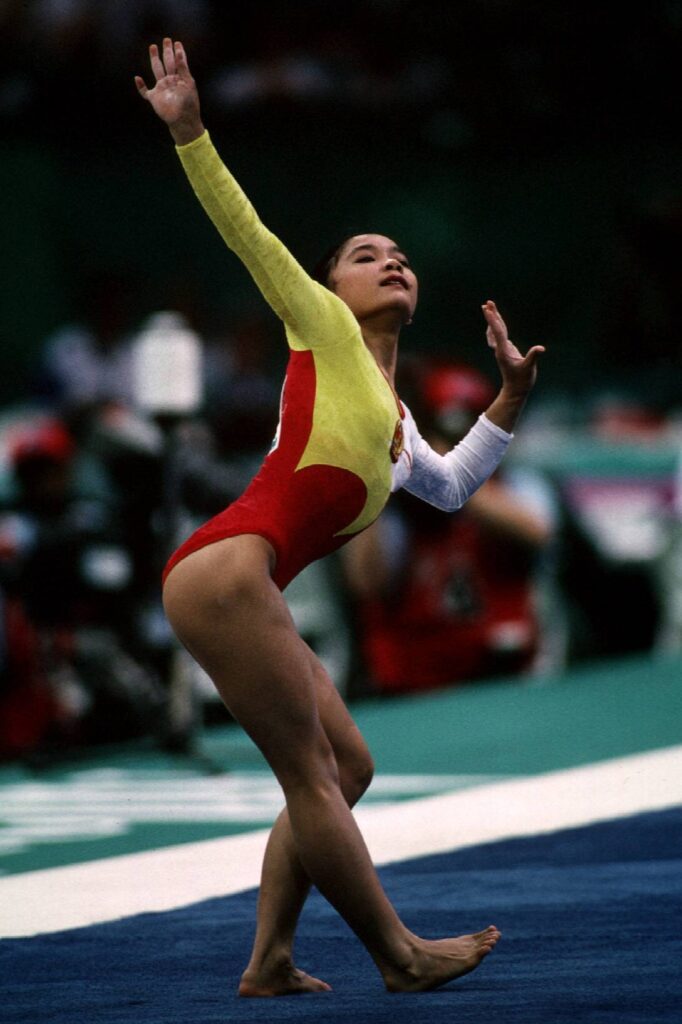
“Lanlan Is Not a Fragile Little Doll”
— Mo Huilan’s Parents Talk About Mo Huilan
At the Hiroshima Asian Games, the 15-year-old girl Mo Huilan from Guilin, Guangxi, won five gold medals, becoming a rising star in Asian sport. Recently, the reporter visited the family housing compound of a printing factory in Guilin City to find Mo Huilan’s home.
This is an utterly ordinary working-class family. There are no modern appliances or furnishings; even their color television was a gift from relatives, given so that Lanlan could watch live gymnastics broadcasts. Mo Huilan’s father, Mo Qiaobao, is a printing worker with only a junior-middle-school education. Her mother, Liu Dongyu, is a temporary factory worker, making a living by pasting paper boxes. Their household registration is still in the countryside.
The reporter was astonished: A “golden phoenix” had flown into the world from here!
When recounting their daughter’s path of growth, the couple became emotional, tears flowing uncontrollably.
“Lanlan was never a delicate girl.”
In July 1985, Mo Qiaobao happened to see a recruitment notice for the Guilin Gymnastics School. He took his twin daughters, Mo Huilan and her younger sister, Mo Huifang, both not yet six years old, to apply. Both were selected by coach Li Guifeng, and from that point on, young Lanlan began her gymnastics career.
Every morning at 5:30 a.m., Mo Qiaobao rode his bicycle to take his two daughters to the gymnastics school. The following year, Lanlan began boarding at the school. The strict training and hard living conditions were too much for a child so young to bear, and Lanlan fell ill. After one week of recovery at home, her father took her back to the school. Lanlan clung tightly to her father’s legs and cried loudly, “I don’t want to go to school. I want to go home…”
Mo Qiaobao fought back tears and pushed his daughter toward the coach. He understood clearly that if his heart softened, she’d give up halfway. Again and again, he reminded his daughter that every training movement must be done better than anyone else’s.
Lanlan remembered her father’s words.
Once, Mo Qiaobao secretly went to the school to watch her train. The students were practicing handstands. He saw Lanlan stubbornly holding herself upside down, her arms trembling uncontrollably, tears streaming down her face. After class, Mo Qiaobao held his daughter tightly in his arms. When he saw that her hands were peeling and bleeding from training, later becoming infected and inflamed, covered with blood and pus, his heart ached deeply. Yet he still smiled and encouraged her to continue training hard. Little Lanlan wrapped her hands in gauze and returned to the training floor.
In 1988, Mo Huilan entered the Guangxi provincial team. That same Spring Festival, her father brought her back to Guilin for the New Year and carried her to the hospital to undergo surgery on her injured foot. Just after coming off the operating table, Lanlan insisted on returning to the team. Even the doctors present were deeply moved.
Who would have imagined that a child not yet ten years old could possess such a sense of commitment to her career?
In 1990, Lanlan was selected for the national team, beginning training that was more systematic and of far greater intensity. No matter how great the difficulties she encountered in training, Lanlan clenched her teeth and persevered. Mo Qiaobao and his wife told the reporter that over the past ten years, Lanlan had never rested for more than one consecutive week.
Mo Qiaobao said that Lanlan’s success should first be credited to the state and to all of her coaches over the years. National team coaches Liu Guicheng and Yuan Zijuan devoted to Lanlan a level of care that surpassed even that of her parents. In order for Lanlan to achieve results, Coach Yuan had been married for many years but chose not to have children. As they spoke of this, Mo Qiaobao and his wife were overcome with tears.
Finally, Mo Qiaobao told the reporter, “Winning in Asia is not Lanlan’s final goal. Breaking out of Asia and surpassing herself — that is Lanlan’s ideal.”
—
People’s Daily, October 21, 1994 · Page 11 (Sports)
Xinhua News Agency reporter: Lu Wei
—
“兰兰不是娇娃娃”
——莫慧兰父母谈莫慧兰
新华社记者鲁炜
在广岛亚运会上,广西桂林15岁的姑娘莫慧兰夺得5枚金牌,成为亚洲体坛的一颗明星。前不久,记者来到桂林市印刷厂家属区,找到莫慧兰的家。
这是一个极普通的工人家庭:没有现代化的电器和家具,一台彩电还是亲戚送的,为的是让兰兰能收看到体操比赛的实况。慧兰的父亲莫桥保是个只有初中文化的印刷工人,母亲刘冬玉是厂里的临时工,靠糊纸盒为生,户口还在农村。
记者为之震惊:“金凤凰”是从这里飞向世界的!
讲述到他们女儿的成长道路,莫桥保夫妇激动不已,泪水禁不住地流:“兰兰从小就不是一个娇娃娃。”
1985年7月,莫桥保偶然看到一则广告:桂林市体操学校招生。他带着两个不满6岁的双胞胎女儿莫慧兰和妹妹莫慧芳一起报了名。她们双双被教练李桂凤选中。从此,幼小的兰兰开始了体操生涯。
每天早上5点半,莫桥保用自行车把两个女儿送到体校。第二年,兰兰住到学校。严格的训练,艰苦的生活,一个尚未懂事的孩子无法承受,兰兰病倒了。一个星期后,父亲再次把在家养好了病的兰兰送回体校,兰兰紧紧地抱着父亲的腿大声哭喊:“我不去学校,我要回家……”莫桥保强忍着眼泪把女儿推给了教练。他心里明白,心一软就会半途而废。他不断叮嘱女儿:每一个训练动作都要做得比别人好。
兰兰记住了父亲的话。一次,莫桥保悄悄地去学校看兰兰训练。训练场上,学员们正在练“倒立”。只见兰兰顽强地倒立着,一双胳膊在不停地颤抖,眼泪不停地往下流。下课后,莫桥保把女儿紧紧地搂在怀里。当看到兰兰的双手因训练脱皮出血、后又感染发炎而布满血和脓时,莫桥保好心痛。但他仍然微笑着鼓励女儿继续苦练。小兰兰用纱布包好手,又回到训练场上。
1988年,莫慧兰进入了广西队。同年春节,父亲把兰兰接回桂林过年,同时背她到医院给她受伤的脚动手术。刚下手术台,兰兰就吵着坚决要回队,在场的医生也深受感动。谁能想到一个不满10岁的孩子能有这样的事业心!
1990年,兰兰入选国家队,开始更正规、更大强度的训练。训练中,不管遇到多大困难,小兰兰都咬着牙坚持。莫桥保夫妇告诉记者,兰兰在近10年里只连续休息过一个星期。
莫桥保说,兰兰的成功,首先归功于国家,归功于她的历任教练。国家队教练刘桂成和袁紫娟对兰兰倾注了胜过父母的爱心。为了兰兰出成绩,袁教练结婚多年也不要孩子。说着,莫桥保夫妇热泪盈眶。
最后,莫桥保告诉记者:在亚洲夺魁,不是兰兰的最终目标;冲出亚洲,超越自我,才是兰兰的理想。
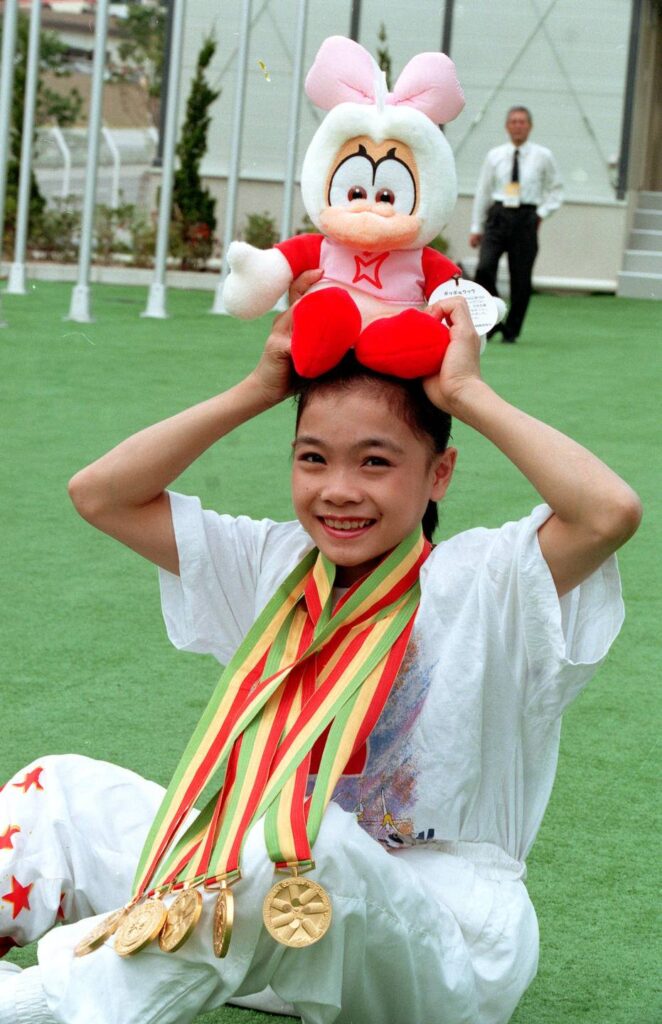
A Note on Mo Huilan’s Age
While other Chinese gymnasts’ ages sometimes varied in the press, Mo Huilan’s age routinely aligned with a 1979 birth year during her competitive career. For example, at a junior competition in 1993, she was described as a fourteen-year-old:
Pan-Pacific Junior Gymnastics Championships
Chinese Women Claim Team and All-Around Titles
The women’s team competition was contested this evening at the 4th Pan-Pacific Junior Gymnastics Championships in Canberra, Australia. China’s junior women delivered an outstanding performance, winning the team title and capturing both gold and silver in the women’s individual all-around. The United States and Australia finished second and third respectively in the team standings.
China’s 14-year-old gymnast from Guangxi, Mo Huilan, demonstrated remarkable strength and potential, leaving a deep impression on observers. In the uneven bars competition, she successfully performed a highly difficult skill—a front somersault over the bar to regrasp—an element that, at present, no other gymnast in the world is able to perform.
Over the first two days of competition, Chinese gymnasts have already claimed four gold medals across the men’s and women’s team and individual all-around events. The remaining ten apparatus gold medals will be decided tomorrow evening.
People’s Daily, December 9, 1983, Page 4
Canberra, December 8 — Report by Shi Zongxing
泛太平洋区少年体操锦标赛
我巾帼小将摘取团体全能桂冠
本报堪培拉12月8日电 记者史宗星报道:在澳大利亚堪培拉举行的第四届泛太平洋地区少年体操锦标赛今晚进行了女子团体比赛,我国小将以出色的成绩摘取了女子团体桂冠并获得女子个人全能冠、亚军。美国队和澳大利亚队分别名列团体第二和第三。
我国14岁的广西选手莫慧兰今晚显示了很强的实力和潜力,给人们留下了深刻的印象。在高低杠比赛中,她成功地完成了前空翻越杠再握这一世界上目前只有她一个人能做的高难动作。
本次比赛前两天,我国选手已获得男女团体和男女个人全能共4枚金牌。剩下的10枚单项金牌将在明晚决出。
However, Chinese websites today often list a different birthdate for Mo: July 11, 1980. If that date is correct, she would have been underage during the 1994 season. She would have still been 13 at the 1994 World Championships in April, where she finished seventh in the all-around. She would have turned 14 before the 1994 World Championships in Dortmund, where she finished fourth with the team, and the 1994 Asian Games, where she won five gold medals and a bronze in the all-around.
With a 1980 birth year, she would have turned 15 in 1995 and would have been age-eligible for the World Championships in Sabae, where she won gold on beam and silver medals with the team and on uneven bars.

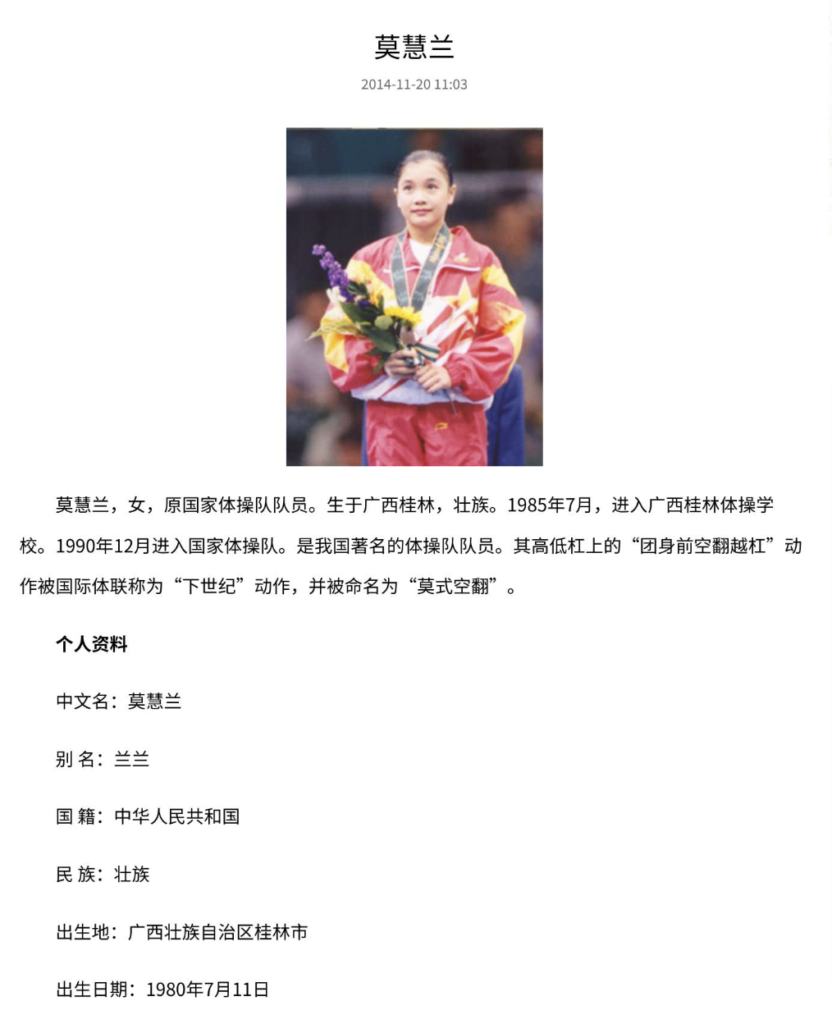
In many ways, this should not come as a surprise. Several Chinese gymnasts—among them Chen Cuiting and Li Li—had their ages adjusted so that they could compete at the Asian Games (and other competitions). When Dong Fangxiao’s age discrepancy later came to light, the mainland Chinese press responded with a wave of criticism, openly acknowledging that athletes’ birthdates were routinely altered.
To conclude, here are a few profiles of Mo Huilan after her retirement. Enjoy!
1998: “Lanlan Wants to Study”
“Lanlan Wants to Study”
She had cut off her ponytail and switched to a short fringe; shed her training gear and put on fashionable clothes. The Mo Huilan before me looked less childlike now—more mature, more relaxed, more at ease.
Mo Huilan, who never managed to win an Olympic gold medal, retired not long ago. Some people said she had gone to the United States to study.
Leaning against the railing of the training ship Shichang, the sea breeze brushed her clothes.
I asked, “When will you return to school?”
Lanlan turned her head and glanced at the cheerful teenagers on the deck. The corner of her mouth moved slightly. She turned back and looked at the clouds on the horizon, already tinged with fatigue.
“I didn’t go to the United States to study.”
I didn’t ask any more. She didn’t explain.
At the invitation of the organizing committee of the ‘I Love My Country’s Maritime Borders’ model ship competition, Mo Huilan traveled with many young participants aboard a naval vessel, departing from Tanggu Port in Tianjin, passing Weihai, and arriving in Qingdao. Throughout the entire trip, “Sister Lanlan” was always the most popular person.
The model ship competition was held in Qingdao. While the young competitors were busy with their events, Lanlan finally had a little free time.
She decided to make a trip to Mount Laoshan.
The sea embraced the dark mountains; green pines dotted the cliffs; green Daoist temples appeared and disappeared among the greenery. Sitting on the beach in front of Taiqing Palace, Lanlan was in a good mood.
“When you don’t have something, you desperately want it. When it truly becomes unattainable, you eventually come to terms with it.” She was talking about the Olympic gold medal.
“As for retiring, there were two reasons. First, I’m getting older, and my physical condition is no longer suitable. Second, my coach has sacrificed far too much—just to help me achieve results, she still hasn’t had a child. After this year, she’ll have reached the high-risk age for childbirth.”
“Is there any possibility of a comeback for the Asian Games?”
“Just look at me,” Lanlan laughed. “Stop training for a month or two, and I get this chubby. For a gymnast, skip one day of training and your bones start to stiffen. The chance of my coming back is basically zero.”
Elsewhere, where the sea meets a mountain stream, swimmers crowded together like dumplings dropped into boiling water. Watching them, her envy welled up visibly.
“I like the sea—it can hold everything. But I can’t swim.”
“The sea is like a book—you have to read it with your heart.” Lanlan gazed calmly into the distance, where everything dissolved into blankness, with nothing but the sea.
“I really want to study. I especially admire Peking University—Renmin University would also be good. I originally planned to study abroad, but for various reasons it didn’t work out.” She paused. “But that’s how life is—things don’t go your way eight or nine times out of ten.”
“What are your plans right now?” I asked.
“None. I still want to study.” Lanlan gave a small smile. Her eyes never left the sea, as if she had returned to the Li River where she was born and raised—sitting by its banks, watching a small boat drift in the distance.
People’s Daily, August 14, 1998, page 8
By Staff Reporter Li Zenghui
兰兰想读书
本报记者 李增辉
剪掉了马尾辫,留就了短穗发,脱下了运动服,穿上了流行装,眼前的莫慧兰少了几分稚气,多了几分成熟和洒脱。
一直未能夺得奥运会金牌的莫慧兰前不久退役了,有人说她去美国读书了。
倚着“世昌号”训练舰的栏杆,海风拂着她的衣裳。
我问:“什么时候返回学校?”
兰兰扭过头扫了一眼甲板上欢乐的少年,嘴角动了动,回过头望着那天边已经有了倦意的云:“我没有去美国读书。”
我没有再问,她也没有解释。
应“我爱祖国海疆”航海模型竞赛组委会邀请,莫慧兰跟着众多青少年一起,乘军舰从天津塘沽港出发,经威海到达青岛,在整个活动期间,兰兰姐姐总是最受欢迎的人。
航海模型竞赛在青岛进行,小选手们忙着参赛,兰兰这才有了些闲暇。
兰兰决定去趟崂山。
大海怀抱着苍山,翠松点缀在岩间,青青的道观时隐时现。坐在太清宫前的海滩上,兰兰心情不错。
“没有得到的时候拼命想要,实在得不到了也就释然了。”她是指奥运会金牌的事。
“退役嘛,有两个原因,一是年龄大了,身体条件不合适,二是我的教练实在是牺牲太大,为了让我出成绩,至今没要孩子,过了今年就到了高危育龄期。”
“亚运会有复出的可能吗?”“你看看我”,兰兰笑了笑,“一两个月不练就胖成这样。体操运动员一天不练,骨头就变硬,我复出的可能性应该为零。”
另一处,大海和山溪汇合处,下饺子般的挤着游泳的人。兰兰看着他们,羡慕的神情油然可掬:“我喜欢海,它能包容一切,但我不会游泳。”
“大海就像一本书,得用心体味。”兰兰悠然地望着远处,那里茫然一片,除了大海什么也没有。
“我很想读书,特别向往北大,人大也不错,原本打算留学却由于种种原因未成行。”兰兰顿了一下,“不过生活总是这样,不尽如人意的事情常八九。”
“目前有什么打算?”我问。“没有,我还是想读书。”兰兰笑了一下,望着大海的眼睛没有移动,仿佛中她回到了生她养她的漓江,她坐在漓江边,望着远处扁舟。
2005: Catching up with Mo Huilan
Catching up with Mo Huilan: Simply One of the Best Ever
Had Lady Luck followed her a little more closely, Mo Huilan could well have been the dominant female gymnast of the mid-1990s. Instead, Mo flipped and flopped in such a way as to avoid the major title that usually defines a career. For Mighty Mo, absolute brilliance in the preliminaries and apparatus finals was often tempered by one costly slip-up in the individual all-around competition.
Born July 11, 1979, in Guiling, the beautiful capital of Guangxi Province, Mo Huilan entered the world with twin sister, Mo Huifang. (Hui means “smart,” lan means “flower” and fang means “fragrance of a flower.”) Both grew up to be gymnasts, but an injury eventually put an end to Huifang’s career.
Huilan forged ahead and clearly possessed what Chinese gymnasts had lacked for years: the ability to perform at a high level on all four events. Not just strong on bars and beam, as was usually the case. This beautiful young gymnast could do it all. One of her signature skills was a daring Gaylord Flip on the uneven bars, which became known as the Mo Salto.
At 15, Mo won five of six available gold medals at the 1994 Asian Games in Hiroshima, Japan. After leading China to an easy team triumph and posting the highest prelim total of 39.425 (.60 clear of runner-up Qiao Ya), Huilan outscored the field on three events in the all-around final, only to fall from beam and finish third. In the apparatus finals, she won all four golds.
There was more of the same for Mo at the 1995 world championships in Sabae, Japan. Again, she was the top qualifier with 78.186, but …another fall at beam (sat down a double tuck dismount) in the final cost Mo .50 and the all-around title. She finished sixth, .494 out of first. Mo qualified to all four apparatus finals, winning the gold on beam, a silver on bars, and placing fourth on vault and floor.
A clear favorite to win the 1996 Atlanta Olympic Games, Mo had other distractions to deal with. “The lowest point in my gymnastics career was prior to the 1996 Olympics,” she says. Mo’s back was injured, and it hampered her training considerably.
This time Mo was not herself in the prelims. She committed numerous errors to rank 13th. “I kept on worrying about [my back],” she says. “The quality of my training was not that good.”
Saved by the “new life” rule, however, Mo regained her form in the all-around final. After three events, she shared the lead with Russia’s Dina Kochetkova. One solid floor routine and China would have its first Olympic female all-around champion.
Mo was drawn to perform last on floor, but the pressure proved too great. After opening with a clean double layout, she attempted a 2½ twist–punch front combination. “I was struggling with that skill during regular training,” Mo recalls. “So when I went to compete, I was extremely nervous. Therefore, I made a mistake.”
Mo over-rotated and stumbled awkwardly out of bounds on the punch front. Though she finished strong with a piked full-in, she scored a 9.65 and placed fourth, just .206 out of first. In the event finals she managed to win the silver on vault.
Mo helped her team win the bronze medal at the 1997 worlds in Lausanne, Switzerland, but her time as a front-runner was finally over.
Looking back on her career, Mo is remarkably philosophical. “Sometimes, I do not think failure is a bad result,” she says. “Gymnastics, after all, is only part of my life. The mistakes will motivate me to work harder.”
After she retired from gymnastics, Mo studied broadcasting in college. After graduating, she worked as a sports journalist and as a program host. She also worked in various capacities for television networks at the 1999 Tianjin worlds, and at the 2000 and ’04 Olympics.
Mo has her theories about the mediocre results of the Chinese women’s team in Athens. “Their performance in the team preliminaries was OK,” she begins. “However, in the team final they were not so good. It is because the gymnasts are generally too young and lack competitive experience.”
Mo says the young gymnasts need to adopt a whole new self-image in keeping with the changing times. “With the rapid change in China, more Chinese women are starting to be aware of themselves,” she says. “If they fully understand themselves, they can release their potential. I am very pleased that, nowadays, most Chinese women have learned how to reach their potential.”
Mo considers herself “a very traditional Chinese lady,” and her future goals are simple. “I wish to have a husband that loves me and a warm, fulfilling family,” she says.
Though she doesn’t follow gymnastics too closely anymore, Mo still has firm convictions on how the sport should progress. She says the elimination of compulsories relieved some of the pressure on gymnasts, who could devote their time to individual elements. But she can do without the escalating difficulty.
“Gymnastics should develop in the direction of beauty,” she suggests. “After all, too much difficulty will lead to injuries. I feel that people will be very attracted to beautiful gymnastics.”
That certainly was Mo’s allure a decade ago. She was one of the best ever, even if Lady Luck was rarely on her side.
— Dwight Normile
International Gymnast, January 2005
More on Age