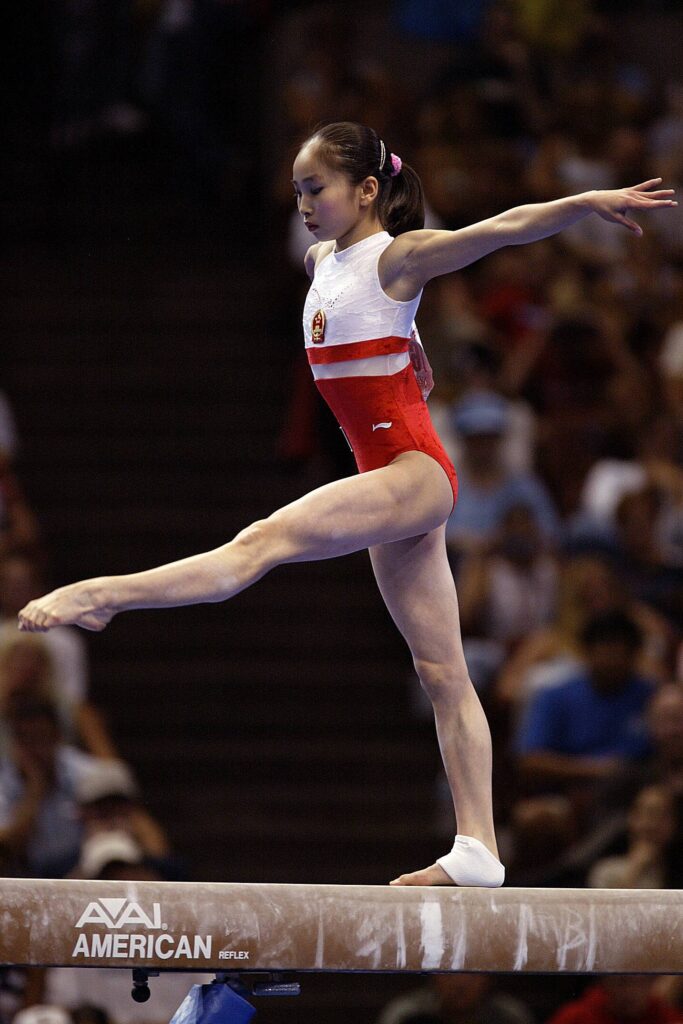
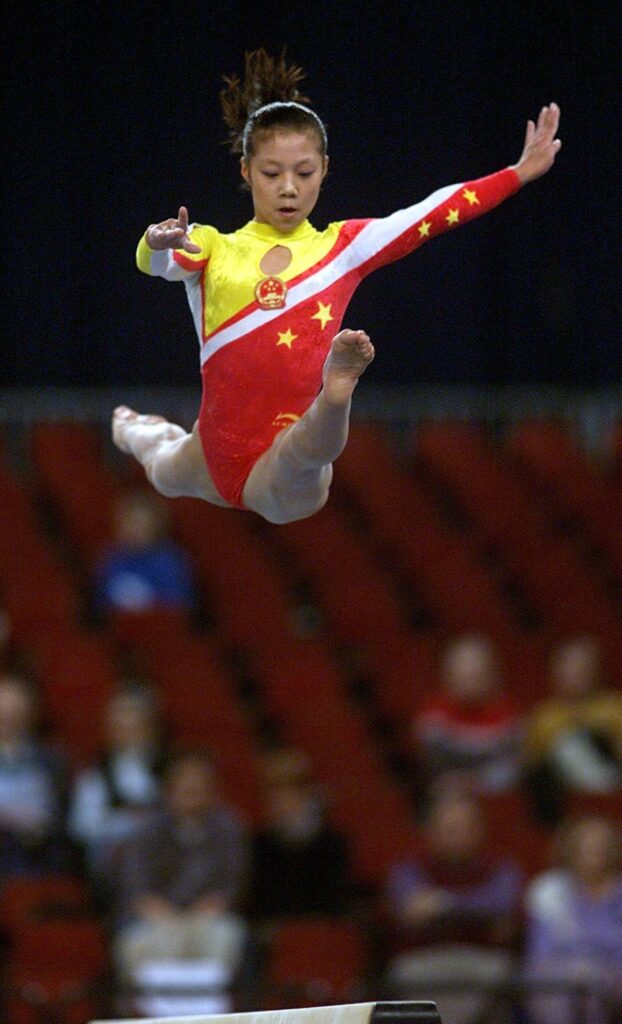
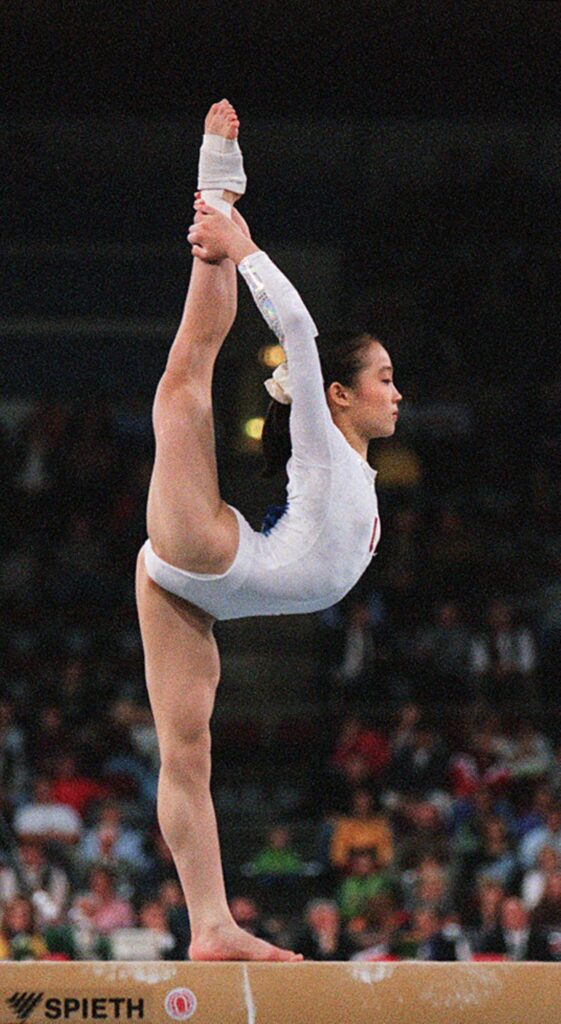
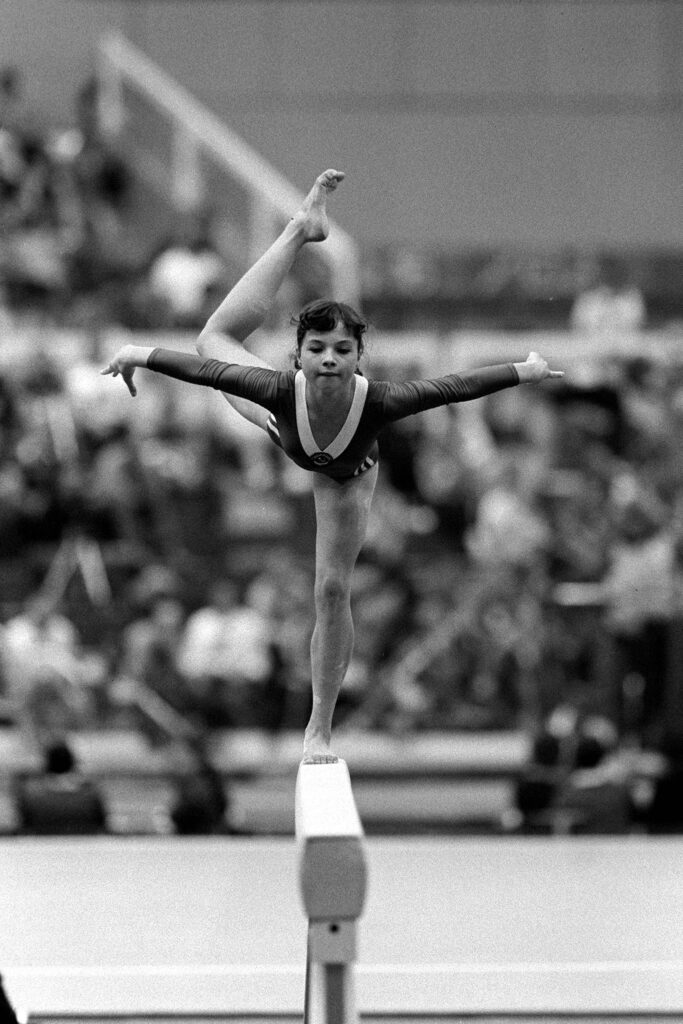
Fan Ye was the only Chinese woman to win a gold medal at the 2003 World Championships in Anaheim, California, and she did it in record style. Her 9.812 on balance beam was the highest score recorded by any female gymnast at an Olympics or World Championships during the 2001–2004 quadrennium.
How old was the recorder holder in 2003? According to the Chinese press that celebrated her victory, she was fifteen. According to the FIG registration records that governed her eligibility, she was sixteen, turning seventeen later that year.
That gap of roughly two years is documented in the two Chinese-language profiles translated below. The first appeared within days of her victory in August 2003: a reported feature in Hebei Daily based on interviews with her parents and provincial coaches. The second, a retrospective profile published by Great Wall Net in November 2018, looks back on her career fifteen years after Anaheim, in the context of the children’s gymnastics centers she later founded. Neither article flags any discrepancy. Taken together, however, they reveal one.
The Hebei Daily report states that she was fifteen when she won the title in Anaheim. The Great Wall Net retrospective notes that she entered the provincial training camp in 1997 at age nine. Both details imply a 1988 birth year, while the FIG’s official record lists 1986.
The discrepancy does not diminish what Fan Ye accomplished on the balance beam in Anaheim. It only raises the question of how old she was when she accomplished it.
Below are translations of the two profiles (and a few more in the appendices). Enjoy!
For many Western gymnastics fans, Chinese gymnastics can feel like a black box—a program that produces world-class results while remaining largely opaque to outside observers. Articles like this one, from the state-run People’s Daily on the eve of the 1999 World Championships in Tianjin, offer a rare window into how Chinese coaches and journalists understood their own program’s strengths, limitations, and ambitions.
The men’s team, averaging under 20 years old and led by Huang Xu, Yang Wei, and Lu Yufu, was tasked with defending the team title won in Lausanne two years earlier. Coaches were frank that a repeat blowout was unlikely; Russia had studied the loss and had come prepared. But the program was deep enough across all six apparatus that a second consecutive gold remained the explicit goal.
The women’s team entered under different expectations and with a striking demographic fact embedded in the preview coverage. The squad’s average age was just 16, the precise minimum required for senior international competition under FIG rules. Only Liu Xuan had previous World Championships experience; the other six were making their debuts. Coaches quietly acknowledged that Romania and Russia were out of reach and framed the real contest as a three-way battle for bronze against the United States and Ukraine. For the balance beam final, China deployed what it called the “5-2-1 plan”: field five gymnasts capable of winning, ensure at least two reach the top eight, and convert one into a champion.
The full article, translated below, appeared in the pages of People’s Daily on October 9, 1999.
Dong Fangxiao, 2000
Dong was a member of the 1999 team that later lost its bronze medal after the FIG determined that she had been born in 1986, meaning she was only 13 at the time of the competition in Tianjin.
At the 1996 World Gymnastics Championships in San Juan, Puerto Rico, fifteen-year-old Kui Yuanyuan stepped onto the floor exercise as an unlikely candidate for gold. Not considered a core member of China’s women’s team, she had nonetheless turned heads in the semifinals with a second-place finish — and then, in the final, delivered a routine that would define her young career. The following profile, published in People’s Daily on April 22, 1996, captures that remarkable night through the eyes of staff reporter Miao Lu.
Kui Yuanyuan’s San Juan triumph was the beginning of a decorated international career. She would go on to help China claim the team bronze at the 1997 World Championships in Lausanne and earn individual bronze on balance beam at that same competition. She was also a member of the 2000 Olympic team that was stripped of its bronze medal.
But was she really 15 in 1996? The answer—drawn from the People’s Daily itself—is most likely no. Six months after describing her as 15 in San Juan, the same newspaper covered the 1996 National Championships, where Kui won the all-around, and referred to her as “not yet 15.” The contradiction is telling. With her birthday reportedly in June, an athlete who was “not yet 15” in October 1996 could not have been born in 1981. Which means she could not have been 15 at the World Championships in April or the Olympics in July—and could not have been 16 at the 1997 Worlds, either.
But was she still delightful to watch? Yes. So, enjoy these articles and videos of Kui.
In October 1978, gymnasts gathered in Strasbourg, France, for the XIX World Artistic Gymnastics Championships. Among the Bulgarian women was Krassimira Toneva, who, like many gymnasts in the sport’s history, was technically too young to be there. She was born in 1965.
Tatiana Frolova had what Soviet journalists called “soft” gymnastics—a quality that made her stand out even among the technical virtuosos of the early 1980s. Blessed with “beautiful physical qualities,” her movements flowed with a natural grace that allowed her to combine power with lyrical expression. When she performed her floor exercise to Chopin’s “Impromptu,” she embodied a style reminiscent of an earlier generation—Kuchinskaya, Petrik, Karaseva—though with far greater difficulty.
She came from a working-class background in Bryansk, where her mother worked as a shop cashier and her father as a fitter at the city’s machine-building plant. Her coach, Vladimir Shishkin, was himself a former miner from Kemerovo who had moved west, married fellow coach Lyudmila Borisova, and formed a partnership that would produce one of the Soviet Union’s top gymnasts. Shishkin encouraged independent thinking in his pupil. Frolova, journalists noted, “liked to think things through herself” and engaged in deep analytical discussions with her coach.
When she burst onto the senior scene in April 1981 at the USSR Cup in Leningrad, her performance seemed to come from nowhere. She had placed eleventh at the 1980 junior championships; now she won silver behind Alla Mysnik and claimed vault gold. Josef Göhler, writing in International Gymnast, called it a “quantum leap.”
He noted that she had been born in 1967. Little did he know that Frolova wouldn’t just leap spots in the rankings; she would leap years, as well.
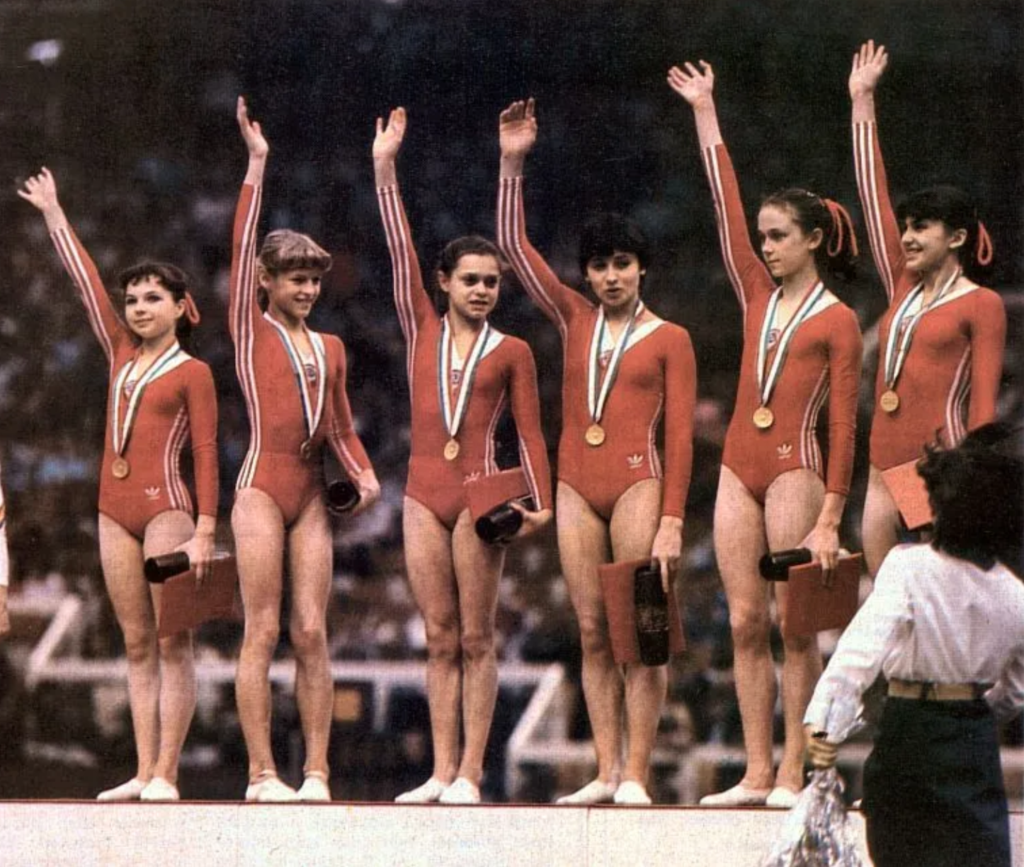
The Soviet team at the 1983 World Championships. From left to right: Bichukina, Mostepanova, Frolova, Shishova, Ilienko, Yurchenko
On October 30, 1983, the Budapest Sports Palace erupted as a Bulgarian gymnast in a red leotard stuck her first vault with textbook control. She shuffled back on her second vault, but her score was good enough. For the first time at a women’s World Championships, the Bulgarian anthem—Mila Rodino—played in the arena. Boriana Stoyanova had become the first Bulgarian woman ever to win a world championship gold medal in artistic gymnastics.
Back home, the press called it a zlatna nedelya, a golden Sunday. Bulgaria’s “golden account,” as one paper put it, had finally been opened.
The moment would be replayed, narrated, and commemorated for decades. What took longer to register was that Stoyanova was not 15 when she won gold.
Stoyanova on the front page of the October 31, 1983 edition of Naroden Sport, Bulgaria’s main sports newspaper.
Moscow, November 1981. A young gymnast takes her starting position at Luzhniki Sports Palace. When the opening notes of Rossini’s La Cenerentola (Cinderella) sound through the arena, fifteen-year-old Natalia Ilienko—so says her official biography—begins what Soviet journalists will soon call a “sparkling” performance, an “étude set to Rossini, in a minuet-gavotte style.”
The routine, choreographed by Natalia Alexandrovna Marakova, is “elegant, polished down to the smallest detail—to every movement of the flexible hands, to each glance—now languid, now playful.” When Ilienko completes her final tumbling pass, the crowd erupts. Moments later, she will stand on the podium as the floor world champion, one of her country’s newest gymnastics sensations.
But there was a problem with this triumph: Natalia Ilienko should never have competed at those World Championships.
How did people in the USSR feel about Olga Bicherova’s age falsification at the time?Did everyone simply accept that it was for the greater good of the Soviet Union?
In a 1987 essay published in Ogonyok under the provocative title “Don’t Lose the Person,” Tokarev returned to this episode not to litigate eligibility rules, but to imagine the human cost of the lie. He opened the article with the age-falsification case, identifying the gymnast only as “B” to spare her further harm. At the tournament’s final press conference, officials calmly insisted that the champion’s age complied with the rules. When a reporter produced not one but two start lists showing that she had not yet turned fourteen, officials dismissed them as “mistakes.” Only later did a federation insider admit to Tokarev that the documents had been deliberately swapped.
What haunted Tokarev was the position in which this placed the girl herself. Friends, relatives, classmates—everyone knew the truth. She was told that lying was necessary, that falsifying her age served “higher interests,” the honor and glory of the state. The burden of the deception, Tokarev suggested, fell not on officials or coaches, but on a child expected to live inside a public fiction.
(Tokarev would return to this case in 1989, writing again in Ogonyok and naming the gymnast explicitly as Olga Bicherova.)
The heart of Tokarev’s outrage, however, centers on the 1985 World Championships in Montreal. There, coach Vladimir Aksenov watched his protégé Olga Mostepanova—sitting in second place after two days of competition—be abruptly removed from the individual finals along with Irina Baraksanova. In their places, head coach Andrei Rodionenko inserted Oksana Omelianchik and Elena Shushunova, who would go on to share the gold medal. When Tokarev recounts this episode, he anticipates the response he knew so well: the medals were still Soviet medals, so what difference did it make whose names were attached to them?
Aksenov explained the reasoning to Tokarev in stark terms. Rodionenko, he said, was taking revenge. After Sovetskaya Rossiya (Soviet Russia) reported that people’s control inspectors at the Lake Krugloye training base had caught Rodionenko hoarding scarce food supplies meant for athletes, coaches were pressured to sign a letter denying the incident. Aksenov was the only one who refused. His punishment was swift: he was barred from accompanying his own athlete to Montreal, and Mostepanova was sacrificed in the finals as retribution. “Olga and Yurchenko hugged each other and burst into tears,” Aksenov recalled. “You could say that all the way back to Moscow, Olga’s eyes never dried.”
Tokarev recognizes that these individual injustices—the falsified documents, the stolen food, the vindictive substitutions—are symptoms of a deeper corruption. He challenges the notion that such deceptions serve “higher interests” or the “honor and glory of the state.” Through pointed examples, from the pentathlete Boris Onishchenko’s rigged épée at the 1976 Olympics to weightlifters caught trafficking anabolic steroids abroad, Tokarev argues that secrecy and complicity had rotted Soviet sport from within. The system demanded that witnesses sign false statements, that coaches look the other way, that everyone prioritize medals over human dignity. His closing plea is both moral and practical: sport cannot be reformed unless it embraces the same transparency and accountability reshaping Soviet society. “No medals,” he writes, “can replace for us what is most valuable—the person.”
What follows is a translation of Tokarev’s seminal essay.
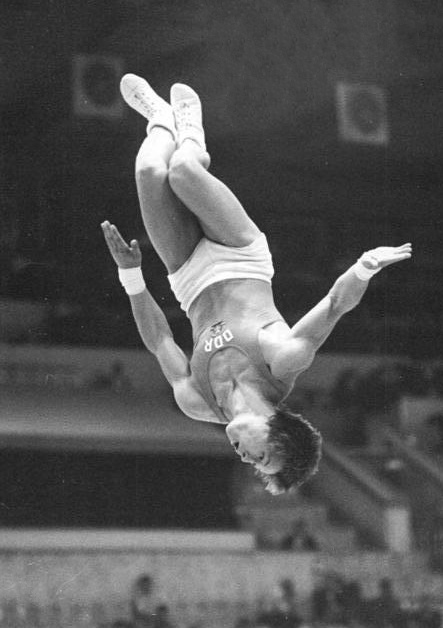
In November 1981, Ralf-Peter Hemmann stood in a packed Moscow arena, preparing for his second vault in the apparatus finals of the World Championships. His first had been flawless—a handspring front with a half twist that stuck to the mat as if pulled by a magnet. The judges awarded him a perfect 10. Now came his Tsukahara. He landed it cleanly. Score: 9.95. The twenty-two-year-old auto mechanic from Leipzig was the world champion.
“After the 10, I still wasn’t sure,” he told reporters afterward, beaming. “But then when the second vault went so well…” He didn’t finish the sentence. He was being called to the podium, where thousands of East German tourists in the sold-out hall cheered for their new champion. It was the kind of victory that makes careers, the kind that gets remembered in record books. The days before had been the hardest, Hemmann said—sleepless with nerves. But in the competition itself, he’d been completely calm.
Then, without warning, he disappeared.
Not literally—Hemmann was still alive. But his gymnastics career ended abruptly in the spring of 1982, with no explanation, no farewell interview, no public acknowledgment of what had happened. One day, he was preparing for a competition in the Netherlands. The next, a club official told him his competitive career was over, effective immediately. The press never called again.
For years, people whispered theories while the official story was buried in Stasi files that wouldn’t surface until after reunification: Hemmann had tested positive for anabolic steroids at that same Moscow World Championship where he’d won gold. The Soviets had caught him, covered it up, and allegedly used the secret as leverage against East German sports officials. Rather than face an international scandal, those officials made Hemmann himself disappear—forced into retirement with his title mysteriously intact.
Thirty years later, Hemmann still didn’t have answers. His case raises troubling questions about how Cold War sports politics may have enabled cover-ups at the highest levels. Rumors of the positive test circulated among judges even during the competition itself. Yet the positive test result was never published, and the International Gymnastics Federation never stripped him of his medal. We may never know for certain why.
Here’s a translation of Sandra Schmidt’s article on Hemmann’s case.
After the 1974 World Championships in Varna, Stanislav Tokarev, Sovetsky Sport’s special correspondent in Varna, took a step back and reflected on the trends in men’s and women’s artistic gymnastics. In so doing, he asked a question that the gymnastics community continues to ask itself 50 years later: Should participation at major competitions be limited to only the best of the best?
Tokarev rejoiced in seeing up-and-coming gymnastics programs participate in Varna, and he criticized the FIG’s qualification process for the 1976 Olympics, which would limit the number of teams in Montréal.
Here’s a translation of his column.
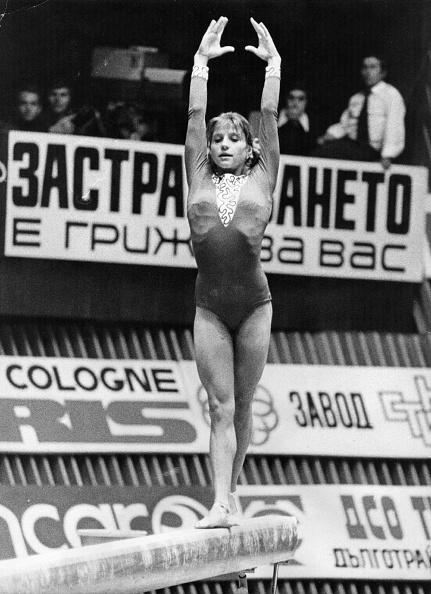
Olga Korbut taking part in the World Gymnastic Championships in Varna, Bulgaria. Original Publication: People Disc – HG0074 (Photo by D Deynov/Getty Images)