At the end of 2018, Ye Zhennan, team leader of the national gymnastics squad, acknowledged that the women’s national team had entered a difficult period. One reason, he explained, was the lack of eligible athletes born in 2001 and 2002:
“This has been an extremely difficult year for the women’s team. Athletes born in 2001 and 2002 are almost entirely missing from the pipeline. The premature retirement of Wang Yan — the All-National Games double champion in vault and floor — combined with serious injuries to key athletes, including Mao Yi, Fan Yilin, and Li Qi, has left the team noticeably weakened. Through the coaching of head coach Qiao Liang and the experience gained at the Asian Games and World Championships, the athletes have undergone a remarkable transformation in both their training level and their mental outlook.”
“女队今年是非常困难的一年,2001、2002年龄段出生的队员几乎断档,全运会跳马、自由操双料冠军王妍的过早退役以及毛艺、范忆琳、黎琪等重点队员出现严重伤病,使队伍实力上有所欠缺。通过乔良主教练在训练水平上的弥补,和在亚运会、世锦赛的历练让队员在训练水平和精神面貌有了焕然一新的改变。”
Archived here.
In a country of more than a billion people, it is difficult to believe that China simply produced very few gymnasts born in 2001 and 2002. There are, however, several possible explanations. Perhaps the national team focused so heavily on preparing the 1999 and 2000 cohorts for the Rio Olympics that the next generation was neglected. Or perhaps some gymnasts born in 2001 and 2002 had their ages adjusted in order to make them eligible for the Rio Olympics.
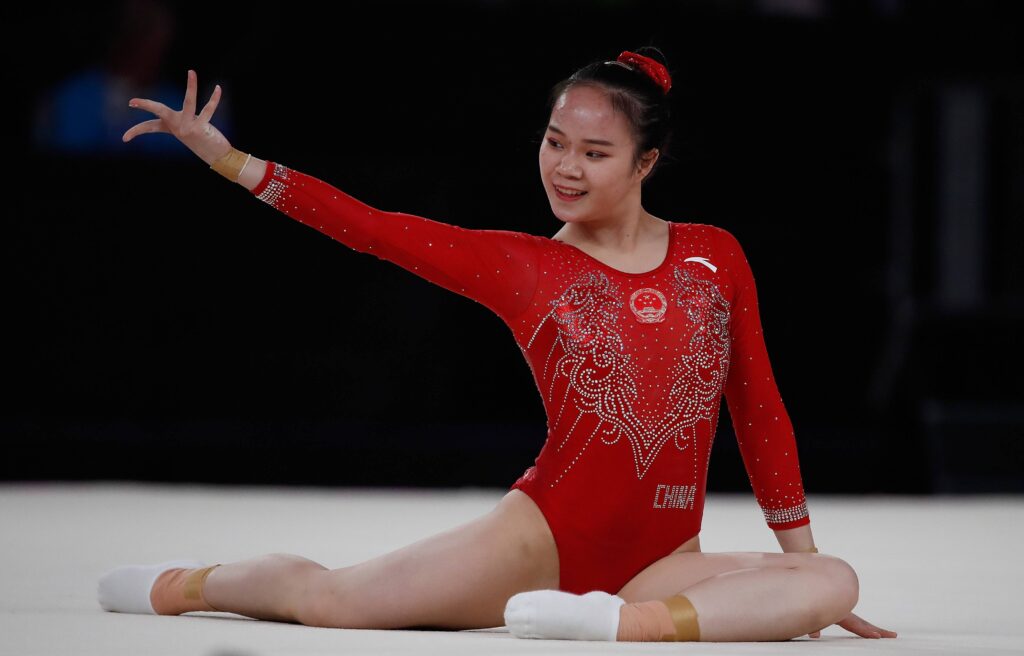
Luo Huan’s case points to that possibility. Her reported birth year appears to shift from 2002 to 2000. But the significance of her age extends beyond a single discrepancy. It offers a window into a broader pattern: a system in which age alterations appear not as rare exceptions, but as something closer to routine practice — often taking place during early childhood, long before a gymnast ever reaches the international stage.
Three Possibilities for Luo Huan’s Age
For Luo Huan, there are three possible birth years on record. Each tells a different story.
2002
At the end of 2018, Wenzhou Sports, a local sports outlet in Zhejiang province, published a profile of Luo Huan that gave her a 2002 birth year.
The article stated:
Luo Huan was born in 2002 in Xiantao, Hubei. She began practicing gymnastics at age four, and was subsequently recruited by our city and funneled into the Zhejiang provincial team. She was selected for the national team in 2012. Luo Huan shares many similarities with Olympic champion Jiang Yuyuan: both are all-around athletes, and both were brought in from other regions to Wenzhou.
罗欢,2002年出生在湖北仙桃,4岁开始练习体操,此后由我市引进并输送至浙江省队,2012年入选国家队。罗欢和奥运冠军江钰源有诸多相似之处,都是全能型选手,都是从外地引进到温州。
[…]
Archived here.
To be sure, among reports available outside China, 2002 is an anomaly in coverage of Luo Huan’s gymnastics career, and a single local article cannot, on its own, outweigh the documentary record. But local profiles of this kind — written for a hometown audience, with no apparent awareness of international eligibility rules — are sometimes more candid about an athlete’s origins precisely because they have no reason not to be. Notably, the report has remained publicly available for nearly eight years without correction or clarification.
If that report is accurate, it would mean that Luo Huan was only fifteen and therefore underage at the 2017 Asian Gymnastics Championships, where she won team and uneven bars gold, along with silver medals in the all-around and balance beam.
2000
The second birthdate for Luo Huan is March 6, 2000. This is the date used in her FIG license and the overwhelming majority of newspaper reports. It has been firmly in place since at least the 12th National Games in 2013:
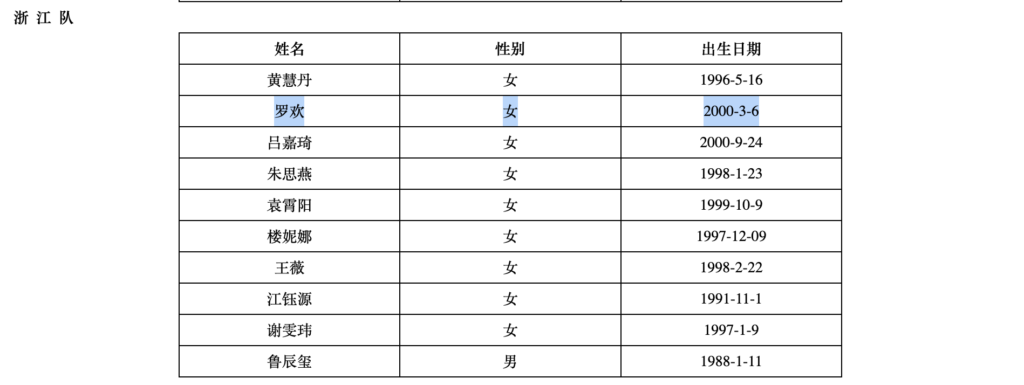
Archived here.
And yet it is not the oldest that Luo Huan has ever been officially recorded.
1999
In 2008, during the Beijing Olympic age controversy, Mike Walker uncovered cached gymnast registration records from the website of the General Administration of Sport of China.
At the time, most attention focused on He Kexin’s registration, which listed her birthdate as January 1, 1994. But Luo Huan also appeared in the 2007 registration records, where her birthdate was listed as November 6, 1999.
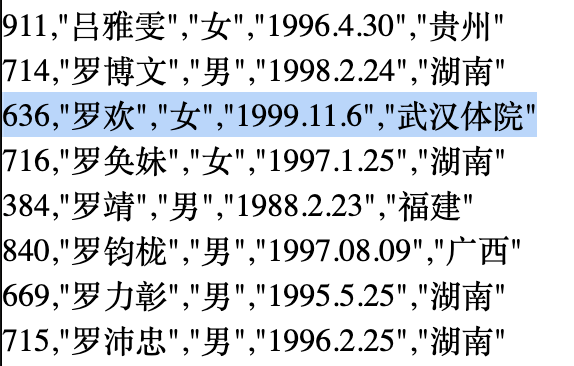
636, “Luo Huan,” female, born November 6, 1999, Wuhan Institute of Physical Education.
It is unclear why she was registered with a 1999 birth year. Perhaps it would make her 14 in time for China’s 2013 National Games. Perhaps it would make her eligible earlier in the 2013-2016 quad. Perhaps it is another reason altogether.
The motivation may never be known. But the registration itself reveals something important. Age alterations are often imagined as something that happens when gymnasts approach senior elite competition. Yet Luo Huan’s 2007 registration suggests that, in some cases, the process may begin much earlier. Some gymnasts may already have had their ages adjusted forward in their earliest official records, making them officially older than they really were from the very beginning.
Put differently: if Luo Huan had actually been born in 2002, she would have appeared in the General Administration of Sport’s 2007 registration database at only five years old, but with a birth year already advanced by three years. If she had been born in 2000, she would have entered the database at age seven with her birthdate shifted forward by four months. In either scenario, the age of a child under eight was being altered.
That detail matters because it changes where responsibility lies. Age falsification is a documented problem in Chinese sport, though responsibility is often placed on the athletes themselves. In 2011, Ci Xin wrote in the China Youth Daily:
[Mr. Wang, a boxing coach,] noted, however, that because so many athletes falsify their ages, a kind of equilibrium tends to emerge among competitors. “But one thing is certain: athletes who do not falsify their ages will be at a disadvantage unless their physical gifts and technical abilities are truly exceptional.”
Ci Xin, China Youth Daily, February 18, 2011, p. 8
不过,由于改年龄者众多,选手之间的实力往往也达成了某种平衡,”但可以肯定的是,不改年龄的运动员,除非身体素质和技术能力极其出众,否则肯定会吃亏。”
But in Luo Huan’s case, it is difficult to believe that a five- or seven-year-old child possessed either the agency or the understanding to register herself with a 1999 birth year. Whoever made that decision was an adult — a parent, a coach, an administrator, or a local official — operating within a system that normalized such decisions.
The Limits of International Governance
The cached registrations offer a rare glimpse into a sporting culture in which age falsification is so embedded that it may begin long before a gymnast ever reaches the junior elite level and long before any international body is watching.
Which raises the question of what, realistically, the FIG can do. The FIG licensing system requires gymnasts to obtain and periodically renew official athlete licenses in order to compete internationally. In practice, it is effective at preventing federations from registering the same gymnast under multiple birthdates or from revising an athlete’s age after a successful junior debut to accelerate her senior eligibility. What it cannot address is a sporting culture in which age alterations may occur when a gymnast is five or seven years old — long before she ever enters the international pipeline.
That, ultimately, is the central limitation of international oversight. The FIG can monitor passports, licenses, and eligibility records once a gymnast enters the international elite system. But if an altered birthdate has already followed an athlete since her early childhood, international governance ends up enforcing the consistency of the record rather than the accuracy of it.
Note
1. The Luo Huan who appears in the 2007 cached registration is the same gymnast who went on to win team bronze at the 2018 World Championships in Doha. According to a Xiantao Daily profile, reprinted on the Xiantao government’s website, Luo Huan was affiliated with the Wuhan Institute of Physical Education early in her career:
Unyielding on the Olympic Stage
During her training at the Li Xiaoshuang Gymnastics School, Luo Huan displayed exceptional talent and consistently strong form, and her path in gymnastics grew steadily smoother.
At seven, she entered the Wuhan Institute of Physical Education; at eight, she was recruited by Wenzhou and brought into the Zhejiang provincial team; at twelve, she was selected for the national team.
不服输拼搏奥运赛场
在李小双体操学校训练期间,罗欢表现出独特的天赋和良好的状态,体操之路越走越顺。
7岁时,罗欢如愿进入武汉体院,8岁时由温州引进至浙江省队,12岁进入国家队。
Note: This article assumes a 2000 birth year—not a 2002 birth year.
2. Today, Chinese athlete registrations often list “competition ages” (参赛年龄). It would be reasonable to assume that the youngest registrants’ competition birth years reflect their actual ones. But Luo Huan’s case suggests otherwise. It’s possible that, by the time some gymnasts enter the official record domestically, their birth years may already have been pushed forward — altered while they were still in elementary school.
Appendix: The Xiantao Daily‘s Profile
Moving Forward in Harmony — The Story of Xiantao Gymnast Luo Huan
Published: August 1, 2024 | Source: Xiantao Daily | Reporter: Li HuiIn the early hours of July 31 (Beijing time), the women’s team gymnastics final at the Paris Olympics was held. The Chinese team — comprising Qiu Qiyuan, Zhou Yaqin, Ou Yushan, Zhang Yihan, and Luo Huan — finished sixth.
Although they did not reach the podium, Xiantao’s own Luo Huan delivered fluid, composed performances on vault, uneven bars, and balance beam, showcasing excellent competitive form. Her bright smile lit up the arena and drew wave after wave of applause and cheers. Online, fans lavished praise on her: “Huan is smooth and steady.”
Before the competition, our reporter reached Luo Huan’s mother, Yang Fenglan, by phone, and also visited the home of Luo Huan’s aunt, Yang Fengyu, and the Li Xiaoshuang Gymnastics School, where Yang Fenglan, Yang Fengyu, and Luo Huan’s first coach, Liu Fen, sat down to recall Luo Huan’s journey.
A Well-Behaved Girl Falls in Love with Gymnastics
“This is the training floor where Luo Huan used to train, and over there are the dormitories where she slept.” On the afternoon of July 30, inside the training hall of the Li Xiaoshuang Gymnastics School, Luo Huan’s first coach, Liu Fen, sat and recounted stories of Luo Huan’s childhood training.
In March 2000, Luo Huan was born in Yanglínwěi Township in our city. At the age of three, she entered the Li Xiaoshuang Gymnastics School and began training in gymnastics under Coach Liu Fen. She boarded at the school from Monday through Friday, spending weekends at her aunt Yang Fengyu’s home.
“You and your husband both work in Shashi, Jingzhou — why not let her attend a sports school there?” At their first meeting, Liu Fen, concerned that such a young child would be difficult for her parents to leave behind, even recommended a coach in Shashi.
Yang Fenglan was unmoved: “Xiantao gymnastics is famous the world over. We came here because of that reputation. Besides, I’m a Xiantao person — if she’s going to train in gymnastics, it should be in Xiantao. One day, she’ll bring glory to her hometown.”
During the trial session, little Luo Huan fearlessly jumped and ran back and forth across the narrow balance beam, her legs light and nimble, her explosive power striking. Liu Fen’s heart leapt: this child is truly the stuff of a gymnast.
“Luo Huan was an exceptionally well-behaved little girl, and she loved to be coddled,” Liu Fen recalled. As the youngest on the squad at the time, with her parents far away, she was always tugging at Liu Fen’s arm asking to be held, snuggling against her, and saying that when she grew up she would become a champion and win a gold medal to give to her.
Training was grueling, and Luo Huan threw herself into it completely. Liu Fen watched with admiration and ached with affection for her, always bringing her more snacks and sweets than the other children, and constantly encouraging her: “Luo Huan, you’re smart, you have drive — if you work hard enough, you could be a world champion.”
“Huanhuan loved to be coddled from the time she was small, and she loved praise — like a ball that bounces higher the harder you hit it, the more you praised her, the faster she improved,” said Yang Fenglan. When the family heard little Luo Huan announce in her baby voice that she had performed well and earned two pieces of candy from Coach Liu as a reward, the whole family burst out laughing.
At six, Luo Huan faced a pivotal decision: continue with gymnastics or go to school? As an only child, her parents hoped she would prioritize her education. Gymnastics, after all, was an extraordinarily hard life. But little Luo Huan answered in her small, unwavering voice: I love gymnastics, and gymnastics is what I want to do.
Unyielding on the Olympic Stage
During her training at the Li Xiaoshuang Gymnastics School, Luo Huan displayed exceptional talent and consistently strong form, and her path in gymnastics grew steadily smoother.
At seven, she entered the Wuhan Institute of Physical Education; at eight, she was recruited by Wenzhou and brought into the Zhejiang provincial team; at twelve, she was selected for the national team.
In 2014, Luo Huan announced herself on the national stage, winning gold in the individual all-around and on uneven bars at the National Gymnastics Championships — her first national titles. In the years that followed, she collected gold and silver medals at the Asian Games, the World Championships, and a host of other major competitions.
“This one is the leotard Luo Huan wore at her very first competition — the oldest one, and the most meaningful. This one is from the Chengdu World University Games [in 2021], her first major competition after she came out of retirement.”
On the morning of July 30, Yang Fengyu laid out the competition leotards she has collected and kept over the years. Having spent so many years living at Yang Fengyu’s home, Luo Huan developed a deep bond with her aunt, often confiding in her, and frequently sending her leotards, mascots, and other mementos from her competitions.
“These are extraordinarily precious gifts. I will treasure them carefully,” Yang Fengyu said. Huanhuan has always been willing to endure hardship. She has given everything in every competition, and every honor she has earned has come at a price.
“Keep a good mindset, and the gold medal will always be yours.” Before every major competition, Yang Fengyu offers Luo Huan those words of comfort.
Luo Huan’s gymnastics career has not been without its sorrows. She missed the Olympics on multiple occasions. On the eve of the 2016 Rio Olympics, she suffered a leg fracture and was removed from the preparation roster. She then missed the Tokyo Olympics as well, for various reasons. In 2021, she announced her retirement and enrolled at Wuhan Sports University.
But for Luo Huan, gymnastics has always been the great love of her life, and she was unwilling to accept that it was over. In 2023, she came out of retirement and returned to the training floor, competing at the World University Games, where she won one gold, two silvers, and one bronze.
“This child has the unyielding competitive spirit of us Xiantao people running through her bones; she always grits through the pain and fights to the end,” Yang Fenglan said. Watching Huanhuan fall from the uneven bars at the University Games, she said, brought tears to her eyes.
In that competition, Luo Huan endured the pain, rose to her feet without hesitation, set her jaw, and finished the routine — and ultimately won a medal.
After each competition, Luo Huan mails her medals and certificates home, and thoughtfully buys gifts for her father, mother, and grandmother. “Over more than ten years, the medals Luo Huan has won have filled two large bags. We help her organize and keep them; they are a treasure that belongs to the whole family,” Yang Fenglan said.
The “Emergency Substitute’s” Smile Gives People Strength
At twenty-four, Luo Huan is the oldest competing member of the Chinese women’s gymnastics team. On the competition floor she is composed and confident, giving herself fully to the performance, her smile blazing through the arena like a flame and drawing the whole crowd in.
In both the qualification round and the final, Luo Huan went first — technically complete and reliably steady. When her teammates finished their routines, she was always the first to offer a hug, instinctively stepping in to help the younger members of the squad settle their nerves.
“Give everything you have, and make the greatest contribution you can to the team.” Today, Luo Huan has grown from the national team’s “emergency substitute” in 2018 into its “big sister.”
It was in 2018 that Luo Huan first came to widespread attention, when she was called up at the last minute to compete at the Jakarta Asian Games. Summoned in a moment of need, she flew from Beijing to Jakarta and immediately threw herself into preparation.
Despite the circumstances, Luo Huan performed brilliantly, demonstrating formidable strength and helping the Chinese women’s gymnastics team win the Asian Games team title for the twelfth time, while also claiming silver medals in the individual all-around and on uneven bars.
In February of this year, at the 2024 Gymnastics World Cup in Cairo, Egypt, Luo Huan closed out the women’s uneven bars final in the anchor position and took silver, securing her qualification for the Paris Olympics.
The wealth of experience accumulated across her long career has made Luo Huan a steadying force at the heart of the current Chinese women’s gymnastics team. During the Paris Olympics gymnastics qualification round, as other younger team members made a series of errors, Luo Huan performed steadily and scored effectively, helping her teammates fight through to a place in the final.
“To represent the country at the Olympics, to stand bravely on that great competitive stage — that is the highest honor of all, and Huanhuan is the pride of our entire family,” Yang Fenglan said. Whatever the result, the whole family is proud of Luo Huan.
To see her beloved student compete at the Olympics for the first time at the “advanced age” of twenty-four, Liu Fen said: “My heart aches for her, and at the same time, I feel a very particular kind of spiritual strength radiating from her. I think this is the mission that this land of Xiantao has given her naturally. Seeing her there, giving herself fully to the Olympic stage with such joy; it made me so happy.”
Reporter: Li Hui (李辉)
一路“欢”歌向前行——仙桃体操运动员罗欢成长经历
Editor: Zhang Qi (张岂)
Responsible Editor: Hu Ping’an (胡平安)
Reviewed by: Xiao Yanli (肖艳丽)
发布时间:2024-08-01
来源:仙桃日报
字号: 大 中 小
北京时间7月31日凌晨,巴黎奥运会体操女子团体决赛举行,由邱祺缘、周雅琴、欧钰珊、张怡涵、罗欢组成的中国队排名第6。
虽未能站上领奖台,但仙桃姑娘罗欢,在跳马、高低杠、平衡木等比赛中动作流畅、稳定发挥,展现出良好的竞技状态,甜美笑容感染全场观众,博得阵阵掌声和欢呼声,网友盛赞她“欢顺,很稳”。
赛前,记者连线罗欢的妈妈杨凤兰,并来到罗欢姨妈杨凤玉家及李小双体操学校,与杨凤兰、杨凤玉及启蒙教练刘芬一同回顾罗欢的成长经历。
乖乖女爱上体操
“这块场地,就是平时罗欢训练的地方,那边是她住的宿舍。”7月30日下午,在李小双体操学校训练馆,罗欢的启蒙教练刘芬坐在场馆内,讲述罗欢小时候训练的故事。
2000年3月,罗欢出生在我市杨林尾镇,3岁时进入李小双体操学校,师从教练员刘芬练习体操。每周一至周五住校训练,周末住在姨妈杨凤玉家。
“你们夫妻都在荆州沙市工作,为啥不让孩子在沙市上体校。”首次见面,刘芬担心孩子小,杨凤兰夫妻会想念“掌上明珠”,还向他们推荐沙市的教练。
不料,杨凤兰态度坚决:“仙桃体操威震世界,我们慕名而来。再说,我是仙桃人,练体操就要到仙桃,以后为家乡争光。”
试训时,小罗欢勇敢地在窄窄的平衡木上跳过来跑过去,奔跑时双腿轻盈灵巧,爆发力强。刘芬心头一热:这真是一个体操的好苗子!
“罗欢小时候特别乖,很爱撒娇。”刘芬说,当时罗欢在队里最小,父母也不在身边,总爱缠着“要抱抱”,喜欢依偎在她的怀里,说长大了要当冠军,获得金牌送给她。
训练很苦,罗欢非常努力。刘芬看在眼中,疼在心中,总给她带来比别人更多的零食、糖果,并经常鼓励她:“罗欢呀,你聪明,有上进心,只要努力,你世界冠军也能当。”
“欢欢从小喜欢撒娇,喜欢被夸奖,就像皮球越拍越高一样,越夸奖她进步越快。”杨凤兰说,当听到罗欢奶里奶气说自己表现好,得到刘教练奖励的两颗糖时,全家开怀大笑。
6岁时,罗欢面临一次重要抉择:是继续练习体操还是去上学?罗欢是家中独女,父母均希望她以学业为重,毕竟练体操太苦了。但是小罗欢用稚嫩的声音给出坚定的回答:我就是爱体操,我就要练体操!
不服输拼搏奥运赛场
在李小双体操学校训练期间,罗欢表现出独特的天赋和良好的状态,体操之路越走越顺。
7岁时,罗欢如愿进入武汉体院,8岁时由温州引进至浙江省队,12岁进入国家队。
2014年,罗欢一战成名,在全国体操冠军赛中获得个人全能和高低杠金牌,这是她首次获得全国冠军。此后,她多次在亚运会、世锦赛等各类大赛上摘金夺银。
“这件是罗欢第一次参加比赛时穿的,时间最久、最有意义;这件是成都大运会的比赛服,欢欢复出后第一次大型赛事。”
7月30日上午,杨凤玉展示自己珍藏的罗欢历年比赛服。因长年住在杨凤玉家,罗欢与她感情很深,爱和她聊天,并经常将比赛服、吉祥物等送给她。
“这些都是非常珍贵的礼物,我会好好珍藏。”杨凤玉说,欢欢特别能吃苦,每一次比赛都拼尽全力,每一份荣誉都来之不易。
“保持好心态,金牌永远是你的。”每逢重大赛事前,杨凤玉总是用这句话安慰罗欢。
罗欢的体操生涯也并非一帆风顺,此前她多次与奥运会失之交臂。2016年里约奥运会前夕,罗欢不幸腿部骨折退出备战名单。此后又因为各种原因遗憾错过了东京奥运会。2021年,她宣布退役并就读于武汉体育学院。
然而,对于罗欢来说,体操是永远的热爱,她不甘心,更不认输。2023年,罗欢复出重返训练场,参加了世界大学生运动会体操比赛,成功摘得1金2银1铜。
“这孩子骨子里流淌着我们仙桃人不服输的拼劲,总是忍住伤痛拼到底。”杨凤兰说,看着欢欢在大运会高低杠摔下那刻,心疼得眼泪都流出来了。
在那场比赛中,罗欢强忍着伤痛,毅然决然站起来,咬紧牙关完成了比赛,最终获得奖牌。
每次比赛完,罗欢都将奖牌和证书邮寄回家,并贴心为爸爸妈妈及外婆购买礼物。“十几年来,罗欢获得的奖牌已有两大包了,我们帮她整理、珍藏,这是全家人宝贵的财富。”杨凤兰说。
“救火队员”的微笑给人力量
24岁的罗欢是中国体操女队年龄最大的参赛运动员。赛场上,她沉着自信,尽情享受比赛,面带微笑像一团火一样感染了全场观众。
无论是预选赛还是决赛中,罗欢总是打头炮,技术全面、发挥稳定;队友完成比赛,她总是第一时间送上拥抱,主动帮助年轻队员们稳定心态。
“拼尽全力,为团队做出最大贡献。”如今,罗欢已由2018年的国家队“救火队员”,成长为国家队“大姐姐”。
2018年,罗欢因为临时替补出战2018年雅加达亚运会而名声大噪。当时,罗欢临危受命,从北京赶到雅加达,并迅速进入备战状态。
虽火线救急,但罗欢在比赛中表现出色,展现出强大的实力,助力中国体操女队第12次获得亚运会体操女团冠军,先后摘得女子个人全能和高低杠银牌。
今年2月,在埃及开罗举行的2024体操世界杯埃及站女子高低杠决赛中,罗欢压轴出场取得亚军,也锁定了本次巴黎奥运会的参赛资格。
身经百战的丰富经历,让罗欢成为目前中国体操女队“定海神针”般的人物。此次巴黎奥运会女子体操资格赛中,面对其他“小花”接连出现的失误,罗欢稳稳发挥、有效得分,最终与队友们拼得决赛资格。
“能够代表国家参加奥运会,勇敢站上奥运会竞技大舞台,就是至高无上的荣誉,欢欢是我们全家人的骄傲。”杨凤兰表示,无论成绩如何,全家人都以罗欢为荣。
爱徒在24岁的“高龄”首次参加奥运会,刘芬说:“我很心疼她,同时,也感受到她带来的一种特别的精神力量,应该说这是仙桃这片热土赋予她的天然使命,看到她尽情享受奥运赛场让人很开心。”(记者 李辉)
编辑:张 岂
责编:胡平安
审核:肖艳丽
More on Age