In 2018, Chen Yile enjoyed a remarkable senior debut. She won team bronze at the Doha World Championships and captured three gold medals — team, all-around, and balance beam — at the Asian Games in Jakarta. Yet according to articles published by both the Chinese Olympic Committee and the General Administration of Sport of China, Chen Yile was still only fifteen years old in 2018 and therefore not old enough to compete as a senior under FIG rules.
The timeline presented in the articles is unambiguous. Both state that Chen Yile was fourteen during the 2017 National Games and fifteen during the 2018 Asian Games, clearly pointing to a 2003 birth year, even though she was officially registered with a 2002 birthdate.
The General Administration of Sport
The General Administration of Sport of China is the Chinese government agency responsible for overseeing elite sports, national teams, athletic policy, and the country’s state-run sports system. Here’s what the agency published in August of 2018.
Chen Yile Becomes the “Little Goddess” of Chinese Women’s Gymnastics in the Tokyo Cycle
Published: August 24, 2018 | Source: China Sports Daily | Author: Yuan Xuejing
Her breakout performance at last year’s National Games made her the biggest dark horse on the gymnastics floor. Now, collecting flowers and applause in Jakarta, she has become the most trusted all-around “little goddess” of Chinese women’s gymnastics in the Tokyo cycle.
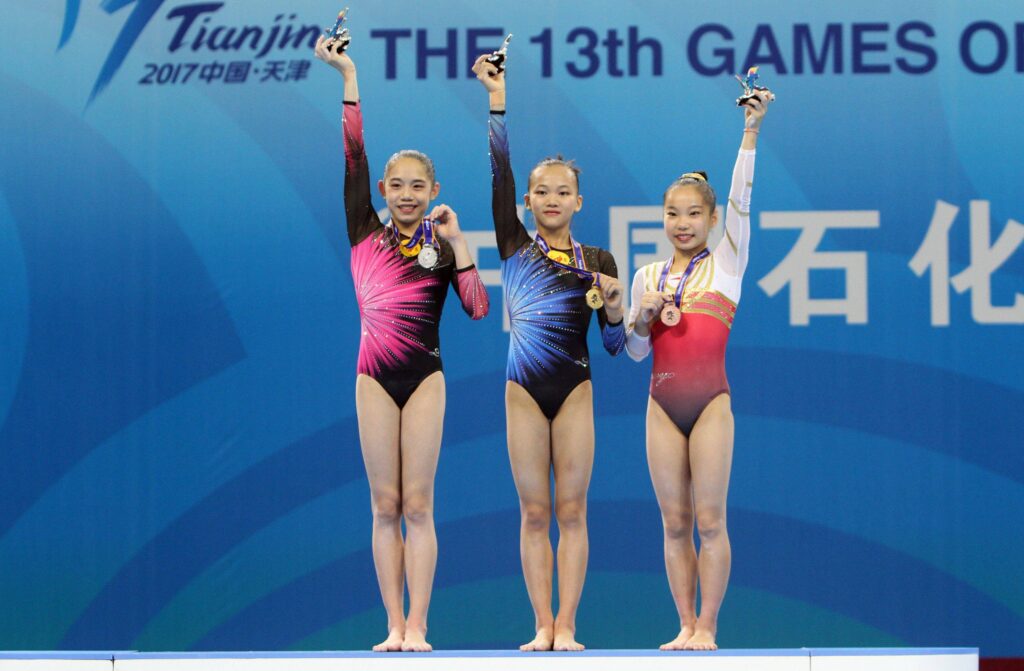
It is not at all an exaggeration to call 15-year-old Chen Yile a heaven’s favored daughter. At last year’s National Games in Tianjin, Chen Yile burst onto the scene and, at just 14, claimed the women’s all-around title that so many have spent careers chasing. From junior competition to senior competition, the young girl made a seamless transition. “Seeing the wider world” had always been her ambition. “In individual events I don’t feel I’m particularly outstanding,” she said, “so my main goal is to compete in the all-around, because my four events are fairly balanced.” In all-around competition, balance and consistency are the most lethal weapons, and Chen Yile has never stopped moving forward.
In day-to-day training, all-around gymnasts work the hardest — more events, longer hours. But Chen Yile does not find training a burden; she genuinely enjoys it. “The athletes who specialize in individual events don’t have it any easier than me. Training the all-around, at least I can switch events to break the monotony. Take Sister Fan Fan” — Fan Yilin — “when she trains the uneven bars, her hands tear badly and she just keeps going. I don’t think I could take that.” The young women of the Chinese gymnastics team are all extraordinarily dedicated. Afternoon training sessions rarely end before six o’clock and often run until seven. Chen Yile understands that the steps to success are built from hard work, and she never allows herself to ease up. “If you relax, you stop improving. And watching others improve while you stay still — that stings.”
The confidence she brings to competition is earned in daily toil. On the competition floor, Chen Yile is always smiling, meeting every challenge with composure. During the Asian Games qualification round — which also served as the all-around final — her floor music was played incorrectly, leaving her stranded at the side of the floor for more than three minutes. She performed not just normally but above her own level, earning the highest score of any competitor in the session. Balance beam 14.800, vault 13.800, floor exercise 13.150, uneven bars 14.200 — a total of 55.950 — Chen Yile took the all-around title by 1.400 points over her teammate and runner-up Luo Huan.
At last year’s World Championships, Chen Yile had not yet reached the age threshold. This year in Doha she will make her World Championships debut. Competing on the same floor as the formidably strong American gymnasts, Chen Yile said modestly that “there is still a great deal to improve.” The experience of the next two years will bring her greater maturity, and the Tokyo Olympics will be the best opportunity for Chen Yile to show the world what Chinese women’s all-around gymnastics can do.
(Reprinted from page 6 of the August 24 edition of China Sports Daily*)
陈一乐成东京周期中国女子体操“小女神”
发布时间:2018-08-24 来源:中国体育报 作者:袁雪婧 字体:大中小
去年全运会一飞冲天,她被视作体操赛场最大黑马。如今在雅加达收获鲜花和掌声,她已成为东京周期中国女子体操最值得信赖的全能小女神。
用“天之骄女”形容15岁的陈一乐一点儿也不过分。去年天津全运会上,陈一乐一鸣惊人,14岁就拿下许多人梦寐以求的女子全能冠军。从青少年赛到成年赛,小姑娘实现了无缝衔接。想去“见见大世面”,一直是她的心愿。“单项的话感觉自己没有特别突出,主要想拼全能,因为我四项比较均衡。”在全能的竞争上,均衡和稳定是最致命的武器,陈一乐始终没有停下前进的脚步。
在平时的训练中,全能选手是最辛苦的,练的项目多、时间长。但陈一乐不觉得训练辛苦,并乐在其中。“主攻单项的队员一点也没比我轻松,我练全能还可以换项调节。就像范范姐(范忆琳)练高低杠时,手皮破得很严重还继续做,如果是我可能受不了。”中国体操女队的小姑娘们都很刻苦,下午的训练课很少能早过6点结束,经常都要练到7点。陈一乐深知成功的阶梯是勤奋,从不敢放松对自我的要求。“你自己放松了,就不会进步。看着别人进步自己没有进步,就会难受。”
比赛中的自信都来自平日的辛勤付出,走上赛场的陈一乐永远在微笑,沉稳应对所有挑战。亚运会资格赛也是全能决赛中,她的自由操音乐放错,被晾在场边超过三分钟,她却能正常发挥甚至超水平发挥,得到所有参赛选手全场最高分。平衡木14.800、跳马13.800、自由操13.150、高低杠14.200,总分55.950,陈一乐领先第二名队友罗欢1.400分摘得全能桂冠。
去年世锦赛,陈一乐年龄未达标,今年的多哈她将首度亮相世锦赛舞台。与实力超强的美国选手同场竞技,陈一乐谦虚地表示“要提高的还有很多”。未来两年的历练将让她更加成熟,东京奥运会将是陈一乐向全世界展示中国女子全能选手实力的最好机会。(转自8月24日《中国体育报》06版)
Archived here.
The Chinese Olympic Committee
China’s Olympic Committee published essentially the same article, but packaged it slightly differently, focusing on several athletes, including Chen Yile.
The Sky Is Wide for Birds to Soar, the Sea Is Vast for Fish to Leap — China’s Newcomers Make Their Mark in Jakarta
2018-08-24, China Sports Daily
As the host of the Tokyo Olympics two years hence, Japan has in recent years invested heavily and laid extensive groundwork, with table tennis, badminton, gymnastics, swimming, and athletics all on the rise. China’s traditionally dominant events face mounting challenges from Japan. For this Asian Games in particular, the better to prepare for Tokyo, China sent a delegation of 845 athletes with an average age of 24.4, of whom 632 had no experience at the Asian Games or Olympics. Young newcomers form the core of the team, with many events handed over to these “junior managers.” While accumulating invaluable competitive experience, they will also face stiff tests from their Japanese counterparts. Whether these rising stars can distinguish themselves in Jakarta will go a long way toward shaping the China-Japan contest at the Tokyo Olympics. The Jakarta Asian Games are now in full swing: in the pool, the Chinese and Japanese swimmers are locked in tooth-and-nail competition, neither yielding an inch; in gymnastics, the gold content of the competition has been somewhat diluted by Japan fielding only its second-string team, yet even Japan’s reserves present a considerable test for China’s young gymnasts. Let us look at which Chinese newcomers on the main battlegrounds of Sino-Japanese competition are capable of shouldering the burden of the future.
Chen Yile, Goddess of the All-Around
Her breakout performance at last year’s National Games made her the biggest dark horse on the gymnastics floor. Now, collecting flowers and applause in Jakarta, she has become the most trusted all-around “little goddess” of Chinese women’s gymnastics in the Tokyo cycle.
It is not at all an exaggeration to call 15-year-old Chen Yile a heaven’s favored daughter. At last year’s National Games in Tianjin, Chen Yile burst onto the scene and, at just 14, claimed the women’s all-around title that so many have spent careers chasing. From junior competition to senior competition, the young girl made a seamless transition. “Seeing the wider world” had always been her ambition. “In individual events I don’t feel I’m particularly outstanding,” she said, “so my main goal is to compete in the all-around, because my four events are fairly balanced.” In all-around competition, balance and consistency are the most lethal weapons, and Chen Yile has never stopped moving forward.
In day-to-day training, all-around gymnasts work the hardest — more events, longer hours. But Chen Yile does not find training a burden; she genuinely enjoys it. “The athletes who specialize in individual events don’t have it any easier than me. Training the all-around, at least I can switch events to break the monotony. Take Sister Fan Fan” — Fan Yilin — “when she trains the uneven bars, her hands tear badly and she just keeps going. I don’t think I could take that.” The young women of the Chinese gymnastics team are all extraordinarily dedicated. Afternoon training sessions rarely end before six o’clock and often run until seven. Chen Yile understands that the steps to success are built from hard work, and she never allows herself to ease up. “If you relax, you stop improving. And watching others improve while you stay still — that stings.”
The confidence she brings to competition is earned in daily toil. On the competition floor, Chen Yile is always smiling, meeting every challenge with composure. During the Asian Games qualification round — which also served as the all-around final — her floor music was played incorrectly, leaving her stranded at the side of the floor for more than three minutes. She performed not just normally but above her own level, earning the highest score of any competitor in the session. Balance beam 14.800, vault 13.800, floor exercise 13.150, uneven bars 14.200 — a total of 55.950 — Chen Yile took the all-around title by 1.400 points over her teammate and runner-up Luo Huan.
At last year’s World Championships, Chen Yile had not yet reached the age threshold. This year in Doha she will make her World Championships debut. Competing on the same floor as the formidably strong American gymnasts, Chen Yile said modestly that “there is still a great deal to improve.” The experience of the next two years will bring her greater maturity, and the Tokyo Olympics will be the best opportunity for Chen Yile to show the world what Chinese women’s all-around gymnastics can do.
[…]
[综合】天高任鸟飞 海阔凭鱼跃–中国新人雅加达崭露头角
(China Sports Daily reporters Yuan Xuejing, Li Xueying, Li Dongye, and Sun Xue) China Sports Daily
2018-08-24 09:37:40 中国体育报
作为两年后的东京奥运会东道主,日本近年来投入重金,布局已久,乒乓球、羽毛球、体操、游泳、田径等项目不断崛起,中国多个优势项目正面临着日本越来越多的挑战。特别是本次亚运会,为了能够更好地备战东京,中国派出了由845人组成的平均年龄为24.4岁的运动员代表团,其中有632人没有亚运会和奥运会经历。年轻新人成为主力军,多个项目“小鬼当家”,他们在积累宝贵的比赛经验的同时,也将经受日本对手的强力考验。新星能否崭露头角闪耀雅加达将很大程度上影响到东京奥运会的中日对决。现在,雅加达亚运会激战正酣,游泳比赛中,中日水军犬牙交错,互不相让;体操虽然由于日本只派出了二队参战而使得比赛含金量有所下降,但日本队本身的实力也对中国体操小将来说考验不小。且让我们看看中日交锋的主战场上到底有哪些中国新人能够承担起未来的重任。
全能女神陈一乐
去年全运会一飞冲天,她被视作体操赛场最大黑马。如今在雅加达收获鲜花和掌声,她已成为东京周期中国女子体操最值得信赖的全能小女神。
用“天之骄女”形容15岁的陈一乐一点儿也不过分。去年天津全运会上,陈一乐一鸣惊人,14岁就拿下许多人梦寐以求的女子全能冠军。从青少年赛到成年赛,小姑娘实现了无缝衔接。想去“见见大世面”,一直是她的心愿。“单项的话感觉自己没有特别突出,主要想拼全能,因为我四项比较均衡。”在全能的竞争上,均衡和稳定是最致命的武器,陈一乐始终没有停下前进的脚步。
在平时的训练中,全能选手是最辛苦的,练的项目多、时间长。但陈一乐不觉得训练辛苦,并乐在其中。“主攻单项的队员一点也没比我轻松,我练全能还可以换项调节。就像范范姐(范忆琳)练高低杠时,手皮破得很严重还继续做,如果是我可能受不了。”中国体操女队的小姑娘们都很刻苦,下午的训练课很少能早过6点结束,经常都要练到7点。陈一乐深知成功的阶梯是勤奋,从不敢放松对自我的要求。“你自己放松了,就不会进步。看着别人进步自己没有进步,就会难受。”
比赛中的自信都来自平日的辛勤付出,走上赛场的陈一乐永远在微笑,沉稳应对所有挑战。亚运会资格赛也是全能决赛中,她的自由操音乐放错,被晾在场边超过三分钟,她却能正常发挥甚至超水平发挥,得到所有参赛选手全场最高分。平衡木14.800、跳马13.800、自由操13.150、高低杠14.200,总分55.950,陈一乐领先第二名队友罗欢1.400分摘得全能桂冠。
去年世锦赛,陈一乐年龄未达标,今年的多哈她将首度亮相世锦赛舞台。与实力超强的美国选手同场竞技,陈一乐谦虚地表示“要提高的还有很多”。未来两年的历练将让她更加成熟,东京奥运会将是陈一乐向全世界展示中国女子全能选手实力的最好机会。
[…]
(中国体育报记者 袁雪婧 李雪颖 李东烨 孙 雪)
Archived here
What makes the case especially revealing is not merely that these articles existed, but who published them. They first appeared in the China Sports Daily — not an obscure fan blog or a local gossip column, but the principal newspaper of China’s state sports system, operating under the direct supervision of the General Administration of Sport. The paper functions not only as a news outlet but as an institutional voice for Chinese sports policy, elite competition, and the national sports bureaucracy. If any journalists in China knew how old Chen Yile was supposed to be, it would be the reporters at the China Sports Daily.
The articles then traveled upward. They were republished on the websites of the General Administration of Sport and the Chinese Olympic Committee — two of the highest sports authorities in the country — which means the age figures did not merely appear in a newspaper and disappear. They were amplified and endorsed at the institutional level.
A typographical error might survive in a newspaper archive. It is harder to explain how one survives republication by the country’s governing sports bodies without anyone noticing or caring enough to correct it. Yet both articles remained online for years, their ages unchanged. At the very least, no one in the upper echelons of the sports system appeared to regard them as mistakes.
That raises an uncomfortable question: was Chen Yile really born in 2002? China’s own top sports authorities did not consistently appear to think so.
Note
1. Because Chen Yile’s registered birthdate is January 5, articles published in August should already reflect her age for that calendar year.
2. When past age controversies turned international, Chinese media had a habit of going to the parents to verify their children’s ages (e.g., Dong Fangxiao and Yao Jinnan). Now, facing a domestic controversy, the same pattern held. After multiple outlets — including the Chinese Olympic Committee and the General Administration of Sport of China — had reported that Chen Yile was only 15 in 2018, the Yancheng Evening News printed familial testimony:
Chen Yile’s father, Chen Qiming, told the reporter that Yile was born in 2002 in Ganzhou, Jiangxi, and had loved dancing and performing from an early age, falling in love with gymnastics once she was exposed to it.
Yancheng Evening News, August 27, 2018
陈一乐的父亲陈启明告诉记者,一乐2002年生在江西赣州,从小喜欢跳舞和表演,接触了体操以后就爱上了这项运动,
The sentence construction is telling. The newspaper could have simply stated that she was born in 2002. Instead, it specifies that her father “told the reporter” she was born in 2002. That distinction matters: the article is not presenting the date as an uncontested fact, but as a claim attributed to Chen Qiming himself. In doing so, it appeals to paternal authority while also subtly distancing the publication from the assertion, suggesting that other understandings of her age may have existed.
And other understandings of her age did exist. Neither the Chinese Olympic Committee nor the General Administration of Sport of China ever amended the articles.
Appendix
The following is a translation of CCTV’s feature coverage of Chen Yile’s all-around victory at the 2017 National Games.
[00:00:00]
Speaker 1: Before last night’s women’s all-around final began, the Guangdong coaching staff was especially worried about the team leader, Liu Tingting, who had injured her foot during qualification. They were busy icing it and helping her keep her body activated. Sitting blankly across from them was a young girl — Chen Yile, whom everyone usually calls “Lele.”
Reporter: Lele, are you ready?
Chen Yile: Ready.
Reporter: Good luck.
Speaker 1: In the previous qualification round, Chen Yile ranked first in the all-around, which surprised many people. Chen Yile was a promising young talent discovered during Guangdong’s winter training last year by national team coaches Wang Qunce and Xu Jinglei. No one expected that after only half a year of polishing, she would achieve results like this. [00:00:30]
Wang Qunce: She’s very grounded. And while being grounded, she also thinks carefully about what she’s doing. So in just half a year, she went from being a completely unknown child to becoming a serious contender for the National Games all-around gold medal.
Speaker 1: Even though she’s still young, Lele is especially mature and considerate. Her supervising coach on the national team, Coach Wang, is already nearly 60 years old, and she often reminds him to take care of his health. [00:01:00]
Wang Qunce: She’s very cheerful. Sometimes she actually turns around and worries about my daily life. She often tells me what I should eat and what I shouldn’t eat. The thing she opposes most is my smoking.
Speaker 1: On the Guangdong team, Chen Yile and Liu Tingting are like sister flowers. On the national team, they also train under the same coaches and are especially close. Chen Yile’s current floor routine was previously performed by Liu Tingting, and Liu personally taught it to her step by step. In Liu Tingting’s eyes, this junior teammate is adorably absent-minded. [00:01:30]
Liu Tingting: She’s pretty quiet, kind of spaced-out. When you talk to her, she doesn’t hear you. If you ask her, “Lele, where are you going?” she’ll just go, “Uh… okay, I’m going,” very slowly like that.
Chen Yile: Sometimes I don’t understand what they’re talking about.
Reporter: Because you’re from Guangdong, right?
[00:02:00]
Chen Yile: No, it’s just that I often can’t hear what they’re saying when they suddenly call me. I zone out a lot, so they think I’m kind of goofy.
Speaker 1: This adorably absent-minded girl also has another talent: drawing. In Liu Tingting’s social media posts, she shared artwork drawn by both herself and Lele. Many teammates joke that Lele is really a painter who was delayed by gymnastics.
Liu Tingting: She’s the professional artist. [00:02:30] I’m just someone who draws with soul.
Reporter: So you still think your drawings are pretty good, right?
Liu Tingting: Of course. Everyone says the facial expressions I draw make me a true “soul artist.”
Speaker 1: This shy and somewhat awkward young girl becomes calm and composed once she steps onto the competition floor. Whether in qualification, the women’s team final, or last night’s all-around final, every one of Chen Yile’s routines was successful. Even though she looked steady during competition, after she came off the floor the coaches discovered her hands were ice-cold from nerves. [00:03:00]
Reporter: Just now after beam, Coach Lu said your hands were freezing. Was that because you were nervous?
Chen Yile: Yes, extremely nervous.
Reporter: But you always look very steady during competition.
Chen Yile: They say I look calm during competition, but actually my whole body is shaking.
Speaker 1: To still perform so smoothly under such intense pressure shows just how much Chen Yile has improved over the past half year. In the all-around standings, she ultimately defeated Liu Tingting with a score of 56.434 to win the title. [00:03:30] And her biggest future goal is to fight for first place at the Olympics.
Chen Yile: I think about going to the Olympics every single day.
Reporter: If you make the Olympics, what would your goal be?
Chen Yile: My goal is first place. No matter what.
[00:00:00]
Speaker 1: 昨晚的女子个人全能决赛开始之前,广东队的教练团队比较担心的是队伍的领军人物,资格赛当中压到脚的刘婷婷。忙着帮她冰敷,帮她保持身体的兴奋度。而在对面坐着发呆的小姑娘,就是陈一乐,一般大家都会喊她乐乐。
记者: 乐乐准备好了吗?
陈一乐: 准备好了。
记者: 加油啊。
Speaker 1: 此前的资格赛上,陈一乐排名全能第一,让很多人感到[00:00:30] 意外。陈一乐是国家队教练王群策、徐惊雷去年带队在广东队冬训时发掘的小苗子。没想到,大半年的打磨,就有如此成绩。
王群策: 很踏实,而且在踏实过程中,她是动脑子那个踏实。所以在大半年的时间里面,她从一个默默无闻的小孩,一跃成为全运会的一个全能金牌的有力争夺者。
Speaker 1: 别看年纪不大,乐乐特别懂事。她在国家队的主管教练王导[00:01:00] 都快60岁了,她经常督促王导要注意养生。
王群策: 她很开朗,她有时候反过头来会关心我的生活。经常我要吃什么,她主动说你应该吃什么,应该不能吃什么。她最反对我抽烟。
Speaker 1: 在广东队,陈一乐跟刘婷婷是姐妹花。在国家队,两人也师出同门,感情特别好。陈一乐目前的自由操就是刘婷婷之前跳的,而且是[00:01:30] 刘婷婷手把手教会她的。在婷婷眼里,这个小师妹呆萌呆萌的。
刘婷婷: 比较安静吧,也是那种呆呆的。你跟她讲话,她听不见的。她跟你讲话:“乐乐,你去什么地方干嘛?”她就是那种:“呃,好的,我去。”就是这种慢慢的。
陈一乐: 我有时候听不懂她们讲什么。
记者: 因为你是广东的是吧。 [00:02:00]
陈一乐: 不是,我老是听不见她们讲什么,她们突然叫我。我老是走神,所以她们觉得我很呆。
Speaker 1: 这位呆萌少女还有一项天份,那就是画画。在刘婷婷的朋友圈里,她发布了乐乐和自己画的画。好多队友调侃乐乐,简直就是被体操耽误的画家。
刘婷婷: 她是专业的画家[00:02:30] ,我是一个灵魂画手。
记者: 你还是为自己的画画艺还不错,是吗?
刘婷婷: 那当然。表情被我画的,他们都说我是灵魂画手。
Speaker 1: 这样一位羞涩又有点木木的小姑娘,上了场就变得沉着冷静。不管是女子资格赛、女团决赛,还是昨晚的个人全能,陈一乐的成套全部成功。虽然看上去她表现很稳,但是比完下场,教练发现她的手掌紧张得冰凉。 [00:03:00]
记者: 刚刚平衡木下来的时候,陆导说你的手都凉了,是因为紧张的吗?
陈一乐: 是的,特别紧张。
记者: 但是我看你在赛场上表现都特别稳。
陈一乐: 她们说我比赛的时候感觉不紧张,其实我全身都在抖。
Speaker 1: 在高度紧张的情况下,还能如此流畅地完成比赛,说明陈一乐这大半年来确实长进不小。全能的奖牌榜,她最终以56.434分[00:03:30]力压刘婷婷夺冠。而她未来最大的目标就是在奥运会上争夺第一。
陈一乐: 我是每天都想上奥运会。
记者: 如果上了奥运会,希望你的目标是什么?
陈一乐: 目标就是第一,不管什么。
In retrospect, it is a painful passage to read, given that Chen Yile did not make the 2021 Olympic team.
More on Age