When the Soviet Union invaded Afghanistan in December 1979, governments across the Western alliance were forced to decide whether to support the American-led boycott of the Moscow Olympics. Most Western European countries ultimately found ways to send their athletes to the Games, often under the Olympic flag rather than their national colors. West Germany was different. As one of the largest and most influential countries in Western Europe, it joined the boycott.
That decision has usually been told as a story of Cold War diplomacy: alliance politics, relations with Washington, and the struggle to balance political principles against Olympic ideals. But for the athletes whose careers had been built around Moscow, the boycott was something far more personal. Olympic opportunities vanished, training cycles lost their purpose, and years of preparation suddenly led nowhere.
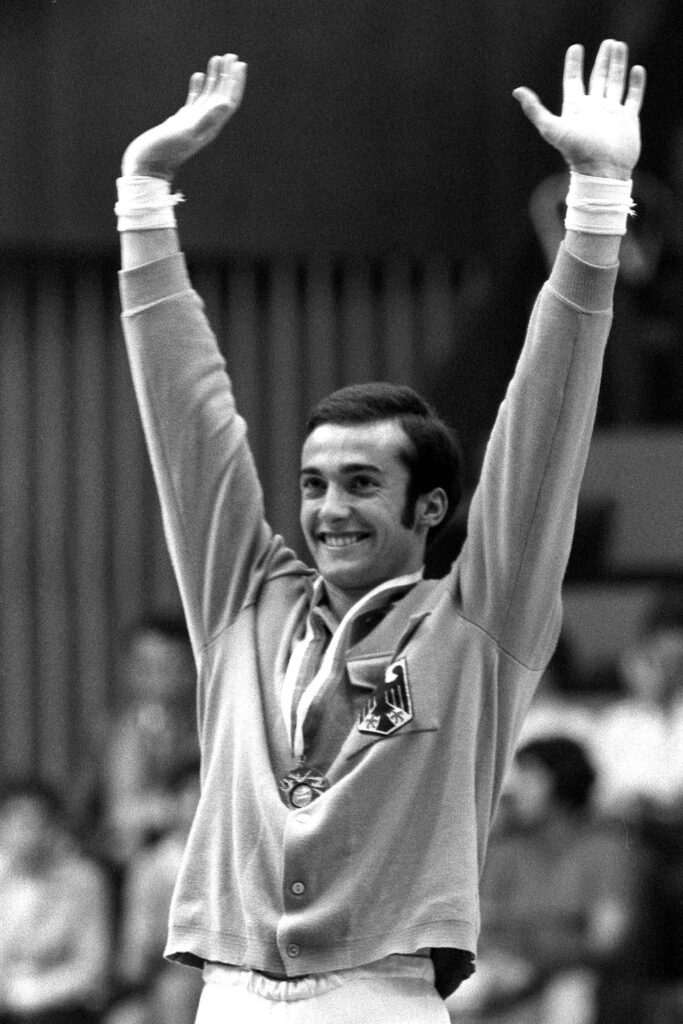
Among those affected were members of West Germany’s gymnastics team. Below, we’ll look at the reactions of Eberhard Gienger and Volker Rohrwick.
West Germany’s Olympic Dilemma: How Bonn Chose Politics Over Sport in 1980
In West Germany, the boycott debate quickly became a struggle over who should decide the country’s Olympic fate. The federal government increasingly favored non-participation, while many sports leaders and athletes insisted that the Olympic movement should remain independent of political pressure. What followed was not simply a dispute over Moscow, but a broader argument about the relationship between sport and the state.
The West German government gradually aligned itself with the American position. Foreign Minister Hans-Dietrich Genscher argued that participation in Moscow would be inappropriate as long as Soviet troops remained in Afghanistan. Chancellor Helmut Schmidt was reportedly more conflicted. He worried about the impact a boycott would have on athletes, yet ultimately concluded that West Germany’s obligations to its Western allies outweighed those concerns. Bonn insisted that the National Olympic Committee (NOC) remained free to make its own decision. Within West German sport, however, there was deep disagreement over what that decision should be.
National Olympic Committee president Willi Daume emerged as the most prominent opponent of the boycott. He insisted that the Olympic movement should remain independent of government policy and argued that the NOC had a responsibility to decide the issue on its own terms. German Sports Federation (DSB) president Willi Weyer took the opposite view. As pressure from Bonn increased, Weyer moved firmly behind the boycott, arguing that West German sport should stand in solidarity with both the federal government and the United States. He also framed the issue in practical terms: since the state had long supported sport with public funds, sport could not simply ignore the government’s request when it was asked for something in return. What began as a dispute over Moscow increasingly became a debate about the autonomy of sport itself.
Most athletes sided with Daume. Throughout the spring of 1980, Olympic hopefuls publicly campaigned for participation, arguing that sport was an inappropriate vehicle for political protest. A rally in Dortmund’s Westfalenhalle, organized by sixty-three elite athletes and attended by thousands of supporters, underscored the depth of opposition to a boycott. Athlete representatives maintained that an overwhelming majority of Olympic candidates favored competing in Moscow. For them, the people being asked to bear the costs of the boycott were the athletes themselves.
Yet the political momentum increasingly favored non-participation. On 11 May, the NOC presidium voted 12-7, with one abstention, to recommend staying away from the Games. Four days later, delegates gathered in Düsseldorf to make the final decision. During a contentious debate, athlete representative Thomas Bach appealed to the assembly to consider the wishes of the competitors, most of whom still hoped to compete in Moscow. His appeal failed. The delegates voted 59-40 in favor of the boycott. Several participants later acknowledged that they would not have made the same decision of their own free will, but felt unable to disregard the recommendation of the federal government.
Athletes felt the consequences most directly. Klaus Hess, president of the rowing association, later described sport as a “sacrificial lamb on the altar of politics,” while Daume warned that neither governments nor foreign leaders would help athletes recover what had been lost.
What exactly had been lost depended on the athlete.
For Eberhard Gienger, the boycott erased what may have been his best opportunity to become an Olympic champion. By 1980, he was one of the world’s leading gymnasts, a world champion and one of the favorites for a medal in Moscow. For Volker Rohrwick, the loss was different. Younger and less established, he was denied not a likely medal but the Olympic experience itself—the chance to test himself on the sport’s biggest stage. Both men would spend decades reflecting on the decision made in Düsseldorf. Their memories reveal a side of the boycott that vote totals and diplomatic communiqués cannot capture.
Eberhard Gienger in 2008
“The 1980 Olympic Boycott Achieved Nothing”
By Ansgar Graw[…]
WELT ONLINE: Mr. Gienger, is the 1980 Moscow boycott responsible for the one gap in your otherwise impressive sporting record — the missing Olympic gold?
Gienger: That’s hard to say, of course. What I can say is that I trained hard at the time for the chance to win in Moscow.
WELT ONLINE: But then in December 1979 Soviet troops marched into Afghanistan, and West Germany followed the American boycott call. Did that come as a surprise to you?
Gienger: The boycott did not come as a great surprise to me in the end, because I had followed developments very closely ever since the Soviet invasion. I was the spokesperson for the gymnastics team, and I was a member of the athletes’ council, so of course we were paying close attention when U.S. President Jimmy Carter called for a boycott.
WELT ONLINE: Did you have any sympathy for Carter?
Gienger: No. My immediate impression was that Carter was running a campaign for his re-election and was using sport and the Olympic Games as a vehicle for it.
WELT ONLINE: Then at some point there was a meeting with Chancellor Helmut Schmidt, and any remaining hope of going to Moscow evaporated?
Gienger: Helmut Schmidt invited the presidents of the national Olympic sport federations and those of us on the athletes’ advisory council to the Chancellery in Bonn. He made clear that the federal government did not want to jeopardize its partnership with the United States and would therefore support the boycott Washington had called for. And then, quite subtly, he said: You’re perfectly free to go to Moscow, but if you go, please pay for everything yourselves.
WELT ONLINE: And what would that have cost?
Gienger: The National Olympic Committee would have had to pay roughly six million deutschmarks [roughly $3.1 million USD] for all the athletes at that point. That was an enormous sum, and the NOC could not raise it without state support. That took the joy out of the Games for us pretty quickly. What was more decisive for me personally, though, was that a few days later parliament approved the boycott by a large majority. As a committed democrat, I no longer had any enthusiasm for participating in the Olympic Games.
WELT ONLINE: Didn’t the exceptional athlete Gienger still say to the democratic citizen Gienger: What a damned shame — 1979 was a bad year, I didn’t even make it to the final at the World Championships, and so I trained hard to show everyone what I was made of in 1980
Gienger: On a personal level, of course you’re deeply disappointed. But the only person I was genuinely angry at was Mr. Carter. And after all, I had already been to two Olympics — Munich and Montréal — and had won bronze at Montréal in 1976. It was harder for the athletes for whom it would have been their first Games.
WELT ONLINE: Looking back, what is your assessment of the boycott?
Gienger: One has to say it plainly: the boycott achieved nothing. And in hindsight, that makes it hurt all the more. But I made the best of it at the time — bought a house with my wife, and we still have it today — while the Moscow Olympics are history.
WELT ONLINE: Are the politicians calling today for a boycott of the Beijing Games also more interested in raising their own profile than in the actual issue?
Gienger: What’s interesting in any case is that people are calling for a sporting boycott while no one is even entertaining the idea of an economic boycott. That costs real money, so people prefer to use sport as a cheap but high-profile instrument. But an Olympic boycott achieves nothing. That was true in 1980, it was true in 1984 when the Eastern Bloc nations stayed away from Los Angeles in retaliation, and it was true in 1972 and 1976 when African countries boycotted the Games. The only effect of these boycotts was that sport was devalued and the top competitors in many disciplines were absent.
WELT ONLINE: What about the ethical argument — that one cannot hold cheerful sporting competitions while China is violating human rights and persecuting Tibetans?
Gienger: That argument doesn’t hold up either, because in my view the Olympic Games are more likely to improve the situation. After all, some 25,000 accredited journalists from around the world will be there, and they will also be reporting on conditions outside the stadiums and competition venues. Beyond that, sport is simply being overestimated when people expect it to solve a problem like the Tibet question — one that world politics has been struggling with in vain for sixty years.
WELT ONLINE: Didn’t you yourself try in 1975 to use sport as a way of quietly circumventing politics, when, at the end of the artistic gymnastics European Championships in Bern, you smuggled East German champion Wolfgang Thüne into West Germany in your car?
Gienger: There was no political motive behind that — it was entirely personal. Wolfgang Thüne asked me for help. I asked him whether he had thought through the consequences carefully, and then I drove him in my car, along with three other people, into West Germany. I wasn’t a very political person back then.
WELT ONLINE: Assuming Germany does participate in Beijing, do we have a realistic prospect of gold on your signature apparatus, the horizontal bar, thanks to Fabian Hambüchen?
Gienger: If Fabian is fit, the chances of at least a medal are fairly good.
[Hambüchen ended up winning a bronze in Beijing, a silver in London, and a gold in Rio.]
WELT ONLINE: With the Gienger salto or without?
Gienger: He’s dropped it by now. The Gienger salto no longer earns high scores under today’s code.
Published March 26, 2008
Note: Gienger went on to win silver on high bar the 1981 World Championships, so it’s likely that the boycott cost him an Olympic medal.
Volker Rohrwick in 2020
“The Withdrawal Came as a Shock to Me”
Forty years since the Olympic boycott: Volker Rohrwick is among the best gymnasts in Germany. He competes for TB Oppau. In 1980, Rohrwick is in superb form. He has gathered experience at many World, European, and German Championships. He has a good program. But then comes the crushing blow. Rohrwick isn’t the only one who has to come to terms with the political decision.It’s an elegant affair. The best athletes of the Federal Republic of Germany have dressed up smartly. Stylishly attired, the West German stars arrive in Wiesbaden. On an evening in March 1980, a banquet is held in the Hessian state capital. The National Olympic Committee has invited all the athletes who had qualified for the 1980 Summer Olympics in Moscow. Among them is Volker Rohrwick of TB Oppau. Rohrwick travels to Wiesbaden full of joy. There, in a festive setting, he receives his Olympic credential.
Volker Rohrwick is 26 years old at the time. He is one of the top gymnasts in West Germany. “1978 to 1981 was my best period,” Rohrwick says. No one knows whether Rohrwick might have crowned his athletic career with an Olympic medal in Moscow. “I was feeling very good and had a very good program,” he says. But it won’t come to that. Because at this point, no one suspects that Germany will boycott the Summer Olympics in Moscow. That decision only takes shape later.
In 1979, the Federal Republic of Germany still wins a dual meet against the USA. Against the USA, of all countries. The superpower calls for a boycott of the Summer Games in Moscow when the Soviet Union invades Afghanistan. That war in the Hindu Kush ultimately overshadows the 22nd Summer Olympics. In protest against the invasion, numerous countries stay away — including the USA and the Federal Republic of Germany. “We had to accept the decision. We were helpless,” Rohrwick says.
[…]
He talks a great deal with Philipp Fürst. Fürst is his coach, his “second” father. Rohrwick trusts him. They form a perfect team. Fürst plays a major role in Rohrwick’s development into an excellent gymnast, and he advises him to think the decision over carefully. In 1980, Rohrwick goes to the German Junior Gymnastics Championships. “I looked at how good they were and saw that they weren’t actually that strong,” Rohrwick recounts. He decides to keep going. The decision is then crowned in 1981 — with his first national all-around title.
Die Rheinpfalz, December 20, 2020
Note: Volker Rohrwick had placed 24th in the all-around at the 1979 World Championships and 23rd at the 1981 World Championships.
Additional References
Wiedemeier, Christian. Olympia und der Boykott – Moskau 1980: Eine Medienanalyse der XXII. Olympischen Spiele von Moskau. Hamburg: Diplomica Verlag, 2014.
More on 1980