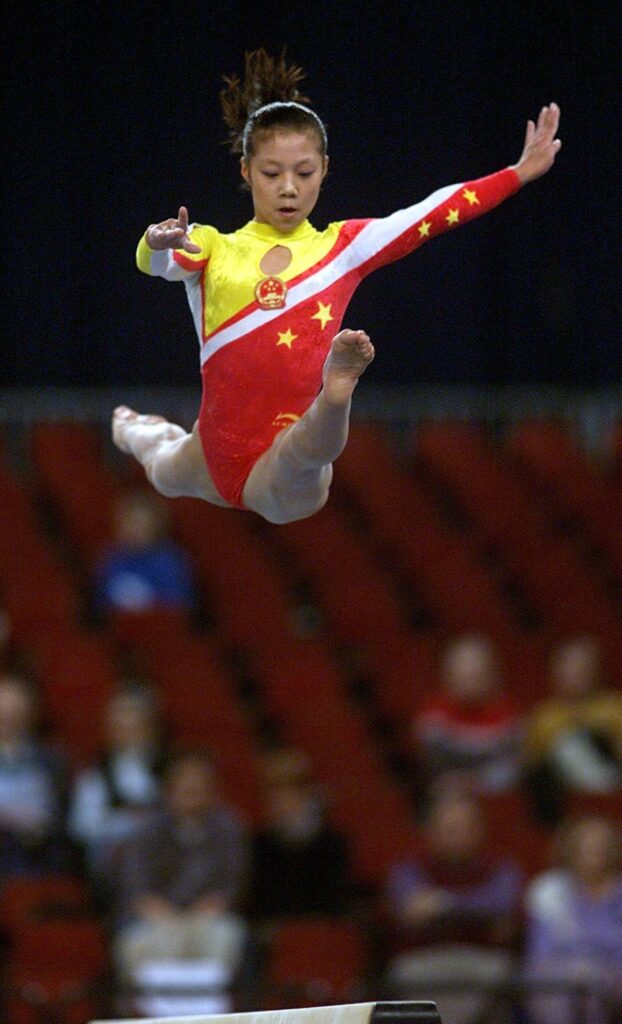
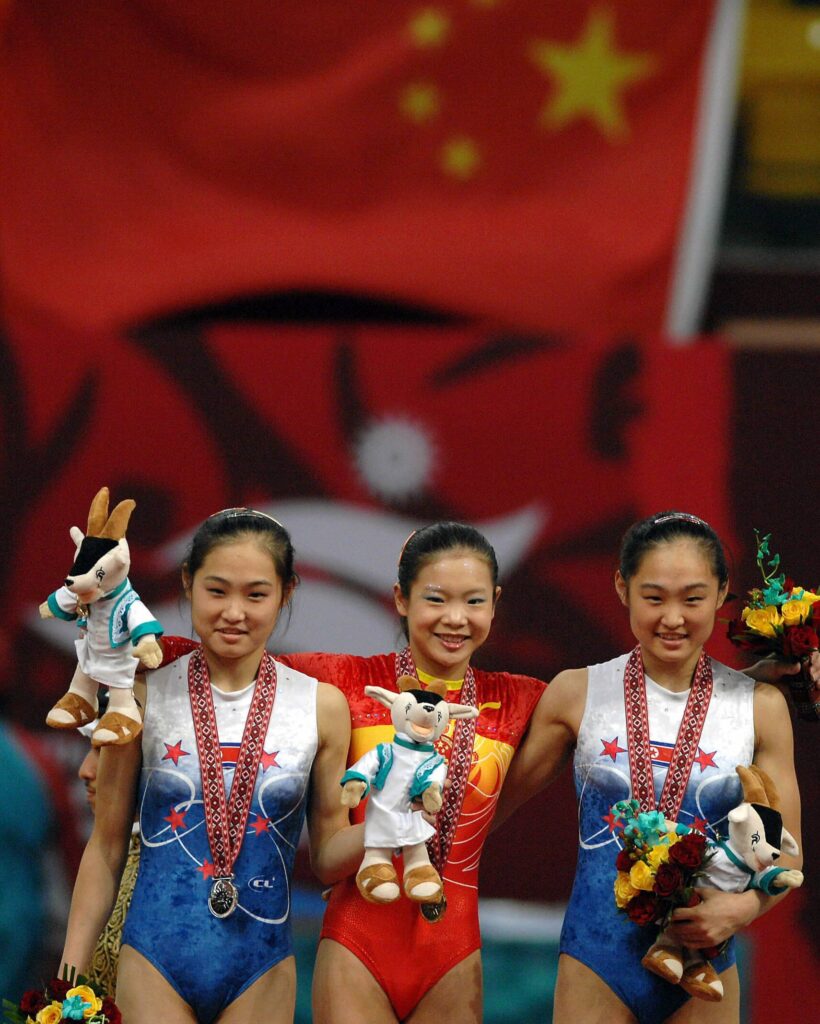
In the autumn of 2002, a sixteen-year-old Beijing gymnast named Zhang Nan arrived at the Busan Asian Games as a relative unknown and left as a star. Competing in her first major international competition, she helped a Chinese women’s gymnastics program — then in the depths of a generational transition — win a team gold medal. She went on to capture three individual golds in the all-around, floor exercise, and uneven bars, announcing herself as the new face of Chinese women’s gymnastics.
The two People’s Daily profiles translated here document Zhang Nan at the very beginning of her rise. The first, published on October 4, 2002 — the morning after her all-around victory — is a brief dispatch from Busan, capturing the immediate excitement of a breakthrough performance. The second, published six months later in April 2003, is a longer portrait that situates her achievement within the harder story of how she got there: a childhood of financial hardship in western Beijing, a training regimen of brutal physical demands, and parents who pushed her—literally—precisely because they understood what was at stake.
Together, the two pieces offer a double exposure — the public triumph and the private formation behind it. They also preserve something of the particular texture of Chinese sports journalism in the early 2000s, which moved freely between match reporting and the kind of intimate biographical detail that Western sports media typically reserved for longer-form features. Read side by side, they sketch a portrait of a young athlete who had already learned, at sixteen, that nothing came easily — and who, by all appearances, was only getting started.
But was she really sixteen in 2002? A Chinese journal article suggests that she was not.