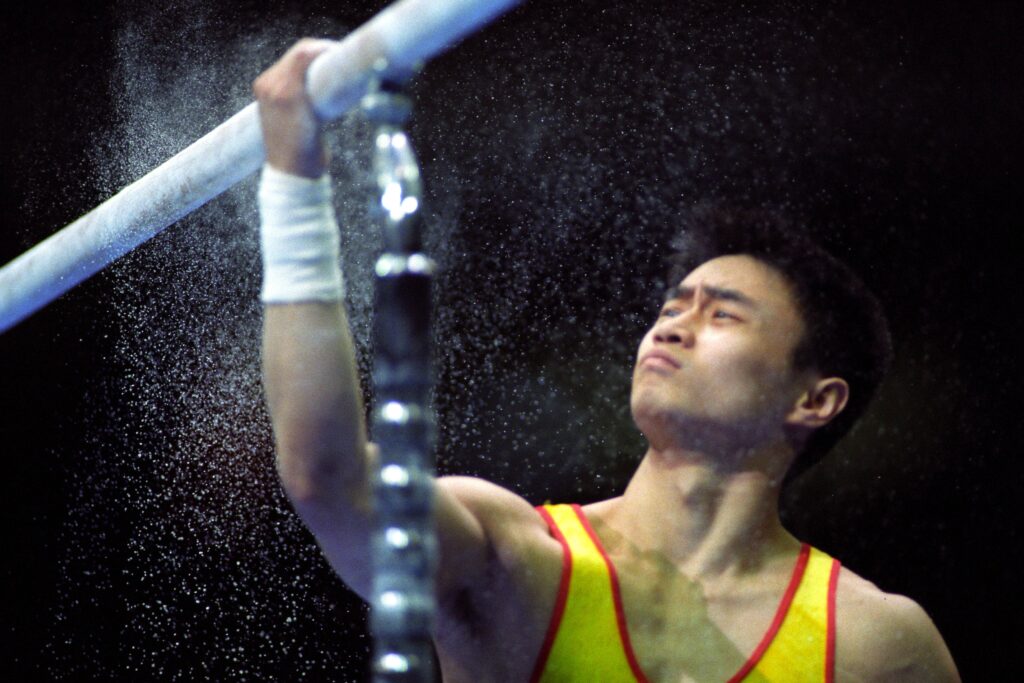
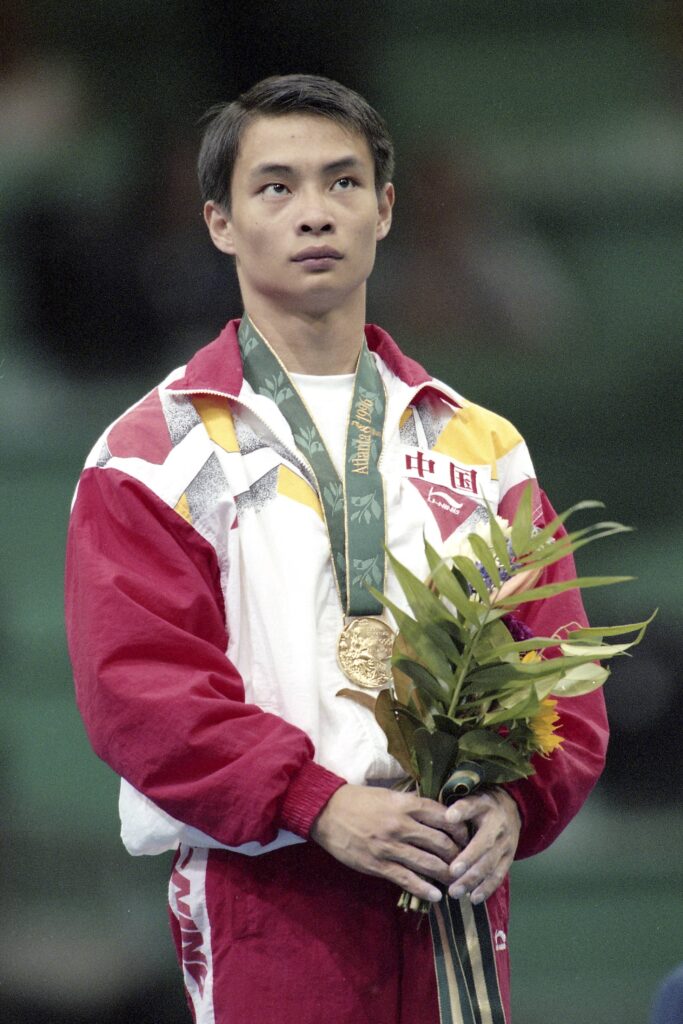
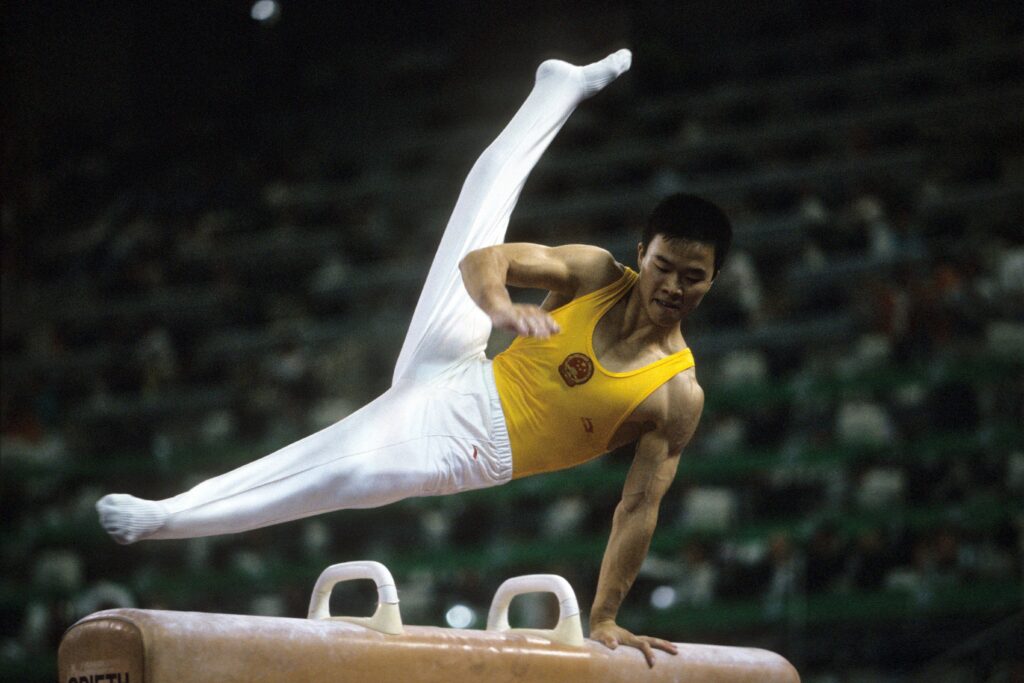
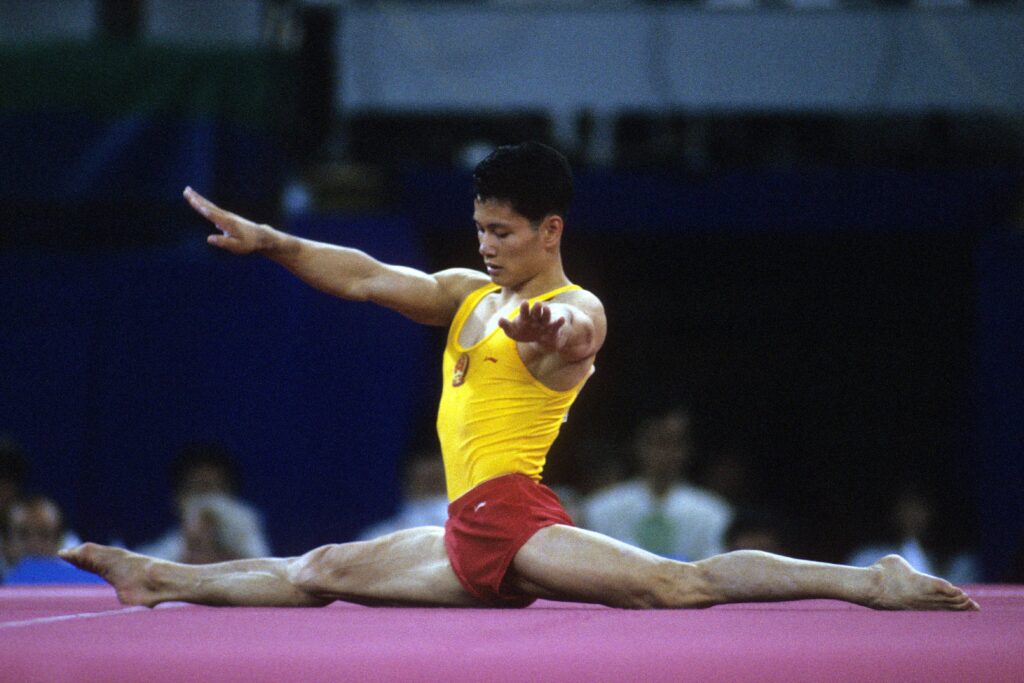
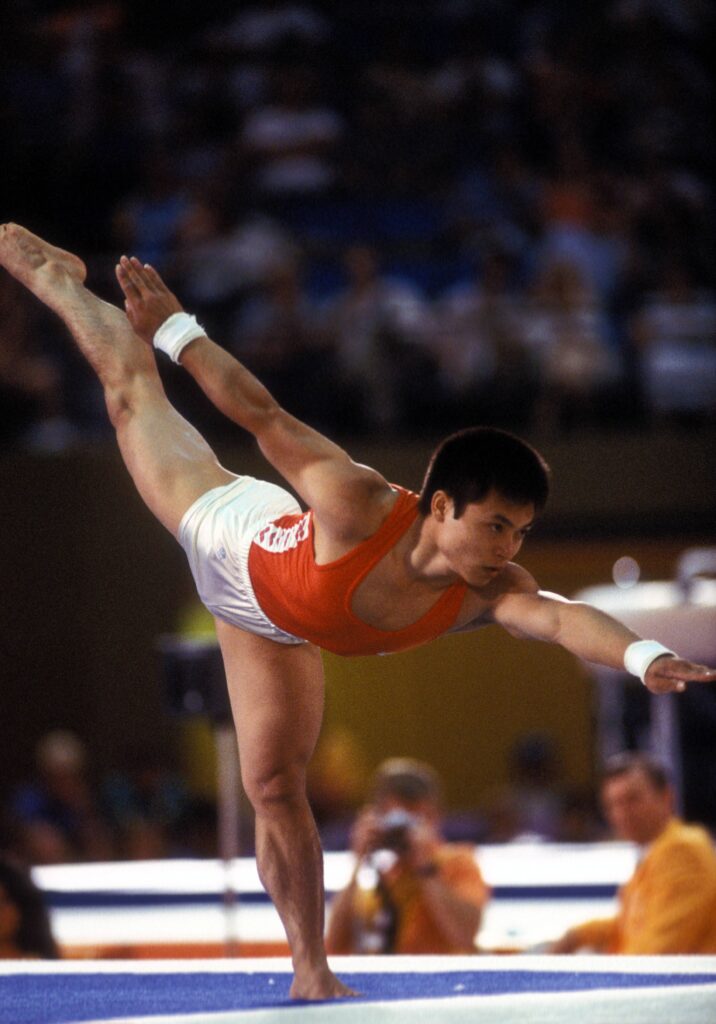
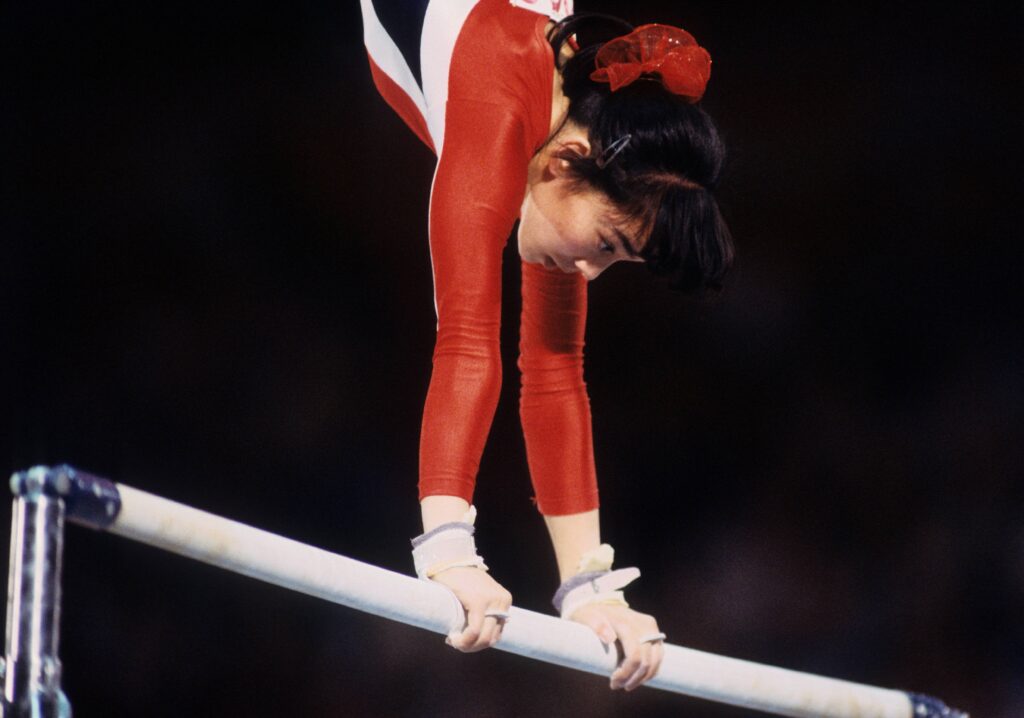
Few gymnasts of the 1990s combined technical precision with artistic elegance as successfully as Huang Liping. A world champion on parallel bars in 1994 and a member of China’s gold medal-winning team at the 1994 World Championships, he also helped the Chinese men win the silver medal at the 1996 Olympic Games. Renowned for the beauty of his gymnastics, one Russian expert reportedly described him as the gymnast who most perfectly combined gymnastics and ballet.
The translations collected here follow Huang through the years after his competitive career. They show him reinventing himself as a coach, international judge, and FIG official while remaining deeply committed to Chinese gymnastics. Along the way, they also reveal a quieter, more personal side of Huang: his fascination with computers and golf, his friendship with a devoted Japanese fan, his marriage to former South Korean national team gymnast Heo So-young (허소영), and his reflections on developing the next generation of champions.
Note: Heo’s Chinese name is Xu Xiaoying (许小英). In English, her Korean name is often transliterated as Hu So-young.
Olympic all-around champion, world all-around champion, and one of China’s greatest athletes, Li Xiaoshuang was among the biggest stars in world gymnastics during the mid-1990s. Yet there is much about him that remains unfamiliar to English-language readers.
For starters, “Li Xiaoshuang” is not actually his given name. Born an identical twin, he was originally named Li Fenghua (李锋华). His older twin brother was Li Weihua (李卫华). Because almost no one could tell the boys apart, their first coach renamed them Dashuang (“Big Twin”) and Xiaoshuang (“Little Twin”), nicknames that eventually replaced their given names entirely. To Chinese readers, this is immediately apparent; to many English readers, it is not.
These two articles, published in Wenshi Chunqiu in 1998, tell the story behind that famous name. They begin not with Olympic medals but with Li’s childhood in rural Hubei, his remarkable relationship with his twin brother, and the coach who discovered the boys and devoted himself to their development. Along the way, they introduce a chatty, mischievous, and fiercely competitive young athlete whom the world came to know simply as “Little Twin.”
Li Xiaoshuang, 1996 Olympics, Copyright: imago/Sven Simon
Li Jing belonged to one of the strongest generations in Chinese men’s gymnastics, but he never wanted to be known simply as another member of the “Li family.” As the careers of Li Yuejiu, Li Xiaoping, and Li Ning captured international attention, fans often remarked that Li Jing even looked like Li Ning, the legendary “Gymnastics Prince.” His response was characteristically direct: “I am who I am—a lively, stubborn son of Hunan.”
That independent spirit defined both his personality and his gymnastics. A six-time world champion and three-time Olympic silver medalist, Li built his reputation on extraordinary difficulty and originality. Chinese writers of the era described his name as virtually synonymous with high-difficulty gymnastics, pointing to the remarkable range of difficult elements and combinations he introduced into his routines soon after joining the national team. Several of those combinations—especially on horizontal bar and parallel bars—were regarded by contemporaries as among the most demanding ever attempted, even if they were never adopted into the Code of Points as eponymous skills.
Yet Li’s career was far from inevitable. Born into a poor family in Hengyang, he nearly abandoned gymnastics after experts concluded that his small hands and short fingers made him unsuited for the sport. Only the persistence of his first coach, Zhou Xin, who convinced him to return to training and build on his exceptional upper-body strength and aptitude for release skills, kept his dream alive. Years of training barefoot in an unheated gym, falling repeatedly from homemade apparatus, and refusing to give up transformed the frail boy who once hung a homemade “World Champion” medallion around his neck into one of China’s greatest gymnasts.
By the end of 1991, Li Chunyang had established himself as the world’s premier horizontal bar specialist. He won back-to-back world titles in Stuttgart (1989) and Indianapolis (1991), helped China to consecutive World Championship team silver medals, the men’s team gold at the 1990 Asian Games, and Olympic team silver at Barcelona in 1992.
This profile appeared in New Sports in early 1990, shortly after Li’s breakthrough victory in Stuttgart. Rather than focusing on the competition itself, it traces the making of a champion—from his discovery as a schoolboy in Shantou and his development under Gao Jian and Huang Yubin to his emergence as the new “King of the Horizontal Bar.” Along the way, it also captures a defining feature of Chinese gymnastics in the 1980s: its determination to match and surpass the Soviet Union in technical innovation, exemplified by Li’s pursuit of the triple back on floor exercise after seeing Valeri Liukin debut the skill in Europe.
Li Chunyang, 1992 Olympics, Copyright: imago/WEREK
Within the gymnastics community, Lou Yun is best known for winning back-to-back Olympic vault titles in 1984 and 1988. Two of his innovations—a handspring rudi on vault and a double side salto with a ¾ twist on floor exercise—appear in the FIG Code of Points under his name. Outside the competitive arena, however, he has repeatedly reinvented himself. Spanning nearly twenty-five years, the articles translated here trace his evolution from Olympic champion to entrepreneur and eventually to one of the public faces of China’s Olympic movement. Although they do not constitute a complete biography, they offer a far fuller portrait of Lou Yun’s life compared to his remarkably sparse Wikipedia page.
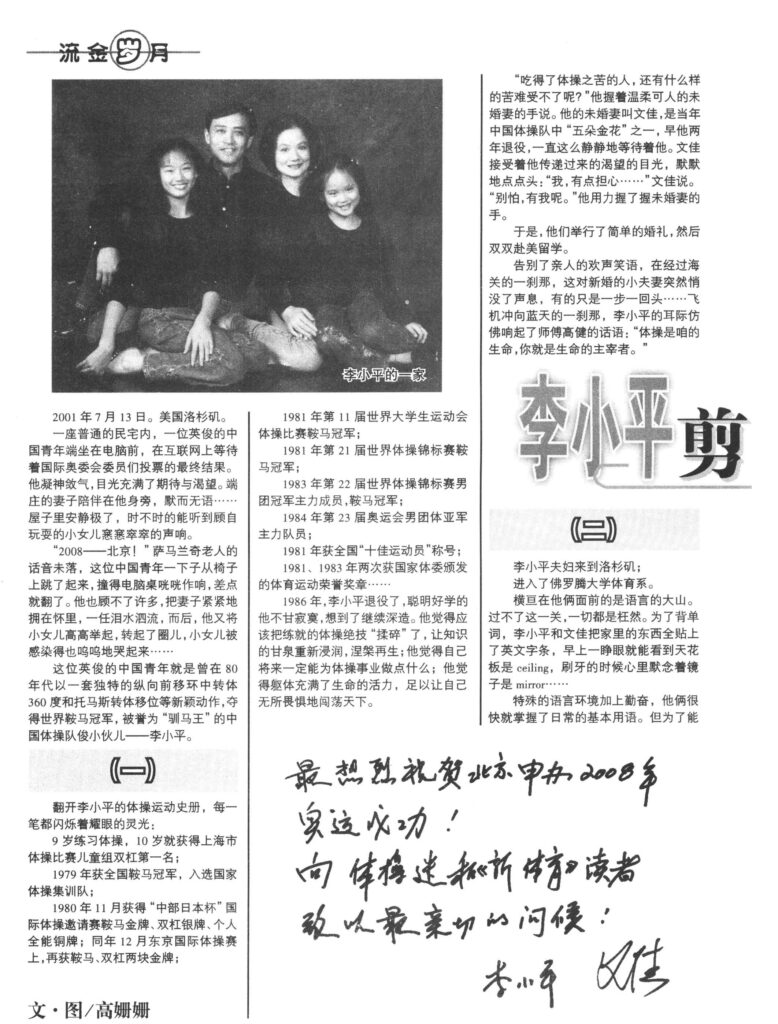
The two texts translated here—a 2001 profile from New Sports and a 2004 Sina.com chat transcript—capture former Chinese gymnast Li Xiaoping during a new phase of his life. One of the world’s leading pommel horse specialists in the early 1980s, Li won the world title in 1981, helped China to its first men’s team world championship in 1983, and earned an Olympic team silver medal at Los Angeles in 1984 before retiring because of injury. By the time these pieces appeared, he and his wife, Wen Jia, herself a former member of the Chinese national team, had built a successful gymnastics club in Southern California while raising a family far from the country where they had made their names.
The New Sports article introduces the couple through Beijing’s successful bid for the 2008 Olympics, describing Li’s emotional reaction to the announcement before recounting their move to the United States, years of financial struggle, and eventual success as gymnastics coaches. The later Sina.com interview is more conversational, allowing Li and Wen Jia to reflect on immigration, entrepreneurship, family life, and their enduring ties to China. Together, the two pieces provide an unusually personal look at two former elite athletes as they navigated life after competition while remaining closely connected to the sport—and to the country—that had shaped them.
Note: Li Xiaoping and Li Xiaopeng are two different gymnasts. Newspaper articles and photo archives often confuse the two. To make matters more confusing, Li Xiaoping is the father-in-law of Li Xiaopeng. Li Xiaopeng, the 2000 and 2008 gold medalist on parallel bars, married Li “Angel” Anqi, who is one of Li Xiaoping’s daughters.
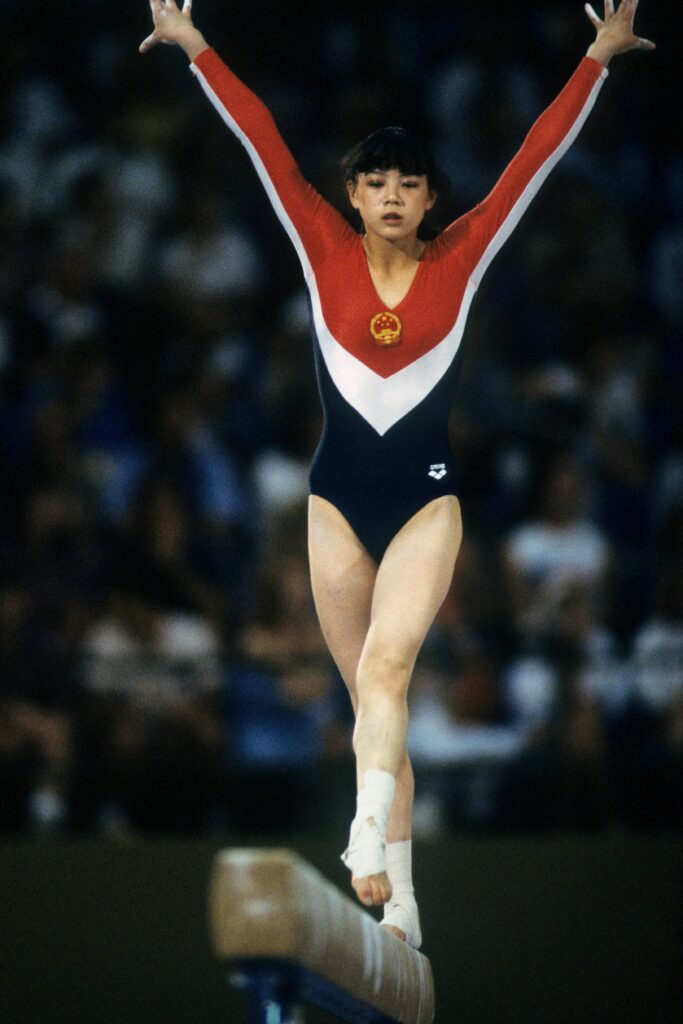
Wu Jiani was one of the most accomplished gymnasts of the early 1980s. At sixteen, she won three gold medals at the 1982 Asian Games and received the only perfect 10 awarded in the women’s competition. A year earlier, she had claimed a bronze medal on balance beam at the World Championships in Moscow, and her shoulder-destroying uneven bars release—commonly called the “Jiani Leap”— was recognized by the International Gymnastics Federation. She would later help China earn its first Olympic team medal in women’s artistic gymnastics, taking bronze at the 1984 Los Angeles Games.
The four profiles translated here, written between 1980 and 1983, are less interested in those achievements than in explaining how they became possible. Each returns to her unlikely beginning in the sport. Wu arrived at the national team with protruding knee joints, stiff ankles, and legs so weak that coaches compared them to those of a child recovering from polio. She failed to finish among the top thirty at her first national championships. Coaches reportedly decided three separate times to send her home, only to relent after watching her climb back onto the apparatus following yet another fall. Again and again, the articles attribute her transformation not to extraordinary talent but to extraordinary persistence: endless repetitions, late-night conditioning sessions, and an almost preternatural refusal to complain.
Read together, the profiles reveal something larger than the career of a single gymnast. They belong to a recognizable genre of Chinese sports writing in which athletic excellence serves as evidence of moral character. Wu’s story—frail child, repeated setbacks, silent perseverance, eventual triumph—was a narrative that readers would have recognized from countless profiles of elite athletes during the reform era. The details vary from article to article, but the structure remains remarkably consistent.
The differences are equally revealing. Three of the profiles were written for readers inside China and dwell on physical shortcomings, repeated failure, and the harsh demands of elite training. The fourth profile appeared in the English-language edition of China Pictorial, a Chinese state magazine published for overseas readers. Unlike the domestic profiles, it smooths away many of the rough edges. The malformed joints disappear, the coaches no longer contemplate sending her home, and the emphasis shifts to a determined girl practicing on a log in her bedroom before emerging as an international champion. Read side by side, the four articles offer not only a portrait of one of China’s pioneering gymnasts but also a glimpse of how the country chose to tell different versions of the same sporting success to domestic and international audiences.
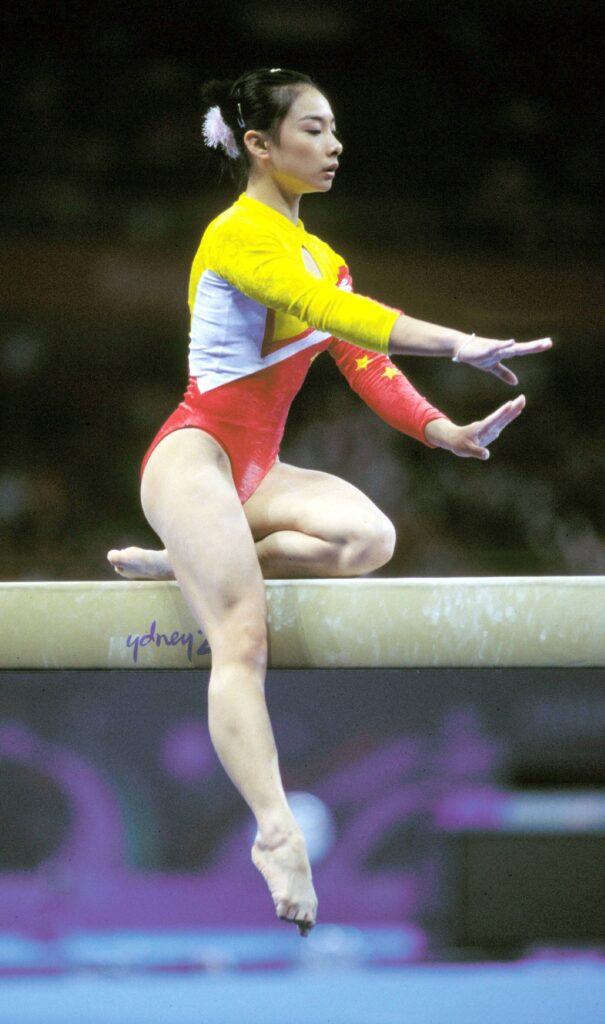
Published in 2012, Liu Xuan’s memoir Xuanmu offers a look back on the journey that shaped one of China’s most celebrated gymnasts. Written more than a decade after her retirement, it traces her path from a timid, sickly child in Changsha to Olympic champion, while also exploring the personal costs of that transformation.
The opening chapters focus on Liu’s childhood and introduction to gymnastics, providing a vivid portrait of the training culture that defined Chinese gymnastics in the 1980s and early 1990s. Alongside stories of relentless conditioning, competition, and athletic ambition, Liu recalls a childhood marked by contradictions. She disliked many aspects of training, envied classmates who spent their afternoons in school, celebrated bouts of illness because they offered a brief escape from the gym, and at times questioned whether gymnastics was worth the sacrifice at all. Yet she also remembers the coaches, teammates, and family members who sustained her along the way. The result is a rare first-person account of the grueling system that produced generations of elite Chinese gymnasts.
Enjoy!
Liu Xuan, 2000 Olympics, Copyright: imago/Schreyer
In 1978, the People’s Republic of China rejoined the FIG. A year later, at the World Championships in Fort Worth, Texas, Ma Yanhong tied East Germany’s Maxi Gnauck for the uneven bars title, becoming the first Chinese gymnast to reach the top of the world podium. Her success fueled hopes that China would make a strong showing at the 1980 Olympic Games, the country’s first Summer Olympics since its return to the Olympic movement. The optimism was evident in the pages of PLA Daily, the newspaper of the Chinese military:
During the competition, news arrived of China’s restoration of its seat at the Olympic Games, and Ma Yanhong was overjoyed beyond measure. She resolved to break through still more difficult movements and win even greater honor for her motherland. On the eve of her imminent participation in the Olympics, we wish to offer Ma Yanhong a line from Tagore: “Just keep walking forward — there is no need to pause and gather the flowers to preserve them, for along the way, the flowers will keep blooming.”
Tagore refers to Rabindranath Tagore (1861–1941), the Bengali poet, novelist, philosopher, and educator who became the first non-European to win the Nobel Prize in Literature in 1913.
Yet those expectations for Moscow would never be realized. Three months after the article’s publication, in April 1980, the Chinese Olympic Committee officially joined the boycott of the Moscow Games. For gymnasts such as Ma Yanhong, Cai Huanzong, and Li Yuejiu, the decision meant the loss of an opportunity that many had spent years awaiting. This article examines the political circumstances behind China’s boycott and how athletes, coaches, and the Chinese media responded to a moment that reshaped the careers of an entire generation.
In 2016, Chinese gymnasts once again faced questions about their ages. The domestic press responded swiftly, emphasizing that every member of the team met the eligibility requirements:
According to the FIG Council, female athletes must be at least 16 years old to compete in major international gymnastics competitions. Although this polished response successfully deflected what was framed as provocative questioning from foreign media, it also underscored a simple point: the five athletes who represented China in the women’s team final at the Rio Olympics were, on paper, all of age—Shang Chunsong, 20; Fan Yilin, 16; Tan Jiaxin, 19; Mao Yi, 16; and Wang Yan, 16. By this account, the doubts raised abroad appeared entirely unfounded, and China’s gymnasts had every reason to hold their heads high.
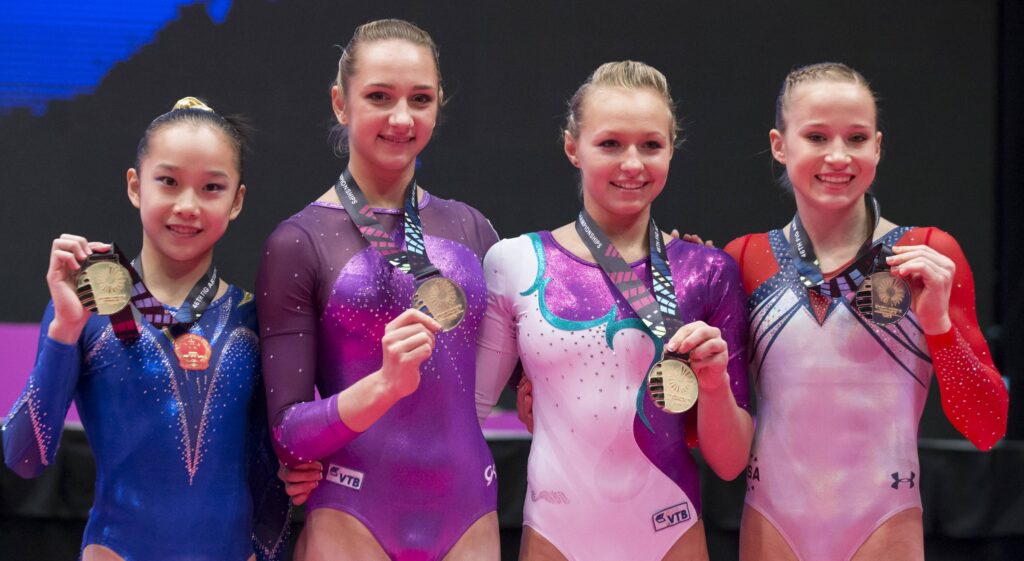
Yet the clarity of that official picture has become cloudy over time. With an official birthdate of November 11, 1999, Fan Yilin should have been 16 during the Rio Olympics, turning 17 afterwards. But in a recent social media video, she stated that she was 15 at the time. If taken at face value, that would place her birth year in either 2000 or 2001. (Chinese bloggers interpreted her remark to mean that she turned 15 in 2016, pointing to a 2001 birth year.) Under either scenario, being 15 in Rio would also imply that she was underage at the 2015 World Championships, where she shared the uneven bars gold with Madison Kocian, Viktoria Komova, and Daria Spiridonova.
The video was quickly deleted, and an apology was issued. A summary of the incident can be found below.
Fan Yilin, Viktoria Komova, Daria Spiridonova, and Madison Kocian — all scored 15.366 for a four-way tie for first place at the 2015 Glasgow World Championships.