Olympic all-around champion, world all-around champion, and one of China’s greatest athletes, Li Xiaoshuang was among the biggest stars in world gymnastics during the mid-1990s. Yet there is much about him that remains unfamiliar to English-language readers.
For starters, “Li Xiaoshuang” is not actually his given name. Born an identical twin, he was originally named Li Fenghua (李锋华). His older twin brother was Li Weihua (李卫华). Because almost no one could tell the boys apart, their first coach renamed them Dashuang (“Big Twin”) and Xiaoshuang (“Little Twin”), nicknames that eventually replaced their given names entirely. To Chinese readers, this is immediately apparent; to many English readers, it is not.
These two articles, published in Wenshi Chunqiu in 1998, tell the story behind that famous name. They begin not with Olympic medals but with Li’s childhood in rural Hubei, his remarkable relationship with his twin brother, and the coach who discovered the boys and devoted himself to their development. Along the way, they introduce a chatty, mischievous, and fiercely competitive young athlete whom the world came to know simply as “Little Twin.”
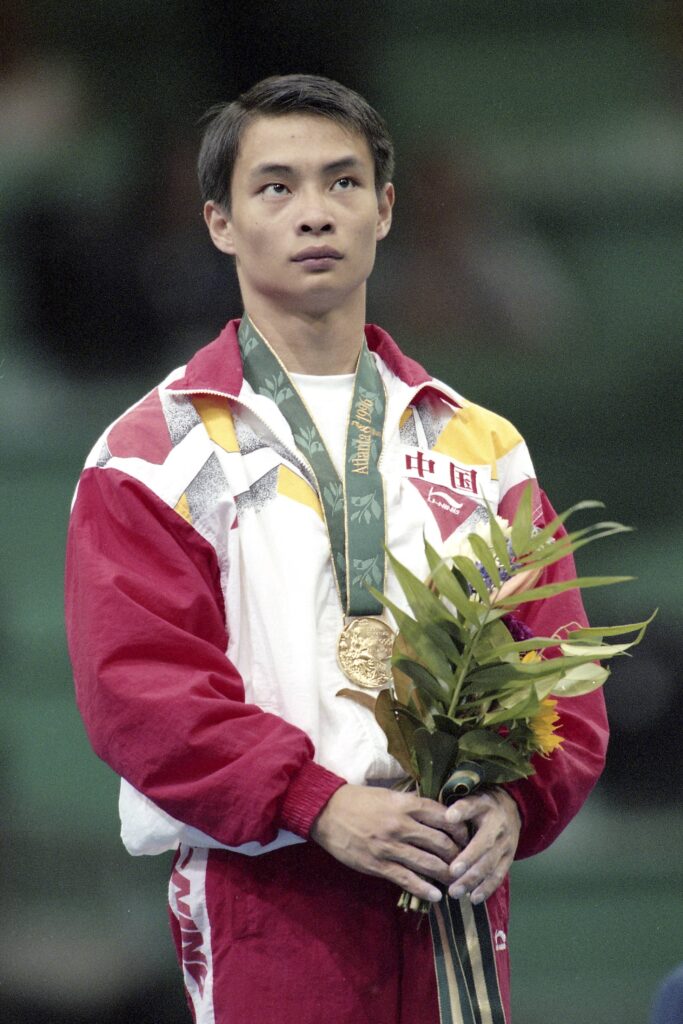
Part 1
The World’s Greatest “Flip”: A True Chronicle of Li Xiaoshuang’s Rise to the Pinnacle of World Gymnastics (Part I)
天下第一“翻”─世界体操王中王李小双成长纪实(上)
Chu Xianwen
Wenshi Chunqiu, October 15, 1998
Preface
At the Barcelona Olympics, Li Xiaoshuang launched himself into the air from the limited runway available on floor exercise, and in less than one second completed the extraordinarily difficult feat of a triple back, landing cleanly on the mat. Sports fans had jokingly called this move the “Goldbach Conjecture” of world gymnastics, and it was China’s Li Xiaoshuang who “solved” it. Li Xiaoshuang was the first to perform the tucked triple in Olympic competition. Then at the Atlanta Olympics, displaying iron will, with five of six events already completed and having fallen behind his rivals, he dared to stake everything on the final event — the high bar — and with one “flip” and one “release,” seized the champion’s crown. He wrote a glorious page in the history of world gymnastics, winning the unanimous cheers of people of every background in the Olympic arena, hailed as a wonder of the age, and moving U.S. President Clinton to offer admiring praise and bring his entire family to meet the hero.
Mother Deng Qunjiao cradled her twins with no small degree of worry. Yet she was, for the Republic, raising a world gymnastics champion with her own hands.
In the early winter of 1973, in the city district of Xiantao (formerly Mianyang County), Hubei Province, two factions were in the thick of “armed struggle” during the Cultural Revolution. The streets were desolate; the roads were cut off and people scarce. Only a fierce northwest wind howled and wailed through this impoverished county town. At around five in the afternoon of November 1st, twin boys were born to Li Jizhou, a dockworker, and his unemployed wife, Deng Qunjiao. The clear, high-pitched cries of the newborns drew neighbors from all around, who came in a steady stream to offer congratulations. The joy indoors formed the starkest possible contrast with the cold wave outside.
“Full month” is the festive occasion marking one month of a child’s life. In the custom of the Jianghan Plain, relatives and friends should gather for a proper feast. But alas, the state “plan” allowed each person only 12 kilograms of grain and two and a half liang of cooking oil per month; they simply could not “squander” such resources, and could only “economize for the revolution.”
Unable to afford any celebration in town, Li Jizhou hitched up his cart and hauled his wife and newborns forty li to Gongming Mountain, where Deng Qunjiao’s family lived; the twins’ maternal grandparents were there undergoing “re-education” from the poor and lower-middle peasants. In fact, grandfather Deng Boliang and his wife were themselves of poor peasant origin, but because he had participated in the revolution, he had been “streamlined” down to the township of Xiliuhe, and then, in response to the call not to “eat free meals in the towns,” had been sent down to farm at Gongming Mountain, over ten li from the township.
Daughter and son-in-law bringing the twin grandsons to the grandparents’ home for the first time — called “leaving the nest” — was a kind of ceremony. When the daughter lifted one bundle of a baby, wrapped like a little ball of fluff, and passed him to her mother, the grandmother was so delighted she bowed her head and couldn’t stop kissing her grandchild. Neighbors who had heard the news soon filled the thatched cottage of the “sent-down” farmers. Perhaps because Gongming Mountain was far from the factional strife of the towns, there was less of the smell of gunpowder here, and the songs and laughter felt richer in human warmth.
The twins were startled awake by the free and easy spirit of Gongming Mountain and at once began waving their fists and kicking their feet, crying at full volume. Mother Deng Qunjiao quickly took them back from the grandmother’s arms to soothe them. At that moment, who could have predicted: Qunjiao, the children you received into your hands were no ordinary souls; you had just cradled in your arms a future world gymnastics champion.
Grandfather Li Yinsheng was a cook at the government guesthouse, steaming mountains of white steamed buns every day. Yet here he was, leading a grandson not yet seven years old all around town, hoping to find two small rice bowls.
Li Yinsheng asked his son Li Jizhou: “What do you plan to name these two boys?”
Grandfather had already thought of names for the twin grandsons still in their swaddling clothes, but needed to consult his son and daughter-in-law.
Li Jizhou smiled: “Please, Father, choose the names for your grandsons.”
So, the grandfather named the boy born five minutes earlier Weihua; the younger brother was called Fenghua. Because the two brothers looked so alike, apart from their mother, Deng Qunjiao, it was hard for neighbors, the maternal grandparents, and even the paternal grandparents to tell at a glance which was Weihua and which was Fenghua. And so they came to be called by a single name: “The Twins!” — and both boys would answer at the same time.
There was another important reason the grandparents had trouble telling them apart: Dashuang had been raised by the maternal grandmother from an early age, while Xiaoshuang was shuttled back and forth between Xiantao and Gongming Mountain. Summer and winter passed, and by 1980 — at the nominal age of seven — it was time for the twins to start school.
Because the family was poor, and because the grandmother who had been helping support the household had passed away, there was one less income, and life became still more straitened.
As already noted, Deng Qunjiao’s household registration had originally been for commodity grain, but because her father, Deng Boliang, had taken the whole family to Gongming Mountain, they had been reclassified as rural grain registrations. When Deng Qunjiao married into the county town, she became what was called a “black person with a black household registration.” The twins followed their mother’s registration, becoming two small “Africans,” and with an older sister as well, the whole family had four “black people.” Now, with the grandmother gone, they had lost yet another commodity grain registration and wage income: how could two commodity grain registrations (Li Yinsheng and Li Jizhou) possibly support four “black people”? And “black people” not only received no grain and oil allocations; they couldn’t be assigned work either.
So grandfather walked the main street holding one grandson by each hand, head down, thinking about how to make ends meet: if only these two little fellows could “grab onto” two small rice bowls, wouldn’t that be wonderful! As he was mulling this over, a flatbed cart loaded with props from a Han opera troupe returning from a rural performance went by. Suddenly, a thought flashed through Li Yinsheng’s mind: hadn’t the Wuhan Han Opera Troupe produced child performers billed as the “Nine-Year-Old Prodigy” and “Six-Year-Old Prodigy”? If he could get his grandsons into the county Han opera troupe, wouldn’t those two rice bowls be within grasp?
Li Yinsheng worked at the government guesthouse and knew quite a few people. He took the boys to the Han opera troupe and poured out his heart to the person in charge. The response was candid: yes, the Han opera had produced popular child performers before, but that was because their parents were actors who had started teaching them from the cradle. If he were willing to entrust his two grandsons to them, they would be welcome but with two conditions: first, it was suggested the boys study academics alongside their martial arts training; second, when they reached a certain age, they would have to pass an audition before acceptance could be considered.
Li Yinsheng, though only a cook, had absorbed some familiarity with the “rules” and principles of officialdom and academia. He did not press the matter, but went about asking: was there somewhere his young grandsons could learn martial arts?
The head coach of the spare-time sports school, Ding Xiapeng, happened to notice a group of small boys pouring out of the lavatory — two of them identical in appearance, yet spreading their wings like great pengs and racing forward, beyond anyone’s ability to catch.
After twenty-one years of unjust treatment, the moment Ding Xiapeng had his reputation restored and his work reinstated, his energy erupted like a volcano. His workplace — the Mianyang County Youth Amateur Gymnastics School — had an impressive enough name, but only five staff members, occupying a small room in the county workers’ club with a few simple pieces of training equipment. After the “Ten Years of Turmoil,” everything lay in ruins; reviving sport was no easy matter. At the meeting to restore his reputation, Ding Xiapeng declared: he would not discuss conditions; he would devote himself to producing elite athletes for the nation. In his small corner of the world, he searched for promising young gymnastics talent.
The experimental primary school, the government auditorium, and the spare-time sports school formed a straight line in the southwestern corner of the county town. Ding Xiapeng kept close watch on every pupil at the school. One day, he suddenly caught sight of a pair of twins who came flying out of the lavatory. He was struck by their extraordinary legs. But the twins had already vanished into the crowd of students. Ding Xiapeng resolved to “lure” them out of hiding. That afternoon after school, he deliberately led more than thirty of his students to practice their moves in the corridor between the auditorium and the primary school, immediately attracting a crowd of young spectators.
His target duly appeared. Li Yinsheng — the pastry cook at the guesthouse whom Ding Xiapeng knew — came along, leading two small boys by the hand. Before Ding could say anything, Li Yinsheng spoke first: “Teacher Ding, I’d like to entrust these two grandsons of mine to you for martial arts training. When they’re a bit older, they can learn acrobatic opera roles. Would that be all right?”
Ding Xiapeng looked carefully. Yes, this was exactly the pair he had had his eye on. He issued an immediate command: “You two — show me some somersaults.”
The two little fellows showed not the slightest stage fright. They performed in front of everyone: the elder brother lay on his back, raised both legs, and clamped them around the younger brother’s head; the younger brother leaned back and clamped his legs around the elder brother’s head. The two brothers merged into a single unit and performed what could only be called a “two-person somersault” — to everyone’s delight. Teacher Ding was very pleased, murmuring: “Not bad, not bad at all…”
Hearing the applause, the twins grew more and more energetic — flipping, jumping, running, kicking — pulling out every trick they had. Ding Xiapeng said to himself: “Two fine pieces of raw jade, but they’ll need careful work.” He asked Grandfather Li: “What are the two boys’ names?”
Grandfather reported the boys’ formal names: Li Weihua and Li Fenghua.
Ding Xiapeng smiled warmly: “How do you tell apart brothers who look so alike?”
Li Yinsheng laughed: “To be honest with Teacher Ding, I hold their hands every day and still can’t tell which is Fenghua and which is Weihua. I always just call them ‘the boys’ and lead them along together.”
Ding Xiapeng found this amusing, but spoke with great seriousness: “I can accept your two grandsons, but on one condition: I must rename them. Gymnastics is a discipline that prizes efficiency; we cannot waste time on names.”
Li Yinsheng immediately agreed: “As long as Teacher Ding thinks they’re worth taking, the names are entirely up to Teacher Ding to change.”
Ding Xiapeng added two new names to the history of twentieth-century world gymnastics.
“They’re twins, so let’s name them with the character ‘shuang’ [double]. The one born first can be Dashuang [Big Twin]; the smaller one Xiaoshuang [Little Twin]. What do you think?” Teacher Ding asked.
Li Yinsheng beamed and praised at length: “Good, good — one word tells you which is which, clear as a bell — easy to remember, easy to remember.”
Ding Xiapeng had previously been labeled a “Rightist” for writing a big-character poster during the “Great Blooming and Contending” period, asking the school leadership to improve teaching equipment. He was not rehabilitated until 1979. In July 1980, the new names he gave his two pupils were “announced to the nation” nine years later, and sixteen years later, illuminated the world of gymnastics and were written into the history books. When Ding Xiapeng was reinstated, he had vowed to repay the nation by producing elite gymnasts, but he never could have imagined that the result would be this glorious.
Having renamed his pupils, Ding immediately dropped to the ground, performed a series of push-ups with extended arms, then stood and said: “This is called a ‘push-up.’ Can Dashuang and Xiaoshuang do what I just did?”
Without a moment’s hesitation, the twins followed their teacher’s lead and performed twenty-five push-ups in a row, to the thunderous applause and admiration of all watching.
Teacher Ding led all his students, including the twins, back to the sports school, where he demonstrated pull-ups on the apparatus. The twins pulled off six pull-ups in a row, drawing looks of astonishment from their older fellow students.
Ding Xiapeng then issued another command: “Dashuang, Xiaoshuang, run laps around the exercise ground. Run as long as you can!”
The two boys shot off like arrows from a bow — one lap, two laps, three laps — until Coach Ding called “Stop!”
The twins’ running speed was astonishing, their legs explosively powerful, their bodies seemingly inexhaustible. Ding Xiapeng was delighted: this kind of physical quality was exactly the basic prerequisite for a gymnast — a rare and precious gift. But when he appraised the two boys’ physiques with a trained eye, his brow furrowed slightly: their legs weren’t straight (they had bowlegs); their stomachs protruded; their shoulder flexibility was poor. These physical shortcomings violated the “beauty” component of the “difficulty, novelty, beauty, and stability” standards required by contemporary world gymnastics. But then he reflected: Is anything in the world one hundred percent perfect? If everything were perfect, what would coaches be for? He resolved: these were fine pieces of raw jade; they must be worked into beautiful gems. Their physiques were indeed lacking, but physical shortcomings could be corrected through targeted remedial training, and what mattered most was their will. Talent should never be buried because of imperfect physique. He thought of himself: three years of study at Jiangling Teachers’ School, recognized throughout the Jingzhou academies for his athletic gifts, on the verge of being recommended for advanced study at a physical education institute — only to be rejected from higher education because of his “bad background,” losing forever the chance to “succeed.” How could he bury talent because of physique when these two boys were in his hands?
Ding Xiapeng drew up a physical correction plan for the “Two Twins” — this was to beautify their exterior; he also had a plan to cultivate their will and endurance — this was to beautify their souls. Only with soul is there magnetism; only then can one surpass one’s opponents and surpass oneself.
In his teaching plan, Ding Xiapeng wrote: “The superior quality Dashuang and Xiaoshuang possess — their capacity for hard work and endurance — must be used to overcome their innate shortcomings. Poor shoulder flexibility: practice extended hanging, pressing, and shoulder rotations for thirty to forty minutes daily. Bowlegs: press by hand, and when that is insufficient, bind with rope to increase the corrective pressure.” Every day, the twins had these additional “specialist” training items beyond what the other students did.
Alongside the physical correction, Coach Ding posed a question to the twins: “What does food taste like?” Xiaoshuang answered: “Food tastes like food.” The coach let it pass and asked, “What does fish taste like?” “Like fish.” “And meat?” “Like meat.” Then Teacher Ding asked with great deliberateness: “And gymnastics?” Xiaoshuang answered without a moment’s hesitation: “Like gymnastics.” The coach smiled: “Not bad as a verbal answer. But in practice, every movement must have the flavor of gymnastics — a flvaor that nothing else can replace. In other words, gymnastics movements must be precisely executed. Do you understand?” Seven was rather young for such lessons, but Coach Ding could not relax his standards just because the children were small. On the contrary, he had to set the bar higher than for ordinary children. And so the “pommel horse circles,” “high bar back giant swings,” and other “routines” all came into play. After training, their somersaults cleared the ground by more than enough; their pommel horse circles reached forty-seven in a single sequence; their high bar back giant swings reached ten. Throughout this training, the two boys showed good temperament, sharp minds, boldness, strength, and tremendous vitality. Ding Xiapeng saw there was still untapped potential, increased their training load, and set new standards, guiding and restraining their behavior further. Then one day, astonishing news spread through the sports school:
Li Dashuang, unable to endure the hardship, had gone missing!
Teacher Ding and the others split into three search parties and scoured every place in the county town where Dashuang might have gone — to no avail. It was Xiaoshuang who had the flash of insight: “Could he have gone to Gongming Mountain?”
Teacher Ding chased after him by bicycle. In just two hours, Dashuang had already covered more than half the road to Gongming Mountain. This “escapade” was both an act of truancy and a display of leg power — those short little legs, those tiny steps, yet somehow keeping pace with a healthy adult’s long strides. It could only be called a miracle.
Dashuang’s truancy made Ding Xiapeng realize that physical gymnastics training alone was not enough; the boys’ souls needed to be cultivated as well. He produced yet another plan, this one for building their will and character.
Going to the experimental primary school for academic classes, coming home for meals, coming to the sports school for training — Teacher Ding managed the twins’ routine and kept close contact with the other two parties (family and school), so that all three were immediately informed of any developments. This was one aspect. Ding Xiapeng also felt his teaching methods were not varied enough, so he cut out pictures from magazines and displayed images of China’s women’s volleyball team fighting with all their might, explaining the brilliant achievements the team had won for the nation through immense hardship and toil. He asked Dashuang: “Do you want to be a gymnastics champion?” Dashuang nodded. He asked Xiaoshuang, who answered in a loud voice: “Yes, very much.” Then: “Can a champion be achieved through daydreaming?” Dashuang shook his head, and Xiaoshuang repeated what the teacher had said about the volleyball team: “It’s won through immense hardship and toil.” Ding Xiapeng told the twins: “There are local champions, national champions, Asian champions, world champions, and then you must compete to be the king of champions, the champion of champions! To become the king of champions, you need skill and ability, but you also need the resolve and determination to fear nothing under heaven. The only thing to fear is falling down and not being able to get back up!”
Dashuang nodded; Xiaoshuang echoed his agreement; then silence fell, each lost in his own thoughts. Ding Xiapeng resolved, step by step and footprint by footprint, to forge healthy souls in his young charges.
“The Twins” — Anecdotes
△ Magnesium Powder and Lime
At the start of training, the “Two Twins” were still wild as ever. After school, they were supposed to go straight through the auditorium to the sports school for gymnastics training. But Xiaoshuang’s eyes wandered: spotting plastic foam floating in the moat, he grabbed two bamboo poles and called on his brother to help fish it out.
“It’s almost time for training,” said Dashuang.
“Let’s fish it out first. It’ll be fun,” Xiaoshuang insisted.
Dashuang had no choice but to comply. When they faintly heard Teacher Ding counting out “One, two, three” on the training ground, they realized they were long overdue at the sports school. Dashuang dropped the bamboo pole first, but Xiaoshuang reassured his brother: “Don’t worry! I have a plan.”
Dashuang followed Xiaoshuang home by a roundabout route, passing a construction site. Xiaoshuang bent down, scooped up a handful of dry lime, and rubbed it on both palms, then held them out for his brother: “Does this look like magnesium powder?” And so Dashuang followed suit.
At dinner, grandfather asked the two boys: “You came home earlier than usual today. Did you go to training?”
Dashuang’s neck turned red, and he didn’t dare answer directly. But Xiaoshuang said brightly: “Of course we went to gymnastics training. Don’t believe me? Look —” He immediately put down his chopsticks and held out both palms, which were indeed coated with white powder. Grandfather took the hands to inspect: “Ah, so this is the magnesium powder, is it?” Xiaoshuang replied: “Yes, we rubbed on magnesium powder. You need it for the high bar and pommel horse so your hands don’t slip.”
In the middle of this grandfather-and-grandchildren mealtime chat, Coach Ding arrived without warning, demanding sternly: “Dashuang, Xiaoshuang, you went straight home after school? Why didn’t you practice?”
The twins bowed their heads. Xiaoshuang wished he could tuck his head between his knees. It was grandfather who stepped in: “Teacher Ding, they came from your place. Look, their hands are still covered in magnesium powder!”
Teacher Ding took the twins’ hands and looked and then immediately pronounced his verdict: “This isn’t magnesium powder. It’s lime!”
△ Dashuang Takes the Blame for His Brother
“Xiaoshuang was sharp-tongued and nimble-witted by day, but at night he had a habit of doing ‘confused’ things,” Deng Qunjiao would recall. The teachers at Xiantao Sports School said the same. After becoming famous, Xiaoshuang admitted with no self-consciousness whatsoever: “I’m embarrassed to say it, but I wet the bed as a child…”
Bed-wetting is bed-wetting; many children have this habit. But the story is not so simple. In 1982, the provincial sports committee organized a gymnastics competition, and the Xiantao team sent both twins. Staying at the guesthouse, the brothers shared a bed, and in the night one of them — it was unclear which — “drew a map” on the sheets. The dormitory erupted in laughter. Xiaoshuang grew so flustered and hot all over that he scrambled on top of his brother and pointed at Dashuang: “He wet himself — not me!”
At that moment, the elder brother Dashuang voluntarily took the blame: “I wet the bed.” Nine-year-old Dashuang was a true elder brother — worthy of the name. He wouldn’t let his younger twin suffer too much embarrassment or be laughed at; he shared his brother’s “burden.”
But the truth came out soon enough. When they slept in separate beds, it was not Dashuang who wet the bed; it was Xiaoshuang, who had shifted the blame.
△ Xiaoshuang Talks, Dashuang Acts
The money was managed by Dashuang, but all expenditures and budgets were decided by Xiaoshuang: what kind of socks, toothpaste, toothbrush, towel, soap, or ice cream to buy, and how much — Xiaoshuang called it, Dashuang ran the errands. Letters home were sent by Dashuang. Dirty or sweat-soaked clothes and socks — Xiaoshuang would fling them off and leave them; his elder brother would pick them up, wash and dry them one by one, fold them, and hand them back to his younger brother.
At competitions where only Xiaoshuang participated without Dashuang, Dashuang would still take care of everything for his brother — buying necessities, packing his travel gear, and offering repeated reminders: “Without me there, you need to watch out for the cold, adapt to the environment, be careful not to get sick…”
Dashuang — the brother born just five minutes earlier — and those instructions he gave his younger brother: the people nearby who heard them were deeply moved, quietly thinking how fortunate Xiaoshuang was.
△ What If You Get Expelled?
Xiaoshuang was exceptionally wild by nature — addicted to play. At one point, his academic work at the experimental primary school fell so far behind that the class teacher issued yellow cards to his family and the sports school. Teacher Ding asked Xiaoshuang: “If your schoolwork is suffering and you also want to keep up with gymnastics training, what should be done?” Xiaoshuang’s answer astonished Coach Ding:
“I’d rather be expelled from school than stop practicing gymnastics!”
Teacher Ding laughed inwardly — laughing at his student’s stubborn dedication and genuine passion. But he could not give in, could not let the boy go astray. He said firmly, “If your schoolwork falls so far behind that the school expels you, the gymnastics team won’t keep you either. Gymnastics requires people of quality — not illiterates.”
Young as he was, Xiaoshuang understood Teacher Ding’s lesson. From then on, his schoolwork gradually improved, and both the primary school and the sports school were satisfied.
In the spring of 1984, grandfather Li Yinsheng went to the Xinhua Sports Ground in Hankou to visit the grandsons who had been at the provincial sports school for nearly half a year. He immediately spotted Dashuang training with the group, but there was no sign of Xiaoshuang anywhere.
Li Yinsheng found Xiaoshuang in the dormitory. Grandfather lost his temper: “Xiaoshuang! Everyone else is out there training. How can you just laze around?”
Xiaoshuang wore a look of deep contemplation: “I need some quiet time alone — to think through how to compete, how to get ahead of the others, how to create new moves!”
Grandfather naturally didn’t understand any of this. With mingled worry and concern, he said, “Whatever the reason, when it’s training time, everyone has to get out there. You’re just sitting here doing nothing. If this keeps up, be careful the provincial sports school doesn’t expel you!”
Xiaoshuang sniffed: “I’m not afraid of being expelled. I promise I won’t go back to Xiantao and make you lose face.”
Grandfather was alarmed: “If you won’t go back to Xiantao and won’t embarrass the family, just what is your brilliant plan?”
Xiaoshuang answered with complete confidence: “I’ll do street performances in Hankou and earn money that way. What’s there to be afraid of?”
△ Singing Puppet Opera, Playing Puppet Characters
It was around the depths of winter 1982, with days of heavy snowfall having cut Xiantao off from river and road transport. The Xiantao spare-time sports school had still arranged holiday “lessons” for the young athletes. That day, at the crack of dawn, Teacher Ding had already gotten up and was jumping around in his room when suddenly someone knocked at the door, followed by a cautious little voice: “Teacher Ding, open up!” It was the nine-year-old twins.
Teacher Ding opened the door immediately. A fierce northwest wind blasted in, and snowflakes knocked him back several steps. He looked closely at the disciples who had just entered. They were veritable snowmen. In the street outside, only two sets of small footprints could be seen leading to his door. Teacher Ding noticed the two children were wearing adult shoes riddled with patches upon patches. He quickly pulled out two pairs of old cloth shoes from under the bed to give the boys a change, but when they took off the rubber shoes, all four little feet were red with cold: no socks, leaking shoes, soaked through with pooled water. Their hands were ice cold to the touch. The twins wore quilted jackets with no lining and couldn’t stop shivering. Teacher Ding’s wife, Zhou Lijun, had also gotten up by now and took in the whole scene. The couple opened an old trunk and produced long underwear and long underpants, which they put on the twins. The two small fellows warmed up and immediately started bouncing around. Xiaoshuang led off singing opera tunes, warbling away without stopping. Teacher’s wife Zhou Lijun was delighted too, and asked them what they were singing and what roles they were playing. The answer: singing puppet opera and playing puppet characters.
△ “I Simply Won’t Show You My Palm”
Doing high bar work is extremely damaging to the skin of the palms, and so “grip guards” exist as a product. But in the 1980s, only adult-sized grip guards were made.
The twins were obsessed with the high bar. The moment they could “get onto” the bar, they were like birds in flight — joyful as could be.
Teacher Ding scheduled their bar sessions interspersed with other events. The intensely focused Xiaoshuang added extra bar practice on his own.
One day Xiaoshuang picked up his chopsticks but wouldn’t hold his rice bowl, head bowed and shoulders tilted over the table, shoveling his food in silence.
“Why are you like a one-armed man?” Grandfather noticed something was off about his grandson. He asked again and again.
Xiaoshuang’s head dropped lower, his body more tilted.
Grandfather was determined to see for himself. What secret was hidden in the hand that wouldn’t hold the rice bowl? He ordered: “Hold out that left hand of yours and let grandfather have a look!”
With no other option, Xiaoshuang brought out his left hand but clenched it into a tight fist, squeezed so hard.
Grandfather ordered again: “Open your palm and show me!”
A second command to open the hand, and instead Xiaoshuang hid the fist under the table.
Grandfather demanded loudly: “Why won’t you dare let me see?”
Xiaoshuang answered defiantly: “I simply will not show you my palm!”
Grandfather forced the fist open and was moved to tears. He now discovered that his little grandson’s palm had been “flayed” by the high bar, with raw flesh exposed where a whole layer of skin had been stripped away.
A grown adult body, fifty or sixty kilograms, pressing down on a child’s tiny frame! Deng Qunjiao was not merely shocked; she went nearly wild with rage, refusing to hear any explanation, crying and screaming and dragging the twins away toward home at a run.
Of the children being trained at the sports school, about forty came and went, and about thirty or more were regular. As the training load increased, children who had initially thought gymnastics would be fun found it too much to bear; parents watching on began to feel their hearts wrench. How could anyone endure such torment? Many parents began withdrawing their children from the sports school one after another.
Deng Qunjiao also consulted the family: perhaps Dashuang and Xiaoshuang should stop doing gymnastics? Grandfather Li Yinsheng shook his head: “Without enduring the bitterest hardship, how can one rise above others? One cannot quit gymnastics halfway.”
Deng Qunjiao could not refute her father-in-law’s argument. But many parents continued to pull their children from the school. When Deng Qunjiao asked them, “What’s really going on at the sports school?” the things they told her were more alarming still.
Hearing is uncertain; seeing is believing. Using the pretext of bringing the boys some clothes, she went to the sports school to conduct “reconnaissance.”
It was exactly the moment when more than thirty students were undergoing “leg press” — i.e., “physical correction” — training. The moment Deng Qunjiao saw the scene, her heart leaped to her throat, and tears fell: Coach Ding was using his entire body weight to press down on her son’s tiny frame; her son’s forehead was streaming with sweat, and his face drained of color.
Deng Qunjiao saw this and lunged forward, grabbing a son to pull him away…
Coach Ding was shocked by this sudden “disruption,” but once he understood the reason, he too held the twins back and told Deng Qunjiao: “This is training. How can anyone become talented without suffering hardship? If you can’t bear to watch, you’re welcome to leave, but the sports school guarantees it will not damage your children’s bodies…”
The two brothers went on strike: “If mom won’t let us go to the sports school, we won’t go to regular school either!”
Deng Qunjiao tried every means — threats and inducements — promising the boys they could go to their grandmother’s new home on the Xiliuhe River during the holidays to play. She told them there were water chestnuts to gather without end and lotus pods beyond counting. Nothing worked. Deng Qunjiao was at her wit’s end.
Coach Ding comes to make amends; Li Yinsheng stands firm and speaks with conviction. Deng Qunjiao retreats step by step; the twins return to the sports school. Fellow students continue to leave; Deng Qunjiao comes to take the boys again; Coach Ding is willing to fight with everything he has.
For the sake of Chinese gymnastics, and to fulfill the ambitions of his younger years, Ding Xiapeng went to the Li household to offer his self-criticism before the twins’ mother: “I only thought about teaching and never communicated with the parents. That was dereliction of duty. Your criticism of me arose from my failure to fulfill my responsibilities. The fault is mine…”
The twins did not side with their mother; instead, they nestled affectionately against Teacher Ding’s legs, staring up at the coach as though they hadn’t seen him in ages.
Grandfather Li Yinsheng said plainly, “Teacher Ding, coming to our door makes you our guest. The boys learning gymnastics — first, Teacher Ding saw something in our grandchildren; second, I myself willingly sent them to the sports school. Training is hard. Without bitterness, how would there be sweetness? My daughter-in-law took the boys home; that is my responsibility. I failed to persuade her, and Teacher Ding has been wronged. Our grandsons are entrusted to Teacher Ding, to the sports school, to the nation. We can only hope that as they grow, they will be of use and hold onto their ‘rice bowls’ — that would be the greatest blessing our Li family could ask for.”
The grandfather’s straightforward words were, to his daughter-in-law, both gentle persuasion and a clear demonstration of reality; to Coach Ding, understanding, communication, and support.
Ding Xiapeng left with his star pupils, his heart full of gratitude.
Deng Qunjiao felt a vague sense of loss, caught between accepting the logic and feeling heartsick for her sons. She watched the two boys happily follow their teacher out the door without looking back. She seemed to reach a kind of understanding: could it be they were all right, and she was wrong? But then the image of a grown adult body pressing down entirely on her son returned before her eyes. How could she be at ease? From then on, she dared not inquire about what went on at the sports school, and whenever something needed checking, she sent Li Hongxia — the daughter only three years older than the twins — to “handle it on her behalf.”
The daughter’s reports to her mother were good news: the two brothers were training happily at the sports school, full of life and vitality. This made the mother laugh and smile. Then the daughter suddenly announced: “I want to join the sports school too!” Deng Qunjiao tried to discourage her: “That’s probably for boys, isn’t it?” The daughter held up her fingers and counted off the names of female students at the sports school. With Grandfather’s support, Li Hongxia got her wish and enrolled in the spare-time sports school. Teacher Ding quickly told Li Yinsheng: “Your granddaughter has good qualities. She’s progressing very quickly.”
Unfortunately, it was not to last: an eye condition sent Li Hongxia home. After that, the daughter never again raised the subject of going to the sports school with her mother.
Reports from the spare-time sports school kept circulating through the community and reaching Deng Qunjiao’s ears. One day, the daughter returned from delivering clothes to her brothers and reported: “Mom, the sports school is failing. It looks like it’s falling apart. On that whole great big practice ground, counting our two brothers, there are only four people left training.”
This news sent Deng Qunjiao into motion: she rushed to the sports school, walking and running alternately, and told Teacher Ding, who was in the middle of training his students: “All the others have left; only four remain. I’m here to take my Dashuang and Xiaoshuang home!”
The warm and kind Coach Ding of just days ago, the contrite Coach Ding who had come to make amends, the Coach Ding who had pleaded so earnestly — this same man, seeing Deng Qunjiao come to claim the boys again, immediately twisted his face in fury, eyes blazing. He made a fist with one hand and pressed the other to his chest and roared: “You want people? What people? Are Li Dashuang and Li Xiaoshuang your private property, Deng Qunjiao? To be taken in or let go as you please, toyed with however you like? Li Dashuang and Li Xiaoshuang are registered gymnasts with the authorities. It’s on record, anyone can check! I have the duty to teach them, and the children have the right to pursue their training! On what grounds do you come here demanding them back?!”
Deng Qunjiao was at first stunned by Teacher Ding’s outburst, but after a moment she refused to be “cowed”: “What do you mean — can’t a mother manage her own sons? That’s absurd! Who are you trying to frighten? Do you think I’m afraid of you?”
Coach Ding turned away from Deng Qunjiao entirely, commanded the students back to the gymnastics room, and stood with hands on hips and feet planted wide, inviolable: “I, Ding Xiapeng, would certainly like to see who dares invade my school!”
The children — only four of them now — were in the gymnastics room practicing by themselves with no teacher supervising them, like fish in water, like birds in the air. The twins had absolutely no intention of getting involved in the argument between their teacher and their mother.
Deng Qunjiao finally retreated, the boys unwilling to leave. She reflected: Was Teacher Ding truly right, and she herself wrong? She withdrew one step at a time, then paused and looked back again and again, her two sons were absorbed in their practice, as if their mother weren’t there at all.
“Ah, it must be what the heavens have arranged.” With a long sigh, Deng Qunjiao walked away helplessly. After that, she never again interfered in the sports school’s affairs, and instead became a wholehearted supporter of her sons’ gymnastics. Exceptional children must have exceptional mothers; otherwise, had she kept holding her sons back, how would the “Two Twins” ever have made their mark on the world of gymnastics?
(To be continued)
Notes
1. Wenshi Chunqiu (文史春秋, literally “Literary and Historical Spring and Autumn”) is a Chinese popular history magazine. It was founded in 1993 and is published under the auspices of the Guangxi regional committee of the Chinese People’s Political Consultative Conference (CPPCC).
2. Li Xiaoshuang was not the first gymnast to compete a triple back at the Olympics. Vladimir Gogoladze performed the element at the 1988 Olympics. Valeri Liukin had competed the skill at the 1987 Moscow News invitational and the 1987 European Championships.
3. The Goldbach Conjecture is one of the oldest and most famous unsolved problems in number theory and mathematics. Proposed by mathematician Christian Goldbach in 1742, it states that every even whole number greater than 2 can be expressed as the sum of two prime numbers (for example, $4 = 2 + 2$, $6 = 3 + 3$, and $8 = 5 + 3$). While it has been verified computationally for numbers up to astronomical sizes, a definitive mathematical proof remains unfound. In Chinese popular culture and media during the late 20th century, the term became a widespread metaphor for an insurmountable intellectual peak or an ultimate, seemingly impossible challenge, popularized in large part by Xu Chi’s famous 1978 reportage on the mathematician Chen Jingrun.
4. The Peng (大鹏) is a gigantic mythical bird described in the Daoist classic Zhuangzi. In the opening chapter, the Peng transforms from the giant fish Kun (鲲) and soars ninety thousand li on its migration to the Southern Ocean, symbolizing extraordinary potential, boundless ambition, and the ability to transcend ordinary limitations. Comparing the twins to the Peng emphasizes their remarkable athletic gifts and hints at their future greatness.
5. During the planned-economy era, people without entitlement to state grain rations were colloquially called “black people” (heiren), in contrast to ration recipients. The author extends this bureaucratic slang by referring to the family as “Africans,” playing on the literal meaning of heiren (“Black people”). The passage reflects period colloquialisms and stereotypes rather than the family’s ethnicity.
前面已经介绍,邓群姣在娘家本属商品粮户口,只因父亲邓伯良携全家下放公明山,随之成了农村粮户口。邓群姣嫁到县城,便成了黑人黑户口。双胞仔随娘,因而就成了两个小“非洲”人,再加上一个小姐姐,全家便有了4口“黑人”!如今祖母去世,又少了一个商品户口和工资收入,两个商品粮户口(李银生、李继州)怎能承载得住4个“黑人”!“黑人”岂止不供给有限的粮油,也不安排工作呢。
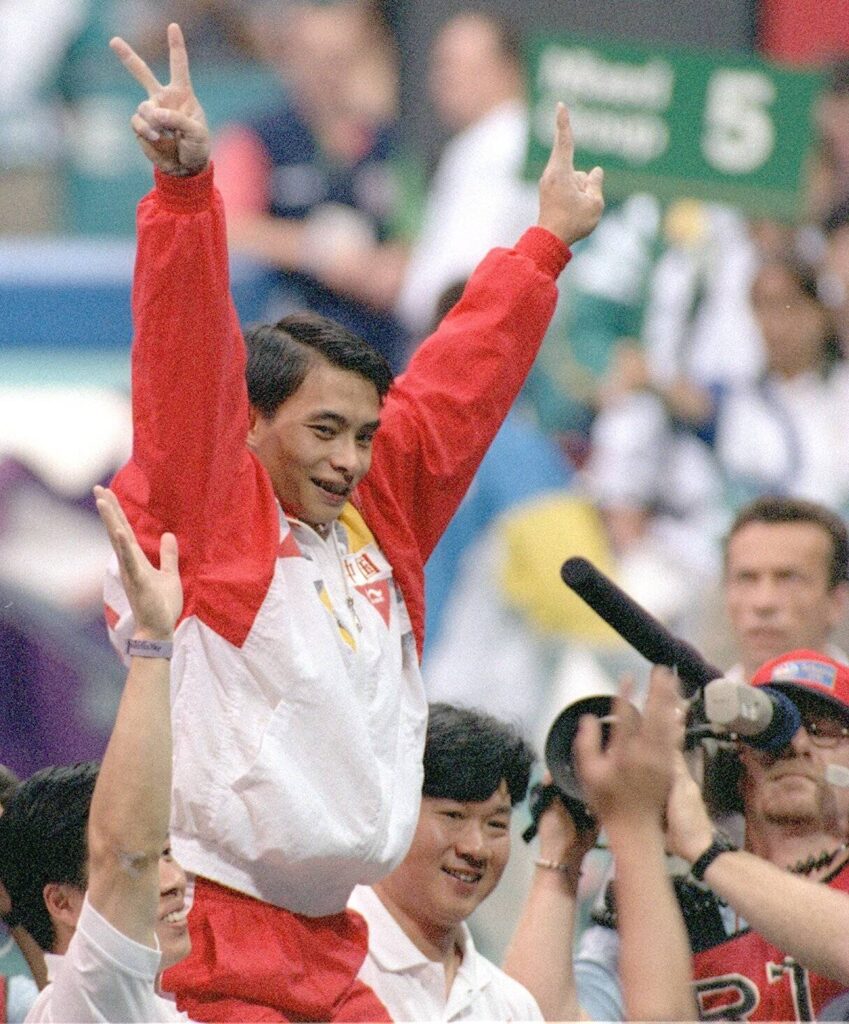
Part 2
The World’s Greatest “Flip”: A True Chronicle of Li Xiaoshuang’s Rise to the Pinnacle of World Gymnastics (Part II)
天下第一“翻”─世界体操王中王李小双成长纪实(下)By Chu Xianwen
Wenshi Chunqiu, December 15, 1998
One part effort, ten parts harvest — Coach Ding’s painstaking dedication and selfless work finally earned their reward. The “Two Shuangs” emerged in the sports world and were immediately spotted by the provincial team. The brothers made their way from a county town to the provincial capital, and the striking resemblance of the twin brothers drew attention wherever they went…
From July 1981 to September 1983 — over two years — Ding Xiapeng poured nearly all of his energy into the “Two Shuangs.” He devoted himself, heart and soul, to their training and moral education, and was attentive to their every need in daily life. Ding Xiapeng’s room was 18 square meters, with a kitchen at the front and living quarters at the back; in addition to the Ding couple’s own bed, it also held sleeping berths for the “Two Shuangs.” During concentrated training periods, the “Two Shuangs” would “move in” to Ding’s room, and over three years, their total time in residence was not less than half a year. Coach Ding’s own children had grown up, his family burdens were light, and his household’s food was clearly better than the Li family’s. The “Two Shuangs” often became honored guests at the Ding household. The Li family felt they were imposing and went to Coach Ding’s home to express their gratitude and apologies. Coach Ding said, “The ‘Two Shuangs’ are my students, and also my little grandsons. Of course, they should eat well and build up their nutrition…” Coach Ding’s wife, Zhou Lijun, loved the “Two Shuangs” like grandchildren. First she altered old adult clothes into small garments for them, so the “Two Shuangs” no longer had to look like puppets; later she simply had proper fitted new clothes made for them. Coach Ding even put his own beloved, latest-fashion sportswear on the brothers.
Three years of deep teacher-student friendship, a thousand days of grandfather-grandson affection — sunlight and rain nurtured the “Two Shuangs'” growth while time turned old Ding’s hair gray. The “Two Shuangs” competed in provincial and national children’s competitions, winning sixth place in floor exercise and fourth place in the team event. The news was sent back to Xiantao, and many people congratulated Coach Ding’s wife, Zhou Lijun, celebrating that their students had brought glory to Xiantao and honor to their teacher.
Teacher Ding had just set down his luggage from the competition trip and was sharing the results with his wife, letting her share in the joy of the “Two Shuangs'” success, when education officials arrived carrying an official letter from the provincial sports commission — the sports committee was still under the education bureau at the time — to negotiate the transfer of the “Two Shuangs” to the provincial gymnastics team. Ding Xiapeng was overjoyed and said, “My whole aim was to deliver top talent to the provincial team, and now it has finally come true. We will continue to send talent to the provincial team and the national team. That is what proves our work is effective.”
Teacher Ding’s selfless dedication moved the officials deeply.
On the public bus from Xiantao to Hankou, a pair of identical-looking children talked and laughed the whole way, their childish banter drawing waves of laughter from fellow passengers. The two of them, oblivious to those around them, chatted freely about their own feelings. Grandfather Li Yinsheng knew his grandsons well and let them range freely in conversation.
They arrived at Hankou’s Xinhua Sports Ground, where the provincial sports school was located. Professor Liu Changsheng of the provincial gymnastics team, who had spotted the pair at a competition, worked here.
Hankou was nothing like Xiantao. Here the roads were wide, the buildings tall, there were many pedestrians, and many vehicles — an endless stream going back and forth. What truly impressed the “Two Shuangs” was the main gate of Xinhua Sports Ground, incomparably larger than the gate of the county sports school. While the “Two Shuangs” and their grandfather — who was carrying the luggage on a shoulder pole — were walking and admiring their surroundings, an old man’s head poked out from a window beside the gate and asked pleasantly: “Who are you looking for? This is Xinhua Sports Ground. Make sure you’ve got the right place…”
Li Yinsheng hastily produced the letter of introduction.
The old gatekeeper had no interest in the letter; his eyes were fixed on the “Two Shuangs,” and he muttered to himself: Oh my, how can twins be this identical! Both are joining the gymnastics team? How extraordinary, how extraordinary!
He waved his arm: “Come in!”
The “Two Shuangs” followed their grandfather inside with proud, swaggering steps.
Whether walking down the street or entering the gymnastics hall, the “Two Shuangs” attracted an enormous amount of attention with their identical height (1.2 meters at the time), large eyes and thick brows, refined noses, and small mouths with full lips — some admiring their remarkable resemblance, others evaluating their skill level in the gym.
To all this, Dashuang (the elder) responded with quiet indifference; Xiao Shuang (the younger) was exuberant and very pleased with himself.
The “Two Shuangs” grew rapidly under the new tutelage in their new environment.
A horse without a bridle, a cow without a pen, will go astray. Li Xiaoshuang’s nickname: “Big Mouth” — his mouth never closed, free to boast; his mouth puffing smoke, clouds of fog. When faced with the coach’s stern criticism, what did Xiaoshuang do?
For those who love to talk, there are many labels: in the north, they are called “kantors,” in Hubei “ribai,” and in general they are called “chatters.” Li Xiaoshuang loved to chat — from every corner of the world, from the beginning of time, all subjects were fair game. From his time in Xiantao, he already had a faithful following of young listeners, and having an audience proved Xiaoshuang had a market. So the wider his topics grew, the more “brilliant” his chat became, and the more addicted he became to chatting.
When he wasn’t in academic classes, he was chatting; when he wasn’t training, he was chatting. But it went far beyond that. The provincial sports school was a boarding school, and once Li Xiaoshuang’s chatting habit took hold, he would talk until midnight, with no sign of stopping, sometimes talking until the eastern sky grew light.
Coach Liu Changsheng found out and told Li Xiaoshuang that endless chatter was a “bad habit.” It disturbed everyone, it disturbed himself, and if you didn’t rest well at night, how could you have the energy to train and study during the day? But criticism remained criticism, and behavior remained behavior. Li Xiaoshuang’s chatting continued unabated, and his faithful audience was never in short supply. Liu Changsheng knew that direct criticism had little effect, so he tried to draw out Xiaoshuang’s strengths instead, approaching through encouragement.
Coach Liu told Li Xiaoshuang, “Loving to chat isn’t a flaw, but there must be limits. A good chat can expand your knowledge and deepen friendships, but too much leads to mental and physical exhaustion, affects training, and harms your body — that’s entirely wrong.”
Xiaoshuang heard Coach Liu’s “praise” and thought he was basically fine, that it was just a matter of going too far — a small thing.
To channel his strength, Liu Changsheng took Xiaoshuang to the movies and guided him to read newspapers and journals, filling Xiaoshuang’s mind with news from the world of sports — using the flow of the current to guide his direction, letting him chat usefully, interestingly, and entertainingly, hoping his chatting would get on track, while requiring restraint in timing and no excess.
But an old bad habit is hard to break, and once Li Xiaoshuang started talking, he had no restraint. All the knowledge Coach Liu had given him he poured straight into his midnight chat sessions.
What to do? Liu Changsheng simply packed his bags and took up long-term residence in the children’s dormitory. During evening rest hours, anyone who dared make a sound would face punishment.
Within a few days of Liu Changsheng’s arrival, results appeared: Xiaoshuang didn’t dare chat, his former audience didn’t want to chat either, and everyone went peacefully to sleep.
Controlling someone for a moment is hard enough for a lifetime. Liu Changsheng’s fear was that Li Xiaoshuang’s chatting habit would relapse, so he needed to go further to consolidate the change. Liu Changsheng slept and rose alongside the children, and this went on for a full year, until he had finally washed away Xiaoshuang’s bad habit of chatting.
When Coach Liu saw Xiaoshuang’s progress, he finally said: “A horse without a bridle, a cow without a pen. What happens? When you have good habits, you’ll rest well, you’ll have full energy, you’ll pour yourself into competition and achieve good results. Isn’t that right?”
Through Coach Liu’s patient guidance, and after a period of enduring hardship and perseverance, Li Xiaoshuang finally overcame his old bad habit. However, another vice then attracted Li Xiaoshuang’s interest — keenly.
“A cigarette after a meal beats a life divine.” “Without tobacco and drink, where’s the manly spirit?” These popular sayings were absorbed by Xiaoshuang. The school banned smoking, but the teenage Xiaoshuang, who couldn’t yet tell right from wrong, truly took up post-meal cigarettes. He couldn’t smoke openly while strolling down the street, so he hid in the toilet; he didn’t dare live that smoky life in the gymnastics hall, so he would wait until his roommates fell asleep, then imitate Zhuge Liang summoning the east wind — blowing clouds and mist beneath his mosquito net.
Coach Liu took his position in the office and summoned Li Xiaoshuang.
The Coach Liu that Li Xiaoshuang encountered was no longer amiable and pleasant but iron-faced, brows tightly knit, lower lip clenched between his teeth, nothing but cold severity — like a judge interrogating a criminal: “Tell me, what mistake have you made? Only the truth! No passing the blame onto outside circumstances!”
Xiaoshuang knew perfectly well that his smoke-blowing under the covers had been exposed, but he insisted on being a “stubborn duck beak.” Not only did he not tell the truth, he truly didn’t pass the blame elsewhere. Instead, he turned the question back: “You tell me, what mistake have I made?”
Liu Changsheng had come prepared and had no intention of arguing with his own student; instead, he flung two cartons of cigarettes in front of Xiaoshuang: “Since you’re so keen on smoking, today I’ll let you smoke to your heart’s content. Two cartons — 400 cigarettes — chain-smoke them; you can’t leave until they’re all smoked.”
Li Xiaoshuang’s duck beak pushed back again: “If you’re going to criticize someone, reason with them. Where did you see me smoking? And if you didn’t see me, who did?”
Defiance, denial, stubbornness.
Coach Liu was so furious that he shot to his feet, raising his right hand — his broad palm poised to come crashing down — but seeing Xiaoshuang remain utterly unmoved, the Coach instead let out a long, deep sigh, slumped back into his seat, buried his head in his arms on the desk, and waved his hand to dismiss the student who refused to admit his smoking.
Li Xiaoshuang lay awake all night, reflecting. What was Coach Liu doing this for? The teacher had no selfish motive whatsoever — it was entirely for his student’s sake, so he could walk the right path and hold his head high before others…
In one night, 15-year-old Li Xiaoshuang grew up. He would absolutely never smoke again. What Liu Changsheng cared about was results. His student refused to admit fault to his face, but actually corrected his bad habit. That too is an excellent quality.
The national gymnastics team — a sacred hall yearned for and revered by countless young athletes. Li Xiaoshuang did not merely dream of it or brush past it in passing, but entered its doors again and again — only to be turned back each time for some reason. What did Li Xiaoshuang do after being sent back?
On the day straddling 1983 and 1984, Huang Liping of the Hubei gymnastics team was noticed by the national team and transferred to Beijing! This news shook the entire sports school. Who did not look up to the national team? To enter the national team was to be, seemingly, only steps away from a world-level medal. As for Li Xiaoshuang — riding high on a string of good competition results, basking in happiness and joy — when Huang Liping stepped onto the northbound train with that one raised eyebrow and one casual wave of his hand, Li Xiaoshuang felt it deeply. That was what it meant to be in full flower! As the train pulled away, Li Xiaoshuang’s thoughts followed it to that capital city blazing with brilliance: if you haven’t made the national team, what kind of hero are you? Those results he’d achieved — as the saying goes, a bamboo strip through tofu — were not worth mentioning!
Determined to catch up to Huang Liping, the fiercely competitive Li Xiaoshuang made up his mind. But the national team was like the apex of a pagoda — the provincial team its body, the county team its base; climbing from base to body, and from body to the very top — easier said than done. Li Xiaoshuang leapt out of bed thinking it was daylight, wanting to train — but the room was still as water; he looked up, and the sky was pitch black. He simply couldn’t sleep. Huang Liping’s advancement had shaken him to the core.
From that point on, Li Xiaoshuang buried himself in hard work, focused on nothing but training. Liu Changsheng watched Xiaoshuang overcome his flaws and pursue excellence with wholehearted determination — wasn’t this exactly the success condition every outstanding athlete must possess? So Coach Liu gradually increased the training load for the “Two Shuangs,” and their results improved day by day.
The “Two Shuangs'” results attracted the national team’s attention, and only eight months after Huang Liping, they too were called north to Beijing — to the capital and the national team they had so long dreamed of.
The brothers were 12 years old and barely 1.2 meters tall. Dashuang’s expression was always calm and steady, while Xiaoshuang was hot-blooded and enthusiastic. He bounced along as he walked, singing his beloved Genuine Hero at the top of his lungs.
Trial training began. The “Two Shuangs'” strength tests — handstand push-ups, horizontal support holds, pull-ups — not only passed smoothly, but placed them near the top among more than 40 outstanding young athletes from around the country.
Having achieved such strong trial results, Xiaoshuang figured that since they had passed the trials with top rankings, there was obviously no reason not to be kept on by the national team. So he dragged his older brother sightseeing around the capital, eating their fill of authentic Beijing snacks.
Then, a week later, the triumphant brothers who had performed so well in the trials received their “return notice” and instantly became a pair of sorry brothers.
Genuine Hero became “Suffering Heroes.” The notice Xiaoshuang received was not “unqualified, not accepted,” but two return train tickets. The person handing over the tickets consoled them: “Go home. There will be opportunities in the future.”
Li Xiaoshuang was absolutely not one to bow his head, let alone surrender to fate. When he received the true “rejection” through roundabout channels, he gave a defiant smile: “I simply refuse to believe this!”
The national team’s assessment of the “Two Shuangs” was almost a life sentence:
“Poor physique.” “Basic technique and form are not attractive.”
Xiaoshuang, upon learning of this assessment, gazed southward, as if seeing Coach Ding’s slightly worried expression. During “form correction” training for the brothers, he had repeatedly urged: “If form correction fails, everything will be wasted. Do you understand, children?” It was precisely because their young hearts had understood the importance of “form correction” that they had argued with their mother and stood by their teacher, continuing to train at the sports school. Today, the national team’s assessment had its logic, but it was dead logic. He raised a question to the heavens: “My physique isn’t good; I was born this way. But surely my exceptional ability can compensate for this flaw?”
Xiaoshuang said to Dashuang, “Let’s fight against ourselves!”
This admirable quality — this unbreakable stubbornness that refused to admit defeat — was Xiaoshuang’s true nature.
Coach Liu Changsheng, far from accepting the national team’s “poor physique” assessment of the rejected “Two Shuangs,” offered encouragement: “Sun Wukong could cross the Flaming Mountain; you should cross your ‘Flaming Mountain’ too. Meet adversity with strength! Whoever has perseverance will succeed!”
Years later, Li Xiaoshuang spoke with great feeling: “I am fortunate. Coach Ding didn’t reject me for my ‘poor physique.’ He led me to set my ambitions and enter the door. When I was frustrated, Coach Liu didn’t blame me but lifted me back into the saddle. We two brothers stood on our coaches’ shoulders to reach for the gold!”
Three years later, in 1988, Li Xiaoshuang had a fine harvest:
Both the National City Games and the National Youth Games were held that year. Xiaoshuang participated in both and won “all-around fourth place” in each!
Two fourth-place all-around finishes rekindled the national team’s interest. Li Xiaoshuang received a notification to attend national team training. Facing this hard-won second “opportunity,” Li Xiaoshuang had shed the blind optimism of the first time, but was also free of doubt and worry. He stepped onto the northbound train — calm and cool, but full of confidence.
However, the situation was no better than the first time. Confidence is not reality. The Xiaoshuang who arrived in Beijing had no one to speak with him and was given no training materials. Everything told him plainly: making the national team was hopeless again. Even more stunning was when a teammate who had come to Beijing to try out whispered: “The coaches are saying privately… your gymnastics results have peaked. There’s probably no hope for further development.”
If anyone else had heard this, they might have fainted, or at least raged at the world. But the strong-willed Li Xiaoshuang simply snorted, looked at everything with contempt, and said: “I simply refuse to believe this!”
Li Xiaoshuang bought an entire box of popsicles, eating them in great bites, mouthful after mouthful, using that icy cold to extinguish the fire in his heart, trying to turn those “assessments” into a puddle of water, utterly useless.
Li Xiaoshuang was “returned intact” by the national team a second time.
The “assessments” collapsed on their own. Li Xiaoshuang’s third entry into the national team — where he finally established his footing — was due to his exceptional ability. He personally “marched to Seoul and opened with victory.” At these Olympic Games, while the team collectively fell short, he won outstanding results. Yet entering the national team is not the same as winning a championship — old problems resolved, new ones arose.
At the 1988 Seoul Olympics, for China’s athletes, it seemed to unfold in the cold of winter — fewer good results compared to the previous Games. Yet Li Xiaoshuang, relying on his sharp mind, steely will, and rock-solid fundamentals, managed in this clash of world powers to pull off the “Thomas flare to handstand, connected with another Thomas flare to handstand” in the Olympic floor exercise and won outstanding results. He then went on to claim the floor exercise gold at the national City Games and finish fourth in the all-around.
Finally, Li Xiaoshuang had entered the national team on the strength of his outstanding results and established himself — no more being sent back to Hubei. Before that, the “Two Shuangs” had already performed well at the Second National Youth Games: Li Xiaoshuang won 3 gold medals and 2 silver medals; Li Dashuang won 2 medals. Li Dashuang also entered the national team.
By rights, Li Xiaoshuang should have been overjoyed to have his wish fulfilled, but he was not. He thought: others enter the national team once; I went up and back three times. What heartbreak! The two setbacks had fired up Li Xiaoshuang’s stubborn streak. He refused to accept the “verdict,” refused to admit defeat. He trained with furious intensity, trying to release his defiant spirit through practice. Li Xiaoshuang’s unusual attitude and behavior bewildered his new coach, Su Yue. The following exchange took place:
Coach Su: “You have no energy during formal training. Why do you come alive outside formal training hours?”
Li Xiaoshuang: “The training environment is too restrictive. I just don’t like training together with everyone else.”
Coach Su: “What do you suggest as a solution?”
Li Xiaoshuang: “I’d like to shift my training time to noon, so it doesn’t overlap with everyone else’s.”
Coach Su nodded: “Agreed.”
Every noon, while others finished training and rested, Li Xiaoshuang “fought alone.” With others around, he found the floor cramped; now alone, he felt the space boundless. Gymnastics training always carried the risk of accidents, so athletes training should always have a coach present — mainly for guidance, but also as a spotter and protector. Coach Su had agreed to Xiaoshuang’s request, but was often absent, leaving Xiaoshuang to train in solitude.
One day, the national team held a test. Of Coach Su’s group, only Li Xiaoshuang participated, and the entire test concluded without Coach Su appearing. Li Xiaoshuang was furious. The moment he saw Coach Su, he bellowed at him, oblivious to those around him. Coach Su, seeing his athlete so unreasonable, angrily grabbed a barbell plate as a threatening gesture; Xiaoshuang, unintimidated, picked up a chair… Fortunately, Coach Su kept his composure; the barbell plate slid slowly from his hand, and a physical confrontation between teacher and student was ultimately averted.
At the Second National Youth Games in 1989, the “Two Shuangs” had submitted excellent results as an answer to the nation, the people, and the family members who cared about their growth. Yet before the meet, many coaches unhesitatingly declared about the “Two Shuangs”: “Given your physical limitations, you won’t make it!”
Such pronouncements would crush any child. Yet the “Two Shuangs” — and especially Xiaoshuang — simply set their jaws, narrowed their eyes, and replied defiantly: “I will answer your ‘verdict’ with my results.”
Li Xiaoshuang’s answer naturally delighted the nation, the people, the family, and even the coaches. So why had some coaches been so blunt before the competition, speaking their minds so frankly? Perhaps it was the use of one tactic from Chinese military strategy:
The stratagem of provocation?
Joining the national team to train under a world champion, enduring great hardship and injury to fight at the Asian Games. Standing atop a high mountain, watching the clouds roll over the peaks, gazing at the world’s summits — how magnificently glorious it all was.
The first Chinese man to win a world gymnastics championship, Huang Yubin, was a renowned national team coach whom insiders called the “champion coach.” This was first because he himself had been a world champion, and second because from his hands came three champions — Fan Di, Li Jing, and Li Chunyang — who had all won world championships. Li Xiaoshuang was fortunate to become his student — how could he not be overjoyed? Yet behind every achievement lie many tears of bitterness! The great Coach Huang Yubin was different from other coaches. His word was law, training volume was high, duration was long, demands were strict, and he absolutely refused to hear words like “so tired,” “unfair,” or “unbearable.”
Xiaoshuang’s personality being what it was, he offhandedly said during training: “Ouch, my hands and feet are really aching and swollen!” Huang Yubin’s face darkened, and without a shred of sympathy, he said: “What are you complaining about? Everyone comes through the same way! I don’t believe there’s a person born who achieves success without pain.”
Coach Huang was so iron-faced and selfless that some people called him “the devil” behind his back. Li Xiaoshuang privately pondered this; he really was a bit devil-like. Knowing that complaining wouldn’t get Coach Huang’s sympathy, what was the point? So Li Xiaoshuang accepted it. When Coach Huang pointed out: “Li Xiaoshuang, your leg strength is weak!” — just that one sentence, and Li Xiaoshuang would go do frog jumps around the enormous gymnastics hall. Coach Huang said: “Jump — at least 3 laps!” But Li Xiaoshuang jumped 5 or 6 laps — doubling and tripling the task. To build his leg strength, in addition to completing the coach’s assignments at double pace, he also trained with barbells — squatting 80 kilograms at a time.
The national team was in intensive “pre-competition training” for the Asian Games. “The chance to compete comes once in a lifetime!” But at this critical moment, during an adaptation training session, while performing a flight move, Li Xiaoshuang fell hard from the horizontal bar to the floor! The crash landing shook Coach Huang, everyone present, and Xiaoshuang himself. Coach Huang gently asked: “Xiaoshuang, how are you? Does it hurt?”
Far beyond hurt. His neck, his shoulder blades felt as if they were being torn apart. Yet Xiaoshuang’s answer was: “It’s fine — as if nothing happened!” At this point, the Asian Games roster hadn’t even been finalized. In circumstances this severe, could anyone dare admit pain? Dare admit injury?
One stumble can cause eternal regret, and one hard fall the same. The only option was to refuse to acknowledge the injury, clench his teeth, endure the pain, swallow the waves of agony rising from his chest, remind himself not to show it, and complete the full training session as though nothing had happened.
The next day, Li Xiaoshuang’s entire back and torso were red and swollen. He had suffered a serious injury. But he could only quietly seek medical attention, not breathe a word of it.
A few days later, the Asian Games roster was announced, and Li Xiaoshuang’s name was on it.
That year, Li Xiaoshuang won the gold medal for the Asian Games team championship and the gold medal in floor exercise; Li Dashuang won the team gold. Li Xiaoshuang also competed at the Moscow News Gymnastics competition, going head-to-head with the renowned Soviet athlete Liukin, winning fourth in the all-around and third in floor exercise and pommel horse; he also traveled to the United States with Lin Yue, Huang Huadong, and other Chinese athletes for the “Goodwill Games,” where they competed against Scherbo and won team bronze and the floor exercise silver medal.
The world of gymnastics advances daily, constantly pushing toward greater difficulty, novelty, beauty, and stability. There is no room for even a moment’s pause or rest. Li Xiaoshuang had been tempered by hardship and broadened his horizons; his ambitions soared. Why should his gaze be fixed only on the national or Asian level? He looked at the world, wanting to scale the peak of the gymnastics world and claim that dazzling crown of champions. Yet this step seemed so distant, and yet so close — impossibly far, and yet just within arm’s reach. Xiaoshuang asked himself: Is it enough to just look and think? No, act, train, fight, and believe. With these, he could reach straight for the champion’s crown at the very summit.
“Say it — do it”: on paper, only a dash separates these two words. But from one end to the other, the price paid is enormous. The “triple tuck” was like death stalking Li Xiaoshuang! His mother, Deng Qunjiao, seeking to protect a son who was flesh and blood, not iron and copper, traveled a thousand li to burn incense and kneel before the Buddha.
The “triple tuck” — tuanshen qiankongtian sanzhoushou — is a tucked salto with three rotations. Using the force of a running start and the explosive force of the takeoff, all movements are completed in under a second; the impact force — exceeding the human body’s capacity by more than tenfold — makes it extremely easy for things to go “wrong” and endanger life.
At the Beijing Asian Games press conference, a sports journalist found Li Xiaoshuang, who had just achieved outstanding results, and asked sincerely: “The whole nation is watching you. What is your next goal?”
Li Xiaoshuang’s thoughts at that moment were running free, soaring through the sky of gymnastics. He was thinking that to this day, no one in world gymnastics competition had ever completed this terrifyingly difficult move. Tumbling was a Chinese tradition; Chinese people had a natural gift for it. Hadn’t he and his brother grown up flipping on Gongming Mountain? So for this “triple tuck,” who else but him? His “flipping” spirit was blazing at its peak, perfectly matching what the journalist had asked, and without any deliberation, without even softening his words, he said plainly: “Next year, I’m going to do the triple tuck!”
In the winter of 1990, Li Xiaoshuang set out to conquer the triple tuck. To build his leg strength and work on every component required for the triple tuck, Li Xiaoshuang trained at high intensity and high density. Living in a constant state of mental pressure, he dragged himself through each practice session, utterly exhausted, not even wanting to speak. Winter turned to spring; he had been training hard for five months. Then in April, disaster struck; an over-rotated move sent Li Xiaoshuang crashing to the ground, and he lost consciousness instantly.
The doctor at Tiantan Hospital said: “You are fortunate; it is only a concussion. If you had fallen harder, the consequences would have been unthinkable.”
The moment Li Xiaoshuang regained consciousness after his blackout. The violent retching that followed was enough to chill his heart and soul. Yet he ignored the medical advice to “rest in bed for a month” and returned to the training floor a few days later, while still seriously injured, sustained by painkillers. This, precisely, was what set Li Xiaoshuang apart from ordinary people.
Li Xiaoshuang admitted: “The triple tuck is indeed monstrous; ‘untameable’ is not too strong a word for it.” At the 1992 World Championships, Li Chunyang failed to master the triple tuck, and Li Xiaoshuang failed to subdue it either. Coach Huang comforted his two prized students: “Never forget: failure is the mother of success!” This saying rolls off the tongue easily, but its full depth is hard to grasp. Li Xiaoshuang felt its truth deeply. In competition, it had been only a matter of releasing power slightly too early, not quite finding the right moment, and success had slipped through his fingers.
After Li Dashuang won the Asian Games team gold, he was hospitalized in 1990 after both his knee menisci ruptured; at the 1991 Japan Cup invitational, he fought his way to gold medals in floor exercise and pommel horse and third place in the all-around, earning a spot in the Olympic training squad.
The two brothers made a pact: they would go to the Olympics together.
Their mother, Deng Qunjiao — mother of the twin champions — had never bowed to fate, even when all four members of the family were “off the books.” She often said: fortune smiles on the virtuous; good things come with perseverance; as long as your heart is true, help will come when you face difficulty. From this, Deng Qunjiao became a devout Buddhist: the Buddha’s light shines everywhere, saving all beings. Morning and evening, she burned incense and kowtowed, praying for those who help others in society, and praying for the fate of her twin sons.
When news came that both sons had suffered serious injuries, how could she not be anxious? She felt that the brothers — about to travel to Barcelona carrying their injuries — were in grave danger, and so she too would make the long journey to a holy mountain to offer incense. She knew that Wutai Mountain was also called Clear-and-Cool Mountain, a place of great temples: Nanshan Temple, Foguang Temple, Xiantong Temple, Tayuan Temple, Bodhisattva Summit, Shuxiang Temple… every temple was said to be efficacious. So she climbed the mountain to worship at the Buddha’s feet, burning incense at each temple, prostrating in reverence, praying for her twin sons to set out safely and achieve good results.
Their mother also traveled to Beijing. Knowing her sons’ eating preferences, she set up a private stove for them, so they could eat comfortably, train with strength, and she accompanied them until the day they flew to Barcelona.
Zhuge Liang played the zither at leisure during the Empty Fort Stratagem to unsettle his opponent Sima Yi. The “Two Shuangs” played cards in apparent absorption on the eve of the final to ease their coach Huang’s tension. He had given so much in the 700 days and nights of training his students… Li Xiaoshuang’s two raised fists announced to the world the success of the “triple tuck.”
The room was brightly lit. Dashuang and Xiaoshuang lay on their beds playing cards, entirely at ease. Coach Huang paced back and forth, stopping now and then to cast a glance at the “Two Shuangs” and think to himself: you — Xiaoshuang — do you really feel a million soldiers at your command? Tomorrow is the final — the moment to unleash the triple tuck. So many journalists are waiting for your moment of flight. Are you truly not worried?
In fact, the “Two Shuangs” had noticed that Coach Huang was unable to sit still over the triple tuck, so they had deliberately set up the game of cards to redirect the teacher’s attention and ease his anxiety. What devoted students.
In the middle of the night, team captain Li Chunyang went to Li Xiaoshuang’s room and told him his final decision: “I won’t attempt the triple tuck; it’s up to you now…” His words were heartfelt and laden with earnest hope.
The next day, the “Two Shuangs” strolled leisurely along the Mediterranean shore — so exotic and picturesque — gazing up at the blue sky and white clouds, looking down at white seagulls on the water. Where was the slightest trace of gunpowder before a decisive battle?
It was approaching five o’clock in the afternoon — that sacred five o’clock! The “Two Shuangs” had claimed victory many times, and almost always at five o’clock. Today, in Barcelona, it was five o’clock again. Xiaoshuang thought privately: perhaps victory will be mine today. Why does this “5” keep following me?
In the final moments before the competition, Dashuang was saying something to the tense Coach Huang. After a brief silence, Coach Huang signaled to Xiaoshuang that the triple tuck must not waver. He walked to Xiaoshuang’s side, gave both shoulders a pat, whispered something, then departed solemnly.
Li Xiaoshuang stepped calmly, with full confidence, onto the carpeted competition floor.
At the moment Xiaoshuang steadied himself, focused his mind, and gathered his energy, Li Dashuang provided a quiet, firm cheer from beside him: “Jump — fling!” The voice was absolutely clear and full of force. Li Xiaoshuang felt light as drifting clouds, free and fluid, entering a marvelous state with no time, no others, no self. When he landed after the aerial — dropping like iron onto the competition mat — tens of thousands of white, black, and yellow palms erupted together in applause that filled every Chinese heart with joy.
So much of Coach Huang’s heart and blood had gone into this; the coach’s hair had turned white, yet he was only 35. So much sweat and bloodshed; so many serious injuries endured; Li Xiaoshuang, who had come as close to death as a hair’s breadth — now finally breathed out, raised both hands, and reported to the entire world: China’s athlete Li Xiaoshuang had successfully completed the unprecedented “triple tuck”!
Gymnastics is beautiful — so beautiful it dazzles the eyes. Gymnastics is also cruel — so cruel it wrings the heart. There is more than one peak in world gymnastics! Li Xiaoshuang was already charging toward another summit — the charge of the king’s battle, the charge to claim the crown.
The Xiantao City Sports School recorded the following about its outstanding student, the “Two Shuangs”:
In 1992, Li Xiaoshuang was awarded the title of “National Model Worker,” and, in the same year, was appointed to the National People’s Political Consultative Conference — at only 19 years old. From 1993 to 1995, he was consecutively named to the Top Ten Athletes in China for three years. At the 1994 World Gymnastics Team Championships, Li Dashuang, Li Xiaoshuang, and their teammates united to win the men’s team title — China’s gymnastics team reclaiming the top position for the first time since 1983. In 1995, Li Xiaoshuang participated in the World Gymnastics Championships held in Japan and won the all-around title; the same year, he was named to the World Top Ten Athletes and the Asian Top Ten Athletes, and joined the Chinese Communist Party. In April 1996, Li Xiaoshuang won the American “HealthMarket Sports Star” Award…
Yet this record concealed weakness and highlighted strength, glossing over much. Take only the year 1994, when both brothers claimed championships: at the Brisbane World Championships individual events, Li Xiaoshuang’s body had broken down from the accumulated stress of preparing for the Barcelona Games. His shoulders ached so severely he couldn’t sleep, couldn’t extend his arms to put on his shirt, couldn’t lift a bowl to eat. The pain left Li Xiaoshuang unable to eat or sleep. Soft-tissue adhesions in his shoulder were causing pain that radiated through the surrounding nerves — an agony that felt like his body was being torn apart. Yet he still carried his injured body to Brisbane and lost 5 of the 6 events he entered. Li Xiaoshuang had hit rock bottom.
Modern medical treatment and pharmaceuticals have made great advances, but against the severity of such an injury and the suffering it brings, they can only do so much. The condition can only slowly improve. He relied on medicine and willpower to fight back against his physical ailments. His psychological treatment came from Coach Huang’s patient, persistent encouragement, as well as his own self-discipline. How could someone like him be laid low by injury?
Gradually, Li Xiaoshuang built a tolerance for pain, testing himself adaptively against it; gradually, he mastered himself, regulated his own emotions, and emotional stability became his guarantee of success. At the World Championships in Dortmund, Germany, Li Xiaoshuang went out as the top first-line performer, and indeed achieved starting scores of 10.0 in 5 of the 6 individual events!
Coach Huang, filled with confidence in his student, gave the solemn command:
Face the summit of world gymnastics — the all-around world championship. The moment to charge has arrived!
Li Xiaoshuang responded with a smile — a smile that held within it the conviction of inevitable victory. But reaching this summit — how easily said! Since China’s men’s gymnastics team first entered world-level competition in 1979, while they had claimed gold in six individual events, the World Championships all-around gold — what the gymnastics world called the “king of kings” — had always eluded China. Could Li Xiaoshuang triumph against all odds and bring glory to his nation?
This was indeed the king’s battle. Li Xiaoshuang believed this was his duty. If not him, then who? He was competitive; he was a champion — don’t look at declarations, look at actions and results. The results would tell the world: in the king’s battle of gymnastics, a king does not accept the old saying “no man is perfect, no gold is pure.” A king’s victory must be flawless, must be solid gold — not a speck of impurity allowed. Now, Li Xiaoshuang was pursuing perfection and charging toward the decisive battle.
Li Xiaoshuang rose from countless injuries and defeats and finally climbed to the peak of “perfection” — becoming the victor of the king’s battle. Americans worship successful athletes no less than the old Chinese revered the emperor — so naturally:
American President Clinton received the “king” with open arms…
Barcelona — Atlanta. Two Olympics. Two very different experiences — no need for deep analysis. One point only: Atlanta was too commercial, reeking of money, leaving the sacred flame tainted, everything chaotic — in order, in character…
What troubled Li Xiaoshuang most deeply was this: at Barcelona, China’s team had opened victoriously, winning the team silver medal; but at Atlanta, because Li Xiaoshuang’s hands slipped on the rings, China lost its chance to win team gold.
Li Xiaoshuang wept bitterly, his face washed with tears, consumed by remorse. That night, Li Xiaoshuang didn’t know how to get through it — whether in a dream or in a half-waking state — constantly murmuring:
Believe in yourself; believe in yourself!
Only success; never retreat!The merciless, unsparing competition at the world’s highest level began. Nemov — Xiaoshuang’s fiercest rival, and a true champion — was showing his full power. After the first five events, he led by 0.035 points. The sixth and deciding event was, as it happened, Nemov’s strongest. Those in the know, who understood the situation well, were quietly preparing to cheer Nemov’s victory and shout his triumph.
Who would claim the prize in this clash of titans?
With the goddess of victory already tilting toward Nemov’s side, Li Xiaoshuang also faltered with fear. This was reality! This was fact!
Huang Yubin — who had converted from world champion to coach — was seasoned, clear-sighted, and wise. He believed this was not the final moment: as long as there was one chance in a hundred, you had to give everything, use every second, fight for yourself.
Coach Huang walked to Xiaoshuang’s side. He said, “I am speaking to you on behalf of the motherland and its people: at this moment, what lies before you is only forward; you have absolutely no right to retreat. This is what the motherland requires! At this moment, the mother who raised you is watching, eyes wide, from in front of the television screen. She too wants to see how her son will show his spirit — jump, with courage!”
This was the greatest possible encouragement. Mother — mother who has suffered so much for her children — watch: your son has no right to let you down!
All stray thoughts vanished. Everything was still. His state of mind was right, and rising from the pain, he climbed to “perfection,” scaled the summit, and completed every movement to utter and dazzling beauty.
The crowd that had prepared to cheer for Nemov turned to applaud Li Xiaoshuang. The goddess of victory met her match in the heavens above. From sky to earth, a great chorus of victory rang out for the Chinese athlete who had claimed the king of kings.
After Li Xiaoshuang won the gymnastics all-around gold medal, journalist Zhang Maoyi encountered the “Prince of Gymnastics,” Li Ning, by chance.
Zhang: “How do you feel about this?”
Li: “In 1984, at the Los Angeles Olympics, I didn’t win the all-around gold; I always felt regret about that. Xiaoshuang has finally fulfilled the ‘all-around’ dream for our Li family. I am truly happy.” I am truly happy.”
Zhang: “Your humorous reply makes me feel this is a kind of wisdom belonging to the whole nation. But I’d still like to hear your assessment.”
Li: “Li Xiaoshuang is an extraordinarily outstanding athlete — with deep reserves of strength, the fierce, life-risking grit of a true daredevil [Pinming Sanlang], and excellent psychological quality. Watching him compete made me feel years younger — as if I were back on the competition floor of my own day.”
Zhang: “Before the horizontal bar event, Xiaoshuang was behind Nemov. Didn’t you feel nervous?”
Li: “It would be false to say I wasn’t nervous. But I was convinced he would win, because he is unlike ordinary athletes; his character is one that never admits defeat.”
Zhang: “Any other impressions?”
Li: “This gold medal is especially meaningful. It proves he is the best athlete in the world.”
The journalist then interviewed the head coach of China’s gymnastics team, Gao Jian. Gao Jian’s view: “Li Xiaoshuang is truly outstanding. He didn’t just win this precious gold medal. More importantly, he demonstrated, in adversity, the superhuman strength of will that an excellent athlete must possess.”
At the Georgia Tech aquatic center, U.S. President Clinton.. received the Chinese champion Li Xiaoshuang, who had just been crowned the men’s gymnastics all-around king at these Olympics. Clinton said with a smile:
“Congratulations on your success. Although you experienced failure in competition, what is admirable is that you were able to stand up again.”
These were the words of a politician.
Li Xiaoshuang replied: “I have no reason not to rise from failure, because behind me is my motherland, and I fight for her.”
Coach Huang had said exactly the same thing to Xiaoshuang in his most difficult moments.
(End)
1. The Chinese text describes the skill as 团身前空翻三周半 (“tuck position triple-and-a-half front somersault”). Because the surrounding passage clearly refers to Li Xiaoshuang’s famous triple back somersault on floor exercise, this appears to be a technical error in the original text. The translation has been emended accordingly.
2. The Chinese expression zhúmiè chuān dòufu (竹篾穿豆腐, “a bamboo strip passing through tofu”) is a colloquial xiehouyu (two-part allegorical saying). The omitted second half—bù zhí yì tí (不值一提, “not worth mentioning”)—is understood by Chinese readers. Li Xiaoshuang uses the idiom to dismiss his earlier accomplishments as insignificant compared with the challenge of earning a place on the national team.
3. Sun Wukong, the Monkey King of the Ming-dynasty novel Journey to the West, crosses the Flaming Mountain (火焰山) only with the aid of Princess Iron Fan’s magical fan after overcoming a series of trials. In modern Chinese, “crossing the Flaming Mountain” has become a metaphor for overcoming seemingly insurmountable obstacles. Coach Liu invokes the allusion to encourage Li Xiaoshuang to overcome the physical limitations that national-team coaches believed would prevent his success.
4. Zhuge Liang: An allusion to the “Empty Fort Stratagem” (空城计), one of the best-known episodes in the fourteenth-century historical novel Romance of the Three Kingdoms. Faced with an overwhelming enemy force, the strategist Zhuge Liang calmly played the qin (zither) atop the city walls, convincing the opposing general Sima Yi that an ambush awaited and causing him to retreat. The episode has become a Chinese byword for projecting calm confidence to disarm an opponent.
5. Pinming Sanlang (拼命三郎), literally translated as “Life-Risking Third Brother,” is a Chinese cultural archetype originating from the classic 14th-century epic novel Water Margin (水浒传). It was the nickname given to the warrior Shi Xiu, who was famous for his absolute fearlessness, fierce loyalty, and willingness to recklessly put his own life on the line in battle. In modern usage—and specifically within elite athletics—the term has evolved into a high compliment to describe a fierce, unrelenting competitor who exhibits an uncompromising “die-hard” spirit, completely disregarding personal injury or exhaustion to achieve victory.
More on Chinese gymnastics