Few gymnasts of the 1990s combined technical precision with artistic elegance as successfully as Huang Liping. A world champion on parallel bars in 1994 and a member of China’s gold medal-winning team at the 1994 World Championships, he also helped the Chinese men win the silver medal at the 1996 Olympic Games. Renowned for the beauty of his gymnastics, one Russian expert reportedly described him as the gymnast who most perfectly combined gymnastics and ballet.
The translations collected here follow Huang through the years after his competitive career. They show him reinventing himself as a coach, international judge, and FIG official while remaining deeply committed to Chinese gymnastics. Along the way, they also reveal a quieter, more personal side of Huang: his fascination with computers and golf, his friendship with a devoted Japanese fan, his marriage to former South Korean national team gymnast Heo So-young (허소영), and his reflections on developing the next generation of champions.
Note: Heo’s Chinese name is Xu Xiaoying (许小英). In English, her Korean name is often transliterated as Hu So-young.
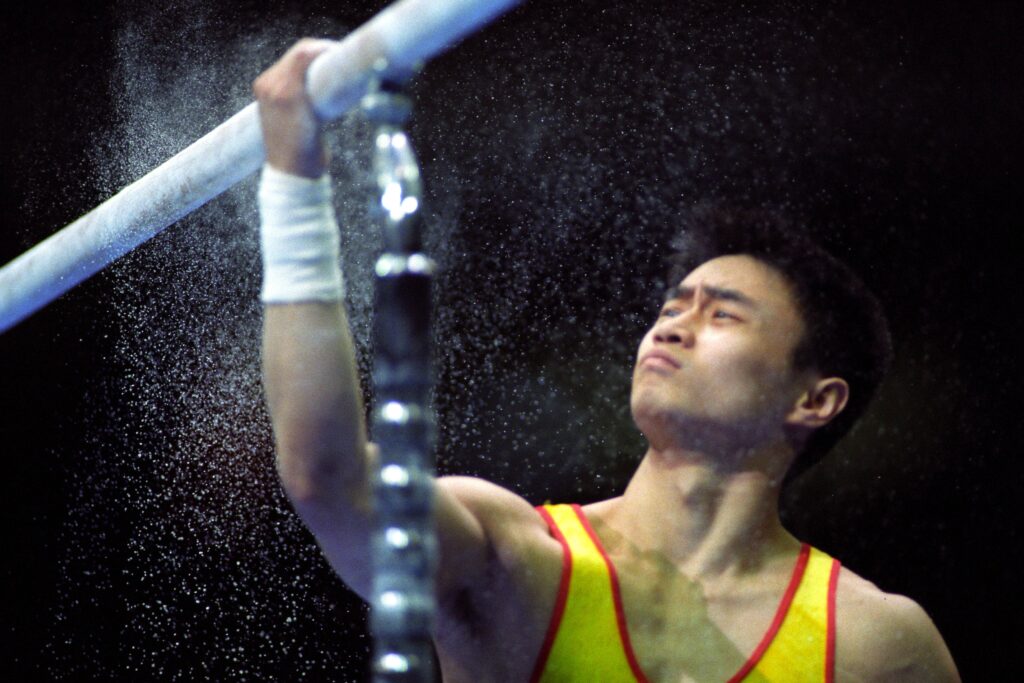
2008
From World Champion to “King of the Kids” in Foshan
By Zhou Jieying
Guangzhou Daily, June 6, 2008For the Olympics, he overcame a devastating injury and fought his way back to his feet. After missing out on gold, he wept on the Olympic competition floor. Years later, he returned to the Olympic Games—not as an athlete, but as a judge, witnessing his former teammates finally fulfill their Olympic dream.
Today, in Foshan, he keeps that Olympic dream alive by leading nearly 400 children in the sport he loves.
Yesterday, the reporter met former Chinese parallel bars star Huang Liping at the Li Ning Gymnastics School in Foshan. This year marks his tenth year living and working in the city. His five-year-old daughter has also begun her own gymnastics journey in the school’s gymnasium. Two months from now, Huang will once again appear at the Olympic Games in Beijing as a member of the FIG Men’s Technical Committee, serving as a judge and giving him a front-row seat to Olympic gymnastics.
An Olympic Journey
Barcelona: Missing the Olympics but Rising Again to Achieve Great Success
When people think of the Chinese men’s gymnastics team in the early 1990s, they often think of Li Xiaoshuang. But those who followed the sport more closely know that, had it not been for a devastating injury in July 1991, Huang Liping would also have entered the 1992 Barcelona Olympics as one of China’s strongest gold medal contenders.
Before his injury, Huang was in outstanding form. He ranked first on virtually every event within the national team and was one of head coach Huang Yubin’s favorite athletes.
Everything changed during a pre-Olympic warm-up competition, when a serious leg injury nearly ended his career.
“My knee was completely blown out. The recovery was incredibly difficult.”
National team leader Gao Jian encouraged him, “Recover, and we’ll put you on the Olympic team.”
The Olympics were every athlete’s dream. Huang threw himself into an agonizing rehabilitation process. After spending a long time in a cast, his knee would not fully straighten once it was removed. Every day, he placed three 20-kilogram barbells on his leg to force it straight.
“It hurt terribly, but for the Olympics, I gritted my teeth and endured it.”
After months of painful rehabilitation, however, his coach finally informed him that he would not compete in Barcelona.
“That was the moment that truly hurt.”
Huang recalls the experience calmly today.
“My leg had been shattered. I was almost disabled. The only thing that kept me going was the dream of competing in the Olympics. That’s what what got me back on my feet. I went on to win more world championships and reached the peak of my career. At the time I certainly felt regret, but now I think that’s just life. It became an unforgettable experience.”
Even today, Huang believes gymnastics gives people the strength to endure setbacks and failure—qualities that benefit them throughout life. He hopes the children laughing and playing in the Foshan gymnasium will gain the same lifelong resilience through gymnastics.
Atlanta: Tears After Losing Olympic Gold
In 1996, Huang finally fulfilled his Olympic dream by competing in Atlanta.
China entered those Games as one of the favorites for the men’s team title. It was the closest Huang and his teammates ever came to winning Olympic gold. In the end, however, they narrowly lost to Russia and settled for the silver medal.
“When we didn’t win, I couldn’t help but cry right there on the competition floor.”
Although Huang won numerous international titles after 1992 and earned the nickname “King of the Parallel Bars,” the absence of an Olympic gold medal remained the one lingering regret of his athletic career.
He returned to the Olympics once more in 2000, this time as a judge, where he witnessed China’s men’s team finally capture the Olympic team title.
Following the Atlanta Games, Huang retired from competition and became a coach for the Chinese national team. Two years later, he moved to Foshan to become head coach of the Li Ning Gymnastics School.
Two months from now, he will again appear at the Olympic Games as a member of the FIG Men’s Technical Committee, serving as a judge in Beijing.
A Bond with Foshan
Olympic Dreams Are Precious, But Education Must Not Be Neglected
“Of course I’m a Foshan resident. I’ve lived here for ten years now. My wife and daughter both live here.”
When Huang first arrived at the Li Ning Gymnastics School, there were only twenty or thirty children training there. Today, nearly 400 children attend the school.
Many graduates have gone on to win provincial and national titles, with some advancing to provincial and even national teams.
Yet Huang believes that for the overwhelming majority of children, growing up happily and healthily through gymnastics is far more important than becoming champions.
“Even for children in elite training, academics always come first. We absolutely won’t allow them to fall behind in school. After all, there’s only one champion. Very few children will ever reach the top of the pyramid. If they stop training midway and have also neglected their education, their future becomes much harder. We want them always to have another path.”
When it comes to running a school, Huang has become every bit as confident as he once was on the parallel bars.
Although he misses his days as an athlete, he now naturally sees promoting gymnastics and helping children grow through it as his responsibility.
“We don’t deliberately screen children for gymnastics. Anyone who wants to come and have fun is welcome. Some parents even bring overweight children simply to help them lose weight. Others have children who are extremely shy or overly active. After spending time here, they gradually improve.”
Promoting “Happy Gymnastics”
Recently, the school organized a gymnastics competition for the students, celebrating the upcoming Olympics.
Every child received a medal.
“As long as the children are happy, that’s what matters. Giving everyone a medal helps build confidence and teaches them that effort brings rewards. We shouldn’t place too much emphasis on competition or on being number one.”
Children aged four or five may not yet understand what the Olympics really mean, but the excitement of competition brings them happiness—and in that sense, the Olympic spirit brings them happiness as well.
“As they grow older, they gradually develop dreams. They learn about the Olympics and world champions. Of course, I hope some of the children we train will one day become Olympic champions. If they become coaches, I hope they’ll be championship coaches. If they become judges, I hope they’ll become the very best judges.”
Huang’s daughter, affectionately nicknamed Little Grape, turned five this year.
She has spent her entire childhood crawling and playing around the gymnastics hall while her parents worked there. Last year, her father finally began giving her formal lessons.
“The little one won lots of gold medals at our Olympic-themed competition recently. She was absolutely thrilled.”
Speaking about his daughter, Huang cannot help but smile.
“Nowadays, many parents think gymnastics is painful and dangerous. That’s because when people hear the word ‘gymnastics,’ they only think about elite competition and winning Olympic medals.”
He believes the public has misunderstood the sport.
“In many countries, gymnastics is simply a fun activity loved by children. At gymnastics schools and clubs, children improve flexibility and coordination, cultivate an appreciation for beauty, and develop perseverance and character.”
At the Li Ning Gymnastics School, Huang says he constantly reminds his coaches of the philosophy that Li Ning envisioned when founding the school.
The priority is promoting gymnastics and making it accessible to everyone, so ordinary children can experience its joy.
Besides improving physical fitness, gymnastics develops perseverance, teamwork, communication skills, and many other personal qualities.
“All of these benefit children’s lifelong growth and help shape their character. It’s just like learning piano or painting. Gymnastics gives children another option and, to some extent, keeps them from becoming absorbed in the internet and video games.”
Huang Liping: Career Profile
Huang Liping was born in Wuhan, Hubei Province, in 1972. He entered Wuhan’s amateur sports school gymnastics program in 1978 and joined the Chinese national team in 1986.
In February 1998 he became a coach of the Chinese national team. That July, he was appointed by China’s General Administration of Sport as head coach of the Li Ning Gymnastics School (National Gymnastics Training Base).
He also serves as a member of the FIG Men’s Technical Committee. He now lives in Foshan with his family and was scheduled to serve as a gymnastics judge at the 2008 Beijing Olympic Games.
Competitive Highlights
- 1991 – Won the vault title at the China Cup International Gymnastics Competition.
- July 1991 – Suffered a serious injury in a warm-up competition in Tianjin, forcing him to miss the Barcelona Olympics.
- 1994 – Won the world title on parallel bars at the 29th World Championships in Brisbane.
- 1994 Asian Games (Hiroshima) – Won team gold; silver in the all-around; silver on horizontal bar; gold on parallel bars.
- 1994 World Team Championships (Dortmund) – Helped China win the men’s team title.
- 1995 China Cup – Won both horizontal bar and parallel bars.
- 1995 World Championships – Helped China successfully defend the men’s team championship; won silver on parallel bars.
- 1996 Atlanta Olympics – Won team silver; finished sixth in the parallel bars final.
Huang Liping’s Olympic Wish
世界冠军到佛山当“孩子王”“I hope the Beijing Olympics will be a great success, and I hope to witness the Chinese team winning Olympic gold on our home soil.”
文/记者周洁莹
图/记者龙成通
为了奥运,他战胜伤痛站了起来;痛失金牌,他泪洒奥运赛场;重归奥运,他作为裁判见证了昔日的队友们夺冠圆梦……如今,他在佛山,带着近400个孩子,快乐地延续、追逐着自己的奥运梦。昨日,记者在佛山李宁体操学校见到了曾经的体操“双杠王”黄力平,到今年,他在佛山生活、工作已整整十年,5岁的女儿也在训练馆中开始了自己的快乐体操生涯。两个月后在北京,他将再次以国际体操联合会技术委员会委员的身份出现在奥运体操赛场,参与裁判工作,成为最近距离见证奥运的佛山人。
结缘奥运
巴塞罗那:
错过奥运却重新站起创佳绩
提起上世纪90年代初的国家体操队,人们都会认为那是李小双的时代。但更熟悉体操的人就会知道,要不是1991年7月那次意外的受伤,黄力平也是巴塞罗那奥运会上各项体操金牌的有力竞争者。受伤前,黄力平状态正勇,各项成绩在队里都名列第一,也是教练黄玉斌最得意的弟子之一。
然而就在奥运会之前,一次热身赛中意外的腿伤几乎断送了他的体操生涯。“膝盖完全断裂了,恢复起来非常艰难。”但当时的领队高健鼓励他,“恢复上来奥运会就让你上。”奥运会是每一个运动员的梦想,黄力平开始进行艰难的功能恢复训练,腿上长时间打石膏,拆下来以后伸不直,就每天用3个20公斤的杠铃来压,“很痛,但是为了奥运会,咬牙坚持。”
咬牙苦练几个月后,教练却告诉他这次奥运会暂不安排他。“那一刻才是真正的痛。”黄力平平静地回忆着。“我当时腿断了,差点残废,就奔着奥运会的目标,才重新站了起来,拿下了更多的世界冠军,走到了运动生涯的巅峰。当时肯定觉得遗憾,但现在却觉得这就是人生,这段经历很难忘。”直到现在,黄力平都认为,体操给人带来那种承受挫折和失败的能量,是受益一生的。他也希望,在佛山训练馆里快乐嬉戏的小孩童都能从体操中获益。
亚特兰大:
痛失金牌泪洒赛场
1996年,黄力平终于来到了亚特兰大,第一次实现了自己的奥运梦。那一届的奥运会体操比赛,中国男队团体夺冠的呼声特别高,这也是黄力平和队友们最靠近奥运金牌的一次,但最后中国队还是惜败给俄罗斯,只得到了团体亚军。“没有拿到冠军,当场就哭鼻子了。”黄力平笑着回忆。尽管从1992年以后,黄力平多次在国际比赛中夺冠,还得到了“双杠王”的美誉,运动生涯中缺少一块奥运金牌还是留下了一点遗憾,直到2000年,黄力平再次出现在奥运会的赛场上,他的角色是裁判。那年,他见证了中国男子体操夺得团体冠军。
亚特兰大奥运会之后,黄力平退役了,成为国家队的一名教练。两年后,他来到了佛山,出任李宁体操学校总教练。两个月后,他将再次以国际体操联合会技术委员会委员的身份出现在奥运体操赛场,参与裁判工作,成为最近距离见证奥运的佛山人。
佛山情缘
奥运梦可贵 学业不可弃
“我当然是佛山人,我在这里已经十年了,我的妻子、孩子都在这里生活。”黄力平刚到李宁体操学校的时候,这里还只有二三十个孩子,而现在,在学校训练的孩子已经有将近400个。从这里走出去的孩子,也多次在全省、全国的比赛中获得金牌,并一度走进省队、国家队。但黄力平认为,对大多数孩子来说,在体操中快乐健康的成长才是最重要的。“即使是参加专业训练的孩子,第一位仍然是文化学习,绝对不会让他们落下功课。毕竟冠军只有一个,能够靠近金字塔顶端的孩子不多。如果中途停止了训练,又荒废了学业,以后的路就难走了。所以我们希望他们有后路可退。”
讲起办学校的“教育经”来,“孩子王”黄力平也头头是道。尽管他最怀念自己当运动员的时光,但如今作为体操学习的总教练,黄力平自然而然地把推广体操、让孩子们在体操中快乐成长当成了自己义不容辞的职责。“我们不会刻意去筛选练体操的孩子,愿意到这里来玩的都可以来。甚至有的家长,把家里的小胖子送来只是为了减肥,有的小孩过分内向、过分多动,来到这里以后,慢慢也好起来了。”
倡导快乐体操
最近,体操学校还为孩子们举办了一次迎奥运体操比赛。“所有参加的孩子都有奖牌,小孩子开心就好,有奖牌拿可以培养他们的信心,而且让他们懂得有付出就有收获的道理,不能过分地强调竞争和第一名。”四五岁启蒙阶段的孩子可能并不知道奥运意味着什么,但热闹的比赛却给他们带来了快乐,也等于奥运给他们带来了快乐。
“年纪稍微大一点的孩子,逐渐就会有梦想,知道奥运、世界冠军。当然,我也希望我们带出来的孩子能拿奥运冠军,将来做教练了,也是冠军教练,做裁判,也是最好的裁判。”
黄力平女儿小葡萄今年5岁了,从小跟着父母在体操馆里爬行戏耍,去年开始,爸爸开始让她真正接受训练。“小家伙最近在我们举办的迎奥运比赛里拿了好多面金牌,开心得不得了。”讲起自己的孩子,作为父亲的黄力平不禁露出微笑。
“现在不少家长都觉得练体操很苦,又危险。其实那是因为大家提到体操,想到的都是国际大赛争金牌的竞技体操。其实在国外,体操是一项深受人们喜爱的有趣游戏。小朋友在体操学校或俱乐部,可以锻炼身体的灵活性与协调性,提高审美情趣,培养意志品质。”
黄力平说,在李宁体操学校,他灌输给教练们的观念,都是李宁办这所学校时最初的想法,最重要的还是推广、普及,让普通的孩子们都能感受到体操的快乐,除了锻炼身体、增强体质,还能培养坚韧、协作、沟通等种种个性和能力,“这对孩子的一生成长、性格形成都有好处。就跟练琴、学画画一样,孩子们多了一种选择,多少可以避免沉迷在网络、电子游戏中。”
黄力平档案:
1972年生于湖北武汉,1978年进入武汉业余体校体操班,1986年进入国家体操队。1998年2月出任国家体操队教练,7月受国家体总的委派,到李宁体操学校(国家体操训练基地)任总教练。目前兼任国际体操联合会技术委员会委员,举家在佛山工作生活;8月份将在北京奥运会上参与体操项目的裁判工作。
体操运动员生涯中,1991年4月参加中国杯国际体操赛获男子跳马冠军。同年7月在天津一次热身赛中受伤,无缘巴塞罗那奥运会。1994年4月,在澳大利亚布里斯班举行的第29届世界体操单项锦标赛上,夺得男子双杠冠军。10月,在广岛亚运会上与队友合作夺得男子团体冠军;夺得男子个人全能第2名,单杠第2名,双杠冠军。11月,在德国多特蒙德举行的世界体操团体锦标赛为中国队夺得男子团体冠军。1995年5月,在中国杯国际体操赛单项比赛中,夺得男子单杠和双杠的冠军。10月,在第31届世界体操锦标赛中让中国男队蝉联男团冠军;个人夺得男子双杆亚军。1996年,在美国亚特兰大举行的第26届奥运会男子体操团体比赛中获亚军;在男子双杠单项决赛中获第六名。
黄力平奥运心愿:
“希望北京奥运成功,也希望能够见证中国队在我们自己的土地上夺冠。”
Note: These articles are not presented in chronological order because the 2008 article provides the most comprehensive discussion of Huang Liping’s competitive career. For that reason, I have placed it first.
2000
Gymnastics Star Huang Liping: I Am a Kite Waiting to Be Released
Sports Weekly, December 7, 2000
Four years ago, Huang Liping returned from the Atlanta Olympics with a men’s team silver medal around his neck. When this reporter encountered him again four years later, he had become head coach of the Foshan Li Ning Gymnastics School in Guangdong. He is as handsome as ever, but the maturity and composure now evident on his face bear no resemblance to the reticence of his younger days.
I Have Become a Gardener of Gymnastics
Entering the training hall of the Li Ning Gymnastics School, one sees the bright five-starred red flag, the flag of the Chinese Gymnastics Association, and the banner of Li Ning Company hanging side by side at the top of the hall. Inside, various pieces of apparatus — vault, horizontal bar, parallel bars — are arrayed throughout, though they stand considerably shorter than standard competition equipment. Colorful small balloons hang from the walls on all sides. Huang Liping explained that he put a great deal of thought into the arrangement of the gymnasium. The national flag is hung high so that students develop from an early age an awareness of competing for national glory; the apparatus must be sized to match the physiology of young children; and the overall environment must ensure that students do not find gymnastics training tedious.
“This is really grassroots work — we are building from absolutely nothing.” Huang Liping arrived in Foshan in July 1998, when the school had only around twenty students training each day. Now imore than 200 children train there each day, with pupils coming from Guangdong, Sichuan, Hunan, and other provinces. “The doors of the Li Ning Gymnastics School are open to every child in society who loves gymnastics,” he said, “and that is what sets us apart from traditional state-run sports schools.” Recruitment draws on kindergartens throughout Foshan — sometimes an entire kindergarten class is brought over to the school. After a period of training, the children are assessed and priority candidates are identified for more intensive development. Compared with specialist sports schools, the school casts a far wider net in its selection. Discipline is strict: coaches are categorically forbidden from physically punishing children in training. Huang Liping spoke of them with evident affection: “Gymnastics is a niche sport — it is already no small thing for parents to send their children here to learn it.”
I Have Caught the Computer Bug and the Golf Bug
As the 1994 World Championships men’s team and parallel bars champion, winner of four gold medals at the Seventh National Games, and inductee into the Chinese Gymnastics Hall of Fame, Huang Liping enrolled this year in the international trade program at Foshan University. He finds English vocabulary the hardest thing to memorize, and has devoted enormous effort to it — small bilingual flashcards bearing words such as rhythm, precision, sport are pasted even on his refrigerator door at home. Outside of work, Huang Liping devotes virtually all his remaining time to computers. His machine has long since been stripped down and reassembled by its owner; he describes his obsession as not quite reaching the level of a true enthusiast, but at the very least a “severe head cold.” His interest in computers goes back five years, to when he was still on the national team. He subscribed to numerous related magazines, assembled his own machine by hand, and has continuously upgraded its components ever since, finding the whole process endlessly engaging. For ease of tinkering, he keeps the computer case open at all times, ready for updates whenever the mood strikes. He also shared a small secret with the reporter: he frequently goes online under the screen name “Dali Heping” — Great Strength, Great Peace — and a friend even had a golf ball specially made with that name inscribed on it.
At the mention of golf, Huang Liping had a great deal to say — birdies, eagles… He learned the game from “Prince of Gymnastics” Li Ning and has become thoroughly devoted to it. That said, his golfing life suffered an unexpected snag just before he traveled to Sydney to judge the Olympics, and he laughs that it was all Li Xiaoning’s fault. It turned out that before departing for Sydney, he bent down to steady Li Ning’s toddling son Li Xiaoning and, in doing so, threw out his back — already troubled by a slipped vertebra. In Sydney, he could only watch enviously as Li Ning and the others spent their free time between judging sessions playing golf and enjoying Australia’s beautiful scenery.. He was not idle, however: retained by several major Guangdong newspapers as a special correspondent, he spent his time in Sydney both judging and filing copy. Beyond computers and golf, Huang Liping has also taken up taekwondo and is now an honorary fourth-degree black belt.
I Am a Kite Waiting to Be Released
Huang Liping, born in the Year of the Pig, remains to this day an eligible bachelor. He joked that he is particularly fond of Sichuan cuisine and may as well simply find a wife from Sichuan. “I really haven’t thought much about marriage yet,” he said. “I feel like a kite still waiting to be released, floating wherever the wind carries it. I may be going to the United States to study next year, so I can only consider this matter seriously once I have truly settled down. Marriage is, after all, a major event in life. As a man, I have a responsibility; I am not getting married in order to get divorced.”
(Staff reporter Xu Feng)
Dali Heping (大力和平): A playful screen name based on Huang Liping’s name (黄力平). It replaces his surname 黄 (“Huang”) with 大 (“great”), turning the given name 力平 into the phrase 大力和平, literally “great strength and peace.”
体操名将黄力平:我是等待放飞的风筝
2000年12月07日 体育周报
4年前,黄力平从亚特兰大奥运会征战归来,胸前挂着一枚体操男团的银牌。4年后,记者再次遇见他时,他已是广东佛山李宁体操学校的总教练。他依然那么帅气,但脸上显现出的成熟与镇定,完全不似往日的拘谨。
我做了体操的园丁
进入李宁体操学校训练馆,鲜艳的五星红旗、中国体操协会的会旗和李宁公司的大旗并排高悬。馆内摆放着跳马、单杠、双杠等各式体操器材,但和正规器材相比要矮一大截。四周的墙上还吊着五颜六色的小气球。黄力平说,体操馆的布置,他煞费了一番苦心。高悬的国旗是为了让学员从小树立为国争光的意识,器材的高矮大小要符合幼儿的生理特征,场馆的布置还要让学员不觉得体操训练的枯燥。
“这里太基层了,简直就是从头做起。”黄力平是1998年7月来到佛山的,开始每天仅有20多人训练。但现在学校每天要接待200多人次训练,学员来自广东、四川、湖南等省。黄力平说:“李宁体操学校的大门对社会上每一个喜欢体操的孩子都是敞开的,这也是学校有别于业余体校的地方。”黄力平说,学校的选材来自佛山市的各个幼儿园,有时候幼儿园整个班的孩子都会拉到学校来。这些孩子经过一段时间的训练后,再从中进行筛选,确定重点培养对象。和专业体校相比,学校的选材面要大得多。学校的制度很严,严禁教练员体罚受训的孩子,黄力平怜爱地说:“体操是个冷门项目,家长能将孩子送来学体操已经够不容易了。”
我患了电脑、高尔夫病
作为1994年世界锦标赛男团和双杠冠军、7运会4块金牌得主和荣登中国体操名人堂的黄力平,今年刚考入佛山大学国际贸易系。他觉得英语单词最难记,为此他花了大量的精力,甚至连家中的冰箱门上都张贴着写满“节奏、精确、体育……”等单词的英汉对照的小卡片。工作之余,黄力平将全部时间都花在了电脑上,黄力平的电脑早已经被主人拆得七零八落,他说自己对电脑的痴迷的程度虽不足以达到“发烧”,但最起码“重感冒”是绝对具备的。5年前,他还在国家队时,就开始接触电脑。他订阅了很多有关杂志,自己还亲自动手“攒机”,不断更新自己的电脑配置,并乐此不疲。为了装卸方便,黄力平干脆让电脑的机箱裸露在外,便于随时更新。黄力平还告诉记者一个小秘密,自己经常以“大力和平”的网名上网聊天,他的一个朋友还精心制作了一个写有“大力和平”的高尔夫球。
谈到高尔夫,黄力平的话便多了,什么小鸟球、老鹰球……黄力平说,他的高尔夫球师从于“体操王子”李宁,现在他已深深地迷恋上高尔夫球。不过,作为一名已有4年历史的双杠国际裁判,这次去悉尼奥运会执裁前,黄力平的高尔夫球生涯突遭“横祸”。黄力平笑着说:“这一切都是李小宁惹的祸。”原来,在去悉尼前,为搀扶李宁蹒跚学步的儿子李小宁,患有腰伤滑椎的黄力平一躬身,把腰给闪了。在悉尼里,他只能眼红地看着李宁他们在执裁之余,尽情挥杆,享受美丽的澳洲风光。不过,他也没闲着,被广东几家大报聘为特约撰稿人后,黄力平在悉尼一边当裁判,一边爬格子。除了电脑和高尔夫,黄力平还喜欢上了跆拳道,现已是一名跆拳道荣誉黑带4段。
我是等待放飞的风筝
属猪的黄力平至今还是一名“钻石王老五”,他开玩笑说自己特别喜欢吃川菜,今后干脆找个四川老婆算了。黄力平说:“我现在确实没有考虑过个人问题,我觉得自己像一只风筝,还在空中不停地飘呀飘,或许明年我将去美国留学,因此只有等自己彻底安顿下来,我才会慎重地考虑这个问题。结婚毕竟是人生的一件大事。作为一个男人,我是要负责任的,我结婚可不是为了离婚。”(本报记者徐峰)
2002
[Close-Up] The Second Korea–China Sports Couple: Heo So-young and Huang Liping
“Love crosses even the Great Wall.”
Following the famous table tennis couple Ahn Jae-hyung and Jiao Zhimin, another Korea–China sports marriage is set to take place—this time between two former national team gymnasts.
The couple at the center of the story are Heo So-young (25), who represented South Korea in women’s artistic gymnastics during the mid-1990s, and Huang Liping (30), the former Chinese gymnastics star who won the parallel bars gold medal at the 1994 World Championships.
The two were scheduled to marry in Seoul on May 4, an occasion celebrated by the sporting communities of both countries.
Their story began at the 1993 World Artistic Gymnastics Championships in Birmingham, England. Huang, then 21, saw Heo, a 16-year-old high school student competing for Korea, and fell in love at first sight. Through former members of the Korean men’s national team, including Lee Joo-hyung and Han Yoon-soo, whom he already knew, Huang was eventually introduced to her.
Afterward, Huang tried to win her affection whenever they met at international competitions, showering her with gifts. However, Heo—still a high school student at the time and uncomfortable with the idea of dating a foreigner—showed little interest, and their relationship did not progress.
Their contact ended when Huang retired from competition in 1996 but resumed last year. After retiring herself, Heo traveled to China to study the language. In March of last year, she visited Guangdong Province to take an international judging examination and reconnected with Huang. When she transferred to Zhongshan University in Guangdong, where Huang was living, the two began dating.
By the end of that year, Huang formally proposed. During the Lunar New Year, he traveled to Korea to seek her parents’ blessing. Nine years after their first meeting in 1993, their long courtship finally culminated in marriage.
Heo’s mother, Lee Jeong-hee (53), said, “There was no special reason to oppose him simply because he was a foreigner. He came to Korea during the Lunar New Year, and once I began thinking of him as part of the family, he became very dear to me.”
At the time, Huang was serving as an international judge and head coach at the Li Ning Gymnastics School in Foshan, Guangdong Province.
Heo said, “There are cultural differences, and sometimes we have trouble communicating, but we plan to build our life together by caring for and understanding each other.”
After holding their wedding in Seoul, the couple planned to settle in China and hold a second wedding ceremony there early the following year.
By Kim Sang-su
Dong-A Ilbo, March 7, 2002, Updated September 18, 2009
[클로즈업]두번째 韓中 스포츠 커플 허소영-황리핑
2003
Gymnastics World Champion Welcomes Baby Girl — Huang Liping Names His Daughter “Grape”
China News Service, April 9, 2003
CNS, April 9 — Huang Liping is a father! The former gymnastics world champion and his Korean wife Xu Xiaoying have welcomed the fruit of their love: a beautiful baby girl, born at a hospital in Seoul, South Korea. Huang Liping has given his daughter an unusual name — “Putao,” meaning Grape.
According to a report by China Sports Daily, Huang Liping said the decision to give birth in South Korea was made primarily because his wife was more comfortable with the medical and living environment there, and it also spared them any language difficulties. The daughter takes after her father — thick eyebrows, large eyes, and long lashes that curl upward prettily. Gazing at his daughter in her swaddling clothes, the new father Huang Liping could not get enough of the sight.
Because of work commitments, Huang Liping spent only a few short days at the side of his beloved wife and daughter before reluctantly returning to China, leaving the care of mother and child in the hands of his in-laws. The baby has now passed her one-month mark — “she must have grown again!” Huang Liping said he misses his wife and daughter enormously, but there is nothing to be done; they are simply too far away, and he can only keep abreast of how mother and child are doing by telephone.
Huang Liping continues at present to serve as head coach of the Foshan Li Ning Gymnastics School in Guangdong. He said he will bring his wife and daughter home after a little while.
Huang Liping’s wife, Xu Xiaoying, is herself a former gymnast — one of South Korea’s finest of the 1990s. She won four gold medals single-handedly at the Korean national championships and, alongside her teammates, claimed a bronze medal in the team event at the 1994 Hiroshima Asian Games, earning her a measure of renown in South Korea. Both husband and wife hope their daughter will one day follow in their footsteps and become an accomplished gymnast.
体操世界冠军喜得千金 黄力平为女取名“葡萄”
中新网4月9日电 黄力平当爸爸了!这位前体操世界冠军与韩国姑娘许小英的爱情结晶,一个漂亮的女孩儿在韩国汉城医院呱呱降生。黄力平给女儿起了个与众不同的名字,叫“葡萄”。p>
据中国体育报报道,黄力平说,选择在韩国生产,主要是考虑到太太对那里的医疗环境及生活环境比较适应,另外也省去了语言上的麻烦。女儿长得像爸爸,浓眉毛,大眼睛,长长的睫毛翘翘的,漂亮极了。望着襁褓中的女儿,初为人父的黄力平是怎么看也看不够。
因为工作忙,黄力平只在娇妻爱女身旁陪伴了短短的几天便恋恋不舍地回国了,照顾妻女一事只好托付给岳父一家人。现在女儿已经满月了,“肯定又长个儿了!”黄力平说,他非常想念妻子和女儿,想也没办法,离得实在太远了,只有通过电话,了解一下母女二人的情况。
目前,黄力平仍在广东佛山李宁体操学校做总教练。他说,过段时间,就把妻女接回来。
黄力平的太太许小英也是练体操出身,是韩国90年代最出色的体操运动员,曾在韩国全国比赛中一人独得4枚金牌,并和队友在1994年的广岛亚运会团体赛中获得铜牌,在韩国小有名气。夫妻二人都希望女儿长大后能继承父母的事业,成为一名出色的体操运动员。
2011
From 2004 to 2020, Huang Liping was a member of the Men’s Technical Committee.
FIG Men’s Technical Committee — Huang Liping: The Same Passion in Different Roles
March 31, 2011Leading the judges’ oath at the Beijing Olympics, and successfully elected First Vice President of the FIG Men’s Technical Committee — Huang Liping has become one of China’s most central figures within the FIG. At the same time, he serves as principal of the Foshan Li Ning Gymnastics School. Yet Huang Liping’s original intention had been to follow Huang Yubin into coaching… Whatever role he has ultimately chosen, his love for gymnastics has never changed.
Huang Liping is one of China’s outstanding gymnasts, having claimed world championship titles on parallel bars and in the team event. In 1996, Huang Liping retired due to injury, but his love for gymnastics meant that from the very beginning he never considered leaving the sport. His initial plan was to apprentice under Chinese national team head coach Huang Yubin and become an accomplished gymnastics coach.
At a gathering of friends, Huang Liping mentioned his wish to become a coach — but Li Chunyang, sitting nearby, offered a different suggestion: “Your aesthetic sensitivity on horizontal bar and parallel bars is so strong, why not become a judge? If you were a judge, no flaw in a gymnast’s technique could escape your eye…” It was an offhand remark, yet it gave Huang Liping a sudden sense of clarity. Two years later, he duly obtained his international judging certification and stepped onto the international judging stage.
At the judges’ panels of the Sydney and Athens Olympics, Huang Liping cut a confident figure, and his officiating drew uniform praise. He has said that he enjoys the work of judging, and that if at all possible, he intends to go as far as that path will take him.
China’s true voice within the FIG began with Li Ning, who — on the strength of his competitive achievements and personal ability to communicate — gained entry to the FIG Technical Committee. Huang Liping followed, likewise securing a place on the FIG Men’s Technical Committee, and in 2008 was elected its First Vice President.
It helps to have someone in the court — that is the most elementary of truths, and Huang Liping is candid about it. After each meeting of the FIG Technical Committee, particularly when new rules come into effect, he invariably brings the latest information back to the Chinese national team. And when rule changes in the course of reform affect the scoring of Chinese athletes, he argues the case on its merits, working to minimize the impact as far as possible. All of this stems from his love of gymnastics, and his love of Chinese gymnastics.
By staff reporter Wang Xiangna
国际体联男子技委会 黄力平:不同角色同样热爱
Olympic.cn, March 31, 2011
北京奥运会上代表裁判宣誓,成功当选国际体联男子技委会第一副主席,黄力平已成为中国在国际体联最核心的人物之一。与此同时,他还担任佛山李宁体操学校的校长。而黄力平最初的想法,是要跟着黄玉斌做教练……不管最终选择了什么角色,黄力平对于体操的热爱从来没有改变过。
黄力平是我国一名优秀的体操运动员,曾收获了世锦赛双杠冠军和团体冠军。1996年,黄力平因伤退役,出于对体操的热爱,他从一开始就没想过要离开体操。跟着中国体操队总教练黄玉斌学徒,做一名出色的体操教练,是黄力平最初的想法。
一次朋友聚会上,黄力平说出了想当教练的想法,坐在一边的李春阳却给出了另外的提议:你在单杠、双杠上对美的感悟能力那么强,为什么不去做裁判?你要当裁判,运动员动作上的瑕疵都逃不过你的眼睛……就是这样一句玩笑,让黄力平有了豁然开朗的感觉。两年之后,他如愿考取了国际裁判资格证书,并就此走上了国际体联的执法舞台。
在悉尼、雅典奥运会的裁判席上,我们都看到了黄力平潇洒的身影,而他的执法也受到了一致好评。黄力平说,他喜欢裁判的工作,如果有可能,他会在这条路上越走越远。
中国在国际体操联合会上真正有发言权,始于李宁,凭借出色的成绩和个人沟通能力,李宁进入到了国际体联的技术委员会。随后便是黄力平,他也顺利进入到了国际体联男子技术委员会,2008年,黄力平当选为男子技术委员会第一副主席。
朝中有人好做官!这是个最朴素的真理。黄力平就很坦诚这一点,每一次国际体联技委会召开会议之后,尤其是新规则实施,黄力平总会将最新的信息带回中国体操队,而当改革过程中影响到中国队的打分时,黄力平也会据理力争,争取把影响减少到最小。这一切,都是出于对体操的热爱,以及对中国体操的热爱。
Appendix A: More on Huang Liping’s Love Story
2002
A Korean-Chinese Gymnastics Couple to Marry
March 6, 2002, The Chosun Ilbo
A Korean-Chinese gymnastics couple is about to tie the knot.
Heo So-young (25), a member of South Korea’s women’s national team during the 1990s, and Huang Liping (30), a former star of China’s world-leading men’s national team, will marry on May 4 at 2:30 p.m. at the Korea Investment Trust Building in Yeouido, Seoul—nine years after they first met.
The couple also plans to hold a second wedding ceremony next spring in China, Huang’s home country.
Their marriage will become the second high-profile Korean-Chinese national team pairing, following table tennis champions Ahn Jae-hyung and Zhao Zhimin.
Heo first earned a place on the Korean national team as a first-year high school student in 1993. She competed at four World Championships (1993, 1994, 1995, and 1997) and won a team bronze medal at the 1994 Asian Games in Hiroshima.
Huang was one of China’s biggest gymnastics stars, winning the parallel bars title at the 1994 World Championships and helping China to the team silver medal at the 1996 Atlanta Olympics. He is now an international judge and serves as head coach at the Li Ning Gymnastics School in Foshan, Guangdong Province.
The two first met at the 1993 World Championships in Birmingham, England, and later greeted each other again at the East Asian Games in Shanghai. After Huang retired following the 1996 Olympics, they lost touch because they no longer had opportunities to meet. They became reacquainted at the 1998 Asian Games in Bangkok. Making his debut there as an international judge, Huang asked a Korean team official to pass his business card to Heo. Surprised that he still remembered her, she contacted him again.
Long interested in studying foreign languages, Heo retired in 2000 and went to Beijing last year to study Chinese. After transferring in the autumn to Sun Yat-sen University in Guangdong Province, where Huang lived, their friendship developed into a romantic relationship.
After Huang proposed late last year, Heo introduced him to her parents during the Lunar New Year holiday and received their blessing to marry.
Her mother, Lee Jeong-hee, said, “They haven’t been together for very long, but they looked so happy and in love that we gave them our blessing. We had no objections at all.”
— Yoo A-jeong, Sports Chosun
‘한-중 체조커플’ 탄생한다
한ㆍ중 체조커플이 탄생한다.
90년대 여자대표로 활약했던 허소영씨(25)와 세계 최강인 중국남자대표 출신인 후앙리핑씨(30)가 오는 5월 4일 오후 2시30분 서울 여의도 대한투자신탁빌딩에서 만난지 9년만에 화촉을 밝힌다.
이들은 내년 봄에 남편이 될 후앙씨의 나라인 중국에서 또 한번 식을 올릴 예정이다.
이로써 탁구의 안재형-자오즈민에 이어 또 하나의 한ㆍ중 국가대표 커플이 나오게 됐다.
고교 1학년때인 지난 93년 처음 태극마크를 달았던 허소영씨는 93, 94, 95, 97년 등 4차례 세계선수권에 출전했고, 94년 히로시마 아시안게임 단체전에서 동메달을 땄다.
후앙씨는 94년 세계선수권 평행봉 우승, 96년 애틀랜타올림픽 단체전 준우승 등을 일궈냈던 스타출신. 현재 국제심판으로 활동하며 광둥성 포산의 리닝체조학교에서 수석코치를 맡고 있다.
지난 93년 영국 버밍햄의 세계선수권때 처음 만난 이들은 상하이에서 열린 동아시아대회때 인사를 나눴다. 96년 올림픽을 끝으로 후앙씨가 현역에서 은퇴, 만날 기회가 없어지면서 멀어졌던 두사람은 지난 98년 방콕아시안게임때 다시 친해졌다. 당시 국제심판으로 처음 나섰던 후앙씨가 한국팀의 한 임원에게 자신의 명함을 허소영씨에게 전달해 줄 것을 부탁했고, 허소영씨는 아직도 자기를 기억해주는 것이 신기해 다시 연락했다.
평소 어학공부에 뜻이 있었던 허소영씨는 2000년 은퇴한 뒤 지난해 중국 베이징으로 어학연수를 떠났고, 지난해 가을 후앙씨가 사는 광둥성의 중산대학으로 옮기면서 둘은 연인으로 발전했다.
지난해 말 후앙씨의 프로포즈를 받은 허소영씨는 설날에 후앙씨를 자신의 부모에게 인사시키고, 결혼승락을 얻었다.
어머니 이정희씨는 “연인이 된지 얼마 안되지만 서로 사랑하는 모습이 너무 예뻐 허락했다”면서 “반대는 전혀 없었다”고 밝혔다.
Appendix B: A Japanese Fan
2000
A Japanese Gymnastics Fan Chases His Stars to China
Text and photos / Li Shaoliu
Hubei Today , October 15, 2000Okuda Makoto had made quite a few international long-distance calls without managing to reach Huang Liping — international gymnastics judge, former world parallel bars champion — and had finally gotten through to me instead. As it happened, a reporter from the Wuhan Evening News and I had recently visited Huang Liping in Foshan, so I was able to fill this Japanese gymnastics “star-chaser” in on Huang’s current situation in some detail. Our phone conversation was conducted in Chinese. I noticed that Okuda’s Chinese had become more and more natural. If you weren’t listening carefully, it was hard to tell he was Japanese.
As in previous calls, he went methodically through his inquiries about Huang Liping, Li Xiaoshuang, Li Dashuang, and even Li Ning, asking after each with remarkable thoroughness. Like any devoted “star-chaser,” he even asked what car Huang Liping was driving lately and what brand of clothes he was wearing. Yet he was not a star-chaser in the ordinary sense; I knew perfectly well that he also harbored a dream of becoming a “China hand,” a dream of becoming a sinologist. And indeed he was already well along the path toward that goal, pressing forward without looking back.
Okuda’s call brought back memories of his relationship with the Chinese gymnastics team — and with Huang Liping in particular — and conjured for me the image of a Japanese young man full of drive and ambition.
It was back in April 1996, at Huang Liping’s home — a dormitory of the Wuhan Chemical Engineering Design and Research Institute on Guanghua Road in Hankou — that I first met Okuda Makoto. That day, I had received a call from Huang Liping’s father asking me to come keep a guest company. The Huang family and my own family had been neighbors and colleagues for decades, very close; Huang Liping was someone I had watched grow up. His learning and development were something I cared about as deeply as his own father did. I knew the guest I was being asked to entertain was certainly one of Huang Liping’s visitors. Sure enough, when I arrived at the Huang home, I found an unfamiliar young man with dark hair and yellowish skin — medium build, fit physique, a face with a few spots of acne behind a pair of glasses, speaking quite standard Chinese. Had Huang Liping’s father not introduced him, you really couldn’t have told at first glance that he was Japanese. Though listening carefully, you could catch a faint foreign lilt in his speech. He was a foreign friend Huang Liping had brought back from Beijing for this competition in Wuhan. Huang Liping was busy with the competition those days and had no time to accompany him, so he had asked me to come keep him company for a chat.
Okuda Makoto was born in Chiba Prefecture, Japan, into a white-collar family. From childhood he loved gymnastics and enjoyed tumbling and acrobatics, but, as he put it, “without any real gymnastics talent.” As a gymnastics “star-chaser,” however, he was something of a minor celebrity in Japan. As early as his first year of middle school, he had commandeered the family television set to watch the gymnastics competition at the Los Angeles Olympics. That viewing experience left him awestruck by the performances of Chinese gymnast Jiang Yun, and he developed an obsession with Chinese gymnastics that eventually compelled him to write Jiang Yun a letter, in English, since at the time he knew no Chinese whatsoever.
He never imagined the letter would be answered. Yet to his astonishment, Jiang Yun — then one of the world’s most celebrated athletes — wrote back to him in her own hand. This left him deeply moved by the warmth and friendliness of Chinese athletes. Though he never afterward had the chance to meet Jiang Yun in person, from that point on he began studying Chinese, and whenever the Chinese gymnastics team came to Japan to compete or perform, he was there at every event, cheering them on with all his heart. Sometimes, to catch a single competition, he would travel from one city to another. Fortunately his family understood his passionate dedication, and supported him fully — in spirit and financially.
In 1989, at the Youth International Gymnastics Competition in Yokohama, Okuda saw Huang Liping perform for the first time and was left with an unforgettable impression. By 1991 in Tokyo, he could sense from Huang Liping’s every movement what he called a “ballet factor,” and felt certain that Huang Liping would grow into a world-class athlete. His assessment coincided exactly with that of a Russian gymnastics authority of the time, who declared that Huang Liping was the gymnast in the world who most perfectly combined gymnastics and ballet. At this point Okuda was already a student in the International Studies Department of the Arts Faculty at a Japanese university, and his self-taught Chinese was advancing well.
Just as his expectations for Huang Liping were at their height, this shining star seemed to vanish suddenly from the vast sky — for after a certain point, Huang Liping’s image disappeared entirely from competition venues and from all media, and Okuda could get no news of him whatsoever.
What had happened to Huang Liping? Okuda was baffled and troubled.
In 1992, while working at Tokyo’s Haneda International Airport, he ran into Chinese gymnast Shen Jian and immediately pressed him for news of Huang Liping. This was how he learned that Huang Liping had sustained a serious injury at a domestic competition, undergone surgery, and had steel pins inserted in the joints of his lower leg. Shen Jian said little more, but from the gravity of his expression, Okuda could see that Huang Liping’s future was uncertain — a worrying situation indeed.
Unable to bear the thought of such a talented athlete simply fading away quietly, he immediately wrote Huang Liping a long letter in Chinese, encouraging him to rest and recover properly and urging him in the strongest terms to fight his way back to the competition floor.
Huang Liping, at the darkest moment of his athletic career in the aftermath of his injury, was deeply moved to receive this warmly effusive letter, and wrote back.
From that point on, a friendship was forged across national lines between a Chinese gymnastics athlete and a Japanese gymnastics fan, and the two corresponded regularly.
In 1993, Huang Liping finally pulled through his extremely difficult ordeal and went to Japan again to compete. Okuda, upon hearing the news, went straight to the hotel where Huang Liping was staying. Describing his feelings at the time, Okuda said: “When Huang Liping appeared before me, I felt I was in the presence of someone of great cultivation, rich in vocabulary, possessed of incomparable willpower and mental toughness. In that moment I felt something luminous inside me, and at the same time felt my own smallness.” To build a friendship with his “idol,” he felt, was the greatest happiness life could offer.
“Work hard — you’re going to become world champion!” he told Huang Liping. By this point Okuda’s Chinese had reached the level where he could converse freely with people in the language, and it no longer sounded stiff.
Sure enough, in 1994 Huang Liping won the world parallel bars title in Brisbane, Australia. Almost at the very moment the news was being broadcast on television, Okuda sent off a congratulatory letter — the earliest of the countless letters of congratulation Huang Liping received from abroad.
That same autumn, Okuda traveled to Hiroshima to see Huang Liping at the Asian Games. The two sat in the hotel café over exotic-smelling drinks and talked like old friends. Their previous meetings had always been brief and confined to the subject of sport. This time, with more leisure, they could talk about other things. Huang Liping asked about Okuda’s plans after graduation. Okuda said: “These past years, I’ve grown more and more interested in Chinese affairs — not just sport. I long to go to China, to see China with my own eyes and understand it. In terms of my personal interests, I’d like to have broader contact with the Chinese gymnastics world. In terms of my professional focus, I have a special passion for Chinese cinema after 1949. The truth is, I have been deeply moved by the character and culture of the Chinese people. China’s history and philosophy are profoundly deep — I have found in them the answers to life’s deepest questions…”
Huang Liping was a man of his word. On returning to China, thanks in large part to a strong recommendation from a professor, Okuda was admitted to the advanced Chinese language class at the Beijing Film Academy for a one-year program. When Huang Liping met Okuda at the airport, Okuda said: “When the plane entered Chinese airspace and I looked out the window at Chinese soil, I had a feeling of pilgrimage. I felt it was entirely natural that a land as magical as this should have produced world champions like Huang Liping and given rise to countless miracles. Japanese culture has inherited so much of the essence of Chinese culture — Japan has been fortunate indeed…”
The advanced Chinese class at the Beijing Film Academy had only five or six students, all overseas scholars with an interest in and foundation for sinology. Perhaps because the other students found it too demanding, they dropped out one by one, until eventually only Okuda remained. The Beijing Film Academy honored its commitment and ran the class through to its conclusion — for an enrollment of one.
The gymnastics Olympic trials happened to be held in Wuhan in 1996, just on the eve of Okuda’s graduation and return to Japan. Huang Liping brought him to Wuhan and put him up at his own home, so that he could enjoy watching Chinese gymnastics and cheering for his friends, and also learn something of the Chu culture of the region. This gave me the opportunity to meet, get to know, and have a long conversation with Okuda.
At that time Okuda was already remarkably accomplished — his Chinese had reached the level where he could discuss Chinese literature and philosophy with me. Throughout our conversation he kept a notebook in hand, and whenever he encountered a character or expression he didn’t know, he would ask me to write it down for him. Huang Liping explained that this was his method of learning Chinese — an extremely effective one. Every evening he would review all the Chinese characters and expressions he had recorded in the notebook that day, going over them repeatedly until they were fixed in memory.
“What is your ultimate goal?” I asked.
“To become a China hand,” he said, smiling — a wholly sincere smile.
I shook my head. “No, that’s only an intermediate goal, not the ultimate one…”
Before I had even finished, he caught on immediately and said: “Right, right, my ultimate goal is to become a sinologist.”
I smiled approvingly. “Excellent, I wish you success in achieving that goal. To become a true sinologist will require real dedication. You should take as your models scholars like John King Fairbank and Joseph Needham. They devoted themselves wholeheartedly to Chinese history and culture, blazing trails through the wilderness. Their painstaking work has done much to break down the barriers between cultures and foster mutual understanding between nations…”
Okuda nodded enthusiastically and asked me to write 筚路蓝缕 [bì lù lán lǚ — “blazing trails through the wilderness”] in his notebook, then asked me to explain it in detail.
We went on to talk about Chu culture, about the mists and rains of the Spring and Autumn period and the turbulence of the Warring States era, about Qu Yuan and Song Yu…
Much time has passed since then, but in our long-distance calls Okuda has mentioned that meeting, saying he “gained a great deal” from it and “will never forget it.” On this occasion, he asked me to pass on his congratulations to Huang Liping on his new roles as head coach of the Li Ning Gymnastics School and international gymnastics judge, and said that he himself was continuing his studies and working toward a degree, though there was still a considerable distance to travel before becoming a true sinologist. His one hardship was the lack of a Chinese-language environment around him, and the lack of people to converse with in Chinese. But he expressed confidence that, taking Fairbank and Needham as his models, he would reach his goal. “Whenever I think of Jiang Yun and Huang Liping, whenever I think of you and the sincerity and warmth of my Chinese friends, I feel an inexhaustible energy.” He quoted the lines: “The road ahead is long and far — I will seek, above and below.” This both moved me — showing the dedication and intelligence of this Japanese young man — and made me feel the tremendous penetrating power of Chinese culture.
“I believe you will succeed,” I told him, speaking on behalf of Huang Liping and all Chinese gymnastics athletes: “Your dream of becoming a ‘China hand’ has already been partially realized — your dream of becoming a sinologist will certainly be realized too!” ❊
Responsible editor: Xiao Juan
1. “China hand” translates 中国通 (Zhōngguó tōng), a term for someone with deep, fluent knowledge of China’s language, culture, history, and society, typically gained through lived experience rather than formal scholarship. In the article, Okuda contrasts this with 汉学家 (hànxuéjiā, “sinologist”), which denotes a scholar of Chinese civilization.
2. “The road ahead is long and far — I will seek, above and below.” A famous line from Qu Yuan’s Li Sao (Encountering Sorrow), expressing perseverance in the pursuit of an ideal despite a long and difficult journey.
3. Chu was a major kingdom of southern China during the Spring and Autumn and Warring States periods (c. 770–221 BCE). Its literary tradition is closely associated with the poet Qu Yuan.
日本体操迷”追星”到中国
文·图/李绍六
奥田真打了好几个国际长途,都没找到国际体操裁判、前世界双杠冠军黄力平,只得拨通我的电话,刚好我与《武汉晚报》记者不久前往佛山看望过黄力平,所以能较详细地向这位日本体操”追星族”介绍黄力平的近况。我们在电话中的交谈是用汉语进行的。我发现,奥田真的中国话越讲越地道了,如果不仔细听,很难听出他是一位日本青年。
与以往的通话一样,他照例一一询问黄力平、李小双、李大双甚至李宁等人的近况,问得细致极了,与所有的”追星族”一样,连黄力平最近开什么车、穿什么牌子的衣服都一一问到。不过,他又不是一般意义上的”追星族”,我清楚他也在做着”中国通”之梦,做着”汉学家”之梦哩!事实上,他正在通往”汉学家”的征途上无义反顾地跋涉着。
奥田真的电话引起我对他与中国体操队成员,特别是与黄力平关系的追忆,也使一位充满进取精神的日本青年的形象,糊糊生地出现在我的脑海里——
还是在1996年4月的一天,在黄力平家里,我见到了奥田真。那是在汉口光华路武汉化工设计研究院宿舍。那天,我接到黄力平父亲的电话,要我到他家里陪陪客人。我家与黄家是几十年的老邻居、老同事,两家过从甚密,可以说黄力平是我看着长大的。对黄力平的学习和成长,我同他的父亲一样,倾注了全部的热情、爱护和关心。我知道要陪的肯定是黄力平的客人。果然,来到黄力平家,见到一位陌生的黄皮肤黑头发的青年。他中等身材,体格健壮,长着几粒青春痘的脸上架着一副眼镜,说着颇为标准的汉语。如果不是黄力平的父亲介绍,一下子还真看不出他是日本人。当然,仔细听来,也可以听出他的话音中多少带点异国调门。他是黄力平这次从北京回武汉参赛带来的外国朋友。那些天黄力平忙于比赛,没有时间陪他,请我来陪他聊聊天。
奥田真出生于日本千叶县一个职员家庭,从小喜欢体操,也爱蹦蹦翻滚,但仅仅是龙攀猴缘而已,用他的话说”没有真正的体操天份”;不过作为体操运动的”追星族”,他在日本却是小有名气的。早在他读初中一年级的时候,他便独霸了家中的电视机,用来看洛杉矶奥运会的体操比赛。这番收看,使他对中国体操运动员姜云的表演惊叹不已,以致于对中国体操产生了痴迷,终于情不自禁地用英文给姜云写了一封信。
当时,他对中文一窍不通,只得用英文写信。他压根儿也没有想能收到回信。可是出乎他的意料,当年红得发紫的世界级运动员姜云竟给他亲笔回了信,这使他感到中国运动员的友好与热情。虽然此后他一直没有机会见到姜云,却从此开始学习中文,并且只要中国体操队到日本参赛或表演,他是每场必到,尽力为中国运动员喝彩。当然,有时为了看一场比赛,他得从这座城市赶往另一座城市。幸亏他家里人理解他追星的执著,从精神上和经济上给了他全力的支持。
1989年,在日本横滨的少年国际体操比赛上,奥田真完一次看到了黄力平的表演,留下了难忘的印象。1991年在东京,他已能从黄力平的一招一式中感受到”芭蕾因子”,确信黄力平将成长为世界顶级运动员!他的看法竟与当年世界体操权威、一位俄罗斯专家的看法完全相同。那位俄罗斯体操权威说:黄力平是世界上将体操与芭蕾结合得最完美的运动员。当时,奥田已是日本大学艺术学部国际机构学科的学生,业余的中文学习也进步很大。
正在他对黄力平满怀期待之时,黄力平这颗耀眼之星似乎突然消失在苍茫的天宇,因为打那以后,无论在比赛场上还是在任何其他传媒里,再也没有发现黄力平的身影,他得不到有关黄力平的任何消息。
黄力平怎么啦?他对此困惑不已。
1992年,他在东京羽田国际机场打工时,碰到中国体操运动员沈剑,急忙向沈剑打听黄力平的情况,这才得知黄力平在国内比赛中受了重伤,进行了手术,下肢关节打了钢钉。沈剑虽然未及细说,但他从沈剑重重的表情中看出,黄力平前途不卜,令人忧心。
他不愿看到如此优秀的运动员就这样悄悄地消失,立即用中文给黄力平写了一封长长的信,鼓励他好好养伤,”一定要争取回赛场啊!!!”
伤后正处在运动生涯的最黑暗时期,接到这封热情洋溢的信,十分感动,便给他回了信。
从此,一位中国体操运动员与一位日本体操追星族的跨国友谊建立起来了,两人经常有信件往来。
1993年,黄力平终于从极其艰难的困境中挺了过来,再度赴日本参赛。奥田真闻讯后,兴奋得直接来到黄力平下榻的饭店。说起当时的心情,奥田真是这样描述的:”当黄力平出现在我面前时,我感到他是一个很有教养的、语言词汇量很丰富并且具有无比毅力和坚韧精神的选手。当时我心目中有一种发光的感觉,同时感到自己的渺小。”他认为和他心中的”偶像”建立友情,是人生中最大的幸福!
“你努力吧,你会成为世界冠军的!”他对黄力平说。此时奥田真的中文水平已达到可以用汉语与人自由交谈的程度,而且说得并不生硬。
果然,1994年,黄力平在澳大利亚布里斯班获得世界双杠冠军!几乎在电视中报道这一消息的同时,奥田真便向黄力平发出了贺信,这是黄力平收到的来自海外的无数贺信中最早的一封。
这年金秋,奥田真来到广岛看望参加亚运会的黄力平。两人在宾馆的咖啡厅内一边品尝散发着异香的饮料,一边谈着家常。他们过去的每次接触,时间都相当短暂,而且话题都是体育。只有这次,时间相对宽裕,他们可以谈点别的。黄力平询问他大学毕业后的发展方向。奥田真说:”这些年来,我对中国的事情越来越感兴趣了,不仅仅限于体育。我渴望到中国去,亲眼看看中国,了解中国;如果说跟兴趣有关,那就是希望对中国体操界有更广泛的接触;如果说结合专业,那就是我特别钟情于1949年以后的中国电影事业。事实上,我被中国人的品格和文化所打动。中国的历史、哲学都很精深,我从中找到了人生奥秘的答案……”
黄力平言必信,行必果,回国后果然也由于教授的鼎力推荐,奥田真被录取到北京电影学院汉语系高级一班,学习一年。当黄力平在机场接到奥田真时,奥田真说:”当飞机进入中国,我从机窗外看到中国土地时,我有一种朝圣的感觉,我觉得在这片神奇的土地上出现像黄力平这样的世界冠军,出现无数的奇迹,是完全合理的;日本文化在许多方面承袭了中国文化的精华,看来日本是幸运的……”
北京电影学院汉语系高级一班只有五六个人,培养对象是海外对汉学有兴趣和有基础的人才。可能由于教授的极力推荐,其他几名学生都坚持不住,纷纷打了退堂鼓,最后只剩下奥田真一名学生了。北京电影学院信守承诺,仍然将这个只有一个学生的班级办到了最后。
1996年奥运会体操选拔赛刚好在武汉举行,也正值奥田真毕业回国的前夕,黄力平便将他接到武汉,住到自己家中,以满足他欣赏中国体操和为他朋友们喝彩的愿望,也让他对中国楚文化增加一些了解。这样,我与奥田真就有了认识、接触和长谈的机会。
当时的奥田真好生了得,他的中文水平已能与我讨论中国文学和哲学了。与他谈话时,他手上总是拿着一个记录本,遇到他不懂的字和词,他便要我写在本子上,黄力平说,这是他学习中文的一种方式,一种十分见效的方式。每天晚上,他都要将一天内记录在本子上的中国字和词反复温习,直至记牢为止。
“你的最终目标是什么呢?”我问。
“中国通。”说着,他笑了起来,一种十分真诚的笑。
我摇摇头。”不,这只是一个阶段性目标,而不是最终的目标……”
我的话音未落,他立即反应过来,接着说:”对,对,我的最终目标是汉学家。”
我赞赏地笑了。”好啊,祝你实现你的目标,当一名汉学家。为了达到这个目标,你可要更加努力。要以费正清、李约瑟诸位先生为榜样。他们悉心于中国的历史和文化,筚路蓝缕。他们的辛苦劳作,对于打破文化间的隔阂,增进国与国之间的相互谅诚,贡献良多……”
奥田真高兴地点头,并要我将”筚路蓝缕”等写在他的本子上,还要我详加解释。
接着,我们谈到了楚文化,谈到了春秋烟雨和战国风云,谈到屈原和宋玉……
事隔很久了,但在国际长途中,奥田真提到那次与我的见面,说他”受益良多””永志难忘”。这次,他要我代他祝贺黄力平走上李宁体操学校总教练和国际体操裁判之路,并说他目前仍在继续学习,攻读学位,但距离成为一名真正的汉学家还有相当的路程;他唯一的苦恼是,他周遭缺乏汉语的学习环境,缺乏之与对话的人。但他表示有信心,向费正清、李约瑟等汉学家看齐,一定能达到,实现理想。”一想到姜云、黄力平,想到您,想到中国朋友的真诚和热情,我就有使不完的劲。”路漫漫其修远兮,吾将上下而求索’。”他引到了那次与我的诗句,这既让我感到奥田真这位日本青年的执著与聪慧,也让我感到中国文化的强大渗透力。
“相信你会成功的。”这次,我同样代表黄力平和所有中国体操运动员向他鼓劲:”你的’中国通’之梦已经初步实现了,你的’汉学家’之梦也一定能够实现!”❊
责任编辑 筱 涓
More on Chinese gymnastics: