The two texts translated here—a 2001 profile from New Sports and a 2004 Sina.com chat transcript—capture former Chinese gymnast Li Xiaoping during a new phase of his life. One of the world’s leading pommel horse specialists in the early 1980s, Li won the world title in 1981, helped China to its first men’s team world championship in 1983, and earned an Olympic team silver medal at Los Angeles in 1984 before retiring because of injury. By the time these pieces appeared, he and his wife, Wen Jia, herself a former member of the Chinese national team, had built a successful gymnastics club in Southern California while raising a family far from the country where they had made their names.
The New Sports article introduces the couple through Beijing’s successful bid for the 2008 Olympics, describing Li’s emotional reaction to the announcement before recounting their move to the United States, years of financial struggle, and eventual success as gymnastics coaches. The later Sina.com interview is more conversational, allowing Li and Wen Jia to reflect on immigration, entrepreneurship, family life, and their enduring ties to China. Together, the two pieces provide an unusually personal look at two former elite athletes as they navigated life after competition while remaining closely connected to the sport—and to the country—that had shaped them.
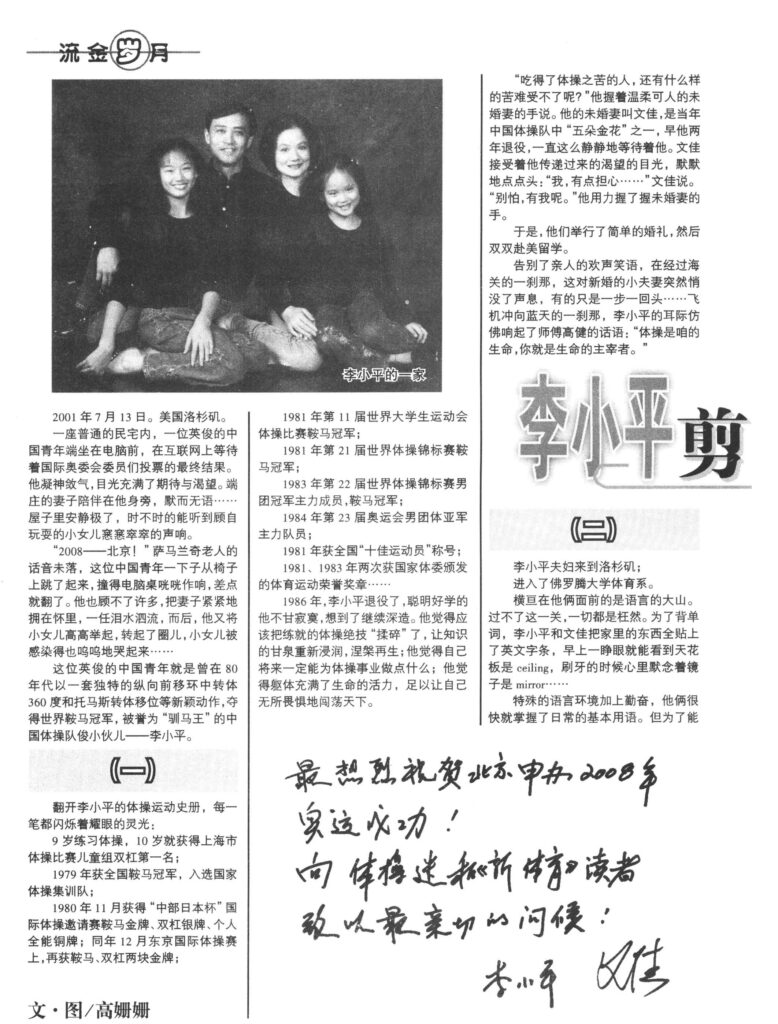
Note: Li Xiaoping and Li Xiaopeng are two different gymnasts. Newspaper articles and photo archives often confuse the two. To make matters more confusing, Li Xiaoping is the father-in-law of Li Xiaopeng. Li Xiaopeng, the 2000 and 2008 gold medalist on parallel bars, married Li “Angel” Anqi, who is one of Li Xiaoping’s daughters.
New Sports, September 2001
Li Xiaoping’s Unbreakable Bond with Gymnastics
July 13, 2001. Los Angeles, USA.
Inside an ordinary house, a handsome young Chinese man sat at his computer, waiting on the internet for the final vote results from the International Olympic Committee members. He held his breath, his eyes filled with anticipation and longing. His dignified wife sat quietly beside him, saying nothing… The house was utterly still, and every now and then you could hear the faint rustling sounds of his little daughter playing by herself.
“2008 — Beijing!” Before the elderly Samaranch had even finished speaking, the young Chinese man leapt from his chair, sending the computer desk crashing and nearly toppling it over. Without a second thought he pulled his wife tightly into his arms and let his tears flow freely, then lifted his little daughter high into the air and spun her around in circles, and she, caught up in the emotion, began to wail along with him…
This handsome young Chinese man was none other than the dashing star of the Chinese national gymnastics team who, in the 1980s, had captured the world pommel horse title with a uniquely innovative set of skills — including a longitudinal forward-traveling circle with a 360-degree turn and a Thomas flare with travel — earning him the nickname “Horse Tamer”: Li Xiaoping.
(一)
Opening the pages of Li Xiaoping’s gymnastics career, every line gleams with brilliance:
He began training in gymnastics at age 9, and at 10 won first place on parallel bars in the children’s division of the Shanghai municipal gymnastics competition.
In 1979, he won the national pommel horse title and was selected for the national gymnastics training squad.
In November 1980, he won gold on pommel horse, silver on parallel bars, and bronze in the individual all-around at the “Central Japan Cup” international gymnastics invitational; that same December, at the Tokyo International Gymnastics Meet, he again won gold on both pommel horse and parallel bars.
In 1981, he was pommel horse champion at the 11th World University Games gymnastics competition.
In 1981, he was pommel horse champion at the 21st World Artistic Gymnastics Championships.
In 1983, he was a key member of the gold-medal men’s team and pommel horse champion at the 22nd World Artistic Gymnastics Championships.
In 1984, he was a key member of the silver-medal men’s team at the 23rd Olympic Games.
In 1981, he received the national “Top Ten Athletes” honor.
In 1981 and 1983, he twice received the Sports Honor Medal awarded by the State Sports Commission…
In 1986, Li Xiaoping retired from competition. Clever and studious, he was unwilling to fade into obscurity and began thinking about continuing his education. He felt he should “break apart” the gymnastics mastery he had built up and let it be soaked through and reborn in the waters of knowledge; he felt that he would surely one day be able to contribute something to the sport of gymnastics; he felt that his body was full of vitality, more than enough to let him venture out fearlessly into the world.
“A person who has endured the hardships of gymnastics — what suffering could possibly be too great to bear?” he said, holding the hand of his gentle and lovely fiancée. His fiancée was named Wen Jia, and she had been one of the “Five Golden Flowers” of the Chinese national gymnastics team in those years. She had retired two years before him and had been quietly waiting for him all this time. Wen Jia received the look of longing he directed at her and nodded gently: “I’m… a little worried…” she said. “Don’t be afraid. I’m here.” He squeezed his fiancée’s hand firmly.
And so they held a simple wedding ceremony, then traveled together to the United States to study.
Saying farewell to the laughter of their loved ones, at the moment they passed through customs, the newlyweds suddenly fell silent, each turning back to look one last time with every step… As the plane surged into the blue sky, in Li Xiaoping’s ears there seemed to echo the words of his coach Gao Jian: “Gymnastics is our life, and you are the master of that life.”
(二)
Li Xiaoping and his wife arrived in Los Angeles and enrolled in the physical education department at Fullerton University.
Before them rose a mountain: language. Without getting past this barrier, everything else was futile. To memorize vocabulary, Li Xiaoping and Wen Jia stuck English labels on everything in the house. First thing in the morning they’d see that the ceiling was “ceiling,” and while brushing their teeth they’d silently recite that the mirror was “mirror”…
The immersive language environment, combined with hard work, meant the two of them quickly got a handle on everyday language. But to work as coaches at a gymnastics club, they also needed fluency in gymnastics terminology. There were no shortcuts to learning. During his years of study, Li Xiaoping slept only three or four hours a day. He wanted to acquire as much knowledge as possible in the shortest time.
But they also had to survive. Working part-time jobs to earn money was the only means of livelihood for the Li Xiaoping household at that time. Wen Jia coached at a gymnastics school called SCAT’s, while Xiaoping took on two jobs: helping out at a gymnastics school called “New Hope,” and doing odd jobs at the university library. The years of studying were truly exhausting and often dreary. Two years after arriving in America, the birth of their elder daughter Li Anqi added no small amount of joy to their quiet lives. Yet after the initial happiness, the couple began to worry about the future. What had been more than $1,000 a month between the two of them had seemed like enough, but with a child the expenses grew considerably. Li Xiaoping was considering taking on another part-time job when his wife Wen Jia stopped him: “Let me be the full-time coach. You focus on your studies; that’s where our hope lies, and our children’s hope too.”
Li Xiaoping felt tears welling in his eyes, but he did not let them fall. Whenever he dragged his exhausted body through the front door and saw the smile his equally exhausted wife offered him, what Li Xiaoping felt, beyond being moved and ridden with guilt, was above all a renewed sense of drive.
After five years of grueling study, Li Xiaoping at last graduated with outstanding marks, receiving both his diploma and his degree from Fullerton University. On graduation photo day, Li Xiaoping in his mortarboard was absolutely exuberant. That same day, he took his wife Wen Jia and their now three-year-old daughter to a photography studio to take the wedding portrait they had never had. He said to Wen Jia with great sincerity: “Of these two certificates I’m holding, one is mine — the other should really be yours. You have worked so hard! We should have had wedding photos long ago. Taking them only now — I’m sorry.”
(三)
Li Xiaoping became a teacher at the New Hope Gymnastics School. Their daughter Anqi also began gymnastics training, and the family of three spent almost every day in the gymnasium. In 1993, the birth of their younger daughter Li Anling brought boundless additional joy to this happy family. Li Xiaoping and Wen Jia were delighted, and elder daughter Anqi was beside herself with excitement. Now she had a little sister to play with, and would never again have to worry about having no one to keep her company.
When life was going along smoothly and contentedly, the volcano inside Li Xiaoping began to stir: he wanted to open his own gymnastics school — one that belonged to him, one that belonged to the Chinese. As luck would have it, a friend approached him at just that moment wanting to jointly invest in a gymnastics club with Xiaoping. Xiaoping and Wen Jia readily quit their jobs to devote themselves fully to the venture. But the world is unpredictable: when things had begun to take shape, that same friend unilaterally decided to withdraw his investment and walk away.
A blow. A devastating blow, washing over the souls and wallets of Li Xiaoping and his wife like liquid mercury spilled across the floor.
Furious, helpless, terrified, Li Xiaoping ground his teeth until they clicked. For a stretch of time, a man who had always been quiet and reserved retreated even further into himself. A man’s momentary weakness can sometimes make a woman’s nerves as taut and strong as steel cables. Wen Jia said to her husband through tears: “If you collapse, I’ll collapse with you. But what about the children? What about our dream? My husband is not a man who can’t take a loss!”
“A man who can take a loss is a true man!” Whose saying was that? The Chinese national gymnastics team’s! His wife’s strength put Li Xiaoping to shame; the resounding motto of the Chinese national gymnastics team jolted him back to his senses. He gently wiped the tears from his wife’s cheeks, held her by the shoulders and said: “Let’s pack up the kids and go have a picnic?”
The seasons turned, and year after year went by. After twelve years, the dream of Li Xiaoping and his wife finally became reality. The “Li Xiaoping Gymnastics School” was born on the other side of the ocean. When it first opened, the school had only around thirty students. Under the painstaking management of the couple, the Li Xiaoping Gymnastics School’s reputation in the local community grew steadily, and many parents came having heard its name, sending their children for training. Today there are nearly 500 students and more than 80 coaches. Members of their program have won California state championships, and three have been selected for the US Junior National Gymnastics Team. What gave Xiaoping and Wen Jia even greater peace of mind was that their elder daughter Li Anqi had shown extraordinary gymnastic talent and had already placed first in Level 6 competition.
(四)
July 16th — three days after Beijing’s successful Olympic bid. Li Xiaoping led his entire family, along with a group of 49 members from the American gymnastics school, back to China to attend a gymnastics summer camp. At this moment of national celebration, to return to the embrace of the motherland, Li Xiaoping said he “could not sleep all night.” The day before leaving the United States, he and his students together hurriedly made a banner reading “Congratulations to China and Beijing on winning the Olympic bid!” covered in dense signatures. Li Xiaoping and Wen Jia presented the banner to the national gymnastics team that had nurtured them.
Quanjude roast duck.
Beijing erguotou liquor.On that side of the table, the students and their parents from the American gymnastics school were eating with great relish.
On this side, Li Xiaoping gripped his coach Gao Jian’s sleeve and clinked glasses of erguotou, cup after cup.
“Xiaoping, you can eat as much roast duck as you like, but go easy on the erguotou.” Gao Jian was already a little tipsy.
“I’m happy, Coach. Happy! Come on — bottoms up!” Xiaoping was also getting a bit high.
“Coach is happy too — happy for your career, proud of your success!”
“That’s nothing, Coach. You know what — now that we’ve won the Olympic bid, how much more… how much more standing do I have over there?!”
Li Xiaoping wept. Gao Jian wept too. The tears of master and student were tears of happiness, tears of pride.
When leaving Beijing, the ever-unsatisfied Li Xiaoping said he had a new goal: to open several more franchise schools in the United States. “The point is simply to keep growing bigger — this is the best opportunity to promote China. Now that we’ve won the Olympic bid, my resolve and confidence are only greater!”■
Editor: Jian Zhi Shi
New Sports, 9-15-2001
Sina Sports, July 2004
“Every Time Feels Like Coming Home” — A Chat Transcript with Gymnastics Veterans Li Xiaoping and Wen Jia
Sina Sports, July 5, 2004, 11:27 AM
Host: Hello everyone, welcome to the celebrity chat room co-hosted by Huao Xingkong, Shanghai Television Sports Channel, and Sina.com. Today we have two very special guests — an enviable model couple. Allow me to introduce Li Xiaoping.
Li Xiaoping: Hello to all the friends who care about gymnastics and about our family!
Host: And his beautiful wife, Wen Jia.
Wen Jia: Hello, hello to everyone online.
Host: Welcome back to China. What brings you home this time?
Li Xiaoping: Next month, we’re organizing a gymnastics summer camp, bringing a group of American children to China to learn gymnastics, experience the country, and get to know it better. It’s also a chance to see old friends, fellow disciples, and our coaches.
Host: How long will you be staying?
Li Xiaoping: About ten-plus days in total.
Host: So much to accomplish in ten days; the schedule must be packed.
Li Xiaoping: Very busy. We came to Beijing first, then we’ll go to Xi’an; tomorrow we’re going to see the Terracotta Warriors; and finally Shanghai, my hometown, to see family.
Host: So these days are mostly filled with gatherings and banquets?
Host: You both look in excellent spirits. Do you get to come back often?
Li Xiaoping: Quite often. We hope to come back every year.
Host: Many netizens submitted questions ahead of today’s visit. One asks: what’s the difference between developing your career in China versus abroad, and has it fundamentally changed your outlook?
Li Xiaoping: We left relatively early. I was the first in our cohort of athletes to retire; I stepped down in 1985 due to injury and went to America. At the time, there was a policy that retiring athletes had to go study, which was a very good policy. It gave us an opportunity to develop in the U.S. I could have gone to a foreign language institute or a sports academy here, but going abroad also meant gaining a new language. Once I got there, I found there were good opportunities, so I started putting down roots. Later, Wen Jia joined me, and having the two of us together made a huge difference; alone, I felt listless and isolated, but with her, I had someone to lean on. Then, after we had children, we gradually settled in, and once you settle, you start to develop. Over these past years, things have slowly gotten better and better.
Host: Wen Jia, you give the impression of being quite delicate, yet you just said he could lean on you when he went to America.
Li Xiaoping: That’s right — abroad, it’s like that. We both came from athletics, we understood each other well, and we could talk through any problem together.
Host: Wen Jia, what differences do you notice between life and work in China versus abroad?
Wen Jia: Life in China before was very simple — just train, compete, train, compete. When we left, we hadn’t really engaged with society at all; the first society we encountered was American society. Everything in front of us was completely new. Before, we never had to worry about food or clothing; suddenly, we were starting from zero. Learning how to live, how to cook, then after having children, how to raise them. We had no breathing room — dealing with school, life, childcare all at once. It was genuinely exhausting, very simple in some ways but relentlessly busy. Even so, we were happy.
Host: A netizen asks: Coach Gao is your mentor. When you meet him, what do you talk about most? And did you share a drink?
Li Xiaoping: Yes, last night we had a gathering — Coach Gao, some team leaders, old friends — we really did get together for a meal. Coach Gao even specially prepared lobster.
Host: The netizen wants to know: did anyone drink too much?
Li Xiaoping: No. I’ve never once gotten drunk in my life.
Host: Good to hear — especially with so many engagements while you’re back. You run the South Coast Club in America, which is doing very well. Can you tell us what each of you does there? Do you coach personally?
Li Xiaoping: In America, we work hard. The two of us do everything. Running a gymnastics club isn’t only about teaching. There’s marketing, communication with students’ parents, accounting, managing coaches, and external relations with the city. We divide it up: Wen Jia handles the books; her mother was an accountant, so she’s especially strong in that area. I handle external affairs — dealing with the city, advertising, liaising with media.
Host: One inside, one outside — a well-coordinated team. We hear several prominent Chinese athletes are now coaching there. Can you reveal who?
Li Xiaoping: The majority are local coaches, because most of our students are young children, and it’s very hard for coaches unfamiliar with American culture to communicate with them. The Chinese coaches we’ve brought in mainly work with the more advanced students. For the younger children, communication is mostly handled by American coaches. We do have two male Chinese coaches — one named Liu Jian and one named Guo Nian — both helping out there.
Host: You said they help you out there. In America, where everything runs on commercial terms, is your relationship with them employer and employee, or friends?
Li Xiaoping: That’s a tricky issue. With the American coaches, business is business and friendship is friendship. When it’s time to be friends, we eat and drink together, no problem, but when it’s business, we do business. Otherwise, mixing the two makes things complicated.
Host: A netizen asks Wen Jia: what was the hardest period you faced abroad, and how did you get through it?
Wen Jia: There were actually a few difficult phases. One was right after our first child was born. I was still very young, barely managing life on my own, and suddenly, there was a baby. At that point, Xiaoping was still in school — we were both in school, actually. I got pregnant shortly after graduating, and since he had started a year before me, it would have been a shame for him to quit halfway through. With just the two of us, we could manage, but adding a child made it impossible — insurance, medical costs, everything multiplied. So there was no choice: he stayed in university, and I gave up studying and went to work full-time. I was pregnant and working, he was studying every night until one or two in the morning because the coursework was so hard with limited language ability. That was a tough time.
Wen Jia: The other really hard time was when we first started the business. Even though we’d been in America for years by then, it was a turning point. As foreigners, we were still learning their rules, their laws, all of it. Starting from zero again was difficult. But we never felt like we had a wall we couldn’t get over. Difficulties are just there — like when we were athletes, the things coaches demanded of us seemed impossibly hard and we got through them anyway. You just have to summon your strength, dig in, and we got through it fine. Two people, working together.
Host: That spirit must come directly from the mental toughness gymnastics builds.
Wen Jia: Absolutely. It’s been a lifelong asset.
Host: Now for a lighter question, from a netizen in Henan: why are there so many gymnasts surnamed Li among Chinese men’s gymnasts?
Li Xiaoping: That must be a coincidence — or maybe genetics, I couldn’t say. Perhaps coaches have a soft spot for kids named Li, feel they have better chances of succeeding, so they invest more time in them, and those kids rise up. An athlete’s own effort matters enormously, of course, but a great deal depends on the coach. When a coach invests heavily in someone, they naturally hope their own career will bear fruit through that athlete, so they put their effort where they see a good return. I imagine that’s the situation.
Host: Could it also be that if you’re named Li, you feel extra pressure to train harder and bring honor to the name?
Li Xiaoping: That’s quite possible.
Host: Another netizen asks: do you find Americans easy to get along with? Do they have an exclusionary mentality toward outsiders?
Wen Jia: We’ve never felt that. We live in Southern California, which is an immigrant city. Students come from all over the world. I’ve heard that in the eastern and central US, where people see fewer foreigners, they might find it novel rather than hostile, but in Southern California, we’ve never experienced that. There are so many different cultures, languages, and customs all mingling in that city that people learn to understand and communicate across them.
Host: At last year’s World Championships in Anaheim, you provided your club to the Chinese national team free of charge for training. The Dutch team even offered to pay, but you turned them down. You also personally handled the national team’s logistics and bought competition-standard equipment specially for them. Why did you do all that? Didn’t it cost you, given that you’re running a business?
Li Xiaoping: Business is business for the outside world. But China is home. Coach Gao is my teacher. When it’s for your own family, that’s exactly what money is for. It’s our way of expressing our hearts.
Host: You may have earned a little less, but you gained something in return.
Li Xiaoping: We were genuinely happy the whole time. We’d been abroad for so many years without a chance to serve the Chinese team. At Anaheim, we mobilized everything we had for nearly a month to serve China, to serve the competition. We did a great deal, and in the end, we saw wonderful results. For us, that was the greatest comfort — because they competed well, we, overseas Chinese, felt proud. Enormously proud.
Host: You, Li Yuejiu, and Huang Yubin are said to be Coach Gao’s three great disciples, and Li Yuejiu and his wife also live in America. Do you see each other often?
Li Xiaoping: Yes, though they’re in Chicago, and we’re in Southern California.
Host: That’s very far — you must meet only rarely?
Wen Jia: They’re also coaching. We might cross paths at national competitions, or we stay in touch by phone — maybe see each other once or twice a year.
Li Xiaoping: Mostly phone contact.
Host: At last year’s Worlds you were all there together. Can you describe that reunion after so many years?
Li Xiaoping: Once the Chinese team arrived, they split into groups — men’s team here, women’s team there, coaching staff separately — and we two, plus others from the club, all turned out to serve them. On the first day, I realized quickly that we needed more help, so I called Yuejiu right away: “Come as fast as you can, we need reinforcements.” He said fine, and within a day or two, he arrived with his wife and four others, plus people from my club. The main work was logistics — buying supplies, picking people up. When Hai Bin was injured and Feng Jing was called in from Beijing, we suddenly had one fewer person, so every day was a reshuffling to keep training covered. On the day of qualifications, Coach Gao called me at six-thirty in the morning: “Come pick us up at six-thirty tomorrow, I need four cars.” I understood immediately — a major operation. That was the day of preliminaries. We arranged everything, planned where to park, what to say — actually nothing needed to be said. Everyone was focused entirely on the competition.
Host: All those small, meticulous details. Was there ever any downtime to reminisce with Li Yuejiu and Coach Gao?
Li Xiaoping: Yes, the last day was wonderful. Everyone had finished competing and done brilliantly, so the mood was very relaxed. Wen Jia took all the men’s and women’s team members to the beach to shop and enjoy themselves. We’re only about fifteen minutes from the water. They didn’t want to leave when it was time to go. I took Coach Gao and Yuejiu straight to a casino for some fun — Coach Gao’s luck was extraordinary, he just kept winning.
Li Xiaoping: We wanted him to unwind and relax after all that tension. And his luck was absolutely astonishing.
Host: I hear Coach Gao is also something of a mahjong master. Did he show off his skills in America?
Li Xiaoping: No time for that. We did all go out to eat together. The happiest moment was that final day. Even the children were overjoyed. We also arranged for a friend to put together a CD chronicling the whole trip — from arrival in Los Angeles through the competition segments, the leisure time, the all-around, the individual events — a complete disc for each person. When we were athletes, we never had that chance, and the technology didn’t exist. Looking at these young athletes now, I thought: for some of them, this might be the highest point of their lives. We captured as much as we could for them, prepared everything. Every person has their own disc with footage of themselves throughout. That will mean a great deal to them as a memento.
Host: Perhaps they don’t fully realize yet how significant this chapter of their lives is. We’re truly grateful to you. Another netizen asks: people say that abroad, if you work hard and are willing to put in the effort, you can succeed. What do you make of that?
Wen Jia: I think there’s real truth in it. There are opportunities — the question is whether you can seize them. Once you’ve seized an opportunity, you still have to work hard. If you’re lazy, if you retreat when things get difficult, you won’t succeed, because success is never easy. You will encounter obstacles beyond imagining. You have to be daring, you have to be willing to work, and you also need a measure of wisdom. In today’s society, effort alone isn’t enough — you need knowledge and intelligence too.
Host: Before going abroad, your lives were relatively enclosed — just training. There are parallels between being an athlete and being an entrepreneur, both require striving. But comparatively speaking, which do you find harder — winning at an international championship, or building your own business in a foreign country?
Wen Jia: They’re different — both were things we’d never experienced before. From childhood, we were conditioned to endure the demands placed on us and to absorb the pressure of major competitions. Having gone through that, I’ve benefited for a lifetime. Now I feel that having survived that period, there’s nothing I can’t get through.
Host: A netizen asks: how many students does your club have? And if one of your students competed against Chinese athletes at the 2008 Beijing Olympics, who would you want to win?
Li Xiaoping: Our focus is running a business, so there shouldn’t be any conflict. For a child to reach that level requires an enormous investment of time, and we haven’t put our effort into that. Our club is primarily recreational, business-oriented. A child training ten or fifteen hours with us versus a Chinese national-team gymnast training exponentially more — they’re simply not in the same category. I don’t think that scenario will arise. I hope it won’t. But if it were my own child, I would want the best for them — while also wanting the Chinese team to do well.
Host: You haven’t commented yet on this. A netizen also asks: I’ve heard you took American citizenship — does your heart stir when you hear the Chinese national anthem playing as a Chinese athlete wins gold?
Li Xiaoping: I’ve been in America eighteen years and I still hold Chinese citizenship. Neither of us has changed nationality — we still carry People’s Republic of China passports. Every time we come back, it feels like coming home. At Anaheim last year, we cheered passionately for them. Those young athletes have become good friends. I’d actually come back for the 1999 Tianjin World Championships after a long absence, and after Anaheim, I felt very close to all of them.
Host: From a professional standpoint, how do you assess this generation of the national team?
Li Xiaoping: If they can perform to their ability, they should be capable of winning the gold. That’s my personal view. What I’ve seen of them — the Chinese team is absolutely a dream team, in excellent shape. They can do it.
Host: In 1984, China participated in the Olympics for the first time and won the team silver, along with many individual gold medals. Nearly twenty years have passed. Can you recall what that experience was like?
Li Xiaoping: Gymnastics scoring has changed significantly in recent years, but back then the role of the judges was enormous — judges essentially controlled athletes’ fates. Gymnastics is like art: if you like something, you find it priceless; if you don’t, you discount it. There were basic rules, but the rules were imperfect then, which gave the American team room to exploit loopholes. With the new scoring system, the three-three panel structure, everyone has equal opportunity — cheating is somewhat harder, relatively speaking. Though it still happens, because gymnastics has no single objective standard, like appreciating artwork.
Li Xiaoping: Beyond deductions that are written in the rules — a step on landing, for instance — there are artistic elements where judges’ subjective preferences come in. Japan has its own style, everyone has their own style. Ultimately, judges have some personal latitude on that final judgment. Looking back, twenty years ago the main problem was that imperfect rules gave the Americans a significant advantage over us. We competed at eight in the morning; they were at their best competing at seven in the evening.
Host: And the margin was so slim — just fractions of a point. Looking back, do you still feel some regret?
Li Xiaoping: Yes. Nine months before that, at the World Championships, he was fifth and I was first. We weren’t even in the same category. The judging had a certain shamelessness to it.
[Note: It’s unclear to whom Li Xiaoping is referring. At the 1983 World Championships, the Chinese team finished first, while the American team finished fourth. On pommel horse, Li Xiaoping tied for second, and Bart Conner tied for seventh.]
Host: Do you feel you performed to your own level at those Games?
Li Xiaoping: The team as a whole performed well, but personally, I didn’t perform to my ability. I should have done better.
Host: Wen Jia, you had a chance to compete at those Olympics but were unable to due to injury.
Wen Jia: An injury, yes — and it happened just about two weeks before the team was to leave. I was already twenty, my body had taken a lot of wear, training required everything I had to get through. And then my lateral collateral ligament ruptured. So close.
Host: How did it feel to watch your teammates go to the Olympics without you?
Wen Jia: I was the first in our group to be sidelined. I was devastated; it’s not a feeling most people can understand. You’ve pushed yourself to the limit, and then: the 1980 Olympics, gone because of the boycott. The 1984 Olympics, there within reach, and then the injury. But looking back now, I also remember a kind of release — the pressure before the Olympics was immense. As a personal matter, though, it remains the greatest regret of my life.
Host: Many netizens have questions about your love story. One asks: you became partners in life after being partners in sports. Is it easier to fall in love with someone who shares your background?
Wen Jia: In those days, our entire world was within the sports system — the athletic commission. I’m not talking about making a choice so much as the reality of the situation. And honestly, it worked in my favor. Within the commission, everyone was athletic elite — not just nationally, I’d say globally. To have trained to that level, whether in character, personality, intelligence, or athletic skill, these were exceptional people.
Host: But there were many such athletes — why him in particular?
Wen Jia: Who knows — fate, I think. Sometimes you see people who seem perfectly matched and it doesn’t work out. Our story had quite a few twists before it reached a good ending. I feel genuinely fortunate: it was because I did gymnastics that I was able to meet him.
Host: A beautiful woman like Wen Jia must have had many admirers. How did you win her over?
Li Xiaoping: Luck.
Host: You talk about courtship like a competition.
Li Xiaoping: It really was fate. When we were athletes, regulations forbade romantic relationships. When I retired and became a coach, coach-athlete relationships were also forbidden — we were in a teacher-student relationship, another barrier. Things kept being pushed back. The management style was more rigid then, though the intention was good.
Wen Jia: The intentions were always good.
Host: A netizen heard that you were put in confinement for a week because of your relationship with Xiaoping — is that true?
Wen Jia: That must be an old teammate of mine who asked that — yes, absolutely true. And it happened right before a major competition. That year, I think it was the Asian Games — they wouldn’t let me train. With selection trials coming up and now I couldn’t train. A week confined to quarters. I felt embarrassed going to the dining hall, knowing it was punishment for breaking the rules. So I practiced secretly in my room.
Host: What were you doing while she was confined?
Li Xiaoping: I was training.
Host: But you missed her. The netizen wants to know: did she hold it against the coach?
Wen Jia: No resentment at all — none. I ran into an old teammate yesterday and said the same thing. As I said, the intention was good. Whether before or now, however open society becomes, an athlete needs to concentrate fully. When a major competition is approaching, you have to choose. If the coach had sat down and talked with me — explained why this was a problem, told me to focus — I would have understood. I was a proud athlete. I would have known which was more important, and I wouldn’t have kept breaking the rules. Maybe the occasional secret note, that’s human nature. But I would have known where to put my energy. The methods today are so much better — people talk things through.
Host: Looking back, what’s your view — should athletes date during their training years or not?
Wen Jia: I think it’s impossible to prevent. When boys and girls reach a certain age, having feelings for someone is the most natural thing in the world. But there has to be moderation. “Dating” as in spending all your time together and neglecting everything else — that’s a problem. Letting romance interfere with what matters. But mutual attraction, knowing there’s something there — that I think is completely normal. Just don’t let it derail the important things.
Host: You’ve been together for decades now — how would each of you describe what still attracts you to the other? Wen Jia, what about him still draws you in?
Wen Jia: His character. Even when we were athletes, I noticed he was exceptionally honest, a man of few words — he still says less than I do, I’m the talker. He’s deeply steady and reliable. Truly a good husband and father, with a very strong sense of responsibility. In my eyes, he has too many good qualities to name. He’s my anchor.
Host: And you, Xiaoping?
Li Xiaoping: In my difficult moments, she encouraged me and gave me confidence. That’s my greatest support — my spiritual pillar.
Host: And her looks had nothing to do with it?
Li Xiaoping: Of course her looks matter too.
Host: Have you two ever argued?
Li Xiaoping: Of course — she has her views, I have mine. On the club, on management, we have different opinions. A couple that never argues is missing something — it’s one of life’s flavors, sweet and sour, bitter and spicy together. When something comes up, we sit down and talk: she gives her view, I give mine, and we find common ground. That’s the best way.
Host: Usually after an argument, one person has to give ground first. Who is it?
Li Xiaoping: I always defer to her. Always.
Host: Even when you’re not the one who was wrong?
Li Xiaoping: I’ll tell her what I think, and then I’ll give way. I’ll give her a hug and say my handling of it wasn’t good, or just say I’m sorry, and give her a hug.
Host: How lovely. Now — you have two beautiful daughters. What future do you envision for them?
Wen Jia: We haven’t thought about it too much. Our older daughter is two years from college. Because of the club, she trained in gymnastics for years, right up until last year, when she started high school. The schoolwork got heavier, and she also attends an arts school with a very long day — eight in the morning until five in the afternoon — leaving almost no time to train. So we sat down and asked her: if you want to keep training, you’d have to switch schools. Otherwise you can stay at the arts school. She’d worked hard to get into a school that produces many talented artists, and she loves it, so she chose to give up gymnastics. She has a real gift for art and I imagine that’s the direction she’ll go. She also loves languages — English is her mother tongue, she speaks some Chinese, and she’s studying French at school. We think communication and languages might be her path.
Host: I found online that your older daughter has won many gymnastics medals.
Wen Jia: She trained beautifully. Her work ethic is just like Xiaoping’s — she pushed through tremendous difficulty. She’s tall, so strength was always a challenge, making everything harder. She trained right up until last year, winning many medals every season, multiple state championships. She was genuinely excellent.
Host: If she had continued to international competition level, would she have represented China or the United States?
Li Xiaoping: That scenario was never going to happen.
Wen Jia: As Xiaoping said, we didn’t develop her in that direction. Our motivation for having both children involved in gymnastics was about the values of sport. Growing up in America, children have everything — it really is a paradise for kids. They haven’t had to struggle for anything. So we put them in gymnastics, where they had to endure physical hardship, learn to push through difficulty, learn to concentrate. Those qualities — resilience under pressure, mental focus — aren’t easily cultivated in other ways. That was the purpose, not to produce champion athletes.
Li Xiaoping: To experience and understand what their parents devoted twenty-plus years of their lives to. Just to know it.
Host: And it’s wonderful that she genuinely loves gymnastics herself.
Li Xiaoping: Gymnastics is a remarkable thing. No matter how wealthy your parents are, sport doesn’t care — you have to go out and work for it. No one can do it for you. I hope they understand: whatever they achieve through their own effort, that’s what will bring real joy.
Host: This trip, the whole family of four is here together — though the younger daughter went to the Summer Palace today. A netizen asks whether you’ve thought about having a son.
Li Xiaoping: We’ve actually talked about it. We’re already in our forties; by the time a child born now turned twenty, we’d be over sixty.
Wen Jia: We’ve thought about it. But practically speaking, the conditions don’t really allow it. We believe in raising our own children — not having others care for them. I want to be there for every stage, change every diaper, do every feeding, watch them grow. These two have already run us ragged. Starting again from the beginning would be very difficult. If my heart had its way, I adore children and would love more. But the conditions have to allow it.
Host: A netizen has noticed that Angela’s Chinese seems a little limited. Have you made a special effort to cultivate it? How is the younger daughter’s Chinese?
Wen Jia: Angela can understand it, but her pronunciation still sounds Chinese. My younger daughter sounds more American, though she actually can speak; she’s just shy about it. Her listening comprehension is basically fine. Mostly it’s the lack of environment.
Host: Angela, do you want to improve your Chinese?
Angela: Very much.
Host: And you’re working on it?
Angela: Yes.
Host: We’re coming up on the end of our time — four quick questions. First, for Angela: what do you want to be when you grow up?
Angela: I don’t know.
Wen Jia: She’s interested in modeling at the moment, and also in design and media.
Host: Would you consider acting?
Angela: I don’t think so.
Host: Would you consider coming back to develop in China?
Angela: Yes.
Host: What is it about China you like?
Angela: The culture and the people.
Host: Our netizens will be pleased to hear that. Now, the four questions: first, as an athlete, did you ever have conflicts with your coaches?
Li Xiaoping: Conflicts with coaches? When I was competing, the approach was basically top-down — whatever the coach said, you did.
Wen Jia: Xiaoping was very compliant. But I had a stubborn streak and strong opinions, so I clashed with coaches from the time I was young. In the end I always did what they said — you can’t progress if you don’t. But there was often friction, and I always had to admit fault eventually. You couldn’t just keep being defiant.
Host: Second question: what was the night before the Olympics like for you?
Li Xiaoping: I couldn’t sleep. Nervous. It felt like I was sleeping but not really sleeping.
Host: What went through your mind?
Li Xiaoping: Nothing, really. Before competitions I tried not to think about anything. It was just nervousness — a state of not being able to sleep properly, not truly resting.
Host: Did that nervousness carry over into the arena, or did it disappear when you arrived?
Li Xiaoping: The moment I stepped out onto the apparatus, it was gone. The hard part is the waiting — the night before, or the moment you’re heading to the venue. But once you’re on the floor and you start moving, it’s fine. The waiting is the hardest.
Host: Third question: what did you each do on the first day after officially retiring?
Wen Jia: I remember — the moment they said I was done, I was lying in bed with my injured foot, and I sent a teammate to go buy twenty-something ice cream bars or something like that. No more weight control. So first thing: eat.
Li Xiaoping: After I retired, the transition came very fast. I retired and almost immediately prepared to go abroad. About a month later I was gone.
Host: Final question: for athletes who will compete at the Olympics a month from now, especially those doing it for the first time — one word of advice each.
Li Xiaoping: Treat the Olympics like just another routine. Go out and perform at your level.
Wen Jia: I just hope they give it everything they’ve got. Our whole family is cheering for them.
Host: With that kind of support behind them, our Olympic athletes should do beautifully. Thank you so much to all three of you for coming to our studio today. Wishing your family every happiness, and wishing Angela’s dreams come true. Thank you to all our netizens — thank you, everyone!
[End of transcript]
Archived here.
If you’d like to learn more about Li’s time on the Fullerton gymnastics team, you can check out these articles from the LA Times:
- The Dream Gymnast: Li Xiao Ping, Titans’ Star Athlete From China, Has Coach Fantasizing About Success (1986)
- Perfection From ‘Great Rider’: Pommel Horse Master Li Xiao Ping Boosts Titan Gymnastics (1987)
- Spreading the Wealth: Chinese Olympic Gymnast Coaches Young Hopefuls in Santa Ana (1997)
Note: In 2021, South Coast Gymnastics was fined $1.3 million for wage theft.
Appendix: Li Xiaoping’s Retirement
Tong Fei and Li Xiaoping Honorably Retire
By Sun Yongsheng, Bi JingXinhua News Agency, Tianjin, April 18 (Reporters Sun Yongsheng, Bi Jing) — Today is a day that Tong Fei and Li Xiaoping, outstanding Chinese gymnasts and multiple-time world champions, will never forget. At the Tianjin Gymnasium, the two waved flowers in their hands to greet the audience, bidding farewell to the competitive arena where they had struggled for so many years, and gave one final performance for the spectators.
Tong Fei, a gymnast from Jiangxi, is twenty-five this year; Li Xiaoping, from Shanghai, is twenty-four. The two achieved outstanding results many times in major international and domestic competitions. Tong Fei twice won world championship titles on horizontal bar and floor exercise. Li Xiaoping won a world championship title on pommel horse. Both were key members of the men’s team that won the team title at the 1983 World Championships. Over their fourteen-year gymnastics careers, undeterred by injury, they strove and struggled, making their own contributions to elevating Chinese men’s gymnastics to the world’s highest level.
PLA Daily, April 20, 1986
童非李小平光荣退役
Author: 孙永盛 毕靖
据新华社天津4月18日电 (记者孙永盛、毕靖)今天,是我国优秀体操运动员、多次世界冠军获得者童非和李小平永远难忘的日子。他俩在天津体育馆手摇鲜花,向观众致意,告别自己拚搏多年的赛场,并向观众作了最后一次表演。
江西选手童非今年二十五岁,上海选手李小平二十四岁。他俩在国际、国内重大比赛中多次创造优异成绩。童非曾两次获得单杠和自由体操世界冠军。李小平曾获鞍马世界冠军。他俩都是1983年世界锦标赛男子团体冠军队的主力队员。他们在十四年的体操生涯中,不顾伤痛,努力拚搏,为中国男子体操运动跃向世界最高水平作出了自己的贡献。@@童非李小平光荣退役 孙永盛 毕靖 体育
More on Chinese gymnastics: