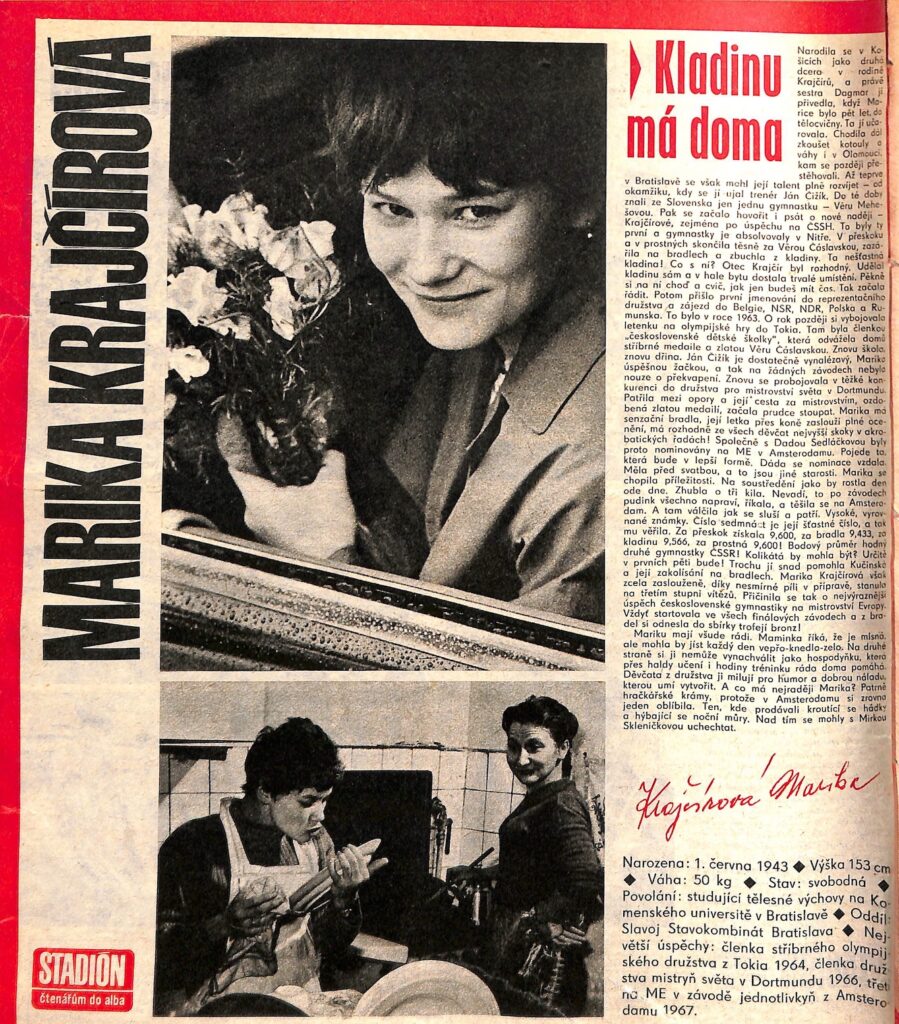
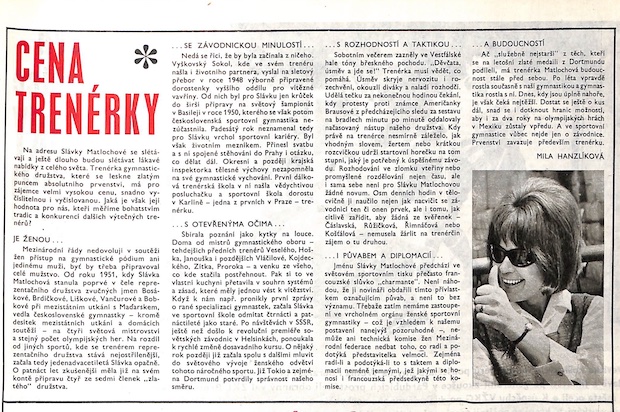
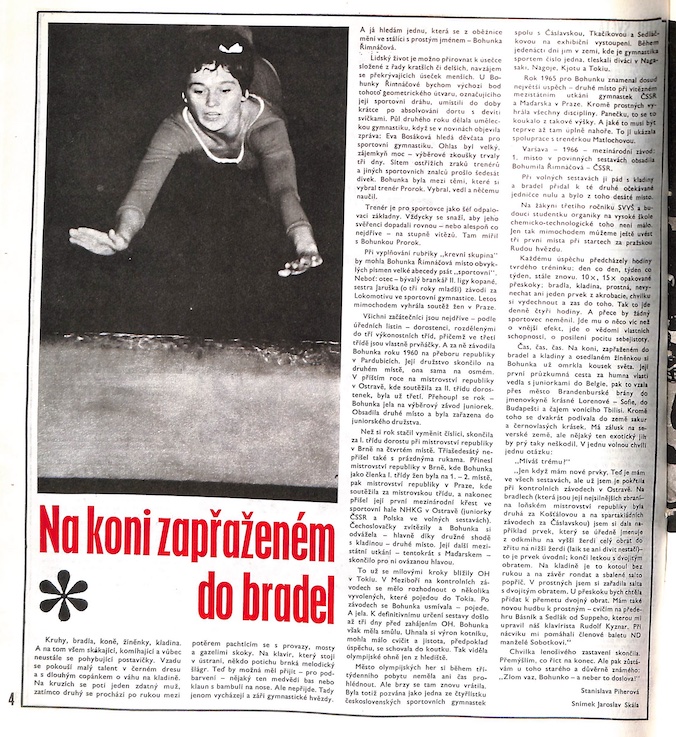
Right before the Mexico City Olympics, the Czech-language magazine Reportér printed a long interview with Věra Čáslavská. It covered a wide range of topics: her relationship with the media, her superstitions, her relationship with her coach, her first World Championships, and more.
At the end of 1967, Věra Čáslavská was on top of the gymnastics world. She had won the all-around at the 1964 Olympics, the 1965 European Champions, the 1966 World Championships, and the 1967 European Championships. In fact, at the 1965 and 1967 European Championships, she swept the gold medals, and in 1967, she scored two perfect 10s.
But how do you ensure that a golden gymnast stays golden? That was the question that the reporter Robert Bakalář posed to Jaroslava Matlochová, Čáslavská’s coach, in an interview published at the end of 1967.
Note: Matlochová would become a part of the Women’s Technical Committee in 1968.
In 1964, Larisa Petrik, who was 15 at the time, defeated Larisa Latynina at the USSR Championships. It was big news within the Soviet Union. Months later, both Larisas were set to attend the European Championships in Sofia, Bulgaria, where Latynina ended up finishing second in the all-around while Petrik was fourth. (Petrik tied for third on beam, winning her first medal at a major international competition.)
As you can imagine, the media enjoyed having two gymnasts with the same name. The Estonian newspaper Spordileht ran an interview with Larisa Petrik, calling her “Larisa the Second.”
The gymnastics world had many questions for Latynina in the lead-up to the 1965 European Championships.
What did Latynina think about taking second place to Věra Čáslavská at the 1964 Tokyo Olympics? What did she think about taking second place to Larisa Petrik at the 1964 USSR Championships? Did she think she still had a chance to win the European Championships in 1965? What did she think of the current state of gymnastics with its ever-increasing difficulty, as epitomized by Čáslavská?
These are some of the questions that Latynina addressed in an interview printed in the Estonian sports magazine Spordileht on May 14, 1965, right before the European Championships in Sofia, where Latynina finished second behind Čáslavská.
Copyright: imago/United Archives; European Gymnastics Championships, 1965, Sofia, Bulgaria. Pictured on the podium are gold medalist Věra Čáslavská of Czechoslovakia, silver medalist Larisa Latynina of the Soviet Union (left), and bronze medalist Radochla of the German Democratic Republic. 22nd May 1965.
Just days before the 1971 European Championships, Nedelia, a weekly illustrated newspaper, ran an interview with Tamara Lazakovich and Ludmilla Tourischeva. (By the way, Lazakovich quit gymnastics, and the coach had to convince her to come back.)
In the same issue, another article looked at the state of Soviet gymnastics, comparing Lazakovich’s and Tourischeva’s distinct styles: “Wave and stone, poetry and prose, ice and fire — Tourischeva and Lazakovich.”
In addition, the article lamented that 13-year-old Nina Dronova could not participate in the European Championships due to her age, and it worried that she might tire of gymnastics before she had her chance to shine on the international stage.
Reminder: At the 1970 FIG Congress, the women’s artistic gymnastics delegates voted to lower the competitive age to 14.
What follows is a translation of the article on the state of Soviet gymnastics, as well as the interview with Lazakovich and Tourischeva (Nedelia, October 11, 1971).
After the USSR Championships in October of 1969, the Moscow newspaper Nedelia interviewed the head coaches of the women’s and men’s national teams: Larisa Latynina and Vladimir Smolevsky.
But instead of asking them about their respective teams, Latynina had to comment on men’s gymnastics, and Smolevsky had to comment on women’s gymnastics. It’s fascinating to see what each coach admires about the other discipline and what irks them, as well. For example, Smolevsky despises “bad ballet” on floor.
What follows is a translation of their remarks. (Thanks to Luba for her assistance.)