Almost 70 years before Nadia Comăneci and Nellie Kim scored their perfect 10s at the Montreal Olympics, there were several perfect scores awarded during the 1907 International Tournament. (The International Tournament was the original name for the World Championships.)
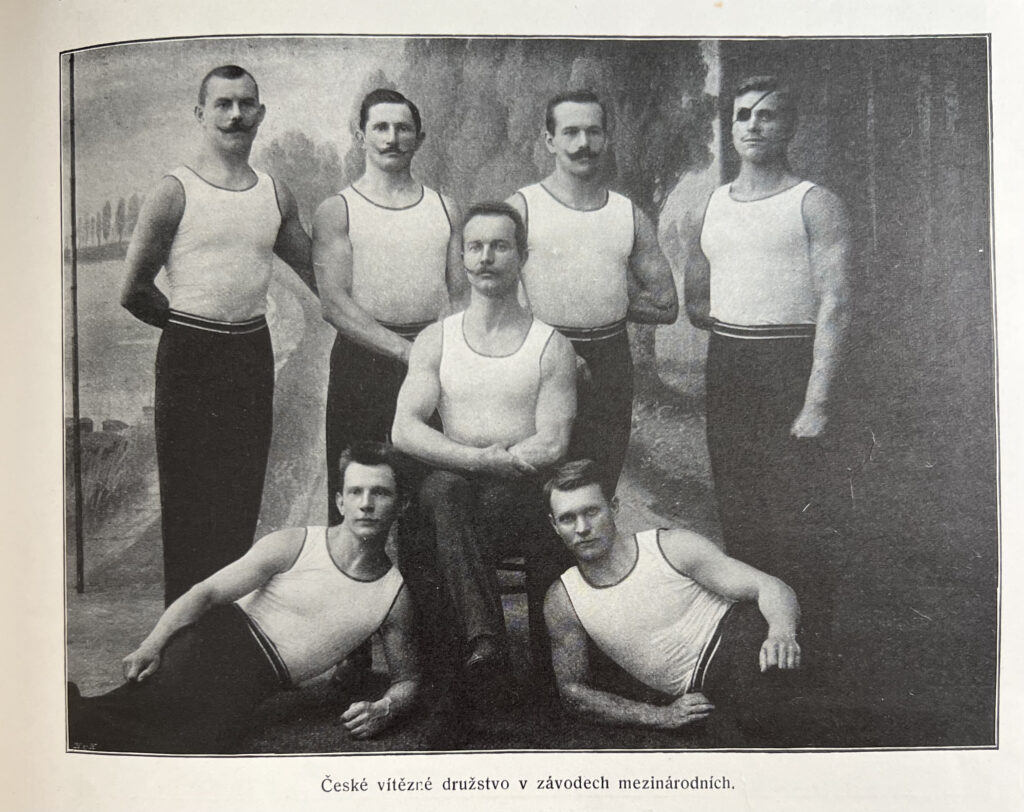
The majority of those perfect scores were for the French team. Nevertheless, the Czech Sokols, newcomers to the International Tournament, took first, ending the French team’s winning streak.
Oh, and, in 1907, one of the first age controversies in gymnastics occurred.
The Czech team. Source: V. slet všesokolský 1907: pamětní list vydaný péči
In 1938, Eugen Mack had yet another perfect score on vault. However, it wasn’t enough to beat the Czechoslovak team.
The Swiss team struggled in athletics (and rings). Shot put, in particular, dashed their hopes of becoming world champions.
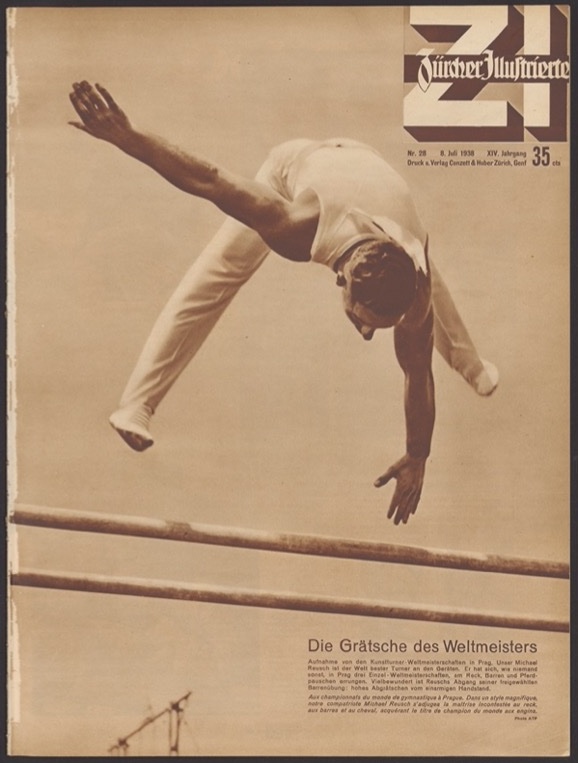
Reusch, one of the top Swiss gymnasts, had a particularly rough time with athletics. Though Reusch won four apparatus titles, his scores didn’t count for the team total, which was based on the top six all-around scores. Reusch finished 7th on his team and 24th in the all-around overall. He scored a 0 in shot put (7.45 m).
Michael Reusch, Zürcher Illustrierte, July 8, 1938
The men’s competition at the 1928 Olympics was a close battle between Czechoslovakia and Switzerland. It came down to the very last event, vault, on which Czechoslovak gymnast Šupčík fell and on which Swiss gymnast Eugen Mack received a perfect score for his compulsory routine.
Modern gymnastics fans might be surprised to know that one of the countries performed to music. During its ensemble floor routine, Yugoslavia told the history of its nation through music and movement. (Technically, it wasn’t Yugoslavia at the time but rather the Kingdom of Serbs, Croats, and Slovenes or SHS for short.)
Of course, there was a fair share of judging drama. It’s gymnastics.
Unfortunately, there were some organizational problems, too. Due to a mathematical error, the wrong person received the bronze medal on rings.
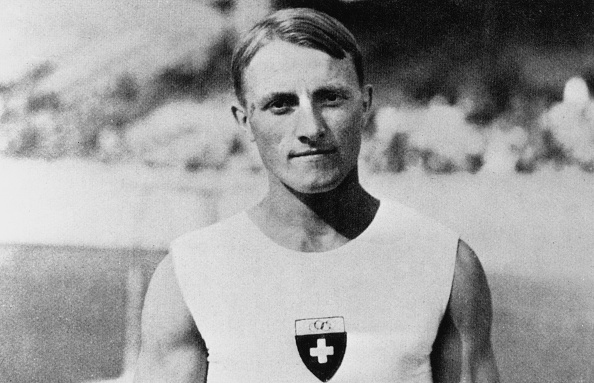
Swiss gymnast Georges Miez (1904-1999) at the 1928 Summer Olympics, held at the Olympisch Stadion (Olympic Stadium) in Amsterdam, Netherlands, August 1928. Miez won gold in the Men’s artistic individual all-around, Men’s artistic team all-around, Men’s horizontal bar, and won silver in the Men’s pommel horse. (Photo by Bob Thomas/Popperfoto/Getty Images)
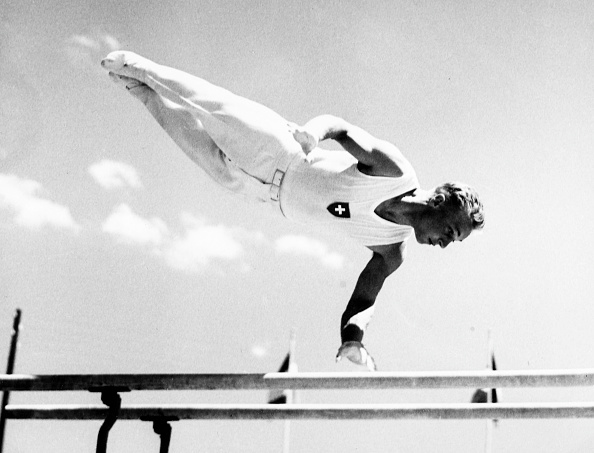
In 1950, Hans Eugster scored a perfect 10 on the parallel bars at the World Championships. It was the first 10 under the very first men’s Code of Points (1949).
The competition wasn’t without its judging controversies that spilled over into the pages of the French and Swiss newspapers.
Kunstturn-WM in Basel 1950: Barren-Sieger Hans Eugster (Photo by RDB/ullstein bild via Getty Images)
At the 1967 European Championships, Czechoslovak gymnast Věra Čáslavská scored two 10.0s. One year later, during the lead-up to the Mexico City Olympics, the Soviet gymnasts scored four 10.0s at their domestic competitions.
Given the flurry of 10.0s just before the 1968 Olympics, it’s somewhat surprising that there weren’t any 10.0s in Mexico City.
Let’s take a look at what happened at the USSR Nationals and the USSR Cup.
After Čáslavská scored two 10.0s at the 1967 European Championships, a flurry of 10.0s appeared in national competitions during the lead-up to the Mexico City Olympics. Two of the recipients were Erika Zuchold and Karin Janz.
At the East German Championships in July of 1968, Zuchold scored 10.0s on both optional floor and vault, and Janz scored a 10.0 on her optional vault.
What follows is a translation of an article from Neues Deutschland.
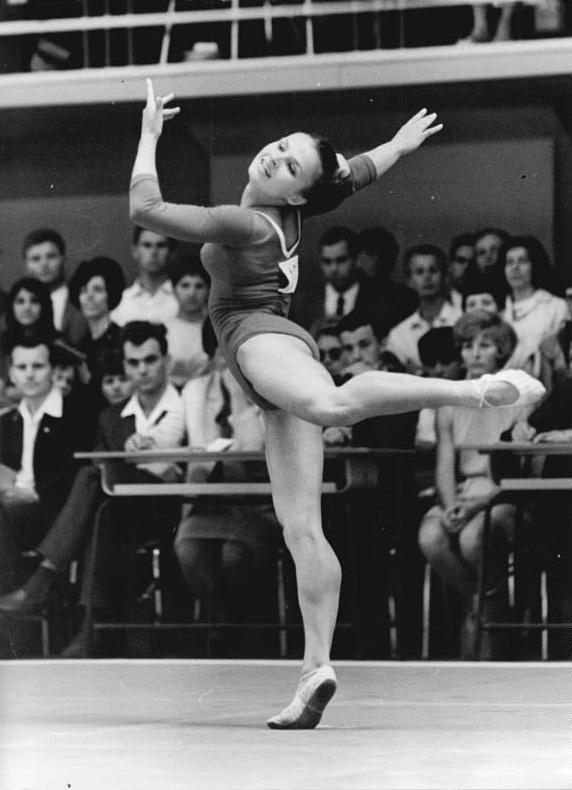
Zentralbild Koch 8.7.1968 Halle: DDR-Meisterschaften im Frauenturnen. Bei den Finalwettbewerben an den einzelnen Geräten, mit denen am 7.7.1968 in Halle-Neustadt die deutschen Frauen-Turnmeisterschaften der DDR zu Ende gingen, holte sich die Achtkampfmeisterin Erika Zuchold (SC Leipzig) auch die Titel am Schwebebalken und im Bodenturnen (Foto). Während der Meisterschaftstage erreichte die Leipzigerin insgesamt sechsmal die Höchstnote “10”.
In July of 1976, newspapers around the world reported that Nadia Comăneci scored the first 10 in Olympic history.
Nadia Comaneci, a 15‐year‐old Rumanian girl, scored the first perfect 10 in Olympic gymnastic history in the women’s uneven parallel bars competition.
New York Times, July 19, 1976
Nadia received a perfect score of 10.00 — the first perfect 10 in Olympic history.
The Daily Yomiuri, July 20, 1976
Unfortunately, what they reported was wrong.
Comăneci was the first female gymnast to score a 10 in Olympic history, but she was not the first gymnast to score a 10. (To be fair, information was much harder to come by in the 1970s.)
A quick recap: At the 1964 Olympics, Endo Yukio won the all-around competition after a questionable pommel horse routine. He had 3 major breaks during his routine. Yet, he received a 9.10, and gymnastics fans were outraged about the overscoring.