Few skills in artistic gymnastics are as recognizable as the Tsukahara vault. More than fifty years after its debut, it remains a cornerstone of international gymnastics. Yet remarkably little is known about how it was created. (See Tsukahara’s skeletal Wikipedia page.)
Most histories reduce its origins to a single sentence: Tsukahara Mitsuo unveiled a new vault at the 1970 World Championships in Ljubljana, and it soon entered the Code of Points bearing his name. This excerpt from Tsukahara’s autobiography, Endless Challenge, offers the fullest account we have from the inventor himself. He describes an accidental beginning, experimenting with the vault after watching a university teammate perform it on the women’s side horse vault in training. At first, he regarded the skill as little more than a curiosity—awkward and lacking the “grandeur” expected of a competition vault. He then recounts months of persistence as nearly everyone around him dismissed the idea as impractical. Only after discovering that the skill worked better piked than tucked did he begin to believe it had competitive potential.
This account provides an invaluable window into how Tsukahara himself understood the creation of the vault that would bear his name. It does not, however, tell the whole story. American gymnast Hal Shaw performed the same vault at the 1968 NCAA Championships, where it was known in the United States as the “O-Shaw.” The two histories have rarely been considered together, and the relationship between Shaw’s vault and Tsukahara’s remains unclear. Whether the two men arrived at the idea independently, or whether knowledge of Shaw’s vault somehow reached Japan before Tsukahara began experimenting with it, remains impossible to determine.
For that reason, this chapter should be read not as the definitive history of the Tsukahara vault but as one essential piece of a larger puzzle. It is the closest thing we possess to an inventor’s notebook: a story of experimentation, stubbornness, failure, and gradual refinement, told by the gymnast whose name ultimately became attached to one of the sport’s most influential skills.
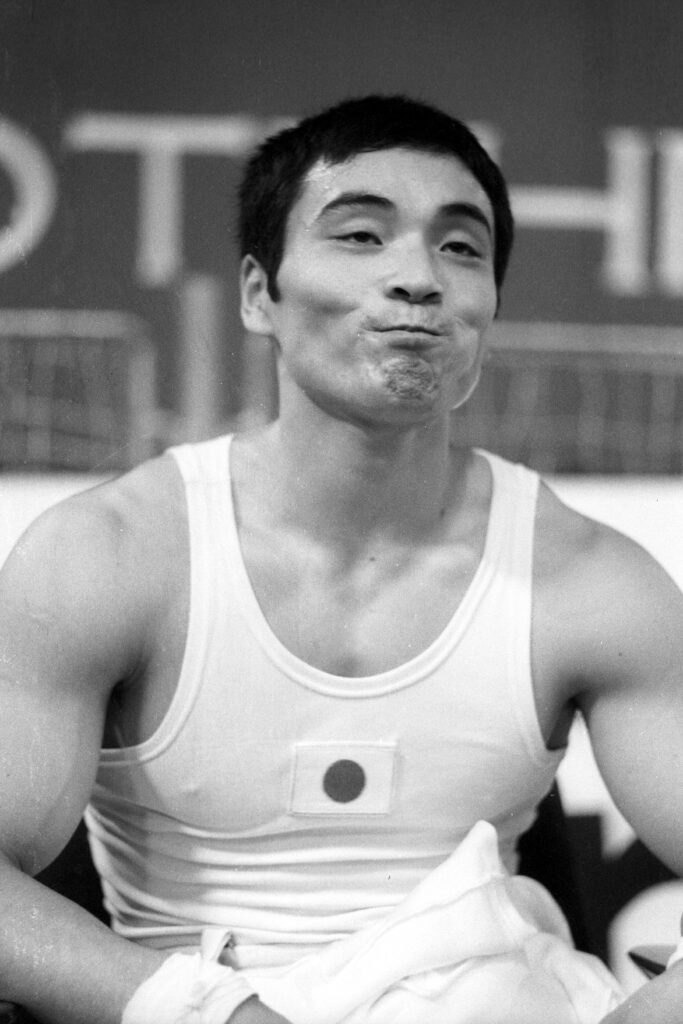
Challenging the Yamashita Vault
Reflecting on the Mexico Games, I decided on my first course of action. As an all-around gymnast, I needed to eliminate my weaknesses before anything else.
At the time, I believed I was terrible at the Yamashita vault. Ever since it had been introduced at the Tokyo Olympics, nearly every gymnast had adopted it in optional competition. I could perform it, but I never scored much higher than 9.2 or 9.3.
Determined to solve the problem, I devoted more time that winter to distance running. I thought that strengthening my legs would improve my Yamashita vault. It didn’t. No matter how much I trained, it showed no signs of improving.
Every university has specialists—gymnasts who are exceptionally gifted on one apparatus and seem able to master any skill on it. One of my classmates was just such a vault specialist.
One day he was practicing on the women’s vaulting horse—which in those days was set crosswise, unlike the men’s lengthwise horse. After pushing off the springboard, he made a half turn into a handstand on the horse, then drove powerfully through his arms into a backward somersault.
Watching him, I thought, That looks like an interesting skill, and tried it myself.
Rotating wasn’t difficult at all.
The more I tried it, the more interested I became. At first I treated it as nothing more than play. I simply couldn’t believe it could ever become an official vault. It lacked the very quality most essential to vaulting—grandeur. It looked less like a vault than as though you were simply falling off the horse.
As I continued fooling around with it, a thought suddenly occurred to me: Why not try it on the men’s horse?
The first attempts were unsuccessful. Because the men’s horse was longer, I couldn’t complete the half turn as I had on the women’s horse. My hands landed one behind the other, allowing only a quarter turn, and I couldn’t get my body into position for the backward somersault.
But after two or three more attempts, I managed to connect it into the salto.
Even then, it was still only a game to me.
Yet that awkward skill—lacking both grandeur and beauty—would eventually become the prototype of the Tsukahara vault. In fact, it was born precisely because I had first conceived it while experimenting on the women’s horse.
No one—not even my classmate, the vault specialist—believed the skill had any future.
“It’s impossible. Even if you add twists, when you block off the horse, you can’t push equally with both hands. There’s no way you’ll ever generate the speed or amplitude of the Yamashita vault.”
Nearly everyone shared that opinion.
That was when my contrary streak surfaced.
Everyone says it can’t be done. Then I’ll complete it and prove that it can.
I immediately began training this unlikely skill in earnest. Surrounded by people whose expressions seemed to say, It’s pointless. You’ll only waste your time. I began my special training on vault.
Absorbed in Whatever I Do
Would this skill ever develop the same amplitude as the Yamashita vault if I simply kept practicing it?
There were moments when I wondered if I should abandon it and devote myself instead to mastering the Yamashita. But I kept going.
Partly, I suppose, out of sheer stubbornness.
I’ve already started. I’ll keep at it until it becomes a vault worthy of recognition.
Yes, it was persistence bordering on obsession.
Whether because of my determination or simply because my efforts finally paid off, the vault gradually acquired the amplitude I had been striving for.
My heels are unusually large even today. They are a lasting consequence of that vault. Repeating the skill over and over, especially at full speed, inevitably made me land on my heels. As the vault neared completion, I struggled almost every day with compression sprains in my heels.
The Tsukahara vault was born at the cost of those heel injuries.
Even now, I find myself thinking, I really was unbelievably stubborn. Whether you call it persistence or simply an inability to give up, I can only shake my head at my own personality. Yet that very stubbornness was what ultimately led to the completion of the Tsukahara vault.
By nature, once something captures my interest, I become so completely absorbed that I lose all awareness of what is happening around me.
I remember one evening when I was very young.
The family was gathered happily around the dinner table when someone suddenly exclaimed, “Where’s Mitsuo? He isn’t here.”
“That’s terrible! He still hasn’t come home!”
My mother, father, grandmother, and grandfather immediately panicked. In an instant, the cheerful atmosphere disappeared, replaced by frantic concern. Thinking I had once again wandered off and gotten lost while trailing after my mother, everyone split up to search for me.
The sun had long since gone down, and it was pitch dark outside.
My grandmother later admitted that she even had the dreadful thought, What if he’s been kidnapped?
Completely oblivious to my family’s anxiety, I had become so engrossed in playing that I even forgot I was hungry.
No matter where they searched, they couldn’t find me.
Finally a neighbor came by.
“I just found your little Mitsuo playing under our kitchen floor. I kept hearing strange splashing and rustling noises and thought perhaps there were mice under there. When I looked beneath the floorboards, there was Mitsuo, covered in mud and happily playing. It gave me quite a fright!”
As it turned out, I had become fascinated by the water dripping down from the kitchen above and had spent hours completely absorbed in playing beneath the floor.
My mother and the rest of the family were so astonished that they forgot to scold me.
That same personality would serve me throughout my athletic career—not only in the creation of the Tsukahara vault, but in every challenge I faced as a gymnast.
Unveiling the Tsukahara Vault
In March 1970, I graduated from Nippon Sport Science University and joined Kawai Musical Instruments. I took my first steps as a company-sponsored gymnast with the Kawai Gymnastics Club.
That year I devoted myself to preparing for the World Championships in Ljubljana, Yugoslavia.
The first stage of the World Championship selection had already been held at the previous year’s All-Japan Championships, and the second qualifying meet was fast approaching.
The maiden voyage of the Tsukahara vault was about to begin.
My heel injury remained chronic. Every practice session left it swollen, but fortunately, it did not interfere with my performance.
The second World Championship qualifying meet began.
As I approached the runway for my optional vault, I was filled with determination.
This time I’ll do it beautifully. I’ll show everyone this vault deserves to be judged alongside the Yamashita vault.
I accelerated down the runway and drove powerfully off the springboard.
A quarter turn.
Hands onto the horse.
Another quarter turn.
I blocked off the horse and tucked into a backward somersault.
I’ve got it…
At that very instant, I landed on my backside.
Ah… I failed.
My heart sank.
The first public unveiling of the Tsukahara vault had ended in failure.
Competition simply felt different from practice.
I’ll have to train even harder.
I attempted the vault again at the final qualifying meet.
This time I managed to stay on my feet, but the score was only a little over 9.0.
Fortunately, my performances on the other apparatus were strong enough to earn me a place on the Japanese national team.
Once the team had been selected, we held a series of training camps before departing overseas.
From morning until night, our days consisted entirely of gymnastics.
Those camps proved enormously effective in improving both my physical condition and my technique.
During one of them, I experimented with performing the Tsukahara vault in a piked position rather than tucked.
Normally, a gymnastics skill develops in stages: first tucked, then piked, and finally laid out.
To my surprise, I discovered that the Tsukahara was actually easier in the piked position than in the tucked one.
The pike allowed me to snap my body like a whip.
As soon as I made that change, the vault suddenly took on real amplitude and grandeur.
Yes… This is it.
Like a fish that is returned to water, I threw myself into practicing the piked Tsukahara over and over again.
After successfully completing our domestic training camp, we departed Japan.
We had an entire week to adjust to the time difference, and I felt in superb condition.
Following another training camp in Romania, we traveled to Ljubljana, Yugoslavia.
The piked Tsukahara, polished still further during our stay in Romania, was finally ready to be unveiled on the world stage.
Before the competition began, one question arose while deciding the competition order.
Where should I be placed in the vault lineup?
No one had the slightest idea how this completely new vault would be judged.
After a lengthy discussion, the coaches finally reached a decision.
“Let’s put him last.”
Being placed last in the lineup traditionally meant occupying the team’s ace position—the spot reserved for the gymnast expected to contend for the all-around title.
Because gymnastics is a judged sport, scores tend to rise as the competition progresses. Even if every gymnast performs equally well, those competing later often receive slightly higher marks.
For that reason, the team’s ace normally performs last on every apparatus.
Anyone hoping to become world champion must first earn that privileged position by finishing first in the domestic selection process.
In my case, however, assigning me the final position was a gamble.
No one knew whether the Tsukahara vault would prove to be a triumph or a disaster.
If the judges appreciated it fully, it could earn an exceptionally high score.
If not, I could simply be regarded as a sacrificial pawn.
The result?
Only one foot shifted slightly on the landing.
The vault had height.
It had amplitude.
Even I felt satisfied with it.
The score appeared:
9.75.
It had been recognized as a true Ultra C.
I was in excellent form that day. The piked Tsukahara now possessed a grandeur it had never shown before.
The gymnasts from around the world—and the spectators filling the arena—responded to this completely unfamiliar vault with enthusiastic applause and cheers.
Even today I can still hear them shouting:
“Tsukahara! Tsukahara!”
From the piked Tsukahara came the layout Tsukahara. Then came the full-twisting Tsukahara, with the twist added during the latter half of the somersault. Later, Kasamatsu refined the idea further and created the Kasamatsu vault.
The family of Tsukahara vaults continued to evolve.
And for me personally, completing the Tsukahara vault laid the foundation for my next Ultra C—the Moon Somersault.
From: Endless Challenge: My Youth Devoted to the “Moon Somersault” 果てしなき挑戦:「月面宙返り」に賭けたわが青春
Additional Materials
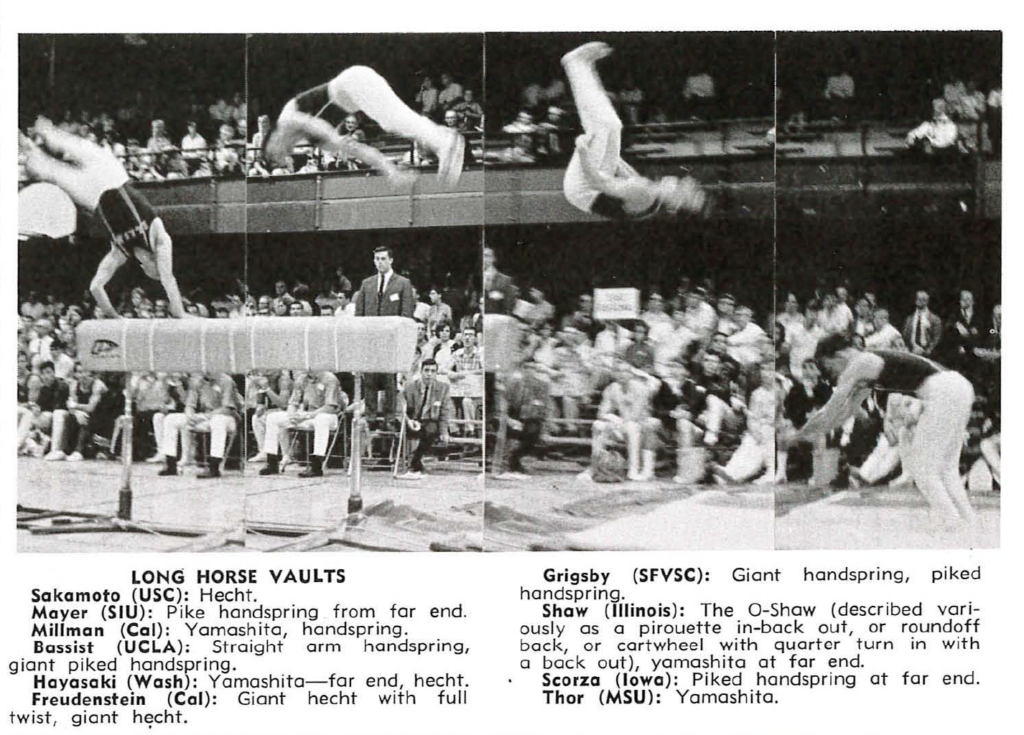
Source: Modern Gymnast, May 1968
In 2004, Tsukahara offered a more succinct—and slightly different—account in an interview with the FIG during the Athens Olympics.
The reason for creating “Tsukahara” in Vault was that I was not really good at performing “Yamashita”. So I thought if there is anything else I can do and was playing (experimenting) different ways and by chance, I performed “Tsukahara” and decided to include in Vault.
More on Japanese gymnastics:
One reply on “Tsukahara on the Origin of the Tsukahara Vault”
Another “super” vault performed first in 1970 was the handspring front by Okamura at the FISU Games in Torino in August that year.