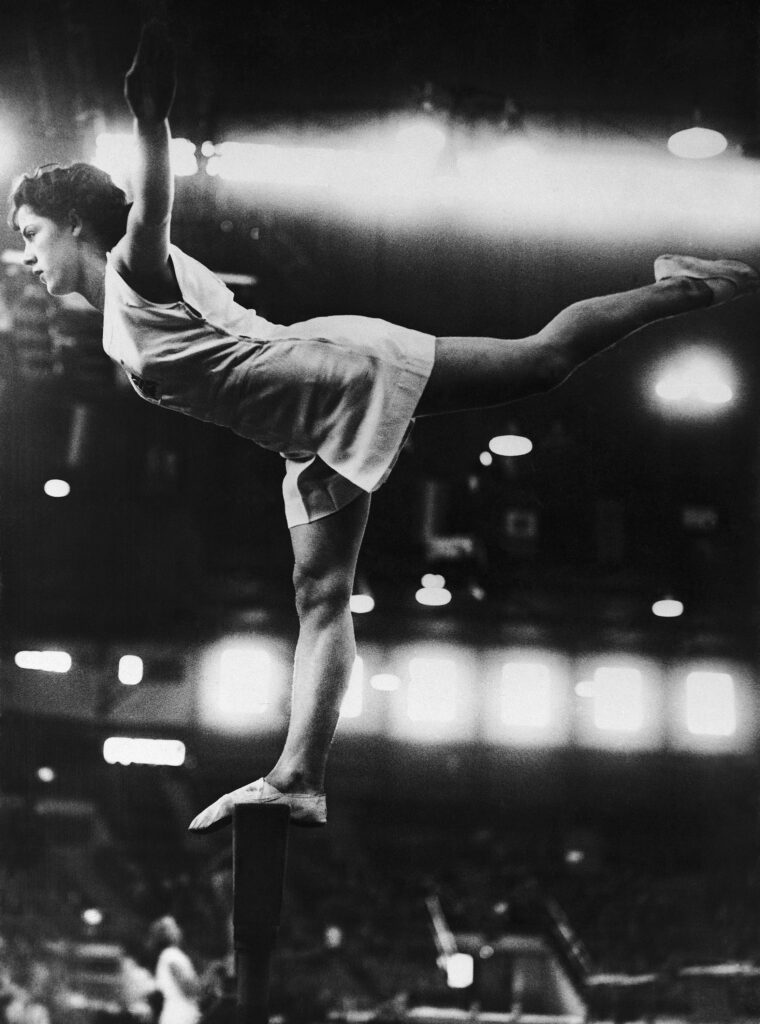
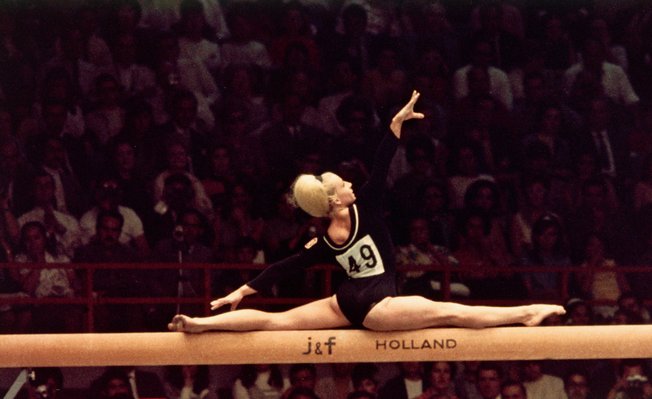
On Monday, October 21, 1968, the women’s compulsories opened the gymnastics competition at the Olympics in Mexico City.
And, as we’ll see, the crowd was very invested in the competition.

On Monday, October 21, 1968, the women’s compulsories opened the gymnastics competition at the Olympics in Mexico City.
And, as we’ll see, the crowd was very invested in the competition.

Why is our national team suddenly so young? It seems to be a recurring question in the Soviet press in the late 1960s, and there were several explanations.
In an article from 1967, one writer suggested that it’s because the Soviet Union was trying to keep pace with the likes of Věra Čáslavská, who made her international debut at the age of 16 at the 1958 World Championships in Moscow.
The articles from 1968 told a different story.
In the first article below, the explanation will sound more familiar to today’s gym nerds. It has to do with the presumed innocence and naïveté of female gymnasts before they reach adulthood.
In the second article, Larisa Latynina offers a slightly different rendition of the rise of the teenage gymnast.
And finally, we’ll take a look at an Estonian article about Larisa Petrik and what she reportedly did with her pigtails.
At the 1967 European Championships, Czechoslovak gymnast Věra Čáslavská scored two 10.0s. One year later, during the lead-up to the Mexico City Olympics, the Soviet gymnasts scored four 10.0s at their domestic competitions.
Given the flurry of 10.0s just before the 1968 Olympics, it’s somewhat surprising that there weren’t any 10.0s in Mexico City.
Let’s take a look at what happened at the USSR Nationals and the USSR Cup.
After Čáslavská scored two 10.0s at the 1967 European Championships, a flurry of 10.0s appeared in national competitions during the lead-up to the Mexico City Olympics. Two of the recipients were Erika Zuchold and Karin Janz.
At the East German Championships in July of 1968, Zuchold scored 10.0s on both optional floor and vault, and Janz scored a 10.0 on her optional vault.
What follows is a translation of an article from Neues Deutschland.

Let’s take a look at the compulsories for the 1968 Olympic Games in Mexico City, including the piano sheet music!
The bar routine turned out to be brutal. Every single team had at least one gymnast score in the 8s (or lower) — even the Soviet Union.
In 1968, the Women’s Technical Committee President Berthe Villancher visited the United States. During her tour, she explained the 1968 Code of Points. This included her unwritten rules and preferences.
Let’s take a look at what she said.
Note: Villancher’s comments have been filtered through Jackie Uphues, who chronicled Villancher’s time in the United States for Mademoiselle Gymnast May/June 1968. (Jackie Uphues might be better known as Jackie Fie to some readers.)
Unless otherwise indicated, all quotes are from Mademoiselle Gymnast May/June 1968.

The 1968 Code of Points was to be ready by May 1, 1968. Opening ceremonies for the 1968 Olympics were set for October 12, 1968. That’s not a lot of time to read the Code and adjust routines.
Thankfully, compared to the men’s Code, the women’s Code was much shorter. Let’s take a look at some of the most salient parts.

Most gym nerds know about Věra Čáslavská’s political stance on the podium at the 1968 Olympics in Mexico City. (If you don’t, Google it. There’s plenty that has been written about it.)
But did you know that some saw tension between Čáslavská and the Soviet gymnasts already at the 1966 World Championships?
On October 1, 1966, the Feuille d’avis de Neuchatel published a column called “Le sport vu par une femme” (“Sports as Seen by a Woman”), chastizing Věra Čáslavská for her actions on the podium. Here’s what it said…

Recap: Doris Brause’s uneven bars routine created quite the sensation at the 1966 World Championships. When she received a 9.766 on bars, the crowd stopped the meet for over an hour, hoping to coerce the judges into raising her score.
The judges didn’t budge.
But uneven bars would never be the same again.
The gymnastics community was buzzing about the women’s competition in Dortmund in 1966. The Soviet Union brought a younger team to the competition, which raised several questions.
Could the Soviets continue to win the team competition?
Could stalwarts like Čáslavská and Latynina continue to dominate the sport?
*Insert dramatic music*
Let’s find out…