During the September 1998 National Championships, several emerging Chinese gymnasts made a strong impression. Among them was Xu Jing. But as the People’s Daily, China’s official state newspaper, noted at the time, Xu was too young to compete at the December Asian Games. And yet, just a few months later, she was in Bangkok, winning gold medals with the team and on floor.
So when was Xu Jing born? It’s not easy to say with precision. What follows is the documentary record—the paper trail that traces how her age has been reported over time.
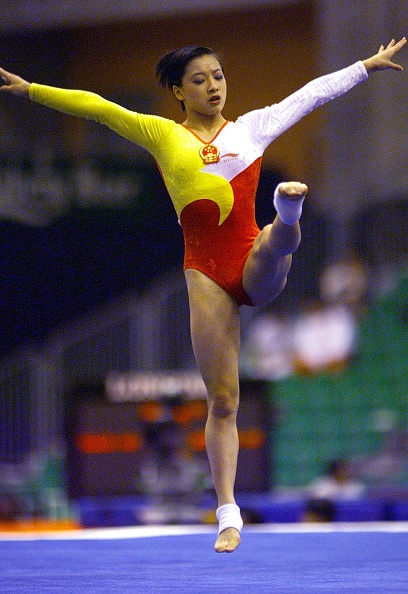
Photo by YOSHIKAZU TSUNO / AFP via Getty Images
In September 1998, both Ling Jie and Xu Jing were considered too young to compete at that year’s Asian Games, as they were reportedly only 14 or 15.
Building on Solid Foundations to Develop Difficulty — A Review of the National Gymnastics Championships
People’s Daily, our correspondent Xu Liqun (Dateline: Tianjin, September 21)
The National Gymnastics Championships were held from the 15th to the 20th at the Tianjin Gymnasium. This was a full dress rehearsal for next year’s World Gymnastics Championships to be held in our country, with competition rules, apparatus, venue, and hospitality arrangements all conducted according to the World Championships model.
[…]
Young Women’s Talent Breaking Through
The most gratifying aspect of this competition was the high level displayed by a large cohort of young female athletes.
At the previous World Championships, Zhang Jian, director of the National Gymnastics Administrative Centre, had still been worried about the inadequacy of the women’s team’s reserve strength. This time, however, a group of young athletes aged 14 and 15 — Guangdong’s Huang Mandan, Peng Sha, and Chen Miaojie; Beijing’s Xu Jing and Bai Chunyue; Hebei’s Dong Fangxiao; Hunan’s Ling Jie and Chen Mi — put in pleasing performances. The most outstanding among them was Guangdong’s 15-year-old Huang Mandan, a young girl competing in her first national championship who placed third in the women’s all-around, demonstrating exceptional ability and remarkable composure in the face of many established stars.
After the competition, Lu Shanzhen, head coach of the national women’s gymnastics team, told our reporter excitedly that these young athletes are the newcomers who quickly stepped up after a cohort of veterans retired following last year’s 8th National Games. Unlike certain elite athletes of the past who relied on high difficulty in individual events to win, these girls have balanced strength across all four events — they are genuinely all-around athletes of a kind rarely seen, well-suited to the direction in which world gymnastics is developing.
Because of their young age, most of them will probably be unable to participate in this year’s Asian Games or next year’s World Championships. But their emergence has brought new hope that Chinese women’s gymnastics as a whole will rise to a new level — the 2000 Olympics should be the stage on which they can truly shine.
[…]
立足稳健发展难度——全国体操锦标赛述评
第5版(教育·科技·文化·体育)
专栏:
立足稳健发展难度
——全国体操锦标赛述评
本报记者 许立群
全国体操锦标赛于15日至20日在天津体育馆进行,这是为明年在我国举行的世界体操锦标赛进行的一次大彩排,比赛规则、器材、场地、接待等都是按照世界锦标赛模式进行。
湖北男队和北京女队获得男女团体冠军,北京的张津京和湖南的刘璇摘取男女个人全能桂冠。10枚单项金牌分布为,男子6项:湖南李小鹏获得跳马和双杠两金,张津京、江苏黄旭分获单杠和双杠冠军,山东邢傲伟、天津董震执鞍马和吊环牛耳。女子4项:北京孟菲独揽平衡木和自由体操两金,山东毕文静和河北董方宵分摘高低杠和跳马桂冠。
女子新苗崭露头角
本次比赛最令人欣喜的是女子项目上一大批年轻选手发挥出较高的水平。
上届世锦赛时,国家体操管理中心主任张健还在为女队的后备力量的不足而担忧。而这次,广东的黄曼丹、彭莎、陈淼洁,北京的许婧、白春月,河北的董方宵,湖南的凌洁、陈密等一批年龄在14、15岁的小将表现喜人。其中最为突出的当属广东15岁小将黄曼丹,这位第一次参加全国大赛就夺得女子全能第三名的小姑娘面对众多名将,表现出高超的水平和不凡的勇气。
赛后,国家体操女队总教练陆善真兴奋地告诉记者,这些小将是在去年八运会一批老队员退役后很快顶上来的新秀,不同以往一些尖子选手靠个别项目难度高取胜,她们4个项目实力平均,是难得的全能型选手,与世界体操的发展趋势相适应。
由于年龄太小,她们中的大部分可能参加不了今年的亚运会和明年的世锦赛,但她们的涌现,为中国女子体操整体水平跃上新台阶带来了新的希望,2000年奥运会当是她们尽情挥洒的舞台。
稳中求新稳中求难
体操的发展在于创新,本届比赛又有新的动作令人称道。广东选手卢裕富在跳马比赛中,首次成功地完成了世界上独一无二的惊险高难创新动作“侧手翻屈体后空翻两周半”,裁判亮出了9.85的高分。卢裕富在前不久的友好运动会上首次让这一跳亮相,动作虽不很完美,但却令体操界为之一震,并将这惊世一跳命名为“卢裕富跳”。
此外,肖俊峰跳马“团身前空翻两周转体180度”,也是目前世界上跳出这个高难动作的唯一一人,李小鹏、卢裕富在自由体操中也都很好地完成了“直体后空翻两周转体720度”的动作。
应当说,友好运动会上“桑兰事件”或多或少给中国体操界带来了阴影。但短短数月后,我国体操选手们重又显现出勇攀世界高峰的大无畏气概。
尽管本次比赛各项目的金牌无一例外地为国家集训队的主力所取得,但他们在赛场上均有不同程度的失误甚至失败,让人不禁为他们的稳定性担忧。
男子全能决赛,卢裕富从单杠、双杠上两次掉下,在跳马单项决赛中,他又落地不稳,丢掉了冠军;李小鹏、肖俊峰、陆斌也有过不同程度的失败,连全能冠军张津京在团体决赛中也曾单杠脱手,得分不到9分;女子单项,曾在去年全运会夺得3枚金牌的湖南选手凌洁平衡木也出现较大失误;自由体操决赛甚至只有几名选手把全套动作成功地完成下来。这表明要想经受住大赛的考验,我们的选手们还需要进一步加强磨练。(本报天津9月21日电)
People’s Daily, September 22, 1998, page 5
Note #1: In the People’s Daily report, Dong Fangxiao was grouped among athletes said to be 14–15 years old. We now know she was born in 1986, which would have made her only twelve at the 1998 National Championships.
Note #2: Huang Mandan is described as a 15-year-old, implying a 1983 birth year. However, she uses a 1984 birth year in the United States.
Bear in mind that this is the People’s Daily—not the Forward Roll Gym Blog—reporting that these gymnasts would be too young to compete at the Asian Games. Yet by December, both Ling Jie and Xu Jing suddenly appeared with 1982 birth years, which made them 16 and eligible for the competition in Bangkok.
Many Westerners overlook the importance of the Asian Games during this period and the extent to which ages appear to have been adjusted in preparation for them. Xu Jing is not an isolated case but part of a broader pattern, one that also touches more prominent figures such as Mo Huilan.
This was not the only time Chinese media contradicted Xu Jing’s official FIG birthdate. Even during her career, a 1982 birth year did not hold. For instance, in 2001, in the lead-up to the National Games, the Beijing Evening News described Xu Jing as an 18-year-old, implying a 1983 birth year given her February birthday.
Within the Beijing women’s gymnastics squad’s full roster, two names stand out: Bai Chunyue and Xu Jing. Both eighteen-year-old “veterans” are mainstays of the national team. Bai Chunyue in particular is regarded as a technically well-rounded performer; she won silver on the balance beam at the recently concluded World University Games gymnastics competition.
Beijing Evening News, November 2, 2001
在北京体操女队的大名单中,白春月和许婧的名字格外引人注目,这两位18岁的“老将”都是国家队的主力,尤其是白春月,更是一位技术全面的高手,在刚刚结束的大运会体
Today, however, Chinese-language encyclopedia pages list Xu Jing’s birthdate as February 1, 1984—an age that would have made her just fourteen at the time of both the 1998 National Championships and the Asian Games.

Xu Jing, born February 1, 1984, began training in gymnastics in 1988. In 1994, she came to Xiannongtan and became a member of the Beijing gymnastics team.
Basic information:
Date of birth: February 1, 1984
Height/weight: 153 cm / 42 kg
Career information: [Read more]
Outside of China, it is difficult to determine the basis for this 1984 date because the encyclopedia entry is not accessible to foreigners. But its publication underscores a broader problem. Writing in the Southern Metropolis Daily in 2010, Liu Hongbo observed:
The fact that a Chinese athlete’s birth year and month have become impossible to pin down — with accounts changing repeatedly, and discrepancies appearing across school enrollment records, athlete registration forms, identity cards, and employment documents, with athletes themselves giving inconsistent statements about their own birthdays — is itself the problem.
中国运动员连出生于何年何月,都变得无法弄清,说法数变,学籍卡、运动员注册表、身份证、工作证,各不相同,运动员对自己的出生日期说起来也会忽前忽后,这本身就是问题。
Here, we can see how a single gymnast has multiple birthdates on record. Depending on the source—be it the official FIG listing, Chinese-language newspaper reports, or later online profiles—three different birth years emerge: 1982, 1983, and 1984.
Amid this confusion, one point stands out: Xu Jing was not born in 1982. Even China’s official newspaper did not think so.
Videos
Here is Xu Jing’s gold-medal-winning floor routine from 1998.
Appendix A: A Short Profile of Xu Jing from New Sport
Profiles of Xu Jing are not easy to come by. Here is one short blurb from the Chinese magazine New Sport.
☆ Getting Close to the Stars ☆
A Chance Encounter with Xu Jing
I had originally gone to the national gymnastics team compound to visit Kui Yuan, but once inside I had a new idea: why not take the opportunity to meet Xu Jing while I was there?
I waited at the entrance to the training hall, eyes fixed on each athlete emerging from inside. After about ten minutes, Xu Jing finally came out. Seeing her for the first time, my excitement was mixed with surprise — she was so petite and delicate. Dressed in her training gear, her cheeks were flushed red and beads of sweat still clung to her forehead. When I explained my purpose, she was happy to talk.
Our conversation began outside the training hall. Xu Jing told me she had only joined the national team after the 8th National Games. The 13th Asian Games were her first official appearance in international competition, and she came away richly rewarded — winning gold in floor exercise and, together with her teammates, taking the women’s team gold as well.
Xu Jing is an all-around athlete, with floor exercise, vault, and uneven bars all among her specialties. Even as far back as last year’s National Gymnastics Championships and the China Cup, Xu Jing’s performances had already been turning heads.
Her interests are quite varied: she enjoys listening to songs by Faye Wong, Miriam Yeung, and others, though she likes popular music generally. Among film stars, she is fond of Anita Yuen and Leslie Cheung.
According to Xu Jing, after lunch she returns to the dormitory for a brief rest, then has dance class at 2 o’clock, followed by training again at 3:30. By the time she gets back to the dormitory it is around 8 in the evening, and lights out is at 10. The next morning, while everyone else is still asleep, they must get up again and train, train, and train some more without pause.
As busy as Xu Jing is, she still chatted with me all this time. After thanking her repeatedly, I reluctantly said my goodbyes.
Tianjin — Yu Ling
New Sport, May 15, 1999
☆ 走近明星 ☆
邂逅许婧
本想去国家体操队看望奎媛,走进大院又萌发新想法,不如顺便见见许婧。
我守候在训练馆门口,目不转睛地盯着从馆里走出来的一个个运动员。大约过了10分钟,许婧终于从训练馆走了出来。初见许婧,我兴奋中更多的是惊讶,她是那么的小巧玲珑,只见身穿运动服的她脸红扑扑的,额头上还挂着汗珠。我说明来意,她很高兴。
我们的攀谈在训练馆外开始了。许婧说,她是八运会后才进入国家队的。第13届亚运会是她第一次在国际比赛中正式亮相,而且收获颇丰,不仅夺得了自由操的金牌,还与队友合作取得了女团金牌。
许婧是位全能型选手,自由操、跳马、高低杠都是她的强项。早在去年的全国体操锦标赛和中国杯体操赛上,许婧的表现就令人刮目相看了。
许婧的爱好也蛮广泛的,她喜欢听王菲、梁咏琪等人的歌,不过,只要是流行歌曲都喜欢,影星则喜欢袁咏仪和张国荣。
据许婧讲,吃过中饭后,回宿舍小憩片刻,2点钟上舞蹈课,3点半接着训练,回宿舍后差不多是晚上8点,10点钟便熄灯了。第二天当人们还在熟睡时,她们就又要起床,马不停蹄地练、练,再练。
许婧这么忙,仍和我聊了这么久,我再三道谢后依依不舍地和她道了别。
天津 雨玲
Appendix B: An Analysis of Xu Jing’s Cuervo
It’s fascinating to see a gymnast’s vault broken down through scientific analysis. It’s gym nerdery at its finest. I’ve translated the first section of the paper below.
Note: In this academic article, the authors, including the head coach of the national team, use Xu Jing’s official birthdate to calculate her age.
Kinematic Analysis of Xu Jing’s Layout Cuervo Vault
Zhang Zhen, He Bo, Yao Xiawen, Lu Shanzhen
(Department of Physical Education, Zhaoqing University, Zhaoqing, Guangdong, 526061)
Sport Science 21.5 (2001): 50-52; 70.
许婧跳马直体奎尔沃腾越运动学分析
张贞,何波,姚侠文,陆善真
( 肇庆学院体育系,广东肇庆 526061)
1. Introduction
As history’s footsteps are about to cross into the new twenty-first century, competitive gymnastics is advancing rapidly in step with the times. Every major world competition sees the emergence of difficult new elements. To achieve outstanding results in world competition, one must continually research and illuminate the techniques of difficult new elements, and on that basis innovate even more advanced ones.
The international women’s gymnastics code of points is constantly changing, guiding the technical development of women’s gymnastics in the direction of “high difficulty, high quality, variety, and elegance.” The specific requirements the code places on vault have also increased its difficulty demands. There remains a large gap between the current vaulting technical level of our country’s athletes and what the code requires. To change this situation and enable our women’s vaulting to make greater breakthroughs in world competition, it is essential to prioritize and strengthen the training and research of women’s vault, and to accelerate the innovation and development of high-difficulty elements. Currently the development of women’s vault movements falls into three main types: front handspring class, round-off [Yurchenko] class, and 180° rotation class. The developmental focus for difficult new elements remains in the second flight phase after the push from the horse. This paper analyzes the layout Cuervo — formally termed the front handspring with 180° twist and layout back somersault — a Group E element under the code with a start value of 9.9, and one of the highest-difficulty elements mastered by our country’s female athletes, belonging to the front handspring class. Statistical data from vault event finals at world competitions from 1995 to 1997 show that very few athletes are capable of completing a layout Cuervo. From domestic and international literature, especially since the women’s vault apparatus height was raised to 1.25m, no one has yet conducted quantitative research on the women’s layout Cuervo. For this reason, the author undertakes a kinematic analysis of this element, with the aim of identifying the technical characteristics and general kinematic laws governing Xu Jing’s execution of it, and providing relevant technical parameters as a theoretical and practical reference for our country’s athletes in improving and developing this category of vaulting technique.
2. Research Subject and Methods
2.1 Research Subject
Xu Jing is a member of the national training squad and a key member of the women’s team of China’s gymnastics delegation to the 13th Asian Games. Her height is 1.43m, weight 35kg, age 16. She placed third in the women’s vault competition at the 13th Asian Games with a score of 9.625.
2.2 Research Methods
2.2.1 Literature Review
More than 50 domestic and international sources dating from 1988 onward were consulted to understand the state of research at home and abroad, and relevant materials were collected and organized for reference.2.2.2 Survey and Interview Method
From October 1998 to April 1999, investigations and interviews were conducted with senior coaches and athletes of the national training squad, researchers at the General Administration of Sport of China, and professors and associate professors in the field of gymnastics.2.2.3 Statistical Processing
The types of vault elements performed in vault event finals at world gymnastics competitions from 1995 to 1997 and at the preliminary rounds of the 8th National Games in 1997 were tabulated. The collected data were smoothed using a low-pass filter with a cutoff frequency of 8Hz. Analysis, screening, and comparative organization of the test data reports were carried out on a 586 PC using Windows 98 as the Chinese-language platform, with WPS97 word processing software used to complete the writing of the paper and the production of figures and charts. A CASIO tx-82C pocket calculator was also used for relevant data processing.2.2.4 Kinematic Research Method
(1) Filming of the movement. On November 12, 1998, during one vault training session before the athletes departed for the 13th Asian Games, two Japanese high-definition video cameras were used from different fixed angles to synchronously film the complete process of Xu Jing’s layout Cuervo. A total of 10 attempts were filmed; three of the better-executed attempts were selected for analysis, designated A, B, and C. Both cameras were equipped with internal time calibration; filming speed was 50 fields per second and exposure time 1/250s. Camera A was positioned 15m from the horizontal center point of the horse, at a height of 1.82m, on the south side of the landing area; Camera B was positioned 10m from the horizontal center point of the horse, at a height of 1.73m, on the south side of the runway. The shooting angle between Camera A and Camera B was 65°. The scale reference method used a radiated three-dimensional fixed-point frame (CHT2); the three-dimensional coordinate frame was filmed before recording the movement.
(2) Three-dimensional video analysis. At the Aijie Human Body Information Research Institute in the Science Building of Beijing Sport University, three-dimensional video analysis was conducted using the Aijie Sports Image and Graphics Measurement and Analysis System. Using the Zatsiorsky human body model (16 segments, 23 node points), three sets totalling 392 frames of movement were analyzed, yielding more than 34,000 data points and producing spatial point coordinates, velocity, angular parameters, and center-of-gravity trajectory diagrams throughout the movement.
3. Results and Analysis
The layout Cuervo as a complete movement can be divided into seven phases: run-up, board contact, take-off, first flight, push-off, second flight, and landing. Based on the needs of the research and the constraints of the filming conditions, this paper focuses its analysis on the key technical phases of take-off, first flight, push-off, and second flight.
3.1 Brief Analysis of Movement Execution
In terms of overall movement quality, all three attempts were of relatively good quality and consistency. Flight height ranged from 2.26 to 2.33m; landing distance ranged from 2.18 to 2.26m; landings were essentially controlled.
From the perspective of the center-of-gravity trajectory in the vertical plane: during the board contact phase the parabolic trajectory of the center of gravity showed relatively little fluctuation; after the take-off, the parabolic trajectory of the first flight gradually rose; the push-off was completed during the ascending phase of the body’s center-of-gravity parabola; after the push-off, the anterior portion of the second-flight center-of-gravity parabola rose in an arc to its highest point, after which the posterior portion descended in an arc under gravity until landing. From the perspective of the center-of-gravity trajectory in the sagittal plane, the body’s center of gravity followed essentially a vertical curve.
From the horizontal velocity data measured in this paper, the overall trend showed horizontal velocity to be greatest during the board contact phase, gradually decreasing through the take-off and push-off phases, and stabilizing as the movement entered the second flight phase.
From the perspective of time distribution across phases: across the three attempts, the average total time from take-off to landing was 1.25 seconds. The proportion of time occupied by each phase was as follows: average take-off time 0.10s, representing 8.0% of total time; average first flight time 0.19s, representing 15.5% of total time; average push-off time 0.16s, representing 12.8% of total time; average second flight time 0.79s, representing 63.7% of total time.
[…]
More on Age