The following chapter is drawn from Xuanmu (璇木), the autobiography of Olympic champion Liu Xuan, published in 2012. Written more than a decade after her retirement, the memoir combines recollections of her competitive career with reflections on the lessons she drew from sport.
In this chapter, Liu recounts the balance beam final at the 2000 Sydney Olympics, the last competition of her career and the performance that earned her Olympic gold. She describes the immense pressure surrounding the event, China’s pursuit of its gymnastics medal targets, and her struggle to compete through a painful back injury. Looking back from the vantage point of adulthood, she presents the competition not merely as an athletic achievement but as a lesson in composure, self-mastery, and finding balance amid uncertainty.
The chapter also contains an interesting historical detail: Liu explains that she did not learn she had been elevated to the Olympic all-around bronze medal until the day after the beam final, when she was informed that Romania’s Andreea Răducan had been disqualified following a positive doping test. Even while acknowledging her own gain, Liu expresses sympathy for Răducan, reflecting on the sacrifices and hardships shared by elite gymnasts regardless of nationality.
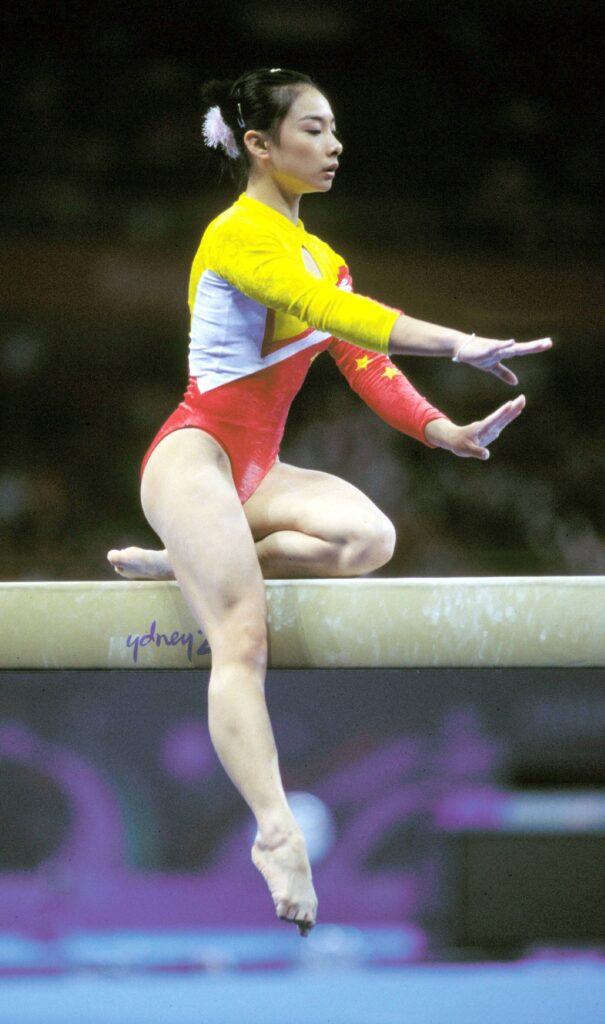
Even now, I can still clearly remember the sense of dark clouds gathering over the Chinese team on the day before the balance beam final.
That highly charged atmosphere arose first from the broader circumstances. Before departing, the Chinese gymnastics team had set a target of winning three gold medals at these Games, but with all the gymnastics competitions nearly concluded, we had only managed to win one gold — in the men’s team competition. On the final day, five individual event titles were to be decided. Among the five events — balance beam, floor exercise, vault, parallel bars, and horizontal bar — only balance beam and parallel bars offered realistic gold medal prospects for us. The entire team had to win both to fulfill the target, but a hundred-percent success rate was easier said than done. Moreover, balance beam — the event that best reflects a nation’s level in women’s gymnastics — had long been dominated at the Olympics by Romania and Russia. No Chinese gymnast had ever won Olympic gold on beam. No one dared say that China was certain to win gold. The mood across the whole team was extremely heavy.
On top of that, I faced personal pressure as well. Although my mindset during the all-around had been quite relaxed, I had carried no medal obligation then. For beam, I not only had the ability to contend for the top, but as team captain I also bore the responsibility of fulfilling the team’s target. My back injury, already aggravated by the all-around, was hurting more than ever. Inside, I felt as though a storm were about to break.
That night I lay face-down on my bed, changed two medicated patches, and tossed and turned, unable to sleep.
The next day at the venue, the arena felt like a pressure cooker; the air was dense, and breathing was difficult.
The balance beam competition was the first of the two gold-medal events for the Chinese team that day. Among the women’s team, both Ling Jie and I had qualified for the final. She competed fifth; I competed last. In an individual event final, the order of competition is an objective factor that is hard to evaluate. Unlike a team competition — where judges watch the overall lineup of a team and scores naturally build upward — in individual finals, judges score purely on each athlete’s personal execution. In past major competitions, there have been cases where the first gymnast put up an outstanding routine, all seven gymnasts who followed felt the pressure of that score and fell short, and the first competitor ultimately won. Going last has both advantages and disadvantages: the advantage is obviously that competing last makes it easy to seal the title with one decisive performance. But the drawback is also clear. Individual event finals are structured so that one event concludes before the next begins, to give the audience maximum satisfaction. When you are the last to compete, the feeling of everyone watching you is enormously destabilizing psychologically. Also, watching everyone else compete first can cause an athlete’s nervous system to go from high tension to a kind of slack, which affects performance. Everyone knows that balance beam is easier to train than to compete on: once stray thoughts enter your mind during competition, wobbles become likely, or you may fall. In this event, above all, it comes down to a test of mental composure.
Before the competition, I did my final warm-up on the beam. As I was preparing to do the layout series, I suddenly felt a sharp, stabbing pain in my injured back and had no choice but to abandon the final layout backflip. After dismounting, the medicinal fluid from the patch on my lower back had seeped out. My teammates asked what was wrong, but I didn’t dare answer — I just turned and walked aside to continue warming up off the apparatus.
I did not watch the first four competitors. I stood at the side of the floor silently running through the movements and rehearsing the key points, trying to keep my full attention on the coming competition. But when Ling Jie went up fifth, I couldn’t help glancing at the podium. Her first half was very steady, but during an Onodi, she wobbled — a wobble worth at least a 0.3-point deduction. In an individual event final, an error like that means the gold is gone entirely.
After seeing Ling Jie’s error, I didn’t dare look at the rest. Because at that moment I knew: everyone had placed the responsibility of winning a medal entirely on my shoulders.
At that moment, my nerves had reached their absolute limit. As far as I can recall, this was the most tense single instant of my entire competitive life. When I heard the announcement that Ling Jie had scored only 9.675, a score that might not even place her in the top three, I felt an invisible weight pressing down on me.
I knew this individual event final was not only about competing for myself — it was about completing the team’s target.
I felt my heart accelerating faster and faster, and my hands had begun to shake quite visibly. I kept telling myself, hard: you have to hold steady. You must hold steady.
For me, when I’m nervous, the best release is movement; physical activity can discharge my tension. So I kept doing dance-throughs on the floor. Xiao Jing, the female coach who had accompanied us into the Athletes’ Village, came running over and grabbed my arm. “Xuan,” she said, “stop. You’ve already done eight full dance sequences. You’ve competed in three events in a row; your body won’t be able to take it.” I could tell everyone around me had been alarmed by my frantic warm-up. They were all worried that a veteran athlete burning herself out like this would have nothing left for the actual competition.
The beam podium was very close to the venue’s exit. To conserve energy while still releasing my emotions, I ran alone to the exit and quietly sang to myself outside the arena. After singing for a while, my emotions gradually settled. I then immediately began running through the beam routine’s key points in my mind.
By the time the coach came to call me to the waiting area, my emotional state had calmed considerably, but my hands were still trembling.
Because I hadn’t watched the other competitors, I didn’t know the scores. While waiting backstage, I heard someone say: “The field is incredibly strong; not one person has fallen.” So I couldn’t help glancing at the scoreboard. On the big screen, two Russian gymnasts — Lobaznyuk and Elena Produnova — were sitting in first and second place, at 9.787 and 9.775, respectively. Those scores were extremely high. To win the gold, I would need to score at least 9.788, meaning I could not afford any mistake on the beam or on the dismount, and absolutely had to stick the landing.
Seeing those scores, the pressure surged back again, and my mind began to waver. By then, the seventh competitor had finished. It was my turn.
As I stepped up to the podium, I still smiled and saluted. I told myself: however nervous I feel inside, I must project absolute calm outwardly; that is the only way to first stabilize myself.
As I prepared to mount, standing on the springboard, I suddenly asked myself: “Are you afraid of failure?”
“It’s not like I’ve never lost before! What is there to be afraid of!” In the instant I raised my head and saluted, I shouted this at myself inwardly, at full volume.
My trembling hands finally touched the beam. At that moment, my heart suddenly became calm. I felt the beam was something I knew intimately; we were almost one body. As I pressed up into the straddle-up to handstand, I realized I was completely in control of this apparatus. My emotions steadied. In that moment, I had no fear at all. Even the jumbled, anxious desires dissolved. I felt at peace, able to face any failure with equanimity, able to accept failure gracefully.
Although at first my movements were somewhat tight — during the layout series my body was slightly off-axis in the air — because my mind was completely free of distracting thoughts, I could control my body with ease. When I landed the layout back-flip solidly upright on the beam, the confidence I felt in my own self-control deepened further.
Next, in the stag-ring leap combination, there was a small wobble, but I was able to compensate easily with a dance movement. And then I fully let go. Believing in myself became everything at that moment. I threw myself into the dance movements — every gesture sharp and precise. This state of self-mastery allowed me to cleanly execute the wolf jump into back walkover with a 90° turn to handstand, the Yang Bo leap, the single-leg 360° turn, and the switch-ring leap combination. Approaching the dismount, I told myself: “You must stick it.” My single thought was: even if I end up sitting on the floor, my feet had to stay planted.
Years later, watching the replay of this competition, I couldn’t help but marvel at the sheer ferocity in my eyes right before that dismount; it was truly intense.
My dismount was a double back. When I came around to one-and-a-half rotations, I felt it inside: “Got it.” Got it — meaning I was definitely going to stick the landing. In that fraction of a second, I believed in myself. This is why self-awareness is so crucial: when you truly know yourself, you can control yourself.
When both feet gripped the floor and held firm, I smiled.
In the final competition of my career, I performed in a way that satisfied me. I had conquered myself. And in that instant, I suddenly understood the true meaning of the balance beam. Only by learning to face everything with serenity and accept everything with equanimity can one find balance amid the ten thousand things of this world.
Perhaps that is the ultimate meaning of the balance beam as one of the oldest traditional athletic disciplines.
[Note: In her early chapters, Liu Xuan discusses her attempts to become one with the wood of the balance beam.]
Although I had performed well, I was genuinely pessimistic about the scoring. After what I felt were two World Championships where my scores had been held down, I no longer held any expectations for judges’ decisions. I was satisfied with my performance, and I felt it was enough to have ended my gymnastics career with a high-quality beam routine.
The score took a long time to appear. Only after the audience had been clapping in a sustained, rhythmic way for some time did it come up.
I didn’t see the score immediately. But through the warmth of the applause I sensed I might have won the gold. The coaches had crowded in front of me, blocking my line of sight — everyone was hoping this gold would fall to the Chinese team. Only when Coach Lu and Xiao Jing turned around and moved to embrace me did I finally clearly see my score: 9.825!
I had won the gold!
After all those who had opposed my competing at the Olympics at my advanced age, I answered every doubt with a gold medal. I buried my face in Coach Lu’s arms and wept. Too many feelings surged up at once — a complex mixture of emotions. I had completed my target. I had finally won an Olympic gold medal.
But I quickly brought my emotions under control, ran back up to the podium, and acknowledged the audience. My performance had won them over, and their applause had moved the judges. After enduring one unjust decision after another, I had finally, in the embrace of the audience’s applause, claimed this richly deserved Olympic championship.
In the post-competition interview, when reporters asked how I felt about winning, my mind went completely blank.
This blankness was entirely different from the blankness after falling from the bars in 1996. That blankness had come from fear, shock, and helplessness — a kind of numb void. But this blankness came from joy and elation; inside I felt grounded and solid. This kind of blankness makes you feel that happiness has arrived with deep roots and a firm foundation.
While waiting for the medal ceremony, Coach Lu immediately called Coach Liu, who was staying in a nearby town. We both choked up several times on the phone. Coach Liu’s hoarse voice kept saying, “Xuan, you were incredible!” By the end, both of us had tears streaming down our faces. I knew what Coach Liu was going through. In the days just before entering the Olympic Village, the team had decided that Coach Liu would remain outside the Village, and that Dong Fangxiao’s coach would enter the competition venue instead — so that the younger team members could perform at their best. In deference to the team’s organizational arrangement, Coach Liu had once again sacrificed herself. When she learned she would not be able to personally accompany the three athletes she had raised and trained into the Olympic competition, she had quietly broken down and wept alone. So on the phone I told her: “Coach Liu, I have completed the target for both of us! This championship belongs to you too!”
Immediately afterward, I used Coach Lu’s phone to call my parents, who had been watching my competition in Beijing. When I said “Dad, I won!” over the phone, I heard my father choke up and manage only three words: “My good daughter…” It was only after I returned home that my mother told me: they had been watching on a small television in the basement, my mother holding a camera, my father holding a scoring sheet. When they saw me win the championship, the two of them threw their arms around each other — jumping, crying, and laughing all at once.
As I prepared for the medal ceremony, I told myself: absolutely no crying. I would keep my most beautiful smile for Sydney.
This was my final competition. I would never again appear on the international stage as an athlete, so I had to smile.
But when you step onto the medal podium, watch the five-starred red flag rise slowly, hear the stirring national anthem fill your ears, in a distant foreign land — a great pride in being Chinese rises naturally within you. In that moment, tears are the most uncontrollable product of emotion.
I don’t know whether I managed to hold that most beautiful smile in that moment. But I know that in that moment, many of the people who love me felt the same happiness I did.
Coming down from the podium, my emotions settled somewhat. What I felt then was more gratitude than joy. I knew this was not the result of my efforts alone — it was the achievement of the entire Chinese gymnastics team. It was the achievement of Coach Lu, Coach Liu, Director Zhang Jian, “Father Gao,” Head Coach Huang Yubin, and also the coaches who did not ultimately walk me to the highest podium — Coach Guo, Coach Zhang, Coach Hu — as well as every coach from my earliest training days. It was also the achievement of the whole-nation sports system — that form of training that efficiently allocates the nation’s competitive sports resources and created our entire generation of athletes. So this championship belongs to everyone!
September 25, 2000 was truly a fortunate day for the Chinese gymnastics team.
After winning the gold and walking through the corridor, it happened to be just as the men’s parallel bars competition was preparing to begin. Xiaopeng said to me: “Sister Xuan, congratulations! Give me some of your luck!” And with that, we, two fellow Hunanese, embraced. I told him: “The good luck will definitely pass to you! Go for it, Peng Peng!”
That day, Xiaopeng’s perfect performance won over the judges, and he too won gold on parallel bars with a score of 9.825. That day, China’s five-starred red flag rose twice, and the national anthem rang through the arena twice. That day, every Chinese spectator and delegation member in the venue erupted. That day, the Chinese gymnastics team fully and perfectly completed its mission at the 27th Olympic Games. And that day, many foreign spectators gave a thumbs-up to every Chinese athlete and coach they saw in team uniform.
That day was China’s day in Olympic gymnastics.
The following day, as was customary, we participated in the gold medalists’ exhibition — a gala performance arranged by the Olympic Committee to thank the audience. As I was warming up on the beam, Coach Lu walked over, grinning and said in his characteristic deadpan humor: “When good luck comes, nothing can stop it!”
Through Coach Lu’s explanation, I learned for the first time that Răducan had been disqualified because a cold medicine she had taken before competing contained a stimulant substance, and consequently, my all-around ranking moved up one place — I had apparently won a bronze medal. Personally, of course, it was something to be glad about. But I also felt deep sympathy for Răducan, because at that time, her form and technique were unquestionably those of the all-around champion. To lose that gold medal through an oversight would surely become the regret of her lifetime.
In our era, Răducan, Khorkina, Amanar, Elena… —every young female athlete had endured untold suffering in order to bloom fully on the competition floor. That is why, whenever I read the epitaph of Lyudmila — the beautiful Soviet female sniper — I am always particularly moved. “Suffering lasts so long, moving with the patient steadiness of a snail; happiness is so brief, like a rabbit’s tail sweeping across the autumn steppe.”
Indeed, the instant of winning a championship is so fleeting compared to the years of grueling training that precede it. Each of us, while still in girlhood, had already learned early to grit our teeth and press on regardless of personal cost. We are ordinary and real, just like everyone else — only we devoted a period of our lives to condensing all our pain into a brief athletic career for the honor of our country. Those years were like a tunnel that only willpower could carry you through, and a landscape no number of words could ever fully describe.
People have always asked me: after winning the gold at the Sydney Olympics, what did you feel? I have said before: to defeat others, you must first defeat yourself.
Now, twelve years have passed. If I were to share again what I learned from winning the Olympic championship, I would say: “That balance beam competition at the 2000 Olympics taught me the truth of ‘let not a single thought arise; lay down ten thousand thoughts.'”
After twelve years of growth and experience, I believe: only when we have rationally dissolved both our desires and our fears can our hearts obtain love and joy, strength and courage. Only by setting down all stray thoughts can we truly dwell without artifice in each present moment of life. This is precisely why I was able to maintain concentration and clear my mind of distractions during that competition.
The balance beam is like a measuring rod for life. Only when you have eliminated fear and desire can you possess a peaceful heart, learn the principle of balance, and truly achieve “balance.” The equilibrium of body and mind allows a person to pick up, put down, and find ease.
Today, my world no longer spins.
Even as the earth slowly revolves and rotates, even as the material world whirls in chaos, I can still maintain an ordinary, undisturbed mind — existing within it all, finding a kind of balance.
More on Chinese gymnastics: