Within China, age falsification in sport is less a subject of dispute than an accepted reality. As Chao Bai wrote in the Southern Daily in 2010, “We do not need foreigners to point it out. We already know that the ages given for many Chinese athletes are far from reliable.” (我们不须外国人道来,我们也知道我国很多运动员的年龄都不大靠谱。)
The harder question—the one that Chinese commentators, academics, and journalists have wrestled with more seriously than foreign observers tend to realize—is not whether falsification happens, but who is responsible for it.
In February 2010, the International Gymnastics Federation confirmed that Dong Fangxiao had competed at the 2000 Sydney Olympics at fourteen years old, three years younger than her registered age. The Chinese women’s team lost its bronze medals from the 1999 World Championships and the 2000 Olympics. The official response from the Chinese Gymnastics Association was prompt and consistent: Dong’s falsification had been a purely personal act.
But many Chinese commentators refused to accept that framing. Together, their articles trace a line of responsibility that runs from a broader sports culture all the way to China’s Gymnastics Center itself. What follows examines age falsification through the lens of Chinese newspapers, beginning with the official narrative.
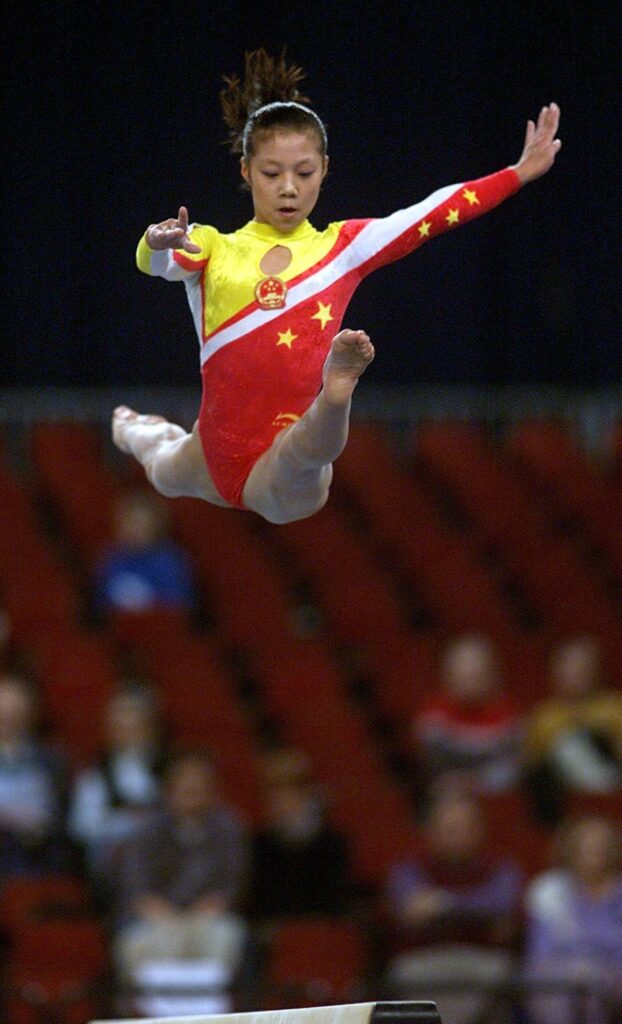
The Official Story: Individual Responsibility
On February 22, 2011, Xinhua—the official news agency of the Chinese state—published an exposé on age falsification in gymnastics. The story it told was simultaneously damning and innocuous.
The piece centered on an anonymous female gymnast identified only as Xiao He. Born in a southern city, she was six years old when her parents moved her household registration—her hukou—to a remote mountain village in the north. Her original identity records were wiped. After 10,000 yuan changed hands, she was registered as four years old. Two years had been erased, purchased through a rural official, in a place where, as the article noted, “household registration is not so strictly managed.”
The rationale was straightforward. In the early years of training, an older child competing against younger ones carries a compounding advantage: greater physical development, more years of practice, deeper technical formation. Appearing younger than she was, Xiao He could dominate her cohort while her body and skills matured ahead of schedule.
At her real age of ten, the process reversed. Her hukou was moved again, this time to an even more remote village in the south. After this second migration, she emerged as twelve. The two years that had been subtracted were now restored—and then some.
The reasoning was just as pragmatic. The International Gymnastics Federation sets a minimum age of sixteen for Olympic competition. Chinese gymnastics culture maintains that female gymnasts, however, tend to peak before puberty, when subcutaneous fat is minimal, and flexibility is at its height. By the time most reach their genuine sixteenth birthday, their bodies have already begun to change. The solution was to age them on paper before their bodies caught up, buying eligibility during the narrow window in which they remained most competitive.
Within gymnastics circles, the practice had its own vocabulary: quxian gailing, “curved age alteration”—or, with darker historical irony, an echo of the Cultural Revolution’s shangshan xiaxiang, which refers to the “sent-down youth” campaign that once dispatched millions of urban children to the countryside.
In Xinhua’s telling, the mechanics of the deception remain resolutely local. The money is a family expense. The migrations are family decisions. The erasure and reconstruction of identity—across multiple jurisdictions, requiring the cooperation of local officials—are presented as something parents arrange, like school enrollment.
But the most obvious question goes unasked. Where did Xiao He’s parents learn to do this? The larger sports bureaucracy that would later rely on such records does not appear in the story.
Xinhua, in other words, does not deny that age falsification exists. It simply contains it, locating both its origins and its execution at the lowest rung of the sports system: the individual and her family.
But Xinhua was not the only publication to address the issue. Other writers, working in the same moment, offered explanations that pushed responsibility far beyond the family.
The Culture
Ci Xin’s piece in the China Youth Daily came on the heels of the 2011 figure skating “age gate” that implicated up to twelve Chinese skaters. To show that the problem ran deeper than any single sport, he looked down the entire youth athletics pipeline.
As a reporter, he had seen age falsification firsthand, and he described what happens when reporters interview these young athletes about something as basic as their own birthdays:
“This reporter has frequently encountered a revealing phenomenon when interviewing athletes: ask them how old they are, and they often have to think for a long time, sometimes even consulting teammates before answering — because some athletes have changed their ages not once but multiple times, and have lost track of their own versions.”
记者在采访不少运动员时就常常遇到一个奇怪的现象,当问及这些运动员的年龄时,他们往往要思考半天,甚至要与自己的队友讨论一番,因为有的运动员不仅改了年龄,还改了不止一次,年龄改来改去,连自己都糊涂了。
Athletes cannot seem to remember when they were born. To explain this phenomenon, Ci Xin turned to coaches for answers. He interviewed Mr. Wang, a recently retired boxing coach from a southern province whose own official age had been reduced by two years during his career. Wang described the practice with the casual matter-of-factness of someone explaining the weather:
“In order to achieve good results as early as possible, falsifying ages in the youth stage to compete as older athletes against younger ones is completely unremarkable in Chinese domestic sport. Just think: among adolescents who are still physically developing, being two years older can easily translate into a clear advantage in physical capacity and technical ability.”
为了尽早取得好成绩,在青少年阶段改年龄进而”以大打小”,在国内体坛已是见怪不怪。试想,处于身体发育期的青少年,年长两岁就很可能形成身体素质和技术能力方面的明显优势。
The logic varies by sport. In many sports, athletes reduce their registered ages so that older, stronger competitors can face younger cohorts. In gymnastics, figure skating, and diving, the reverse applies: the thinking goes that younger bodies carry an advantage in flexibility and form, so registration ages are inflated upward to meet domestic and international minimums. Dong Fangxiao’s age, Ci Xin notes, was bumped up by three years for exactly this reason.
Because almost every regional team does it, a kind of equilibrium emerges at the national level: athletes of the same real age still face one another, albeit under altered ages. But this apparent balance masks a coercive culture. Any coach or athlete who chooses to play by the rules is effectively doomed, forced to compete on an uneven field. As Mr. Wang put it, “An athlete who doesn’t falsify their age will be at a disadvantage unless their physical and technical abilities are truly exceptional.” (不改年龄的运动员,除非身体素质和技术能力极其出众,否则肯定会吃亏。)
An unnamed industry expert told Ci Xin that the culture of Chinese competitive athletics—focused on winning trophies and gold medals at any cost—was the primary reason young athletes manipulate their ages.
Other writers, however, push the argument further, reframing the issue not as a specifically Chinese problem but as a feature of elite sports culture more broadly. In a 2010 Southern Weekend piece titled “Who Took Away China’s Medal?”, referring to the medals that the FIG stripped, the authors argue that all systems operate under similar pressures—and that, at the highest levels of competition, those pressures can produce similar outcomes:
“Regardless of which sporting system, in today’s world of extreme competitive athletics, all systems permit brutal competition to exist, drive athletes beyond limits without restraint, and tolerate victory by any means necessary — producing fraud, doping, corruption, and all their derivatives as natural consequences. “
“不论何种体育体制,在当今极端的竞技运动世界中,所有的体制都允许残酷的竞争存在,漫无节制地驱使运动员超越极限,容忍不择手段地夺取胜利——舞弊、服药、腐败及其所有派生物,都是其自然而然的结果。”
Not every country turns to age falsification to win. The question is what distinguishes the ones that do, and in China, the answer runs through the state.
The State
Writing in the Southern Metropolis Daily days after the FIG’s 2010 ruling on Dong Fangxiao, Liu Hongbo rejected individual blame from the outset. What struck him first was not the fraud itself, but the fact that no one in China seemed to notice the age discrepancy:
What is regrettable is that the determination of Dong Fangxiao’s actual age was not made by Chinese sporting authorities. Although the Chinese gymnastics team stated that it cooperated fully with the FIG investigation, the fact remains that the FIG launched that investigation entirely on the basis of publicly available anomalies — anomalies that had never come to the attention of China’s own sporting bodies.
令人遗憾的是,董芳霄年龄的认定,不是由中国体育部门做出。尽管中国体操队表示全力配合了国际体联的调查,但毕竟国际体联之所以展开调查,完全是基于一些公开的疑点,而这些疑点并没有进入中国体育部门的视线。
When these contradictions surfaced, the sports establishment went into denial. Lu Shanzhen — Deputy Director of the Gymnastics Management Center and head coach of the women’s team — flatly deflected: “I trust that what the provincial and municipal sports bureaus reported is the athletes’ true ages.” After the medals were stripped, he and the Chinese Gymnastics Association insisted the ruling was based on “insufficient evidence” and reserved the right to appeal.
Liu’s response was bone-dry:
“What, exactly, would constitute ‘sufficient evidence’? The fact that a Chinese athlete’s birth year and month have become impossible to pin down—with accounts changing repeatedly, and discrepancies appearing across school enrollment records, athlete registration forms, identity cards, and employment documents, with athletes themselves giving inconsistent statements about their own birthdays—is itself the problem.”
怎样才算”充分证据”?中国运动员连出生于何年何月,都变得无法弄清,说法数变,学籍卡、运动员注册表、身份证、工作证,各不相同,运动员对自己的出生日期说起来也会忽前忽后,这本身就是问题。
From this point, Liu’s argument moves beyond the immediate case. His deeper claim follows from a simple premise: sport in China operates as a state enterprise. When age falsification becomes pervasive under such conditions, it is difficult to view it as anything other than a systemic, state-linked outcome.
Sport in China is a state enterprise, not a simple social pursuit or matter of personal interest. The whole-nation system, the gold-medal strategy, and the patriotic emotion of “Five-star Red Flag, I am proud of you” that accompanies athletic victory — all of this reflects that reality. Accordingly, the problems that emerge in Chinese sport are understood as problems of state conduct. Doping, for instance, and age falsification — both are treated, fundamentally, as national embarrassments. The state exercises full authority over sport and therefore bears the full consequences. Individual athletes who falsify may be acting on personal motives, but when falsification becomes a widespread pattern, it is difficult to characterize it as anything other than a systemic phenomenon.
体育在中国是一种国家行为,而不是简单的社会事业和个人兴趣,举国体制、金牌战略和运动优胜后”五星红旗我为你骄傲”的抒情,都是表现。因此,中国体育所出现的问题,也被理解为国家行为的问题。例如兴奋剂,例如年龄造假,基本上都会被视为国家的污点。国家对体育行使全权,从而也承担全部后果。个别运动员造假,可算是个人原因,但如果运动造假成了普遍现象,那么就很难不说是一种体制性行为。
That argument leads Liu to a broader warning. When a state systematically manufactures official fictions for the sake of international prestige, it corrodes its own global credibility:
“A diploma, a transcript, a birth certificate, a professional history, a set of research materials that you personally provide may all be regarded as unreliable. Credentials, performance reports, and expense documentation submitted by companies or institutions may be regarded as unreliable. Statistical data released by the state may be regarded as unreliable.”
你个人提供的学历证明、成绩表格、出生证明、任职经历、论文材料可能被视为不可信,企业或者机构提供的资质证明、业绩报告、活动费用等等可能被视为不可信,国家提供的统计数据可能被视为不可信。
The final question is the essay’s sharpest: “If the world cannot be asked to trust so much as an athlete’s birth date, how are we to be trusted in anything at all?” (如果连运动员的年龄都不足以取信世人,我们怎能在世界上取信于人?)
The Gymnastics Center
Chao Bai, writing in the Southern Daily days after Liu, turned from the abstract question of state responsibility to something more specific: the particular excuses being made by a particular official.
Gymnastics Center Director Luo Chaoyi had gone on the defensive. He claimed that Dong’s Olympic paperwork had been accurate at the time and argued that the three-year reduction in her registered age must have been a private forgery concocted by the athlete and her parents after she retired.
It’s an explanation that many found preposterous. As Ci Xin observed, the Chinese Gymnastics Association went to extraordinary lengths to deflect institutional responsibility. Chao Bai was incredulous. The discrepancy, he noted, had been identified by the international community simply by watching a televised interview—Dong’s own words, broadcast nationally during the Beijing Games. If foreign journalists could spot the contradiction from a single interview, the athletic departments responsible for her records had no plausible excuse. “The conclusion is obvious,” Chao wrote. “It was not that they could not have known, but that they chose not to act.” (显然,他们是“非不能也,实不为也”。)
He then constructed a rhetorical trap:
“If Dong Fangxiao at the time acted on her own initiative to reduce her age in order to compete, thereby deceiving the organization, the Center is guilty at minimum of a failure of oversight, and owes the Chinese public an apology. On the other hand, if it was the authorities themselves who manipulated her age to meet some ‘national requirement’ in pursuit of medals, then her restoring her correct age upon retirement would be entirely natural. If that interpretation holds, the essential precondition for Dong Fangxiao’s supposed ‘individual act’ was, in fact, a collective one.”
倘若董芳霄当年为了参赛出于”个人行为”而把年龄改小,欺骗了组织,他们至少该属于失察,要对国人表示歉意。另一方面,倘若是他们为了所谓牌牌而硬让人家的年龄符合”国家需要”,那么人家在退役后把年龄改回来就实属正常不过。这个判断成立的话,导致董芳霄”个人行为”的关键前提,仍然是”集体行为”。
Chao’s dilemma leaves the Center with no flattering option. Either it failed in its supervisory duty, or it was complicit in the original fraud. There is no version of events in which the institution emerges as an innocent party.
To show that this pattern of manipulating official records was not confined to gymnastics, Chao pointed to Wang Yali, a regional official who had recently been caught subtracting five years from her age to meet the eligibility threshold for political promotion. The sports bureaucracy and the party bureaucracy were operating from the same playbook.
Domestically, a system that tolerates infinite contradictions can sustain itself indefinitely; as the local idiom has it, “when you have too many lice, you stop feeling the bites” (虱子多了不咬人). In such an environment, inconsistency ceases to register as a problem at all. But on the international stage, where trust rests on verifiable facts, a forged birth date cannot be overlooked so easily. What is tolerated at home becomes a question of credibility abroad. In that sense, the handling of the Dong Fangxiao case did not simply expose an individual violation; it raised a broader question about the reliability of the system that produced it, and the national reputation tied to it.
The Persistence of the Problem
No single account—whether cultural, institutional, or individual—can fully explain the persistence of age falsification. Each of these perspectives captures part of the truth. The state, its governing bodies, and the broader culture of competitive sport do not operate in isolation; they reinforce one another, creating the conditions in which age falsification becomes not an aberration, but a predictable outcome.
A 2011 report in Times Business News, written in the wake of the figure skating controversy, makes this dynamic explicit, describing age falsification not as an isolated violation but as a “grotesque byproduct” of China’s Olympic gold medal strategy—an imperative set at the highest levels of sport. As one veteran coach explained, such practices are not decisions athletes or coaches can make on their own, but are instead carried out through “coordinated cooperation among multiple interested parties” across an entire chain of incentives.
Within such a system, elite sport takes the shape of a pyramid: only a small number of athletes reach the top, while the rest become the material from which it is built. The pressure to advance is relentless, and age falsification becomes one of many available strategies to win at any cost—less an aberration than a consequence of how the system is built.
Seen in that light, the persistent discrepancies in Chinese women’s gymnastics are less surprising. They are the bureaucratic residue of a system in which eligibility rules, competitive pressure, and institutional incentives continually pull records out of alignment with reality.
They are not exceptions to the system but traces of how it works.
Notes
1. If Xiao He’s story is true, her age was changed before she ever needed an FIG license, meaning it would have passed undetected.
2. Despite its nominal status as an independent governing body affiliated with the FIG, the Chinese Gymnastics Association is in practice controlled by the state-run National Gymnastics Management Centre, with significant overlap in senior personnel between the two organizations. Luo Chaoyi, for instance, simultaneously served as NGMC Director and CGA President from 2013 to 2017. In this article, I do not make an effort to disentangle the two organizations — if it is even possible to do so.
3. Chao Bai states that foreign journalists uncovered Dong Fangxiao’s age discrepancy through an interview she gave. While that is indeed how Yang Yun’s case came to light, I have not seen this claim substantiated in English-language coverage of Dong Fangxiao’s age. In addition to her Olympic credential, journalists typically mentioned her personal blog:
Dong’s blog also said she was born in the Year of the Ox in the Chinese zodiac, which dates from Feb. 20, 1985, to Feb. 8, 1986.
4. Here is the full quote from the anonymous soccer coach.
Gold Medal Strategy: Athletes Sucked into the Age-Falsification Black Hole
金牌战略:运动员陷入改龄“黑洞”
Many people may wonder why the General Administration of Sport has been unable to stamp out age falsification — a practice that violates fair competition — despite repeated prohibitions. The answer is straightforward. “Age falsification is a grotesque byproduct of China’s Olympic gold medal strategy. This is not something athletes or coaches can simply decide to do on their own — it is the result of coordinated cooperation among multiple interested parties across a whole chain of incentives,” said a veteran football coach who spoke with this reporter yesterday. “Elite sport is a pyramid. Only a handful of people can stand at its apex; the vast majority must become the sacrificial material from which the base is built. And to avoid being sacrificed, people will try every available means — even if that means stopping at nothing to claw their way to the top.”
也许很多人不解,为何中国体育总局对于运动员改龄这一违背公平竞争的行为屡禁不止?答案很简单。“改龄是中国奥运金牌战略的畸形产物。改龄这种见不得光的事,不是运动员或教练员所能改就能改的,这是一个利益链下各相关部门联手合作的结果。”昨天,一位资深足球教练在接受本报记者采访时称, “竞技体育是一个金字塔,最后能站在塔尖上的毕竟是少数人,而大部分人则要成为搭建塔基的牺牲品。为了不成为牺牲品,就要想尽一切办法,哪怕是不择手段也要爬上塔尖。”
Archived here
5. Even China Central Television, the state broadcaster, has acknowledged that age falsification in gymnastics exists and is aimed at securing medals.
Unlike soccer, basketball, and gymnastics, where “age games” are played in the pursuit of honors, China’s absolute dominance in table tennis means there is no need to falsify ages for major international competitions. Instead, age fraud appears more often in youth competitions.
与足球、篮球、体操等项目为了争夺荣誉玩”年龄游戏”不同,由于中国在乒乓球项目上拥有绝对的统治地位,因此不需要因为国际大赛而篡改年龄。相反,年龄造假更多地出现在青少年比赛中。
Archived here.
Appendix: Full English Translations
Inside the Gymnastics Age Scandal: Frequent Hukou Changes—10,000 Yuan to Cut Two Years Off
Xinhua News Agency | Feb 22, 2011
Among all sports, gymnastics is relatively unusual. In most sports, athletes tend to lower their ages, but in gymnastics, ages are sometimes lowered and sometimes raised—repeatedly adjusted back and forth. In interviews, reporters uncovered many insider accounts of gymnasts altering their ages: before age 10, they “compete as older athletes against younger ones”; after age 10, they “compete as younger athletes against older ones.” Only after retirement do they return to their real age. One female gymnast, Xiao He, experienced this convoluted process. To carry it out, her household registration (hukou) was moved repeatedly—north to rural areas, then south to the countryside—an exhausting ordeal.
Nationwide databases still can’t stop age falsification
Before identity records were networked nationwide, changing one’s age was not especially difficult. With enough money and the right connections, it could be done. Did computerization put an end to it? Not at all. Insiders say: if someone wants to fake something, nothing is impossible.
Xiao He was born in a southern city. At age six, her parents moved her household registration to a remote mountain village in the north, wiping out her original identity records. After paying 10,000 yuan to register her there, she became four years old on paper. When she reached her real age of ten, her registration was moved again—this time to an even more remote southern village. After this second change, she became twelve. Insiders explain that in remote areas, household registration is less strictly managed, making falsification much easier—as long as one is willing to pay. Within the gymnastics community, this practice is called “curved age alteration,” or a modern version of the old “sent-down youth” (shangshan xiaxiang).
Sometimes older than you, sometimes younger than you
What are the benefits of these repeated changes? One insider explained that before age 10, being even one year older means significantly greater understanding and training, so competing against children one or two years younger makes it much easier to achieve strong results. In this respect, gymnastics is similar to other sports.
At the 2005 National Games, rhythmic gymnastics star Zhong Ling publicly exposed misconduct within her sport. The controversy escalated into mutual accusations of age fraud. Media reports at the time showed cases of athletes winning national youth titles at age 13 and then again at age 15—despite the fact that the maximum age for youth competitions is 13.
After age 10, however, female gymnasts begin to face the challenges of puberty. Physical development brings increased subcutaneous fat, which is detrimental in a sport requiring extreme agility. As a result, gymnasts aim to achieve results before puberty. At the same time, the International Gymnastics Federation sets a minimum age of 16 for Olympic participation. By that age, many gymnasts have grown taller or gained weight, losing some of their earlier lightness. To get around this, ages are adjusted upward.
This dynamic surfaced in a well-known incident involving Yang Yun. In a 2007 interview with CCTV, she let slip that she had won her Sydney Olympic medal at age 14. She later claimed it was a verbal mistake, but the implication was obvious.
[Note: Even Xinhua is admitting that Yang Yun was underage in Sydney.]Of course, many athletes prefer to appear younger. After retirement, they often change their ages back again. The high-profile case of Dong Fangxiao came to light precisely because she reverted to her real age, exposing inconsistencies.
Related: Olympic medal revoked
On April 28, 2010, the International Olympic Committee announced that the Chinese women’s gymnastics team would be stripped of its bronze medal from the 2000 Sydney Olympics. The medal was re-awarded to the United States.
The decision was based on findings that Dong Fangxiao, who competed in Sydney, was under the minimum age of 16 at the time. Registration records from the 2008 Beijing Olympics listed her birthdate as January 23, 1986, which would have made her 14 in 2000—violating International Gymnastics Federation rules.
After the investigation, officials from the Gymnastics Management Center of the General Administration of Sport stated that Dong Fangxiao’s age falsification was likely the result of actions taken by her and her family.
“Figure Skating’s ‘Age Gate’ Is a Good Opportunity for Chinese Sport to Examine Itself” Ci Xin, China Youth Daily, February 18, 2011
Two days after the Chinese Skating Association clarified that Zhang Dan and Zhang Hao’s ages were not in question, there is no sign that the figure skating “age gate” scandal is dying down. Today further media reports emerged claiming that three younger members of the Chinese figure skating team — Yan Han, Zang Wenbo, and Xu Zuoren — are also suspected of age falsification. When this reporter contacted the National Winter Sports Management Center today, we were told that since the center’s figure skating director is currently leading the team at the Four Continents Figure Skating Championships in Taipei, any further findings from an investigation into the “age gate” matter will likely have to wait until that competition concludes.
Whatever the ultimate outcome, however, this incident has already done clear damage to China’s sporting image. Multiple foreign media outlets have pursued the story, and even the International Olympic Committee has weighed in, calling on the Chinese Skating Association to conduct a targeted and thorough investigation. In recent years — most prominently with the case of Dong Fangxiao, whom the International Gymnastics Federation formally determined had falsified her age — the age issue among Chinese athletes has attracted enormous international attention. Now, with as many as twelve Chinese figure skaters’ ages under suspicion, it has again prompted widespread domestic and international doubt about why Chinese athletes keep finding themselves caught in “age gate” scandals. And in fact, age manipulation among Chinese athletes is far from an isolated phenomenon.
Mr. Wang, a boxing coach in a southern province who retired from competition just a few years ago, had his own age reduced by two years during his career. Today, he says, his own athletes follow the same pattern — and their coaches actively support it. “In order to achieve good results as early as possible, falsifying ages in the youth stage to compete as older athletes against younger ones is completely unremarkable in Chinese domestic sport. Just think: among adolescents who are still physically developing, being two years older can easily translate into a clear advantage in physical capacity and technical ability.”
Because so many athletes falsify their ages, a rough parity tends to reassert itself among competitors — but as Wang notes, “one thing is certain: an athlete who doesn’t falsify their age will be at a disadvantage unless their physical and technical abilities are truly exceptional.”
In most disciplines, athletes want to make themselves younger. In a few — gymnastics, figure skating, diving — the reverse applies: younger athletes have superior flexibility, especially females, whose physical condition changes dramatically once puberty begins. A younger body is actually better suited to competitive performance. Gymnast Dong Fangxiao increased her registered age by three years — which then left her out of compliance with IOC age requirements when she competed at the 2000 Sydney Olympics.
In Chinese sport, athletes falsifying their ages has long been an open secret. This reporter has frequently encountered a revealing phenomenon when interviewing athletes: ask them how old they are, and they often have to think for a long time, sometimes even consulting teammates before answering — because some athletes have changed their ages not once but multiple times, and have lost track of their own versions.
By-any-means-necessary thinking in pursuit of results: age falsification is yet another malignant tumor in Chinese competitive sport. An industry expert told this reporter today that the core values of Chinese competitive athletics — focused on trophies and gold medals above all else — are the primary cause of young athletes manipulating their own ages.
Age falsification may bring temporary advantage, but it leaves lasting psychological damage. Once exposed, the harm to the athlete’s wellbeing and the damage to China’s sporting image will far outweigh whatever brief benefit the falsified results brought. This expert noted that in a certain sense, falsifying one’s age can be understood as another form of doping — equally contrary to the spirit of sport. The sad reality is that China’s sports establishment now takes a firm stance against doping, while lacking any effective measures to prevent age falsification. At the grassroots level, the practice flourishes openly. When Dong Fangxiao was formally found by FIG to have falsified her age last year, the Chinese Gymnastics Association went to extraordinary lengths to deflect institutional responsibility, characterizing Dong’s falsification as a purely personal act.
The Dong Fangxiao “age gate” should have served as a warning bell for Chinese sport — a genuine opportunity to conduct a thorough investigation, correction, and development of preventive measures across the board. In fact, that incident prompted not a moment of reflection or self-examination in Chinese sporting circles. Industry insiders point out that now, with the figure skating team again caught in the “age gate” vortex, the instinct to minimize and smooth things over may calm the immediate situation — but if Chinese sport continues in this state of complacency, the scenario from the 1990s, when China’s sport was internationally questioned and isolated over doping, could very easily repeat itself.
Chinese text archived here.
“Who Bears Responsibility for Athletes’ Age Falsification?” Liu Hongbo, Southern Metropolis Daily, March 1, 2010
According to Xinhua News Agency, the International Gymnastics Federation has confirmed through investigation that Chinese gymnast Dong Fangxiao falsified her age, and has announced the annulment of her results at the Sydney Olympics. A second member of that Sydney squad, Yang Yun, received only a warning after the evidence of age falsification was deemed insufficient.
Xinhua’s reporting was admirably objective. It noted that Dong Fangxiao’s FIG registration lists her date of birth as January 20, 1983, whereas the information she provided when serving as an official at the Beijing Olympics gave her birth date as January 23, 1986. The second athlete, Yang Yun, is registered with the FIG with a birth date of December 2, 1984, yet during an interview at the Beijing Olympics she acknowledged that she had been only fourteen years old at the Sydney Games — below the FIG’s minimum age requirement of sixteen for Olympic competition.
During the Beijing Olympics, the ages of China’s women’s gymnastics team had already attracted scrutiny from the international press. For the time being, the ages of the Chinese gymnasts who competed in Beijing have not been found by the FIG to have been falsified. Nevertheless, the age questions surrounding the Sydney Games have now been substantially confirmed, and it is fair to say that the clean image of Chinese gymnastics has been compromised.
Indeed, the FIG’s finding against Dong Fangxiao damages the clean image of Chinese gymnastics — yet regardless of whether any such finding was ever made, questions about the cleanliness of Chinese gymnastics had long since existed. The only difference is that, so long as no formal finding had been rendered, Chinese gymnastics was still able to present a façade of cleanliness.
What is regrettable is that the determination of Dong Fangxiao’s actual age was not made by Chinese sporting authorities. Although the Chinese gymnastics team stated that it cooperated fully with the FIG investigation, the fact remains that the FIG launched that investigation entirely on the basis of publicly available anomalies — anomalies that had never registered with China’s own sporting bodies.
Still more regrettable is what happened after the FIG rendered its finding: Lu Shanzhen — Deputy Director of the Gymnastics Management Center under the General Administration of Sport and head coach of the women’s team — along with the Chinese Gymnastics Association, continued to insist that the FIG had acted on “insufficient evidence,” expressed that they found the decision “deeply regrettable,” and declared that they “reserved the right to offer further explanation or to appeal.” I can understand the awkward position these individuals and institutions find themselves in. What I cannot understand is their posture in the face of a scandal.
What, exactly, would constitute “sufficient evidence”? The fact that a Chinese athlete’s birth year and month have become impossible to pin down — with accounts changing repeatedly, and discrepancies appearing across school enrollment records, athlete registration forms, identity cards, and employment documents, with athletes themselves giving inconsistent statements about their own birthdays — is itself the problem. The FIG issued only a warning to Yang Yun, who admitted to being fourteen at the time of the Sydney Games, while in Dong Fangxiao’s case the documentary evidence is ironclad: the birth information she provided as a staff member at the Beijing Olympics does not match her FIG registration. The case is closed.
Last year, when responding to the FIG investigation, Lu Shanzhen stated: “I trust that what the provincial and municipal sports bureaus reported is the athletes’ true ages,” and insisted that “neither athlete has a problem with age falsification.” Whether the ages reported by provincial and municipal sports bureaus can be trusted — whether Dong Fangxiao, Yang Yun, Chinese gymnasts broadly, or indeed the Chinese sporting world at large has a problem with age falsification — is not actually a matter of “insufficient evidence.” It is a question of whether anyone has the courage to confront the truth. Age falsification in Chinese sport is not a secret; it is something close to an open arrangement. As long as the paperwork is in order, it is nearly impossible to investigate. Using overage athletes in team ball sports, and underage athletes in skill-based disciplines — neither is anything new.
Sport in China is a state enterprise, not a simple social pursuit or matter of personal interest. The whole-nation system, the gold-medal strategy, and the patriotic emotion of “Five-star Red Flag, I am proud of you” that accompanies athletic victory — all of this reflects that reality. Accordingly, the problems that emerge in Chinese sport are understood as problems of state conduct. Doping, for instance, and age falsification — both are treated, fundamentally, as national embarrassments. The state exercises full authority over sport and therefore bears the full consequences. Individual athletes who falsify may be acting on personal motives, but when falsification becomes a widespread pattern, it is difficult to characterize it as anything other than a systemic phenomenon.
When falsification openly plays out on the international stage, it can generate foundational suspicion toward all manner of materials originating from China. What is at stake is not a few medals or a few sets of data in a few papers — it touches on a generalized distrust of Chinese people. A diploma, a transcript, a birth certificate, a professional history, a set of research materials that you personally provide may all be regarded as unreliable. Credentials, performance reports, and expense documentation submitted by companies or institutions may be regarded as unreliable. Statistical data released by the state may be regarded as unreliable. A society that is not only unable to stop falsification but actively shields it will be viewed with suspicion by the international community’s mechanisms of trust, placing every person within that society in a shared predicament — and further poisoning every social relationship within it.
Under the whole-nation system, sports falsification and the falsification of foundational records — deceiving international organizations, the international sporting community, and the international community at large — inflict serious damage on national credibility, social trust, and the trust that governs ordinary human relations. Measured against that damage, defending a sanctioned athlete, or a national team, or a single sport, or even the overall image of Chinese athletics, is a trivial and unworthy enterprise. If the world cannot be asked to trust so much as an athlete’s birth date, how are we to be trusted in anything at all?
(The author is a commentator for Changjiang Daily)
Chinese text archived here.
“The Gymnastics Center Cannot Shirk Its Responsibility” Chao Bai, Southern Daily, March 3, 2010
On February 27, the International Gymnastics Federation announced the results of its age investigation into Dong Fangxiao, a former member of China’s women’s gymnastics team, finding that she was fourteen years old when she competed at the 2000 Sydney Olympics — not the seventeen her competition registration stated. The FIG accordingly decided to annul the results Dong Fangxiao obtained at the 2000 Olympics, the 1999 World Championships, and other competitions.
That such a dishonorable affair has spilled onto the international stage is something the Chinese public, I trust, will find as regrettable as the Chinese Gymnastics Association says it does. But what happened next gives us cause for something else — bewilderment. On March 1, Luo Chaoyi, Director of the Gymnastics Center under the General Administration of Sport, stated that Dong Fangxiao’s age at the 2000 Sydney Olympics had not involved any falsification whatsoever, and that the three-year reduction in her age after retirement must have been her own doing, along with her family’s. The bewildering part is this: Director Luo and the Gymnastics Center he represents have washed their hands of all responsibility — adopting the posture of men for whom the matter is entirely someone else’s concern — and the effect is deeply uncharitable.
The Gymnastics Center cannot shirk its responsibility. If Dong Fangxiao at the time acted on her own initiative to reduce her age in order to compete, thereby deceiving the organization, the Center is guilty at minimum of a failure of oversight, and owes the Chinese public an apology. Beyond that: the foreigners spotted the inconsistency from an interview Dong Fangxiao gave during the Beijing Olympics — turning her own words against her — while the relevant Chinese authorities were in a far better position to have noticed. The conclusion is obvious: it was not that they could not have known, but that they chose not to act. On the other hand, if it was the authorities themselves who manipulated her age to meet some “national requirement” in pursuit of medals, then her restoring her correct age upon retirement would be entirely natural. If that interpretation holds, the essential precondition for Dong Fangxiao’s supposed “individual act” was, in fact, a collective one. Reading between the lines of Director Luo’s statement, it is not hard to detect a flash of exasperation — even the tone of someone making an example to warn others. Perhaps in the Gymnastics Center’s view: what’s done is done, so why on earth did she go and change it back? You caused the trouble, you carry the bag.
Kneading ages like statistical figures to suit whatever purpose is needed may be something of a national characteristic in this country — and by no means confined to the sporting world. In official circles, how many people have mangled their own biographical records beyond recognition in order to secure a promotion or cling to a post a few years longer? Just recently, during an inspection by the Central Organization Department, it emerged that Wang Yali, former deputy secretary of the Shijiazhuang Municipal Communist Youth League Committee in Hebei, had fabricated her way into office. When she was elected deputy secretary on January 7, 2008, she had “subtracted” five years from her age — placing her a full eleven months clear of the thirty-year-old eligibility threshold. After all that retouching, Wang Yali became the youngest member of the Shijiazhuang Municipal Political Consultative Conference standing committee. How bitterly ironic. The author Shen Rong once wrote a celebrated piece called Subtract Ten Years — she framed it as absurdist fiction. When absurdity can be lived out in reality, what does that make reality?
We do not need foreigners to point it out: we already know that the ages given for many Chinese athletes are far from reliable. Did not Yao Ming’s “Age Gate” cause a considerable stir in the NBA in its day? Soccer coach Chen Yiming, thrust into the spotlight by the book China’s Soccer Underworld, gave an interview not long ago in which he revealed that Soccer Association officials had on their own initiative demanded and ordered clubs to alter players’ ages so that certain players could be fielded in under-20 and under-17 national squads — and went further, confessing painfully that he himself had once changed a player’s age specifically to get him into the Olympic squad. The lesson of the Dong Fangxiao affair is a serious one. Competing at her true age, she might well have achieved remarkable results regardless. If our sporting authorities cannot draw sufficient lessons from this — if instead they conclude that Dong Fangxiao brought it on herself — then this tuition fee will have been paid for absolutely nothing. In future, no matter whose age is falsified, muddying things domestically may be manageable enough; after all, when there are too many lice, you stop feeling the bites. But to be exposed and humiliated on the international stage is a matter touching on the credibility of the nation. Is that a small thing?
Chinese text archived here.
“Reflections on the Protection of Athlete Health Prompted by the ‘Age Gate’ Scandal”
Zhao Hui, Science and Technology Information, Issue No. 35 (2011)
The smoke of the Sydney Olympics has long since cleared, and public memory has faded with time. Yet when the International Olympic Committee moved to resolve China’s gymnastics “age gate” affair — stripping Dong Fangxiao of her individual medal and rescinding the Chinese women’s team’s Olympic bronze — the reaction at home was one of widespread outrage. For those working in sport, and especially for the governing bodies of competitive gymnastics, the more pressing question was this: why are the FIG and the IOC so sensitive to the question of gymnasts’ ages? In light of this, it is necessary to analyze in depth the issues underlying the affair — and in particular to think carefully, in the context of the repeated revisions the FIG has made over the past several years to athlete age eligibility rules in the name of protecting gymnasts, about certain deeper questions those revisions raise.
1. The “Age Gate” Affair: A Full Account
The 2000 Sydney Olympics represented the peak of Dong Fangxiao’s athletic career. Together with teammates Yang Yun, Liu Xuan, Kui Yuanyuan, Ling Jie, and Huang Mandan, she helped secure the women’s team bronze medal, and went on to win five individual gold medals at the East Asian Games — earning the nickname “the Eastern Gazelle.” It was Béla Károlyi, the American “miracle coach,” who in recent years became the principal figure behind the exposure of the “age gate” affair, dedicating himself to uncovering the practice of age falsification in Chinese gymnastics. His list of reported athletes included Yang Yun, He Kexin, Jiang Yuyuan, Yang Yilin, and Deng Linlin — encompassing nearly all of the core members of the Chinese women’s gymnastics team in the years since the turn of the millennium. As China made history at the 2008 Beijing Olympics by winning the country’s first-ever women’s team gymnastics gold medal, questions about the ages of the competing athletes grew increasingly sensitive. In June 2009, the FIG launched a formal investigation into Dong Fangxiao’s age, prompted by discrepancies between the personal information she had submitted as an athlete at the Sydney Olympics and the information she had submitted as a technical official at the Beijing Olympics. On April 29, 2010, the IOC closed its investigation into the “age gate” affair. The FIG simultaneously announced that Dong Fangxiao had been only fourteen years old when she competed at the 2000 Sydney Olympics; her individual medals from those Games were stripped, and the Chinese team’s women’s team bronze was rescinded and awarded instead to the United States. In Yang Yun’s case, insufficient evidence meant the matter was resolved with only a warning. Dong Fangxiao herself made no public comment. China offered no formal appeal of the decision, stating only that the age falsification had been the individual athlete’s own act, and expressing regret at the outcome.
Beyond the loss of her Olympic bronze medal, the majority of Dong Fangxiao’s major international results were also wiped from the record. Injury, unemployment, and a cascade of punishments converged on her at once. People began to ask a question that would not go away: could stripping an athlete of the medals she had won with her youth and her health — could wounding a child, as she then was — truly constitute justice? There were no winners in the “age gate” affair. It was, in the end, only a symptom of the blind spots and failures that run through contemporary competitive sport.
2. The Age Restrictions: Questions Raised and Contradictions Exposed
The practice of competitive athletes falsifying their ages to compete has a long history. In the 1980s, the FIG raised the minimum competition age from fourteen to fifteen in order to protect athletes who were still in the critical years of growth and physical development. Yet restrictions on the difficulty of competitive elements were handled inadequately — if anything, difficulty requirements increased. Because younger athletes possess a natural advantage in executing high-difficulty skills, some were driven to falsify their ages in order to compete. The result of this vicious cycle is easy enough to imagine: athletes grew younger and younger, skills grew more and more difficult, and the margin for injury grew ever wider. Competitive fairness and the health protection of artistic gymnasts became a distant, unreachable ideal. From 1997, the minimum age was again raised, this time to sixteen, and in 2009 the FIG introduced new regulations for the protection of female athletes’ bodies, stipulating that women competing in major international events must be no younger than sixteen — a rule applying not only to the Olympic Games. The effect was that gymnastic programs in countries or regions where female athletes tended to skew young did not always have time to adjust the age structure of their rosters. Age falsification may, in some cases, have been a response born of necessity.
The evidence in the Dong Fangxiao “age gate” case was unambiguous, and the FIG’s regulations on athlete age are well known throughout the gymnastics world. Yet many insiders — including a number of prominent gymnasts and officials — expressed regret and sympathy over her case. The main reasons were these: first, whether age restrictions can genuinely protect athlete health in practice; second, whether the age at which gymnasts reach peak performance actually aligns with these rules, and whether that peak age is consistent across athletes of different nationalities and ethnic backgrounds; third, the scientific determination of an athlete’s true biological age remains far from a resolved question; and fourth, the fairness with which the rules are enforced has itself been called into question.
What this analysis reveals is that new rules are not a cure-all. There are far too many factors at play beyond the written regulations, and the reality of unwritten rules — the so-called qiān guīzé — is an objective feature of the landscape. When the pursuit of honor and material interest diverges from the demands of fairness, the situation calls for cool-headed, rational judgment. The guiding principle must be a people-centered one: athlete health as the foundation, and the active development of sport built upon it.
3. The Fundamental Purpose of Age Restrictions: Protecting Athlete Health
In recent years, as the technical demands of artistic gymnastics have continued to rise across all disciplines, the sport’s development toward greater difficulty, novelty, and aesthetic expression has been accompanied by increased requirements for landing stability and the display of strength through skill execution. The connecting sequences between elements, and the difficulty of those connections, have also risen considerably. Early specialized and scientifically structured training has become a prerequisite for achieving elite results in international competition. The age at which athletes begin formal training has moved earlier and earlier — some begin systematic training around the age of four — and the age at which athletes produce their best competitive performances has dropped correspondingly. Yet gymnastics is among the sports with the highest injury rates of any competitive discipline. Available data indicate that the injury situation in Chinese women’s gymnastics is extremely serious: 100% of athletes have sustained injuries of one kind or another, with an average of 5.8 injuries per athlete. This problem is particularly acute in the training of young athletes, especially in specialized training: their bodies and minds are not yet fully developed, their capacity for self-protection is limited, and prolonged high-intensity professional training runs directly counter to their physiological, biochemical, and biomechanical characteristics. They are therefore more prone to injury in both training and competition. Those injuries in turn disrupt systematic training and in some cases bring an athlete’s career to an early end. Moreover, when athletes begin specialized training too young, the grinding, repetitive cycle of training and competition produces enormous psychological pressure, leading to disengagement and resistance. These factors can together produce a perverse cycle: mature athletes leave the sport prematurely, while young athletes are pushed into competition before they are ready.
In fact, senior athletes are capable of achieving strong results and bring distinct advantages — greater expressiveness, more well-rounded physical conditioning, greater consistency in executing high-difficulty skills and their connections, and a physical maturity that allows for a fuller expression of the sport’s aesthetic qualities. Younger athletes, by contrast, often carry structural weaknesses in these areas that cannot be overcome — limited strength and an underdeveloped capacity for physical expression.
It is therefore clear that while age restrictions may not, in the short term, be sufficient to reverse the current inadequacy of athlete health protection, they do over the long run offer genuine benefits — ultimately fostering a virtuous cycle and a path of sustainable development. The advantages outweigh the drawbacks, and the measures are a necessary course of action.
4. How Enforcement of Age Restrictions Should Reflect a Humane Concern for Athletes
The handling of the Dong Fangxiao case, while widely met with sympathy and even sorrow, ultimately resulted in a ruling against her. The force of that strict enforcement sent a jolt through the gymnastics world, and left many with the feeling that the law is without mercy. In fact, the strict enforcement of age restrictions ought, precisely in its rigor, to make room for a deeper concern for health and for the human dimension of the athletes involved.
Sanctioning athletes who have violated the regulations is appropriate. But the circumstances and context of each case should also be weighed — whether the violation was an inadvertent oversight or a deliberate act. Where the athlete herself bears no fault, or no substantial fault, a more flexible approach to enforcement may well be the more humane and more instructive course. After all, these athletes were still minors at the time they violated the rules. When new regulations first come into effect, the development of transitional provisions and the establishment of buffer mechanisms may prove more effective in the long run.
5. Conclusion: Protecting Athlete Health — A Long Road Ahead
Age restrictions on competition eligibility have existed for decades, yet strict enforcement and the sanctioning of violators have remained rare occurrences. China has now received what amounts to the first red card. There is no cause for despondency or shame in this; the essential response is timely self-correction and adaptation to the rules. The fundamental purpose of age restrictions is the protection of athlete health, and the FIG has delivered that message through the Dong Fangxiao “age gate” affair. Ethics, fair play and honesty, health, excellence in athletic performance, character and education, enjoyment and fun, teamwork, dedication and commitment, respect for rules and law, respect for oneself, respect for fellow competitors, courage, solidarity and unity — these are the values that constitute the true spirit of sport. But as long as competitive athletics involves significant individual or institutional interests, the struggle will not cease. Protecting athlete health remains a weighty task, and the road ahead is long.
More on Age