Coaches and gymnasts rarely leave detailed accounts of the failed attempts, incremental breakthroughs, and training methods that transform an idea into an eponymous skill. As a result, the origins of even the sport’s most famous elements are often reduced to little more than a date and the name of a competition.
This excerpt from Tsukahara Mitsuo’s autobiography is a rare exception. He takes the reader through the entire process of learning the Moon Salto (i.e., a half-in, half-out): discovering an unfamiliar trampoline skill, adapting it for high bar, devising progressions, repeating elementary drills hundreds of times, confronting crippling fear, and gradually convincing himself that the impossible might actually be possible.
Along the way, Tsukahara shares memorable anecdotes that illuminate how gymnasts trained before modern training methods became commonplace. He explains, for example, that he first practiced a double back dismount from the horizontal bar not in a gymnasium, but by landing in an outdoor sandpit, which resulted in a gash on his face. Later, while working toward the Moon Salto, he waited until everyone else had left the gym before attempting it, preferring to work on the skill with complete focus.
More than half a century later, the Moon Salto is rarely performed in men’s gymnastics and now carries a modest C rating. Yet its significance extends far beyond its current difficulty value. It opened the door to an entirely new family of skills, and before long, gymnasts were taking full-twisting double back somersaults to events such as floor exercise and still rings. Gymnastics advances by building on the innovations of one’s predecessors. I hope you enjoy Tsukahara’s story.
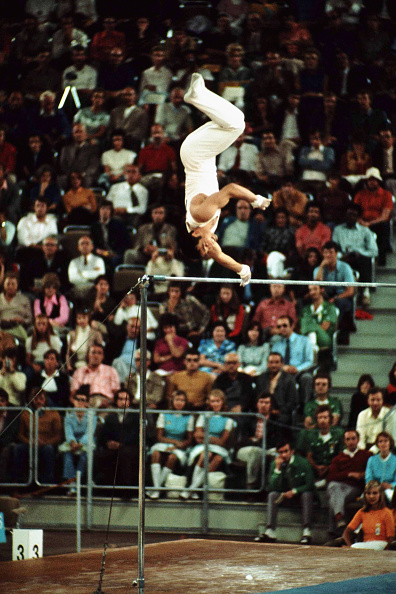
The Birth of the Moon Somersault
New Skills Are Born in the Off-Season
It was the beginning of 1971, the year before the Munich Olympics.
In Japan, the artistic gymnastics off-season generally runs through the winter months, from January to April. In the Soviet Union and the countries of Eastern Europe—East Germany, Romania, Hungary, and others—it was the opposite: summer was the off-season, while competitions were concentrated in winter. These days, however, there is scarcely an off-season at all. The competition calendar has become so crowded that one could almost say the season lasts all year.
I learned through experience just how important winter training is. I have always believed that the success or failure of this period determines everything about my gymnastics in the coming season. Based on reflections from the previous year’s competitions and training methods, this is the time to plan for the season ahead and to build the comprehensive physical fitness and strength that cannot be developed once the competitive season begins. Throughout the winter I work through this preparation with great care.
Among all these activities, I pay particular attention to running. Gymnasts excel at explosive power, but we lack the endurance of marathon runners. It is therefore essential to build an ample reserve of stamina.
Needless to say, running also strengthens the legs and hips. Anyone who thinks gymnasts train only inside the gymnasium is badly mistaken. Quite a few spend hours running laps around the track until they are drenched in sweat.
But I believe the most important aspect of off-season training is carefully identifying your own weaknesses and strengthening them thoroughly. The off-season is also the ideal time to devote yourself to learning new skills. Nearly all of the Ultra C skills developed by Japanese gymnasts were created during this period. Most of my own original skills also emerged in the off-season.
For a long time I had a strong sense that twisting skills simply were not my forte. In high school, the only twisting element in my routines was a full-twisting back somersault on floor. On the other apparatus I avoided twists altogether, relying instead on various somersault elements.
“I really need to start using twists.”
Allowing one’s routines to become stale is something every gymnast must avoid.
I think everyone is like this: the things we are worst at are often the things we avoid. I was no exception. Yet I always had a strong desire to turn my weaknesses into strengths. As long as I was going to compete in gymnastics, it was only natural to want to master the skills that gave me the most trouble.
Unlike sports in which your opponent is another person, gymnastics pits you against the apparatus. No one complains if you perform only the skills you do well. But if you want to survive in competition, you have to overcome your weaknesses. And twisting was precisely the weakness I could not afford to leave unconquered. Twisting skills were an indispensable part of gymnastics.
The Remarkable “Half-In Half”
[Note: Tsukahara consistently refers to the skill as “Half-In Half” (ハーフ・イン・ハーフ), the terminology then used in Japanese trampoline. In modern English gymnastics, the same skill is almost universally called a “half-in, half-out.” I have preserved Tsukahara’s original wording where it appears in the text.]
The gymnasium of the Nippon Sport Science University in Fukasawa, Setagaya, Tokyo, was where I spent my four years as a university student. The gymnastics team and the trampoline team trained there together, using separate areas of the same facility.
From time to time, I would bounce on the trampoline for fun or as part of my warm-up.
Trampolining is a sport in which athletes use the spring of the bed to launch themselves high into the air while performing somersaults and twisting skills. Skilled performers can rise more than five meters above the ground, giving them enough height to execute an astonishing variety of techniques. At the highest level, their performances resemble a circus act. The body appears to become a single object in motion, so extraordinary that it hardly seems possible a human being could perform it.
I watched the trampoline team’s routines with admiration and envy. Their skills were magnificent and full of power.
One day during the 1971 off-season, I made a decision.
“This winter, I’m going to incorporate serious trampoline training into my daily routine.”
I hoped it might give me a new feel for twisting and for somersaults—the very movements I struggled with. Under the guidance of the trampoline team, I began slowly with the fundamentals.
At first, I could barely stay on my feet, stumbling around the trampoline awkwardly. After about a month, however, simple twisting skills and somersaults became easy. Once I mastered a full twist out of a back somersault, I added another twist and began performing double twists. Before long, I could also execute a full twist from a front somersault with considerable confidence.
“If twisting really was this easy, I should have started trampoline training years ago.”
I even felt a little regret.
I repeatedly discussed the theory of twisting with members of the trampoline team and studied every specialist book I could find. Then I would visualize the sensation of twisting over and over in my mind—what would now be called image training. At the same time, I never neglected my actual practice on the floor.
This routine continued for about two weeks. Yet connecting the physical sensation of performing the skill on the floor with the movements I could picture in my mind proved extraordinarily difficult. Even when I understood everything perfectly in theory, my body refused to move accordingly.
I am still working to grasp the ideal form of twisting—the true essence of the movement.
“What on earth was that?”
One day a member of the trampoline team launched high into the air and performed an incredibly complicated skill that I could not immediately comprehend.
The moment I saw it, I stood there in stunned silence.
I immediately turned to another trampoline athlete nearby.
“What was that skill just now?”
He explained that it was an advanced trampoline skill called the Half-In Half.
In the Half-In Half, the gymnast performs a double somersault while adding a half twist during each somersault. It combined the tremendous power of a double somersault with the graceful beauty of twisting. The movement was unlike anything I had ever seen in artistic gymnastics. It was utterly mysterious.
When I watched it for the first time, I desperately tried to understand how the performer’s body had rotated and twisted the way it did, but I simply could not figure it out.
Finally, I asked him,
“Could you do it one more time?”
“What an incredible skill. If I could bring this into artistic gymnastics, everyone would be astonished. I want to do something no one else can.”
That was what drove me.
I had become captivated by the Half-In Half.
So I asked one of the trampoline athletes a question.
“Do you think someone with only my level of trampoline ability could eventually learn the Half-In Half if I practiced it?”
At that point, I knew absolutely nothing about the theory behind the skill or how difficult it actually was. Looking back, it was a rather outrageous question. I even wondered whether I was being hopelessly overconfident.
I fully expected the answer to be something like:
“You’d better not get your hopes up.”
Instead, the trampoline athlete replied without the slightest hesitation, “You’ll be fine. Tsukahara-san, you’ll definitely be able to do it. I’d even guarantee it.”
His words filled me with joy.
I believed him completely. They gave me tremendous confidence and an even stronger determination to succeed.
Applying It to the Horizontal Bar
So began my intensive training on the trampoline to master the Half-In Half.
I mapped out a step-by-step progression for learning the skill and resolved to practice a little every day according to that plan.
Sometimes I drifted off course and flew in completely the wrong direction. At other times, I lost my balance so badly that I nearly landed on my head.
But the trampoline team members were always standing beside me, ready to spot me firmly, so I could practice without fear.
At first, I simply repeated belly-drop drills from a back somersault with a half twist. I did the same thing dozens, even hundreds of times, until it went well. Once I had a certain amount of control, I moved on to back-drop drills: a back somersault with a half twist followed by a front somersault.
In fact, this is where the essence of the Half-In Half lies.
Until then, the common understanding was that twisting should be done in a layout position—that is, with the body stretched straight. But in the Half-In Half, the twist has to be done not in layout, but in a tucked position, with the knees, hips, and back bent.
Because this was my first experience with such a movement, it naturally did not go as I wanted. No matter what, I kept trying to twist in a layout position. Twisting after tucking the body created a completely new sensation, unlike anything I had felt before.
Day after day, I devoted myself to practicing a tucked back somersault with a half twist. When you do nothing but the same thing over and over, you begin to get sick of it and even feel like giving up. But I knew perfectly well that unless I taught my body this sensation, I could not move forward. Having come this far, all I could do was endure, dreaming of the completed skill. By faithfully repeating the basic drills again and again, I gradually began to grasp this new feeling.
Before I knew it, the time and volume I spent on the trampoline had exceeded the time I spent practicing gymnastics, my actual specialty.
That could not be helped. Some of the trampoline team members even joked—though perhaps half-seriously—“Why don’t you quit the gymnastics team and switch to trampoline?” I could only laugh, but the truth is that I had become completely captivated by the trampoline.
The gymnastics team members who watched my trampoline practice out of the corner of their eyes must have been thinking, What on earth is he doing? Doesn’t he need to practice gymnastics?
Practicing the Half-In Half on trampoline gave me the following idea: I could use this skill as a horizontal bar dismount. To do that, I needed to examine carefully the difference between the amount of airtime in trampolining and the time required for a horizontal bar dismount.
At the time, I was using a piked double back somersault as my horizontal bar dismount in my optional routine. The average airtime for that skill was about one and a half seconds. The horizontal bar was 2.50 meters high then. Today it is 2.55 meters. After building momentum with giants and releasing the bar, the body, at its highest point, rises about one meter above the bar. In other words, the body should be floating about 3.50 meters above the mat.
A Half-In Half on a trampoline cannot be done unless you bounce to a height of three to four meters. If the Half-In Half I wanted to attempt on horizontal bar had the same airtime as a piked double back somersault, or close to it, then it ought to be fully usable as a horizontal bar dismount.
Through the trampoline team’s enthusiastic and skillful instruction and through repeated practice, I had become able to perform the Half-In Half on the trampoline to a certain degree. I began to feel, All right, this can work on horizontal bar, too. If the airtime was the same, I was convinced that it could absolutely be done.
The Wall Standing in My Way
Once I had acquired the feeling for twisting on the trampoline, the next step was to transfer it to the horizontal bar and test it there. Before that, however, I had to remember to picture the movement in my mind again and again. This is called image training.
At first, though, it did not really click. That was probably because I had never actually seen the movement performed on horizontal bar. If I had been able to see it, even on film, the time and effort I spent solely on the Half-In Half would surely have been reduced to about one-tenth.
On a trampoline, you can kick with your feet, lift your body into the air, and twist. But on horizontal bar, you have to release from a giant swing and make your body rise into the air. The technique and timing of the release are, in any case, extremely difficult. And of course, compared with a trampoline, it is hundreds of times more dangerous.
From the very beginning, the Half-In Half on horizontal bar gave me trouble.
Now, how should I practice this?
I was already worrying about it before I even began training it on the bar. For me, when trying to learn a new skill, the most important thing is choosing the right training method and not making a mistake in the order of progression.
If you get the method or the progression wrong, the skill will never be completed no matter how much time passes. Even if you do manage to finish it, it will become a poor-quality skill, one that fails to capture the viewer’s imagination. That is a serious problem. Naturally, the likelihood of failure in competition becomes much higher. And if the basic drills at the earliest stage of attempting a new skill are wrong, the damage is irreparable.
I resolved to begin with the basic drills, taking the greatest possible care not to head in the wrong direction. Even among Japan’s top, All-Japan-class gymnasts, the greatest attention is paid first to the correct training method for the initial basic movements. Put another way, unless you pay attention to such things, you cannot become a first-rate athlete. In any case, I decided to apply the twisting practice method from trampoline directly to horizontal bar training.
I stacked three Evermats, each about twenty centimeters thick and roughly the size of a bed filled with sponge, at the landing area beneath the bar. This was a safety measure so that even if I fell on my head or back, the impact would be reduced.
I jumped up to the horizontal bar. Whenever you are about to challenge a new skill, an indescribable excitement runs through your entire body.
Of course, I was not going to attempt the Half-In Half from the start. First, from a forward-grip giant, I released with all my force and tried a tucked back somersault with a half twist. As I repeated this again and again, I began to feel, Somehow, this might work.
Unlike the trampoline, there is no spring when you land. Even with the softness of three stacked Evermats, the shock of falling was considerable. I never plunged straight down headfirst, but at first, when I hit my chest, stomach, or back directly, I felt breathless for an instant.
When you have fixed your eyes on a goal and are charging straight toward it, you cannot sit around complaining that it hurts or that it is hard. I was driven by a single thought: I want to complete this new skill that no one has ever done as soon as possible. At such times, you enter a kind of excited state.
The tucked back somersault with a half twist became successful, both in height and in the timing of the release, and I moved on to the next stage. After doing a back somersault and half twist, I now had to transition into a front somersault.
A tremendous amount of training time went into discovering whether this was possible. The difficulty was obvious, but at the front-somersault stage, I was attacked by an extraordinary fear. It was greater than I had imagined.
The Moment of Decision
All right. Today, no matter what, I’m going to make it all the way through the front somersault.
I would head to the gym with that determination. But once I actually jumped up to the horizontal bar, I could not do it. Once fear appears, even for a moment, it is very difficult to act. I myself had no concrete idea what the result would be. Irritation and impatience mixed with fear, making my feelings even more complicated.
Day after day, it was the same: Today I can rotate. Tomorrow I have to rotate. There were several days when an entire practice ended with nothing but that hesitation.
Ah, what a pathetic person I am, I would blame myself. Or I would be tormented by feelings of inferiority: Maybe I can’t do this. I’ve become a miserable coward.
Around the time I became captivated by the Half-In Half, I would wait until the gymnasium was empty before practicing. Usually it was at night. It was never anything as grand as “secret training.” I simply wanted to concentrate on that single act: whether I would rotate or not. If I saw the other team members moving around, or if any noise entered my ears during practice, my resolve would begin to waver. I must have been extremely nervous.
When the others had left, I would change into my training clothes and begin warming up, telling myself, Just rotate. If you go for it, you can absolutely do it.
For a moment, I would make up my mind. But the more serious I became, the more the tension increased, and the more cornered I felt.
People around me apparently said, “Tsukahara has seemed a little strange lately. What on earth is he trying to do?” I did not even have the composure to care about such comments. I never asked anyone for advice or consulted anyone. It was the first time I had ever agonized and practiced completely alone. I had entered entirely into my own world. I had experienced something similar to the fear I felt while attempting the Half-In Half once before, in high school.
It happened in my first year at Kokugakuin High School, when I was first trying to learn a double back somersault dismount from horizontal bar. I attempted the skill not inside a gymnasium, but on the high school athletic field.
To soften the area where I would land, I dug up the ground around the horizontal bar in the sandpit with a shovel. I had the strange sensation that I was digging my own grave.
I had already mastered the single back somersault in junior high school, and at that age, more than anything, I had youth on my side. I was afraid, but I was able to decide to go for it. With many members of the gymnastics team spotting me under the bar, I felt reassured and let go almost unconsciously.
My eyes were wide open. First, I saw the blue sky. Then I saw the faces of the teammates spotting me and the sandpit below. I thought I had quite a bit of time. But when I landed, everything went black.
No wonder: I had plunged headfirst into the sand. I cut the area just above my eye on a small stone buried in the sand. It really was a “kamikaze attack.”
The first time, I experienced only the feeling of crashing into the sandpit before I had any idea what was happening. Because of that, when I tried it a second time, an indescribable fear came over me. As long as one continues in gymnastics, this kind of fear inevitably follows you around.
More than two months had passed since I began trying to introduce the trampoline Half-In Half to the horizontal bar. I was not even halfway to completing the skill.
If I keep being afraid forever, I’ll never be able to do anything.
At last, I felt that the moment of “decision” had arrived. I think that instant came at the very peak of emotional intensity. My heart had been pounding since morning. Even while sitting still, sweat seeped into my palms. When I stepped into the gymnasium, I felt as if I were trembling.
From the moment I began warming up, the only thing in my head was the skill I had to do on the horizontal bar. I put on my grips and covered my hands with magnesium carbonate.
Let’s just rotate.
Resolving that, I took a deep breath and jumped to the horizontal bar. I built momentum in my forward-grip giants. Then, with all my courage, I let go, keeping my eyes wide open.
I rotated!
At last—finally—I had made it as far as the front-somersault phase.
Trying not to lose the sensation of having rotated through to the front somersault, I remained crouched in the Evermat for a while. My body would not stop trembling. My heart was racing so fast it felt as though it might burst. I felt something beyond words, and it was very hard to breathe.
At that moment, I was so overwhelmed with astonishment at having leapt past fear that I was not yet able to feel the joy of success.
It took quite some time before I could enjoy the happiness of it, before my heartbeat returned to normal.
See? You can do it if you try. You did well.
I told myself this.
Once I had calmed down, I tried it a second time. Strangely, once I had rotated the first time, the fear vanished on the second attempt as if it had never existed.
In high school, fear had appeared on the second attempt, but this time it did not. Compared with the first attempt, I lifted my body higher, and both the twist and the somersault seemed to have much more room. At that moment, I even felt that all the anguish I had gone through until then had been absurd.
Why didn’t I make this decision sooner?
I even felt irritated with myself.
The front-somersault section was the most important part of the skill. If I forgot this section, the skill could break apart in midair, so I repeated it hundreds of times in practice. Thanks to that repetition, the sensation became firmly embedded in my body rather than merely understood in my head.
[…]
The First Public Showing of the Moon Somersault
How many hundreds—no, how many thousands—of times had I practiced the “Moon Somersault” I had created? By then, a certain kind of confidence had begun to grow in me. At last, the opportunity came to unveil the skill in competition. It was about ten months after I had first begun working on the Half-In Half on trampoline.
October 1971. The meet was both the first Japanese qualifying competition for the Munich Olympics the following year and the All-Japan Championships.
Right up until the competition, I had been including the “Moon Somersault” in my full routines—that is, practice in which I performed the entire routine continuously, just as in competition. Depending on my physical condition that day, however, there were times when it went well and other times when it was so unstable that I nearly injured myself.
Before long, I lost the feel for it, and the “Moon Somersault” began to go awry. In situations like this, you must never panic.
Just as in the earliest stage of training, you bring out the Evermat and start over from the basic movements. The important thing is to repeat them thoroughly until you can recall the sensation of a successful attempt.
After the compulsory competition on the first day, it was finally time for horizontal bar in the optional routines. I got through the first half of the routine safely enough and moved into the final dismount.
Just do it the way you do it in practice. Stay relaxed, I told myself, and let go with all my courage.
This feels good.
Both the twist and the somersault felt right. But then, unbelievably, after landing, I made a disastrous mistake: I rolled backward. The cause was over-rotation, though there were other flaws as well. My first attempt at the “Moon Somersault” in competition, regrettably, ended in a crash landing.
The feeling in practice and the feeling in competition really are very different. I need to rethink this skill from the ground up.
That was what I felt keenly after the All-Japan Championships were over.
It was one thing to have used the “Moon Somersault” in competition for the first time. But afterward, it raised major questions among people in gymnastics. The first problem arose among the judges.
One of the judges scoring my routine tilted his head and asked, “What was that skill just now?”
Since this was its first public showing in Japan, of course it could not have been listed in the rule book. Even that judge, a gymnastics specialist who had once been a competitor himself, apparently could not understand the strange movement, which twisted and bent in a confusing way and was over in an instant.
Because the landing was also unsuccessful, some people may have thought my hands had slipped off midway through the routine and that I had simply been thrown from the bar. In any case, the judges must have been unsure how much to deduct and what score to award. It was only natural that they did not know how to evaluate a skill they were seeing for the first time.
The first “Moon Somersault” I performed in competition certainly attracted attention at the outset, but as an overall evaluation, it seems people were not yet ready to draw any firm conclusions.
The next question was whether the “Moon Somersault” could become a skill that would hold up internationally. Japanese gymnastics had produced many Ultra C elements, and thanks to them, Japan had gone from victory to victory since the 1960 Rome Olympics. The question was whether the “Moon Somersault” could join the glorious line of historic Ultra Cs: the “Yamashita vault,” the “Kirimomi dismount,” the “twisting vault,” the “Tsukahara vault,” and others.
I heard that there was considerable debate within the strengthening division of the Japan Gymnastics Association, but the conclusion was that the “Moon Somersault” was indeed an extraordinary Ultra C.
While those discussions were taking place inside the association, I was single-mindedly trying to complete the “Moon Somersault,” training intensely to give the skill sharpness and flavor.
After that, with the Munich Olympics approaching, the second qualifying competition and final qualifying competition were held in Japan. Naturally, I used the “Moon Somersault” as my trump card in the optional horizontal bar routine. But the results were not especially good. I touched my hands down and made other mistakes. It went well in practice, but in actual competition, I always seemed to fall just short. Perhaps the pressure was getting to me. If I could not succeed with it in competition, it had no meaning at all.
After earning my ticket to the Olympic team at the final qualifying competition, I fought the “Moon Somersault” desperately during the national team training camp. As I practiced it dozens and then hundreds of times, my success rate gradually rose.
Even if you are close to 100 percent successful in practice, competition has its own strange atmosphere, and failure can still happen. But the most important thing is to possess a powerful confidence: I absolutely will not fail.
Through hundreds of repetitions, that confidence began to well up inside me.
In Munich, I will make it succeed.
That was the vow I made to myself.
[…]
From: Endless Challenge: My Youth Devoted to the “Moon Somersault” 果てしなき挑戦:「月面宙返り」に賭けたわが青春
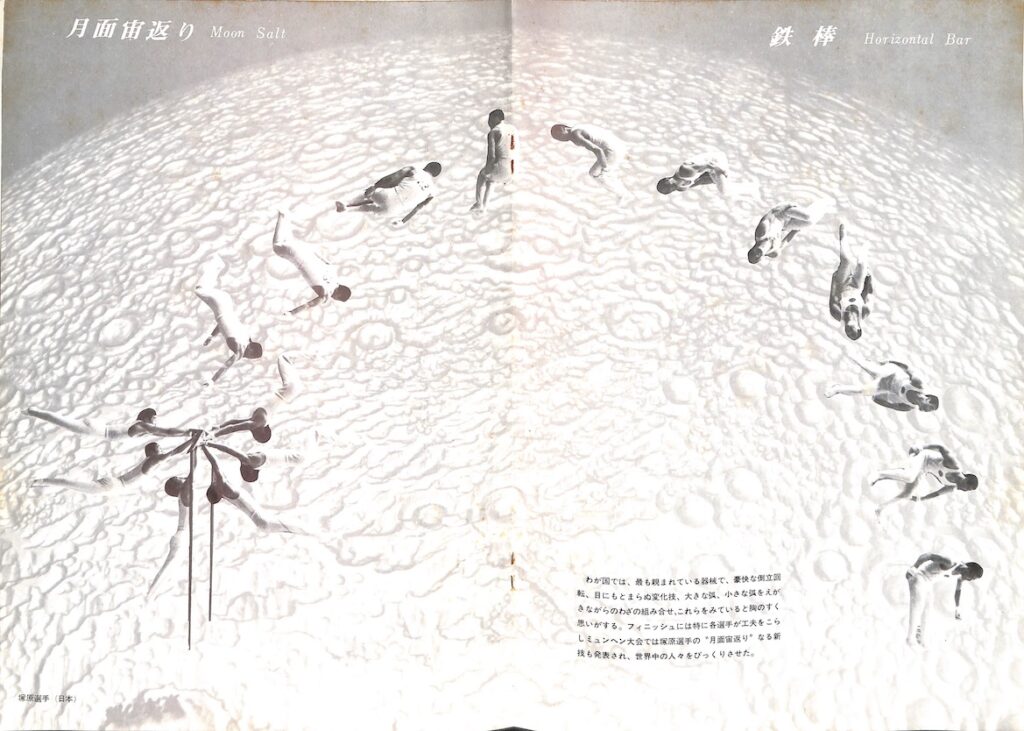
In 2004, Tsukahara gave an abridged version of the story in an interview with the FIG:
The “Moon Salto” on Horizontal Bar was a different story. I was not very good at the sense of aerial (twisting / turning in the air) which was very important for gymnasts. So in order for me to overcome the weak aerial sense, I practiced Trampoline. Already in other gymnastics leading nations included Trampoline for training but it was rare in Japan in my days. I decided to get serious with Trampoline to improve my gymnastics ability. As I practiced, I ended up performing “1/2 in, 1/2 out” which was not familiar in gymnastics area and is the base of “Moon Salto” (the original name). Then I came to the conclusion that, Trampoline goes up about 5 meters and Horizontal Bar also let you up 5 meters. So, I thought I can do the same technique on Horizontal Bar and challenged. It took me about 3 months to make “Tsukahara” for the Horizontal Bar and about 1 year to complete it.
More on Japanese gymnastics: