Li Jing belonged to one of the strongest generations in Chinese men’s gymnastics, but he never wanted to be known simply as another member of the “Li family.” As the careers of Li Yuejiu, Li Xiaoping, and Li Ning captured international attention, fans often remarked that Li Jing even looked like Li Ning, the legendary “Gymnastics Prince.” His response was characteristically direct: “I am who I am—a lively, stubborn son of Hunan.”
That independent spirit defined both his personality and his gymnastics. A six-time world champion and three-time Olympic silver medalist, Li built his reputation on extraordinary difficulty and originality. Chinese writers of the era described his name as virtually synonymous with high-difficulty gymnastics, pointing to the remarkable range of difficult elements and combinations he introduced into his routines soon after joining the national team. Several of those combinations—especially on horizontal bar and parallel bars—were regarded by contemporaries as among the most demanding ever attempted, even if they were never adopted into the Code of Points as eponymous skills.
Yet Li’s career was far from inevitable. Born into a poor family in Hengyang, he nearly abandoned gymnastics after experts concluded that his small hands and short fingers made him unsuited for the sport. Only the persistence of his first coach, Zhou Xin, who convinced him to return to training and build on his exceptional upper-body strength and aptitude for release skills, kept his dream alive. Years of training barefoot in an unheated gym, falling repeatedly from homemade apparatus, and refusing to give up transformed the frail boy who once hung a homemade “World Champion” medallion around his neck into one of China’s greatest gymnasts.
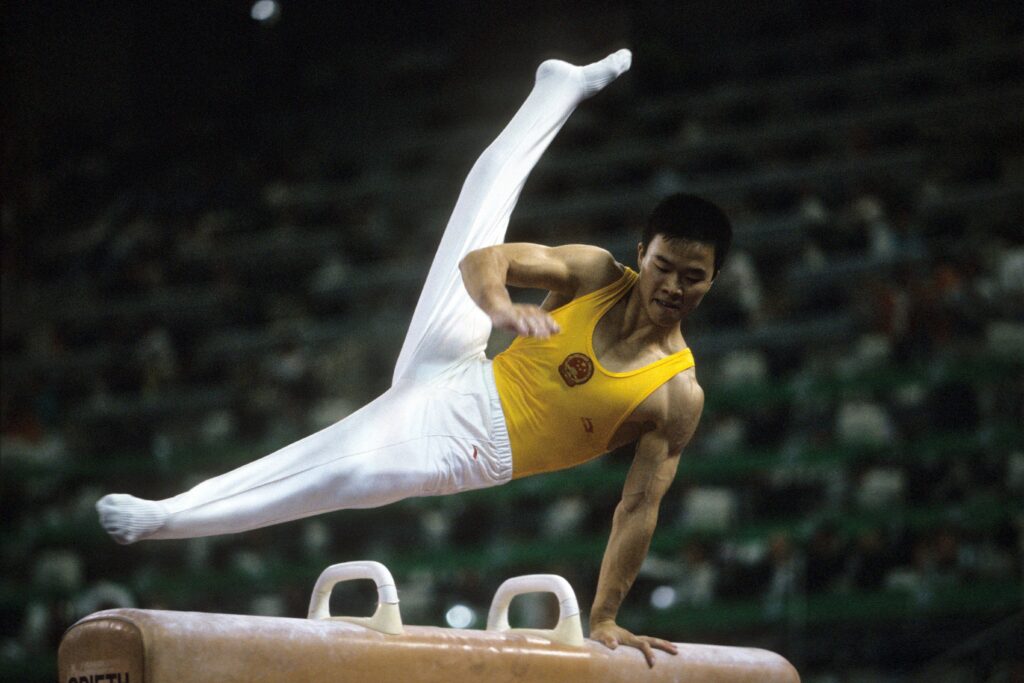
1992
Li Jing: Firm Belief in “I Am Who I Am!”
By Yang LinMany foreign competitors are surprised—how can the Chinese gymnastics team have so many athletes surnamed Li? And it’s true: Li Yuejiu, Li Xiaoping, Li Ning, and among the current “Li brothers” are Li Chunyang and Li Jing.
Perhaps because expectations for Li Jing have run too high, many gymnastics fans say he bears a striking resemblance to the “Gymnastics Prince” Li Ning.
Even Li Jing himself finds this comparison a bit of a stretch. “I am who I am—a lively, stubborn son of Hunan!”
Li Jing has his own particular charm. His bright, dark eyes often flash with intelligence and mischief. When training is grueling and monotonous, Li Jing likes to think up little “pranks” that get everyone laughing.
Lately, Li Jing seems to have grown noticeably more mature. In his spare time outside training, he has taken a strong interest in writing, putting his own life experiences into literary form. He dreams that one day his fiction might win favor with readers.
Of course, right now his most pressing task is preparing for the Olympics. Li Jing’s record of achievements already includes no shortage of gold medals—from the World Championships and the World Cup gymnastics competitions; the only one still missing is an Olympic gold.
This top performer on the Chinese men’s gymnastics team also has a weakness: he’s prone to getting overheated in the moment. He recognizes this himself—competition, he says, shouldn’t be like going to a casino, where you either win big or lose everything. At last year’s World Championships, he pushed himself to the brink and pulled through, and it was enough to make everyone watching break into a cold sweat! Afterward, he said, I need to change!
Gold medals and hard lessons can spur a person on in equal measure. Li Jing has said that competition has made him grow up, giving him more experience than his peers—experience that will benefit him for the rest of his life.
李敬:笃信“我就是我!”
Author: 杨琳
很多外国选手惊讶,中国体操队怎么会有这么多姓李的?还真是,李月久、李小平、李宁,现役的“李氏兄弟”当属李春阳和李敬。
可能是出于对李敬的期望值过高,很多体操迷都说李敬长相酷似体操王子李宁。
其实连李敬自己都觉得这种说法过于牵强。“我就是我,又活泼又倔强的湖南伢子!”
李敬自有李敬的可爱之处,一双黑亮亮的眼睛常闪动着聪敏而又调皮的目光。训练艰苦又枯燥时,李敬就会琢磨出小小的“恶作剧”,引出一片笑声。
最近,李敬似乎长大成熟了许多,训练之余甚喜舞文弄墨,把自己的生活经历写成文学作品。他幻想有一天,李敬的小说能够受到读者的青睐。
自然,目前当务之急是备战奥运会,在李敬的功劳簿里,金牌不少――世界锦标赛、世界杯体操赛,唯独还差一枚奥运会的。
这位中国体操队一号主力也有弱点,就是容易头脑发热。他自己也认识到了,比赛总不能像上赌场,要么赢个痛快,要么一败涂地。去年世锦赛,他置死地而后生,真让人为他捏一把冷汗!事后他说,我要改!
金牌和教训同样能使人受到鞭策。李敬说,比赛使他长大了,比同龄人有更多的体验,这种体验会使他终生受益。
PLA Daily, April 3, 1992
2007
From a Fearless Child to a Gymnastics Hero: Li Jing “Fell” His Way to a World Championship
Xingchen Zaixian – Changsha Evening NewsA boy of about ten, wanting to understand how trains worked mechanically, once dared to lie down on the railway tracks to listen to a train approaching from a distance — causing the entire train to make an emergency stop. Even as he caused this near-disaster, the young boy’s exploit made him famous throughout the Beijing Institute of Physical Education. This curious, mischievous child who loved to use his head would later become a stunning marvel in the history of world gymnastics.
He is Li Jing, world gymnastics champion from Hunan.
Origin Story: Recruiting Li Jing Took “Three Visits to the Thatched Cottage”
Li Jing was born into a family in hardship in Hengyang. His father became paralyzed the year after marrying, having failed to get timely treatment for a viral infection, so the burden of the household fell entirely on his mother’s shoulders. Born unusually frail due to poor nutrition, Li Jing was sent by his mother to the Hengyang Municipal Sports School at age six to build up his body.
But just as young Li Jing was ready to devote his life to gymnastics and dream of becoming a champion, an incident nearly severed his connection to the sport.
At the time, when experts assessed Li Jing’s physical attributes, they judged his hands to be small and somewhat thick, with short fingers — from a professional standpoint, a major shortcoming. Gymnastics selection favors larger hands and longer fingers, better suited for gripping bars and supporting on apparatus. The experts therefore said Li Jing would struggle to develop on horizontal bar, rings, and parallel bars, and that it would be very difficult for him to achieve results. This verdict was devastating for Li Jing and his family, and the despair caused Li Jing to stop training.
To save this promising talent, Coach Zhou Xin of the Hengyang Municipal Sports School had to make repeated visits — “three visits to the thatched cottage” — to Li Jing’s home to persuade him and his family. Zhou Xin believed that if Li Jing’s arm strength and grip strength were built up, and if training incorporated “flight” elements suited to his own unique style, then it was entirely possible for him to master various high-difficulty moves. Zhou’s persuasion worked, and young Li Jing returned to training. Subsequent events would prove that difficult skills were indeed no problem for Li Jing.
Warm Family Bonds: His Parents Were His Greatest Support
Li Jing was also a filial son. He often said: “In this world, the person I love most is my mother, and the person I admire most is my father. My parents are the greatest support in my life and career.” The first thing Li Jing did after returning home with his first world championship title was push his father slowly along the road through their hometown…
Li Jing entered sports school at age six, left home for the Beijing Institute of Physical Education at age ten, and after joining the national team continued nonstop training and competition — his time at home was brief, and time spent with his parents was limited. Yet he always said his parents had the greatest influence on his life.
Li Jing’s mother was a hardworking, self-sacrificing woman devoted entirely to her children. She was the one who cared for Li Jing’s paralyzed father and bore the weight of the household; she was the one who raised Li Jing and his two older brothers, giving everything for them; and she was the one whose foresight guided Li Jing onto the path of gymnastics… A mother’s love for Li Jing cannot be fully expressed in words. Even now, whenever he travels for work, Li Jing always makes time to shop for his mother — from domestic to imported goods, winter clothes to summer clothes, from coats and long skirts down to something as small as a pair of stockings…
Growing Up Tough: A World Champion Forged Through Falls
Entering sports school meant the beginning of hardship. Every morning, while other children were still asleep, young Li Jing was already on his way to the sports school.
Winters then were bitterly cold; the training hall had no heating, and the doors and windows didn’t close properly, letting in a cold wind. Without gymnastics shoes or hand guards, young Li Jing had to stand barefoot on the concrete floor, training in thin, single-layer clothing. The mats were cold, the apparatus was cold, even the air was cold, and Li Jing’s small body shivered in the biting wind. There was also the problem of equipment: due to insufficient funding at the time, the Hengyang Municipal Sports School couldn’t even supply some of the necessary training apparatus. “The pommel horse, the horizontal bar — I made those myself. Conditions back then were truly difficult,” recalls Zhou Xin, Li Jing’s first coach, with a sigh even now.
But the harsh environment couldn’t stop the resolute Li Jing. To master each movement, he practiced over and over, his frail body falling from the apparatus again and again. To make up for weak lower-body strength, at age six he had to run a route of over 30 kilometers every three to five days. “Back then, practicing the ‘goat’ [i.e., pommel horse], his hands would be rubbed raw, and his head would get cut open, but he’d pay no attention — he’d fall off and jump right back on,” Coach Zhou recalls with emotion. It was through this kind of tempering that Li Jing gradually solidified his resolve to dedicate himself to gymnastics.
On his eighth birthday, young Li Jing, brimming with ambition, made a small round tag, writing “World Champion” on one side and “Li Jing” on the other, hung it around his neck, then stood on a small wooden stool and announced to his whole family: “I am going to become a world champion!”
Remarkable Achievements: Original High-Difficulty Skills No One Else Could Do
Regarding his prized student, Zhou Xin once evaluated the young Li Jing when he first started gymnastics this way: “Before age ten, his training difficulty wasn’t very high, but his movements already had the qualities of precision, extension, and elegance.”
As he gradually developed, Li Jing began to show his talent in various competitions, and in January 1987 he formally joined the national team. Li Jing brought his habit of using his head and training hard to the national team as well; because he learned quickly and had strong intuition, within a single year he developed a difficult, novel “signature move” on every apparatus — whereas most gymnasts, at best, develop one difficult new skill on a single apparatus in a year.
Li Jing used his intelligence and hard work to master formidable skills. At the time, “Li Jing” was synonymous with high-difficulty gymnastics moves. On horizontal bar, his move — a piked front salto with a one-and-a-half twist flying over the bar and regrasping it — remains something no one else in the world can do to this day. On parallel bars, the combination he developed — a backward giant swing with a 360° turn into a handstand, directly into two consecutive “Healy” (Healy — handstand front roll with 360° turn) moves, directly into two front saltos into an upper-arm hang — carries four bonus difficulty factors in that single combination, and no one dares attempt it even now…
[Note: Li Jing does not have any eponymous skills in the Code of Points. The piked Gaylord (mentioned above) is unnamed.]
A Glorious Career
Li Jing was born in 1970 in Hengyang, Hunan. He competed in 19 international gymnastics competitions, winning 39 gold, 22 silver, and 12 bronze medals, including 6 world championships and 3 Olympic runner-up finishes. He retired in 1997 and subsequently returned to work at the Hunan Gymnastics Administration Center; he is currently on secondment to the National Gymnastics Administration Center.
- 1986: Competed at the World Student Games in France, winning the men’s team gymnastics championship with his teammates.
- 1989: Won the parallel bars title at the 25th World Gymnastics Championships.
- 1990: Won the pommel horse title at the 8th World Cup.
- 1991: Won the parallel bars title at the 26th World Gymnastics Championships.
- 1992: Won three Olympic runner-up medals (rings, parallel bars, team) at the 25th Olympic Games.
从胆大小孩到体操英雄 李敬”摔”出一个世界冠军
一个十来岁的孩子,为了弄懂火车的机械原理,竟敢趴在铁轨上聆听火车由远而近的声音,结果导致整列火车紧急刹车。闯下大祸的同时,小小年纪的他也扬名整个北京体育学院。这个爱动脑筋、有着极强的好奇心却又爱调皮捣蛋的孩子,日后成为了世界体操史上一个令人震撼的的奇迹。
他,就是湖南的体操世界冠军——李敬。
出道故事
“三顾茅庐”请李敬
李敬出生在衡阳一个苦难的家庭里,父亲在婚后第二年就因为病毒感染没能及时治疗而瘫痪,家庭的重担就压在其母亲一人肩上。出生时就因为营养条件跟不上而异常瘦弱的李敬为了锻炼身体,6岁时就被母亲送到了衡阳市体校。
然而,当小李敬准备把自己的一生都交给体操,梦想成为体操冠军时,一场变故差点他与体操无缘。
当初,许多专家在考察李敬的身体素质时,都认为李敬的手掌小且偏厚、手指短,从专业的角度来看,这是一个很大的缺陷。体操选材就是要求手掌要大些,手指要长,这样才有利于握杆和撑器械。因此,专家都说李敬在单杠、吊环和双杠等项目上的发展存在困难,很难练出成绩。这一判决,对于李敬和他的家人来说,无疑是个致命的打击,绝望使得李敬停止了体操训练。
为了拯救李敬这棵苗子,衡阳市体校的周信教练不得不“三顾茅庐”,先后几次去李敬家里劝说他和他的家人。周信认为,只要增强李敬的手臂力量以及握力,并在训练中采用适合其自身独特风格的“飞行”动作,那么他完成各种高难动作是完全有可能的。周信的劝说有了成效,小李敬重新回到训练场。而往后的事实也证明,高难动作对李敬来说的确不是问题。
温暖亲情
父母是他最大支柱
李敬也是一个孝顺的孩子,他常说:“在这个世界上,我最热爱的是母亲,最崇拜的是父亲。父母是我生活和事业的最大支柱。”当李敬第一次拿到世界冠军后回到家,第一件事就是推着父亲慢慢地行走在家乡的大道上……
李敬6岁进入体校训练,10岁时离家考入北京体育学院,进了国家队后更是不断训练和比赛,在家的时间很短,与父母相处的时间也不长,但他总说父母对自己一生的影响最大。
李敬的母亲是一位吃苦耐劳、一切为了孩子的慈母。是她,照顾着李敬瘫痪的父亲,承担起家庭的重担;是她,将李敬和他两个哥哥拉扯大,为他们付出一切;也是她,不乏远见卓识,引导李敬走上体操之路……母亲对李敬的爱,是用文字无法说清楚的。如今,每逢出差在外,李敬总要找时间上街为母亲购物——从国内到国外,从冬装到夏装,大到风衣长裙,小到一双丝袜……
顽强成长
“摔”出一个世界冠军
进入体校,也就意味着艰辛的开始。每天清晨,当其他孩子还在睡梦中时,小李敬却已经走在通往体校的路上。
那时的冬天很冷,训练场没暖气,门窗也关不严实,冷风嗖嗖;没有体操鞋和护掌,小李敬只能光着脚站在水泥地上,穿着薄薄的单衣进行训练。垫子是冰冷的,器械是冰冷的,就连空气都是冰冷的,李敬小小的身躯在瑟瑟寒风中不住地发抖。还有训练器材的问题,因为当时经费不足,衡阳市体校甚至连一些必要的训练器材都不能供给。“鞍马、单杠等都是我自己做的,那时候的条件确实相当艰苦。”李敬的启蒙教练周信现在想起来仍唏嘘不已。
然而,窘困的环境没能阻挡坚毅的李敬,为了练好每一个动作,李敬一次次重复练习着,他瘦弱的身体也一次次从器械上摔下;为了弥补下肢力量的不足,6岁大的他每隔三五天就得跑上一趟30多公里的路程。“当时为了练习‘山羊’(即鞍马),他手练得脱皮,头也磕破了,却全然不知,摔下来又再次跳上去。”周信教练感叹地回忆着。就是在这样的磨炼下,李敬逐步坚定起自己为体操献身的信念。
8岁生日那天,小李敬踌躇满志地制作了一个小圆牌,一面写上“世界冠军”,一面写上“李敬”,并把小圆牌挂在脖子上,然后站到小木凳上向全家宣布:“我要当世界冠军!”
傲人成就
独创高难动作无人能做
对于自己的爱徒,周信曾这样评价刚接触体操的李敬:“他在十岁以前训练的难度动作不是很大,但他的动作当时就有了规范、舒展、潇洒的特点。”
逐步成长起来的李敬随后开始在各项比赛中初露锋芒,并在1987年1月正式进入国家队。而李敬也把爱动脑筋和刻苦训练的优点带到了国家队,由于接受能力强、悟性高,他竟在一年之内就在每个项目上都练出了一个高难新颖的“绝招”动作,而一般人一年最多也不过在一个单项上练出一个高难动作。
李敬用他的聪慧和努力练就了一身过硬的本领。当时,“李敬”就是体操高难动作的代名词。在单杠上,李敬的“屈体前空翻一周半越杠飞行再抓杠”这一动作至今世界上都无人能做;双杠项目上,李敬练出的“向后大回环转体360°成倒立直接接两个连续的希里夸尔(即倒立前翻转体360°)再直接接前空翻两周挂臂”,这一串动作连接难度就有4个加分因素,现在也无人敢问津……
荣耀时光
李敬,1970年出生,湖南衡阳市人。共参加国际性体操大赛19次,夺得金牌39枚、银牌22枚、铜牌12枚,其中世界冠军6次,奥运会亚军3次。1997年退役,后回到湖南体操管理中心工作,现借调到国家体操管理中心工作。
1986年参加在法国举行的世界中学生运动会,和队友一起夺得男子体操团体冠军。
1989年第25届世界体操锦标赛中,获双杠冠军。
1990年第8届世界杯赛中获鞍马冠军。
1991年第26届世界体操锦标赛中获双杠冠军。
1992年第25届奥运会上获吊环、双杠、团体3项亚军。
Archived here.
Appendix: Articles about the Hunan Gymnastics Training Center
A Home of Champions
Chen Cuiting, Lu Li, Li Jing, Liu Xuan, Ji Liya… celebrated names in Chinese and international gymnastics alike; they share a common “home” — the Hunan Gymnastics Training Center.
The training center has been in operation for eleven years. Over that time, its athletes have won a combined 50 gold medals: 6 world titles, 9 Asian titles, and 31 national titles. Hunan has on this basis risen to the top of the eight gymnastics powerhouse provinces in China, and the center has come to be known as “the cradle of champions.”
These athletes entered the center when they were very, very young, to receive systematic and scientific training. Swinging between the uneven bars, leaping on the balance beam, tumbling across the green-carpeted floor — sweat and tears accompanied by pain. Young as they were, they endured it all, for the sake of seeing the five-starred red flag rise slowly above the competition arena.
On the training floor, the coaches are like stern fathers; off it, they are like loving mothers. Some young athletes come from difficult family circumstances and cannot afford the full costs of schooling, training, and daily life. In such cases, coaches take the children into their own homes, where they eat and live alongside the coaches’ own sons and daughters. At six in the morning the coaches are already on the training floor leading the squad through drills; at night, after the athletes have gone to bed, they still make their rounds checking on the dormitories and keeping watch. The hardship can well be imagined — and yet they say: we have never once regretted it.
(Excerpted from China Pictorial*, 1997, Issue 10; text by Leng Hanbing)*
International Communications
11-15-1997
冠军之家
陈翠婷、陆莉、李敬、刘璇、吉丽雅……在国内、国际体操界声名赫赫,他们有一个共同的”家”——湖南体操训练中心。
训练中心成立11年了。11年来,中心所属运动员共获得50枚金牌:世界冠军6个、亚洲冠军9个、全国冠军31个,湖南因而名列中国体操8强之首,这个中心也被称为”冠军的摇篮”。
这些运动员在很小很小的时候就进入中心接受系统而科学的训练。在高低杠间穿梭、在平衡木上腾跃、在绿地毯上翻滚……汗水、泪水伴着伤痛。小小年纪的他们都经受住了,为了比赛场上五星红旗冉冉升起。
教练场内的教练像严厉的父亲,训练场外的教练则像慈爱的母亲。有的小运动员家境不好,难以负担学习、训练、生活所需的一切费用,教练就将他们接到自己家与自己的儿女同吃、同住。清晨6点他们就进入训练场跟队出操,晚上运动员休息了,他们还要查铺值班。清苦可想而知,而他们说:我们从不后悔。
(摘自《人民画报》1997年第10期 冷寒冰文)
Together, We Spread Our Sleeves and Dance with the Wind
— A Portrait of the Hunan Provincial Gymnastics Management Center
◎ Wang Fei
Within the compound of the Hunan Provincial Sports Bureau stands a three-story building — the Hunan Provincial Gymnastics Management Center (referred to here as the Gymnastics Center). From here emerged Lu Li, Hunan’s first Olympic champion; here was forged Li Xiaopeng, “hero of a generation”; and here soared Liu Xuan, the “Spinning Beauty.” Here, eleven athletes have been trained to the level of international master of sport, twelve to the level of national-grade coach, and eleven to the level of international judge. Here, one miracle has followed another: four Olympic gold medals, twenty-three World Championship gold medals, twenty-four Asian Games gold medals, and eighteen National Games gold medals bear witness to the glory of this place. For many consecutive years it has been awarded honorary titles by the CPC Central Organization Department, the State Sports Commission, the CPC Hunan Provincial Committee, and the Hunan Provincial People’s Government, including “National Advanced Grassroots Party Organization,” “Dual Civilization Model Unit,” “National Advanced Collective in the Sports System,” “Outstanding Unit for Ideological and Political Work among Provincial Directly Subordinate Organs,” and “Provincial Civilization Exemplary Unit.”
What has made this place so glorious? Following the footsteps of the Gymnastics Center’s growth, one can clearly see the hardships and honors that have marked this training institution’s path.
Teaching in Accordance with Individual Aptitude: Laying the Foundation of a “Cradle of World Champions”
In the early 1980s, Hunan had no formal institution overseeing gymnastics training across the province. As China’s reform and opening-up policies took hold and the International Olympic Committee’s legitimate status was restored, sports development entered a period of rapid change. In 1985, the Party committee of the Hunan Provincial Sports Commission decided to establish two key gymnastics schools: the Hunan Gymnastics Sports School and the Changsha Municipal Gymnastics School. At the end of 1988, the Hunan Provincial Gymnastics Team merged with the Hunan Provincial Gymnastics School to form the Hunan Provincial Gymnastics Training Center — the first sports training center of its kind in the country. The center then pioneered nationally a fully integrated “pipeline” training system linking professional and amateur training, strengthened the overall planning of gymnastics across the province, and implemented unified management integrating policy, training, competition, professional development, and talent selection.
Serving as the connecting hub between amateur gymnastics training points in cities and counties and the provincial professional team, the Hunan Provincial Gymnastics School at the time had only a single rudimentary building as its training facility, was severely understaffed, and had equipment in a state of disrepair. Working in conjunction with the provincial sports commission’s training and competition departments and the provincial gymnastics team, the school provided industry guidance for amateur gymnastics training across the province, strengthening talent identification through year-round provincial competitions and making gymnastics a compulsory event at the Provincial Games. This greatly advanced the development of amateur gymnastics training throughout the province, rapidly expanding the number of city-level training points and bases from the mere six or seven that existed at the time to the eleven that remain today — in Changsha, Hengyang, Zhuzhou, and elsewhere — and gradually growing the number of competitive athletes province-wide from thirty or forty to over a hundred, establishing Hunan’s unrivaled province-wide talent identification network, the foremost of its kind in the country.
Zhou Xiaolin, who was then a coach at the provincial gymnastics school, visited virtually all of Changsha’s 200-plus primary schools and kindergartens every year, supplemented by recruitment advertising and joint training programs with outside institutions, in an effort to screen eligible children as broadly as possible. Over time, Zhou Xiaolin accumulated rich experience in gymnastics talent identification. The athletes he selected generally shared four key traits: a strong competitive drive and boldness; explosive power; good coordination; and strong aptitude — a solid capacity to understand and absorb instruction.
When Chen Cuiting entered the provincial gymnastics school for training, Zhou Xiaolin identified her shorter upper limbs and small hands, but also her strong overall physical qualities — particularly outstanding leg strength and good coordination and mental composure — and applied tailored instruction, emphasizing her strengths while compensating for her weaknesses, enabling Chen Cuiting to develop rapidly. In 1985, at her first national competition — the gymnastics events of the inaugural National Youth Games — she won the women’s team title and the balance beam gold medal, took silver on floor exercise, and placed third in the all-around. After being selected for national team training, she swept three gold medals at the 10th Asian Games in Seoul in 1986, earning the title “Queen of Asian Gymnastics” and being named one of the ten best athletes in the country.
When Lu Li arrived at the provincial gymnastics school for training, Zhou Xiaolin conducted an initial physical assessment and found that her limbs were well-proportioned, her muscles long and slender with good elasticity, her bones straight and her joints small. When her top was opened, her back was covered in dense dark hair, and her arms and legs were similarly well-covered. Based on experience, Zhou Xiaolin recognized this as the mark of a promising gymnast and focused special attention on her development. Lu Li did not disappoint: in 1991 she won the uneven bars title at the National Gymnastics Championships. Shortly after joining the national team, she rapidly became its cornerstone, ushering the uneven bars into the “Lu Li era.”
Thereafter, Zhou Xiaolin went on to develop and send forward Liu Xuan, Peng Yuanchun, Ma Ying, and eight other outstanding athletes.
Ling Jie’s first coach, Feng Chun, was a young coach with a strong sense of professional dedication. When Ling Jie came to train under her, she was small, light, and slightly thin, but well-proportioned, with long fingers, large palms, well-proportand limbs, and a graceful figure. Over two years of observation, Feng Chun found that Ling Jie had excellent flexibility and coordination, showed strong natural aptitude on the balance beam and uneven bars, and had the innate physical attributes of long fingers and large palms. Feng Chun focused targeted training on her accordingly, laying a solid foundation for Ling Jie on balance beam and uneven bars. In July 1990, the Hunan Provincial Youth Games were held in Xiangtan. Ling Jie swept the mixed pairs acrobatics title in the gymnastics and acrobatics competition. Experts assessed her thus: at seven years old, her uneven bars work had already reached the first-level standard of a ten-year-old, and she had strong potential. From that point on, Ling Jie officially entered the world of competitive gymnastics.
World champion Li Jing’s path into gymnastics, meanwhile, was very much the achievement of Zhou Xin, a senior coach at the Hengyang Municipal Sports School. Li Jing began engaging with gymnastics at just over five years old and was deeply enthusiastic about the sport, curious about every piece of apparatus. Though short and light, he had an outgoing, energetic, competitive, and never-say-die personality. Physical testing also revealed that Li Jing was the best in his group in movement control, balance maintenance, upper-body pushing strength, and coordination — qualities that Zhou Xin recognized as a remarkable find. After being selected, Li Jing received targeted training from Zhou Xin. In 1979, at his first provincial gymnastics competition, he performed well — and came to the attention of Teacher Bo Yunxiao, who had come to Hunan to recruit for the Beijing Institute of Physical Education’s competitive sports school. Li Jing was taken to Beijing.
Over more than twenty years, the Gymnastics Center has sent more than ninety athletes to the provincial gymnastics team, of whom nine have entered the national team. In 1988, at their first participation in the National Children’s Gymnastics Competition, they swept eight gold medals across boys and girls; in 1992, the girls’ team dominated completely, sweeping all six women’s gold medals at the National Children’s Gymnastics Competition; in 1996 and 1997, they won eleven gold medals in two consecutive years across both boys and girls; in 1998 they won six women’s gold medals. In 1992, Comrade Li Tieying visited the school for an inspection, personally inscribed the words “Cradle of World Champions,” and posed warmly for photographs with all the coaches. In 2005 and 2006, the school was designated respectively by the General Administration of Sport as a “High-Level Sports Reserve Talent Base” and an “Olympic Outstanding Talent Base.”
These achievements laid a solid foundation of reserve talent for Hunan gymnastics and accelerated its ascent to the peaks of the world.
Building a Professional Coaching Team that Integrates Veterans, Mid-Career Coaches, and Young Talent
Fan Siguang, the former director and head coach of the Hunan Gymnastics Training Center, was diagnosed with septicemia in the early 1970s — at its worst, he required a full blood transfusion once a year. Yet for decades without interruption he remained fixed to gymnastics training and coach development, nurturing generation after generation of outstanding Hunan gymnastics coaches.
In July 1982, in preparation for the 5th National Games, Fan Siguang was appointed to oversee the entire women’s team coaching operation. Confronting the team’s inherent weaknesses in speed and strength, he boldly cultivated and promoted young coaches, forming an “advantaged structure” that combined veteran, mid-career, and young coaches, and fully bringing into play the veteran coaches’ roles of passing on knowledge, providing assistance, and mentoring — leading young coaches by example to take on backbone responsibilities, with excellent results.
During summer training, a young coach named Guo Xinmin had some divergent ideas about training — his actual practices differed slightly from the plan’s requirements, not dramatically, but noticeably enough. Fan Siguang proactively invited him home for a heart-to-heart conversation, and in the course of a chat lasting three or four hours, led him to thoroughly understand the plan’s requirements and rationale without his even realizing it. There were many such instances: Fan Siguang was tireless in analyzing the problems in young coaches’ teaching, using both positive and negative examples from his own experience and others’ to educate, and providing theoretical analysis to help build understanding. Young coaches held Fan Siguang in great esteem, calling him an excellent teacher of the highest caliber.
Through years of careful cultivation and bold deployment, Guo Xinmin and other young coaches successfully became the backbone of the Hunan women’s gymnastics team. In 1986, a research group organized by the gymnastics department of the State Sports Commission investigated the state of coaching teams in gymnastics programs across all provinces, and gave high marks to Hunan’s coaching staff and coaching structure in its report.
Fan Siguang received the State Sports Commission’s “Third-Level Sports Medal” and the “Honorary Medal for Pioneers of New China’s Sports”; in 1996 he began receiving special government allowances; in 1997 and 2000, the Hunan Provincial Party Committee and provincial government successively awarded him a first-class merit citation, and the provincial federation of trade unions granted him the title of “Hunan Province Outstanding Worker.”
Lu Li’s professional team coach, Xiong Jingbin, was Fan Siguang’s protégé. Under his teacher’s years of cultivation, Xiong Jingbin combined boldness with meticulous attention to detail. When Lu Li joined the team, preparations were underway for the 1988 2nd National Youth Games. Drawing on Lu Li’s physical strengths, Xiong Jingbin boldly innovated in training, successfully adapting a skill performed by a gymnast at the 6th National Games — a “reverse hang giant swing into a reverse hang front salto” — modifying it and introducing a new technique of alternating two-handed grip changes for women, which became Lu Li’s competition skill. It was precisely this routine that enabled Lu Li to defeat one competitor after another, winning the unanimous approval of the FIG Technical Committee and international gymnastics judges. FIG President Titov praised her, saying: “The ingenuity of Lu Li’s uneven bars choreography, the elegance of her movements, and the brilliance of her execution have brought the uneven bars into the ‘Lu Li era.'”
Yan Ninan, the second director of the Gymnastics Center, devoted herself to training with unwavering dedication for decades, never missing a single early-morning training session. She also required coaches to attend every daily training session without exception. She spent every day from morning to night on the training floor, attentive to coaches and athletes alike. She traveled frequently on official business, but the moment she returned, she would go straight to the gymnasium to watch training without even setting down her luggage. She suffered from high blood pressure and would fall ill whenever she pushed herself too hard, but as soon as her condition improved slightly, she would be back on the training floor to assess the situation and resolve problems. Her colleagues affectionately called her a “workaholic.”
As the first person to serve as a member and vice-chair of the FIG Women’s Technical Committee, Yan Ninan is the first and, to this day, only Chinese woman to be awarded the title of “FIG Honorary Judge” by the International Gymnastics Federation. She used her status as an international judge to make an enormous contribution to the development of Hunan gymnastics.
In the early 1980s, Chinese uneven bars routines contained only a single flight element. On one occasion, Yan Ninan noticed an unassuming gymnast at an overseas competition performing a new flight element with ease. She immediately recommended it for trial by the Hunan gymnastics team, and it was mastered quickly by everyone, making Hunan the first in the country to complete a double flight on uneven bars. In the intense preparation period for the 1997 8th National Games, gymnastics programs across all provinces and cities only learned the new rules at a national judges’ training course held in March of that year — but Hunan had already obtained the information at the end of 1996, winning precious time that contributed to the Hunan gymnastics team’s great success at the 8th National Games.
Many other coaches at the Gymnastics Center have never properly rested over a holiday, working from dawn to dark, putting in overtime, setting aside personal interests, and devoting themselves entirely to training. Some coaches enter the gymnasium after 8 a.m., give supplementary lessons to individual athletes through the lunch hour, and don’t finish until six or seven in the evening — more than ten hours in the gym. Several coaches serving with the national team have been stationed in Beijing for extended periods, rarely making it home even once in several years, offering their youth and energy entirely to gymnastics.
Because of a coaching team defined by “unity, pragmatism, selflessness, and efficiency” — veterans mentoring the young, the young inspiring the veterans, striving generation after generation — the Gymnastics Center, this “assault boat” of Hunan sports, has surged with vitality.
Three Historic Leaps
The first leap: from “building through hardship” to “sustained development.” The Hunan women’s gymnastics team was established at the end of 1957, and the men’s team was formed in July 1958. In training, Hunan gymnastics drew lessons from the Japanese women’s volleyball team, intensifying training according to the “three emphases and one large” principle — emphasizing difficulty, strictness, and practical-combat conditions, with high-volume training — rapidly raising the team’s overall technical level. In 1988, the implementation of the “pipeline” training system greatly advanced the identification and foundational training of Hunan gymnasts and the pipeline of reserve talent. The training and competition standard of the Hunan gymnastics team rose rapidly. In 1987, the Hunan women’s gymnastics team won the team gold medal and one individual all-around gold medal at the 6th National Games. In 1993, at the 7th National Games, the Hunan gymnastics team won the women’s team gold and two individual event gold medals. In 1997, at the 8th National Games, the team claimed six gold, two silver, and two bronze medals; the women’s team again won the team title, successfully defending the team championship across the 6th, 7th, and 8th National Games and claiming a hat-trick of consecutive team titles. Hunan gymnastics firmly established its dominant position in women’s gymnastics nationwide.
The second leap: beyond Hunan, toward the world. As Hunan gymnastics joined the front ranks nationally, it also stepped beyond China’s borders, marching toward the peaks of Asian and world gymnastics. Multiple Hunan athletes were selected for the national team, and competing as national team members in international competitions and events, they achieved outstanding results.
In 1989, Li Jing blazed the trail for Hunan gymnastics at the world level, winning the parallel bars title at the World Championships. China national gymnastics team head coach Gao Jian told reporters from Japan’s Asahi Shimbun at a press conference that Li Jing’s difficulty level was the highest in the world and the greatest in the history of Chinese gymnastics. On the strength of these signature skills, Li Jing went on to win six world titles in major international competitions.
In 1997, sixteen-year-old Li Xiaopeng set out for the World Artistic Gymnastics Championships in Lausanne, Switzerland. With a fearless spirit, backed by fierce self-belief, he and his teammates won the men’s team gold medal, making him China’s youngest gymnastics world champion. In October 1999, Ling Jie won the balance beam title at the 34th World Artistic Gymnastics Championships — her first world title, and the only gold medal China’s women’s gymnastics team won at that competition.
The third leap: unleashing the “Hunan whirlwind” at the Olympics. At the 1992 Barcelona Olympics, Lu Li achieved a perfect score of 6.0 on every uneven bars element to realize Hunan’s “zero breakthrough” in Olympic gold medals.
At the 27th Sydney Olympics in 2000, Hunan gymnastics achieved results that astonished the world. Li Xiaopeng, Liu Xuan, Ling Jie, and Yang Yun, with tenacious determination and exceptional skill, won three gold, one silver, and five bronze medals — nine in total — making an outstanding contribution to the Hunan contingent’s overall haul of seven gold, one silver, and five bronze for thirteen medals, ranking first in the country. Liu Xuan outshone all rivals to claim the women’s balance beam gold medal, while Li Xiaopeng turned the tide at a crucial moment: not only making an indispensable contribution to the men’s team gold, but also winning the men’s parallel bars gold, becoming the new standard-bearer of China’s men’s gymnastics team.
Li Xiaopeng, China’s most decorated gymnast after Li Ning, won a total of fourteen world and Olympic titles between 1997 and 2006. His vault and parallel bars skills were named the “Li Xiaopeng vault” and the “Li Xiaopeng hang,” respectively, by the FIG. This remarkable string of achievements records the most dazzling period of his life and marks the zenith of Li Xiaopeng’s gymnastics career.
From its founding in 1957 through the establishment of the Gymnastics Training Center in 1988 and on to the present day, Hunan gymnastics has endured hardship and explored with tenacity. Generation after generation of Hunan gymnastics people, through steadfast pursuit, diligent effort, and remarkable achievement, have demonstrated to the world a spirit of “daring to be first, striving without end” — writing one sporting legend after another, and giving true meaning to the word “honor.” The facts speak for themselves: Hunan gymnastics is a premium program in Hunan sports, and the Hunan gymnastics team is a pillar of Hunan’s Olympic contingent.
The Steadfast Support Behind the Glory
In the 1950s and 1960s, at the very beginning of competitive sports’ turn toward professionalization, the Hunan Provincial Party Committee and provincial government already included the gymnastics team among the first professional sports teams established in Hunan. In the 1970s, the Hunan gymnastics team seized its opportunity, rising as a dark horse and earning high recognition from government departments and competent authorities. In the early 1980s, the provincial sports commission advanced the operational philosophy of “grasping gold medals in one hand, grasping development in the other”; in 1987, it proposed the guiding philosophy for competitive sports of “grasping science in one hand, grasping management in the other, to comprehensively revitalize Hunan sports,” deepening the reform of sports. Institutionally, the Gymnastics Center took the lead in reform, injecting new vitality into the development of Hunan gymnastics. After the Hunan Gymnastics Training Center was reformed and elevated into the Hunan Provincial Gymnastics Management Center, it more effectively strengthened the integrated management of gymnastics training across the province.
Over many years, across different historical stages and training cycles, with the concern and support of the provincial Party committee and provincial government, Hunan gymnastics has benefited greatly in terms of institutional structure, staffing, funding, amateur training, scientific research, medical supervision, venues, and equipment. Hunan gymnastics’ cross-century glory, and the indelible mark it has left on the history of Chinese gymnastics, are inseparable from the provincial Party committee and provincial government’s far-sighted wisdom and acuity in scientific decision-making and management, their forward-looking vision that keeps pace with the times, and their spirit of innovation.
To realize the dream of Hunan gymnastics reaching the pinnacle of world gymnastics — a dream that multiple generations have striven toward for many years — and to sustain ongoing development, the Gymnastics Center Party general branch has played a pivotal role. The Center’s achievements and honors embody a powerful spirit of the age and reflect the brilliant light of the Party’s ideological and political work. They are the inevitable result of the Center’s long-sustained efforts to strengthen ideological and political work through a patriotic spirit of winning glory for the nation, an innovating spirit of continuous pioneering, and a selfless spirit of hard struggle — building a leadership team that fights with unity and gives without reserve; a team of athletes who compete for national glory and strive with determination; a team of coaches that is scientifically grounded, pragmatic, and bold in innovation; and a team of administrators who work with diligence and deliver high-quality service.
“Ideological awareness leads, behavior follows.” Before the 8th National Games, the men’s gymnastics team was underperforming and could not summon the spirit or energy needed in training. To reverse this passive situation, the Gymnastics Center Party general branch conducted separate individual motivational work and also inspired the team with stories of veteran coaches and athletes who had trained through hardship. One such story was that of Li Jing, who during pre-competition training on the eve of the 7th National Games suffered an injury — a torn knee ligament and tibial displacement. For the sake of gymnastics and for national honor, Li Jing summoned iron will and gradually returned to training. Within less than a year, he was competing at the Asian Games and World Championships, making an outstanding contribution to China’s men’s team title. Former men’s team head coach Hu Zhaoyan suffered from cerebral arteriosclerosis, high blood pressure, retinal detachment, and other ailments. For the 8th National Games preparations, disregarding his own health, he arrived at work before anyone else and left after everyone had gone. During lunch breaks and in the evenings, he went to the athletes’ dormitories to check on them and offer guidance, and the demands of his work caused him to faint in the gymnasium on several occasions. Under this example of teaching through words and deeds, the athletes’ selfless dedication and training drive were fully ignited. At the 8th National Games, the men’s gymnastics team won two gold medals, one silver, and a sixth-place team finish.
With the attention and care of the provincial Party committee and provincial government, and with a leadership team defined by “unity, pragmatism, integrity, and efficiency” rallying hearts and minds, Hunan gymnastics successfully made the leap from “building through hardship” to “sustained development.” ⊙
Monthly Magazine, 2008-06-05
共舒长袖舞大风
——记湖南省体操运动管理中心
◎ 王飞
在湖南省体育局大院内,有一栋三层楼房——湖南省体操运动管理中心(简称体操中心)。这里,冲出了湖南第一个奥运冠军陆莉,造就了”一代天骄”李小鹏,飞出了”璇美人”刘璇;这里,培养了国际级运动健将11人、国家级教练12人、国际级裁判11人;这里,创造着一个又一个奇迹,奥运金牌4枚、世界比赛金牌23枚、亚运金牌24枚、全运会金牌18枚的业绩见证了这里的辉煌;这里连续多年被中共中央组织部、国家体委、中共湖南省委、湖南省人民政府等授予”全国先进基层党组织”、”双文明模范单位”、”全国体育系统先进集体”、”省直机关思想政治工作标兵单位”和”全省文明标兵单位”等光荣称号。
是什么造就了这里的辉煌?循着体操中心成长的足迹,人们可以清晰地看到这一训练单位的一路艰辛与鲜花。
因材施教,奠基”世界冠军的摇篮”
20世纪80年代初期,湖南还没有一个正式的机构主持全省体操训练工作。随着我国改革开放政策的实施和国际奥委会合法地位的恢复,体育事业呈现日新月异的发展。1985年,湖南省体委党组决定成立湖南体操运动学校和长沙市体操学校两所重点体操学校。1988年底,湖南省体操队与湖南省体操学校合并,成立湖南省体操训练中心,这是全国体育界第一个体育训练中心。接着,该中心在全国首开先河,率先实施专业队和业余训练”一条龙”训练体制,加强对全省体操运动的统筹规划,实现政策、训练、竞赛、专业与选才等有机结合的”一体化”管理。
作为连接地市业余体操训练点和省专业队的中间枢纽,湖南省体操学校当时只有一栋非常简陋的房子作为训练场所,人员十分缺乏,训练器材破旧不堪。学校配合当时的省体委训练处、竞赛处和省体操队,对全省体操业余训练进行行业指导,采取在全省常年比赛中加强选才工作以及将体操作为省运会必报项目的措施,大大促进了全省业余体操训练的开展,很快使全省地市体操训练点和基地由当时仅有的六七个增加到保持至今的长沙、衡阳、株洲等11个训练点和基地,使全省比赛运动员由三四十名逐步增加到百人以上,形成了湖南在全国首屈一指的全省范围内的体操选才网络系统。
时任省体操学校教练的周小林,每年差不多都要把长沙市内的200多所小学和幼儿园跑遍,加上打招生广告以及与外单位联合办班的形式,力求对适龄儿童进行最大范围内的筛选。久而久之,周小林积累了丰富的体操选才经验,所选人才一般具备四大特征:一是好胜心强,胆子大;二是爆发力好;三是协调性好;四是悟性好,有较强的理解和接受能力。
陈翠婷进省体操学校训练时,周小林根据其上肢较短、手掌小,但其身体素质好,尤其腿部力量突出,协调性和心理素质较好等特点,因材施教,扬长避短,使陈翠婷很快成长起来。1985年,陈翠婷首次参加全国比赛,在全国第一届青少年运动会体操比赛中,就获女子团体和平衡木两项冠军、自由体操亚军、全能第3名。入选国家队训练后,1986年,在汉城第10届亚运会上,陈翠婷独揽3枚金牌,获得亚洲”体操皇后”的美誉,并被评为全国10名最佳运动员之一。
陆莉到省体操学校训练时,周小林初检了她的身体,发现她手腿匀称,肌肉细长且弹性好,骨骼直,关节小,打开上衣只见背上的汗毛浓黑,手臂、腿上的汗毛也很浓。根据经验,周小林认为这是一个好的体操苗子,对其重点施教。果然,陆莉不负所望,1991年摘取全国体操锦标赛高低杠冠军。进入国家队不久,很快成为国家女子体操队的顶梁柱,把高低杠带入了”陆莉时代”。
此后,周小林又陆续培养输送了刘璇、彭园春、马英等11名优秀运动员。
凌洁的启蒙教练冯春,是个事业心很强的年轻教练员。凌洁到她手下训练时,个小体轻、偏瘦,但身体的比例较匀称、手指长、手掌大,四肢比例及形体优美。在两年的训练观察中,冯春发现凌洁的柔软性及协调能力很不错,且在平衡木和高低杠上很有悟性,并具备指长掌大的先天性条件,因此有针对性地对其进行重点培养,为凌洁的平衡木和高低杠打下了良好的基础。1990年7月,湖南省青运会在湘潭市举行。凌洁在体操、技巧赛中一举夺得技巧混双冠军。专家评价凌洁:7岁的孩子,高低杠动作已达到10岁小孩的一级水平,有培养前途。至此,凌洁正式踏入竞技体操大门。
而世界冠军李敬”干”上体操,则当属衡阳市体校的高级教练周信的功劳。李敬5岁多就开始接触体操,对体操的兴趣非常浓厚,对每一项器械都有着强烈的好奇心。虽然他的身材矮,体重轻,但性格开朗、爱动、争强、好胜、不服输。同时,在基本素质测试中发现,李敬在控制动作、维持身体平衡的能力、上肢的推撑力以及协调性等方面,都是同组队员中最佳者。这些表现让周信如获至宝。入选后,周信对李敬进行针对性的训练。1979年,李敬首次参加全省体操比赛,就取得了好成绩。结果,正好被北京体院竞技体校来湖南招生的薄云霄老师看中,李敬被招去北京。
20多年来,体操中心为省体操队输送了90余名运动员,其中9名运动员进入国家队。1988年首次参加全国少年儿童体操比赛,一举夺得男、女共8枚金牌;1992年女队以绝对优势包揽了全国少年儿童体操比赛女子全部6枚金牌;1996和1997连续两年都同样获得男、女共11枚金牌;1998年获得女子6枚金牌……1992年,李铁映同志来校视察,亲笔题词”世界冠军的摇篮”,并与全体教练员亲切合影留念。2005年和2006年该校分别被国家体育总局评为”高水平体育后备人才基地”和”奥林匹克优秀人才基地”。
正是这些,奠定了湖南体操后备人才的坚实根基,加速了湖南体操攀登世界高峰的步伐。
注重打造”老中青”三结合的专业教练队伍
原湖南体操训练中心主任兼总教练范嗣光,20世纪70年代初期被诊断患有败血症,严重时每年需更换一次血,但他几十年如一日,”钉”在体操训练和教练的培养上,培养出了湖南体操一代又一代叱咤风云的教练员。
为迎战第五届全运会,1982年7月,范嗣光被任命总管整个女队的教练工作。针对队伍的先天不足(速度、力量差),他大胆培养和启用年轻教练,组成老中青三结合教练的”优势结构”,并充分发挥老教练们传、帮、带的作用,用实际行动引领年轻教练的骨干作用,收到了很好的效果。
夏训中,年轻教练郭新民对训练有些不同的想法,实际训练和计划要求不一样,尽管不明显,但还是能察觉出来,范嗣光就主动请他到家里促膝谈心,使他在不知不觉中把原计划制定的要求、理由透彻理解,一谈就是三四个小时。像这样的情况还有很多,范嗣光总是孜孜不倦,分析年轻教练教学中存在的问题,并运用自己的和他人的正反两方面的经验、教训进行教育,从理论上进行分析帮助理解。年轻教练都很服范嗣光,称他是个好老师,水平高。
经过多年的精心培养、大胆使用,郭新民等年轻教练顺利成为湖南女子体操队的骨干力量。1986年,国家体委体操处组织调研组对全国各省体操的教练队伍状况进行调查,在调查报告中对湖南队的教练班子和教练结构给予了很高的评价。
范嗣光先后获国家体委颁发”体育运动三级奖章”、”新中国体育开拓者荣誉奖章”;1996年享受政府特殊津贴;1997年和2000年,湖南省委、省政府先后为他记一等功、省总工会授予他”湖南省优秀职工”称号。
陆莉的专业队教练熊景斌就是范嗣光的弟子。熊景斌在老师的多年培养下,胆大而且心细。陆莉进队时,正值备战1988年全国第二届青运会,根据陆莉的身体特长,熊景斌在训练中大胆创新,成功借鉴第六届全运会上一名体操选手做的”反吊大回环接反吊前空翻”动作,加以改造并采用女子双手换握的新方法,作为陆莉的比赛动作。正是这套动作,让陆莉过关斩将,一举战胜许多国手,得到了国际体联技术委员会和国际体操裁判们的一致肯定。国际体联主席季托夫称赞道:”陆莉高低杠动作编排的精巧、动作的精美、完成的精彩,使高低杠的发展进入了’陆莉时代’。”
体操中心第二任主任燕呢喃,几十年如一日,一心扑在训练上,从没拉下一次早操课。不仅如此,她还要求教练员每天出操,从不含糊。她每天从早到晚都是呆在训练场上,关心教练员,关心运动员。她出差的时间比较多,但只要一回来,连行李都顾不上放,第一件事就是跑到体操房观看训练。她患有高血压,一旦太过劳累就会犯病,但只要病情稍好,就跑到训练场了解情况,解决问题。同事们都心疼地称她是一个”工作狂”。
作为第一位担任国际体操联合会女子技术委员会委员和副主席的燕呢喃,是我国第一个也是至今唯一的一个被国际体联授予”国际体操荣誉裁判”称号的女裁判员。她利用国际裁判的身份,为发展湖南体操事业作出了巨大的贡献。
20世纪80年代初,中国的高低杠成套动作中都只有一个空翻(腾越)动作。有一次,燕呢喃在国外比赛中发现一个不起眼的运动员很轻松地完成了一个新的空翻动作,于是立即推荐给湖南体操队试练,果然很快成功,人人掌握,在全国率先完成高低杠双飞行。在备战1997年第八届全运会的紧张阶段,全国各省市在当年3月份的全国裁判员学习班上才得知新规则内容,而湖南队早在1996年底就已得到信息,为在第八届全运会上湖南体操队大获成功赢得了宝贵时间。
体操中心还有不少的教练员,没有好好地休息过节假日,起早摸黑,加班加点,不顾个人得失,一心扑在训练上。有的教练员从上午8点多进体操房,中午为个别运动员补课,到下午六七点钟才下课休息,10多个小时呆在体操房。在国家队任教的几个教练员,长期驻留在北京,几年难得回一次家,把自己的青春和精力都奉献给了体操事业。
因为有了这样一支”团结、务实、无私、高效”的教练队伍,以老带新,以新促老,一代接一代地努力奋斗,体操中心这艘湖南体育的”冲锋舟”才焕发出勃勃生机。
三个永载史册的跨越
第一越,由”艰苦创业”到”持续发展”的跨越。1957年底,湖南女子体操队成立,1958年7月组建湖南男子体操队。在训练中湖南体操向日本女排学习,按照”三从一大”(从难、从严、从实战出发,进行大运动量训练)的办法强化训练,全队技术水平迅速提高。1988年,”一条龙”训练体制的实施,大大推进了湖南体操运动员的选才和基础培训、后备人才的输送。湖南体操队训练和比赛水平得到迅速提高。1987年,湖南女子体操队夺得第六届全运会团体金牌和1枚个人全能金牌;1993年,第七届全运会,湖南体操队又夺女子体操团体金牌和2枚单项金牌;1997年,第八届全运会,湖南体操队勇摘6枚金牌、2枚银牌、2枚铜牌,女队再次夺得团体第一,成功蝉联六、七、八届全运会团体冠军,荣登全运会三连冠。湖南体操稳稳占据全国女子体操霸主地位。
第二越,跨出湖南,走向世界。湖南体操在进入全国先进行列的同时,也走出了中国,向亚洲、世界体操高峰进军。湖南体操队多名运动员入选国家队,他们作为国家队成员参加国际体操比赛和活动,取得了优异成绩。
1989年,李敬首开湖南体操先河,获得世界锦标赛双杠冠军。中国体操队总教练高健在一次新闻发布会上对日本《朝日新闻》记者称赞说”李敬的动作难度是世界上最高的,也是当今中国体操有史以来最大的。”李敬就凭借这些”绝招”动作,在世界大赛中6次获得世界冠军。
1997年,16岁的李小鹏出征瑞士洛桑世界体操锦标赛,以”初生牛犊不怕虎”的精神,凭着强烈的自信,与队友们共同夺得了男子团体金牌,成为中国最年轻的体操世界冠军。1999年10月,凌洁夺得第34届世界体操锦标赛平衡木冠军。这是凌洁第一次获得世界冠军的桂冠,也是中国女子体操队在这次比赛中拿下的唯一一枚金牌。
第三越,在奥运会上刮起”湖南旋风”。在1992年巴塞罗那奥运会上,陆莉以高低杠6个满分的优异成绩实现湖南”奥运金牌零的突破”。
2000年,在第27届悉尼奥运会上,湖南体操取得了令世人叹服的辉煌成就。李小鹏、刘璇、凌洁和杨云,以坚韧的毅力和高超的技艺夺得了3金1银5铜共9枚奖牌,为奥运湘军以7金1银5铜共13枚奖牌列全国第一作出了突出贡献。刘璇技压群芳,夺得女子平衡木金牌,李小鹏力挽狂澜,不仅为夺得男团冠军立下汗马功劳,还摘得男子双杠金牌,成为中国男子体操队新的领军人物。
李小鹏,这位继李宁之后我国获得世界冠军最多的体操运动员,从1997年到2006年,一共夺得了14个世界和奥运冠军。他的跳马动作和双杠动作分别被国际体联命名为”李小鹏跳”和”李小鹏挂”。这一连串的成绩,记录了他人生最绚丽的时光,也造就了李小鹏体操生涯的鼎盛时期。
湖南体操自1957年建队直至1988年成立体操训练中心再到如今,卧薪尝胆、艰辛探索,几代湖南体操人用执着的追求、辛勤的汗水和骄人的成就,向世人展示着”敢为人先,奋斗不止”的风采和一个个体育神话,诠释着”荣誉”一词的真实含意。事实证明,湖南体操不愧为湖南体育的精品项目,湖南体操队不愧是奥运湘军的主力军。
光环背后的坚强后盾
20世纪50年代至60年代,在竞技体育刚步入专业化初始阶段,湖南省委、省政府就把体操队列为湖南省首批成立的专业队之一。20世纪70年代,湖南体操队抓住机遇,异军突起,得到了政府部门和职能主管部门管理者的高度重视。20世纪80年代初,省体委提出”一手抓金牌,一手抓建设”的业务指导思想,1987年提出竞技体育”一手抓科学,一手抓管理,全面振兴湖南体育”的指导思想,体育改革得到了深化。在体制上,体操中心率先进行了改革,为湖南体操事业的发展注入了新的活力。湖南体操训练中心改革提升为湖南省体操运动管理中心后,更加有效地加强了对全省体操训练的”一体化”管理。
多年来,在各个不同的历史阶段和不同的运动训练周期,在省委、省政府的关心和支持下,湖南体操在体制、编制、经费、业训、科研、医监和场馆、器材等等方面大受其益。湖南体操能有跨世纪的辉煌,能在中国现代体操史上画上浓墨重彩的一笔,与省委、省政府在科学决策、科学运作中的高屋建瓴的气度和睿智,与时俱进的前瞻视野及创新思维密不可分。
为了实现湖南体操跃上世界体操巅峰这一个几代人为之奋斗了多年的梦想,保持持续发展,体操中心党总支发挥了至关重要的作用。体操中心的成绩和荣誉,体现了强烈的时代精神,闪烁着党的思想政治工作耀眼的光辉,是体操中心长期用为国争光的爱国主义精神、不断创新的开拓精神和无私奉献的艰苦奋斗精神加强思想政治工作,着力建设一个团结坚强、无私奉献的领导班子;一支为国争光、顽强拼搏的运动员队伍;一支科学求实、勇于创新的教练员队伍;一支艰苦奋斗、优质服务的管理人员队伍的必然结果。
“思想先觉,行为先导。”八运会前,体操男队成绩欠佳,精神振奋不起来,训练也有点提不上劲。为了改变这种被动局面,体操中心党总支除了分头单独做思想动员工作外,还用老教练、老队员艰苦奋斗刻苦训练 स्टोरी鼓励大家。如李敬在七运会前夕的赛前训练中,不幸受伤,膝关节韧带断裂,胫骨移位。为了体操事业,为了国家荣誉,李敬以顽强的毅力逐渐恢复训练。不到一年时间,便参加了亚运会和世锦赛,并为中国男队夺取团体冠军立下汗马功劳。原男队总教练胡兆炎患脑动脉硬化、高血压、视网膜脱落等多种疾病。为了备战八运会,他不顾自己的安危,上班来得比别人早,下课走得比别人晚。午休和晚上还到运动员宿舍查房开导运动员,由于工作太累,几次晕倒在体操房。在这种言传身教下,运动员的无私奉献精神和训练劲头被激发出来。在八运会上,体操男队夺得2金1银和团体第6的好成绩。
因为有省委、省政府的重视和关怀,有这样一支”团结、务实、廉洁、高效”的领导班子凝聚人心,湖南体操成功实现了由”艰苦创业”到”持续发展”的跨越。⊙
More on Chinese gymnastics