Zhang Jinjing’s career was short but brilliant. Within just a few years, he rose from precocious teenage prospect to world champion and captain of the Chinese men’s team.
Just as quickly, however, it began to unravel. Injuries, disciplinary setbacks, and the relentless emergence of a new generation steadily pushed him out of contention. These translations trace that remarkable arc as it unfolded in the 1990s—from the excitement surrounding a gifted teenager, to the burden of leading one of the world’s strongest teams, to the abrupt end of a career that shone brightly but all too briefly.
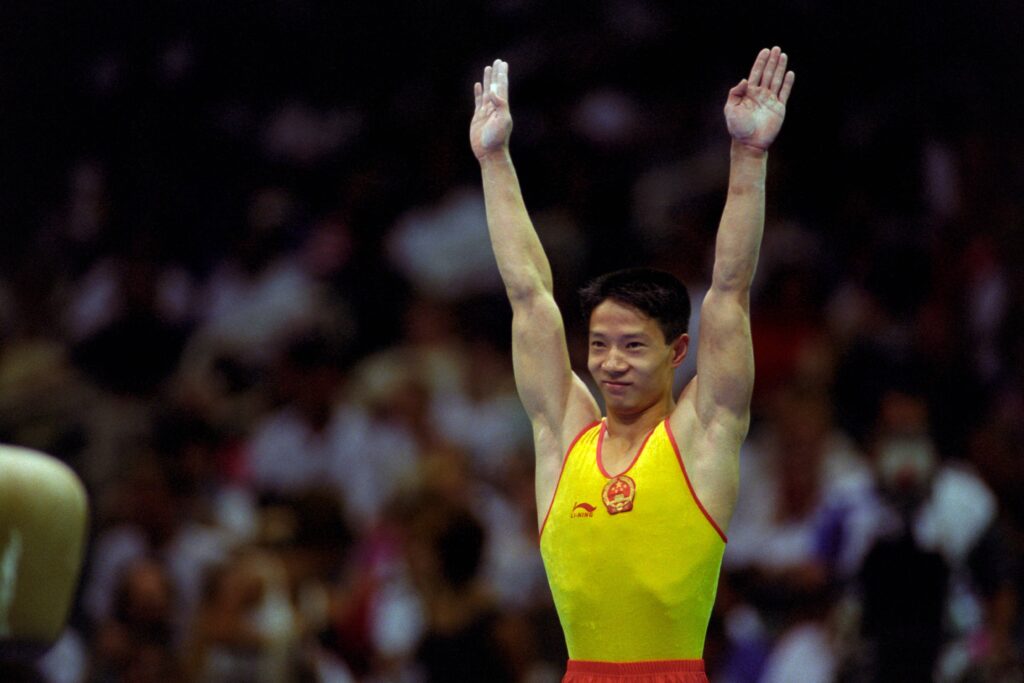
1994
A Rising Star in China’s Gymnastics World
By Peng Jingya
Sports World, September 10, 1994In May, amid fiery red pomegranate blossoms and songs celebrating the crimson month, the 1994 China “Sanqin Evening News Cup” International Gymnastics Competition arrived. The Shaanxi Gymnasium, located outside Xi’an’s South Gate, had been freshly renovated, and amid the festive atmosphere created by fluttering red flags and eye-catching billboards, gymnasts from 16 teams representing 11 countries gathered here to compete fiercely for the 12 gold medals and the weighty Sanqin Evening News Cup.
Once the competition began, the rivalry proved intense indeed, and the Chinese men’s team’s results were cause for great celebration. The young men not only swept the top four places in the men’s all-around, but also captured six championships across the six individual event finals. In this high-level, high-standard, high-caliber contest, a new star of gymnastics emerged — a single athlete who claimed three golds, one silver, and one bronze all by himself, becoming the most popular news figure among the people of Xi’an. He was none other than 17-year-old Zhang Jinjing.
In the men’s all-around competition, Zhang Jinjing’s performance fell short of ideal, and in the end he finished runner-up to teammate Li Bo by a margin of just 0.515 points (55.960). Back at the team’s lodgings, with his coach’s help, Zhang Jinjing carefully reviewed the lessons and experience from the competition, resolving to fight for a good result in the individual event finals.
The next day, Zhang Jinjing appeared on the competition floor with a whole new bearing. Competing fourth in the floor exercise final, his beautiful series of tumbling turns captured the judges’ and spectators’ attention right from the start; this was followed by a front tumbling pass landing cleanly and crisply. Finally came a series of high-difficulty tumbling passes — his saltos as fierce as a coiling dragon, his landings as if nailed to the floor. He won over the judges and claimed the floor exercise championship.
In the vault competition, Zhang Jinjing performed a back handspring with a 180-degree twist [onto the horse] followed by a front pike, scoring 9.375 and taking another gold medal. In the final event, high bar, competing last, he first performed a reverse giant swing after mounting, then a front somersault; after his body followed a perfect arc through the air, rotating exactly as the laws of mechanics dictated, he caught the bar precisely with both hands. Just as the audience was marveling at his daring performance, yet another high-difficulty release move appeared before everyone’s eyes. In this way, he won his third gold medal. In addition, Zhang Jinjing also took three bronze medals on pommel horse, rings, and parallel bars. With seven medals hanging around his neck, he said happily: “Xi’an is a rare place of good fortune. If I get the chance, I’ll definitely come back here again.”
Zhang Jinjing was born in Beijing. He began training in gymnastics at the Shichahai Amateur Sports School at just over 5 years old, and by now has had nearly twelve years in the sport. His family was an entirely ordinary working-class household; both parents were construction workers. Because his mother was from Beijing and his father was from Tianjin, the family gave him the name “Jinjing” (combining characters for Tianjin and Beijing) to commemorate both parents’ hometowns and his own birthplace. Zhang Jinjing was mischievous and restless by nature from birth, always stirring up trouble. At that time, his father was still working in Tianjin and often didn’t come home, so his mother raised him alone, which was very hard on her. Every day he was forever brandishing sticks as though they were swords, roaming wild all day with the neighborhood boys, and often making his playmates cry and run home to complain about him. His mother worried constantly because of this.
Watching her child run so wild, his mother grew anxious, thinking she needed to find a place that could rein in this little wild colt and give her some peace of mind. Fortunately, her brother knew a gymnastics coach at the Shichahai Amateur Sports School, and so his mother sent him there.
As it happened, the moment mischievous little Jinjing entered the gymnastics hall at Shichahai Sports School, he was completely captivated. The broad, soft foam mats, the swaying rings, the strange pommel horse and other apparatus — all of it stirred up a deep fascination in him.
Little Jinjing had a real natural aptitude for learning movements; where other children needed to repeat a movement many times, he could grasp the essentials on his very first try, and this earned him great favor from his coach. After starting elementary school, he still went to the gym to train every afternoon after school let out, without fail. One day, he arrived at the gym after school to find the atmosphere somewhat unusual; asking around, he learned that a coach from the Beijing team had come to select athletes. Seeing all his companions trying their hardest to show themselves off, he felt his own excitement rise. He was specially introduced to Coach Bai Yuanshao of the Beijing team. This Coach Bai had just graduated from the Beijing Institute of Physical Education and was in the process of selecting athletes, preparing to make his mark. The moment he laid eyes on Zhang Jinjing, he was captivated by that pair of bright, clever eyes. Coach Bai later recalled: “The instant I saw those dark eyes darting about, I sensed he had real aptitude.” After Zhang Jinjing performed over a dozen handstand variations in front of Coach Bai, he was chosen. Coach Bai judged that Zhang Jinjing had excellent flexibility and strong supporting strength — the most fundamental qualities a gymnast needs — and was a promising talent worth developing.
At age 8, Zhang Jinjing joined the Beijing team, and his young friends all envied him, praising him as someone with a bright future. For the first time, he too felt that sense of being set apart from the rest, and his heart swelled with joy. His mother, too, was overcome with unexpected happiness — tears welling in her eyes — and immediately called his father, still working in Tianjin, to share the news.
However, Zhang Jinjing never imagined that life on the Beijing team would be nothing like Shichahai Sports School. Here there was no sense of “play” at all — only grueling training, only what amounted to almost merciless conditioning. He was like a joyful little stream that had flowed into a rugged, dangerous shoal, and now lived a hard life woven through with sweat, tears, and blood. Once, after a training session ended, his coach took him out to the outdoor field for physical conditioning; the task was to climb a five-meter vertical iron pole. That pole was only about a fist’s width around, smooth and slippery, extremely difficult to climb, relying entirely on arm strength to pull oneself up, while the coach stood below with a stopwatch; anyone who exceeded the set time would be punished. Zhang Jinjing summoned all the strength in his body, struggling upward inch by inch, his two arms aching as if they were about to tear apart, tears blurring his eyes that he couldn’t even reach up to wipe away. He never forgot the taste of that pain for the rest of his life; inwardly he muttered to himself: why does the coach have to torment us like this? Of course, it was only after he achieved success in major competitions that he came to understand the coach’s deep, well-meaning intentions behind tormenting them back then.
Faced with a son whose hands were covered in blisters and whose face was streaked with tears, his mother also wept with a heavy heart. Indeed, other children his age were still snuggling up to their parents for comfort, while little Jinjing, not even 10 years old yet, was already made to endure this suffering. His mother was a sensible woman; though she loved her son dearly, she nonetheless encouraged him to fight on and struggle forward. When little Jinjing complained of his hardships, she listened patiently, but when she heard her son wanted to give up and quit, she grew angry: “Jinjing, to accomplish anything at all in this world, you must put in hard, difficult labor; success is never easily won. Right now you’re growing your body, building your strength; only by enduring hardship and laying a solid foundation can you achieve results. You absolutely must not give up halfway. Grit your teeth and hold on.” His mother’s simple, sincere words moved her son’s heart, and Zhang Jinjing returned to the team to persevere in training.
The grueling strength training finally began to show results. Zhang Jinjing’s arms swelled with enviable muscle, and his chest grew both broader and thicker. Strength was the foundation; because his well-developed muscles contained tremendous explosive power, Zhang Jinjing performed with great ease many high-difficulty movements that seemed impossible for others, as easily as reaching into his own pocket. High bar and parallel bars in particular became his strongest events, giving him real medal-winning potential. Take, for example, the release moves on high bar — extremely dangerous world-class elements where success and failure often hang on the finest of margins. Yet Zhang Jinjing performed them with barely any errors, simply reaching out his hand. In a competition in Canada last year, his brilliant routine actually defeated Olympic champion Scherbo. Whenever this comes up, Zhang Jinjing lights up with excitement, saying: “Although Scherbo lost to me because of an error on his part, competing on the same floor as a world champion is something I’ll never forget.”
Zhang Jinjing is a deeply affectionate child, filled with filial devotion and a wish to repay kindness. Five years ago, when his mother fell ill with a high fever, the then-12-year-old secretly saved his own dinner into a lunchbox and brought it home for his mother to eat. Because he hadn’t asked for leave before going home, he was criticized by his coach upon returning to the team, but in his heart he still felt at peace, because he had shown his mother a small measure of filial devotion. As for Coach Bai Yuanshao, Zhang Jinjing feels even more gratitude. He said with deep feeling: “Coach Bai is just like a father to me — strict, yet also caring toward me. Whenever I feel unwell or suffer a minor injury, he always shows concern for me, tells me to rest properly, and looks after my meals and daily life in every way, making me feel the same warmth as if I were by my own father’s side.”
Seven years of hardship on the Beijing team transformed Zhang Jinjing from an innocent, worldly-unwise young troublemaker into an outstanding gymnast. It was in his 15th year that he was selected for the national team, taking up the weighty responsibility of bringing honor to his country. This past February, he represented China in Hiroshima, Japan, at the 6th Asian Junior Gymnastics Championships held there. Composed and decisive, performing brilliantly, he won four championships — men’s team, men’s all-around, high bar, and parallel bars — becoming the “gold medal powerhouse” of the Chinese team. After this year’s 1994 China Sanqin Evening News Cup international competition, he said with full confidence: “This year holds the World Gymnastics Championships and the Asian Games. I’m determined to seize the opportunity, bring honor to my homeland, and scale new heights.”
At 17, in the very bloom of youth, at the golden season for a gymnast, people hope that Zhang Jinjing will press on with even greater effort and see his wishes fulfilled. □
中国体操界的
一颗
新星
文/彭静亚
五月,火红的石榴花,在一片红五月的歌声中,迎来了’94中国”三秦晚报”杯国际体操大赛,位于西安南门外的陕西体育馆修葺一新,在招展的红旗、醒目的广告牌装扮的热烈气氛中,来自11个国家的16支队伍的体操健儿们,在这里展开激烈地较量,争夺那12块金牌和沉甸甸的三秦晚报杯。
比赛开始,竞争果然激烈,中国男队的成绩令人欢欣鼓舞,小伙子们不仅包揽了男子全能的前四名,还在六个单项决赛中,夺得六项冠军。就在这次高水平、高规格、高层次的角逐中,冒出了一位体操新星,他一人独揽三金一银一铜,成为最受西安人欢迎的新闻人物。他,便是年仅17岁的张津京。
在男子全能比赛中,张津京发挥不够理想,最后仅以0.515分之差(55.960)屈居队友李勃之后,获得亚军。张津京回到驻地,在教练的帮助下认真总结比赛中的经验教训,决心在单项决赛中争取好成绩。
第二天,张津京以新的姿态出现在了赛场。自由体操决赛时他第四个出场,那一串漂亮的跟头旋,从一开始便吸引了裁判和观众,接着又是一个前空翻回笼,干净利落。最后又来了一串高难度的跟头,空翻如蛟龙,落地似钉牢。他征服了裁判,获得自由体操冠军。
跳马比赛,张津京一个鲣子板上转体180°接屈体腾越,获得9.375分,再获金牌。最后一项单杠,他最后一个出场,上杠后先是反弓大回环,再接前空翻,当身体按力学轨迹在空中先成飞行和旋转之后,他又准确地两手抓杠。正当观众为他的惊险表演赞叹时,又一个高难度的飞行动作出现在大家面前。这样,他获得了第三块金牌。另外,张津京还获得鞍马、吊环、双杠三块铜牌。一个人胸前挂了七块奖牌,他高兴地说:”西安是个难得的风水宝地,肯有机会,我还要再来这里”。
张津京,出生于北京市,他从5岁多便开始在北京什刹海业余体校习体操,算起来,已有近十二年的运动生涯了。他的家,是一个极普通的工人家庭,父母都是建筑工人。由于母亲是北京人,父亲是天津人,所以家里人便给他起了个”津京”名子,以纪念双亲的籍贯和出生地。张津京生来顽皮好动,惹是生非。那时候,父亲还在天津上班,经常不回家,妈妈带着他,很是辛苦。他每日里总是舞刀弄棒,整天和邻里的男孩儿们四处窜野,还常把小伙伴们打得哭着上家告状,母亲为这没少操心。
看着孩子这样野,母亲心里发愁,她寻思着得找上一个能管得住这小野马的地方让她省点心。幸好,舅舅认识什刹海业余体校的一位体操教练,于是,妈妈便把他送到什刹海业余体校。
说来也巧,玩皮的小津京一到什刹海体校的体操馆,便被吸引住了。那宽大柔软的海绵垫、悠来晃去的吊环、奇怪的鞍马等器械,都使他产生了浓厚的兴趣。
小津京学动作很有悟性,别的孩子要重复多少次的动作,他一试便有眼有角,因此深得教练的喜欢。上小学之后,他还是每天下午放学后便背上书包去体操馆训练,从不间断。有一天,他放学后来到体操馆,感到气氛有些异常,一打听,原来是北京队的一位教练来这里挑选队员。看到同伴们个个都在努力表现自己,他心里更热起来。他被特别介绍给了北京队的白远绍教练。这白教练刚从北京体院毕业,正在选队员准备大干一番。当他第一眼望见张津京时,就被那一双机灵的大眼睛吸引住了。后来,白教练回忆说:”一看到那双转动着的黑眼睛,我就感觉到他有悟性”。张津京在白教练面前做了十几个倒立动作之后,就被相中了。白教练认为,张津京的韧带力好,支撑力强,具有体操运动员最基本的素质,是个可塑之材。
8岁的张津京进了北京队,小伙伴们都羡慕他,夸他有出息。他也第一次感到了那种与众不同的滋味,心里乐陶陶。母亲也因此意外的喜悦,两眼流出了泪花,并立即将这一消息打电话告诉给还在天津工作的丈夫。
然而,张津京万没想到,北京队里的生活远非什刹海体校,这里没有”玩”的意思,有的只是苦练,有的只是近乎残忍的磨练。他就像一条欢乐的小溪流入了坎坷的险滩,过起了汗水、泪水和血水相交织的艰苦生活。有一次,训练课结束后,教练带他去室外操场上进行身体训练,任务是爬5米多长的铁杆。那铁杆,只有一握粗细,又光又滑,爬起来十分困难,全靠力气引体向上,教练还在下面掐着秒表,谁超出了规定时间,谁就要被罚。张津京鼓出全身的气力,艰难地向上移动着,两只胳膊简直就像要断裂一样地疼痛,眼泪模糊了双眼也不能伸手去擦一下。这疼痛滋味,他终生难忘,他心里嘀咕:教练为什么要这样来整我们?当然,当他在大赛中获得成功之后,才明白了教练当年整他们的良苦用心。
面对两手血泡和满脸泪痕的儿子,母亲也心疼地哭了。是呀,别的孩子这么大时,都在父母身边撒娇,而小津京还不到10岁,便让他去受这份罪。母亲是懂事理的人,她虽疼爱儿子,但却鼓励儿子去奋斗、去拼搏。小津京诉苦,她耐心地听,但听到儿子想打退堂鼓时,她却生气了:”津儿,这世界上要办成任何一件事,都要付出艰苦的劳动,成功是不会轻而易举地获得的。你现在正在长身体,长力量,只有吃苦打好基础,才能获得成绩,你千万不能半途而废,要咬牙坚持”。母亲质朴的语言,打动了儿子的心,张津京又回到队里坚持训练。
艰苦的力量训练终见成效,张津京的双臂隆起了令人羡慕的肌肉块,胸膛也变得又宽又厚起来。力量是基础,由于发达的肌肉块蕴含着极大的爆发力,所以很多看来是无法完成的高难度动作,张津京做起来十分轻松,如同囊中取物一样。尤其是单杠和双杠,更成了他的强项,更具有夺牌的实力。比如单杠上的飞行动作,是极为惊险的世界流动作,成功与失败往往是在毫厘之间。可张津京做起来,大手一伸,极少失误。去年加拿大一次比赛中,他的一套潇亮动作竟战胜了奥运会冠军谢尔博。一提起这件事,张津京就显出兴奋,他说:”尽管谢尔博是因为失误输给我,但能与世界冠军同场竞技,令人难忘”。
张津京是个很有感情的孩子,他有孝心,也有报恩之心。五年前,母亲病了,发着高烧,12岁的他便偷偷将自己的一份晚饭装在饭盒里,送回家去给妈妈吃。由于他回家时没有请假,回队后受到教练批评但他心里仍然感到舒坦,因为他给妈妈尽了一点孝心。对于白远绍教练,张津京更是感激。他深情地说。”白教练就像我的父亲一样,既严格又心疼我。每当我身体不适时受了小伤时,他都关心我,让我好好休息,多方面照顾我的饮食和起居,使我感到像在父亲身边一样的温暖”。
北京队的七年磨练,张津京从一个不谙世事的顽童,成长为一名优秀的体操运动员。就在15岁这一年,他入选国家队,扛起了为国争光的重任。今年2月,他代表中国去日本广岛,参加在那里举行的第6届亚洲青年体操锦标赛。他沉稳果断,发挥出色,取得男子团体、男子全能和单杠、双杠四项冠军,成为中国队中的”金牌大户”。这次’94中国《三秦晚报》杯国际比赛之后,他充满信心地说:”今年有世界体操锦标赛和亚运会,我一定要把握好机会,为祖国争光,攀登高峰”。
17岁,正是花季少年,正是体操运动员的黄金季节,人们期望张津京再接再厉,如愿以偿。□
1995
Zhang Jinjing: A Newborn Calf
By Ba Mei
New Sports, November 15, 1995At the 1995 World Gymnastics Championships, the Chinese gymnastics team achieved a brilliant record of 3 golds, 6 silvers, and 1 bronze — reaping the rewards of hard training, and also discovering promising new talent.
Among the new names, not-yet-18-year-old Zhang Jinjing was among the most representative. This Beijing native, competing in his first world-level competition, not only succeeded in all 12 team routines — making a decisive contribution to China’s successful title defense — but also turned in solid individual results: making the all-around top eight and taking bronze on high bar, becoming one of the tournament’s most promising new stars.
(I)
The draw was unfavorable; the men’s team was not only scheduled for the early session, but their very first event was rings.
Who would be sent out to strike the opening blow, the one that would set the tone for the whole competition? That responsibility fell to newcomer Zhang Jinjing.
The two rings hanging in midair looked like a pair of giant exclamation points, impossibly high. He charged forward, starting again from zero. Making his debut, Zhang Jinjing didn’t panic. Gripping the rings tightly, he spread the wings of a young eagle.
“Starting from zero” was an unforgettable, bone-deep memory from Zhang Jinjing’s life journey.
While recovering from a fracture in 1994, Zhang became obsessed with video games out of sheer boredom. That obsession ultimately led him into a serious lapse in judgment that he would later deeply regret. The national team responded with stern disciplinary action, but also gave him the opportunity to rebuild his career.
Setbacks are life’s catalyst. With coach Bai Yuanshao’s help, Zhang doubled his previous training load, beginning a new start in life.
A year of grueling, transformative training brought Zhang Jinjing back to himself. Before the World Championships, he vowed to wash away his shame with gold and to wannounce his arrival as an adult at 18 through success.
Zhang Jinjing kept his word. From taming the unruly rings to soaring through the perilous high bar, in routine after routine of aerial rotations he found the confidence to surpass his former self; in success after success he came to understand that only self-respect brings true strength.
From compulsory to optional routines, he made not a single error across all 12 events. In China’s men’s team title defense, Zhang Jinjing made an essential contribution.
On the podium, Zhang Jinjing raised his flowers high, bidding farewell to his past. As the national anthem played, Zhang Jinjing stepped ahead of schedule into the ranks of “adulthood.”
(II)
As he transferred to the opposite pommel, he attempted a “single-pommel circle with a turn [i.e., a spindle]” and made a mistake. Zhang Jinjing fell right off the horse! The whole arena groaned in dismay.
After the team competition ended, Zhang Jinjing and his senior teammate Li Xiaoshuang advanced into the individual all-around final. After three rotations, he was again right behind Xiaoshuang, ranked second.
At this year’s May National Gymnastics Championships, Zhang Jinjing had likewise trailed just behind Li Xiaoshuang to take the all-around silver medal. At this World Championships, could Jinjing repeat that “gold-silver duet” with Xiaoshuang once again?
Competing fourth, Zhang Jinjing was riding the pommel horse like a whirlwind, and just as spectators were delighting in it, Jinjing suddenly lost his grip and fell off. In a sport decided by the finest margins, this fall dropped Zhang Jinjing out of the top eight.
“That’s strange; they cut that second ‘single pommel circle with a turn’ from the routine over a month ago for the team event, so why did he use it today?” Coach Bai Yuanshao, watching his star pupil’s every move on TV, was baffled.
Afterward, Bai learned in a phone call from those at the competition what had happened: eager for victory, Zhang Jinjing had added difficulty to his pommel horse routine on his own initiative, and in the end couldn’t execute it, losing his grip and falling.
This wasn’t the first time Zhang Jinjing had acted on his own without authorization.
(III)
Born into a construction worker’s family, Zhang Jinjing was mischievous and restless as a child. His mother, unable to control him, sent him to the Shichahai Sports School to train in gymnastics, mainly so someone could keep an eye on him after school.
In 1985, Bai Yuanshao, freshly graduated from the Beijing Institute of Physical Education, took Zhang Jinjing on from coach Pan Jie, taking charge of both his training and his schoolwork.
On one term exam, Jinjing’s grades were poor, and his teacher’s comments weren’t favorable either. Jinjing felt this was quite humiliating. When his coach asked him for his report card, he lied and said it “hadn’t been issued yet.”
He later explained to his friends that he wanted to use the break to work hard and fix things… and indeed, over that vacation, young Jinjing trained diligently and behaved.
This time, however, acting on his own carried a painful price. Despite his hard work in the remaining two events, Jinjing ultimately placed 8th in the all-around, but he had lost a major opportunity, and with it a weighty all-around medal.
If setbacks had once spurred Zhang Jinjing on, then this lesson should serve as a warning to him!
“In the high bar final, I’ll give it everything I’ve got,” said Zhang Jinjing.
Six years into the national team, making his first appearance at a major competition, Zhang Jinjing had taken somewhat longer to develop, but his solid fundamentals made him an all-around-type gymnast. This was especially true on the bar events; not only was he consistent, but the quality of his execution was high. Advancing alone into the high bar final was proof enough of this.
Standing alone against the odds, could Zhang Jinjing withstand the fierce, relentless pressure from his rivals?
Zhang Jinjing normally lacked much of the reckless, all-out fighting spirit, but when it truly came down to the wire, he wasn’t one to be pushed around either.
At the first National Games for Youth in 1989, the then-11-year-old Zhang Jinjing suddenly developed Achilles tendon and bone inflammation before the competition, and his foot hurt too much to bear weight. After every event, he had to be carried between apparatus by coach Bai Yuanshao. Competing injured, he still helped the Beijing team win team bronze and the parallel bars gold, earning him the nickname “Little Iron Hero”…
The decisive moment arrived. As Zhang Jinjing stood beneath the bar, the earlier competitors — Scherbo, Dunev, and Wecker — had been trading blows, “driving” the score up to 9.8. To win a medal, Zhang Jinjing would need to surpass his own team-competition performance.
Under the watchful eyes of his rivals, this newborn calf had no choice.
Determined to win a medal, Zhang Jinjing threw everything into it.
He leapt onto the bar — overgrip, undergrip, giants, pirouettes, releases… a seamless string of movements flowing like water. As he landed with composure, the judges awarded him a score 0.05 higher than that of world star Scherbo.
Scherbo could only shake his head in admiration—the next generation had arrived.
Raising his arm in acknowledgment, Zhang Jinjing’s heart was already dreaming of tomorrow.
初生牛犊
张津京
□ 巴妹
在1995年世界体操锦标赛中,中国体操队取得了3金6银1铜的辉煌战绩,收获着苦练的成功,也收获了新人脱颖的希望。
新人榜里,不满18岁的张津京,算得上是最有代表性的。这位初涉世界大赛的北京后生,不仅在团体的12项赛比赛中全部成功,为中国男队卫冕立下了汗马功劳,而且单项战绩不俗:全能跻身前八,单杠摘得铜牌,成为本届赛事最具潜力的新星之一。
(一)
抽签不利,团体赛中男队不仅排在早场,而且第一个项目便是吊环。
派谁出阵去打响这事关全局的头炮中的头炮呢?重任落在新人张津京身上。
凌空高悬的两个圆环,如同一对巨大的惊叹号,高不可测。”冲上去,从零开始”,初次登场,张津京没有惊慌,紧攥双环,展开了雏鹰的翅膀。
“从零开始”,是张津京人生路途中一段刻骨铭心的记忆。
1994年,骨折养伤中的张津京在百无聊赖中迷恋上了电子游戏机,并因此干了一件令他追悔莫及的错事。为此,中国体操队曾对他做出了严肃的处理,给了他跌倒后重新站起的机会。
挫折是人生的催化剂。在教练白远绍的帮助下,张津京用超出以往一倍的训练负荷,开始了人生新的起步。
一年脱胎换骨的苦练,张津京重新找回了自我。出战世界锦标赛前,他立誓要用金牌雪耻,要用成功书写18岁的”成人宣言”。
张津京没有食言,从驾驭不羁的吊环到飞越惊险的单杠,在一次次腾空飞旋中他找寻到超越过去的自信,在一项项的成功中他体会到自尊才能自强。
从规定到自选,12项无一失误,中国男队团圆之战,张津京立下了汗马功劳。
领奖台上,张津京高举着鲜花与过去告别,国歌声中,张津京提前跨入”成人”行列。
(二)
移环再做”单环转体”失手,张津京从鞍马上摔了下来!全场为之扼腕。
团体比赛结束,张津京与师兄李小双杀入个人全能决赛圈。前三轮赛完,他又紧随小双之后,积分排名第二。
今年5月的全国体操锦标赛上,张津京便是这般紧咬李小双之后,坐上全能亚军之席的。这届世锦赛,津京能紧跟小双再演一出冠亚军”二重唱”吗?
第4项出场,张津京在鞍马上如疯如狂,正当人们为此津津乐道之时,津京却忽然失手,落马。在锱铢必较的体操比赛中,这一掉,张津京便跌到8名之后。
“怪了,为了打团体赛,这第二次的’单环转体’一个多月前就减了,今天他怎么又用了呢?”从电视里观着爱徒一举一动的白远绍教练百思不得其解。
事后,白教练从前线打来的电话得知,原来,求胜心切的张津京在鞍马比赛时擅自增加难度,终于力不从心失手落马。
自作主张这在张津京已不是第一次。
(三)
出生在建筑工人家庭的张津京从小调皮好动,妈妈实在管不了他,只得送他去什刹海体校学体操,为的是放学后有一个管他的地方。
1985年,刚从北京体院毕业的白远绍从潘杰教练手中挑来了张津京,管起了他的训练,也抓起了他的学习成绩。
一次期末考试,津京的成绩不理想,而且老师的评语也不太好,津京觉得挺丢人。当教练向他要期末成绩单时,他谎称”没发”。
事后小伙伴解释:我想在假期里努力改正……的确,一个假期下来,小津京既肯练又听话。
不过,这次自作主张的代价是惨痛的。尽管经过后两项的努力,津京最终跻身全能第8,但是,失去的是一次重大的机会,丢掉的是一枚沉甸甸的全能奖牌。
挫折曾使张津京奋起,那么,教训当使张津京警醒!
“单杠决赛,我会全力去拼的。”张津京说。
进入国家队6年,首次被启用打大赛的张津京,虽说雕琢的时间长了点,但是,扎实的基本功,使他成为一个全能型的运动员。特别是杠上项目,他不仅稳定性好,而且动作质量高。独自一人杀入单杠决赛,便足以证明这一点。
势单力薄,张津京能顶得住对手们狂轰滥炸、轮番攻击的压力吗?
张津京平时的确少拚命三郎的气质,但真到了”刺刀见红”的节骨眼上,他也不是吃素的。
1989年第一届青运会,年仅11岁的张津京赛前突发跟腱骨骼炎,脚疼得不敢落地。每一项次比赛完,都得靠教练白远绍抱着他换项,当他带伤为北京队赢得团体第三和双杠金牌时,也获得了”钢铁小英雄”的称号……
决战时刻到了。当张津京伫立杠下,先出场的谢尔博、杜维耿夫、维克尔,争相”攀比”,已把比分”炒”到了9.8分。要想赢得一枚奖牌,张津京必须超越自己在团体赛的水平。
虎视眈眈之中初生牛犊别无选择。
立誓夺牌的张津京豁出去了。
只见他飞身上杠,正握,反握,回环,扭臂,腾越,翻飞……一连串行云流水般的动作一气呵成,当他翩然落地,裁判给他亮出了高于世界名将谢尔博0.05的高分。
摇头轻叹,谢尔博深感后生可畏。
振臂示意,张津京心中憧憬着明天。
1997
★This Issue’s Spotlight★
Before the Chinese men’s gymnastics team departed for the World Gymnastics Championships in Lausanne, Switzerland, one focal point of public attention was whether Zhang Jinjing could become the new leading figure of the Chinese men’s team following Li Xiaoshuang.
The Lausanne competition brought Zhang Jinjing a satisfying result: not only did he lead his teammates to the men’s team title, but he also claimed the world championship title on parallel bars.
Behind the beautiful routines and outstanding results lies Zhang Jinjing’s endearing personality and sincere character. Get close to him, and you’ll find he’s a remarkably engaging young man… In this issue’s “Spotlight” feature:
● Zhang Jinjing’s heartfelt and philosophical answers to reporters’ questions showcase the strength of his character
● “Zhang Jinjing’s Feeling Dictionary” offers insight into his thoughts at every stage of his gymnastics career
● A series of “New Prince’s Bests” lets you understand him more completely and thoroughlyZhang Jinjing: New “Lead Ram”
(□ = Reporter ■ = Zhang Jinjing)
□ First of all, congratulations on winning the world championship again. So, how are you feeling now — not bad, I imagine?
■ Not bad, that’s true. But as captain of the men’s team, after winning the title I cautioned my young teammates to hold themselves to even stricter standards — to think about how we used to train, and to do even better going forward. This is really also a way of spurring myself on, of leading by example!
□ Has anyone taught you this lesson before?
■ Xiaoshuang taught me this. It’s a proud tradition of our men’s gymnastics team; the captain sets the example, and he must pass down good conduct and good results from one generation to the next.
□ So as captain, is the pressure especially heavy on you during a major competition like this?
■ The pressure of being captain is certainly considerable, but I’ve always had confidence I could handle it well. This group of boys on the team are all very obedient, and they’re willing to give everything. They held firm at the critical moments, and that made the team proud. I’m very satisfied.
□ At the moment you won the title, what were you thinking? Were you deeply grateful to your coach, Bai Yuanshao?
■ How could the word “grateful” even begin to cover it? He’s coached me for 12 years. Twelve years — I’ve grown from a little boy into a grown young man, and become a world champion; he’s grown from a young coach into an excellent coach who has raised a world champion. You could say he’s happy for me, and I’m happy for him. It’s recognition of everything we’ve poured into these past twelve years, and it means a great deal for both of our futures. I should say that every time I achieve a good result, it draws the hearts of teacher and student even closer together.
□ You and your coach clearly have deep feelings for each other, but have there been any conflicts or arguments?
■ Coach Bai is like a father to me. In training and in life, I listen to him. He’s scolded me on the training floor before — being scolded really hurts a boy’s pride — but I’ve never talked back, and I’ve never held it against him, because he never loses his temper without reason, and afterward he always sincerely apologizes to me. Through mutual apology and mutual understanding, we resolve every conflict between us.
□ As you continue winning titles, financial rewards inevitably become part of the picture between you and your coach.
■ Neither Coach Bai nor I are the type to place great importance on material interests, but we’re both people who value feelings deeply. My parents have always taught me to stay indifferent to fame and fortune, and I don’t believe material gain is worth sacrificing everything for.
□ Including the deep bond between teacher and student?
■ Of course, this is one of the most important relationships of my life. It has already sustained me for 15 years, and it will continue to sustain me.
□ Hearing you say that is quite moving.
■ I’m speaking from the heart. Long ago, Coach Bai once told me: “It isn’t the end of the world if an athlete doesn’t perform well, but as a person, you absolutely must be good. Only that way, when you fail, will others continue to support you as always and help you start over.” I’ve kept these words firmly in my heart ever since. That’s why being a good person has always been my first pursuit.
□ I’m glad to hear you say that. So how do you view the road ahead?
■ The road ahead is still long! But right now, what I want most is the individual all-around world championship — that’s my next goal to strive for. ■
★This Issue’s Spotlight★At 20, Zhang Jinjing has been bound to gymnastics for 15 years. From the day he first stepped into the gym, this deeply emotional young man has left behind his own distinct feelings at every stage. If you’d like to know his thoughts and reflections at any one of his key moments, look no further.
Zhang Jinjing’s Feeling Dictionary
▲ 1982, sent by his mother to the Shichahai Amateur Sports School —
Fun. Such a huge gym, and I could find places to run around without anyone telling me to stop. Hey, there was even a foam pit. I just wanted to keep jumping into it.
▲ 1984, selected for the Beijing team by coach Bai Yuanshao —
Baffled. Just like that, I was on a professional team. I was a bit dazed and confused about it! But since I’d been chosen, I figured I’d better train hard!
▲ 1989, transferred to the national team together with coach Bai Yuanshao —
Excited and nervous both. The national team wasn’t some place you could just casually get into, but what exactly was it like there? If you asked the coach, it was his first time there too, so he probably felt about the same as me. Now that I’d made the national team, I really wanted to train hard and make something of myself!
▲ 1995, becoming a member of the world men’s team championship squad for the first time —
I didn’t even know how we’d won the title, and I could hardly believe I’d become a world champion. Standing on the podium, I kept muttering to myself, “So this is what the world champions’ podium looks like.” That night, my good friend Fan Bin and I bought a few bottles of beer to celebrate becoming world champions, and as we drank we kept saying to each other: “Ha! We’re world champions?!”
▲ The night before the men’s team battle at the 1997 World Championships —
I tossed and turned, unable to sleep, just wanting the competition to hurry up and start, while also worrying for my teammates. We were competing with an entirely new lineup this time, and honestly, we really weren’t sure of ourselves. And as team captain, I not only had to avoid mistakes and perform excellently myself, but also had to encourage my teammates to perform normally. The responsibility weighed heavily on me!
▲ Watching teammates compete during the team final —
Even more nerve-wracking than competing myself. After all, we were a group of young athletes going into battle. Even though we all had some confidence, in the warm-up competition before the event, everyone had been falling all over the place, and nobody felt sure of themselves anymore.
I felt that every time a teammate successfully completed a routine, it brought our hearts a little closer together.
▲ Finally defending the world men’s team championship title —
Redemption. We’d lost the team title at the Atlanta Olympics, and this time we fought to win it back. Although I could no longer find that wonderful feeling from becoming world champion for the first time two years earlier, I was still happy for the younger teammates experiencing it for the first time.
▲ Making a mistake and falling off the apparatus while chasing the all-around title —
Completely stunned. In that moment of falling, I didn’t know anything at all. I didn’t even have time to feel disappointed or regretful. Afterward, I thought that I must have blacked out for an instant.
▲ Winning my first individual world championship title —
Even more confident, doubly proud. Before the parallel bars final, after analyzing my opponents, I confidently believed that as long as I successfully completed my routine, the championship would be mine! That day, when I landed steadily off the parallel bars, I couldn’t help but pump my arm and shout out loud — to release my emotions, and also to signal the judges. In the end, I received the judges’ recognition, which was proof that I belonged at the top!
Standing on the podium, watching the national flag rise and hearing the national anthem play, the thought “I am a world champion” kept flashing through my mind. At the same time, I felt doubly proud of that flag rising because of my effort, and that anthem playing because of my effort.
▲ Bidding farewell to the glory of Lausanne and returning to Beijing, back to the gym —
Very tired. Everything in the gym hadn’t changed at all, while the glory of Lausanne felt like a dream. There wasn’t even a moment left for me to savor the past, and the road to creating new glory had to begin all over again from here. Looking at those familiar pieces of apparatus that had been with me every day, I knew it was time to partner with them once again and set out on the road ahead. ■
New Sports, November 15, 1997
★本期星座★
中国男子体操队出征瑞士洛桑世界体操锦标赛之前,张津京能否成为李小双之后中国男队的领军人物是人们关注的一个焦点。
洛桑之战,张津京交了一份满意的答卷:不仅率领队友勇夺男子团体冠军,同时坐上了双杠世界冠军的宝座。
漂亮的动作、出色的成绩后面是张津京可爱的性格和真诚的为人,走近他,你会发觉他是个很有魅力的小伙子……在”本期星座”中——
●张津京充满深情和哲理的答记者问呈现给你他十足的人格魅力
●《张津京的感觉辞典》使你对他体操生涯每个阶段的感受了然于心
●一系列”新王子之最”令你更全面、更透彻地认识他
新”头羊”
张津京
(□记者 ■张津京)
□首先祝贺你再度夺得世界冠军,怎么样,现在心情不错吧?
■不错是不错,但作为男队的队长,在夺冠后我就告诫我的小队友,让他们更严格地要求自己,想想以前是怎么练的,以后更要做好。这实际上也是对我自己的鞭策,以身作则嘛!
□以前也有人这么教育过你吗?
■小双就这么教育过我,这是我们体操男队的光荣传统,队长是表率,他要将好的作风和好的成绩一代一代传下去。
□那么你作为队长,在这大赛中压力是不是非常大?
■当队长我的压力当然挺大的,不过我一直有信心干好。队里这帮男孩儿都很听话,也能豁出去拼,关键时刻都顶住了,这为我们孩子争足了面子,我很满意。
□夺冠的时刻想了些什么?是不是非常感激你的教练白远绍?
■怎是”感激”二字了得?他带我12年了,12年,我从一个小男孩长成了大小伙子,当了世界冠军,他也从一个年轻教练到托举起世界冠军的优秀教练,可以说是他为我高兴,我为他高兴,这是对我们过去多年齐心付出的肯定,同时也对我们彼此的未来大有好处。应该说我每取得一个好成绩,就把我们师徒俩的心扣得更紧。
□你们师徒情深,那么有没有过矛盾和争吵呢?
■白指导就像我的父亲,我在训练和生活中都听他的。他在训练场上骂过我,骂,对于一个男孩子是很伤自尊心的事,但我从不顶撞,也从没有恨过他,因为他从来都不是无缘无故乱发火,而且事后他都会诚恳地向我道歉,我们会在彼此的道歉、相互的理解中化解所有的矛盾。
□那么随着你在世界大赛中不断摘金夺银,接踵而来的利益问题就会摆在你们师徒面前。
■我和白指导都不是那种看重利益的人,但我们同样都是重感情的人。父母亲一直教育我要淡泊名利,而且我也认为物质利益决不足以毁掉一切。
□包括师徒深情?
■当然,这是我生命中一段非常重要的感情,已经支撑了我15年,并且还将继续支撑我。
■怎是”感激”二字了得?他带我12年了,12年,我从一个小男孩长成了大小伙子,当了世界冠军,他也从一个年轻教练到托举起世界冠军的优秀教练,可以说是他为我高兴,我为他高兴,这是对我们过去多年齐心付出的肯定,同时也对我们彼此的未来大有好处。应该说我每取得一个好成绩,就把我们师徒俩的心扣得更紧。
□这番话听来令人感动。
■我说的是肺腑之言。很早以前,白指导就曾告诉我说:”一个运动员练不好不用怕,但做人一定要好。只有这样,在你失败的时候,别人才会一如既往地支持你,帮你重新开始。”这段话我一直牢记在心。因此做一个好人一直是我的第一追求。
□很高兴听到你这样说,那么你如何看待前面的路?
■前面的路还长着呢!但眼下我最渴望得到的是个人全能的世界冠军,这是我的下一个奋斗目标。■
–
★本期星座★
20岁的张津京已与体操结缘15年。从步入体操房的那天起,感情丰富的他在每个阶段都留下了独有的心情感受。如果您想了解他的某一重要时刻的所思所想,请查询——
张津京的
感觉辞典
▲1982年被妈妈送进什刹海业余体校——
好玩儿。那么大个体操馆,可找着随便跑不挨说的地儿了。嘿!还有海绵坑呢,可得使劲儿地跳。
▲1984年被白远绍教练选进北京队——
莫名其妙。这么就进专业队了,有点儿稀里糊涂!既然被选上了就好好练吧!
▲1989年和白远绍教练一同被调入国家队——
兴奋又紧张。国家队可不是个能随随便便就进的地儿,可那里头究竟是个什么样儿呀?问教练吧,他也头一回来,感觉肯定差不多。但进了国家队,练出成绩争口气是真的!
▲1995年第一次成为世界男子体操团体冠军成员——
不知道怎么拿的冠军,更不敢相信自己已经当上世界冠军了。站在领奖台上,我一直在自言自语说”这就是世界冠军的奖台”;当天晚上我和好友范斌为庆祝当上世界冠军买了几瓶啤酒,我们边喝边对自己说:”哈哈!我们是世界冠军啦?!”
▲1997年世锦赛男子团体大战前夜——
翻来覆去睡不着,只想比赛快点儿来,又为队友捏把汗。我们这次以全新阵容出战,说实在的是心里没底儿,我又是男队队长,不仅要自己不出差错、出色完成,还要鼓励队友正常发挥,责任重大啊!
▲团体决战时看队友比赛——
比自己上场还紧张。毕竟我们是一群年轻队员出战,尽管我们都有信心也好,但赛前参加的热身赛,大家噼哩啪啦地都砸,谁心里都没底儿了。
我觉得每当队友成功完成一套动作时,我们的心就靠得更近一些。
▲最终卫冕世界男子体操团体冠军——
争气。我们在亚特兰大奥运会上丢掉的团体冠军,这次又让我们给拼回来了,我虽然找不到两年前第一回当世界冠军的美妙感觉了,但还是为几个第一次当世界冠军的小弟兄高兴。
▲冲击男子全能冠军失误掉下器械——
全懵了。掉下来的那一刻我什么都不知道,甚至来不及沮丧和遗憾。事后我想,当时我的眼圈一定是黑的。
▲拿下个人项目的第一个世界冠军——
更加自信、倍感骄傲。我在双杠决赛前分析对手后就自信地认为,只要我成功完成自己一套动作,冠军就是我的!那天当我从双杠上稳稳落地时,我情不自禁地挥臂大叫了一声,为发泄情感,也为提示裁判。最终我得到了裁判的认可,这证明了我的实力!
站在领奖台上看国旗升起,听国歌奏响,”我是世界冠军”的想法不断闪现,同时我为那面因我的努力而升起的国旗,因我的努力而奏响的国歌倍感骄傲。
▲告别洛桑的辉煌又回到北京,回到体操房——
很累。体操房的一切都没有改变,洛桑的辉煌像一场梦。没有一点儿留给我品味过去的时间,而再创辉煌的路又要从此开始。望着那些曾朝夕相伴的器械,我想我又该与它们携手上路了。■
1999
Zhang Jinjing: “I Am the Best”
Sports Reference
August 11, 1999Since Li Xiaoshuang retired because of injury, Zhang Jinjing has assumed the responsibilities of captain of the Chinese men’s gymnastics team and become its leading figure. At the 1997 World Gymnastics Championships in Switzerland, the handsome young gymnast led a squad of newcomers to the men’s team title while capturing his first world championship on parallel bars. He was also named one of China’s Top Ten Athletes of 1997.
However, as the leader of the Chinese men’s team, Zhang failed to achieve the results he had hoped for at last year’s Asian Games. His performances in training and competition had also been inconsistent in recent months. Critics began saying, “Zhang Jinjing is getting old,” and “The Zhang Jinjing era is over.”
Faced with such criticism, Zhang responded decisively at the National Championships in Dongguan in May. He won the all-around title by an unquestionable margin, finishing a full point ahead of Guangdong’s Xiao Junfeng in second place, while also capturing the horizontal bar title. Once again, he proved his standing within the Chinese team.
After the National Championships in Tianjin last September, Zhang’s form had declined. His performances at the Bangkok Asian Games were only average. Although he won one gold medal among the six apparatus events, several younger teammates attracted more attention. Then, at the American Cup in March, he managed only a bronze medal on pommel horse. Public opinion quickly turned against him, with some even claiming that Zhang was about to be dethroned as the “big brother” of the Chinese men’s gymnastics team.
Zhang was visibly angered by such comments. “At last year’s Asian Games and National Championships I still won two gold medals. The reason I didn’t achieve better results was that my injuries were quite serious and affected my performance. But I gave everything I had in every competition, and I have a clear conscience about my results.”
He continued: “When someone encounters difficulties, if instead of helping or encouraging them you simply say, ‘Serves you right,’ I’d like to know what you would think if you were in their place.”
Asked how he viewed winning championships, Zhang offered a measured perspective.
“Gymnastics is a competitive sport, and many factors determine the outcome of a competition. An athlete’s ability is the key factor, but there are also things like the fairness of the judging and the competition environment. Any one small factor can cause you to miss out on a championship. Even an outstanding gymnast can perform poorly because of injury. Who can guarantee that someone will win forever? If people dismiss an athlete simply because they fail to win for a period of time or in a few competitions, or draw conclusions without any basis, I think that’s extremely irresponsible.”
The upcoming World Championships in Tianjin and the following year’s Olympic Games had been described as the “battle of the century” for gymnastics.
Asked about his preparations, Zhang replied, “Although I’ve been dealing with injuries, they won’t affect the upcoming competitions. Recently I’ve been concentrating on recovering my technical level and improving the quality of my routines. I had been working hard on a new vault—a handspring with a 180-degree turn [onto the horse] into a front layout with a 1½ twist (540°)—but because my wrist fracture hadn’t completely healed, I had to give it up.”
The reporter then joked, “So how many gold medals have you set as your goal?”
Zhang paused before answering. “Winning a championship is every athlete’s goal. But in gymnastics, the difference between first, second, and third place is very small—sometimes almost nonexistent. My goal is to win the parallel bars title. I’ll also fight for gold on the other apparatuses. But the title I want most is the all-around championship, because that’s what best proves a gymnast’s highest level—especially the Olympic all-around title.”
When asked about his rivals, Zhang said that the gymnast widely regarded as the world’s greatest all-around talent, Belarus’s Ivan Ivankov, was not his biggest concern.
“I believe the greatest threat to my winning the all-around is Russia’s Alexei Bondarenko. He’s strong on every event, has tremendous experience in major competitions, and is very consistent. At next year’s Olympics, he may be my toughest competitor.”
As captain of the Chinese team, Zhang not only had to lead younger teammates against international rivals but also contend with fierce internal competition. Nevertheless, he emphasized that the atmosphere within the national team was positive.
“Whether it’s the federation, the team, or the coaches, they don’t put excessive pressure on you. Everyone trains in a relaxed environment, but everyone who earns a place on the national team—the highest academy of gymnastics—also understands that no one is forcing you to do gymnastics. You choose it yourself. Once you understand that, you devote yourself wholeheartedly. Only by training well can you achieve results, win championships at home and abroad, realize your own value, and bring honor to both the team and the country.”
At 22 years old, Zhang acknowledged that retirement was beginning to loom. “After next year’s Olympic Games, I’ll retire.”
Many athletes choose to attend university after retirement. Zhang had already given considerable thought to his future.
“As a famous gymnast, making a living after retirement won’t be a problem. But I don’t want to live a meaningless life. I want to continue my education and raise my academic level so I can adapt to society. I don’t want people saying that athletes are all brawn and no brains. I’m interested in fields like public relations or international trade, but what I’d most like to study is for an MBA. Whether I’ll do that in China or overseas depends on the circumstances.”
The reporter observed that all of those fields require strong English skills and asked how his English was progressing.
Zhang smiled. “Not bad. I can handle everyday conversation.”
According to Zhang, although the national team offered English classes, most of his English had actually been taught by his girlfriend, whose surname was Liu. She was also studying for an MBA.
张津京:我是最好的
1999年8月11日 体育参考
自从“全能王”李小双因伤退役后,张津京就挑起中国男子 体操队队长的重担,成了全队的领军人物。在1997年9月瑞士体 操世界锦标赛上,这位英俊少年率领一批新秀勇夺男子团体冠军, 他自己还第一次尝到了双杠冠军的滋味。并被评为1997年度全国 “十佳运动员”。作为中国体操男队“领头羊”的张津京在去年 亚运会上没取得理想的成绩,前段时间训练和比赛中状态一般, 人们说“张津京老了!”“张津京时代结束了!”
面对种种不利的影响。在今年5月东莞举行的全国赛上,津 京以无可争议的比分取得了全能冠军,领先第二名广东的肖俊峰 整整1分,并夺得单杠冠军,再一次证明自己在中国体操队的实 力。
去年9月天津全国赛后,张津京的状态不太理想。曼谷亚运 会的成绩也一般,6个单项中仅取一金,还不如一些新队员风光。 今年3月在“美国杯”赛中仅在鞍马上取得块铜牌。一时间舆论 对他很不利,甚至说:“张津京要被挤下中国男子体操队‘大哥 大’的王座”。
对此种说法和看法,张津京显得非常愤慨,他对记者说:“ 去年亚运会和全国锦标赛我都取得了两块金牌,之所以没能取得 更好的成绩,是因为那段日子我伤势较重影响我正常发挥,但每 场比赛我都尽了最大的力,对取得的成绩我感到问心无愧”。接 着他说:“如果一个人在遇到困难时,你不去帮助和鼓励他,反 而对人家说‘活该’不知道你会有什么想法”?
对于如何看待冠军,津京认为:“体操是一项竞技运动,比 赛的结果会有很多因素决定,运动员的实力是关键因素,但是, 还会有如裁判的公正与否,比赛环境等因素。这其中小小的一个 因素就会使你与冠军失之交臂。就算一名优秀运动员,也会有受 伤而发挥不好的时候,谁能保证他永夺冠军,如果因他一段时间 或几场比赛没有取得冠军就否定一名运动员,或下一些没有根据 的结论,我想这样的人是不是太不负责任了。”
将要拉开战幕的天津体操锦标赛和明年的奥运会体操比赛被 人们称为体操界的“世纪之战”。
记者向津京了解他现在的备战情况如何。他表示:“虽然自 己身上一直有伤病,但不会影响将要进行的比赛。前段时间全力 攻一个叫‘踺子180度加前手翻前直体540度’的跳马动作,因手 腕骨折没有完全恢复不得不放弃,现在主要是在恢复技术水平, 加强动作质量。”
记者笑着问他:“在这个大赛上,给自己订了多少块金牌的 目标?”津京没有马上回答,而是侧过头想了一会儿说:“夺冠 是每个运动员都想的目标,而体操比赛冠军与第二名、第三名的 实力差距是很小,有时是不相上下的。我自己的目标是争取双杠 的冠军,其他单项也会努力争金,不过我最想得的还是最能证明 一个体操运动员最高水平的全能冠军,尤其是奥运会全能冠军。 ”
谈到对手,津京认为被人们目前公认的男子全能奇才白俄罗 斯的伊万科夫不是他最大的对手。他说:“我认为,对我夺取全 能冠军,威胁最大的是俄罗斯的邦达连科,这名运动员每个单项 的水平都不错,而且大赛经验丰富,发挥稳定,明年奥运会上, 他可能是我最大的竞争对手”。
作为中国体操队队长,津京不但要率领新队员向国外选手挑 战,而且要接受内部的竞争。不过津京坦率的说:“在国家队里, 不论是组织上还是队里、教练,都不会给你太大的压力,队里给 大家一个轻松的训练环境,同时让每个进国家队这个体操最高学 府的人都明白,练体操不是别人要你练,而是自己要去练。只有 认识了,才会全心全意的投入进去,只有练好了才会出成绩,才 能在国内外比赛上夺得冠军。你的价值才能被体现出来,同时你 也为队里、国家争了光。”
津京今年已经22岁了,作为一名体操运动员来说,将要面临 退役的问题。津京表示:“打完明年的奥运会,自己将要退役了。 ”
一般情况下,运动员退役后,都会选择上大学。津京认为: “作为一名体操名将,退役后生存是没问题的,但自己不愿没有 意义地生活下去。退役后,想让自己充充电,使自己的文化水平 上一个台阶,能适应社会的发展潮流。不要让人说,运动员都是 头脑简单,四肢发达的人,我会选择如公关、贸易方面,不过我 最想上工商管理硕士(MBA),在国内还国外读,看看情况再说。 ”
记者说:“你选择的这些专业,对英语要求都很高,你现在 英语怎样了”?津京微微一笑,说:“还行吧,一般日常用语还 过得去。”
据津京介绍,虽然队里文化课中也开了英语,但他的英语主 要是他的女朋友教的。他的女友姓刘,也读(MBA)。
1999
Zhang Jinjing Remains in Beijing
Sports Weekly
October 8, 1999With the World Gymnastics Championships about to begin, the omission of Zhang Jinjing—once regarded as one of the leaders of China’s new generation of male gymnasts—has attracted widespread attention from both Chinese and international reporters. According to the Chinese team’s coaches, Zhang is currently training with the Beijing team while undergoing treatment for his injuries, devoting himself fully to preparing for next year’s Olympic Games.
Unable to compete in a World Championships being held on home soil, Zhang admitted his disappointment.
“I’m very sorry that I won’t have the opportunity to compete this time, but there’s really nothing I can do about it. With my wrist injury still not healed, even if I competed, I couldn’t guarantee a good result.”
Zhang explained that as early as 1996, doctors discovered a stress fracture of the ulnar styloid process in his left wrist. Because this type of stress fracture remains difficult to cure completely, the pain has been managed primarily through injections. The injury significantly disrupted his training for a period.
Then, at the end of July this year, just as he was fully immersed in preparing for the World Championships, he strained the muscles in his lower back during training, forcing him to miss more than a month of practice. In mid-August, while attempting to master a highly difficult vault—a handspring with a 180-degree turn into a front layout with a 1½ twist (540°)—misfortune struck again when his right wrist developed a stress fracture. The symptoms were almost identical to those of his left wrist three years earlier. It was ultimately this injury that forced Zhang to withdraw from the World Championships ahead of time.
Perhaps because his omission came as such a surprise, many people found it difficult to understand why the 22-year-old, who had won the all-around title at the National Championships in May, had been left off the team. Along with expressions of regret came various rumors—that his training discipline had declined after achieving success, or that he had a poor personal relationship with head coach Huang Yubin.
Zhang was quick to reject such speculation. “There is absolutely no truth to any of that.”
Zhang said that after realizing he would miss the Tianjin World Championships, he shifted his focus entirely to next year’s Olympics and has continued training with the Beijing team. Thanks to prompt treatment, he has now resumed normal training on every apparatus, and his overall form has been steadily improving.
However, head coach Huang Yubin made it clear in interviews with Chinese and foreign reporters that Zhang’s previous accomplishments alone would not earn him a place on the Olympic team.
“Zhang Jinjing’s past results belong to the past. His performance during this winter’s training camp, along with his showing at next year’s Olympic selection trials, will directly determine whether he still has an opportunity to compete at the Sydney Olympics. If he cannot meet the required standard, it could mean that he will never compete in the Olympic Games. China’s men’s team is exceptionally deep in talent, and through these World Championships many of our younger athletes will quickly mature and be ready to take on the responsibility of competing at next year’s Olympics.”
张津京留守京城
1999年10月8日 体坛周报
世界体操锦标赛开战在即,曾被视为中国体操新一代“领军 人物”的张津京的落选,引起了中外记者的广泛关注,据中国队 教练介绍:张津京目前正随北京队边训练边治疗,全心全意备战 明年的奥运会。
对于自己在家门口的比赛时只能作壁上观,张津京本人也是 相当无奈:“这次没有机会上场比赛,我本人也很遗憾,但这确 实也是无可奈何的事情,因为在腕伤迟迟未能治愈的情况下,我 即便参赛也难以保证取得好的成绩。”
张津京介绍,早在1996年,他的左手腕就发现有尺骨胫 突疲劳性骨折,由于这种疲劳性骨折目前尚难以治愈,因此只能 通过打针来缓解疼痛。受此伤病困扰,他的训练一度受到了严重 影响。今年7月底,正当张津京全力以赴投入到对世体赛的准备 之时,他的腰肌又不慎在训练中拉伤,再次耽误了一个多月的训 练。8月中旬,正当他准备攻克一个叫作“踺子180度加前手 翻前直体540度”的跳马高难度动作时,右手腕又祸不单行地 出现了疲劳性骨折,症状与当年的左手腕几乎一模一样。事实上, 正是这一伤病,最终使得张津京不得不提前与世体赛说再见。
或许是张津京的落选太过让人意外的缘故,所以对于这位5 月份还在全国赛上夺得全能冠军的22岁的小伙子,人们在惋惜 的同时,也不免夹杂着种种猜测,诸如他在取得成绩后训练作风 出现问题,与总教练黄玉斌个人关系不和等等,对此,张津京赶 紧表示:“绝对不存在这方面的问题!”
张津京称,在注定将和天津世体赛擦肩而过之后,他已将注 意力集中到明年的奥运会上,并且这段时间他一直在北京队训练。 由于治疗及时,张津京目前在各个项目上均已正常训练,整体能 力也呈现上升趋势。不过,黄玉斌在接受中外记者采访时也明确 表示:“张津京的成绩只能说明过去,他在今年冬训中的表现, 以及在明年奥运选拔赛中的能力,将直接决定他是否还有机会参 加悉尼奥运会。如果达不到相应的要求,也可能意味着他将永远 远离奥运会,因为,中国男队人才济济,通过本届世体赛很多年 轻的队员可以很快地成熟起来,并承担起明年参加奥运会的任务。 ”
Appendix: A Recent Video with Zhang
Currently, Zhang Jinjing is a coach at Head over Heels in Emeryville, California. Here’s a short profile of him:
More on Chinese gymnastics: