Xiao Junfeng was born in Xi’an but was recruited to compete for Shenzhen in 1990. There was just one problem: the city had a gymnastics team on paper but nowhere for it to train. So Xiao trained instead on Ersha Island in Guangzhou and at intensive camps in Chengdu. A decade later, he stood on the podium in Sydney as part of the Chinese team that won the country’s first Olympic men’s gymnastics team title. Shenzhen had its first Olympic champion—even if its new champion had spent little of his career training there.
The piece translated here appeared in the Shenzhen Special Zone Daily on September 19, 2010—ten years to the day after the congratulatory telegram with which it opens, and weeks after the thirtieth anniversary of the Shenzhen Special Economic Zone. It pairs Xiao’s account of his career with that of Han Xingyuan, who headed the training section of the municipal sports work brigade in those years. Xiao tells the story of becoming an Olympic champion; Han tells the story of the system that acquired him.
Enjoy!
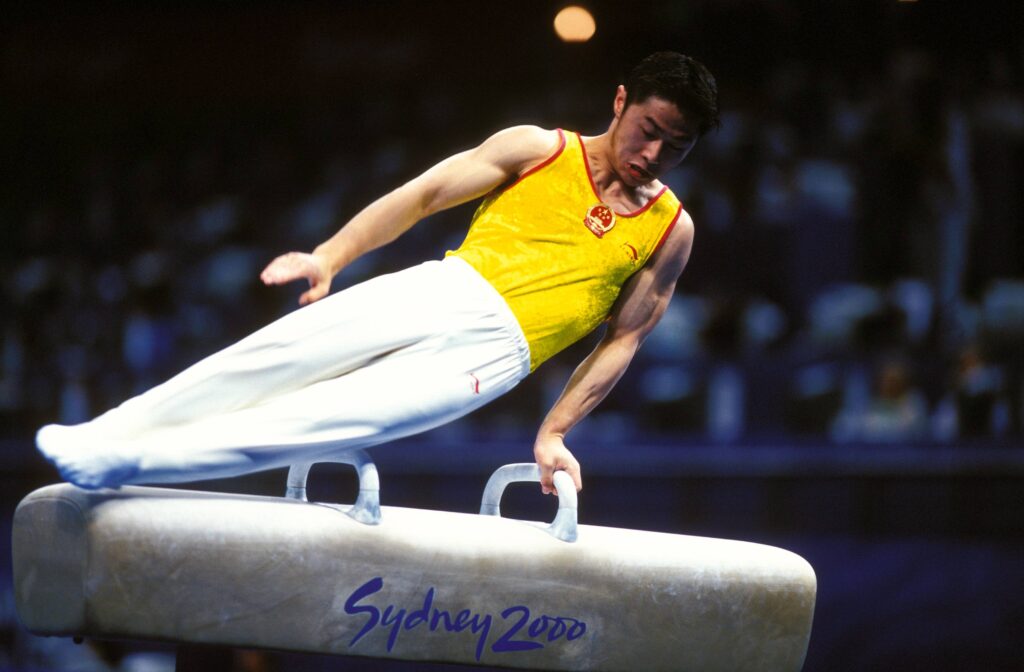
The Olympic Champion Drawn In by Huo Yuanjia
Shenzhen Special Zone Daily (深圳特区报), September 19, 2010, reporter: Wu Mengfei (吴孟菲)On September 19, 2000, the Shenzhen Municipal Party Committee and Municipal Government sent a congratulatory telegram to the Chinese sports delegation then competing at the 27th Olympic Games in Sydney, expressing congratulations to the Chinese gymnastics team for winning China’s first-ever Olympic men’s gymnastics team gold medal. The telegram read: “Our city’s athlete Xiao Junfeng, as a member of the national gymnastics team participating in these Games, represents the strong support of the General Administration of Sport for Shenzhen’s sporting endeavors, and is the result of the National Gymnastics Management Center’s cultivation. We extend our sincere gratitude.” With Xiao Junfeng standing on the medal podium, Shenzhen gained its first-ever Olympic champion. This gold medal was not only the pinnacle of Xiao Junfeng’s sporting career but also filled the gap left by Shenzhen’s having had no Olympic champion.
The cultivation of sporting talent is not accomplished in a single day. Shenzhen’s competitive sports work, which began from a point where not a single provincial games champion had emerged from the city, has to date produced thirty world titles and one Olympic gold medal; at the Beijing Olympics, eight Shenzhen-affiliated athletes were selected for the Olympic roster. This is closely connected to the emphasis placed on talent recruitment, cultivation, and development. Today Shenzhen has found a path of its own, with Shenzhen characteristics, for “making its own blood” in sporting talent.
Oral accounts by:
Han Xingyuan (at the time, head of the training division at the city’s sports training unit; now deputy director of the city’s Culture, Sport, and Tourism Bureau)
Xiao Junfeng (former member of the national men’s gymnastics team; Shenzhen’s first Olympic champion; currently in business)
Xiao Junfeng’s account: How Huo Yuanjia led me to choose gymnastics
My hometown is Xi’an. As a child, to put it generously, I was lively and energetic. In truth, I was just extremely mischievous. One time during a physical education class, a man pulled me aside and handed me a form, telling me to take it home for my parents to look at. When I got home, my father asked me whether I wanted to train in gymnastics. That was when I realized the man was a gymnastics coach from the competitive sports school attached to Xi’an Institute of Physical Education.
At the time I had no idea what gymnastics was. What I do remember is that the television was running a popular broadcast of Huo Yuanjia, and my friends and I were busy imitating everything we saw. I naively believed that learning gymnastics was more or less the same as learning martial arts — that if I learned gymnastics, I could become a “martial arts master” just like Huo Yuanjia. So I agreed to join the gymnastics team.
In 1989, I won three gold medals at the National Children’s Gymnastics Competition, became a Class-One athlete, and had both the ability and the opportunity to enter a professional team. In 1990, the Shenzhen Municipal Sports Training Unit was in the process of forming a gymnastics team, and I was identified and brought to Shenzhen, becoming a Shenzhen-affiliated athlete. But because Shenzhen’s competitive sports program was only just getting started at the time, the hardware facilities couldn’t keep up; there was no training venue. So I spent the majority of my time training at the Ersha Island training base in Guangzhou, and a considerable stretch of time at intensive training camps at the Sichuan Provincial Sports Technical Institute in Chengdu. Although I wasn’t based in Shenzhen for training, this young and dynamic city gave me more room to grow and provided more opportunities for me to participate in competitions at every level.
Olympic moments: joy and sorrow together
In 1995, my standout performance at the National City Games caught the eye of national team coach Xiao Mengchun, and I entered the national team at the end of that year. At the 1997 World Championships, I stepped onto the world stage for the first time and won the team title alongside my teammates— my first world champion title. Subsequently I also won golds in the floor exercise at the 1999 World Cup and in the vault at three World Cup events in 2000. The media bestowed on me the nickname “Prince of the Vault,” and the outside world placed high hopes on me winning the title at the upcoming Sydney Olympics.
In 2000, I finally stood on the Olympic stage that every athlete dreams of. Looking back now, it truly was a dreamlike journey. In Sydney, I reached the highest point of my sporting career, but I also left with regrets.
As one of the core members of the Chinese men’s gymnastics team, I had been placed in the main lineup for the men’s team competition before the qualifying round. Since this was my first Olympic Games, excessive nervousness and fatigue led to a serious ankle injury during the qualifying round. Team competition does not allow substitutions to the roster, and in the moment I took to the floor I silently resolved: “Even if my leg breaks I am going to see this through.” We put everything else out of our minds and gave everything we had on the floor, and in the end, my teammates and I stood together on the team champions’ podium.
When that Olympic gold medal was placed around my neck, I felt joy and sorrow at once. Years of effort had finally been rewarded, but it was far from the perfection I had imagined. Because beyond the team event, I was also entered in the vault individual final, and that was a gold medal I had been determined to win. But because of the injury, I lost my chance to compete for it. I had had the opportunity to add one more gold medal for Shenzhen, for China.
The Olympic torch relay: a dream fulfilled again
In 2001, because of my continuing injuries, I had no choice but to retire. To develop myself further, I went to study at Xi’an Institute of Physical Education. In 2008, Shenzhen invited me to serve as the first torchbearer in the Shenzhen leg of the Beijing Olympic torch relay, giving me a wonderful opportunity to step back into the Olympic world. After all these years, Shenzhen still thought of me like family, entrusting me with this honorable mission; I was deeply moved. In the moment when I held the Olympic flame in my hands and ran through the streets of Shenzhen, I felt my Olympic dream had been made whole.
I have since left the academic world. There were many opportunities to work as a gymnastics coach, but I am more interested in applying what I have learned and engaging more broadly and deeply with society, so I am now making my way in the business world, hoping to carve out my own path there as well.
Han Xingyuan’s account: “The roadside track-and-field team” and “the thatched-shed wushu team”
Judging from athletes like Xiao Junfeng alone, outsiders often form a mistaken impression of Shenzhen — that Shenzhen merely subscribes to “grabbism” — pick out a good prospect from somewhere, grab him and he’s ready to use, grab him and he brings the city glory. This is an enormous misconception. Identifying talent is important, but cultivation is a long-term undertaking that cannot be relaxed for a moment.
In attracting talent, we owe a great deal to the development of the Shenzhen Special Economic Zone. Rapid economic development was first reflected in the growth of Shenzhen’s sports infrastructure. When the sports training unit was established in 1988, there was not a single office building, not a single training venue, not a single running track; conditions were extremely difficult in every respect. Coaches and athletes had to find solutions themselves and create the conditions they needed from nothing. With no athlete dormitories, we rented worker housing in the Bagualing industrial district. With no running track, the track and field team trained on the roads. With no training venue, the wushu athletes trained in a makeshift thatched shed. Hence the names “the roadside track-and-field team” and “the thatched-shed wushu team.”
After years of construction, the Bijiashan training base where we are now located has sixteen thousand square meters of completed facilities to date. Its venues for gymnastics, wushu, rhythmic gymnastics, and ball sports are among the best in the country. Auxiliary training facilities including a covered track and a strength training gymnasium are all in place. With conditions like these, talent naturally congregates. Every year, a good number of parents from all over the country come on their own initiative, bringing their children to Shenzhen in the hope of training at our city’s various levels of amateur sports schools. At the same time, our city’s sports program continues to take a proactive approach. The city’s sports training unit and all levels of amateur sports schools together employ over two hundred professional coaches, who every year scout in competitions and sports schools all over the country, identifying promising young prospects. The story of how Shenzhen recruited Xiao Junfeng back in the day is a good example of this.
Four main forces in cultivating sporting talent
Currently, our city has four main forces in cultivating sporting talent: the municipal sports training unit, the municipal amateur sports schools, the district-level amateur sports schools, and “specialty” schools — that is, schools with a traditional strength in a particular sport, such as Buji Middle School in volleyball, OCT Middle School in baseball, and Shenzhen Middle School in football. To expand the pool of talent cultivation, our province and city and district authorities provide favorable policies regarding funding, teaching staff, and other resources to these designated schools. Without letting talent flow outward, the “blood” cannot circulate. So in our talent export work, we have provided a range of incentive measures aimed at ensuring athletes themselves want to advance, coaches are willing to develop and release talent, and the city maintains a high annual talent output rate. These preferential policies take the form of continued payment of allowances and subsidies to a portion of the outstanding sporting talent the training unit sends up to higher levels, improving individual treatment and protecting athletes’ interests. In addition, we promote to athletes in our system the excellent training environments of the provincial and national teams — a higher-level, more rigorous, and more scientifically grounded training environment plays a crucial role in an athlete’s technical development — with the aim of motivating athletes to actively compete for the opportunity to be advanced, thus promoting the flow of talent.
In the past eight years, our city has sent over three hundred high-quality athletes to provincial and national teams. It is fair to say that in the three links of recruitment, cultivation, and export, we have built a tightly connected chain and found a path that works for us. But this does not mean the work is complete; one significant problem still awaiting resolution is what happens to “athletes who remain behind.” Our city is currently discussing supplementary economic measures for athletes who choose their own employment upon retirement; once these measures are introduced, they will be of tremendous help in addressing the future of these athletes. This is also an entirely new attempt at our city’s sports talent cultivation work.
Note: Huo Yuanjia, a twenty-episode martial-arts serial produced in 1981 by Hong Kong’s Rediffusion Television (later Asia Television), dramatizing the life of the Tianjin-born martial artist associated with the founding of the Chin Woo Athletic Association. Guangdong Television introduced it to mainland China in 1983, after which stations around the country followed, making it the first Hong Kong television drama broadcast on the mainland and an immediate phenomenon. Its theme song, “The Great Wall Will Never Fall,” became almost as ubiquitous as the series itself.
被“霍元甲”引入行的奥运冠军
2000年9月19日,深圳市委、市政府向正在悉尼征战第27届奥运会的中国体育代表团发去贺电,祝贺中国体操队首次为我国夺得奥运会体操比赛男子团体冠军。贺电称,“我市运动员肖俊峰作为国家体操队的队员参加此次奥运会,是国家体育总局对深圳体育事业的大力支持,是国家体操管理中心栽培的结果。谨此深表谢意。”随着肖俊峰站上领奖台,深圳也从此拥有了第一位奥运冠军。这枚奥运金牌不仅仅是肖俊峰体育生涯的巅峰,更弥补了深圳没有奥运冠军的遗憾。
体育人才的培养,非一日之功。深圳竞技体育工作开展至今,从原先没有一名省运会冠军选手,到目前已经夺得世界冠军30个,奥运金牌1枚;北京奥运会中,共有8名深圳籍选手入选奥运阵容。这与重视人才引进、人才培养与输送有着密切联系。目前,深圳已经走出了一条有深圳特色的体育人才“造血”之路。
口述:
韩星元(时为市体工大队训练科科长,现任市文体旅游局副局长)
肖俊峰(原国家男子体操队队员,深圳第一位奥运冠军,现经商)
肖俊峰口述:因“霍元甲”选择体操
我老家在西安,小时候说好听点是活泼好动,其实我就是特别淘气。有一次上体育课,一位叔叔把我拉到一边,给了我一张表格,说让拿回家给父母看。回家后,我爸问我愿意不愿意练体操。我才知道,那位叔叔是西安体院竞技体校的体操教练。
当时我根本不知道什么是体操,我记得电视上正在热播《霍元甲》,我和我的小伙伴们也跟着有样学样。我就天真地认为,学习体操跟学习武术差不多,只要学了体操,就能成为跟霍元甲一样的“武林高手”,所以我同意了进体操队。
1989年,我在全国少儿体操比赛上拿下了3块金牌,成为了国家一级运动员,并且具备了进入专业队的能力和机会。1990年,深圳市体工大队正在组建体操队,那时我被看中并被引进深圳,成为了一名深圳籍运动员。但是因为当时深圳的竞技体育事业才刚起步,硬件条件跟不上,没有训练场地。所以我大部分时间都在广州二沙岛训练基地训练,还有很长一段时间在成都的四川省运动技术学院集训。虽然我并没有固定在深圳训练,但是深圳这座新兴的城市也给了我更多上升空间,提供了更多的机会让我参加大大小小的体操比赛。
奥运时刻有喜也有悲
1995年,因为在城运会上的突出表现,我被国家队肖萌春教练看中,当年年底进入国家队。1997年世锦赛,我第一次登上了世界舞台,并且一举与队友们夺得体操团体冠军,这也是我第一个世界冠军称号。此后,我又在1999年世界杯自由体操项目和2000年三站世界杯赛跳马项目中夺得冠军。媒体还封给我一个“跳马王子”的称号,这也让外界对我在即将举行的悉尼奥运会上夺冠寄予厚望。
2000年,我终于得以站上所有运动员梦寐以求的奥运赛场。现在想起来,那真是一次梦幻般的旅程。在悉尼,我站在了自己职业生涯的最高峰,但同时也留下了遗憾。
作为中国体操男队的主力,我在预赛前被排进了男团的主力阵容。由于这是我第一次参加奥运会,过度紧张和劳累,导致我在预赛时踝关节严重受伤。团体赛是不允许更换名单的,上场的一刻我暗下决心:“腿断了我也要坚持下去。”我们忘却了一切,在场上尽情发挥,终于,我和队员们一同站在了团体冠军颁奖台上。
当脖子上挂上了这枚奥运金牌的时候,我悲喜交加。这么多年的努力终于得到了回报,但是,远没有我想象中的完美。因为除了男子团体,我还要参加跳马单项,而对于这枚金牌我原来是志在必得的。可是因为受伤,我失去了争取它的机会,我本来有机会为深圳、为中国再添一枚金牌……
火炬传递再圆奥运梦
2001年,因为持续的伤病,我只好选择退役。为了充实自己,我到西安体育学院深造。2008年,深圳邀请我担任北京奥运会火炬传递接力深圳站的第一棒,给了我一个绝佳的机会让我再次走进奥运。这么多年过去了,深圳依然像家人一样惦记着我,给予我如此光荣的使命,我非常感动。当我手中握着奥运圣火,跑在深圳的大街上的那一刻,我觉得我的奥运梦圆满了。
目前,我已经离开了学校,本来有很多机会去做一名体操教练,但是,我更希望我能学以致用,并且更深入广泛地接触社会,所以我正在生意场上拼搏,希望也能闯出属于自己的另一片天。
韩星元口述:“马路田径队”和“草棚武术队”
仅从肖俊峰等一些运动员的例子来看,外界往往会对深圳有一个误解,认为深圳仅仅是秉承了“拿来”主义,挑选一个好人才,“拿来”就能用,“拿来”就能为城市争光。这绝对是一个很大的误区。挑选人才固然重要,培养更是一项不可松懈的长期工作。
在吸引人才上,我们主要得益于深圳经济特区的发展。经济飞速发展,首先体现在深圳的体育硬件设施建设发展上。体工大队在1988年成立之初,没有一栋办公楼、没有一块训练场地、没有一条跑道,各方面条件都异常艰苦,教练员和运动员只能想尽办法自己去解决困难,创造条件。没有运动员宿舍,就租用八卦岭工业区的员工宿舍;没有跑道,田径队就在马路上训练;没有训练场地,武术运动员就在简易草棚中训练。因此有了“马路田径队”和“草棚武术队”的称号。
经过这些年的建设,目前所在的笔架山训练基地已落成场馆1.6万平方米,拥有全国一流的体操、武术、艺术体操和球类训练场地。风雨跑道、力量练习馆等辅助训练场馆也一应俱全。有着这样的优越条件,人才自然聚拢。每年都有不少来自全国各地的父母毛遂自荐将子女带来深圳,希望能够在我市各级业余体校深造。
与此同时,我市体育工作也坚持“主动出击”的做法。要知道,我市体工大队、各级业余体校共有专业教练200多人,他们每年都会在全国各地的大小比赛及体校中选人,物色好苗子。说起这方面,当年深圳引进肖俊峰就是个很好的例子。
培养体育人才我市有四大主力军
目前,在培养体育人才方面,我市有四大主力军:市体工大队、市业余体校、各区业余体校及“特色”学校。其中,所谓“特色”学校是指在某个体育项目中,有着传统优势的学校。比如布吉中学的排球、华侨城中学的棒球、深圳中学的足球……为扩大人才培养面,我省、市、区都会对这类“挂牌”学校给予财政、师资等方面的政策倾斜。
不让人才走出去,就不能让“血液”流通。所以,我市在人才输出工作中,给予了多项鼓励措施,力求运动员自己要上进、教练员愿意将人才输出,保障全市每年较高的人才输出率。这方面的优惠政策表现在对体工队所输出的部分优秀体育人才继续发放津贴补助,提高个人待遇,保证运动员利益。另外,在运动员队伍中宣传省队、国家队的优秀训练环境,更高、更严谨、更科学的训练环境对一名运动员的技术水平提高有着至关重要的作用,目的是让运动员主动争取被输出机会,促成人才流动。
在最近8年时间内,我市已经向省队、国家队输送的高质量人才达到300多人。可以这样说,我市在引进、培养、输出三个环节环环紧扣,已经走出了适合自己的一条路。
但是并不意味着已经完善,其中有待解决的重要问题之一,是“滞留”运动员的出路问题。目前我市正在讨论有关运动员退役自主择业经济补充办法,办法一旦推出,对于解决“滞留”运动员的出路有着极大的帮助。这也是对我市体育人才培养工作的一次全新尝试。
Appendix: On Xiao Junfeng’s 2000 Victories
Xiao Junfeng Wins Two Golds on Gymnastics Circuit, Moves Closer to Sydney
April 7, 2000 — Tiyu Cankao (Sports Reference)
At the recently concluded Swiss and German legs of the 2000 gymnastics series, Guangdong gymnast Xiao Junfeng performed superbly, winning two gold medals. After he returned to China, a reporter interviewed him.
Xiao said that he was genuinely a bit surprised to have won two gold medals. His “handspring stretched forward salto with 2½ twists (900°)” was a vault of extreme difficulty that in the past only South Korea’s Yeo Hong-chul could perform and that no one could do anymore. Xiao himself had been practicing it for only a little over two months. Moreover, just before leaving for Europe, he had been going through a rough patch with the skill, so he had no idea before the competition how well he would be able to perform it.
But once he arrived in Switzerland, his performances got better with each round. In the end, he unexpectedly won the title with a score of 9.750, which he found, in his words, hard to believe.
After moving on to Germany, Xiao struggled to adapt to the food and equipment there and was also extremely fatigued from competing in consecutive events. Nevertheless, he managed to perform up to his capabilities and took first place with a high score of 9.735.
Reflecting on why he had been successful, Xiao believed it probably came down to the high difficulty of his routines combined with relatively few minor execution faults. He explained, “At these two competitions, some of the world’s top vaulters competed, including [Evgeny] Sapronenko of Latvia and [Dieter] Rehm of Switzerland. Their difficulty was also very high, but they had relatively more little faults—things like flexed feet, bent legs, leg separation, and unnecessary movement—so it was difficult for the judges to give them really high scores.”
Eliminating these sorts of execution errors—flexed feet, bent legs, leg separation, and unnecessary movement (勾、曲、分、动)—had been one of the Chinese gymnastics team’s principal objectives during its winter training that year.
“At most, Coach Huang had me take fourteen vaults in one day in order to help me fix these problems!” Xiao said. “I trained in the morning, at noon, and at night, until my head was spinning and I felt like throwing up. After training, he would also make me write down the problems I was having in practice on a memo board and read them over several times every night before going to sleep. Looking back on it now, I’m really grateful to him.”
Xiao Junfeng was an all-around gymnast. Besides vault, he was also strong on the other apparatuses, particularly floor exercise. In 1997, he had defeated a field of strong competitors to win the Korean Open, and he had also taken first place numerous times in domestic competitions.
In Germany, his floor exercise had initially gone well, and he ranked first in qualification. In the final, however, he initiated a salto too early and suddenly landed sitting on the floor. It was a major error, and the judges consequently deducted the 0.5 in bonus for difficulty. In Switzerland, he lost a medal for the same reason.
Xiao said that the greatest benefit of his European trip was actually not the two gold medals. Rather, competing had helped him identify the shortcomings and gaps in his everyday training. For example, his vault landings were still not particularly stable; his timing on the saltos in his floor routine was not quite right; and on parallel bars he still had a problem with crossing or twisting his legs. These were all issues he would need to address in future training.
In the new millennium, Xiao Junfeng’s greatest wish was to win a coveted Olympic gold medal. Asked whether he was confident he could do it, he smiled and replied, “I’ll work hard and go for it!”
Before Xiao had even returned to China, the reporter had interviewed head coach Huang Yubin at the gymnastics training hall about the sensitive question of who would be selected for the Sydney Olympic team. Although Huang did not answer directly, his remark—“The gymnasts have all improved very quickly during this winter’s training, Xiao Junfeng, for example”—made it easy to see that Huang had high expectations for his prized pupil.
— Xiao Han
体操系列赛独得两金 肖俊峰走近悉尼
在日前结束的2000年体操系列赛瑞士站和德国站的比赛中,广东选手肖俊峰发挥出色,独得两枚金牌。回国后, 记者对他进行了采访。
肖俊峰说,其实这次能拿两枚金牌他真的有些意外,因为“前手翻直体前空翻转体900度”这个过去只有韩国 选手吕宏哲能做,现在却没有人能掌握的高难动作他只练了两个多月,而且走的时候正“回犯儿”,所以究竟能比成什么样儿 赛前自己心里一点底都没有。谁知道,到了瑞士自己一场比一场发挥得好,最后竟然以9.75分获得冠军,真是不可思议。 转战德国后,尽管自己对那里的饮食、器械不太适应,而且连续作战后身体又极度疲惫,但最后还是发挥了水平,以9.73 5的高分拿了第一。
总结获胜的原因,肖俊峰认为,这可能跟自己的动作难度大、小毛病少有关系。他说:“这两站比赛,世界跳马 高手像拉脱维亚的萨普马南科、瑞士的雷姆等都参加了,他们的难度虽然也很大,但勾、曲、分、动等小毛病相对多一些,所 以裁判很难把分打上去。”
消除“勾、曲、分、动”是中国体操队今年冬训的主要内容之一,“黄导为了帮我解决这些问题,最多的一天让 我跳马练了14次!早上练、中午练、晚上练,练得我头晕眼花,直想吐。训练完了,他还让我把自己训练中存在的问题写在 记事板上,每天睡觉前看上几遍。现在想想,我真的挺感谢他的。”肖俊峰说。
肖俊峰属于全能型选手,除了跳马,其他几项也不弱,尤其是自由操。97年,他就曾在韩国公开赛上战胜各路 高手,夺得冠军,全国比赛更是多次登顶。这次在德国,他的自由操本来比得也不错,预赛排名第一位,但是决赛时因为空翻 发力太早,一下子坐在了地上。这可是重大失误,结果被裁判扣去了0.5分的难度加分。在瑞士,他因为同样的原因与奖牌 失之交臂。
肖俊峰说,其实,这次欧洲之行,他最大的收获不是拿了两枚金牌,而是通过比赛找到了自己平时训练存在的不足和 差距。比如跳马落地还不是特别稳、自由操空翻掌握不好火候,双杠还存在“绞腿”现象等,这都是自己今后需要解决的。新 千年,肖俊峰最大的愿望就是夺得一枚宝贵的奥运金牌,问他有没有信心,他笑一笑说:“努力争取吧!”
肖俊峰尚未回国的时候,记者曾在体操馆就谁将入选悉尼奥运阵容这一敏感问题采访过主教练黄玉斌,黄导虽然 没有直接回答,但从“今年冬训队员们进步都很快,像肖俊峰” 这句话中不难看出,黄导对自己的这位得意弟子寄予了很高 的期望。肖寒
More on Chinese gymnastics