Here’s more than you ever wanted to know about Li Xiaopeng. 😜
Then again, few gymnasts have careers that leave quite so much to talk about. From his arrival on the Chinese national team as a teenager to his final Olympic triumph in Beijing, Li spent more than a decade at the center of one of the most successful eras in Chinese men’s gymnastics. Along the way, he became an Olympic champion four times and accumulated an extraordinary collection of medals on vault and parallel bars, while also helping China to some of its greatest team successes.
The translations collected here tell that story from many angles and at many different moments: the gifted and mischievous child, the young star suddenly thrust onto the world stage, the champion wrestling with injuries and disappointment, and the veteran trying to make his way back for one last Olympics. Read together, they offer something more interesting than a conventional career retrospective: a portrait of Li Xiaopeng assembled in real time, as Chinese journalists, coaches, teammates, and Li himself tried to make sense of a career that was still unfolding.
2000
Li Xiaopeng’s Stories — Never-Ending
by Xiang Nong, New Sports, February 15, 2000
Seven-Color Stars — NEW SPORTS
People surnamed Li have always had a special affinity with gymnastics. The saying “Li’s Army” has long circulated, and one could draw up a long list of names — every one of them a household name.
Right after Li Xiaoshuang came Li Xiaopeng. Several members of “Li’s Army” collaborated with comedians Chen Peisi and Zhu Shimao on a sketch performed at the 1998 Spring Festival Gala, and the smallest, most pint-sized one among them was Li Xiaopeng.
Li Xiaopeng, 19 years old, from Changsha, Hunan — gymnastics world champion… An introduction like that could open a book. So let’s pluck a few stories from this “book” and enjoy a preview.
Story One: The Youngest “Applicant”
One day in 1987, the Changsha Evening News ran a recruitment notice: the Changsha Municipal Amateur Sports School was enrolling 100 male and 100 female students to study gymnastics.
A mother reading the evening paper spotted the notice and asked her 6-year-old son if he was interested. The boy asked, “What is gymnastics? Is it fun?” The mother answered without thinking, “It’s fun.” The boy agreed. The next day, the mother took him to register.
The mother’s name was Pan Jianguo, and the boy was Li Xiaopeng. In the advertising history of the Changsha Evening News, applying at age 6 is certainly an age record.
Story Two: “Jumping Far” or “Running Fast”
The gymnastics class enrollment test was simple: a teacher examined the children’s leg muscles, then tested their strength through a physical contest.
Mother Pan recalls that Xiaopeng competed in a standing long jump that day and jumped the farthest. Though she can’t remember exactly how far.
Xiaopeng’s own memory is that it was a running test, and the teacher felt he ran fast. Though he can’t remember how fast either.
Either way, Story Two ends with Xiaopeng receiving an enrollment notice a week later.
Story Three: Born Talented
Xiaopeng was naturally energetic and loved practicing cartwheels and similar moves even before he ever took gymnastics.
Once he joined the gymnastics class, that natural talent came into its own. The class had enrolled several hundred students, but the attrition was rapid; that had been agreed in advance. Two months later, only ten-odd students remained: gold panned from sand.
Xiaopeng, relying on the skills he’d developed through self-taught, informal methods, luckily survived the cuts and became a promising young seedling under coach Qiu Ji.
Story Four: Educating Grandmother
In the blink of an eye, nearly a year had passed. Xiaopeng was now 7, still in the basic-skills stage, repeating every day the same training content from when he first enrolled.
One day, on a whim, Grandmother suddenly asked to watch her grandson train. The old woman saw her precious grandchild crammed in among the other children, stretching his joints, and her heart ached. The moment Xiaopeng came off the floor, she rushed over and asked him tenderly, “Does it hurt? If it’s too hard, let’s just go home!”
Xiaopeng took his grandmother’s hand and consoled her: “If you don’t endure hardship when you’re young, you’ll amount to nothing when you grow up!”
Story Five: Supporting Himself
Before long, Xiaopeng was selected for provincial team training camp. At age 8, he officially became a member of the provincial team.
From that point on, Xiaopeng received an athlete’s stipend. In his parents’ eyes, he had started earning a wage.
From then on, he never asked his family for a single cent and began supporting himself entirely. At the time, the Li family was not well-off; his parents’ incomes were modest, and Xiaopeng lifted a significant burden from the household.
Story Six: The “Number One” Period
There were eight athletes in Xiaopeng’s cohort on the provincial team. Coach Yi Shuji held monthly tests, and the top finisher was almost always Li Xiaopeng.
On the provincial team, Xiaopeng sailed along smoothly, winning gold medals at various competitions nearly every year. According to his father Li Zhenyu’s count, Xiaopeng took home six gold medals in one year alone. Most notable was the gold in floor exercise at the 1994 National Youth Championships.
Since we’re on the subject of being “number one,” here’s a small digression: the first time Xiaopeng got hit (apologies for tarnishing the young hero’s image — Author’s note). Coach Yi was normally good-tempered and rarely raised his hand. But that time Xiaopeng wasn’t putting in the effort: the coach had assigned him pommel horse scissor work, Xiaopeng lost the feel for it and began slacking off; the errors naturally kept piling up and couldn’t be corrected; Coach Yi was finally pushed past his limit and got rough. Xiaopeng was an obedient child; this was the first and, to date, only time he was struck during training, and it was never repeated after he joined the national team. As for outside the training hall, read on.
Story Seven: A Brief Desertion
Xiaopeng went AWOL once during his provincial team days. Since years have passed, the two accounts of what happened don’t quite agree.
First, hear mother Pan Jianguo’s recollection:
Xiaopeng was born competitive and never liked to lose. I remember this happened when he was 9. A bigger teammate hit him; he found a way to hit back, but there was still resentment festering inside, and he wanted to come home and complain. The next morning at 9 o’clock, without asking his coach for leave or telling anyone else, he just set off walking home. Think about it; even by bicycle, getting from our home to the provincial team compound takes half an hour; Xiaopeng walked it in two hours. Once he’d gotten it all off his chest, I sent him back. In my memory, that was the only time Xiaopeng ever cried as a child.
Xiaopeng’s own account is an entirely different “version”:
It was a Sunday. The team required everyone back by noon, but I didn’t let my mother bring me until evening, right in the middle of a team meeting. I had been completely out of control at that point, and the coach had been holding in his anger. In a flash of temper, he slapped me — this time outside the training hall (Author’s note) — and my nose bled. I knew the coach meant well, but being hit in front of my mother felt deeply humiliating — to me and to her. So I was furious at the coach and didn’t want to keep training no matter what.
The next day, with 5 yuan in my pocket, I wandered into an arcade on the street and played games furiously. Still not satisfied, I drifted around, then spent half the day in a park. By then, I had no money at all — not even bus fare to get back — so I just wandered home on foot, which took about two hours.
……
Both “versions” end the same way: after one day as a deserter, Xiaopeng returned to the team.
Story Eight: The Mischievous Years
On the provincial team, Xiaopeng’s progress was rapid; things it took others a long time to learn, he mastered quickly. Then, for a spell, something good turned problematic: Xiaopeng was constantly in a state of feeling “underfed,” and suddenly lost his drive.
During training sessions, Xiaopeng found the time hard to bear and would draw on the floor with chalk or arrange matchsticks to kill time.
There was a billiards table in the sports brigade compound’s courtyard, and Xiaopeng became a regular, often beating teammates much older than him. The more hobbies he picked up, the more people he socialized with, and he began growing his hair long and even started going out to sing karaoke…
Story Nine: Leaving Home
(This chapter is not the clichéd tale of a wayward youth; Xiaopeng was a good boy, and his destination was, of course, the national team — Author’s note)
On a Saturday in February 1996, Coach Yi told Li Xiaopeng that the provincial team was recommending him for a training trial with the national team — go home immediately, pack your bags, and head to Beijing.
Although he had long dreamed of breaking into the national team, Xiaopeng had not expected the good news to come so soon.
The following evening at 7 o’clock, Li Xiaopeng said goodbye to his parents and boarded a train to Beijing alone.
Story Ten: A Pair of Nike Shoes and a New Team Uniform
Xiaopeng was going to the national team; his parents were overjoyed.
The afternoon before his departure, his mother went out to get things ready and specifically asked Xiaopeng if there was anything he wanted, promising to grant any wish. Xiaopeng thought for a moment and said: nothing else — just buy me a pair of Nike shoes.
Xiaopeng had long wanted a pair of Nikes, but they were too expensive and his mother had never brought herself to buy them. He made the same request again, and this time his mother readily agreed.
When she came home, she was indeed carrying a shoebox. Xiaopeng was thrilled and immediately put the shoes on. He didn’t know that his mother’s monthly income was just over 400 yuan, and the shoes had cost 500.
He arrived at the national team compound at 7 in the evening. The team required him to attend early morning exercises the next day; Xiaopeng got up at the crack of dawn, and the very first thing he did was make sure to wear the Nike shoes his mother had bought him.
Not long after, the national team issued new uniforms. By custom, the team distributed uniforms twice a year, and Xiaopeng was initially delighted, thinking he’d arrived at just the right time. Then he learned: there was none for him. It turned out the national team only issued uniforms to full members. This had been agreed with the sponsor in advance, and there was no extra to spare. Xiaopeng was on trial, just an unofficial “unregistered resident,” and naturally not eligible. Stung, he made a private vow: for the sake of that uniform with “China” printed on it, he had to work harder.
Story Eleven: Conquering High-Difficulty Skills
Xiaopeng was a changed person; he cut his hair, gave up billiards, and stood up straighter.
At first, in coach Wang Hongwei’s group, it was still basic training, but Xiaopeng didn’t find it tedious. After all, the national team was full of elite athletes, all training in the same gym together. What was a local champion worth there?
At the end of 1996, Li Xiaopeng transferred to coach Chen Xiong’s group, and at the same time began adding difficulty elements to his routines. Gymnastics competitions are won through difficulty plus quality; without high-difficulty skills, even the most polished routine is just fundamentals.
Xiaopeng’s aptitude and natural flair astonished Chen Xiong; his ability to learn high-difficulty skills was simply remarkable. The fastest instance was learning an E-group skill on parallel bars, a “giant swing tucked double salto to upper arm hang.” After Chen Xiong spotted him twice with a safety belt, Xiaopeng asked to try it on the bars and nailed it on the first attempt. Within a single week, he had extended the skill into a super-E element, a “piked double salto to upper arm hang.”
With difficulty in hand, it was like a martial artist who has trained for years suddenly being imbued with a grandmaster’s power — ready to head down the mountain and take on the world. Three months later, Xiaopeng competed abroad for the first time, traveling to Cincinnati, USA, for a three-nation meet between China, the United States, and Romania, where he and his teammates won the team title.
In September 1997, Xiaopeng joined the World Championships in Switzerland as an alternate. The plan from team leadership and coaches was to let the young newcomer gain experience observing a major competition. But his form was exceptional — the quality he showed in training captivated everyone — and before the competition opened, he was elevated from alternate to starter. He competed officially and played a decisive role in China’s men’s team winning the team gold. He was the biggest individual winner on the squad, taking home one gold, one silver, and one bronze — three medals in total.
Story Twelve: A Love of Reading
Xiaopeng is highly intelligent with wide interests, and his greatest hobby is reading.
On the provincial team, coach Yi Shuji encouraged them to read widely, and Xiaopeng took this very much to heart. Over time, his reading ranged across many fields.
He read literary classics; titles he could rattle off include The Count of Monte Cristo and Around the World in Eighty Days, among others.
He read wuxia fiction — from Jin Yong to Gu Long, the full range.
He read science fiction, such as Twenty Thousand Leagues Under the Sea.
He also read romance novels — Qiong Yao’s books, naturally — though he says he no longer reads “them” anymore.
Story Thirteen: Taking the Initiative to Apologize
This story comes from 1998, a detail coach Chen Xiong recalled offhandedly.
They were practicing a vault — a round-off back handspring front somersault with a 540° twist. Xiaopeng had a fever but concealed it and kept training. Naturally, the technique wasn’t landing properly; Chen Xiong, unaware of the reason, grew angry and walked out. Xiaopeng ran after him barefoot — it was October, already quite cold — grabbed hold of Coach Chen, and apologized with unmistakable sincerity: “Don’t be angry. I’ll train hard, I promise.”
Coach and athlete returned to the gym together, and Xiaopeng kept at it until he finally nailed the skill.
Chen Xiong only learned afterward that Xiaopeng had been training through illness and was deeply moved.
Heaven rewards the persistent: it was precisely that skill that earned Xiaopeng the vault gold at the 1999 World Championships in Tianjin.
Story Fourteen: The Elbow Injury
People often ask Xiaopeng: can you fill Li Xiaoshuang’s shoes and become the standard-bearer of Chinese gymnastics? Xiaopeng usually just smiles and says nothing.
When coaches are asked the same question, their answers carry a note of regret: if only he didn’t have that injury…
The injury is in his right elbow — a degenerative overuse condition. In January 1998, he suddenly couldn’t continue training; his right arm hurt badly. His mother took him to Beijing’s most authoritative hospital, Peking University Third Hospital, where doctors recommended surgery. After careful deliberation, the decision was made to pursue conservative treatment instead, which amounted to reluctantly forgoing treatment, because surgery carried the risk of ending his gymnastics career entirely.
The injury has limited his development on support events, with pommel horse most severely affected.
To this day, Xiaopeng cannot bend his right arm outward, and the base of his right hand cannot reach his right shoulder.
Story Fifteen: Washing Socks in Exchange for Autographs
Xiaopeng’s quick wit extends beyond the training hall and competition floor.
During the Tianjin World Championships, many retired gymnastics greats came to cheer. On one occasion, the recently retired Bi Wenjing knocked on Li Xiaopeng’s door, hoping he’d sign autographs for a few friends. Xiaopeng’s mind turned quickly and he had a mischievous idea: I’ll sign, but I happen to have a pile of socks; how about one wash earns one signature?
Bi Wenjing is from Shandong, straightforward by nature, and also Xiaopeng’s younger “sister” in the gym. She would have helped wash socks even without the signing. So while Xiaopeng stepped out, she washed every single one of his socks and hung them up to dry.
When Xiaopeng came back, he was genuinely startled but played it cool, then pretended to be incredulous and exclaimed, “She actually did it!”
He signed the autographs, of course — every one of them, carefully and sincerely.
……
Xiaopeng is still young. This book has barely had its first few pages turned, and the remaining stories are his to write. Fortunately, the next chapter isn’t far off: the Sydney Olympics later this year.
Who knows what stories Xiaopeng will bring us? they’re sure to be more spectacular than anything in this article. ■
Written by Xiang Nong
Editor: Li Yang
2001
Ten Questions Targeting Huang Yubin & Li Xiaopeng
Written by Cai Peiying
New Sports, August 15, 2001
Idol Chat Room
Wishing upon stars and the moon, fans have finally gotten Li Xiaopeng to appear as an idol. This is surely the voice of many Xiaopeng fans. What makes this edition of “Idol Chat Room” especially noteworthy is that a “coach-level idol” is making his grand debut for the first time!
Across three Olympics, the Chinese gymnastics team’s results have improved with each Games, making head coach Huang Yubin a natural idol in the eyes of gymnastics fans. Meanwhile, his protégé Li Xiaopeng’s popularity has been on a steadily soaring trajectory since his debut. For the first time, an idol coach and an idol athlete appear together. Read on:
1. Your most important battle?
Huang: For a coach, every time you pursue a goal and accomplish it, you feel deeply moved and it leaves a profound impression. The 1992 Barcelona, 1996 Atlanta, and 2000 Sydney Olympics were three different stages, each with its own significance. None can replace the others, so all of them were extremely important.
(Three Olympics, three steps up — individual event, all-around, team gold — the weight of each medal grew heavier, and the effort poured into each step is immeasurable.)
Li: Judged by results, it would definitely be Sydney, because we won China’s first-ever Olympic team title in gymnastics, and I also took an individual event gold.
But the competition that left the deepest impression on me personally was the 1999 Tianjin World Championships. I failed on parallel bars in the final. I never imagined it; I went there aiming for gold, fully intending to win, but, in the end, I messed up a new skill I hadn’t fully mastered yet. A basic mistake.
In Tianjin, I was sharing a room with Huang Xu, and I’d wake up early and suddenly be hit by it: “Ah, Huang Xu, I really failed!” I told myself not to dwell on it, but I just couldn’t shake the feeling…
2. Your most successful student / most respected coach?
Huang: Right now it’s still Li Xiaoshuang. His results have been the most outstanding — two Olympic titles, and his influence has been the greatest. From his tucked triple salto in 1992 to the 1996 all-around title, Xiaoshuang’s fighting spirit left an extremely deep impression on everyone.
Li: Every coach who has ever worked with me. My first coach, Coach Qiu, was wonderful to us — he often took us out to play, and it was he who nurtured my love for gymnastics. Thenm there was my coach at the Hunan team, Yi Shuji, who trained me for nine years; our bond runs very deep. After joining the national team, Wang Hongwei coached me for ten months — not long, but I’m especially grateful to him, because he refined some of my finer technical details and improved my movement quality. And then there’s my current coach, Chen Xiong, who has elevated me to the world stage.
3. Your greatest difficulty?
Huang: Injury. It’s the biggest problem plaguing both athletes and coaches. The feeling of a finely crafted gem being shattered in the final second before completion is truly heartbreaking. Take Huang Liping’s injury, for example. We need results, but we absolutely cannot build results on a foundation of injury. An athlete’s body matters more than a championship.
We’re now more careful in our work, paying closer attention to athletes’ levels of fatigue, when to stop spotting new skills, and so on. We truly hope not to see any more injuries.
Li: For me, it would have to be my injury. My elbow joint can’t move normally. Even washing my face every day is difficult; I can only use one hand (Cai: like a cat washing its face?), and brushing my teeth, too. So events where you have to rely heavily on your arms, like pommel horse and horizontal bar, are really affected.
4. The biggest challenge you currently face?
Huang: That would be the 2004 Olympics. On this point we need to learn from the Chinese table tennis team — it’s what Comrade Li Ruihuan called the character “透” (tòu, “thoroughness”): “If you don’t study it thoroughly, you won’t understand it thoroughly.” Looking ahead to 2004, we need to study and think through every aspect in detail, from changes to the rules to competition strategy. If our research doesn’t go deep enough, we won’t reach the top.
Li: Raise my start value, and keep the injury from recurring.
5. Who has influenced you most?
Huang: My mentor Gao Jian, of course. In terms of thinking, principles of conduct, team training management, and even manner of speech, Gao’s influence on me has been enormous. People often say that watching how Huang Yubin handles things reminds them of Gao Jian. Naturally. I learned from him. Of course, in the process of learning, I’ve incorporated my own understanding and developed things that are new and different from before; only that way can a team continue to progress. Management is critically important; if management falls short, the team can never reach an ideal state. Our gymnastics team has always placed great emphasis on the team’s cultural and moral education: we regularly invite teachers to give lectures on team history, on the law. We partnered with Beijing Sport University to run a college program to raise the athletes’ cultural level — a low cultural level will inevitably affect technical development. Ideological education must also be attended to. On the eve of this year’s July 1st, several key members of the men’s team — Li Xiaopeng, Yang Wei, Xing Aowei, and Zheng Lihui — all joined the Chinese Communist Party… (For the story of Xiaopeng and the others joining the Party, please see later in the issue.)
Li: My parents. When I was young, my mother would send me to the sports school every morning — half an hour by bicycle. She had asthma, and often couldn’t make it halfway; we’d have to walk the rest of the way. My father… Mom says I’m especially like Dad in my stubbornness. When I was young, doing strength training, I was told to do 30 repetitions — I did 30 — but the coach thought I’d only done 27. I wouldn’t admit to it and got scolded, but I just stubbornly refused to back down…
6. Your greatest regret?
Huang: Not being able to compete in the Olympics as an athlete.
Li: Not having won an all-around title.
7. Your greatest wish?
Huang: Naturally, to achieve good results at the 2004 Olympics. Beyond that, for my family to be safe and healthy, and for my son to do well in his studies…
Li: To achieve good results at the 2004 Olympics. I also wish I could be carefree, that my family could be peaceful and happy, and that I could take a proper long holiday… Too many wishes (laughs).
8. The happiest moment of your life so far?
Huang: Hmm… I think it would still be the moment of achieving success in my career. (Cai Peiying adds: What about when you became a father? Huang laughs but doesn’t answer.)
Li: Honestly, very few. I’ve always felt training was so hard—there wasn’t much happiness in it… (laughs). It wasn’t until winning the gold at this Olympics that I felt I’d finally had a taste of sweetness.
9. Please describe your own personality.
Huang: Personality traits… What do you say my personality traits are? I don’t think that should come from me… I hope I can achieve “impartiality in conduct, putting others before myself” — like what Premier Zhu Rongji said: “Devote myself entirely to my duty until the day I die.”
Li: I’m a Leo, and many of the traits of that sign can be found in me… like pride. I also have a trait of laziness — that might be my defining characteristic (laughs).
10. Assess Li Xiaopeng / Huang Yubin.
Huang: Li Xiaopeng as an athlete… has excellent psychological composure in competition, is quite steady, keeps a clear head, rarely makes major errors, and can perform at or even above his normal level. He has all the qualities of an elite athlete.
Li: Coach Huang is the kind of person who looks easygoing on the outside but is actually very strict. He only has to stand there to command respect, without even looking stern, and from time to time, he’ll come out with a bit of dry humor to get a laugh from everyone.
★ A Different Kind of Idol
On the eve of July 1st, the Chinese gymnastics team held a “July 1st Poetry Recital and New Party Member Induction Ceremony.” At the event, Li Xiaopeng, Xing Aowei, Yang Wei, and Zheng Lihui solemnly pledged their oaths before the flag and joined the Chinese Communist Party.
The poetry recital that followed was a succession of highlights, with laughter throughout. Gao Jian, serving as MC, was witty and humorous, and Huang Yubin himself transformed from head coach to head judge, getting a taste of that role.
In the end, the group led by Ling Jie — the “Liu Gui Cheng Xie Zhimin Group” — took the top prize, while Yang Wei, Xing Aowei, Yang Yun, Kui Yuanyuan and others won third place. But Idol Appearance wasn’t finished yet: two additional special awards were presented.
Best Performance Award: Gao Jian
This award for Gao truly went to the most deserving recipient. His hosting was witty and humorous, a torrent of eloquence and clever remarks. Some classic lines included:
“Ah! Ah! Poetry recitation requires feeling — you must learn to express emotion — one ‘ah’ earns an extra 0.3 points!”
“Xie Ying, do you know where you lost that 0.2? I’ll tell you — it’s because of ‘this’…” — The rhythmic gymnastics team leader Xie Ying’s recitation won unanimous applause. She was wearing a beautiful shawl and, perhaps out of nervousness, kept unconsciously adjusting the corner of the shawl as it slipped. Gao Jian had no shawl to adjust, so he could only “imitate” by hitching up his pants — the comic effect was immediate.
“A harder dismount — not bad, that earns a 0.2 bonus!” — After Wang Hongwei’s group finished their recitation, they suddenly struck poses for a group tableau.
“Ah! — (two-second pause) — Please don’t be upset!” — The poetry recitation led by world champion Li Xiaopeng, “Two Poems by Revolutionary Martyrs,” received only 8.95 points, and Gao expressed his consolation to them for this “injustice.”
Related: The Chinese Men’s Gymnastics Team’s “Image Project” (2003)
2008
Li Xiaopeng: Soaring Like the Kunpeng
By Zhou Yan & Huang Hai
New Xiang Review (新湘评论) — August 1, 2008
Profile: Entered Changsha City Sports School at age 6; joined the Hunan Provincial Team at age 12; selected for the National Team at age 15.
- 1997 World Gymnastics Championships: Men’s Team Gold, Parallel Bars Gold.
- 1998 World Cup Final: Floor Exercise Gold, Parallel Bars Gold.
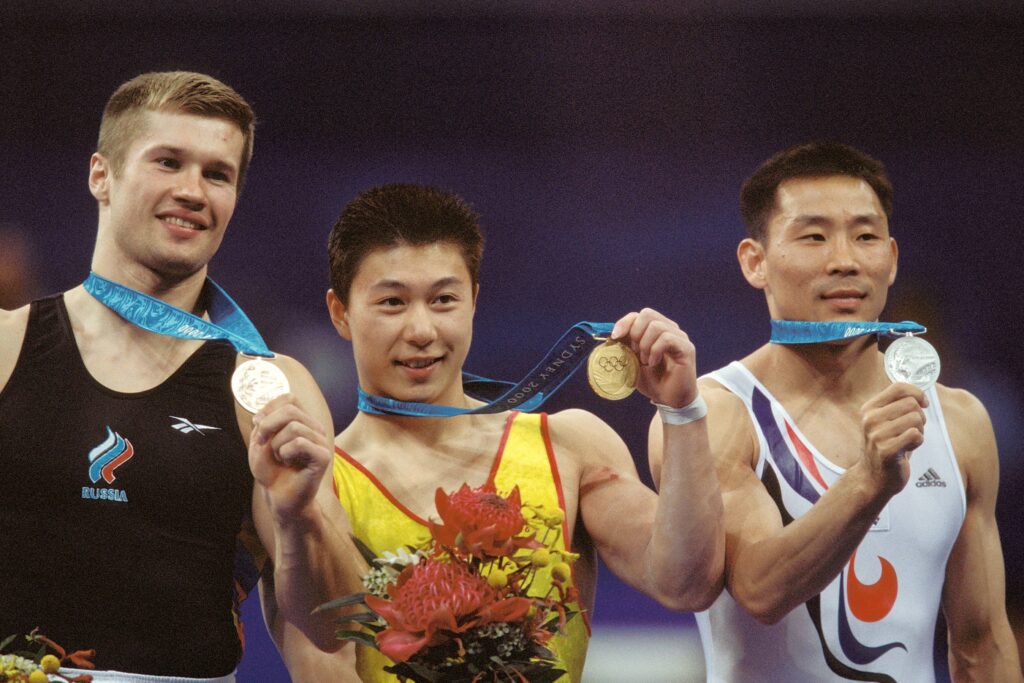
- 2000 Sydney Olympics: Parallel Bars Gold, Men’s Team Gold.
- 2001 East Asian Games: Team Gold, Floor Exercise Gold.
- 2002 Asian Games: Men’s Team Gold, Vault Gold, Parallel Bars Gold; World Championships: Vault Gold, Parallel Bars Gold; World Cup Final: Parallel Bars Gold.
- 2003 World Gymnastics Championships: Men’s Team Gold, Vault Gold, Parallel Bars Gold.
- 2006 World Cup Final: Parallel Bars Gold.
As the leading figure of the Chinese men’s gymnastics team, Li Xiaopeng is striving to compete in his third Olympic Games. From the glory of Sydney to the heartbreak of Athens, and through years of battling persistent injuries for the Beijing Olympics, the 27-year-old athlete has never given up on his beloved sport.
Having recovered from injury, Li is currently in Beijing preparing for the Olympic Games. In a recent interview, he reflected on his two drastically different Olympic experiences with a serene mindset: “The ups and downs of my two Olympic journeys have matured me. I’ve been battling injuries for the past two years. My goal for the Beijing Olympics is simply to do my best.”
“I’m Fearless, Like Huo Yuanjia“
Gymnasts generally fall into two types: those who rely more on physical ability and those who rely more on dexterity. Gymnasts of the latter type have an intuitive feel for skills and tend to pick them up more easily.
Li Xiaopeng belongs to the latter, born with natural athletic intelligence. He began gymnastics at age 6, joined the national team at 15, competed in two Olympics, and has won more than ten titles. He even developed two original elements named after himself: the “Li Xiaopeng Vault” (Li Xiaopeng tiao) and the “Li Xiaopeng Arm Hang” (Li Xiaopeng gua) [on parallel bars]. Anyone who has worked with him can sense that his natural aptitude far exceeds that of ordinary athletes.
Yet, Li remains modest: “I don’t consider myself a genius, nor do I feel I’ve worked harder than others. I’ve never found gymnastics grueling. Training hard every day, watching myself improve step-by-step, and eventually winning a gold medal—I truly enjoy that process. You could say I’m just built for gymnastics.”
As a child, Li was notorious around the compound for his rambunctious nature—either tumbling in the courtyard or practicing handstands at home, never sitting still for long. He was constantly covered in scrapes and minor scars. Around age one, he playfully jumped from a second-story ledge straight into a sandpile on the ground floor. Terrified, his mother burst into tears, but young Xiaopeng shouted back loudly, “I’m Huo Yuanjia, I fear nothing!” When he was 5, his mother spotted a flyer for an amateur gymnastics class on the street, immediately recalling his energetic nature and the fascinated look in his eyes when watching Li Ning’s gymnastics broadcasts at age 3. Back home, she said to him, “Xiaopeng, let’s go learn gymnastics!”
By the time he was on the Hunan Provincial Team, Li was already making a name for himself in national competitions, leading to his selection for the national team before turning 15. The day before leaving, while out with his mother, he saw a pair of sneakers he loved that carried a heavy price tag. He lingered at the counter for a long time, but realizing the shoes cost over two months of his mother’s salary, he walked away. He knew she would buy them if he asked, but he couldn’t bear adding to his family’s financial burden. Though he quickly tried to forget about it, his mother handed him those very shoes as he was packing his bags. Instead of joy, Li felt overwhelming guilt, knowing how much his mother would have to scrimp and save to make up for the expense. Though the shoes no longer fit, he keeps them to this day.
[Note: It’s interesting to compare how these stories are told here with their telling in the first translation in this series.]
Triumph in Sydney, Defeat in Athens
An athlete’s ultimate dream: Olympic Gold! In September 2000, Li Xiaopeng finally got his chance to contend for Olympic glory, stepping up as the key leader of the Chinese men’s team. However, during qualifications, he suffered a major error on the vault. With his teammate’s routine also failing, their “double insurance” collapsed, placing the Chinese team second behind Russia in the team preliminary. That night, the entire gymnastics delegation was on edge: the Men’s Team Olympic Gold had been a 16-year dream.
Li Xiaopeng quietly resolved not to carry the regrets of his predecessors into the next century and vowed to fulfill that dream in Sydney. He felt he couldn’t afford to lose; the watchful eyes of everyone around him left no room for complacency. He could endure pain, but not failure. If he lost, it would not be just his own defeat, but that of the entire men’s team and the entire country; at stake was China’s place in world gymnastics. What would be lost was not simply an Olympic gold medal, but the dream shared by generations, young and old, throughout the Chinese gymnastics community. The pressure on his shoulders was immense beyond imagination.
“Trust yourself and have confidence!” On September 18, 2000, during the team final—a sleepless night for the Chinese team and fans nationwide—Li Xiaopeng and the Chinese men’s team finally captured the Olympic team title in Sydney.
Despite the gold medals and acclaim, Li Xiaopeng remained modest, still the same likable young man. He was only 19 that year, yet both in and out of competition he already possessed a remarkable presence and the bearing of a seasoned champion. He had talent but never flaunted it; confidence but never arrogance. He could learn from failure and turn those lessons into success the next time around. He could endure pain to compete, offering his finest routines to the audience while keeping the pain to himself. Each time he reflected on his shortcomings, he created another opportunity for future success; he continually set himself new goals, giving himself fresh motivation to improve. “My goal is definitely not just two Olympic gold medals!” he said. In his mind, he had already fixed his sights on Athens.
Four years later in Athens, Li arrived with high expectations, once stating, “If I win two gold medals, I’ll cry,” reflecting his deep confidence and drive.
His first event was the vault, his signature apparatus featuring his unmatched “Li Xiaopeng Vault.” Right before his rotation, Russian gymnast [Alexei] Bondarenko injured himself on his second vault and was carried off on a stretcher. Though seasoned, the desire to restore the Chinese team’s reputation was already burning inside him.
Li made a serious error on his first vault and fell backward onto the mat, ending up flat on his back. His hopes of contending for the title were over.
The parallel bars final that followed was just as fiercely contested. Li Xiaopeng was the defending Olympic champion on the event, and his signature “Li Xiaopeng” was equally spectacular. From the mount through the swings and flight elements, his routine flowed seamlessly—but on the landing, he made another mistake. He failed to stick the dismount and incurred a crucial 0.1-point deduction. His score of 9.762 left him with only the bronze medal.
On the podium, wearing the olive-branch wreath that symbolized his achievement, he mechanically waved toward the stands, tears already beginning to well up inside him. Shortly after, a reporter handed him a phone; his father comforted him over the line: “You did well this time, aim higher next time.” Overwhelmed, Li broke down in tears.
Persevering Through Pain
March 13, 2007, Gymnastics Hall: While practicing a roundoff–back handspring into a 2½-twisting salto, he lost control on the landing and felt a sudden sharp pain in his right ankle. The resulting comminuted fracture of the ankle kept him out of competition for an entire year.
Missing a full year was unprecedented in his career, yet he persevered. Over eighteen months of quiet recovery, he never gave up, focusing on rehab, training, adapting to new scoring rules, and increasing routine difficulty for the Beijing Olympics. Although listed on the roster for the June 2007 National Championships, he did not compete, and he opted out of the World Championships for safety. By December 28, 2007, during an internal team test, Li showcased newly upgraded routines on five apparatuses (excluding vault).
The central question was whether he could regain peak form. Li remained confident: “My competition experience isn’t an issue. After being away from international events for so long, I’m actually looking forward to the atmosphere.” His coach, Chen Xiong, agreed, emphasizing that the primary focus was avoiding injury rather than lack of experience.
By winning at the 2006 World Cup Final, Li Xiaopeng collected what Chinese accounts counted as his 14th world championship gold, tying Li Ning’s record and becoming the new “Prince of Gymnastics.
“Every gold medal is hard-won. Winning is a reward to myself and my coaches. My goal is simply to give my absolute best at the 2008 Beijing Olympics.”
1. The phrase kūnpéng zhǎnchì (鲲鹏展翅), literally “the Kunpeng spreads its wings,” draws directly upon classical Chinese literature, specifically the foundational Daoist text Zhuangzi (庄子) by Chuang-tzu. In the opening chapter, “Free and Easy Wandering” (Xiaoyao You 逍遥游), the Kun (鲲) is described as a legendary leviathan in the northern ocean that transforms into the Peng (鹏), a mythical giant bird whose wings are like clouds hanging from the sky, capable of soaring thousands of leagues into the heavens. In modern usage, the phrase symbolizes lofty ambition, heroic grandeur, and unbounded potential. The title creates a deliberate wordplay on the gymnast’s given name, Li Xiaopeng (李小鹏): the character Peng (鹏) in his name is identical to the mythical bird Peng (鹏) in Kunpeng, framing his rise and international dominance as the fulfillment of his namesake’s metaphor.
2. Huo Yuanjia, a twenty-episode martial-arts serial produced in 1981 by Hong Kong’s Rediffusion Television (later Asia Television), dramatizing the life of the Tianjin-born martial artist associated with the founding of the Chin Woo Athletic Association. Guangdong Television introduced it to mainland China in 1983, after which stations around the country followed, making it the first Hong Kong television drama broadcast on the mainland and an immediate phenomenon. Its theme song, “The Great Wall Will Never Fall,” became almost as ubiquitous as the series itself.
2008
Li Xiaopeng: Strength Engraved Behind the Gold Medal
By Huang Wei, staff reporter
News Universe (新闻天地), September 1, 2008Mount, flight, arm hang—a clean, powerful routine. He landed solidly, and the entire arena erupted in cheers. A competition-high score of 16.450.
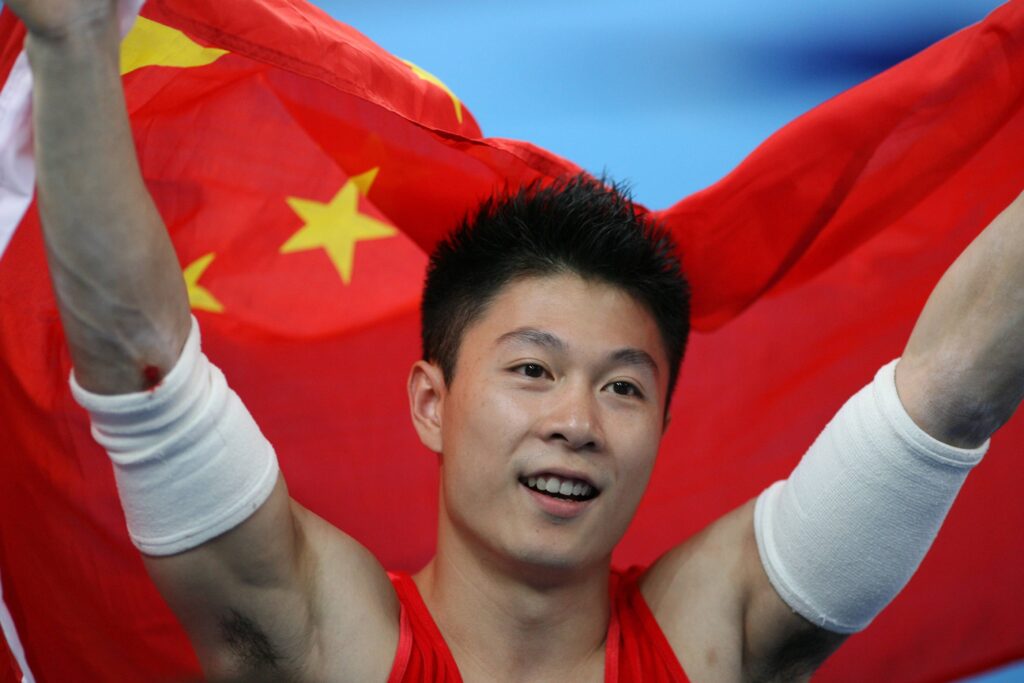
On August 19, 2008, the “Prince of Gymnastics,” Li Xiaopeng, once again reigned supreme on the parallel bars, as he had at the Sydney Olympics, adding another chapter to his legend as the king of the event. With 16 world titles and four Olympic gold medals to his name, he had surpassed Li Ning’s historic record for gymnastics golds and ushered in a new era of glory for Chinese gymnastics.
After the competition, Li said that his many years in gymnastics had taught him one thing: “When you fall, you have to get back up and stand even taller.” His coach, Chen Xiong, was equally emotional: “For Xiaopeng to come back from injury and reach the level he is at today—the road he has traveled has been anything but easy.”
A Vow Made by Shaving His Head
Born in 1981, Li Xiaopeng began gymnastics at the age of six. Even then, his talent stood out among children his age. At 15, he was selected for the national team. In 1997, the 16-year-old made an impressive debut at the World Championships, winning team gold, parallel bars silver, and floor exercise bronze. He became the youngest gymnast in the history of the Chinese team to win a world title.
That successful debut boosted Li’s confidence, and from then on he returned from virtually every major international competition with several gold medals. In October 1999, the 34th World Gymnastics Championships came to Tianjin. Compared with two years earlier, Li carried himself with greater composure and confidence. In the first competition, he and his teammates delivered strong performances to capture the team title.
The individual event finals began on the afternoon of October 16, and all eyes naturally turned to the young star. Li defeated the field with a steady performance to win the vault title. But on parallel bars, one of his strongest events, he made a mistake and missed out on the gold.
Li was not defeated by the setback. He immediately fixed his sights on the Olympics a year later: “I have to win that gold medal back!” So determined was he that before the Sydney Olympics he even shaved his head as a declaration of his resolve.
To perfect his parallel bars routine, Li trained harder than ever, carrying that determination with him for an entire year. Sometimes, to make an arm-hang element more precise and fluid, he trained until both arms were streaked with blood. Once, after losing control of a somersault, he came down headfirst and struck his eye against his knee. The area beneath his eye immediately turned black and blue, but he joked that he had given himself a “panda eye.” Years of gymnastics training had also left him with a chronic overuse injury to his Achilles tendon.
In 2000, Li finally had his chance to contend for Olympic gold. By then, he had become one of the leading figures on the Chinese men’s gymnastics team. On the day of qualifications, Li made a serious error on vault, and the team’s “double insurance” on the event failed to deliver. China finished the preliminary round behind Russia in second place. That night, everyone on the gymnastics team had their hearts in their throats: the Olympic men’s team title represented a 16-year dream.
Li quietly resolved that he would fulfill that dream in Sydney. He said he could endure pain, but he could not accept defeat. The lure of Olympic victory in Sydney was irresistible. If he lost, it would not be just his own defeat, but that of the entire men’s team and the entire nation; at stake was China’s place in world gymnastics. What would be lost was not simply an Olympic gold medal, but the dream shared by generations, young and old, throughout the gymnastics community. So many hopes and good wishes rested on his shoulders. The immense pressure borne by this 19-year-old was almost impossible for others to imagine, yet whether he won or lost, he could still face the crowd with a composed smile.
On September 18, 2000, the day of the men’s team final, Li stepped onto one of the world’s biggest stages. He led the Chinese men’s gymnastics team to its first Olympic team title. He then followed that victory with the parallel bars title, scoring a superb 9.825. Tears streamed down his face—tears of victory, tears of success. “All these years I’ve devoted to gymnastics have finally paid off!” he said emotionally.
A Waterloo in Athens
Just as Li was setting out ambitiously toward his next goals, injuries began to take their toll. In 2002, he suffered his first serious injury, laying the groundwork for the chronic problems that would trouble him in the years ahead. In preparation for the 2004 Olympics, the team treated him conservatively for a period of time. His condition improved somewhat, but the underlying problem remained.
In 2004, Li injured his Achilles tendon. At that year’s Athens Olympics, the Chinese gymnastics team met its “Waterloo,” and Li missed out on gold in several events, including the team competition, vault, and parallel bars. Afterward, he and Yang Wei hid in a bathroom, where they embraced and sobbed. For a time after Athens, Li was deeply discouraged; he could see no light ahead. Chinese team head coach, Huang Yubin, later recalled that the Athens defeat dealt a devastating blow to everyone: Yang Wei wanted to retire, while Li Xiaopeng and Huang Xu stopped training. For a long time, only a handful of younger gymnasts on the team were training.
After a period of reflection and readjustment, everyone came to the same conclusion: whoever had lost the gold should be the one to win it back. They could accept defeat, but they could not be afraid of defeat. But Li continued to be plagued by relentless injuries. At the 2005 National Games, he won gold on both parallel bars and vault, but afterward problems developed in his ankle. A month later, he missed out on the title at the World Championships, and a fall made the ankle injury even worse.
Before the old injuries had healed, new ones appeared. Injury after injury left Li unable to train normally, and the muscles in his legs gradually began to atrophy. Once powerfully built, he had become almost a “glass man” [i.e., injury-prone]. “If this keeps up, it’s practically the same as retiring,” he said. The constant injuries inevitably left Li anxious at what should have been the prime of his athletic career.
After repeated discussions between Li’s family and his coaches, the gymnastics team devised a detailed rehabilitation program. Professional rehabilitation specialists from Hong Kong were brought in to consult with the coaching staff and team doctors, while a full-time doctor was seconded from the Hunan Provincial Gymnastics Team to oversee Li’s muscle relaxation and rebuilding of strength. For a long period, his injuries continued to be treated conservatively. In addition to conventional treatments, every day he had to soak his feet in a specially prepared traditional Chinese medicinal bath formulated by the Hunan team doctor.
The prolonged treatments turned Li’s feet dark brown. But given the complexity of his injuries, they could do little beyond restoring some function to his joints and muscles and increasing his tolerance for pain. In other words, whenever Li competed, he had to endure the pain in his feet.
In January 2006, Dr. Zhao Hongbo performed surgery on Li’s injured foot and ankle, his first operation since the onset of his injuries. The surgery addressed loose bone fragments in the ankle joint, but inflammation of the tendon sheath still required a lengthy course of treatment and rehabilitation. The operation kept Li largely out of sight through most of 2006. Apart from occasional press reports about his injuries, he endured more than a year away from the spotlight and came perilously close to missing the Olympics altogether.
Meanwhile, rumors swirled outside the team. Some questioned whether Li still had the ability to compete at the highest level; others speculated that he might retire. The reserved Li offered no response. He simply continued his treatment and kept training with his head down, enduring the pain.
Back on Top Eight Years Later
Li could not allow himself to remain on the sidelines. He resolved to reclaim at the Beijing Olympics the team gold medal that embodied both the strength and spirit of Chinese gymnastics. After two years of rehabilitation and waiting, Li finally made his full return to competition in April 2008 at the World Cup in Germany. There, he once again won gold on his strongest event, parallel bars, a victory that demonstrated his confidence as he prepared for the Olympics. As if to further reaffirm his dominance on the event, Li won another parallel bars gold at the World Cup event in Tianjin in May.
Those performances earned Li a place on China’s Olympic team. His return allowed the Chinese men to raise the difficulty of their routines in the team competition, and eight years after Sydney, they reclaimed the Olympic team title by a commanding margin. At the moment of victory, Li Xiaopeng, Yang Wei, and Huang Xu—three veterans competing in their third Olympics—clung tightly to one another and wept. “This gold medal was won through the sweat and blood of the entire team,” Li said emotionally afterward.
On August 19, 2008, the parallel bars final was Li’s final appearance at the Beijing Olympics. The exceptional quality of his execution carried him to gold. Asked about surpassing Li Ning’s record for world titles, Li said: “Li Ning is someone who created an entire era. He will always be my idol. He is a legendary figure in China, and I don’t think I could ever surpass him.”
Asked what his many years in gymnastics had taught him above all else, Li thought for a moment before answering earnestly: “When you fall, you have to get back up—and stand even taller.”
Although his career had contained both triumph and hardship, Li Xiaopeng’s 16 world titles were already enough to secure his place in gymnastics history. His personal coach, Chen Xiong, said emotionally: “What he has achieved today is inseparable from his grueling training, his tenacious spirit, and his refusal to accept defeat. The road he has traveled has been extraordinarily difficult. His four Olympic gold medals are the finest reward for everything he has put into the sport.”
2008
Li Xiaopeng’s Mother: “Son, I Thank You!”
By Sun Bing, China Economic Weekly / Beijing
At noon on August 12, all six members of the Chinese men’s gymnastics team stepped onto the highest podium at the National Indoor Stadium, and five-starred red flags rose one after another amid the strains of the national anthem. Eight years after Sydney, the Chinese men’s gymnastics team had finally reclaimed the most important gold medal in Olympic gymnastics—the men’s team title. It was also the Chinese delegation’s tenth gold medal of the Beijing Games.
Meanwhile, Li Xiaopeng’s mother, Pan Jianguo, sat in front of a television, unable to hold back tears of joy as she watched her son compete. Fearing her presence might put extra pressure on Xiaopeng, she had given up the idea of watching the competition in person. Instead, she had come to the Li Ning Company’s 2008 Olympic Reception Center at Peking University, where she watched the Chinese men’s team—and especially her son—on live television alongside a large group of reporters. China Economic Weekly interviewed her as the competition unfolded.
“Congratulations! You were wonderful!”
Li’s mother wore a simple, elegant outfit and carried herself with dignity. She did not say much, but she was exceptionally warm and approachable. She told the reporter that because her son was competing in such an important event that day, she had barely slept the night before and had gotten up before four in the morning.
Watching the live broadcast on television, she appeared somewhat nervous, at times with a solemn expression.
“My palms are all sweaty,” she said with a smile. “I’m especially nervous, but I have a lot of confidence in Xiaopeng. I knew he would be able to stick it!” At this point, tears were already glistening in her eyes.
Li Xiaopeng first appeared on vault. Although the gymnasts before him had performed well, they had not put China in a particularly strong position. Li was the last Chinese gymnast to compete on the event. He sprinted down the runway, took flight, flipped through the air, and landed solidly. His 7.2-difficulty vault immediately brought the house down, ultimately earning him an excellent score of 16.775. China finished with 190.60 points, comfortably ahead of the United States in first place.
Li’s final event was high bar. As he prepared to dismount, his mother softly called out, “Stick it!” On the television, Li landed solidly. The small room immediately erupted in applause and cheers, and a relieved smile appeared on his mother’s face.
At the previous Olympic Games, China’s men’s team had returned home empty-handed, leaving the Chinese men with a lingering sense of regret. One can imagine the enormous pressure the six young men faced. But they did not disappoint. All six performed exceptionally well that day, and China easily captured the title by a commanding 7.25-point margin over Japan.
Immediately after the competition, Li’s mother called her son, and the two had a brief conversation in their native Changsha dialect.
“Pengpeng, congratulations on winning the championship,” she said, her voice already trembling.
“Thank you, Mom!” Li replied, his voice filled with unusual excitement and emotion.
Because the arena was noisy and the signal was poor, the call was difficult to hear, and Li’s mother had to hang up. She immediately sent her son a text message containing just six Chinese characters: “Congratulations—you were wonderful!”
“I Really Want to Cook Him a Meal”
Li’s mother had already been in Beijing for more than a week, but she had yet to see her son. “I have to wait until all of his competitions are over before I can see him,” she said. And because he still had competitions ahead, she did not dare take up too much of his time. “I really want to cook him a meal. He’s worked so hard; none of this has been easy for him!”
In fact, she had not seen her son for some time even before coming to Beijing. Even on this trip, when she had come specifically to watch him compete, she could only check on him by telephone.
Li’s mother told the reporter that she had learned about her son’s most recent injury from television. “Whenever he calls home, he always says he’s doing well. He never talks about his injuries,” she said.
During the men’s team competition, Li had suffered a large scrape on his arm. Although the television camera showed only a fleeting shot of a coach tending to the injury, his attentive mother noticed it. She expressed her concern: “I was very worried about him. He had already scraped it open during qualifications.”
At that moment, the television was showing footage of the six members of the men’s team after winning the title. With their arms around one another’s shoulders, they formed a circle, heads bowed as they wept like children. The first to raise his head was Li Xiaopeng, but his eyes were already filled with tears. “This gold medal really didn’t come easily!” Even the presenter was almost too choked up to speak.
Li’s mother was extremely pleased with her son’s performance that day. “I hope he can keep working hard, because he still has the individual event finals ahead,” she said.
“Son, I thank you! You’ve worked so hard!” Li’s mother finally said what she most wanted to say to her son.
Grateful for Li Ning’s “Care and Support”
With China’s victory in the men’s team competition at the Beijing Olympics, Li Xiaopeng surpassed Li Ning’s record of 14 major international titles, becoming the Chinese gymnast with the most such titles. Li Ning had won 14 gold medals at major world competitions; Li Xiaopeng had now reached 15. Xiaopeng’s dream of “surpassing Li Ning” had finally come true.
But behind that deceptively simple number lay hardships and tears beyond what most people could imagine.
In earlier years, Li Xiaopeng had virtually become synonymous with Chinese gymnastics. Some media even used the term “Xiaopeng whirlwind” to describe the state of Chinese gymnastics at the time. Gold medals, flowers, applause, and spotlights surrounded him, especially after his Olympic triumph in Sydney in 2000, when his gymnastics career reached its first great peak.
Beginning in 2002, however, injuries continued to plague Li Xiaopeng. He was injured in 2002, but in preparation for the 2004 Athens Olympics, he underwent conservative treatment, ultimately making the condition more complicated. At the 2005 National Games, he again badly injured his ankle while competing on parallel bars and vault. His left ankle contained not only loose bone fragments but also tenosynovitis.
In January 2006, Li Xiaopeng underwent his first operation. Although the surgery kept him out of virtually every competition that year, it could only be said to have solved half the problem. The other problem—tenosynovitis caused by chronic overuse—could not be treated surgically and would require a very long recovery.
At the time, many media outlets reported the assessment of Chen Fangcan, a professional rehabilitation specialist at Hong Kong Polytechnic University, regarding Li’s foot. In his view, Li’s injury could never be completely eliminated, and his foot would “hurt constantly” in future training and competition. All doctors could do was “help restore function to his joints and muscles and increase his tolerance for pain.”
The nightmare of injuries continued to torment Li in 2007, and he missed every competition that season. Many media outlets began to speculate: “Would Li Xiaopeng even be able to compete in gymnastics at the Beijing Olympics?” Some even believed that he might have no choice but to consider retirement.
But when Li Xiaopeng returned to the Olympic stage on August 12, 2008, and once again, won over the judges and spectators with a performance as flawless as ever, what we witnessed was not merely the winning of a gold medal, but the growth of a man who had risen, phoenix-like, from the ashes.
“Xiaopeng was magnificent. He made new history for the Chinese team and for Chinese gymnastics—and brought still more honor to those of us who bear the Li name.” The “Prince of Gymnastics,” Li Ning, called Li Xiaopeng’s mother immediately after the competition to offer his congratulations.
“Thank you, thank you for all the care and tremendous support you’ve given him,” Li’s mother told Li Ning. “I really hope Xiaopeng can achieve further success in the individual event finals.” Li Ning, too, was full of anticipation and confidence about Li Xiaopeng’s remaining competitions.
As for talk of “surpassing Li Ning,” Li Xiaopeng himself responded with great sincerity: “There’s no way I can compare myself with him. Everyone has their own era. Li Ning’s era can never be surpassed.”
His words reflected his deep respect for Li Ning, the great senior figure who had come before him.
Li Xiaopeng — Principal Competition Results:
★ 1997 World Gymnastics Championships: men’s team gold, parallel bars silver, floor exercise bronze
China Economic Weekly, 2008, Issue 32
★ 1998 Gymnastics World Cup Final: men’s floor exercise and parallel bars double gold
★ 1999 World Gymnastics Championships: team gold, men’s vault gold
★ 2000 Sydney Olympics: men’s team gold, parallel bars gold
★ 2002 Gymnastics World Cup Final: men’s parallel bars first place
★ 2003 World Gymnastics Championships: men’s team, vault, and parallel bars gold
★ 2004 Athens Olympics: men’s parallel bars bronze
★ 2005 World Championships: parallel bars silver
★ 2006 World Cup Final: parallel bars gold
★ 2008 Beijing 29th Olympic Games: gymnastics men’s team gold
★ 2008 Beijing 29th Olympic Games: gymnastics men’s parallel bars gold
2024
Li Xiaopeng: Grateful for the “Defeat” at the Athens Olympics
Xiao Junzhen, Xiangsheng Bao (Hunan CPPCC News), July 26, 2024 — Convergence Media Reporter
On July 23, Olympic gymnastics champion and International Gymnastics Hall of Fame member Li Xiaopeng posted a video on social media titled Heartbeat Olympics: See You in Paris. In the video, wearing a red polo shirt emblazoned with “CHINA,” he returned to the National Indoor Stadium, the gymnastics venue for the Beijing Olympics and a place of triumph for Li.“Returning to a familiar place, I find myself both nostalgic for the past and looking forward to the future,” Li said. Sixteen years later, the passion and excitement of the Beijing Olympic arena still stir the heart. Now, 16 years on, he will travel to Paris with his family to cheer on the Chinese team and witness more memorable Olympic moments and stories.
Before long, “Li Xiaopeng Returns to the National Indoor Stadium” became a trending topic, drawing widespread attention online. Li’s recollections transported viewers back to that glorious arena—with all eyes upon him, Li Xiaopeng takes a deep breath, every leap and rotation expressing his love for and dedication to gymnastics.
Li competed in three Olympic Games, winning four Olympic gold medals and 16 world titles, surpassing his predecessor, the “Prince of Gymnastics,” Li Ning. His gymnastics career was the stuff of legend, but it was also filled with twists and turns.
At the 2000 Sydney Olympics, the 19-year-old “Changsha lad” Li Xiaopeng led the Chinese men’s gymnastics team to the team title and captured parallel bars gold in the individual event finals, reaching the first peak of his career. In the international competitions that followed over the next several years, he won virtually every title on offer and had two gymnastics skills named after him—the “Li Xiaopeng Vault” and the “Li Xiaopeng” on parallel bars. Chinese gymnastics, too, reached an entirely new height.
The turning point came in 2004. That year, China’s men’s gymnastics team was derisively dubbed the “falling team” as the entire squad suffered a Waterloo. In the vault final, Li got his steps wrong on the run-up and came down hard, sitting on the mat. “It was a devastating blow, both for the team and for me personally,” Li recalled.
The four years from 2004 to 2008 were the darkest and most arduous of Li’s athletic career. He underwent treatment, suffered fractures, and even trained in a cast, but he never spoke lightly of giving up. He battled against his own limits, stubbornly overcoming both his injuries and the psychological toll they had taken.
Whenever he is asked about his Olympic memories, Li readily admits that what left the deepest impression on him was the “defeat” at the 2004 Athens Olympics. “At home, all my old gold medals are carefully packed away, but my competition bib from the Athens Olympics hangs in the most prominent place,” Li said.
At the 2008 Beijing Olympics, Li stood in the parallel bars final before 30,000 spectators. The instant he raised his hand to begin, the arena fell so silent that he could hear his own heartbeat. The moment he landed and stood firm, the gold medal was his. At 27, competing in an Olympics on home soil, Li claimed the 16th world title of his career, becoming the Chinese gymnast with the most world titles in history.
The “father of the modern Olympics,” Pierre de Coubertin, famously said that the important thing in the Olympic Games is not winning but taking part. In Li’s view, he should be grateful for his “defeat” at the Athens Olympics: worthwhile achievements rarely come without setbacks, and perseverance means never giving up. To him, that is the essence of the Olympic spirit. Even in retirement, Li often dreams of being back on the competition floor, his belief in the pursuit of glory that drove him then still undiminished.
For the Paris Olympics, Li will travel to the Games in person to cheer on the Chinese team. “I’ll be watching the gymnastics events in which China has a chance at gold, including the men’s events and men’s all-around, as well as women’s uneven bars and balance beam. I hope every Chinese athlete will compete fearlessly in Paris, give everything they have, and leave behind a brilliant mark all their own,” Li said.
湘声报/2024年/7月/26日/第004版
征战奥运 体育湘军的五环印记
中国体操界获得世界冠军最多的运动员
李小鹏:感谢雅典奥运会上的”失败”
政协融媒记者 肖君臻
7月23日,体操奥运冠军、国际体操名人堂成员李小鹏在社交平台上发布了一个题为《心跳奥运·巴黎见》的视频,视频中的他身穿印着”CHINA”的红色Polo衫来到国家体育馆,这里是北京奥运会体操比赛场馆,也是李小鹏的夺冠福地。
“故地重游,既怀念过去,又憧憬未来。”李小鹏说,16年前,北京奥运会赛场上的热血沸腾至今仍激动人心。16年后,他将和家人一起前往巴黎,为中国队加油助威,见证更多奥运精彩和故事。
一时间,”李小鹏重返国家体育馆”成为热点词条,引发网友们的关注。李小鹏的讲述,带着网友们穿越到那个辉煌的赛场——在万众瞩目下,李小鹏深吸一口气,用每一次跳跃和旋转展现着他对体操的热爱与执着。
李小鹏历经3届奥运会,斩获4枚奥运金牌,拿下了16个世界冠军,超越前辈”体操王子”李宁。他的体操生涯足够传奇,可谓一波三折。
2000年悉尼奥运会,19岁的”长沙伢子”李小鹏率领中国男子体操队获得了团体冠军,并在单项比赛中斩获双杠金牌,迎来职业生涯的第一个巅峰。在此后几年的国际大赛上,他几乎囊括了所有的冠军,并且拥有了以自己名字命名的体操动作”李小鹏跳”和”李小鹏挂”。中国体操也由此达到了一个全新的高度。
转折出现在2004年。那一年,中国体操男团被称为”掉跤队”,全军遭遇滑铁卢。跳马决赛时,李小鹏步点跑错,”啪”地坐在地上。”对于团队和我都是毁灭性的打击。”李小鹏回忆。
从2004年到2008年,是李小鹏运动员生涯中最灰暗又最负重前行的4年,期间经历疗伤、骨折、打石膏训练等状况,但李小鹏从不轻言放弃,和自己较量,顽强地克服了伤病和心理落差。
每每被问及奥运往事时,李小鹏坦言,印象最深的是2004年雅典奥运会的”失败”。”在我的家中,那些过往的金牌都被封存得好好的,但雅典奥运会的比赛号码牌,就挂在了最显眼的位置。”李小鹏说。
2008年北京奥运会上,李小鹏站在3万名观众瞩目的双杠决赛现场,一抬手的刹那,空气安静得能听到自己的心跳。落地站稳那一刻,金牌一锤定音。27岁的李小鹏,在家门口的奥运赛场上,拿下了人生中第16枚世界冠军金牌,成为中国体操界获得世界冠军最多的人。
“奥林匹克之父”顾拜旦有句名言:奥运会上重要的不是胜利,而是参与。在李小鹏看来,要感谢雅典奥运会上的”失败”,好事多磨和永不言弃并存,这就是奥运精神所在。退役的李小鹏时常梦回赛场,依旧笃定当年对荣光的追逐。
此次巴黎奥运会,李小鹏将前往现场为中国队加油助威。”我会去观看男子体操、男子全能、女子高低杠、平衡木等有’争金点’的体操项目,祝愿每个中国健儿都能在巴黎赛场上无以畏惧之姿挥洒汗水,留下独一无一的璀璨足迹。”李小鹏说。
More on China