Teng Haibin was supposed to be the future of Chinese gymnastics. In 2003, at just eighteen, he helped China win the world team title and unexpectedly took the pommel horse crown, as well. Coaches called him a “genius” and the future standard-bearer of the national team; what impressed them as much as his talent was an almost unnerving composure under pressure. Teng himself had a simpler formulation: “Steadiness is my form of power.”
What followed was a career that repeatedly tested that steadiness. Teng became Olympic champion at nineteen, but his Athens gold came only days after a disastrous team final in which his own mistakes helped end China’s hopes of defending its title. He then spent the better part of a decade trying to return to the Olympic stage, missing Beijing and coming agonizingly close in London before an injury forced him out at the last moment.
The pieces collected here trace what happened to that quiet teenager once the future everyone predicted for him actually arrived: champion, disappointment, comeback, husband, father, and eventually coach. Enjoy!
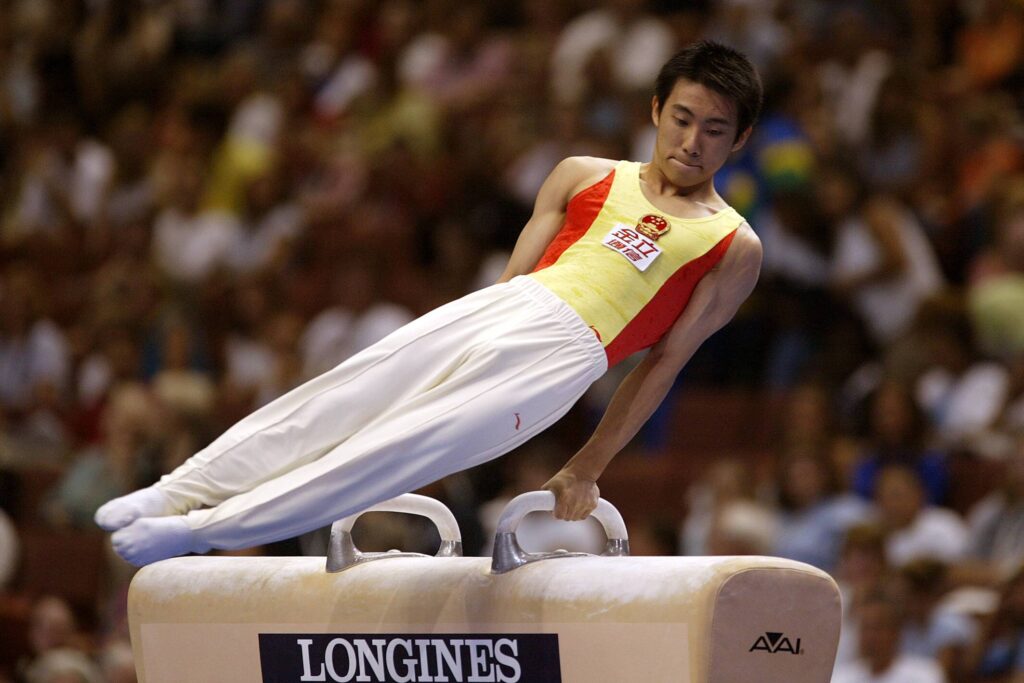
2003
Teng Haibin Wins the Pommel Horse World Title: A Gymnast of Extraordinary Talent, Hailed as the Future Leader of Chinese Gymnastics
PLA Daily, August 25, 2003
“Genius” — that was the word used by Zhang Jian, former head of the Gymnastics Management Center under the General Administration of Sport, to describe Teng Haibin. “The future standard-bearer of Chinese gymnastics” was the consensus assessment among those who know the sport. Today, in the pommel horse final, Teng Haibin once again displayed his remarkable gifts.
Pommel horse is not his primary event. Ranked seventh after qualifying and drawn to compete first, he was clearly at a disadvantage. Yet he left the audience transfixed almost immediately. Teng Haibin mounted the horse and moved through his routine — circles, cross-support swings — with a fluency and ease that seemed effortless. A score of 9.762 for the first competitor of the day stunned everyone in the arena. The competition quickly confirmed, however, that Teng Haibin’s early lead was where it would stay.
After winning, Teng Haibin was characteristically modest: “The pommel horse title should rightfully have belonged to Xiao Qin. It was only his unexpected mistake that gave me this unexpected prize.” Head coach Huang Yubin saw it differently — Teng Haibin’s victory was both a surprise and not a surprise. Pommel horse may not be his main event, but Teng Haibin’s defining quality is that he rises to the occasion at major competitions.
Even while training with the Beijing team at the age of eighteen, he was already known for his composure under pressure. It was precisely this quality that Huang Yubin most valued when Teng Haibin joined the national squad. “Haibin has an exceptional instinct for the sport. He trains with his mind and competes with his mind. On the big stage, he performs with the poise of a veteran.” At the previous year’s Asian Games in Busan, after teammates including Yang Wei had stumbled, Teng Haibin stepped forward and won gold on both pommel horse and horizontal bar, establishing himself as a core member of the team.
At this World Championships, Teng Haibin served as a linchpin of the men’s team final, contributing 28.962 points across three events — pommel horse, parallel bars, and horizontal bar — making him a key figure in the gold medal effort.
(Special correspondent Cheng Kangxuan, dispatched to Anaheim)
2004
Teng Haibin: Strength in Steadiness
By Li Qingyu | New Sports, April 1, 2004
At the 2000 National Youth Championships, Teng Haibin of the Beijing gymnastics team competed in six events without a single mistake. The performance left a deep impression on Huang Yubin, head coach of China’s men’s national team, who was then identifying prospects for the 2004 and 2008 Olympic Games: this kid is really steady.
Today, Teng has become Huang Yubin’s final protégé. His mentor’s assessment is simple: “Haibin’s gymnastics is fluid and precise, and he has an exceptionally calm mind. His steadiness is astonishing.”
Yet Teng’s maturity beyond his years also raises questions. Huang Yubin has predicted that Teng will one day “shine brilliantly” in the gymnastics world. Can someone so mild-mannered shoulder that responsibility?
Reporter: After the World Championships in Anaheim, you left people with two impressions as a newly crowned world champion. One was your exceptional technical ability; the other was your remarkably calm demeanor. Some people feel that calmness suggests a lack of the passion expected of an athlete. What do you think?
Teng Haibin: I think introverted athletes are less affected by outside influences. They can look at everything around them calmly, which gives them time to think before making decisions. When you do that, your chances of success are higher. Also, introverted athletes can confuse their opponents. Your rivals can’t tell what you’re thinking from your behavior, and they don’t know what you’re going to do next.
I’m naturally introverted, but that has never prevented me from becoming a good athlete.
Reporter: When did you first come to understand that about yourself?
Teng Haibin: Back in kindergarten, people called me “Ikkyu.” I suppose that meant I was always thinking about things. After I started gymnastics, whenever I learned a new skill, my coaches would make me repeatedly review the key points in my mind. I would break the routine down into individual elements and mentally perform it before ever getting on the apparatus. Usually, my success rate on the first attempt was pretty high. Over time, thinking before acting became a habit.
Reporter: Are you always able to remain calm when facing problems?
Teng Haibin: No. That’s something you have to train. The experience that stands out most happened last August at my first World Championships. I didn’t look nervous on the surface, but after arriving in Anaheim, my palms sweated during every training session. Once the nerves set in, trouble followed. I injured my knee on a simple dismount. After I recovered, I was surprised to find my name on the competition roster. I thought to myself, “Just being able to compete is already fortunate. If I perform to my level and don’t let the team down, that will be enough.” Without any pressure weighing on me, I felt relaxed and ended up getting a good result.
In Anaheim, I learned how to adjust my mindset. When you’re nervous, take a deep breath, shift your attention, and think about skills you’ve successfully performed before. That still-water calm isn’t something you can fake. First, your technical level has to be high enough that things come naturally. Second, you need experience gained through competition.
Reporter: This year, you’ll face a new challenge: the Olympics. What measures has the team taken in preparation, and what have you done personally?
Teng Haibin: The Olympic atmosphere in the team is very intense. Starting in mid-November last year, countdown boards for the Olympics were installed at the entrance to the dining hall and outside the athletes’ dormitory. They’re impossible to miss. Beginning in February, yogurt and chocolate started being provided during breaks between apparatus sessions, and before long, black-bone chicken soup was added as well. During training hours, athletes aren’t allowed to give interviews. On March 4, the team announced that Fridays would be designated media days. At all other times, reporters are asked not to disturb us. In special circumstances, approval must come from Gymnastics Center director Gao Jian and head coach Huang Yubin. Today, March 13, the team also hired an acupuncturist. In the past, acupuncture was used simply wherever something hurt. Now, treatments focus on specific acupoints after training as part of recovery and conditioning.
Competing at the Olympics is something I’ve dreamed about for a long time, but haste makes waste. After September of last year, my training volume became too high, and I developed fluid accumulation in my knee twice. Right now, my training emphasizes quality over quantity. Male gymnasts don’t have to worry much about weight control. I love eating meat, and to build up strength reserves, I have a big meal every few days. Recently, I’ve even been eating Western food to get used to foreign cuisine. That way, when I compete in Athens, unfamiliar food won’t affect my physical condition.
Of course, I also want to prove something through the Olympics: that I am an athlete with real potential, not just a passing flash in the gymnastics world.
Reporter: Coach Huang Yubin has said that you matured physically rather late and that strength is one of your weaknesses, though your coordination helps compensate for it. Is strength really your weak point? Which events does it affect?
Teng Haibin: Pommel horse, parallel bars, and horizontal bar are my strongest events. Those events depend more on technique, so you can get by with a little less strength. Rings are different. Strength plays a much larger role there, and right now I simply can’t do it well enough. My strength really is lacking. To use a soccer analogy, I enjoy playing football, but I don’t play as a striker or defender because I can’t win physical battles. I play in midfield. When the ball reaches my feet, I pass it on. There’s no physical confrontation, and I can still enjoy the game.
During winter training, I mainly worked on building strength through ring exercises. These past few days I’ve been able to hold the “airplane” position—a horizontal-cross variation on rings. I still can’t maintain it for long. I can hold a proper iron cross for several seconds, and that’s already a significant improvement for me. A month ago, those skills existed only in my dreams.
The whole purpose of improving my strength is to make a breakthrough in the all-around.
Reporter: Many people now see you as the next leader of Chinese men’s gymnastics. Strength is your “wings.” Once those wings are fully developed, what do you hope to become?
Teng Haibin: I’ve already talked about strength. Technically speaking, Brother Xiaopeng has the world-famous Li Xiaopeng Vault. I once applied to the International Gymnastics Federation to have a skill named after me—a parallel-bars element involving a 360-degree turn—but they ruled that it wasn’t entirely my own invention, so it wasn’t accepted. This year, Coach Huang has created a new routine for me with a very high start value. The framework is already there, but it’s still too short, and we’re continuing to add elements. This routine probably won’t be ready for this year’s Olympics, but it will definitely be ready by 2008.
The four Olympic champions who currently form the backbone of the team are my role models. But learning from them doesn’t mean copying them. Take pommel-horse traveling elements, for example. Some gymnasts perform them with a very wide straddle, but that style doesn’t suit me. I do them better with a narrower leg position. I view those champions as targets, but ultimately my goal is to surpass them. And compared with many of the athletes on the senior team, I’m still quite young. That’s my greatest advantage. Overall, I’m still some distance away from becoming a true team leader, but the goal isn’t beyond reach.
Reporter: Li Xiaopeng competes like a tiger—aggressive and commanding. People often describe you as soft by comparison, as lacking that same aura of dominance. Is that what they mean?
Teng Haibin: What I want is for opponents, the moment they see me, to think: “I can’t understand his gymnastics, and I can’t imitate it.” At the same time, I want to make sure I don’t lose a single detail or give my opponents even the slightest opening. If I can do that, why wouldn’t they fear me? And all of it comes from one thing: steadiness. Steadiness is my form of power.
Reporter: Which events give you the best chance at the Olympics?
Teng Haibin: The team competition, first and foremost. As for individual events, I’ll keep working hard. ▲
Editor: Ye Nan
2004
Teng Haibin Wins Pommel Horse Gold: “This Medal Means Everything to Us”
Xinhua / Sohu Sports, August 23, 2004
Teng Haibin, who secured Chinese gymnastics’ first gold medal at the Athens Olympics in the pommel horse final on the 22nd, seemed almost unable to believe it had happened. Even after the medal was placed around his neck, he said he had not expected to win.
Walking out of the mixed zone, Teng Haibin was immediately surrounded by Chinese journalists. At nineteen, his face showed no particular sign of elation. Facing a cluster of microphones and recording devices, his first words were: “Thank you to everyone who supported me — my parents, my coaches, my friends.”
In the men’s team final a few days earlier, Teng Haibin had competed in four events and made serious errors in three of them, contributing to China’s fifth-place finish. Four days into the gymnastics program, the Chinese team — which virtually every media outlet had tipped to dominate — had collected just a single bronze, in the women’s individual all-around.
Teng Haibin’s pommel horse gold finally broke the pall that had settled over the team.
Though he said, “I’m very happy; this medal means everything to us,” the slight young man could not fully set aside his anguish over his errors in the team final. “Even this gold cannot make up for the mistakes I made in the team final,” he said. “Especially for the senior members of the team, my errors meant that four years of their work came to nothing.”
Teng Haibin was the last to compete. Romanian veteran Urzică had already posted a formidable score, and no one expected what followed: Teng Haibin’s 9.837 surpassed it. Urzică took silver by a margin of 0.012 points, but said afterward: “I don’t feel that I lost.”
Teng Haibin himself acknowledged: “I hadn’t thought I would win this gold. It was a genuine surprise.”
He had previously won pommel horse gold at the World Championships as well, though on that occasion both Urzică and teammate Xiao Qin had made errors. Xiao Qin is widely considered China’s strongest performer on the event, but a mistake in qualifying had kept him out of the final.
2012: Injury
Chinese Delegation Flag-Raising Ceremony: Teng Haibin Bids Farewell to the Olympics in Tears After Injury
Beijing News, July 26, 2012
[…]
Beijing Athlete
Old Injury Fails to Heal; Teng Haibin Tearfully Bids Farewell to Olympics
Gymnastics team makes last-minute substitution; Guo Weiyang called in as replacement
The Chinese gymnastics team has made a last-minute change to its lineup. Beijing gymnast Teng Haibin will miss the London Olympics after an arm injury failed to heal in time. Alternate Guo Weiyang, who had been training in Northern Ireland, was urgently summoned to London to replace him.
Teng was the pommel horse champion at the Athens Olympics and one of the relatively few Athens Olympic champions on the Chinese delegation. Because of problems with his competitive form, he missed the Beijing Olympics.
Before arriving in London, Teng injured his arm during a training session in Northern Ireland and was unable to train normally. Yesterday, the Chinese gymnastics team held a training session at the Olympic competition venue, the North Greenwich Arena. Teng trained only vault and parallel bars. On parallel bars, however, he was unable to exert force through the injured arm. His teammates watched from the sidelines, and team captain Chen Yibing was moved to tears.
The Chinese gymnastics team ultimately decided to make the substitution, urgently calling Guo Weiyang into the lineup. When the team announced the decision, Teng fought back sobs as tears streamed down his face.
“I’ve done everything I could…”
Guo updated his Weibo account last night to confirm the news: “London, here I come.”
In a telephone interview, he said he had remained ready at all times. “I’ve been training systematically the whole time, so there’s no problem with me competing. I feel terrible about what happened to Haibin, and I hope he can recover as soon as possible.”
(Zhang Bin)
2013: Retirement
Teng Haibin: Retirement After the National Games — Coaching a Possibility
Beijing News, August 7, 2013
Background
Yesterday, the Beijing delegation to the 12th National Games held a send-off ceremony at the Capital Hotel. The 628-strong team is led by eight Olympic champions, among them Teng Haibin. In an exclusive interview with New Beijing News, he revealed that this National Games will be his final competition, and that a career of remarkable highs and lows will draw to a close in Liaoning.
Profile
Teng Haibin, born 1985. Joined the Beijing gymnastics team in 1996, entered the national team in 1998, and was once regarded as the leading all-around figure in Chinese gymnastics. At the 2004 Athens Olympics, he won gold on pommel horse, but subsequently missed both the Beijing and London Games.
On Retirement
A farewell at the National Games — no pressure on results
Beijing News: We didn’t see you at the founding ceremony for the Beijing delegation.
Teng Haibin: I was in training at the time — the schedules clashed, so I couldn’t make it. I need to make the most of the time I have and try to contribute something to the Beijing delegation at these Games. After all, this is the last competition of my career.
BN: When did you first start thinking about retiring?
TH: Honestly, I thought about it quite early. I was already thinking about it back in 2008. But then I won the men’s all-around gold at the 2009 National Games and felt I still had something to offer. I wanted to prove myself, so I carried on for another four years.
BN: Chen Yibing and Xiao Qin, who are around your age, have both stepped back from competition.
TH: That’s right. I’m currently the oldest member of the Beijing gymnastics team. I have an edge over the younger athletes in experience, but I’m well behind them in physical condition, and I’m carrying a lot of injuries. So the decision came fairly early: when the Liaoning National Games ends, I leave the competition floor.
BN: How are you approaching the result in this final event?
TH: I won’t put too much pressure on myself. If I can get through the competition in good shape and close out my career on a satisfying note, that’s enough. That said, this is my third National Games, so naturally I’d like to finish as high as I can.
BN: You were the all-around champion at the last National Games — but you’re not entering the all-around this time?
TH: No. Before these Games, I decided to withdraw from the all-around, mainly for physical reasons. With Beijing not having made the men’s team final either, I’ve had to channel whatever I have left into the individual events. I’m hoping to do well on pommel horse and parallel bars.
On Regrets
London left wounds, but they’ve healed
BN: You made your name young — Olympic champion at nineteen in Athens. But then you missed two Games in a row.
TH: Missing two consecutive Olympics is something I’ll carry with me for the rest of my life as an athlete. But it’s precisely from those painful experiences that I gained things I couldn’t have gained otherwise. Right now, I’ve made peace with those regrets. They’re just part of the journey.
BN: Between Beijing and London, which absence weighs on you more?
TH: Beijing was on home soil, and I wanted desperately to be part of it. Missing selection was hard. But I’d say London is the one I regret more. I had already traveled to England with the main squad — the goal was right there — and then injury forced me to withdraw. I had also put in far more for London; the preparation had been harder.
BN: After so many years in gymnastics, as you prepare to leave, are there people you want to thank?
TH: I want to thank every coach I’ve had. Above all, Coach Huang — head coach Huang Yubin — who brought me to the world championship podium and the Olympic podium, and who taught me the skill that bears my name. [The “Teng” element — a back uprise with a 360-degree turn to a handstand on parallel bars.]
BN: Have you achieved everything you set out to achieve in gymnastics?
TH: When I first started, I wanted to make the national team. Once I was on the national team, I wanted to become a world champion. Once I was a world champion, I wanted to win Olympic gold. I did all of those things. I’d say I achieved essentially everything I set out to achieve.
BN: Looking back at the end of your career, are you satisfied?
TH: There have been gains, and there have been many regrets. Satisfied, I suppose, because being dissatisfied wouldn’t change anything. (Laughs.)
On Life
Marriage plans after the National Games
BN: Since May, you’ve been talking about “enjoying gymnastics.” What brought about that shift?
TH: It actually started the year before. In the lead-up to London, I was putting enormous pressure on myself. Once London was over, I finally let go. Since then, my training has run on self-discipline, and I feel like I’ve genuinely started to enjoy the sport.
BN: What does gymnastics mean to you, in the end?
TH: I will always be grateful to gymnastics. Everything I have now is connected to it; our family’s life improved because of gymnastics, and most of my friends come from the gymnastics world.
BN: Have you thought about what you might do after retirement?
TH: Honestly, nothing specific yet. Further study is one possibility; coaching is another. Nothing is settled. For now, my only focus is training well and performing well at the National Games.
BN: It’s well known that you’re in a relationship with Zhang Nan of the Beijing gymnastics team. Any thoughts on when you’ll marry?
TH: Marriage is something we’ve thought about, but we’ll make concrete plans after the National Games. Zhang Nan is currently coaching the Beijing women’s team and has her own National Games responsibilities; we both need to get through this period first.
BN: One last question, a predictable one: if you have children someday, would you steer them toward competitive gymnastics?
TH: If I had a child, I’d definitely take them along to the gym to play around. But I probably wouldn’t push them toward competitive gymnastics. Let them enjoy it recreationally, and at a certain point, move on to something else. That seems like a good approach.
Interview by New Beijing News reporter Fan Yao
2013: Marriage Proposal
Teng Haibin’s Proposal Secret: A Fake Interview, a Real Proposal, and a Nearly Forgotten Ring
Teng Haibin’s Proposal Secret: A Fake Interview, a Real Proposal, and a Nearly Forgotten Ring
Beijing Youth Daily, August 26, 2013
Sunday is traditionally the one rest day of the week for China’s national gymnastics team. But yesterday afternoon, the gymnasium was as busy as a normal training day, with athletes everywhere. They had not come to put in extra work before the final Sunday ahead of the National Games; they had come to witness the proposal of Beijing veteran Teng Haibin, on the eve of his retirement, and to offer the couple their congratulations.
The proposal had been carefully planned by Teng Haibin and a close friend. The woman at the center of it was Zhang Nan — herself a former gymnastics star, now a coach with the Beijing team. Caught completely off guard, she was at first lost for words, then dissolved into tears. In her heart, she had been waiting for this moment for a long time. But before long, her tears were dispelled — and replaced by laughter — by a comedic mix-up neither of them had planned.
Teng Haibin told Beijing Youth Daily that he had chosen this moment to propose because he was about to leave for the National Games, after which he would officially retire. Yesterday was the last Sunday he would spend at the national training center as an athlete. A special day, reserved for a special person.
A Carefully Planned Proposal
Teng Haibin is by nature introverted and not given to grand speeches, though there is a romantic streak beneath the surface. He spent several days thinking through how to propose. “From the start, I had the 25th in mind. It was my last Sunday at the national team, which made it a very particular day,” he said.
For the specifics, he needed help. Xueming, a longtime friend who works at a talent agency, is known for his ideas, and he was the natural person to approach. The two worked out a plan together, but to carry it off, they needed one more person. They thought of Fan Ye, a former gymnastics world champion now working in media.
The scenario they devised went like this: Teng Haibin would bring Zhang Nan to the gymnasium on Sunday under the pretense that she was there to be interviewed by Fan Ye. Fan Ye’s role was to guide the conversation toward the past — ideally drawing out some emotional memories. At the right moment, when Zhang Nan’s feelings had been sufficiently stirred, Teng Haibin would appear with flowers and a ring and propose. No press was invited, in keeping with Teng Haibin’s preference for privacy, but the plan was romantic enough, and the element of surprise was guaranteed.
A Ring Mix-Up That Only Made It More Memorable
Shortly after four o’clock yesterday afternoon, Teng Haibin arrived at the gymnasium in casual clothes with Zhang Nan; Fan Ye was already waiting, ready to play her part. While Zhang Nan settled into the “interview,” Teng Haibin slipped away to the changing room and put on the white dress shirt he had prepared.
By this point, Fan Ye had succeeded in moving Zhang Nan. She was visibly emotional, eyes glistening with tears. According to the plan, this was Teng Haibin’s cue. But he had just discovered that, in his nervousness, he had left the ring behind.
No ring — how could he propose? He was in a bind, and there was no time to spare. Someone — nobody could afterwards say exactly who — suggested he borrow one from a friend present. As it happened, one of the friends there was married and had a ring on hand. Teng Haibin borrowed it, tucked it in his pocket, and walked out carrying the flowers.
“I truly had no idea,” Zhang Nan said afterward. “That he would propose to me then, in that place.” The two had been together for years, though they had only gone public with their relationship earlier that year. For Zhang Nan, this moment had been a long time coming. Teng Haibin went down on one knee and produced the ring. She said yes at once, but the joy, the astonishment, the tenderness, and happiness all came out together as tears. Teng Haibin looked at her, smiling, and said, “You’ll have to give it back; I borrowed it.” Zhang Nan stared at him in bewilderment for a moment; once he explained, her face broke into a warm smile.
Two People Who Put Their Careers First
The borrowed ring turned an already memorable proposal into something even more so, giving the couple a story they will carry with them for years. But the sweetness was brief. The proposal was only a small interlude before both left for the National Games.
Teng Haibin had already said publicly that this would be his final National Games, after which he would formally retire. “My event lineup this time isn’t as full as last time, and the pressure isn’t quite as heavy. But I still want to compete well. I don’t want to leave any regrets at my last National Games,” he said. Zhang Nan, meanwhile, was attending in her capacity as a Beijing gymnastics team coach, with athletes of her own to prepare. The sport brought them together, and both are still wholly devoted to it.
“Did you ever think about declaring your feelings at the National Games itself?” a reporter asked. “Never, honestly,” Teng Haibin said. “I’m not someone who likes to make a big show of things. The competition floor is a place for competing; I wouldn’t want to do something like that there.”
As for what comes after retirement — further study or work first — he said he had not yet decided. And the wedding? “I think probably next year,” he said. “For now, both of us are focused on our careers.” He said it with the sound of a man who could not be happier.
2025: Coaching
The Tempering and Transmission of Gold
— A Profile of Chinese Gymnastics Team Coach Teng Haibin
Yang Shuhuan
(Renmin University of China, Beijing 100872)
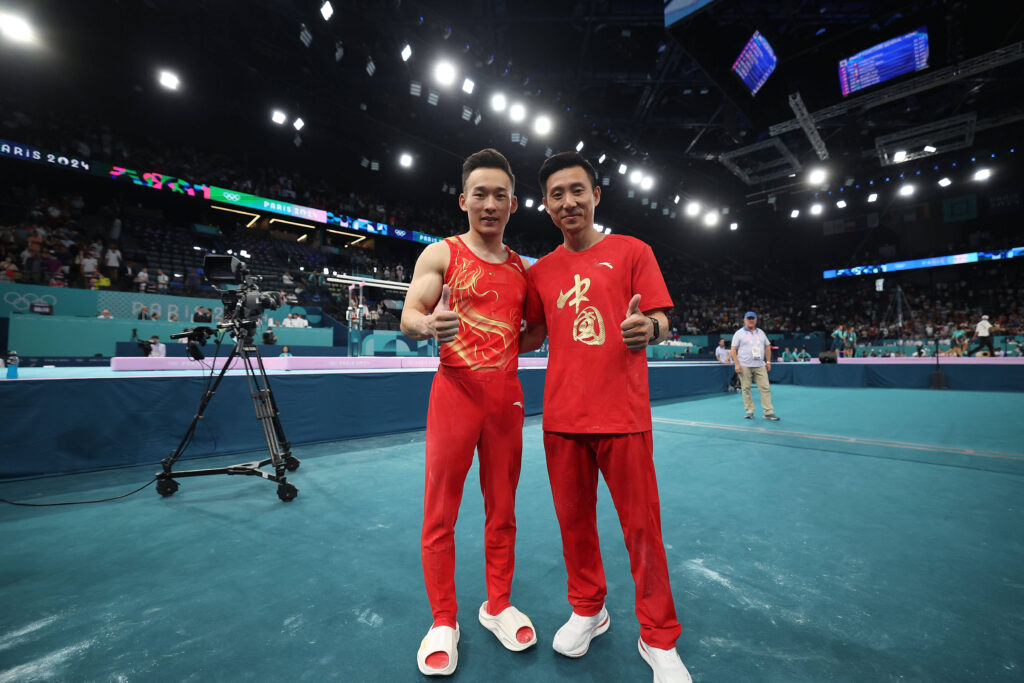
At the parallel bars final of the 2024 Paris Olympics, Chinese competitor Zou Jingyuan captured a score of 16.200 to successfully defend his title. It was another peak moment for Zou following his Tokyo Olympic victory, and the finest possible reward for his head coach — former Olympic champion Teng Haibin. In the qualification round and men’s team final of these Games, Zou scored 16.200 and 16.000, respectively, on parallel bars, a display that was both consistent and exceptional. Teng has accompanied Zou on the international competition circuit since the Rio Olympic cycle, guiding him to gold at two consecutive Olympics. Teng integrates his competitive experience with the tradition of mentorship, translating the composure and precision he showed as an athlete into calm judgment and insight as a coach. His path as a coach is one paved by a champion’s will, the transmission of craft, and a spirit of innovation — a vivid footnote in the story of China’s gymnastics forged through a hundred trials.
1 Glory and Regret: Forging the Original Heart
Teng Haibin’s coaching style is rooted in an athletic career woven from both glory and regret — an experience that not only shaped his resilient character but endowed him with the empathy to understand his athletes. Cast back to the 2004 Athens Olympics, a turning point in Teng’s athletic life. At that time, he was a rising star of the Chinese men’s gymnastics team, shouldering alongside his teammates the responsibility of defending the Olympic team title. “Before we left, I had no particular thoughts about individual event goals; my mind was entirely on the team competition.” Recalling the preparations of that year, he said frankly that all his focus was on team honor; personal results were of secondary concern. Yet the beauty and brutality of competitive sport are never far apart: the Chinese men’s gymnastics team suffered an unexpected defeat in Athens and failed to reach the podium, a setback Teng has never been able to forget. “We were not well enough prepared for the Olympics; that was a lesson.” The team loss cast a shadow over the whole squad, and the athletes faced pressure and trials unlike any before. Amid that disappointment, Teng Haibin arrived at the pommel horse individual final. Several days of quiet reflection and readjustment gradually relieved his mental burden, and he refocused his attention on competing. In the end, Teng Haibin won China’s only gold medal at the Athens Olympics.
That gold medal was like a shot of adrenaline, reigniting confidence and hope in a Chinese gymnastics team at its lowest ebb. For Teng, his coach’s trust, the support of older teammates, and a shift in mindset together enabled him to perform beyond his usual level. The Athens experience led him to begin thinking about the dialectical relationship between the individual and the team; what remained in his heart was no longer the glory of personal achievement, but the conviction and emotion rooted deep within the collective. That spirit of putting the collective first quietly took hold in him, eventually evolving into the core of his coaching philosophy, emphasizing teamwork and placing collective honor first.
From the young man in Athens to his retirement in 2014, Teng Haibin’s athletic career was far from smooth sailing, and those moments of hardship remain vivid in his memory. His hope of making amends for the team competition disappointments at the Beijing and London Olympics was dashed when opportunities slipped away. A competition-day injury at London left an indelible mark of regret on his career. “I went through many setbacks; it was very painful and disorienting at the time.” The enormous sense of deflation left him at a loss for a time, yet those pains and valleys forged a deep understanding of life and sport. “Looking back now, those years taught me: life will never be plain sailing, effort doesn’t always bring reward, but you must still give everything you have.” These experiences were like gold tempered in fierce flame, in that they honed his strength of will and distilled a life wisdom that sees through the ways of the world. When athletes encounter injury, fluctuating results, or emotional turbulence, Teng Haibin can always put himself in their shoes and understand their anxiety and frustration, because he has personally lived through every one of those moments of confusion and struggle. “Training and competition will never go entirely smoothly. I make a point of spelling out the difficulties in advance, so the athletes are fully prepared.” Guidance and comfort built on lived experience tends to move athletes more deeply than pure theory. It is precisely this empathy and understanding of pain points that have become an irreplaceable asset in his coaching career, quietly underwriting the bond of trust between him and his athletes.
2 Steady Coaching, Outstanding Achievement
In 2014, Teng Haibin concluded his athletic career and, driven by his love and attachment to gymnastics, chose to remain with the national team, transitioning from athlete to coach. In the early period of his coaching career, he started with the most fundamental teaching and mentoring work in the youth squad, before formally joining the national team coaching group at the end of 2014 and beginning to participate in the development of elite athletes. Though the role transition was not easy, his steady, reserved temperament and wealth of experience quickly earned him recognition. Speaking of his coaching style, Teng considers “composure” his defining quality: “I am a man of few words. On the competition floor, I give athletes a sense of calm assurance. When athletes panic on the floor, the coach cannot panic. Gymnastics is not about raw drive alone; you must execute every movement with stability and cool-headedness.” This composure is not a deliberate performance but the natural expression of years of accumulated experience and personal character. He knows well that performance under pressure often turns on a single moment, and that a coach’s every word and action can affect an athlete’s mindset and rhythm. A calm, collected coach can serve as a steadying anchor for an athlete’s state of mind, helping them deliver their true level at the critical moment.
In the practical work of coaching, Teng Haibin has demonstrated an outstanding ability to tailor his teaching to the individual. Zou Jingyuan is an athlete of outstanding ability who pursues perfection in every detail, an attitude Teng greatly admires, but Teng has also been alert to the risks this creates. “His drive for excellence is admirable, and his training is extremely hard-working; he can exceed the required number of repetitions without being prompted. But for precisely this reason, I need to regulate and gate-keep for him, because overtraining easily leads to injury and accumulated fatigue. That is the biggest challenge he currently faces.” Teng goes on to explain the potential effect of this “pursuit of perfection” in competition: “Several times in competition he has used too much force in trying to obtain a high score, causing execution errors. Competition is different from training. The forces generated in live performance are larger, making many factors harder to control.” In response to this, Teng has not simply imposed restrictions but has chosen patient guidance. In major competitions, he has repeatedly reminded Zou Jingyuan that “stable performance is more important,” helping him find the optimal balance between “perfection” and “success.” As Teng said after the Paris Olympics: “He keeps growing and gets better at competing. He has found a very good balance between pursuing perfection and ensuring success.”
In the exploration of new skills, Teng Haibin demonstrates forward-looking vision. Gymnastics is a sport in constant pursuit of breakthrough and innovation; new skills named after athletes represent not only a technical leap but a fine tradition in the development of the sport. Zou Jingyuan, driven by his desire to leave his own distinctive mark on gymnastics history, successfully had the high-difficulty skill the “Zou Jingyuan Cross” named after him. “Innovation and transmission are inseparable in gymnastics. Chinese athletes have had many skills named after them, such as the ‘Li Xiaopeng hang’ and the ‘Li Ning cross.’ We, too, hope to leave our own mark and be written into gymnastics history.” In the practice of innovation, Teng not only works with athletes to explore the technical details and feasibility of new skills but actively helps them repeatedly refine and adjust the execution. Drawing on his own extensive competitive experience, he carefully assesses the technical difficulty and injury risk that new skills may entail. “Innovation means breaking convention. it may increase the probability of injury and failure. My responsibility is to help athletes pursue innovation while also keeping a grip on feasibility and reducing risk.”
The Paris Olympics was a severe test for both Zou Jingyuan and Teng Haibin. After the team competition loss, Zou’s shoulder injury worsened and training was nearly suspended. Caught between Zou’s fierce determination to compete injured and the potential risks involved, Teng Haibin once again demonstrated the calm judgment and resolute decisiveness of an experienced coach. “His injury was serious. He was barely able to train normally before the competition, essentially relying on competition-day form to carry him through.” Before the rings final, Zou was already in severe pain, but his powerful conviction about competing for his country kept his resolve firm. Facing such a difficult choice, Teng chose to trust the athlete’s judgment and mobilized every available resource to support him. In the end, Zou held firm under pressure and successfully defended his parallel bars gold. This was not only a personal victory but an honor held aloft by the coach, the team doctor, and the entire support team together.
3 Giving Everything, Forging Unity
“Teaching by example” and the tradition of passing skills from experienced members to newcomers are fine traditions of Chinese sport, particularly gymnastics, that have continued to this day. Teng Haibin is both a beneficiary and a practitioner of this tradition. He not only passes on unreservedly the technical principles and competitive experience accumulated during his athletic career, but also focuses on cultivating team spirit and a sense of responsibility in his athletes, working to foster a positive and striving team atmosphere. For veteran athletes with rich experience, Teng hopes they will play a leading role within the team. “In training and in competition alike, we hope the veterans can set an example for younger athletes in every respect — not just at the competitive level, but also in terms of showing tenacious willpower in the face of difficulties.” Throughout the mentorship process, Teng has always believed that a coach’s influence extends beyond technical instruction to encompass spiritual guidance and intellectual inspiration. He shares without reservation both his successes and hard lessons as an athlete, and also incorporates the training philosophy of his own predecessors into his daily teaching, stimulating athletes’ drive to learn independently and develop their own understanding. Within the national team, Zou Jingyuan has gradually become a figure of leadership, taking on a greater share of team responsibilities. “He recently took up the chairmanship of the newly established Athletes’ Committee, responsible for organizing team meetings, conveying the coaching group’s training philosophy and tactical intentions, and facilitating the exchange of experience among team members.” Teng is deeply gratified by Zou’s growth and willingness to take on responsibility. In his view, athletes growing simultaneously in their sense of responsibility and team consciousness matters not only for the cohesion and fighting capacity of the squad but for the future of the team itself.
A successful sports team cannot do without efficient collaboration and a support group united in its objectives. Teng points out that modern competitive gymnastics training and preparation are no longer a matter of individual effort but a systematic undertaking in which coaches, sports scientists, medical staff, logistics personnel, and other forces cooperate. “Our group is undeniably united and cohesive, and always puts finding better ways to help the athletes as the primary task. In daily training and management, we are committed to building a positive, candid, and collaborative team atmosphere.” Teng believes a coach is not merely the maker of training plans but a team coordinator and continuous learner. “The emphasis now is on composite teams. Medical and fitness personnel use data to help athletes better understand their physical condition, making training more targeted.” To this end, he has promoted cross-departmental communication to ensure the free flow of information and sharing of resources. When differences arise over training methods, recovery protocols, or competitive strategies, he encourages all parties to speak freely and engage in rational discussion, stressing that the starting point and the endpoint of all communication and decision-making is “one mind, one effort,” serving the athletes together and helping the national team achieve its goals.
4 Discerning Selection, Unwavering Training
As both a participant in and a builder of Chinese gymnastics, Teng Haibin focuses not only on developing top-level athletes but has thought deeply about the current state, challenges, and direction of reform for Chinese gymnastics. “Times are changing. Today’s athletes need not only gymnastics talent but also the spirit to endure hardship and fight hard.” With improving material conditions, the younger generation is exposed to more information and has more active minds, but differs from its predecessors in willingness to endure suffering. Teng emphasizes that beyond physical talent and potential, athletes’ “soft power” — qualities such as strength of will, learning ability, adaptability, and team spirit — is equally important. “Young athletes must have solid minds and psychological fortitude; competitive experience through competition is therefore crucial. Strong psychological quality and tenacious will are the keys to standing out in high-level competition.”
Faced with the new challenges that the current social environment poses for the cultivation of competitive sports talent, Teng believes coaches should play a guiding role. This encompasses not only updating training philosophy and management models to introduce more scientific and personalized approaches, but also focusing on team culture-building, fostering a positive and focused training environment, helping athletes resist distractions, and concentrating on improving their competitive strength and event competitiveness.
“From the grassroots level to provincial teams to the national team, the number of people practicing gymnastics keeps shrinking, and the pool from which we can select is continually narrowing.” Teng points out that gymnastics demands exceptionally early cultivation and long-term investment, and that the grueling nature of training deters many young people — a situation that seriously affects the reserve of talent and the long-term development of Chinese gymnastics. Gymnastics is not only a competitive sport but a foundational physical activity, with irreplaceable value in cultivating young people’s physical development, balance, flexibility, coordination, and spatial awareness; it should be promoted and popularized in the context of national fitness and youth physical education. “The more people participate in gymnastics and love it, the more solid our talent base will become.”
Looking ahead to the imminent Los Angeles Olympics and the longer-term future, Teng Haibin and the Chinese gymnastics coaching team have already begun strategic thinking and planning. “The Chinese gymnastics team has always placed victory in the team competition as its top priority. It is a symbol of the team’s cohesion and collective spirit. The team event reflects the nation’s overall strength.” To achieve this goal, it is necessary both to fully leverage the core leadership and mentorship role of experienced veterans and to look to the future, boldly cultivating and deploying younger athletes, facilitating an orderly transition between generations, and achieving a healthy cycle of talent development.
In the cultivation of competitive sports talent, the tension between academic study and athletic training receives much attention — namely, how to strike a balance between cultural learning and specialist training. Teng believes an athlete’s all-round development is a matter of depth and breadth, both in career terms and in life. “Top-level athletes are very smart and learn quickly. Gymnastics movements cannot rely on the body alone — learning ability is critically important, and study must never be abandoned. Whether it is understanding movements, grasping tactical intentions, or adapting in the moment, none of it is possible without good logical thinking and rapid learning ability.” Accordingly, in daily training, Teng and the coaching group also attach importance to guiding athletes to strengthen their cultural learning, broaden the scope of their knowledge, and raise their overall quality, laying the foundation for more far-reaching development.
5 Living One’s Convictions, Looking to the Future
Coaches are often called the “unsung heroes” behind the competitive stage — a profession full of hardship and challenge, but also carrying pressures and loneliness that are difficult to articulate. “This profession is genuinely very demanding. The day-to-day pressure is great, the rhythm of holidays and rest days differs from that of ordinary people, and there is certainly a degree of debt owed to one’s family.” Prolonged training camps and constant travel have long since become the norm for national team coaches, and Teng Haibin spends very little time with his family. Teng’s wife, Zhang Nan, is a former outstanding national gymnastics team athlete; she has shown great understanding and tolerance for the particular demands of her husband’s work, becoming an important pillar supporting Teng in holding firm to his post. “She understands the training rhythms and daily routines of a coach, and provides a great deal of support.” It is precisely the combination of his love for gymnastics and his family’s support that sustains the warmth and energy Teng pours into Chinese gymnastics.
From the teenage pommel horse sensation to the steady and resolute gymnastics coach, Teng Haibin knows well that the core driving force sustaining him through all obstacles is his sincere love for gymnastics and an unwavering conviction in the pursuit of excellence. This conviction has never been abstract. It is embodied in the meticulous refinement of every technical movement, in the keen observation and individualized teaching he brings to every athlete, and in his deep hopes and tireless striving for the long-term development of Chinese gymnastics. Teng Haibin’s life trajectory is intertwined with the vicissitudes of Chinese gymnastics, each enriching the other. His story is a vivid embodiment of a generation of Chinese sportspeople who faced adversity without fear, climbed to the heights, and pursued excellence — and it is the most representative portrait of the gymnastics spirit of this era. On the future journey of Chinese gymnastics, Teng Haibin and the athletes he leads will surely continue to write an ever more brilliant and magnificent chapter with wisdom, sweat, and fighting spirit.
Chinese Sports Coaches, Vol. 33, No. 2, 2025
More on Chinese gymnastics