If one were to write a list of men’s gymnastics prodigies, Dmitri Bilozerchev would be at the top. But he was not the only gymnast to win a world all-around title at the age of sixteen. China’s Feng Jing achieved the same feat in 2001 and did so under rather unlikely circumstances. With China’s top gymnasts at home preparing for the National Games, Feng was part of a young, second-string squad sent to Ghent. He finished just eighteenth in qualifying and then surprised even himself by walking away as the world all-around champion.
Yet for such a remarkable achievement, Feng Jing has become a surprisingly obscure figure in gymnastics history. His world title did not lead to the Olympic career one might have expected: he was an alternate in 2004, missed the Beijing team in 2008, and retired two years later. The two translations below capture him at opposite ends of that journey. The first, published just after his breakthrough in 2001, introduces a mischievous sixteen-year-old whose winding path through China’s gymnastics system had suddenly ended at the top of the world. The second catches up with him years after retirement, when the former prodigy had happily traded elite gymnastics for what he repeatedly calls an “ordinary life” as a university teacher.
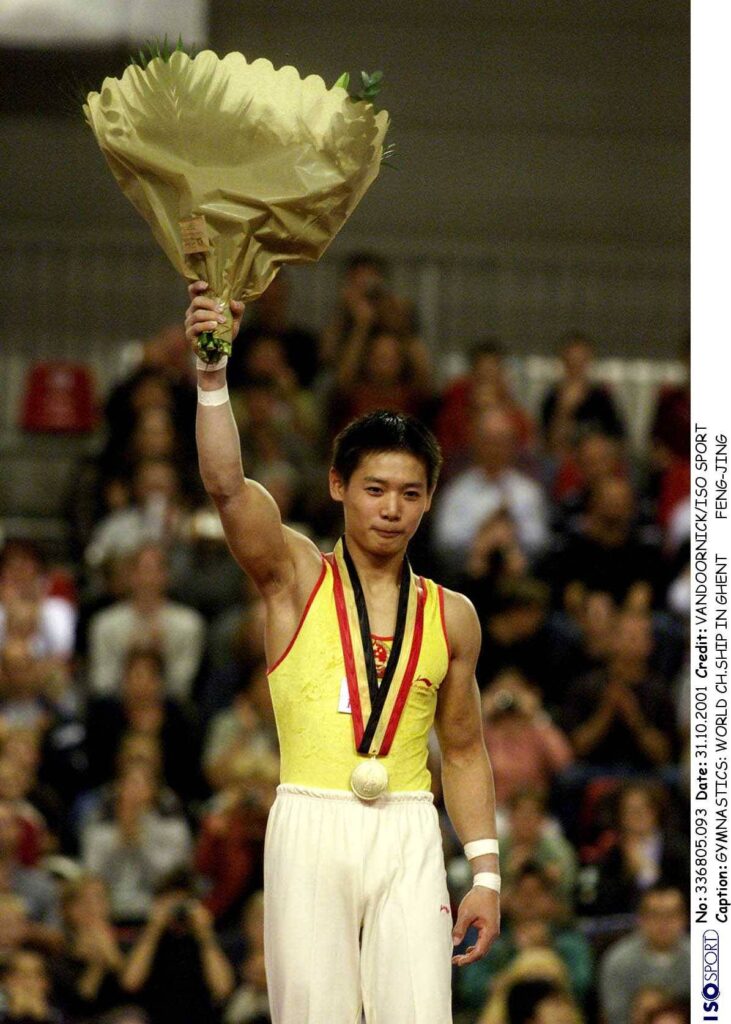
Note: Technically, Dmitri Bilozerchev is not the youngest men’s world all-around champion in history; Feng Jing is.
2001
Chinese Gymnastics: Three Young Tigers
Written by Gao Shanshan, New Sports, December 15, 2001
At the recently concluded World Gymnastics Championships in Belgium, China’s men’s gymnastics team — fielding an all-junior lineup — achieved the impressive result of fifth place in the team event. Those fresh-faced, youthful smiles announced to the world the promise of Chinese gymnastics.
Feng Jing: Gymnastics Is Hard, But Its Appeal Is Boundless
16-year-old Feng Jing pulled off a real surprise this time: he won the all-around gold medal, a title second in prestige only to the team title.
Feng Jing was born in Xi’an, Shaanxi Province, into a family of teachers. His father is a track and field instructor at Xi’an Institute of Physical Education, and his mother is a middle school teacher. From an early age, Feng Jing trained running alongside his father, and his energetic, mischievous nature meant he was naturally drawn to sports. But young Feng Jing gave his parents more than a few headaches, because he was genuinely quite naughty: the family lived in a communal apartment building, and the neighbors’ bottles and jars in the hallway had a habit of disappearing; or someone’s bicycle tire would go mysteriously flat for no apparent reason — it all turned out to be the work of this little “imp.” After that, whenever something went missing in the building, the first place anyone checked was the Feng household, which put his parents in constant embarrassing situations — while little Feng Jing would hide behind a door and laugh to himself.
When he was six and a half, one day after school, his parents took him, without explanation, to the Xi’an sports school and signed him up for the gymnastics team. A bewildered Feng Jing followed the other children into the gymnasium, and the moment he saw all those strange and varied pieces of apparatus on the floor, he fell in love with gymnastics, even though he had no idea yet what gymnastics actually was.
When real training began, the young boy gradually came to realize that practicing gymnastics was not an easy thing. At times, it was genuinely hard to bear. But fortunately his background in track and field gave him a stronger physical foundation than the other children, and he picked up skills faster than they did, so he always came first in competition. This made little Feng Jing love gymnastics more with every practice, and grow more confident with every session. But when he was 9, the school gymnasium burned down completely in a fire. With no training venue, he and his teammates had no choice but to follow the team’s arrangements and scatter to various provinces to train wherever they could find space. In this way Feng Jing ended up in Guangdong, eventually entering the Shenzhen Municipal Sports School. In 1994, the first time he competed on behalf of the Shenzhen team at the provincial games, he immediately swept four gold medals in the junior division — parallel bars, horizontal bar, pommel horse, and rings — and was soon selected for the Guangdong provincial team.
After about a year of training in Guangdong, Feng Jing followed his coach to Sichuan; after more than a year in Sichuan he went to the Beijing Institute of Physical Education for ten months, then moved on to Yunnan to train… In his own words: “It was really like fighting a guerrilla war.”
In Yunnan, the coach who had always worked with Feng Jing — Su Kangni — was replaced by someone new. The sudden coaching change left Feng Jing deeply unsettled, and on top of that he was now the only one left from his original cohort. His mood deteriorated, his training suffered, he developed resistance toward the new coach, and he spent his spare time playing video games; his technique quality dropped rapidly. Later Feng Jing was sent to Guizhou and changed coaches again, and this new coach, Lu Lifeng from Guangdong, played an enormously important role in Feng Jing’s development. “Coach Lu was extremely strict with us, and his teaching level was very high. Under his guidance I improved quickly. He was the one who elevated my understanding of gymnastics to a whole new level.”
Half a year later, Feng Jing was sitting in his room reading when his coach suddenly came to find him, telling him to pack up quickly. He was going to the national team. Feng Jing couldn’t process it at first; once he understood that he was actually going to the national team, he was so elated he could barely contain himself, and rushed off with his coach right away. His life always seemed to be full of surprises and the unexpected.
Once at the national team, Feng Jing learned he had been called up for a national training camp. He was fortunate to encounter Jin Weiguo, the person who brought about his second turning point: “Director Jin is truly an outstanding coach. His teaching level is very high, and he explains technique with exceptional clarity and thoroughness — one explanation and we understood. I felt very lucky to train in his group, and my technique improved quickly.” After the training camp, Feng Jing stayed on with the national team. This was 1999.
At the World Championships, Feng Jing lived up to expectations, proved his ability, and gave everyone a tremendous surprise. He has now set his sights on Olympic gold, and we hope he gets there.
I asked Feng Jing: After all this training, how well do you feel you truly understand gymnastics? He said, “My sense of it is that gymnastics is a very hard discipline — but it is also an enormously appealing one. It always gives me a feeling of warmth and belonging.” ■
Xiao Qin: The Road Ahead Is Still Long
Xiao Qin of the Bayi team is a genuine gold medal contender on pommel horse, with the technical standards and execution quality to match the world’s best. But at this World Championships, Xiao Qin did not fulfill his wish of being crowned world “King of Pommel Horse.” Instead, by the razor-thin margin of 0.025 points, he lost to the reigning Olympic champion on the event, Romanian Urzică, and had to settle for silver.
The result was hard to accept. In competition, Xiao Qin’s pommel horse routine featured sweeping amplitude, seamless flow, and beautiful continuity; his long arms gave him high support points, and with his legs held perfectly straight throughout, the entire performance was elegant and a delight to watch, drawing thunderous applause from the entire arena. Experts noted that his routine should have scored at least 9.8, yet the judges ultimately awarded only 9.775 — a genuinely unjust score. The veteran Urzică competed after Xiao Qin; his performance was also quite accomplished, but was visibly heavier than Xiao Qin’s and showed some leg separation, yet the judges gave him 9.8. This provoked clear dissatisfaction from the audience. But competition is competition, and judges are judges. An announced result doesn’t simply get changed, and young Xiao Qin had no choice but to swallow his pain and stand on the silver medal podium.
Back at the team hotel, Xiao Qin broke down and wept. He felt deeply wronged: “We young team members rarely get the chance to compete at a World Championships. Everyone wants to perform well. My pommel horse is strong enough to win gold, and I came here specifically aiming for gold. If I had performed poorly, I could accept that. But I performed well, and the judges still didn’t give it to me. That’s what I find so hard to bear…”
Xiao Qin is an introverted, steady-natured boy who loves gymnastics and has genuine talent for it. Although he narrowly missed gold this time, for a young Chinese athlete to achieve this level of result and create this kind of impact at a World Championships is already remarkable. In all three of his rounds, he scored above 9.75, putting the stalwart Urzică in a cold sweat. This experience will undoubtedly make Xiao Qin even stronger in future competitions. The 6-3-3 competition format demands that countries wanting strong results — particularly in the team event — must have elite specialists on every individual apparatus. Xiao Qin’s outstanding pommel horse work offered a significant lesson for the Chinese team’s future training: every event must have athletes capable of putting up high-quality, polished routines, in order to maintain China’s status as a gymnastics powerhouse in major future competitions.
Back home, Xiao Qin’s spirits recovered considerably. Calm again, he revisited the World Championships: “Actually, getting silver was normal. Compared to Urzică, I’m a nobody. I gave up a lot of points just in terms of name recognition. But my pommel horse technique is in no way inferior to his. And I’m still young. The road ahead is long. One day, I will stand on that world champion’s podium.” ■
Liu Jinyu: Being a Good Captain Is My Duty
Liu Jinyu is from Liaoning, but transferred to Jiangsu last year. This young man with the frank, open character typical of northerners was among the older athletes in the junior squad at the World Championships. He is naturally talkative and cheerful, with many friends and excellent relationships with every teammate. So the coaches designated him captain for this competition. Liu Jinyu said, “The coaches trusted me to be captain, so I feel obligated to look after every teammate’s wellbeing and morale.” His teammates said, “We originally planned that making the top eight in the team event would count as mission accomplished. But we ended up fifth, and that is inseparable from having such a good captain.”
In the team final, the Chinese boys were remarkably united: during warm-ups backstage, after every athlete finished his routine, they all encouraged each other, which visibly impressed the foreign teams watching. They had not expected Chinese junior athletes to carry themselves with such spirit. As a result, the young Chinese gymnasts performed better and better, with a real chance at a top-three finish. Morale was sky-high, and they were ready to give everything. But then the unexpected happened: Deng Weiwei’s floor exercise starting score was docked 0.5 points, which immediately hurt their overall total. The coaches immediately filed a protest with the technical committee, but received no satisfactory response.
All the athletes were devastated. With that deduction, their dream of a top-three finish had collapsed. Liu Jinyu was angry and felt helpless too, but he immediately thought: there are still more events to compete; we can’t let everyone carry this feeling into them. So he shook himself off, gathered everyone together, and said loudly: “Heads up, all of you! Don’t let the foreigners see us like this. We need to fight for China’s honor! Look, not making the top three is perfectly normal. We’re lucky to even have this opportunity to come to a World Championships. Some senior athletes are better than us but still haven’t gotten this chance. Don’t let performing well in the final go to your heads. Just compete steadily and honestly. What place we finish doesn’t matter, do you understand?” Hearing their captain say this, the athletes shed about half their dejection, straightened up, and began preparing for the remaining events. Liu Jinyu saw that morale had recovered and smiled with satisfaction.
Right after that, Feng Jing won the all-around gold, and everyone rushed to congratulate him, but Liu Jinyu’s congratulation came with an extra word: “Settle down quickly. There are still events ahead.” Feng Jing, deeply impressed by Liu Jinyu’s maturity and composure, immediately reined in his excitement and began preparing for the event finals.
In the event finals, Xiao Qin agonizingly missed the pommel horse gold medal. The whole team felt for him and cursed the judges for their unfairness. A tied gold would have been completely justified. Xiao Qin himself was inconsolable, crying continuously. Liu Jinyu came to his side and patted his shoulder: “Xiao Qin, don’t be upset. You’re a man now. You should be able to take a loss. Besides, Urzică already had a bigger reputation than you and performed very well — the judges giving it to him isn’t unreasonable. You’re still young; he has only a few more competitive years, and your time to win gold will come. Stop crying; believe in yourself.” Xiao Qin was deeply moved by his captain’s heartfelt words and gradually regained his confidence.
At this World Championships, the Chinese boys accomplished their mission with distinction — every placing from first through sixth was represented among them. When asked why they competed so well, they all said the same thing unprompted: “We had a great captain!” But Liu Jinyu’s answer was different: “Every one of us was outstanding.” ■
2018
Feng Jing: Living an Ordinary Life
Do you remember Feng Jing? He’s the young man from Shaanxi who won the men’s individual all-around gold medal at the 2001 World Gymnastics Championships in Ghent, Belgium. Years have passed. Where is he now? The day after the Start of Spring solar term,* I finally reached him by phone. “It’s been eight years since I retired,” he said cheerfully. “I’m a teacher at Xi’an Physical Education University now, living an ordinary, unremarkable life.”
The Road to the Championship: Ups and Downs
The 2001 World Championships fell close to the 9th National Games, and since the main squad needed to stay in China to prepare for the Games, the Chinese gymnastics team sent second-tier athletes to Belgium. Feng Jing was fortunate enough to be one of them.
Only 16 years old and competing at Worlds for the first time, Feng Jing was nervous. After all, every day of grueling training had been building toward results like this. In the men’s all-around qualifying round, he placed eighteenth. The field included heavyweights like Belarus’s two-time world all-around champion Ivan Ivankov, and to Feng Jing, a world title seemed out of reach. He didn’t overthink it; he simply told himself to compete earnestly and perform at his normal level.
Then came the final. Feng Jing walked out calmly and got through all six events at his usual standard, and the surprise came. He edged out every other competitor by the narrowest of margins to win the men’s individual all-around title, the defining achievement of his career. That gold medal carried special weight: in the history of Chinese gymnastics, the only world all-around champions before him were Li Xiaoshuang, and after him, only Yang Wei and Xiao Ruoteng. For claiming the all-around crown, he deservedly won CCTV’s 2001 Best Newcomer award in Chinese television sports. Recalling how he felt at the time of his victory, he’s still excited: “I really never expected to win. I was kind of stunned. I was just too young back then.” He joked, “I used to say, half-jokingly, that once my photo went up on the gymnastics team’s wall of world champions, I’d go home and get married.”
His photo did go up on the wall, but the young Feng Jing naturally didn’t go home to get married. Carrying his dream of an Olympic title, he set his sights on the 2004 Athens Olympics. As the reigning all-around world champion with real strength, making the team seemed likely. But for various reasons, he was disappointingly left as an alternate. In that moment, he felt some disappointment, but told himself he was still young and could aim for the next Olympics.
After missing the 2005 World Championships, Feng Jing kept training hard day after day, believing effort would eventually pay off. The 2006 World Championships were held in Denmark, where the Chinese men’s and women’s teams both won team gold, leaving a fine mark in the fairy-tale kingdom. Feng Jing again had the fortune of stepping onto the world championship podium — this time as a late addition to the Denmark trip, brought in to replace an injured main-squad member, but he made a major contribution to the men’s team’s success. Standing on the top podium, already a world champion once before, Feng Jing found this win felt almost routine — like winning just another ordinary title.
That victory gave Feng Jing a glimpse of what lay ahead, and it motivated his training further. But for various reasons, he again missed the 2007 World Championships, which also meant his chances of making the 2008 Beijing Olympics had grown slim. Still holding onto his dream, he trained relentlessly alongside the main group that was preparing for 2008. But the team, considering that the Olympics called for athletes with standout individual events, once again left him off the roster. “At that moment, I’d already lost heart. I started thinking about retiring — I felt there was no point in continuing.” But his coach, Jin Weiguo, told him, “A blessing in disguise, who knows? Over all these years, you’ve already gained so much, and you can’t let down what the country and the province have invested in training you. Hang in there a bit longer — you might still get something out of it.”** After hearing this, Feng Jing found the courage to keep going.
The 2009 11th National Games became Feng Jing’s perfect farewell performance. Though he was from Shaanxi, he competed for the Guangdong team. In the final, he and his teammates helped Guangdong win its third consecutive men’s team title. Feng Jing said that although he’d missed the Olympics, achieving three straight National Games team titles meant his gymnastics career still felt complete.
In 2010, Feng Jing announced his retirement.
Becoming a Student Again Felt Great
As early as 2002 to 2006, Feng Jing had actually been an undergraduate at Xi’an Physical Education University. But since he trained in Beijing for years on end, he had little time to actually study. In truth, he was only enrolled in name. After more than a decade as an athlete, Feng Jing felt it was time to recharge and catch up on his education. He chose to pursue graduate study at Beijing Sport University.
Everything felt fresh to him. In his own words, it was simply fun — everything was different now. He used to carry his bag onto the team bus every day headed for training; now he carried his bag and textbooks to class instead. He studied athletic training, a major that let him connect theory with his own practical experience, so the coursework came relatively easily. But for foundational subjects like English and computer science, his weak academic background made adjusting difficult. Even so, he approached it the same way he’d approached training — with steady, grounded effort — and whenever he hit something he didn’t understand, he’d promptly ask classmates or instructors for help.
Despite being a world champion, Feng Jing carried no airs, and he liked joking around and chatting with classmates. Because of this, in his English and computer science classes, some classmates would sit next to him on their own initiative to help explain concepts he found hard to grasp. Teachers and fellow students often used time after class to tutor him and lend him a hand. Feng Jing speaks of this with real gratitude and fondly recalls his university years.
Becoming a Teacher, Still Like a Student
After graduating with his master’s degree in 2013, Feng Jing faced two choices: take a division-level administrative post with the Guangdong Sports Bureau, or return to Xi’an Physical Education University as an ordinary teacher. Having left home young to train, spending more time with his parents had long been something he wished for, and combined with the fond memories of his time at Beijing Sport University, he chose in 2014 to return to Xi’an PE University to teach.
Feng Jing’s father was also a coach at Xi’an PE University, and it was there that Feng Jing’s own path in gymnastics began. Having gone from Xi’an to Guangdong and then to Beijing, Feng Jing came full circle back to the school that had once trained him. Looking at the teachers who had watched him grow up since childhood, and at every tree and blade of grass on campus, everything felt familiar and dear to him. At Xi’an PE University, Feng Jing teaches mass/recreational gymnastics. Many retired athletes choose to become elite coaches, but Feng Jing felt that years of professional gymnastics training had already been exhausting enough — he wanted something more relaxed, and more importantly, he wanted to help push forward the development of gymnastics at his alma mater.
“Being an ordinary teacher,” Feng Jing said, “feels really great.” Now he teaches more than 20 class periods a week, instructing freshmen and sophomores, and the normal course load leaves him plenty of time to unwind.
College students studying recreational gymnastics generally learn basic movements, nothing too difficult. Even so, some students, due to physical limitations, can’t complete certain moves and want to give up, to become “deserters,” but Feng Jing always talks them out of it. He tells them that anything worth doing will involve difficulties, and that overcoming one hurdle means moving up a level. He doesn’t just teach the technique; he personally demonstrates the moves and works hands-on to help students correct their form, staying with them until the problem is solved. Gradually these students find the knack for doing the moves correctly, and their training grows more confident.
While Feng Jing won’t let students become “deserters,” he’s happy to accommodate their needs wherever he can. When students feel too tired and want to rest, he readily agrees, giving them a relaxed environment. Nearly two decades in professional gymnastics left Feng Jing feeling it had all been too hard, too exhausting. He doesn’t want his students to suffer the way professional athletes do.
Teaching recreational gymnastics, Feng Jing draws on rich technical experience and moves like a fish in water. He describes it as a college student teaching elementary schoolers. But when it comes to professional theoretical research, he finds it relatively difficult to put things into words. For this, he often turns to senior professors for guidance, and regularly exchanges ideas and learns from his colleagues.
The display boards at Xi’an PE University feature photos introducing the school’s world-champion faculty, and that’s how students learn of Feng Jing’s background. Just as he’d blended in with classmates during his graduate studies at Beijing Sport University, here too he blends right in with his students. The post-90s generation of students feel no distance at all from this world champion. After class, they often eat together, and when something is troubling them, they’ll go find Feng Jing to talk it over. Teacher and students alike describe their relationship as close, both mentor and friend. Students say he’s the teacher who feels most like one of them.
Today, Feng Jing has indeed brought a wife home, and become a happy father. He’s visibly put on weight, and walking down the street, no one recognizes him anymore. Out of the public eye, he now lives comfortably. Throughout the interview, he kept repeating: “Life is relaxed now, and I have enough time to spend with my family. That’s the state I wanted.”
Author: Lin Jingyuan
Source: New Sports (新体育), Issue 4, 2018
More on Chinese gymnastics