Qiao Ya was a member of the Chinese team that won silver at the 1995 World Championships. Like many of China’s beam queens, she came agonizingly close to an individual medal: in the 1994 event final, she fell at the end of her layout stepout series, dropping out of contention and into seventh place. In 1995, Qiao Ya once again finished seventh on beam (without a fall). But when she hit her routine, it was a thing of beauty.
Her career followed a familiar pattern in another respect. Like many Chinese gymnasts of the era, her age was adjusted. Her birth year was changed from 1979 to 1977, which made her eligible for the 1991 World Championships and the 1992 Olympic Games, though she ultimately competed in neither.
She did appear at the 1992 Chunichi Cup, where she placed thirteenth in the all-around. In 1993, she competed primarily in smaller meets such as the China Cup, where she won the all-around at her actual age of fourteen and at her competitive age of sixteen. Her first major senior assignments, however, did not come until 1994, when she was fifteen and age-eligible by her true birth year (1979).
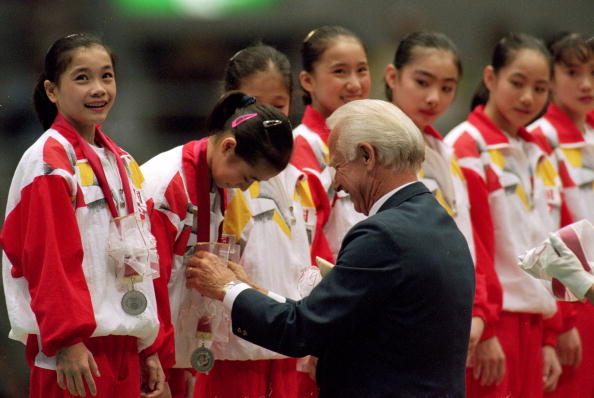
Unfortunately, it is hard to find a decent photo of just Qiao Ya, so here’s the entire team in 1995.
During Qiao Ya’s career, one might have assumed that her age had been adjusted by only a single year. Rather than 1977, her birth year at times appeared to be 1978. For instance, in a 1993 article from the People’s Daily, she is described as a fifteen-year-old gymnast from Hubei—an age that would correspond to a 1978 birth year (1993–15 = 1978).
China Cup International Gymnastics Championships
Huang Huadong and Qiao Ya Win Men’s and Women’s All-Around Titles
Beijing, October 8 — Report by Xu Liqun
The 1993 China Cup International Gymnastics Championships opened today at the Capital Gymnasium in Beijing. Chinese gymnasts Huang Huadong and Qiao Ya captured the men’s and women’s all-around titles respectively. The runners-up and third-place finishers were Huang Liping and Bae Gil-su in the men’s competition, and Guan Yuqing and Simona Amânar in the women’s event.
Huang Huadong delivered a steady performance across all six men’s apparatus to claim the title with a total score of 56.800. The 7th National Games men’s all-around champion, Huang Liping, also performed strongly. On parallel bars, he successfully completed two E-value difficulty elements—a tucked double back somersault to upper-arm support and a piked double back somersault to upper-arm support—earning the event’s highest score of 9.825. His overall total was just 0.025 points behind the champion.
North Korea’s star gymnast Bae Gil-su, an Olympic gold medalist, posted the highest score on pommel horse with 9.775, once again demonstrating his exceptional dominance on the apparatus. He went on to finish third in the men’s all-around with 56.375 points.
In the women’s all-around final, 15-year-old Hubei gymnast Qiao Ya showed remarkable composure against strong international competition, winning the title with 38.925 points. Guan Yuqing placed second with 38.550. Romania’s Simona Amânar excelled on balance beam to secure third place with 38.437 points.
Chinese gymnast Yuan Kexia had been widely tipped to win before the competition, but a major error on balance beam limited her to 9.175 on that apparatus. Despite strong efforts on the other three events, she was unable to recover and narrowly missed the podium.
The men’s and women’s apparatus finals will be contested tomorrow. Experts expect the competition to be even more fiercely contested.
People’s Daily, October 9, 1993, page 3
中国杯国际体操赛全能比赛黄华东乔娅分获男女冠军
专栏:体育
中国杯国际体操赛全能比赛
黄华东乔娅分获男女冠军
本报北京10月8日讯记者许立群报道:1993年中国杯国际体操赛今天在首都体育馆开始。我国选手黄华东、乔娅分获男女个人全能冠军。获得男女全能第二、三名的分别是中国黄力平、朝鲜裴吉洙和中国关玉青、罗马尼亚西蒙娜·阿玛娜。
黄华东在男子全能6个单项角逐中发挥稳定,以56.800分夺魁。七运会男子全能冠军黄力平亦表现出色,在双杠上成功地完成了团身和屈体后空翻两周挂臂两个E组高难动作,获得该项最高分9.825,总成绩仅比冠军低0.025分。朝鲜名将、奥运会金牌得主裴吉洙获得鞍马项目最高分9.775,再次显示了他在该项的超人实力。他还获得了男子全能第三名,成绩为56.375分。
15岁的湖北小将乔娅在女子全能决赛中不畏强手,表现沉着,以38.925分勇夺金牌。第二名关玉青的成绩为38.550分。罗马尼亚的西蒙娜在平衡木上发挥出色,夺得了女子全能第三名,成绩为38.437分。中国的袁珂霞赛前夺魁呼声甚高,但她在平衡木上出现了严重失误,仅得了9.175分,尽管在其他三个项目上奋力追赶,但终未能扭转局面,痛失奖牌。
明天,将进行男女各单项决赛,行家认为比赛会争夺更加激烈。
But today, the Chinese-language internet uses January 10, 1979, as her birthdate.
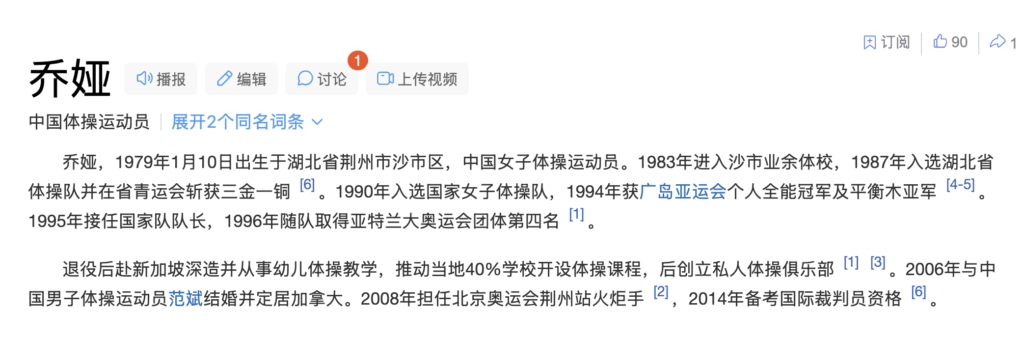
It is also the birthdate used by the Singaporean press when calculating her age. For example, after she moved to Singapore to coach gymnastics, an October 13, 2003, article in Streats described her as a 24-year-old—implying a 1979 birth year.
Singapore gymnastics has been down and out for a long time. But not for long if former Chinese gymnast Qiao Ya has her way. Now coaching in Singapore, the 24-year-old intends to raise the profile […]
“Bright Future,” Lim Han Ming, Streats, October 13, 2003
A Singaporean radio talk show called The Living Room also used a 1979 birthdate when Qiao Ya appeared as a guest. In the show’s biography, she was described as being 15 in 1994—once again implying a 1979 birth year.
At 15, [Qiao Ya] was picked to be Captain of China’s Gymnastics team, a role she played for three years, from 1994 to 1996.
A Golden Future for Singaporean Gymnastics? December 30, 2009
If both China and Singapore are using the same birthdate, it’s safe to say that Qiao Ya was born in 1979—not 1977.
More Articles about Qiao Ya
Her 1994 Title at the Asian Games
Qiao Ya in Tears Before Her Coach
By Li Hongbing
When Mo Huilan—who looked every bit the champion—fell from the balance beam, the coaches’ hearts leapt into their throats. Although Yuan Kexia and Qiao Ya were still temporarily holding first and second place, Japan’s Mari Kosuge and Uzbekistan’s Chusovitina were close behind. And with vault—the final event—being China’s weak point, was the all-around gold about to slip away?
Yuan Kexia scored only 9.425 on vault. Before Qiao Ya took the runway, she frowned at her coach and said, “My foot really hurts.” She had twisted her ankle three days before leaving for Japan and was still wrapped in thick bandages. Gritting her teeth, she went—9.5!
All eyes then turned to Chusovitina on uneven bars. If she scored 9.85, China would lose the all-around title. The judging seemed to drag on unusually long. Finally, the score flashed on the screen: 9.775! And so, China’s three young gymnasts—Qiao Ya, Yuan Kexia, and Mo Huilan—stood together on the podium.
But the spectators could all see, on the giant arena screen, that Qiao Ya was crying—crying with both grievance and pain. Her foot hurt terribly, and her head throbbed as if it were about to explode. Coach Wang Kaishun tenderly massaged her head, while Coach Bao Xianqin seized the moment to offer a lesson:
“Now you see the value of 0.1, don’t you? In training you never care about that 0.1—look how close it was today! They were only 0.1 behind us!”
(Filed from Hiroshima, October 5)
People’s Daily, page 4
乔娅泪对教练
本报记者李泓冰
最具冠军相的莫慧兰从平衡木上一掉下来,教练的心都提到了嗓子眼:虽说袁珂霞和乔娅还暂居前两位,可是日本的小菅麻里和乌兹别克斯坦的丘索维吉娜紧随其后,最后一项跳马又是我们的弱项,难道全能这枚金牌要丢?
袁珂霞的跳马只得了9.425分。乔娅上场前,对教练皱着眉说:“脚疼得厉害”。她在来日本前三天脚腕扭伤,至今还缠着厚厚的纱布。她咬着牙上了——9.5分!大家都盯着高低杠上的丘索维吉娜,如果她能得9.85分,我们的全能冠军就丢了。偏偏打分的时间又出奇地长。终于,屏幕上显示9.775分!于是,中国的三位小姑娘:乔娅、袁珂霞、莫慧兰全都站到了领奖台上。
可是在场的观众却全都从场上的巨大显示屏上看到了乔娅在哭,而且哭得又委屈又伤心。她的脚疼极了,头也疼得像要炸开。教练王开顺心疼地帮她按摩头部,鲍献琴教练仍不失时机地教诲道:“现在看到0.1分的价值了吧?平时训练都不在乎这0.1,看今天多悬呐!人家比咱们只差0.1分!”
(本报广岛10月5日电)
Carrying the Olympic Torch in 2008
Jingzhou Torchbearer Qiao Ya: Bringing the Torch to Show the Children of Singapore
June 2, 2008— Source: Changjiang Business Daily
Changjiang Business Daily (reporter Zhao Junwei) — “Hello!” The voice of Qiao Ya came through the phone. This former captain of the national women’s gymnastics team retired after the Atlanta Olympics, went abroad to study shortly thereafter, and is currently working as a gymnastics instructor in Singapore.
Qiao Ya is from Jingzhou, Hubei. She was once one of the finest athletes on China’s women’s gymnastics team, winning the all-around title at the 1994 Hiroshima Asian Games, and then representing China at the Atlanta Olympics, where the team placed fourth in the women’s team event.
After nearly ten years on the national team, Qiao Ya retired and went to Singapore to pursue further studies. After graduating, she found a job with the Singapore Sports Council teaching gymnastics to young children. At the start, she coached just over 30 amateur gymnastics enthusiasts — children who represented almost the entire population of gymnastics practitioners in Singapore.
Now 40% of Singapore’s schools have incorporated gymnastics into their curricula, and Qiao Ya has fulfilled her own dream by establishing a private gymnastics club.
Although Qiao Ya has been in Singapore for nearly ten years, she returns home every year to visit her family and her former national team. This time, she came back to carry the Olympic torch. When the children in Singapore heard about it, they were overjoyed and hoped Coach Qiao Ya would be able to bring the Olympic flame back to Singapore. Qiao Ya laughed and said: “I also love the Beijing Olympic torch very much — its colors are especially beautiful. Although my father has already said he wants to keep the torch, I’ll work on him and hope that I’ll be able to bring it back to Singapore to show the children there, let them touch it with their own hands, and feel the Olympic spirit.”
荆州火炬手乔娅:把火炬带给新加坡小朋友看看
2008年06月02日
来源:长江商报
长江商报(记者赵俊伟)”HELLO!”电话那头传来了乔娅的声音,这位前国家体操女队队长,在亚特兰大奥运会后退役,不久前往国外求学,目前在新加坡从事体操教学工作。
乔娅来自湖北荆州,曾是中国女子体操队最优秀的选手之一,1994年获得广岛亚运会体操赛的全能冠军,之后代表中国体操队出征亚特兰大奥运会,取得女子团体第四名。
在国家队奋斗了近十年,乔娅退役后,前往新加坡读书深造,毕业后在新加坡体育理事会找到一份从事幼儿体操的教学工作。最开始,乔娅在新加坡只带30多名业余的爱好体操的小朋友,这几乎就是新加坡练体操的人口。
现在新加坡学校已经有40%将体操作为课程在学校推广,而乔娅也实现了自己的梦想,拥有了一所私人的体操俱乐部。
乔娅虽然在新加坡呆了近10年,但每年都会回家、回国家队看看,这次回国传递奥运火炬,新加坡的孩子们得知后都非常高兴,希望乔娅教练能够将奥运会圣火带到新加坡。对此乔娅笑着说:”我也非常喜欢北京奥运会火炬,它的颜色特别好看,虽然我父亲已经提出了要保留火炬,但我会给父亲做思想工作,希望到时候能将火炬带回新加坡,给那里的小朋友们看看,让他们亲手摸摸,感受奥运气息。”
More on Age