Ling Jie, like many Chinese gymnasts, was a standout on uneven bars and balance beam, and like many other Chinese bars and beam queens, her age appears to have been adjusted. In her case, her birth year was moved backward to 1982, making her eligible to compete at the 1998 Asian Games in Bangkok, where the Chinese women won team gold.
Even during her competitive career, there were indications that Ling Jie had both a registered “competition age” and an “actual age” (实际年龄). What, precisely, her “actual age” is remains a matter of debate. Today, Ling Jie lives in the United States, where she coaches at World Champions Centre—the Biles family’s gym—and uses one birth year; yet in the coverage of the Sydney Games, the Chinese press circulated another.
This article does not attempt to resolve the question of her true birth year. What is clear, however, is that she was not born in 1982 and therefore was not 16 at the 1998 Asian Games.
Below, you can find what has been printed about her age, as well as several profiles about the 1999 beam champion.
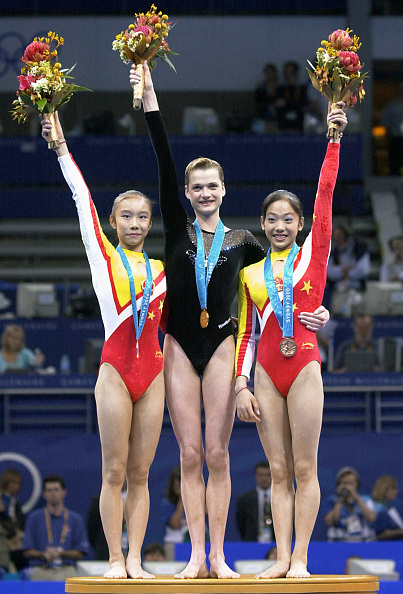
Ling Jie’s “Actual Age”
In 1999, when Ling Jie won gold on beam and bronze medals with the team and on uneven bars, the People’s Daily published an article honoring the team competition’s standout performers. In it, Xu Liqun calculated Ling’s age using her official competition birthdate, describing her as 17. In fact, according to her official FIG birthdate, she was still 16 at the time of publication, turning 17 just days later.
Honoring the Heroes After the Team Competition
Xing Aowei: Setting the ToneSeventeen-year-old Xing Aowei was the youngest member of the Chinese men’s team. In the team final he competed on five apparatuses. On vault, floor exercise, and parallel bars, he was the first to perform for the team and made no mistakes, completing his assignments superbly. For a young athlete competing in his first major international event, such performance was exceptionally rare.
Head coach Huang Yubin noted that the leadoff gymnast plays a crucial role. Whether the first athlete can perform well greatly affects the morale of the entire team. There are three standards for choosing the leadoff competitor: appropriate difficulty, high execution quality, and stable performance. Xing possessed all three qualities and was therefore entrusted with the responsibility.
Lu Yufu: One Vault Decides Everything
Guangdong’s Lu Yufu had the best physical condition on the team and consequently mastered the greatest number of high-difficulty skills. On vault in particular, his signature “Lu Yufu vault” is currently performed by very few in the world.
During the men’s team vault final, Yang Wei made a significant error and landed seated on the mat. When it was Lu Yufu’s turn, spectators held their breath. If he failed as well, China’s prospects for the title would have dimmed considerably.
With a powerful run and takeoff, he performed a handspring into a two-and-a-half twisting back somersault and landed steadily. Lu succeeded, earning 9.737—the highest vault score for the team. That single vault calmed everyone’s nerves.
On horizontal bar, although Lu beautifully executed a Tkatchev release to Tkatchev with a 360-degree turn, he unexpectedly slipped off with one hand during a comparatively simple skill. Even so, Zhang Jian, director of the Chinese Gymnastics Administrative Center, still praised him highly as the “number one contributor” in the team competition.
Liu Xuan: The Veteran Steadies the Army
After China secured the women’s team bronze medal, Zhang Jian said with satisfaction, “We made the right personnel decision. Putting Liu Xuan in was a last-minute choice before the competition, and now it has proven absolutely correct.”
At 20 years old, Liu was the senior member of the women’s squad. This World Championships might well have been her farewell performance, and she hoped to deliver her best showing.
However, China’s women had an unfavorable start in qualification. On balance beam, lowered start values reduced the scores of Liu and two teammates, and Liu ultimately missed the apparatus final she had hoped to reach. Admirably, she did not dwell on her personal disappointment. Instead, she remained energetic and steady, encouraging her younger teammates with enthusiasm.
In the women’s team vault final, the first three Chinese gymnasts all made serious errors. As the last to compete, Liu stepped up smiling, calm and composed. Relying on her strength, confidence, and experience, she scored 9.325—the team’s highest vault mark.
In terms of results, Liu and two teammates were all qualified to enter the uneven bars final. But because the competition limited each team to two finalists per apparatus, Liu voluntarily yielded her place to Ling Jie. Through her character alone, she earned a perfect 10 off the competition floor.
Ling Jie: A Bud Beginning to Bloom
Seventeen-year-old Ling Jie from Hunan was the most outstanding performer among China’s young women at this World Championships. In the team final, she performed strongly on all four events, scoring 38.418—the highest total among her teammates.
During the team vault final, the three gymnasts before her had each made errors. Remarkably, despite it being her first major international competition, Ling did not panic at the critical moment. She completed her routine successfully, lifting team morale and restoring hope for a medal.
She grew stronger as the competition progressed. On the final apparatus, uneven bars, her routine was light, fluid, airy, and elegant, with high difficulty. She earned an impressive 9.787.
Ling’s uneven bars is China’s strongest gold-medal prospect. Khorkina is widely known as a bars powerhouse, but in recent years she has faced Ling three times—and lost all three. Experts say that technically, Ling has already surpassed Khorkina. What she lacks now is experience.
(Filed from Tianjin, October 13)
People’s Daily, October 14, 1999, page 8
团体赛后表功臣
本报记者许立群
邢傲伟:头炮打得响
17岁的邢傲伟是中国男队最年轻的选手。团体赛上他参加了5个项目,在跳马、自由体操和双杠项目上都是率先上场,没有任何闪失,出色完成了任务。第一次参加国际大赛的小将能有如此表现极为难得。中国体操队总教练黄玉斌说,打头炮的选手很重要,第一个上场的队员能否出色发挥很大程度上影响全队的士气。选择打头炮的选手有3个标准,动作难度要适当、动作质量要高、发挥要稳定。邢傲伟因具备了这些条件而被委以重任。
卢裕富:一跳定乾坤
广东选手卢裕富的身体素质在全队最突出,因而也是全队掌握高难度动作最多的选手。特别是在跳马项目上,他的“卢裕富跳”,目前世界上没有几人可以完成。男团跳马决赛时,杨威出现了较大失误,落地坐在了垫子上。该卢裕富上场了,人们也捏着一把汗。如果这次他也失败,中国队夺冠前景将不容乐观。有力的助跑、起跳,“侧手翻接后空翻两周半”落地平稳,卢裕富成功了,得到了9.737分的全队最高分,这一跳让所有的人吃下了定心丸。
在单杠比赛中,卢裕富虽然出色地完成了“特卡切夫腾跃接特卡切夫腾跃转体360度”,但却在做一个并不高难的动作时意外单手脱杠。尽管如此,中国体操运动管理中心主任张健依然高度评价他是团体赛上的“头号功臣”。
刘璇:老将定军心
在中国队夺得女团铜牌后,张健欣慰地说:“我们用人是用对了。上刘璇是赛前临时决定的,现在看决策十分正确。”
已20岁的刘璇是女队中的老大姐,本次世锦赛很可能是她的告别演出,因而她希望自己有最出色的表现。但中国女队出师不利,在团体资格赛平衡木比赛中,由于起评分被压低,刘璇和另外两名队员成绩受损,使得本想在平衡木单项比赛中争取奖牌的刘璇无缘决赛。然而令人钦佩的是,刘璇没有沉浸在自己的烦恼中唏嘘哀叹,她依然以饱满的精神、稳定的发挥热情地激励小师妹们。
女团跳马决赛,前3名选手相继严重失误,最后一个出场的刘璇面带微笑,镇定自如。她以自己的实力、信心和经验得到了9.325的全队最高分。
论成绩,刘璇和另外两名队友都可进入高低杠决赛,但由于赛会决定每队只能有两人参加单项决赛,刘璇主动提出把机会让给队友凌洁。她以自己的人格魅力赢得了场外的10分。
凌洁:小荷初露角
17岁的湘妹子凌洁在参加本届世锦赛的年轻女队员中是发挥得最好的一个。在女团决赛中,她4项均发挥出色,得到38.418分,位居全队之首。
女团跳马决赛时,先她出场的3名队友一个接一个失误。难能可贵的是,第一次参加国际大赛的凌洁关键时刻没有慌张,成功地完成了自己的动作,令全队士气大振,为中国队最终夺得奖牌重现了希望。随后她越比越好,在最后一项高低杠比赛中,她的动作轻、灵、飘、美,动作难度大,赢得了9.787的高分。
凌洁的高低杠是中国队摘取金牌希望最大的一个项目。霍尔金娜是众所周知的高低杠强手,但在近年的比赛中,她3次与凌洁相遇,3次败下阵来。专家们评价,从技术上比,凌洁已经超过了霍尔金娜,现在所欠缺的就是经验。
(本报天津10月13日电)
But Ling Jie likely was not born in 1982. A year later, after Ling Jie won silver on uneven bars and bronze with the team at the Sydney Games, a curious detail surfaced. In his summary of the Chinese team’s performance, Fu Guoliang, a regional sports official in Hunan, noted that some gymnasts had “actual ages,” and he counted Ling Jie among them.
Gymnast Li Xiaopeng is 19 this year and will be 23 at the next Olympics — the prime age for a male athlete. Gymnast Ling Jie will still be under 20 in actual age at the next Olympics, and has expressed the ambition to follow Liu Xuan’s example and win gold at the Athens Games. Gymnast Yang Yun is just 14 years old in actual age; she made her debut in Sydney and immediately attracted attention in the gymnastics world, winning a bronze medal — her future is boundless.
体操运动员李小鹏今年19岁,下届奥运会时23岁,正是男运动员的黄金年龄。体操运动员凌洁到下届奥运会实际年龄还没有20岁,她表示要以刘璇为榜样,争取在雅典奥运会上夺得金牌。体操运动员杨云实际年龄才14岁,在悉尼初试身手,就引起体操界的注目并夺得一枚铜牌,前程不可限量。
According to Fu Guoliang, Ling Jie would still be under 20 at the 2004 Athens Olympics. But with an October 22, 1982 birthdate, she would have been 21 during those Games, turning 22 shortly afterward. By his account, then, 1982 cannot represent her “actual age.” With a 1984 birth year, however, Ling Jie would be just 19 during the Olympics, turning 20 only after the Games had concluded. In other words, 1984 is the earliest year in which Ling Jie could have been born.
And indeed, 1984 was the birthdate that some Chinese publications used. After the Sydney Games, New Sports (新体育) published a deeply personal letter by Ling Jie’s father, which repeatedly underscored her 1984 birthdate. At one point, the article states: “Jie-zi, when you come back from the Olympics, you will be turning 16” (洁子,从奥运会回来,你就要过16岁生日了。).
Later, he recalls the moment of her birth fondly:
In the golden autumn of October 1984, a little girl arrived at [Redacted address] in the northern district of Hengyang city. She brought us joy; she brought us hope. That little girl was you — our Jie-zi.
84年的金秋十月,衡阳市城北区[Redacted Address]添了一位小姑娘,她给我们增添了快乐,增添了希望。她就是你,我们的洁子。
凌洁,爸爸有话对你说, New Sports, October 15, 2000
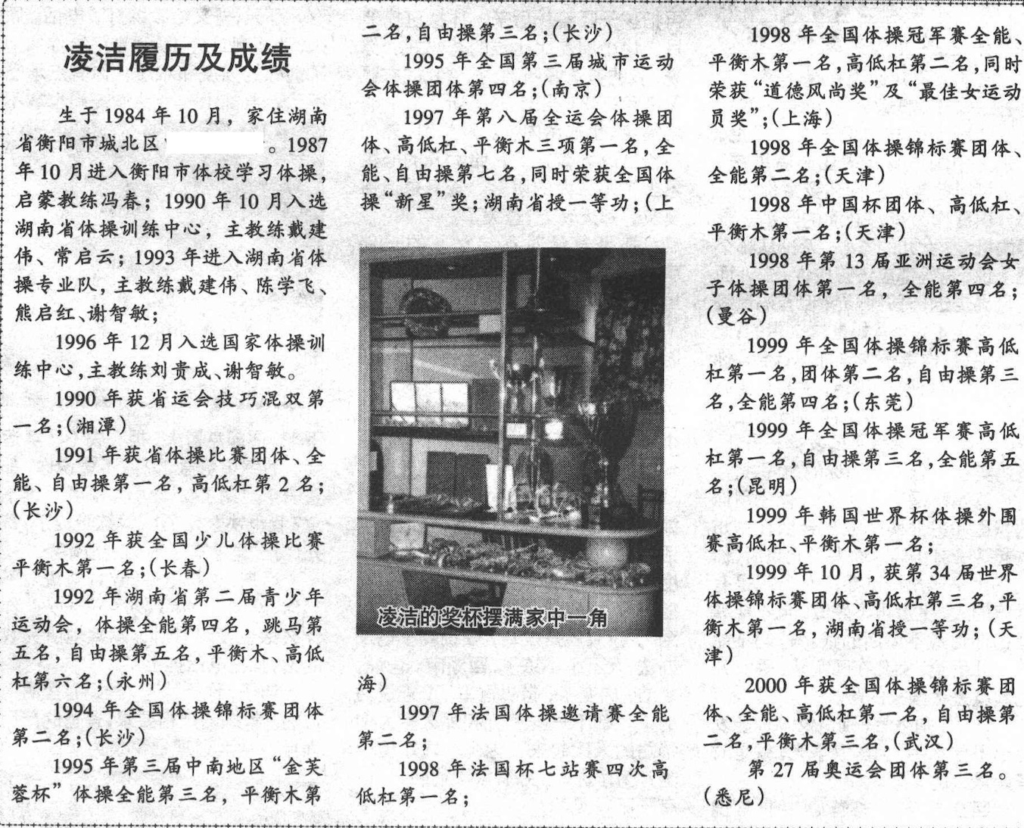
The article closes with a full biographical profile of Ling Jie, cataloguing her achievements. It opens again with her birth date:
Born October 1984; home address: [Redacted Address], Northern District, Hengyang City, Hunan Province.
生于1984年10月,家住湖南省衡阳市城北区[Redacted Address]。
For readers of New Sports, there was no doubt that Ling Jie was born in 1984, and for those who read Fu Guoliang’s report on the 2000 Olympics, 1984 was the earliest that Ling Jie could have been born.
But there is one more wrinkle to this story. Today, Ling Jie lives in the United States and does not use 1984 as her birth year. She uses a 1983 birth year—at least, on social media. For example, she celebrated her 36th birthday on October 22, 2019, on her public Instagram account.
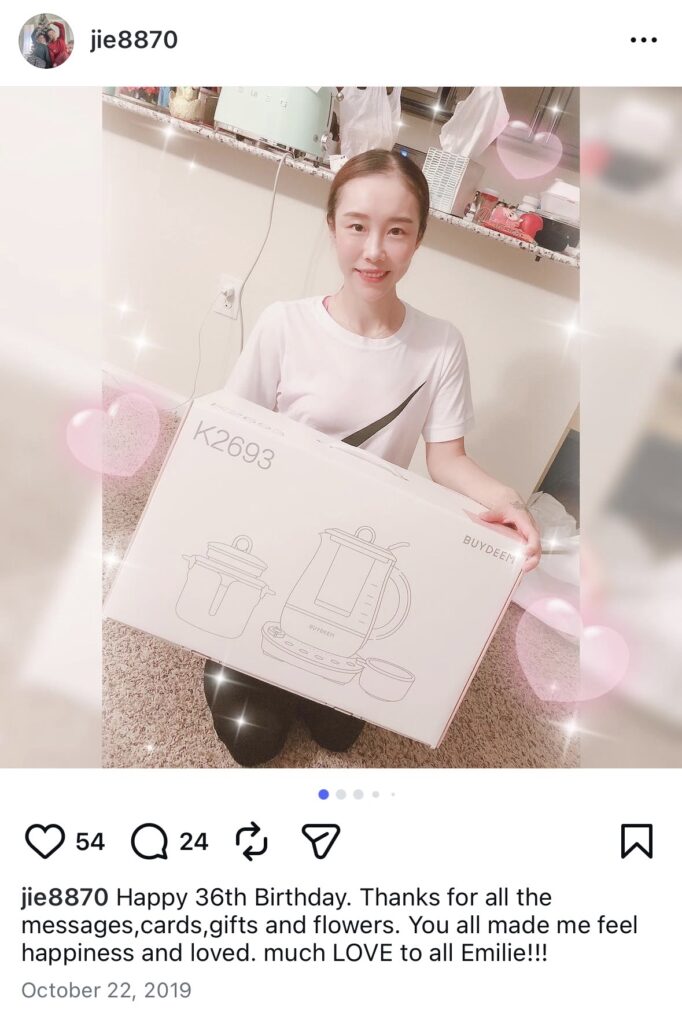
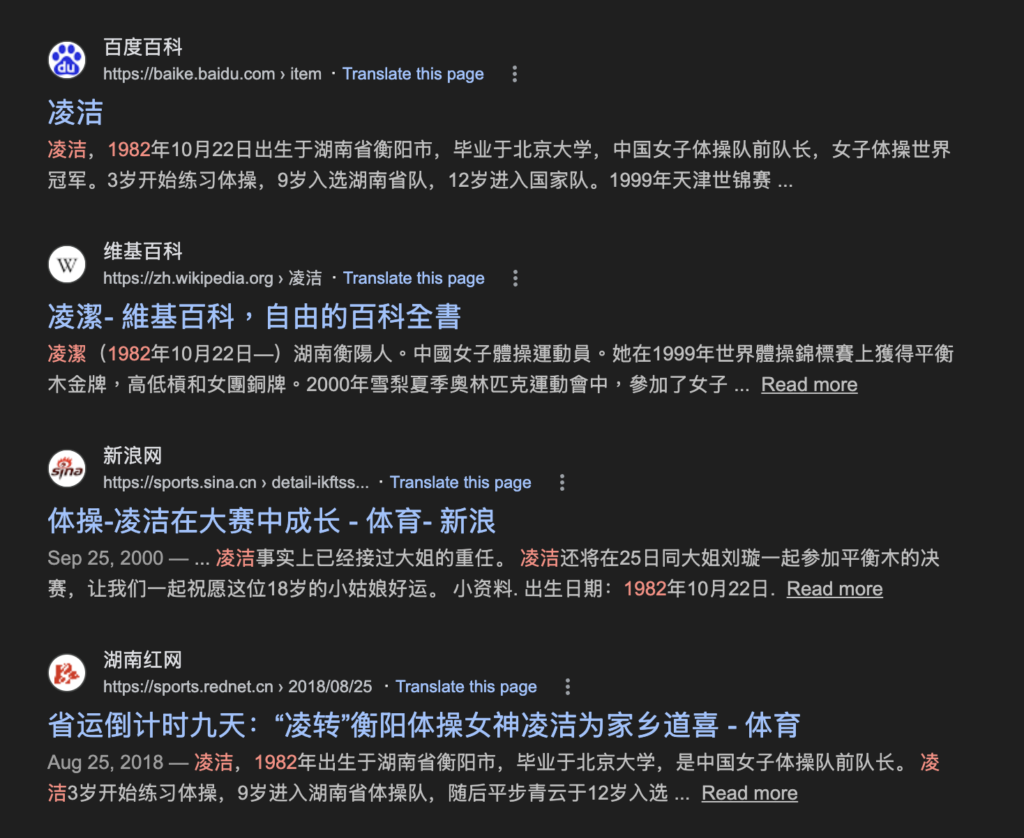
Meanwhile, the Chinese-language internet continues to use 1982 as her birth year. But if there is one point of clarity in this mystery, it is this: Ling Jie was not born in 1982. Even she no longer uses that year.
Appendix A: A Translation of the New Sports article
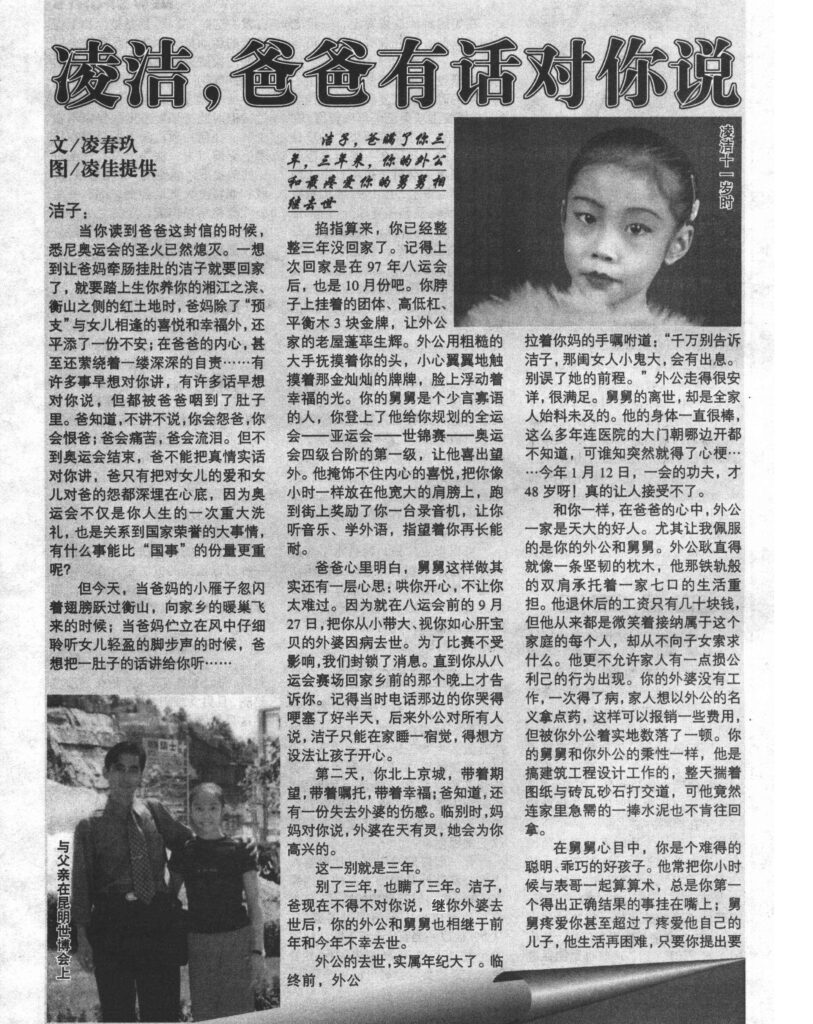
Note: This letter will mix first-person (e.g., I) and third-person references (e.g., Father). In English, it sounds odd to mix the two, but in Chinese letters, it is common in intimate or family contexts. This letter will mention physical abuse, so please take care as you read.
Ling Jie, Your Father Has Something to Say to You
Written by: Ling Chunjiu
Photos provided by: Ling Jia
Jie-zi,
By the time you read this letter from your father, the Olympic flame in Sydney will have already been extinguished. Thinking that the Jie-zi who has weighed so heavily on your parents’ hearts is about to come home — about to set foot again on the red earth along the Xiang River and beside Mount Heng that gave you life and raised you — beyond the joy and happiness your parents are already drawing in advance from the thought of being reunited with their daughter, there has also crept in a measure of unease. Deep in your father’s heart, there even lingers a thread of profound self-reproach… There are many things I have long wanted to tell you, many words I have long wanted to say, but your father has swallowed them all down. I know that if I neither speak nor say, you will resent me, you will hate me; your father will suffer, your father will weep. But until the Olympics were over, I could not speak the truth to you. I had no choice but to bury deep in my heart both my love for my daughter and my daughter’s grievances toward me because the Olympics are not only a defining baptism in your life; they are also a matter bearing on national honor. What could possibly weigh more than affairs of the nation?
But today, as your parents’ little wild goose flutters her wings and leaps over Mount Heng, flying back toward the warm nest of home, as your parents stand in the wind listening carefully for the sound of their daughter’s light footsteps, your father wants to pour out everything he has been holding inside…
Jie-zi, your father has been separated from you for three years. During these three years, your grandfather and the grandfather who loved you most passed away one after another.
Counting on one’s fingers: you have been away from home for three full years now. I remember your last visit home was after the Eighth National Games in ’97 — October, as I recall. The three gold medals hanging around your neck — team, uneven bars, and beam — filled your grandfather’s old house with a radiant glow. Grandfather stroked your head with his big, rough hands, gently touching those gleaming medals, a look of luminous happiness on his face. Your uncle is a man of few words, but seeing you reach the first of the four-level staircase he had mapped out for you — National Games, Asian Games, World Championships, Olympics — filled him with a joy beyond all expectation. Unable to hide his delight, he hoisted you onto his broad shoulders just as he used to when you were small, ran out to the street, and rewarded you with a cassette recorder so you could listen to music and practice foreign languages — pinning his hopes on you growing ever more capable.
Father understood that behind your uncle’s gesture lay another layer of feeling: he wanted to keep you happy, to spare you from too much grief. Because just on September 27th, before the Eighth National Games, your grandmother — who had raised you from a tiny child and cherished you as the dearest thing in the world to her — passed away from illness. To keep it from affecting your competition, we kept the news sealed. We only told you the evening before you returned home from the Games venue. I remember how, on the other end of the phone, you wept until you were choked with sobs for a long while. Afterward, Grandfather told everyone: Jie-zi can only sleep at home for one night — we have to find a way to make the child happy.
The next day, you headed north to the capital, carrying with you hopes, entrusted wishes, happiness, and, as Father knew, also the grief of having lost your grandmother. As you parted, your mother told you: Grandmother’s spirit watches over you from heaven, and she will be happy for you.
That parting stretched into three years.
Three years of being apart and three years of keeping secrets. Jie-zi, your father must now tell you: after your grandmother passed, your grandfather and your uncle also died, one after another, the year before last and this year.
Grandfather’s passing was, after all, a matter of age. On his deathbed, Grandfather took your mother’s hand and instructed her: “Whatever you do, don’t tell Jie-zi. That girl is small but sharp — she has a future ahead of her. Don’t stand in the way of that.” Grandfather went very peacefully, very contentedly. Your uncle’s death, by contrast, came as something no one in the family had anticipated at all. He had always been in excellent health — so many years had passed without him knowing which way the hospital doors opened. Yet who could have known he would suddenly suffer a heart attack… on January 12th of this year, gone in an instant, and only 48 years old. It is truly impossible to accept.
Like you, in your father’s heart, your maternal grandfather’s family members are among the finest people in the world. I am especially in awe of your grandfather and your uncle. Grandfather was as upright as a sturdy railway tie, his railroad-track shoulders bearing the weight of a family of seven. After retirement, his salary was only a few dozen yuan, yet he always received every person who belonged to this family with a smile, never asking anything of his children in return. He would not permit any member of the family to engage in the slightest act of benefiting oneself at public expense. Once, when your grandmother — who had no work unit — fell ill, a family member wanted to obtain medicine in Grandfather’s name in order to get some costs reimbursed. Grandfather gave them a thorough scolding. Your uncle had exactly the same character as your grandfather. He worked in architectural engineering and design, spending his days poring over blueprints and dealing with bricks, tiles, sand, and stone — yet he would not bring home so much as a handful of cement even when the family urgently needed it.
In your uncle’s eyes, you were an exceptionally bright and well-behaved child. He loved to recount how, when you were little and doing arithmetic together with your cousin, you were always the first to come up with the right answer. He loved you even more dearly than he loved his own son. No matter how hard his circumstances, whenever you said you wanted whatever you wanted, he never said a word of disagreement — he always gave you whatever you asked for. After you joined the national team, he would personally record video footage of every major domestic and international competition you took part in — he said he intended to keep recording until you had won an Olympic gold. I remember in 1998 when your team organized a speech competition: your uncle carefully chose every word of your speech, rewrote the text for you, and dictated it to you character by character over a long-distance phone call, like a “fax”…
In your heart, your uncle held a place that sometimes even surpassed your parents. What you admired most about him was his tenacity and hard work: because the family was poor, he had no opportunity to attend university, yet through sheer grueling self-study, he worked his way up from an ordinary technician to assistant engineer and then engineer. When your uncle came to Beijing on a work trip in 1998, you said you were too excited to sleep. You used your rare Sunday holiday time to take him to the big parks in Beijing, and took many photographs of him. That was a kind of opportunity your parents never once received. For the past two Spring Festivals, your parents have spent the holiday accompanying you at the national training center in Beijing. One year, you drew up a very detailed outing plan, intending to take your parents to tour the famous sights of Beijing. But when the time came to set out, you changed your mind — better to go browse the shops first, you said, and then it won’t be too late to visit. The result was that your parents each carried home a large bag of things, all items you liked. By the time we got back to the training center, you were tired, and your parents were worn out, and the sightseeing plan quietly fell apart…
How could your parents not understand the love your uncle had for you, and the love you had for him? The death of your grandfather — and especially your uncle — has been a grief for the whole family, and it goes without saying it will be a sorrow beyond measure for you. On New Year’s Eve this past Spring Festival, at the guesthouse of the national training center in Beijing, you insisted on calling your grandfather and uncle yourself to wish them a happy New Year. Father told you they were both celebrating the holiday at your aunt’s house and had already been wished well — why bother? But you stubbornly used Father’s mobile phone to dial your aunt’s home. What you could never have anticipated was that your parents and the rest of the family had already agreed on a cover story precisely in case you did this: Grandfather has gone to sleep; your uncle has gone out to wish friends a happy new year…
Jie-zi, don’t blame Father for being heartless in not telling you because affairs of the nation, however small they seem, are always greater than family matters, however large. Besides, what you are doing is a great undertaking that brings pride to our ancestors and honor to our countrymen. Only by training with single-minded dedication, performing at your full ability in international competition, and winning glory for our country can you repay the years of nurturing the nation has given you; repay the red earth of the hometown that bore and raised you; and repay the loved ones who have left us…
Jie-zi, you must be strong — don’t let it break you…
Thirteen years: you have walked a hard road. Thirteen years: your parents and all who love you have walked it beside you…
Jie-zi, when you come back from the Olympics, you will be turning 16. You began learning gymnastics at age three — that is now thirteen full years — and compared to children your age, the path you have walked has been filled with far greater hardship. Over those thirteen years, you have been steeped in sweat, in tears, and sometimes even in blood. When Father thinks of this, his heart aches terribly. Children your age elsewhere are still being pampered and indulged at their parents’ sides — but Father’s daughter has had to spend years far from her loved ones, suffering and enduring in distant places. How could Father not be heartbroken? How could he not weep? But this path of gymnastics was one you chose yourself. You have been stubborn since you were small — once you fix your mind on something, you will not rest until you make something of it. That was always going to mean more hardship than most people face. But seen from another angle: no bitterness, no sweetness. Your grandmother in the countryside always used to say: there is no happiness too great to reach for, no hardship too great to bear. A little suffering for a young child — sleep a night, and it passes. What does it amount to in the end? And besides, even as you endure hardship, you have also enjoyed what hardship brings: the glorious moments of standing on the podium with a medal are the least of it — just in terms of the wider world you have seen, at home and abroad, how many people your age could compare with you? Father believes: a person who has not been tempered by the trials of life can rarely have a life of any brightness or distinction.
Father grew up a poor child in the countryside, the ninth of his siblings. When I was very young, the family could not afford to keep me, and my parents gave me to be adopted by your current paternal grandparents. At seventeen, Father joined the army. In 1981, he was demobilized and assigned to Hengyang city. At that time, Father was utterly alone, without a penny to his name. It was your mother and your grandfather who took me in.
Later, your mother and I were married. Together our wages came to barely eighty-something yuan — life was hard, but warm and full of feeling. In the golden autumn of October 1984, a little girl arrived at [Address Redacted] in the northern district of Hengyang city. She brought us joy; she brought us hope. That little girl was you — our Jie-zi.
When you were born, you had a vermilion birthmark on your forehead in the shape of an inverted character. Your grandmother in the countryside said: It marks a dragon or a phoenix. And so the whole family placed their hopes in you — that you would grow up to achieve something great and make your mark on the world. In those days, your parents were pressed hard at work. The moment your mother’s fifty-six days of maternity leave were over, she handed you to your grandmother to care for. Every morning, your grandmother would make her way tremblingly from across the river, a large bag of vegetables she had bought along the way slung over her arm, and then hold you tightly and make her way tremblingly back across the river; every evening, after Father or Mother finished work, one of us would rush over to bring you back from the other side of the river.
Back and forth for three full years. During this time, when you were a little over two, the factory your parents worked at set up a nursery. To spare your grandmother from too much exhaustion, your mother enrolled you there. But the very first day, at noon, a nursery teacher came to fetch your mother and told her: your child has not eaten or drunk a single thing since she arrived that morning — she has done nothing but cry, and has not stopped even now at noon; her throat is hoarse from it. Your parents were caught between laughter and tears. As luck would have it, a notice in the newspaper offered a way out: the gymnastics class at the Hengyang city sports school was enrolling children aged three and above, at eight yuan per month. Your parents decided to try sending you there. What left us overjoyed was that you took to it immediately with pure delight. A month and a half later, the class of fifty children had dwindled to barely a dozen — and you were reveling in every moment. When you were five, the sports school introduced a boarding system, though parents could occasionally keep their child at home for a night without the teachers saying anything about it. Sometimes on Sundays, after a full day spent playing with you, your parents were tired and too lazy to take you back to the sports school — but you refused to hear of it. Even when your parents were occupied with something until eleven o’clock at night, your eyes drooping shut with exhaustion, you would still insist on being taken back. At such a young age, to be so utterly devoted to gymnastics, your parents truly never expected it. That was the moment they realized: our Jie-zi truly loves gymnastics with her whole heart.
When you were six, you competed in the Hunan Provincial Games gymnastics and acrobatics competition, and won the mixed-pair acrobatics gold in one stroke. That was the first championship of your life. That evening, you stayed home and slept beside your parents. Father gently stroked your rosy cheeks and your dark hair, too happy to sleep. Father was so proud of you — he knew you were destined for greater things. Right after that competition, you were spotted simultaneously by the Hunan provincial gymnastics team (amateur) and the provincial diving team (amateur). Your parents let you choose for yourself, and without a moment’s hesitation, you chose the gymnastics you loved so deeply.
From that point on, you set out on a path both more rugged and more extraordinary.
From that point on, your parents walked beside you on a path both more arduous and more filled with pride.
You spent three full years at the amateur sports school in Changsha. Other children had long since transferred to professional teams, while you were still plugging away quietly at the amateur school — your parents showed nothing on their faces, but inside they were being fried in hot oil and roasted over open flame. If you truly could not make it into the professional system, and had also wasted your schooling, how would we face our daughter in the future? Father was tempted to urge you to give up gymnastics and go to school — but every time he went to the gymnasium and saw that look of fierce concentration in your eyes, the words reached his lips and were swallowed back down. Later, one of Father’s old army comrades told me he could arrange for you to be taken into a provincial professional team in a major city, with a household registration transfer and a salary. Your father and mother thought it over carefully and ultimately declined the offer. Father felt that, at that point, you belonged not only to us, but also to the coaches and the collective who had nurtured you. And another important reason: your parents believed our daughter was a raw and uncut piece of jade — put through the refining process, she was sure to shine brilliantly.
We were not wrong. At age nine, the doors of the Hunan provincial professional gymnastics team finally opened to you.
Father has never praised you to your face, but deep in his heart, he has always carried an inextinguishable weight of longing and love for his daughter — a bond of flesh and blood woven from pride and hope. Your fierce devotion to and passion for gymnastics fills Father with wonder, and the composure and strength you have shown in the face of pain at such a young age leave him awe-struck.
In your six years in Changsha, you suffered two serious injuries. Both times you broke your left arm. I remember one afternoon after your second injury, when Father rushed from Hengyang to see you. The dormitory was empty, and someone told me you were still training. I hurried over to the damp and stifling gymnasium and, from a distance, caught sight of your slight, deep-red silhouette hanging on the uneven bars in a dim corner. One hand gripped the bar; your injured arm was largely hidden behind your body, with only the thick plaster cast at the elbow and the white bandage at the back of your neck clearly visible. When you walked toward Father from the other side of the bars, he saw that your flushed face was drenched in sweat, and that the injured arm cradled in its splint rose and fell with each breath of your chest. The sling was soaked through; it had dug a raw groove into the skin of your neck, pressing into the flesh. Father gently lifted your injured hand, and a foul smell seeped out from the wrappings of the plaster cast…
Father’s nose stung with sudden grief, and he could no longer hold back his tears — he turned his head hastily toward the window. You told him, “It’s nothing, go home.” Father said it was too painful to keep training with an unhealed injury; you said that falling behind would be a worse suffering. Father worried the injury wasn’t healing properly; you said the team doctor said it was fine, and told him to go home.
Whose child does not ache their parent’s heart? Even as Father ached, he felt a deep and genuine happiness: he has a strong and courageous daughter.
After you went to Changsha, the one who suffered most was your mother. In order to look after you, she would rush to the train station every Saturday after work (there was no five-day working week in those days). She always chose the cheapest slow train to save on the fare. The journey from Hengyang to Changsha is barely 200 kilometers, yet sometimes it took four or five hours to arrive. On Sunday, she would wash your clothes, bring you something different to eat, keep you company, and help take your mind off things — then rush back again that evening. She would arrive home unable to sleep a full night’s sleep before it was time to go back to work. In those days, the attendance rules at your mother’s work unit were extremely strict. On the rare occasions when you fell ill, or something happened with the team, she could not afford to miss too much work — partly because she was a person of pride and determination, and partly because if she lost her job, surviving on Father’s salary alone would make even the train fare to visit you a hardship. But over six years, no one can manage to be fully present for both child and work. With no other choice, your mother finally resigned from her job so she could devote all her time to looking after you.
Your mother is an understanding, reasonable, and forbearing woman — one who has endured humiliation and carried heavy burdens. She is a kind and strong woman. For every trip to Changsha, she would set out laughing and return smiling, however much toil and hardship had gone on in between. But one time she came back from visiting you with a stricken face, and the moment she walked through the door, she collapsed in tears. She said: I’m done, I can’t bring myself to go to Changsha again. It turned out that when she had given you a bath that day, she had accidentally discovered a wound on your left earlobe, crusted over with dried blood. When she asked you about it, you said nothing; later, some of your young teammates told her that a few days earlier, after a poor performance in an important competition, the coach had grabbed and torn your ear. Your mother was devastated. But you said, “It’s fine, it’s already healed. Besides, the coach didn’t mean to — it’s our own fault, we could have competed better.” In truth, your mother didn’t want to blame anyone — she knew the coaches gave far more than any parent could. But a daughter is the flesh of her mother’s heart; how could she bear it without letting herself cry?
Those six years of hardship yielded a train-load of achievements. And more heartening still: in December 1996, you were honorably selected for the national gymnastics team.
Jie-zi, Father does not want to go into detail about your four years on the national team. But what I want to tell you is this: the tempering you have received there will set your life on a road of gold — because that road must be paved with the five flavors of salt, sourness, bitterness, heat, and sweetness. Many have helped lay the stones, but you must be the one most willing to endure the hardship.
Jie-zi — every time Father writes you a letter, he falls gravely ill afterward. What father in this world does not love his own daughter? What father does not long for the happiness of having his daughter nestle and confide in him?
Jie-zi, I wonder if you are still angry with your parents now? Before the Olympics, you told us we could join the tourist group and go to Sydney with you — both to cheer for the Chinese sports delegation, and to broaden our horizons a little. You even offered to use part of your own savings to cover our expenses in Australia. It was a rare opportunity, a daughter’s filial love — by any reasonable measure, your parents should have agreed, gone out to see the wider world. But in the end, we decided not to go. This is how your parents thought about it: this Sydney trip is your first Olympic Games. You are young, your experience in major competitions is still not sufficient, and you need to be fully focused. We worried that having us there alongside you would distract you and affect how you performed. And besides, we simply could not bear to spend your hard-earned money.
Both your parents have been laid off. Father used your savings to partner with two uncles to set up a small shop in Liuzhou. After you went to Beijing, your mother came to Liuzhou to work odd jobs as well. Your parents are people of dignity — however difficult business may be, we cannot earn money through disreputable means. We cannot bring shame upon our daughter. Our daughter is on the national team; to shame our daughter is to shame the nation.
Jie-zi, don’t be angry, don’t be regretful. If you can perform at your very best and win glory for the country, that is the greatest filial devotion you can show to your parents.
Looking back, Father’s heart is filled with a deep sense of guilt about this. From the day you were born, it was your grandmother who raised you. After you went to Changsha, your mother took over more of the care; once you went to Beijing, we would see each other perhaps once or twice a year. It is fair to say that Father has fulfilled very few of his obligations toward you — yet whenever it came to making demands of you, I was always strict. In your mind, Father is more disciplinarian than a nurturing presence, more stern than gentle. And so in my presence — even on the phone — you would grow so quiet that Father felt both helpless and hopeless. You never threw tantrums at Father, never wheedled or complained, and least of all never confided or nestled with me… Every time Father thinks of these things, he sinks deep into self-reproach and pain and cannot pull himself free for a long time.
This self-reproach in Father’s heart actually goes back ten years. One evening when you were three or four years old, Father came home from work and found you playing in the street; he called for you to come inside. A long while passed, and there was no sign of you. It had grown dark, and Father, worried that something had happened, called out several times without you responding. That day Father had already had some trouble at work, and seeing you refuse to listen, he grabbed you up like a caught chicken, carried you into the yard, and yelled at you roundly… Afterward, Father felt both regret and heartache. Your grandmother scolded me about it later: young fathers are all the same — they don’t know how to love right or care right, and they end up frightening the child! Later, the gymnastics class put on a little program where the children were asked to talk about whose father was the best. You said, “My father is so terrifying — he grabbed my clothes and was going to beat me to death!” When Father heard those words, he was shaken to the core and consumed with guilt. He had not realized that his poor way of handling things had cast such a large shadow over his daughter’s heart. Father was filled with regret he could never undo. That night, Father wept.
When it comes to his daughter, that is the thing Father is most sorry for. It has sat on his heart like a stone ever since.
Jie-zi, Father has a bad temper — but when he has sometimes lost his patience with you, it was truly out of having no other choice.
This year, while preparing for the Olympics, you went through a difficult patch emotionally. There was a move on beam that you could not get right for an entire week. When the coach, frustrated, said a few words to you, you not only talked back, but actually “cursed” at the coach, then cried and said you didn’t want to train anymore. Father, panic-stricken, immediately called you. On the phone, you wept and poured out your grievances about how grueling and difficult the training was — you said you could endure all of that, but what you could not endure was being wrongly accused. If you didn’t curse, you didn’t curse — no use insisting you did when you didn’t. If it came to it, you’d just quit and go back to Hunan. Father said: Ling Jie, you’ve changed. Now that you’re a world champion, even the tone you speak in is different. Compared to all the people who laid the road for you, what is that title worth? For you, the coach cannot go home, cannot see her children; she looks after you like a parent, and you repay her with ingratitude. If you quit, never mind failing the nation, failing the coach, failing your family — you’d even be failing yourself. Father ordered you to immediately apologize to the coach and get back to training. On the other end of the line you said, “If I’m being wronged, I won’t train.” Father grew more agitated, “Say that again? Father is going to buy a train ticket right now and come to Beijing and beat you to death!” Three thousand li [≈ 930 miles] away, you wept and hung up the phone. The next day, I called the coach and learned that you had gone to apologize to her that very evening, and that training was going well; Father’s anxious heart finally settled.
Half a month later, Father went to a mobile phone shop to have his handset adjusted. The shopkeeper told me, “Your daughter left you a message.” Father was startled. He took the phone and read the following words: “Dad and Mum — I hope you can understand me! If even you don’t believe me, then I truly don’t want to train anymore.” I just can’t understand why you never ask how I’m feeling, or comfort me.” Father held the phone, and seemed to see you before him — standing alone and rigid on the balance beam, your face drenched in sweat, two streams of tears running down it… Father’s heart felt as if it were being twisted by a fine copper wire, and his eyes burned hot.
That day, Father called the coach again. It turned out that to prepare for the Olympics, the team had specifically intensified the difficulty and demands of your training; you were struggling to keep up, and on top of that, you couldn’t master this one move for an entire week, so you had grown anxious and panicky, worried that you wouldn’t be able to go to the Olympics. The coach was also anxious, and said: “I’m not trying to scold you — I’ve been fretting over this for a whole week!” You muttered under your breath: “Who isn’t anxious? I feel like I’m going to die of it too!” The coach heard this as: “I want you to die!” — and that is what set off everything that followed.
Afterward, Father called you and apologized, saying he had been wrong to lose his temper at his daughter without first finding out what had actually happened. You said not a single word in reply — you listened quietly to the end of what Father had to say, and then hung up the phone.
Jie-zi, the suffering you endure — your parents see it as clearly as if looking in a mirror. The coach’s strict demands, Father’s harsh scolding — in the grand scheme of things, they are for the honor of the nation; in personal terms, they are for the sake of your future. And isn’t that precisely why you endure the hardship? The Ling family is a family of people who have all grown up through hardship. Your paternal grandfather worked without stopping into his seventies — he was out tending ducks when he died. Your parents have suffered no small amount in life, and for your sake. Every parent hopes their children will surpass them — that is the driving force and the hope of a life. The meaning behind all of this, you will understand when you are older.
As you grow older day by day and Father grows old day by day, Father’s longing and tenderness for you deepen with each passing day. He hopes his daughter will make something of herself — and even more, he longs to enjoy the happiness of having his daughter nestle close to him and confide. Every time Father sees you curling up beside your uncle’s knees and trying to make him laugh; every time he happens to catch sight of someone else’s daughter in the street, pulling at her father’s arm and playing and teasing him — Father feels just like someone biting into a plum after the spring rain: sweet and warm, and yet sharp and aching all at once…
Father has tried many ways to connect with you. When visiting you in Beijing, he would suggest taking you out to eat — you said the food at the training center was fine. In the evenings, he’d suggest a walk — you said you still had homework to finish. Hard-won opportunities to chat, borrowing the excuse of giving you a massage — and yet after just a few sentences you’d be fast asleep with a little snore… At times like this, Father would even blame himself: if he hadn’t let his daughter take up gymnastics, he wouldn’t have to be so severe with you; if you hadn’t left home so young, Father could have enjoyed the warmth of family life as other fathers do.
As you’ve grown, your feeling of attachment to your parents has grown ever stronger. When you were little, you were so well-behaved, rarely crying — yet now that you’re older, you’ve started to cry more, especially at partings. Sometimes, clothes we’ve just washed for you or shoes we’ve barely cleaned, you’d ask us to wash and clean again… You can’t bear to leave us, and we, even more so, cannot bear to leave you. In the past two years, your parents have boarded the southbound train home with tears in their eyes.
But Father knows: what shelters under a mother hen’s wings is always a chick. Your parents’ hope is that our daughter will be an eagle soaring freely in the open sky!
Jie-zi, Father is waiting for you to come home. Father still has so much more to say to you.
Your Father
September 20, 2000
(Compiled by Liu Tianxiang)
Ling Jie: Biographical Résumé and Competition Record
Born October 1984; home address: [Address Redacted], Northern District, Hengyang City, Hunan Province. Entered Hengyang City Sports School to study gymnastics in October 1987; foundational coach: Feng Chun. Selected for Hunan Provincial Gymnastics Training Center in October 1990; head coaches: Dai Jianwei, Chang Qiyun. Entered Hunan Provincial Professional Gymnastics Team in 1993; head coaches: Dai Jianwei, Chen Xuefei, Xiong Qihong, Xie Zhimin.
Selected for National Gymnastics Training Center in December 1996; head coaches: Liu Guicheng, Xie Zhimin.
1990: Provincial Games acrobatics mixed-pair, 1st place (Xiangtan)
1991: Provincial gymnastics championships — team, all-around, floor exercise 1st; uneven bars 2nd (Changsha)
1992: National children’s gymnastics competition — beam 1st (Changchun)
1992: Hunan Provincial 2nd Youth Games — all-around 4th, vault 5th, floor 5th, beam and bars 6th (Yongzhou)
1994: National Gymnastics Championships — team 2nd (Changsha)
1995: 3rd Central-South Region “Golden Hibiscus Cup” — all-around 3rd, beam 2nd, floor 3rd (Changsha)
1995: 3rd National City Games — team 4th (Nanjing)
1997: 8th National Games — team, uneven bars, beam 1st; all-around and floor 7th; awarded National Gymnastics “Rising Star” Prize; Hunan Province First-Class Merit Citation (Shanghai)
1997: French Gymnastics Invitational — all-around 2nd
1998: French Cup (7-meet series) — uneven bars 1st on four occasions
1998: National Gymnastics Championship — all-around and beam 1st, bars 2nd; awarded “Moral Excellence Award” and “Best Female Athlete Award” (Shanghai)
1998: National Gymnastics Championships — team and all-around 2nd (Tianjin)
1998: China Cup — team, uneven bars, beam 1st (Tianjin)
1998: 13th Asian Games — women’s gymnastics team 1st, all-around 4th (Bangkok)
1999: National Gymnastics Championships — bars 1st, team 2nd, floor 3rd, all-around 4th (Dongguan)
1999: National Gymnastics Champion Cup — bars 1st, floor 3rd, all-around 5th (Kunming)
1999: Korea Gymnastics World Cup qualifier — bars and beam 1st
1999 (October): 34th World Gymnastics Championships — team and bars 3rd, beam 1st; Hunan Province First-Class Merit Citation (Tianjin)
2000: National Gymnastics Championships — team, all-around, bars 1st; floor 2nd, beam 3rd (Wuhan)
27th Olympic Games — team 3rd (Sydney)
[Reminder: This was penned before Ling Jie won a silver on uneven bars on September 24, 2000, and it was published long before the IOC stripped the Chinese team of its bronze medal.]
Appendix B: Additional Articles about Ling Jie
2001: Liu Xuan’s Heir Apparent
“Liu Xuan: After I Retire, Ling Jie Is Most Likely to Take My Place”
Xinhua News Agency, June 29, 2001Xinhua News Agency, Changsha, June 29 (Reporters Liu Tao and Ming Xing) — “After I retire, Ling Jie is the most likely to take my place,” said Liu Xuan, the leading figure of China’s women’s gymnastics team. “I hope she will be patient in the future and learn to wait for opportunities.”
At 22, Liu Xuan is about to retire from the Chinese gymnastics team. As the oldest female gymnast in the team’s history, she has set an example for extending the athletic lifespan of gymnasts. Speaking calmly about her retirement, Liu said, “As a gymnast, I’m already getting older. China has many outstanding young female gymnasts emerging, and they can step in to take my place.”
Liu Xuan holds high expectations for Ling Jie, who, like her, is from Hunan. She said, “In terms of physical ability and competition experience, Ling Jie is maturing and is fully capable of becoming the next leader of China’s women’s gymnastics team.”
At the same time, Liu offered Ling Jie several pieces of advice: “She must be patient and not rush things. While managing herself well, she should also learn to guide her teammates. In training, she needs to truly set an example. In addition to training well herself, she should observe her teammates and help them overcome difficulties. Only by doing well herself can she serve as a role model for others.”
“Never be afraid of failure, because failure is the mother of success. During the process of growth, one must learn to wait for opportunities and remain patient. Don’t become discouraged by temporary setbacks. Every athlete goes through different phases at different times. Given enough time, Ling Jie will succeed,” Liu said.
2007: Catching up with Ling Jie
“A Gymnastics Sprite: Stylish and Dedicated”
Changsha Evening News via Star Online, May 11, 2007Despite it having been seven or eight years since she last won a world title, no one has forgotten that she was once China’s first double world champion in women’s gymnastics. Now a coach, Ling Jie makes no attempt to hide her personal style: bright nail polish, “’80s-style” ear piercings, and a distinctive tattoo on her hand. With a slightly rebellious streak, she even donated her first world championship gold medal to the Hunan Gymnastics School.
* * *
A Mischievous Athlete
“I Became a World Champion Because I Didn’t Want to Go to Kindergarten”
Even Ling Jie herself might not have imagined that years later, she would become just like the coaches she once sparred with—strict with her athletes and constantly concerned about them.
Her transformation is striking because, as an athlete, she was never truly a “well-behaved” child—at least not beneath the surface. Ling recounts this with a hint of pride. She was rarely scolded in training because she knew how to “read” her coaches:
“If I saw a coach looking unhappy, I’d remind myself to behave and execute everything well. But if the coach seemed happy, I knew I could slack off a little.”
Even as young athletes passed by, Ling didn’t seem worried they might pick up her tricks. This slightly mischievous yet charming cleverness seemed to come naturally to her.
“I started gymnastics because I refused to go to kindergarten,” she said. As a child, she was known for being difficult—crying whenever she was sent to kindergarten. With busy parents at a loss, they sent her to a gymnastics team instead, hoping coaches would “straighten her out.”
Instead, the experience produced a world champion—without ever erasing her playful nature. Coaches even mistook her for a well-behaved child.
After retiring, Ling finally left behind the “battle of wits” with her coaches. Free from strict discipline, she embraced things she couldn’t do before—piercings, tattoos, and nail polish.
“It’s a kind of release. Training was so hard and restrictive. Now I can finally do what I want.”
Some might question whether such a stylish appearance is too flashy for a coach. Ling brushes this off: “The quality of training is what really matters.”
No affectation, no pretense—this is Ling Jie: a spirited, almost ethereal figure in gymnastics.
* * *
A Responsible Coach
“If They Don’t Listen, I Might Even Swat Them”
After studying at Peking University and working as an assistant coach in France, Ling ultimately returned to the sport she loves. In September 2005, she came back to Hunan to coach at the provincial gymnastics school, beginning a new chapter.
Having once sparred with coaches herself, she now fully understands their challenges:
“Sometimes I get so frustrated I grit my teeth—I want to give them a beating. But of course I can’t really hit them—it would drive me crazy.”
Occasionally giving a light swat on the backside, then retreating to cool off, became her way of venting frustration.
Working with children aged 8 or 9, Ling now carries real responsibility. She has adopted her former coaches’ mindset: “I really like them—they all work hard. I’m strict during training, but in daily life, I’m like a friend.”
As a former athlete, she understands what her young gymnasts are thinking. Behind her sternness lies genuine care and responsibility: “I have to be strict—I’m responsible for them and for my job.”
At one point, as the children resumed training, Ling cut the interview short: “We’ll stop here—I need to go spot them.”
In that moment, the mischievous girl of the past disappeared, replaced by a dedicated coach.
* * *
A Future Judge
“I Want to Become an International Gymnastics Judge”
“Believe in yourself, work toward your goals, and let others talk…”—this is how Ling describes herself on her blog.
From a young age, she trained in Hengyang, known for her tall, well-coordinated physique and intelligent style. At nine, she won a national youth balance beam title, marking the beginning of her rise.
At the 1997 National Games, she won three gold medals (team, uneven bars, and balance beam), building the confidence and experience needed to compete on the world stage.
In October 1999, she won the balance beam gold at the Tianjin World Championships—China’s only gold at that event—ending a two–World Championships drought. She later added an Olympic silver on uneven bars in Sydney, and through continued effort became the first Chinese woman to win world titles on two different apparatus.
Today, Ling continues steadily along her path. Though she is already a capable coach, she remains focused on her long-term goal:
“I’m studying now and preparing for the international judging exam.”
Honors and Achievements (Ling Jie)
- Born October 1982; began training at age 3 in Hengyang
- Entered Hunan gymnastics school at 6; provincial team at 9; national team at 12
- 1998 Asian Games (Bangkok): Team gold, 4th all-around, 7th beam
- 1999 World Cup (series): Uneven bars gold, beam gold
- 1999 World Championships (Tianjin): Team bronze, beam gold, uneven bars bronze
- 2000 Sydney Olympics: Team bronze, uneven bars silver, beam 7th
- 2000 World Cup Final (UK): Uneven bars gold, beam bronze
2019: Catching up with Ling Jie in the United States
“Big Names Weigh In on the Bid | Hunan Native Ling Jie: Cheering for Hunan’s National Games Bid”
Source: Rednet (红网) | Author: Xiang Qun | Editor: Fu Huanyu | Feb. 13, 2019Rednet, Feb. 13 (Reporters Xiang Qun, Zhou Yumo, Luo Xueyao) —
“The news that my hometown is bidding to host the National Games is truly wonderful. I sincerely hope Hunan succeeds,” said former captain of China’s women’s gymnastics team, Ling Jie.Although she had no break during the Spring Festival and was busy coaching and leading her students in training and competitions, Ling—currently in Houston, USA—still accepted an interview via WeChat with Rednet Sports. After hearing that Hunan planned to bid for the 15th National Games in 2025, she even recorded a video to show her support.
Ling Jie, born in Hengyang, began practicing gymnastics at the age of three. She entered the Hunan provincial team at nine and was selected for the Chinese national team at fourteen. Her strongest events were the balance beam and uneven bars.
At the 1999 Tianjin World Championships, Ling won the balance beam gold with a high score, rising to fame with her original high-difficulty skill, the “Ling Turn.” This was the only gold medal won by China’s women’s team at that competition and ended their two–World Championships gold drought.
[Note: In 1999, Ling won gold on beam and bronze on bars. The Ling Turn is performed on uneven bars.]
In fact, Ling’s exceptional talent was evident as early as age eight, when she won a provincial youth gymnastics competition in July 1990. After being selected for the national team in 1996, she reached the peak of her career between 1997 and 2001. During that time, she achieved strong results across major competitions, including the National Championships, National Games, Asian Games, World Cup, World Championships, Universiade, and Olympic Games.
“Since the 8th National Games in Shanghai more than twenty years ago (1997), I have participated in five National Games as both an athlete and a coach. At the Shanghai Games, I won three gold medals (team, uneven bars, and balance beam). My students include Zeng Siqi from Xiangtan and current national team member Wang Cenyu. The National Games are the starting point for athletes to reach the world stage. It has always been my wish to compete in the National Games in my hometown. Now that my hometown is bidding to host the Games, I sincerely hope Hunan succeeds. If that happens, I will definitely make time to return home and take part in this grand event,” Ling said happily.
Ling also told Rednet Sports that she is currently working as a gymnastics coach at a club in Houston called the World Champions Centre.
“I work about 35 hours a week and coach 22 children, ranging from levels 7 to 9 in the U.S. system. The oldest is 15, and the youngest is only 8. Although this is somewhat like a professional team, the children’s levels vary, and I hope they can all improve through my training.”
Speaking about the Spring Festival, Ling said cheerfully:
“Even though there’s no holiday in Houston and this is a busy competition period, traveling with my students for training and meets, I still feel happy when the New Year comes. After all, for Chinese people, the Spring Festival is something deeply rooted in our hearts.”She also revealed that she had fallen ill just before the holiday:
“Perhaps the training and competitions were too demanding. Managing so many children, along with daily life and competition responsibilities, made me feel unwell. Fortunately, my son is by my side, and everyone has taken good care of me. I’ve mostly recovered now.”
With Hunan preparing its bid for the 2025 15th National Games, Ling expressed particular excitement. After one competition, she even recorded a short video on-site in support:
“I hope, through Rednet Sports, to express my feelings about my hometown’s bid. I wish Hunan every success in securing the 15th National Games—go for it!”
More on Age