Where were China’s gymnasts in the 1970s? Why did they suddenly appear again at the 1979 World Championships, where Ma Yanhong tied for gold on uneven bars?
The answer has to do with the People’s Republic of China’s status with the FIG. Sounds kind of dull, right? But I don’t know that you can call delegations storming in and out of an FIG meeting “dull.” At any rate, unless you were a gymnastics fan in the 1970s, you might not know the story of China’s readmittance to the FIG because little has been written in English about the subject.
To be sure, this story touches upon the relationship between China and Taiwan, which, to state the obvious, is a complicated one. I am not about to dive into centuries of Chinese and Taiwanese cultural and sports history. Instead, this story will be told primarily through the FIG’s very own minutes — with a little IOC history sprinkled in for context.
Setting the Scene
In 1964, the People’s Republic of China withdrew from the International Gymnastics Federation (FIG) over the organization’s two China policy. Shortly thereafter, China underwent the Great Proletarian Cultural Revolution (1966-76), during which many national sports teams were disbanded. The Chinese gymnastics team, however, was not one of them. In the early 1970s, on the heels of the country’s ping-pong diplomacy, Chinese gymnasts returned to the world stage. After several dual meets, China took part in the 1974 Asian Games, winning the men’s and women’s team titles.
At the time, the gymnastics governing body of the People’s Republic of China was not a member of the FIG. According to the Bulletin of Information, the FIG’s executive committee did not agree with the decision to include the People’s Republic of China while excluding Taiwan from the 1974 Asian Games. Taiwan, after all, was a member of the FIG:
In order to take part in the Asiatic Games, the federations must belong to this organization. As Taiwan no longer belongs to the “Federation for Asiatic Games,” it is decided by applying Art. 12 of the FIG statues, that there is nothing to prevent the gymnasts of the People’s Republic of China [from] participating in the Asiatic Games. However, the Executive Committee in its entirety deplores the fact that the organizatory committee has not seen fit to invite Taiwan who is a member of [t]he FIG.
FIG’s Bulletin of Information, no. 2, 1974
1974: Early Dialogues
That same year, the People’s Republic of China began its quest to rejoin the FIG. The country’s representatives opened a dialogue with the FIG in 1974, but no formal application for readmission was filed.
The FIG was keen to see how the IOC would handle the issue in 1975 before taking any action.
Here’s what was recorded in the minutes of the FIG’s General Assembly in 1975, specifically Arthur Gander’s report on the events of 1974:
The delegations or representatives of the People’s Republic of China and of Taiwan visited us again during the administrative period. The subject of discussion was constantly the readmission of the People’s Republic of China to the FIG and the eviction of Taiwan as a legally affiliated federation. The position of the three interlocutors remain unchained and all endeavors have so far failed to bear fruit. No demand for admission has yet reached us although a demand of this kind has been submitted in the meaintine [sic] to the IOC. This problem of readmission will be taken up by the IOC at its meeting in May. We shall very probably learn the IOC’s decision by the time our Assembly General meets in Berne.
The People’s Republic of China, by virtue of Art. 12 c) of our statutes, was able to participate in the Asiatic Games in Tehran as Taiwan had been excluded from these games because of a decision taken by the sports federations of Asia.
Arthur Gander, “Report of the President of the FIG for the Year 1974”
“Extract from the minutes of the Assembly General held in Berne-Switzerland on 29th and 30th May 1975,” FIG Bulletin, No. 2, 1975
Bold text in the original
More Context: The People’s Republic of China and the IOC in 1975
As mentioned in the quote above, the People’s Republic of China sought IOC admission at the Lausanne Session in May 1975. However, the country’s Olympic committee struggled to apply properly and, as a result, was not admitted.
However, Beijing was oblivious to the basics: the application took the form of a diplomatic démarche and explicitly demanded the IOC to withdraw the recognition of the ROCOC and affirm the COC’s jurisdiction over ‘all sports on the entire territory of China’ (Zhao, 1975). Moreover, critical documents were missing from the application. Like two decades ago, the ‘China question’ was not simply about the matter of Taiwan, but also about the status of Chinese sport governance. Therefore, though the IOC welcomed the application and announced that it would be discussed at the Lausanne Session, its Technical Director Harry Banks, under the instruction of Lord Killanin, requested that the COC submit a complete application dossier, including a formal application bearing the President’s and the Secretary-General’s signatures, two copies of certified constitution, a list of EB members, and a list of affiliated national federations, assuming that they complied with Olympic rules.
Y. Andrew Hao, Thomas M. Hunt & Matthew T. Bowers, “Institutionalism Prevails: The International Olympic Committee’s Management of the ‘China Question’, 1952–1979,” Journal of Global Sport Management
Note: In the quote above, ROCOC stands for the Republic of China’s Olympic Committee (i.e. Taiwan’s). COC stands for China’s Olympic Committee (i.e. the People Republic of China’s).
Note: Much more could be written about the IOC and the “China Question” in the lead-up to the 1976 Montréal Olympics. It was a political quagmire because Canada recognized the People’s Republic of China in 1970. Meanwhile, the Taiwanese Olympic Committee was a member of the IOC at the time. For a deeper dive, check out chapter 6 of Xu Guoqi’s Olympic Dreams: China and Sports, 1895-2008.
For now, let’s fast forward to 1978 when China reappears in the FIG’s official bulletins.
1978: Readmission
Context: People’s Republic of China Rejoins Athletics (Track and Field) Just Weeks Before the FIG’s General Assembly (October 20 and 21)
It was the second time in two weeks that a sports federation has accepted Peking’s application and expelled Taiwan. The International Amateur Athletic Federation made the same move in Puerto Rico Oct. 7.
UPI as printed in the Lincoln Journal Star, October 21, 1978
Reminder: If you’re reading this website, you probably agree that gymnastics is the premiere event at the Olympics. However, athletics is considered the premiere event at the Olympic Games, so it was a big deal when the People’s Republic of China rejoined the IAAF.
Context: The 1978 World Championships were in Strasbourg, France, and France Recognized the People’s Republic of China in 1964.
A similar situation to the Olympics in Montréal. As a result, Taiwanese gymnasts’ participation was in question at the World Championships in Strasbourg.
The Gymnastics Federation, prompted by France, are probably anxious to have this question resolved since there is likely to be problems over Taiwan competing in Strasbourg. An official of the French Government denied this yesterday, but I understand that France will not allow Taiwan to compete as a team but only as individuals which is something the Gymnastics Federation is unlikely to accommodate.
The Guardian, October 12, 1978
Note: The FIG Bulletin is largely silent about whether the Taiwanese gymnasts would be granted visas to compete in France. That is somewhat surprising, given that diplomatic relations and visas were a sticking point at the 1974 World Championships in Bulgaria. In the bulletins, there’s only one remark about Taiwanese gymnasts attending the 1978 World Championships. It comes from Mr. Tung, a Taiwanese delegate. In the summary of his remarks regarding the admission of the PRC, he states:
Why were our gymnasts not allowed to enter France? We demand justice.
“Extract from the minutes of the General Assembly held in Strasbourg on 20th-21st October 1978,” FIG’s Bulletin of Information, no. 4, 1978
So, what happened at the 1978 General Assembly of the FIG?
Let’s start by looking at the wording of China’s request for readmission.
China’s Request for Admission
APPLICATIONS FOR ADMISSION
[…]
b) People’s Republic of China
This request is worded as follows:
“The National Sports Federation of China has the honour to certify that the gymnastics association of the People’s Republic of China is the only national group recognised by our Federation as the governing body for gymnastics throughout the entire country, including the province of Taiwan.”
FIG’s Bulletin of Information, no. 3, 1978
In other words, the Gymnastics Association of the People’s Republic of China sought to be recognized as the only federation for China, which, in its view, included Taiwan.
Did the application go through?
Spoiler alert: If you’ve read the title of this post, you know that the answer is, “yes.”
The FIG’s 56th Assembly: The People’s Republic of China Rejoins the FIG
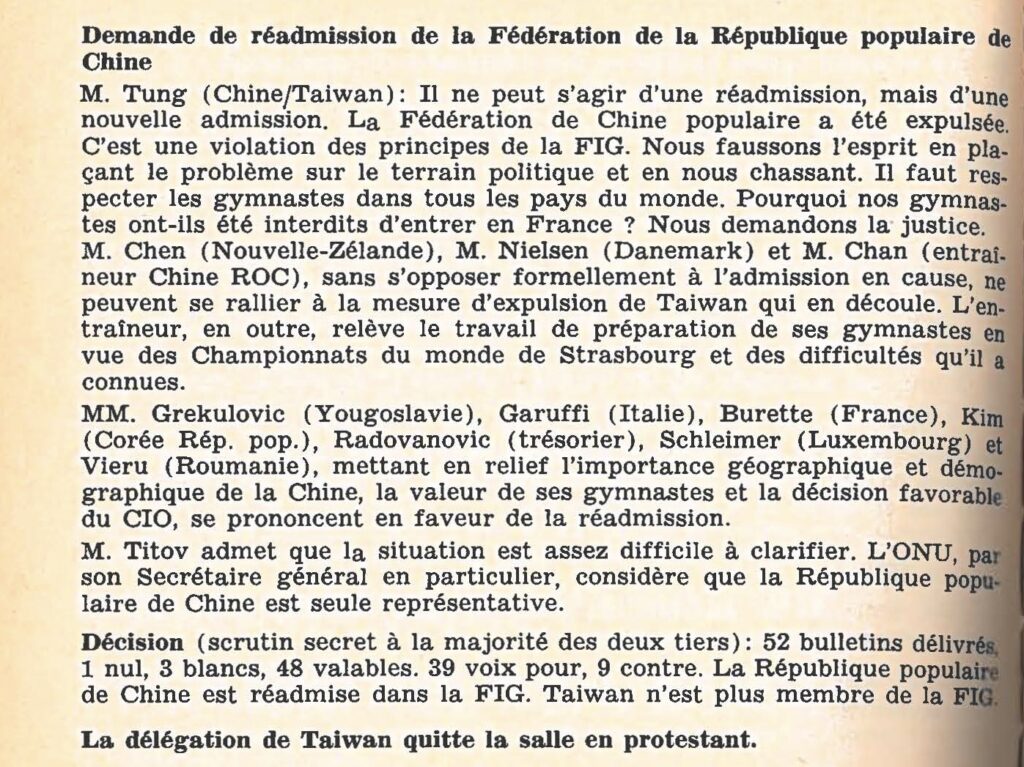
The “China Question” went to a secret ballot in 1978. Here’s what the FIG’s Bulletin of Information records:
Request for the readmission by the Federation of the People’s Republic of China
Mr. Tung (Taiwan/Republic of China) pointed out that there can be no question of a readmission but of a new candidacy. The Federation of Pop. Rep. of China was excluded. This is a violation of the FIG principles. The picture is distorted if the matter is placed on a political footing. The same respect is due to gymnasts no matter what their origin. Why were our gymnasts not allowed to enter France? We demand justice.
Mr. Chen (New Zealand), Mr. Nielsen (Denmark), and Mr. Chan (trainer from the Taiwan Republic of China) indicated that they did not wish formally to oppose the issue in question but were unwilling to accept the exclusion of Taiwan which would result. The trainer, moreover, drew attention to the preparatory work done by this [sic] gymnasts for the World Championships and the difficulties he had experienced.
Messrs. Grekulovic (Yougoslavia), Garuffi (Italy), Burette (France), Kim (People’s Republic of Korea), Radovanovic (treasurer), Schleimer (Luxembourg), and Vieru (Roumania) pointed out the geographic and demographic importance of China, the value of its gymnasts and the favorable decision of the IOC,* and declared themselves in favor of readmission.
Mr. Titov admitted that the situation was a delicate one. The United Nations, and their secretary-general in particular, considered that only the People’s Republic of China is representative.
Decision (secret ballot, demanding a two-third majority): Ballots issued 52, invalid 1, blank 3, valid 48. 39 votes in favor, 9 against. The People’s Republic of China is readmitted as a member of the FIG. Taiwan is no longer a member of the FIG.
The Taiwan delegation left the conference room, protesting. [Bold type in the original]
“Extract from the minutes of the General Assembly held in Strasbourg on 20th-21st October 1978,” FIG’s Bulletin of Information, no. 4, 1978
*Note: This quote makes it sound like the People’s Republic of China had been admitted to the IOC when the FIG’s vote took place in 1978. It had not. That would not happen until 1979. The United Nations, on the other hand, recognized the PRC in 1971.
So, there you have it.
That’s the official record of the People’s Republic of China’s admission to the FIG. If you asked the attendees, they could add more color to the written account. For example, Hardy Fink recalls that the Chinese delegation was waiting outside the door and marched in after the Taiwanese delegates left the room in protest. Somehow, that detail didn’t make it into the official record.
Appendix: The Reaction from China
The People’s Daily, October 23, 1978
International Gymnastics Federation Restores China’s Lawful Seat and Expels the Chiang Clique
Xinhua News Agency, Paris, October 20 —
The 56th Congress of the International Gymnastics Federation was held in Strasbourg. At its meeting on the 20th, the Congress adopted a resolution restoring the lawful seat of the Gymnastics Association of the People’s Republic of China within the International Gymnastics Federation and revoking recognition of the so-called gymnastics association of the Chiang clique.Representatives from gymnastics associations of 51 countries and regions attended the Congress. During the meeting, many representatives upheld justice and forcefully called for the restoration of the lawful seat of the Gymnastics Association of the People’s Republic of China within the International Gymnastics Federation, and for the withdrawal of recognition from the so-called gymnastics association of the Chiang clique.
After intense debate, the Congress proceeded to a vote. The resolution was adopted by 39 votes in favor and 9 against.
The Congress also elected a new leadership body of the International Gymnastics Federation.
[Note: The “Chiang clique” refers to the nationalist government led by Chiang Kai-shek and its representatives after they retreated to Taiwan in 1949.]
国际体操联合会恢复我国合法席位驱逐蒋帮
新华社巴黎十月二十日电 国际体操联合会第五十六届代表大会在法国斯特拉斯堡举行。代表大会在二十日的会议上通过决议,恢复中华人民共和国体操协会在国际体操联合会中的合法席位,撤销对蒋帮所谓体操协会的承认。
来自五十一个国家和地区的体操协会的代表出席了这次大会。在会议上,许多代表主持正义,强烈要求恢复中华人民共和国体操协会在国际体操联合会的合法席位,强烈要求撤销对蒋帮的所谓体操协会的承认。经过激烈的辩论,大会投票表决,结果以三十九票赞成,九票反对,通过这个决议。
大会还选举了国际体操联合会新的领导机构。
The People’s Daily, October 24, 1978
“Green Hills Cannot Block the Eastward Flow”
— Congratulations on the International Gymnastics Federation’s Restoration of China’s Lawful Seat
(International Commentary)Following the decision on the 5th of this month by the International Amateur Athletic Federation to restore the lawful seat of China’s track and field association in that organization, the International Gymnastics Federation decided on October 20 to readmit China’s Gymnastics Association and at the same time revoke its recognition of the so-called gymnastics association of the Chiang clique. Thus, China’s lawful seat has now been restored in sixteen international sports organizations.
There is only one China in the world—the People’s Republic of China—and Taiwan is a province of China. In international sports organizations, only China’s sole legitimate nationwide mass sports organization—the All-China Sports Federation—and its affiliated national sports associations have the right to represent China. The people of Taiwan are our compatriots. We have consistently welcomed Taiwanese athletes to come to the mainland to participate in competitions and have guaranteed their freedom of travel. This has been our repeatedly declared policy.
Now, the International Amateur Athletic Federation and the International Gymnastics Federation, under the impetus of farsighted figures in the sports world and the broad masses of athletes, have followed the trend of history and made the correct decision to restore China’s lawful seat. This is worthy of welcome.
It should be pointed out that in some international sports organizations there remain individuals who stubbornly cling to the erroneous position of excluding China. They defy the strong desire of athletes from various countries to engage in exchanges and competition with Chinese athletes, invent various pretexts, and attempt to continue obstructing the correct resolution of China’s lawful seat. But “green hills cannot block the eastward flow.” No force can destroy the friendship and unity between the Chinese people and athletes and the peoples and athletes of other countries. The day will inevitably come when all international sports organizations recognize and restore China’s lawful seat.
青山遮不住 毕竟东流去
——祝贺国际体操联合会恢复我国合法席位
继国际业余田径联合会于本月五日恢复我国田径协会在该组织中的合法席位之后,十月二十日国际体操联合会决定重新接纳我体操协会入会,同时撤销了对蒋帮所谓体操协会的承认。至此,我国在十六个国际体育组织中的合法席位已经恢复。
世界上只有一个中国,就是中华人民共和国,台湾是中国的一个省。在国际体育组织中,只有我国唯一合法的全国性群众体育组织——中华全国体育总会及其所属的各全国性单项体育协会才有权代表中国。台湾人民是我们的同胞。我们一直欢迎台湾运动员到内地来参加各种比赛,保证他们来去自由。这是我们一再宣告的政策。现在,国际业余田联、国际体联,在体育界有识之士和广大运动员的推动下,顺应历史潮流,做出恢复中国合法席位的正确决定,这是值得欢迎的。
应该指出,目前在一些国际体育组织中还有一些人顽固地坚持排斥中国的错误立场,违背各国运动员要求与中国运动员来往、比赛的强烈愿望,制造各种借口,妄图继续阻挠我国合法席位问题的正确解决。但是,“青山遮不住,毕竟东流去”。任何力量也破坏不了我国人民和运动员与世界各国人民和运动员之间的友好团结。所有国际体育组织承认和恢复我国合法席位的日子,是终究会来到的。
More on China